What Are Complete Solar Kits for Home — and Which One Do You Need?
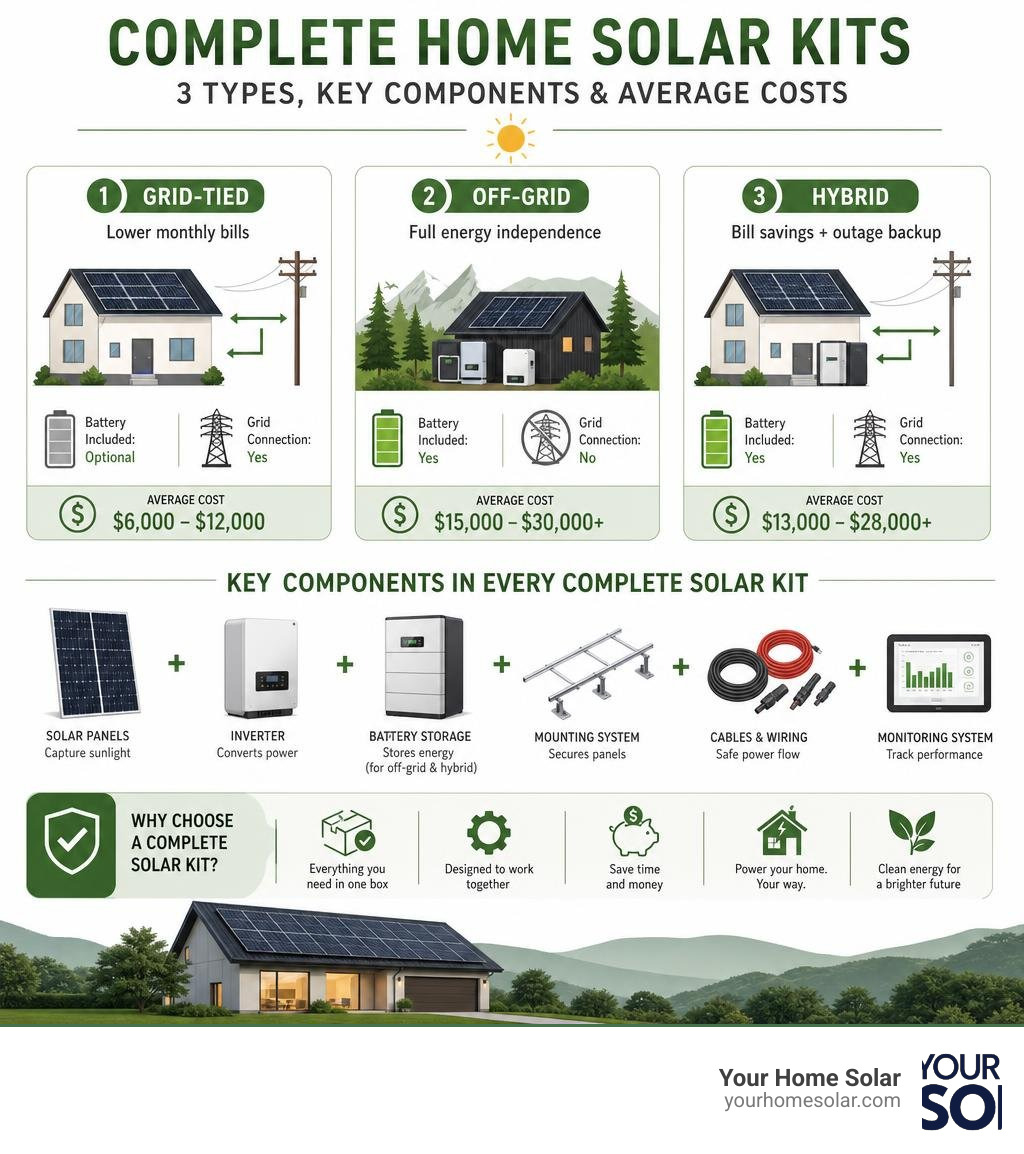
Complete solar kits for home bundle everything you need to generate and store your own electricity into a single purchase. Here’s a quick breakdown of the main types to help you decide fast:
| Kit Type | Best For | Battery Included | Grid Connection |
|---|---|---|---|
| Grid-Tied | Lowering monthly bills | Optional | Yes |
| Off-Grid | Full energy independence | Yes | No |
| Hybrid | Bill savings + outage backup | Yes | Yes |
The short answer: If you want backup power during outages and lower bills, a hybrid kit is usually the best fit for most East Tennessee homeowners. If you just want to cut your electric bill, a grid-tied kit costs less. If you want to go completely independent, off-grid is the way to go.
Shopping for home solar can feel overwhelming fast. There are dozens of kit sizes, battery types, inverter brands, and installation options — all with different price tags and trade-offs. And if you live somewhere like East Tennessee, where storms knock out power and utility bills keep climbing, the stakes feel even higher.
This guide cuts through the noise. Whether you’re comparing a small starter kit to a whole-home system, or trying to figure out if DIY installation is worth the risk, you’ll find clear, honest answers here.
I’m Ernie Bussell, Founder and CEO of Your Home Solar — East Tennessee’s #1 solar energy contractor — and I’ve spent years helping homeowners evaluate complete solar kits for home across a wide range of budgets, energy needs, and property types. My background spans the U.S. Navy, a decade in education, and hands-on leadership scaling a $40 million solar operation, so I’ll give you the straight facts without the sales pressure.
Basic complete solar kits for home glossary:
Understanding Complete Solar Kits for Home
When we talk about a complete solar kit, we mean a pre-packaged bundle designed to take the guesswork out of sourcing individual solar parts. Historically, putting together a home solar system felt like trying to assemble a complex puzzle with pieces from ten different manufacturers. If your inverter didn’t play nice with your battery chemistry, or if your racking system wasn’t rated for your specific roof type, you were left with an expensive, non-functioning science project.
Today, manufacturers and distributors compile these systems into all-in-one solutions. These packages ensure that the solar panels, inverters, charge controllers, battery storage, and mounting hardware are fully compatible right out of the box.
Whether you are looking for Complete Off-Grid, Hybrid, Grid-Tie, and Mobile Solar Kits or smaller setups for recreational use, understanding how these components interact is crucial. Selecting the right setup comes down to weighing a pre-packaged kit against a fully customized system. For a deeper dive into this comparison, check out our guide on Kit or Custom: Finding the Perfect Household Solar Panels for Your Needs.
What is Included in Complete Solar Kits for Home?
A truly complete solar kit for home contains several essential components that work in harmony to turn sunlight into usable household electricity:
- Photovoltaic (PV) Panels: These are the workhorses of your system, capturing sunlight and converting it into direct current (DC) electricity. Premium kits often feature high-efficiency monocrystalline or bifacial N-type TOPCon panels, which can harvest extra energy from the rear side of the panel.
- Inverter (Pure Sine Wave): Since your home appliances run on alternating current (AC) electricity, you need an inverter to transform the DC power produced by your panels. High-quality kits use pure sine wave inverters to ensure clean, stable power that won’t damage sensitive electronics.
- Charge Controller: In systems with battery storage, this component regulates the voltage and current coming from the solar panels to prevent overcharging and extend battery life.
- Battery Storage: Lithium batteries—specifically Lithium Iron Phosphate (LiFePO4 or LFP)—have become the gold standard for home energy storage due to their long lifespan and safety profiles.
- Racking and Mounting Hardware: This includes the rails, clamps, and brackets used to secure your panels to your roof or a ground-mounted system.
- Balance of System (BOS): This catch-all term covers the necessary cables, pre-terminated wiring, rapid shutdown devices, surge protectors, and safety disconnects required to make your system code-compliant and safe.
If you are exploring off-grid options for cabins, sheds, or mobile properties, you might also want to look at Home & Residential Solar Kits – SunGoldPower to see how these components are scaled for smaller footprints.
Grid-Tied vs. Off-Grid vs. Hybrid Solar Kits
Understanding the functional differences between the three primary solar kit designs will help you choose the right path for your home.
Grid-Tied Solar Kits
Grid-tied systems are connected directly to your local utility grid. When your panels produce more electricity than your home needs, the excess is sent back to the grid. In areas with net metering policies, your utility company credits you for this surplus power.
The primary drawback is safety: to protect utility line workers, grid-tied systems automatically shut down during a power outage, meaning you will still lose power when the grid goes down unless you have a specialized battery backup. You can explore various pre-packaged options from retailers like Complete Solar Power Systems | Off-Grid, Hybrid, Grid-Tied .
Off-Grid Solar Kits
Off-grid systems are entirely isolated from the utility grid. Because you rely solely on what you generate, these kits require a robust battery bank to keep your lights on overnight or during consecutive cloudy days. They are ideal for remote cabins, agricultural outbuildings, or properties where running a utility line is cost-prohibitive.
Hybrid Solar Kits
Hybrid systems offer the best of both worlds. They remain connected to the utility grid to take advantage of net metering and reliable backup power, but they also include a dedicated battery bank. During a power outage, a hybrid inverter automatically isolates your home from the grid (a process called islanding) and continues to power your critical appliances using stored battery energy.
Sizing and Costing Your Home Solar System
Sizing and budgeting are the two most critical steps in your solar journey. If you undersize your system, you will still rely heavily on the grid (or run out of power if you are off-grid). If you oversize it unnecessarily, you will extend your payback period.

Sizing Complete Solar Kits for Home to Match Your Energy Needs
To determine the right size for your complete solar kits for home, you must first understand your baseline energy consumption. According to the U.S. Energy Information Administration (EIA), the average power usage in the USA per home is around 877 kWh per month.
To calculate your specific daily watt-hour consumption, look at your utility bills from the past 12 months. Find your total annual kilowatt-hour (kWh) usage and divide it by 365 to get your average daily consumption. For example, if you use 10,950 kWh per year, your daily average is:
$$\text{10,950 kWh} \div 365 = \text{30 kWh per day (or 30,000 watt-hours)}$$
Once you have your daily watt-hour target, you must factor in your local solar resource, known as “peak sun hours.” In East Tennessee—covering areas from Knoxville and Maryville to Johnson City and Kingsport—we average about 4 to 4.5 peak sun hours per day.
To find the solar array capacity you need, divide your daily watt-hour goal by your local peak sun hours, and add an efficiency buffer (typically 20% to 30%) to account for real-world losses like temperature drop, wiring resistance, and dust:
$$\text{System Capacity} = \left( \frac{30,000 \text{ Wh}}{4.2 \text{ hours}} \right) \times 1.25 = 8,928 \text{ Watts (or roughly a 9 kW system)}$$
For a comprehensive walkthrough on planning these calculations and designing your layout, read The Ultimate Guide to Designing Your Own Solar Panel System.
Average Costs and Financial Incentives
The price of a complete solar kit varies widely based on capacity, battery storage, and component quality. The national average cost for a residential solar energy system in the United States ranges between $16,870 and $23,170 after federal tax incentives—and this range typically does not include professional installation labor.
Fortunately, several financial incentives can significantly reduce your out-of-pocket expenses:
- Federal Residential Clean Energy Credit (Section 25D): This federal tax credit allows you to deduct 30% of the total cost of your solar system—including equipment, battery storage, and installation labor—from your federal taxes. This incentive remains highly active in June 2026.
- Local Utility Rebates: Depending on your location in East Tennessee (such as Knox County, Sullivan County, or Washington County), local municipal utilities or electric cooperatives may offer local rebates or favorable net metering terms that shorten your return on investment (ROI).
With a properly sized system, most homeowners achieve a full payback period within 7 to 10 years, after which the electricity generated by your system is virtually free.
Installation, Lifespan, and Maintenance
Once you have purchased your kit, you face a major decision: should you roll up your sleeves and install it yourself, or should you hire a certified professional?

DIY vs. Professional Installation
There is no denying the appeal of a DIY project. A DIY solar installation is a great way to save nearly half of your total solar costs, as professional labor and permitting services often make up a significant portion of a turnkey solar quote.
If you have strong DIY skills, basic electrical knowledge, and comfort working on roofs, installing your own racking and mounting panels can be highly rewarding. Many homeowners choose to handle the physical mounting of the racking and panels themselves, and then hire a licensed local electrician to complete the final, high-voltage AC connections to the home’s main service panel. If you want to explore the DIY route, our step-by-step guides can help:
- DIY Solar Kits: Everything You Need to Know for Home Installation
- From Zero to Solar: How to Build Your Own Home Solar Power System
- DIY Solar Power: A Step-by-Step Installation Guide
However, professional installation offers distinct advantages, particularly when it comes to long-term reliability and safety. Working with high-voltage DC electricity carries inherent risks of electrical shock and fire if connections are not crimped or torqued correctly.
Furthermore, self-installed systems in certain East Tennessee utility jurisdictions can face hurdles during the utility interconnection process if they lack professional electrical drawings or certified sign-offs.
Lifespan and Maintenance of Solar Kit Components
Complete solar kits are long-term investments, and their components have varying lifespans:
- Solar Panels: Built to last the longest, solar panels typically perform well for 25 to 30 years, slowly degrading at a minor rate of about 0.5% efficiency loss per year.
- Lithium Batteries (LiFePO4): These advanced batteries typically last between 10 to 15 years (or 6,000 to 8,000 charge cycles) before their capacity drops to 80% of its original rating.
- Lead-Acid Batteries (AGM/GEL): Older battery technologies are cheaper upfront but only last around 3 to 7 years and require careful depth-of-discharge management.
- Inverters and Charge Controllers: These hard-working electronic components generally last 10 to 15 years and will likely need to be replaced once during the lifetime of your solar panels.
Maintenance Best Practices
To keep your system operating at peak efficiency, we recommend a simple maintenance routine:
- Panel Cleaning: Gently wash your panels with water to remove pollen, dust, and bird droppings. Avoid harsh chemicals or abrasive brushes that could scratch the anti-reflective coating.
- Visual Inspections: Regularly check your racking and mounting hardware to ensure everything remains secure after heavy windstorms.
- Connection Checks: Inspect visible wiring for signs of wear, insect damage, or corrosion, ensuring all seals and conduit remain intact.
Regulations, Weather Performance, and Outages
Your home solar kit does not live in a vacuum—it must withstand the elements and comply with local regulatory frameworks.
Performance in Different Weather Conditions and Outages
A common worry is how solar kits perform when the weather turns sour.
On cloudy or rainy days, your panels will still produce electricity, though their output will drop to about 10% to 25% of their peak capacity. Modern panels are built to withstand high wind resistances and heavy snow loads. In fact, cold winter temperatures actually improve panel efficiency, and a light dusting of snow will quickly melt off dark panels as soon as the sun emerges.
If you experience a power outage, your system’s behavior depends entirely on its configuration:
- Grid-Tied Systems: Will shut down immediately for grid safety.
- Off-Grid and Hybrid Systems: Will automatically isolate from the grid and pull power from your battery bank.
For those living in storm-prone areas, implementing a storm-proof energy plan with a hybrid kit ensures your critical loads—like refrigerators, medical devices, and well pumps—remain powered through extended utility outages. If you are considering a smaller or highly adaptable backup system, read our analysis on Is a Portable Solar System Right for Your Home? or explore mobile power options in Tiny Home, Big Power: Choosing Solar Kits for Mobile Living. You can also learn about smaller panel configurations in Portable Solar Panels: Your Ultimate Guide to Off-Grid Power.
Permits, Warranties, and Interconnection
Before you mount a single panel, you must navigate the legalities of residential solar:
- Permitting: Most municipalities in East Tennessee require structural and electrical permits before you can install solar panels on your property.
- Utility Interconnection: To connect a grid-tied or hybrid system to the local grid, you must submit an interconnection agreement to your utility provider (such as KUB in Knoxville or BrightRidge in Johnson City) and pass a final electrical inspection.
- Warranties: Premium solar panels come with a 25-year performance warranty. Inverters and lithium batteries typically carry a 10-year manufacturer warranty. If you choose to install a kit yourself, verify that the manufacturer’s warranty covers self-installation, as some brands require certified technicians to validate the warranty.
Frequently Asked Questions about Home Solar Kits
Can a complete solar kit power my entire house?
Yes, a properly sized complete solar kit can power your entire house. To achieve this, you must size the solar array to match your total monthly energy consumption (averaging around 877 kWh in the U.S.) and include a battery bank large enough to carry your household electrical load through the night and consecutive cloudy days.
Do DIY solar installations void manufacturer warranties?
It depends on the manufacturer. Many high-quality solar kit brands explicitly cover DIY installations under their standard product warranties, provided the system is installed in strict accordance with their manuals and local electrical codes. Always read the fine print of your component warranties before purchasing.
How do solar kits perform during a grid blackout?
Standard grid-tied solar kits will shut down completely during a blackout to prevent backfeeding electricity into dead utility lines. If you want your solar panels to keep running during an outage, you must choose a hybrid or off-grid kit equipped with a battery bank and an automatic transfer switch.
Conclusion
Investing in a complete solar kit for home is an excellent pathway to lowering your utility bills, reducing your carbon footprint, and securing reliable backup power for your family. Whether you choose the cost savings of a DIY installation or the absolute peace of mind of a professional turnkey project, the key is choosing high-quality, compatible components tailored to your home’s unique energy profile.
At Your Home Solar, we provide comprehensive home energy solutions across East Tennessee—including Knoxville, Maryville, Oak Ridge, Johnson City, and Kingsport. Our trusted local team is dedicated to 100% customer satisfaction, offering custom solar, backup generator, and EV charger installations designed to perform reliably for decades.
Ready to transition to clean, independent energy? Let our experienced team design a system tailored precisely to your property.
Get a Custom Residential Solar Solution from Your Home Solar