
What Does a 5kW Solar System With Battery Backup Cost?
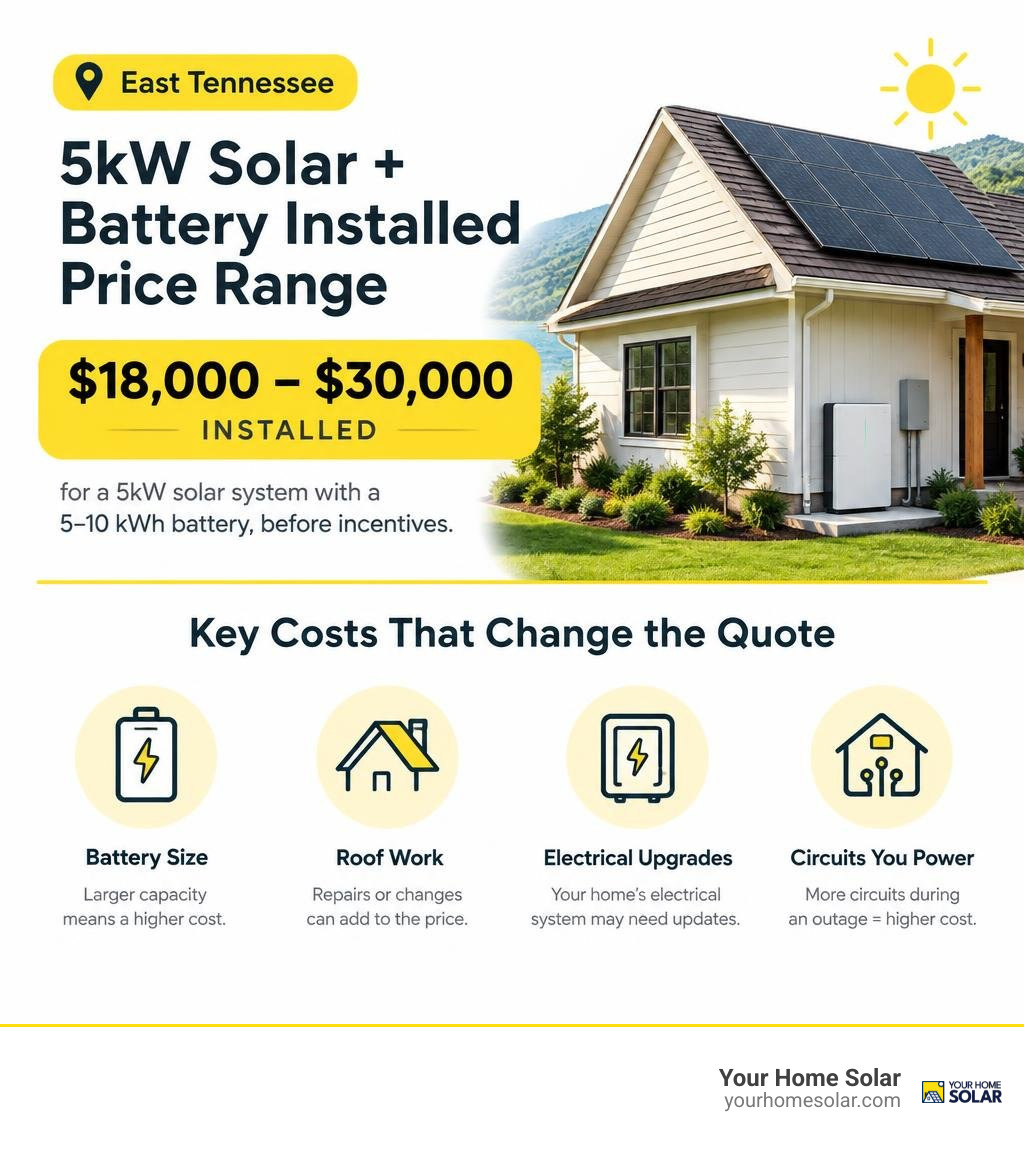
In East Tennessee, budget roughly $18,000 to $30,000 installed for a 5kW solar system with a 5-10 kWh battery, before any incentives. The final price depends on battery size, roof work, electrical upgrades, and which circuits you want powered during an outage. When homeowners ask us about the 5kw solar system with battery backup price, we always recommend getting a quote that shows those costs separately so you can compare systems fairly.
I’m Ernie Bussell, founder of Your Home Solar, and I help homeowners understand the 5kw solar system with battery backup price beyond the number on a quote. Since 2020, I’ve worked in solar operations and installation planning, experience I’ll draw on as we break down what you get for your money.
5kw solar system with battery backup price vocab explained:
- cost of backup battery for a residential solar systems
- battery storage for solar pv system
- deep cycle battery for solar storage
Comprehensive 5kW Solar System with Battery Backup Price Breakdown
When evaluating a complete residential solar-plus-storage setup, it helps to understand what goes into the total invoice. Equipment alone does not determine your final investment; labor, engineering, permitting, and electrical integration represent significant portions of the cost.
We find that breaking down the cost of solar PV battery storage in 2026 comes down to four primary categories:
- Solar PV Array: The photovoltaic modules and racking hardware.
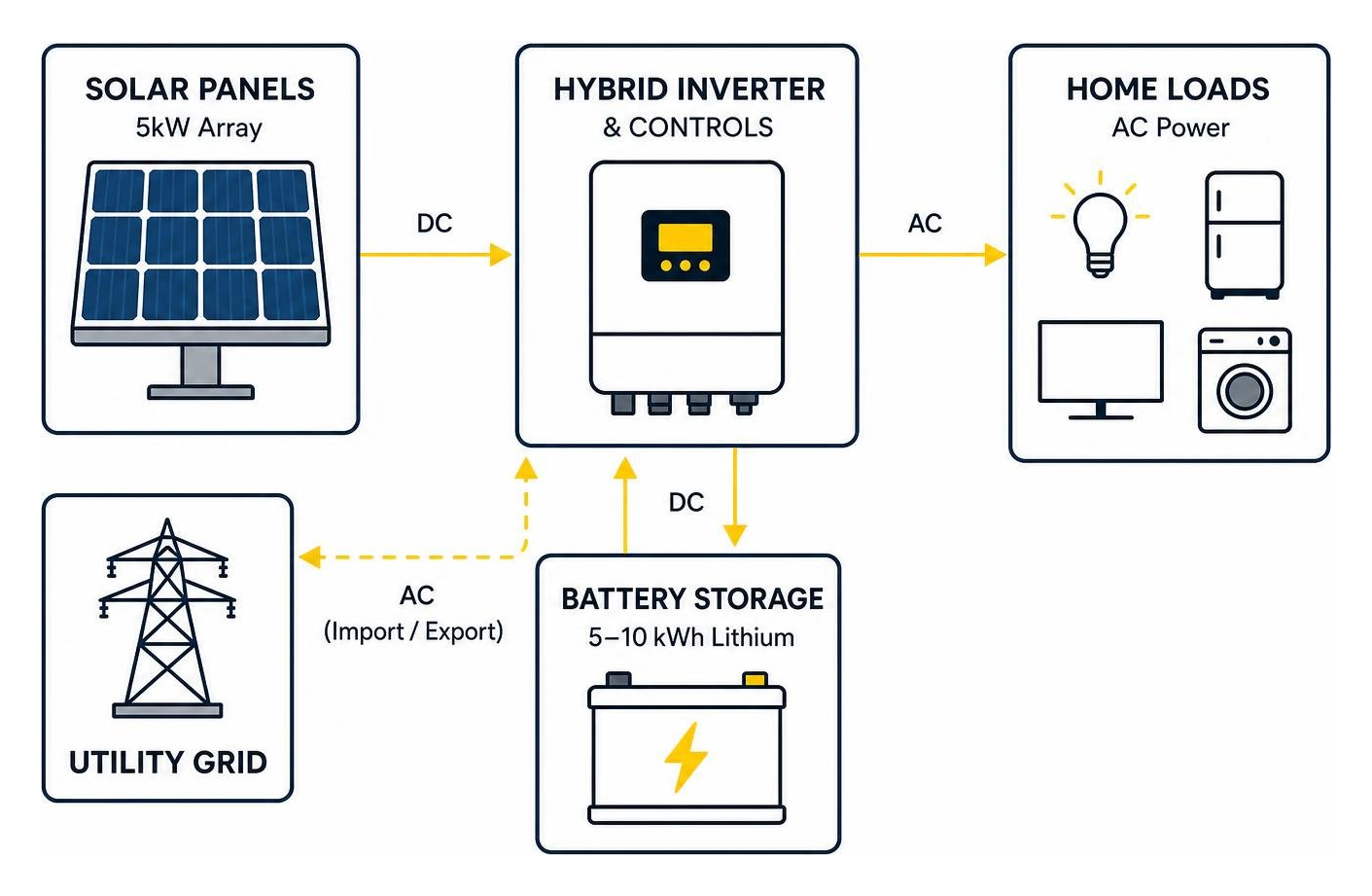
- Power Conversion: The hybrid inverter system that manages solar production, home loads, and battery charging.
- Energy Storage Unit: The lithium chemical cells, internal battery management system (BMS), and protective casing.
- Balance of System (BOS) & Labor: Electrical conduits, disconnect switches, subpanels, utility interconnections, permitting, and skilled craftsmanship.
| Cost Component | Typical Price Range (USD) | Share of Total Investment |
|---|---|---|
| 5kW Solar Array (Panels + Racking) | $4,500 – $7,000 | 25% – 30% |
| Hybrid Inverter & Controls | $2,000 – $4,000 | 10% – 15% |
| 5–10 kWh Lithium Battery Unit | $6,000 – $11,000 | 35% – 45% |
| Electrical BOS, Permitting & Installation Labor | $4,000 – $6,500 | 20% – 25% |
| Total Turnkey System (Gross) | $16,500 – $28,500 | 100% |
Average 5kW Solar System with Battery Backup Price by Region
Solar pricing varies around the globe due to differences in labor costs, local grid infrastructure, supply chain import tariffs, and national subsidy programs. Looking at international data highlights these cost dynamics:
- United States (East Tennessee): Turnkey pricing generally ranges from $18,000 to $30,000 before federal tax credits, reflecting rigorous electrical codes, dedicated backup subpanels, and standard 25-year installation standards.
- Australia: Basic hardware without heavy permitting costs results in a 5kW array costing $5,000 to $7,000 AUD, with an integrated battery adding $7,000 to $10,000 AUD ($12,000 to $17,000 AUD total).
- Europe: Direct equipment bundles for a 5.52 kWp mono 5 kW solar kit with a 4.8 kWh battery often retail around €3,800 to €5,500 for hardware alone, with full turnkey installations reaching €8,000 to €12,000.
- Philippines: Fully installed packages range from PHP 250,000 to PHP 400,000, with a hybrid 10kWh lithium configuration settling around PHP 380,000 (~$6,800 USD).
- Pakistan: Turnkey hybrid systems with 3 to 4 hours of backup capacity cost between Rs. 672,000 and Rs. 805,000 (~$8,000 to $9,600 USD).
- Kenya: Complete 5kW hybrid lithium solar kit packages at 48V retail around KSh 262,100 (~$2,000 USD) for lower-capacity hardware suites.
Equipment Component Costs: Panels, Inverters, and Storage
When sizing and sourcing hardware, each primary device serves a distinct purpose:
- Photovoltaic Panels: Modern 400W to 460W high-efficiency panels typically run between $0.60 and $1.10 per watt at retail scale. A 5kW system requires roughly 11 to 13 panels.
- Hybrid Inverters: Unlike standard string inverters, hybrid units manage bidirectional power flow between panels, home loads, batteries, and the grid. Homeowners can compare 5kW solar inverter prices to balance peak efficiency against features like built-in islanding protection.
- Lithium Storage: Lithium Iron Phosphate (LiFePO4) storage units average $700 to $1,200 per usable kWh installed. A 5kWh module adds around $4,000 to $6,000, while a larger 10kWh pack costs closer to $8,000 to $11,000.
Key System Components and Technical Specifications
A home energy setup is an integrated ecosystem designed to handle continuous electrical conversion, surge currents, and rapid weather shifts.
Tier-1 Solar Panels and Roof Requirements
Modern 5kW arrays rely on monocrystalline silicon technology, frequently leveraging N-Type TOPCon (Tunnel Oxide Passivated Contact) cells. These panels deliver cell efficiencies between 20% and 23%, combined with a low temperature coefficient of approximately -0.30% per degree Celsius. This design helps maintain electrical production during hot East Tennessee summers in places like Knoxville and Oak Ridge.
- Physical Footprint: Expect to allocate roughly 250 to 350 square feet of unobstructed roof space.
- Orientation and Pitch: A south-facing roof tilted between 25 and 35 degrees yields optimal annual generation. East and west orientations remain viable options, producing roughly 10% to 15% less energy over the course of a year.
- Shading Constraints: Even partial shading across a string can reduce system voltage. Using microinverters or DC power optimizers helps mitigate localized shade from tree canopies.
Hybrid Inverters and Power Management
The hybrid inverter serves as the central manager of your system. Units rated for 5kW continuous AC output handle incoming DC electricity from the solar array, route direct current into the 48V battery bank, and invert power into pure sine wave AC for household appliances.
Modern units feature sub-20-millisecond automatic transfer switches. When the utility grid fails, the inverter isolates your home’s circuits from the main line to prevent backfeeding, supplying continuous power to your protected circuits without dropping Wi-Fi routers or digital clocks. Integrated mobile applications provide real-time visibility into generation, state of charge, and load usage.
Battery Storage Technologies and Usable Capacity
Lithium Iron Phosphate (LiFePO4) chemistry has largely replaced traditional lead-acid and standard NMC batteries for residential storage. LiFePO4 batteries offer high thermal stability, do not experience thermal runaway under normal operating conditions, and eliminate toxic off-gassing.
- Depth of Discharge (DoD): Premium LiFePO4 packs allow a 90% to 95% DoD, meaning a 5.12kWh battery provides roughly 4.6kWh to 4.86kWh of usable energy each cycle.
- Cycle Life: Rated for 6,000 to 10,000 full charge-discharge cycles while retaining at least 70% of initial capacity. For most homes, that equals 12 to 15+ years of daily use.
- Battery Management System (BMS): An internal digital controller monitors cell voltages, balances charge states, and regulates temperature. When analyzing home battery backup costs, investing in a quality BMS protects the longevity of your storage assets.
System Types: Grid-Tied vs. Off-Grid vs. Hybrid Configurations
Choosing the right system architecture depends on your energy goals, site access, and local utility regulations.
| Configuration | Grid Connected? | Outage Protection? | Battery Storage Included? | Best Application |
|---|---|---|---|---|
| Standard Grid-Tied | Yes | No | Optional (AC Coupled) | Lowest cost; simple utility bill reduction |
| Dedicated Off-Grid | No | Always Islanded | Mandatory | Remote cabins, rural plots, no utility lines |
| Hybrid Multi-Mode | Yes | Yes (Seamless) | Mandatory | High storm resilience; peak-rate arbitrage |
For a broader breakdown of how these operational modes work in practice, explore our practical guide to battery-backed solar systems.
Grid-Tied Solar with Storage
Grid-tied setups remain connected directly to the local utility grid. During peak sunlight, solar power supplies your home, and any excess flows back to the utility under local net metering or interconnection guidelines. Adding an AC-coupled battery allows you to store daytime surplus to offset expensive evening power rates. However, without a dedicated hybrid isolation switch, standard grid-tied inverters automatically shut down during blackouts to ensure utility lineman safety.
Off-Grid Energy Systems
Off-grid configurations operate completely disconnected from utility lines. These systems require larger battery banks (often 15kWh to 30kWh) to carry household loads through multiple consecutive cloudy days, often paired with an automated propane or diesel generator for supplemental winter charging.
Hybrid Multi-Mode Systems
Hybrid setups offer a practical middle ground for homeowners across East Tennessee communities like Maryville, Sevierville, and Farragut. A hybrid inverter powers the home directly from solar, tops off the battery bank, and maintains an active link to the grid.
If local lines go down during summer storms or winter freezes, the system automatically disconnects from the grid and powers your critical load panel without interruption.
Real-World Performance, Daily Output, and Appliance Coverage
A 5kW solar array paired with battery backup offers dependable performance when sized appropriately for your household’s baseline consumption.
Daily and Seasonal Energy Generation
In East Tennessee, a 5kW array receives an average of 4.2 to 4.8 peak sun hours per day over the year.
- Average Daily Generation: 18 kWh to 24 kWh per day during spring and summer months; 10 kWh to 15 kWh per day during shorter winter days.
- Annual Output: Roughly 5,800 kWh to 6,800 kWh annually, depending on orientation, shading, and local weather patterns.
Local severe weather patterns can cause sudden grid interruptions. Homeowners can review historical utility reliability data and Johnson City solar cost and payback trends to evaluate how localized storm activity impacts their power security.
Essential Load Runtime During Grid Outages
A 5kW inverter can deliver up to 5,000 watts of continuous AC power, but managing your battery capacity dictates how long those circuits remain active during an extended outage.
For example, a fully charged 5.12kWh battery (offering 4.8kWh usable capacity) provides roughly 4,320 watt-hours of deliverable energy:
- Critical Baseline (250W continuous): Powers an ENERGY STAR refrigerator (cycling intermittently), LED lights, home internet router, and mobile device charging.
- Expected Runtime: 17 to 18 hours without any solar replenishment.
- Moderate Load (800W continuous): Runs critical baselines plus a small ductless mini-split heat pump or water transfer pump.
- Expected Runtime: 5 to 6 hours.
- High Load (2,500W+ continuous): Powering electric ovens, central air conditioning, or clothes dryers will drain a 5kWh battery in less than 1.5 to 2 hours. High-draw appliances should be managed carefully during extended grid outages.
Financial Returns, Incentives, and Long-Term Value
Investing in clean energy provides predictable operational costs that hedge against future utility rate adjustments. When considering your overall budget, comparing the numbers against a larger 10kW solar system with battery backup cost can help clarify whether a 5kW or larger system fits your home’s long-term energy profile.
Estimating the Long-Term ROI Against the 5kW Solar System with Battery Backup Price
The return on investment for a solar-plus-storage setup depends on your local utility rate structure, baseline consumption, and available backup benefits:
- Utility Bill Offsets: Generating ~6,200 kWh annually offsets $750 to $1,050 in retail electricity costs per year at regional electric rates, compounding as utility prices increase.
- Estimated Payback Period: A solar array on its own often pays for itself in 7 to 10 years. Adding battery storage extends that timeline to 10 to 14 years, reflecting the added cost of energy storage.
- Resilience Value: While financial models track kilowatt-hour savings, maintaining continuous refrigeration, water pumps, medical devices, and lighting during winter storms provides peace of mind that goes beyond standard utility savings.
Homeowners can review options for cost and financing of solar systems to secure competitive loan rates and optimize project cash flow.
Tax Credits, Grants, and Net Metering Schemes
- Federal Residential Clean Energy Credit (Section 25D): Allows qualifying homeowners to claim a tax credit equal to 30% of the total installation cost (covering both solar modules and battery storage of 3kWh or greater). On a $22,000 installation, this credit can reduce your net tax liability by $6,600.
- Local Utility Programs: Certain regional municipal utilities and electric cooperatives offer interconnection programs or time-of-use tariffs that reward homeowners for storing cheap off-peak power and avoiding high peak-demand rates.
Frequently Asked Questions About 5kW Solar Battery Systems
How much roof space do I need for a 5kW solar setup?
A modern 5kW system requires approximately 250 to 350 square feet of unshaded roof space. Using 440W to 460W high-output panels, this array requires just 11 to 12 modules, making it suitable for standard single-family residential rooftops.
What appliances can a 5kW system run during a blackout?
A 5kW hybrid inverter can comfortably start and operate essential household circuits: your refrigerator, freezer, LED home lighting, Wi-Fi networks, television, desktop computers, and well pumps (with proper soft-starter kits). However, energy-intensive loads like central electric furnaces, clothes dryers, and level-2 EV chargers should be excluded from the backup subpanel or used sparingly.
Is a 5kW battery enough to achieve complete energy independence?
A single 5kWh battery provides practical emergency backup for essential circuits during overnight hours and short power outages. However, achieving year-round grid independence typically requires a larger 10kW array paired with 20kWh to 30kWh of storage to handle extended winter cloudy spells.
Conclusion
A 5kW solar system with battery backup provides a balanced mix of daytime energy production, utility bill savings, and emergency backup power. By pairing high-efficiency panels with a reliable hybrid inverter and a durable LiFePO4 battery pack, you can safeguard your home against unexpected outages while locking in lower energy costs for years to come.
At Your Home Solar, we design and install tailored energy systems for homeowners across Knoxville, Johnson City, Kingsport, Morristown, and communities throughout East Tennessee. Explore our ultimate guide to solar batteries and energy storage solutions to design the ideal backup system for your home.