
Is a 10kW Solar System with Battery Backup Worth the Price?
The 10kW solar system with battery backup price typically falls between $25,000 and $45,000 for a complete, professionally installed system in 2026 — before any incentives or tax credits.
Here’s a quick breakdown of what to expect:
| System Type | Estimated Cost (Before Incentives) | After 30% Federal Tax Credit |
|---|---|---|
| 10kW grid-tied (no battery) | $20,000 – $26,000 | $14,000 – $18,200 |
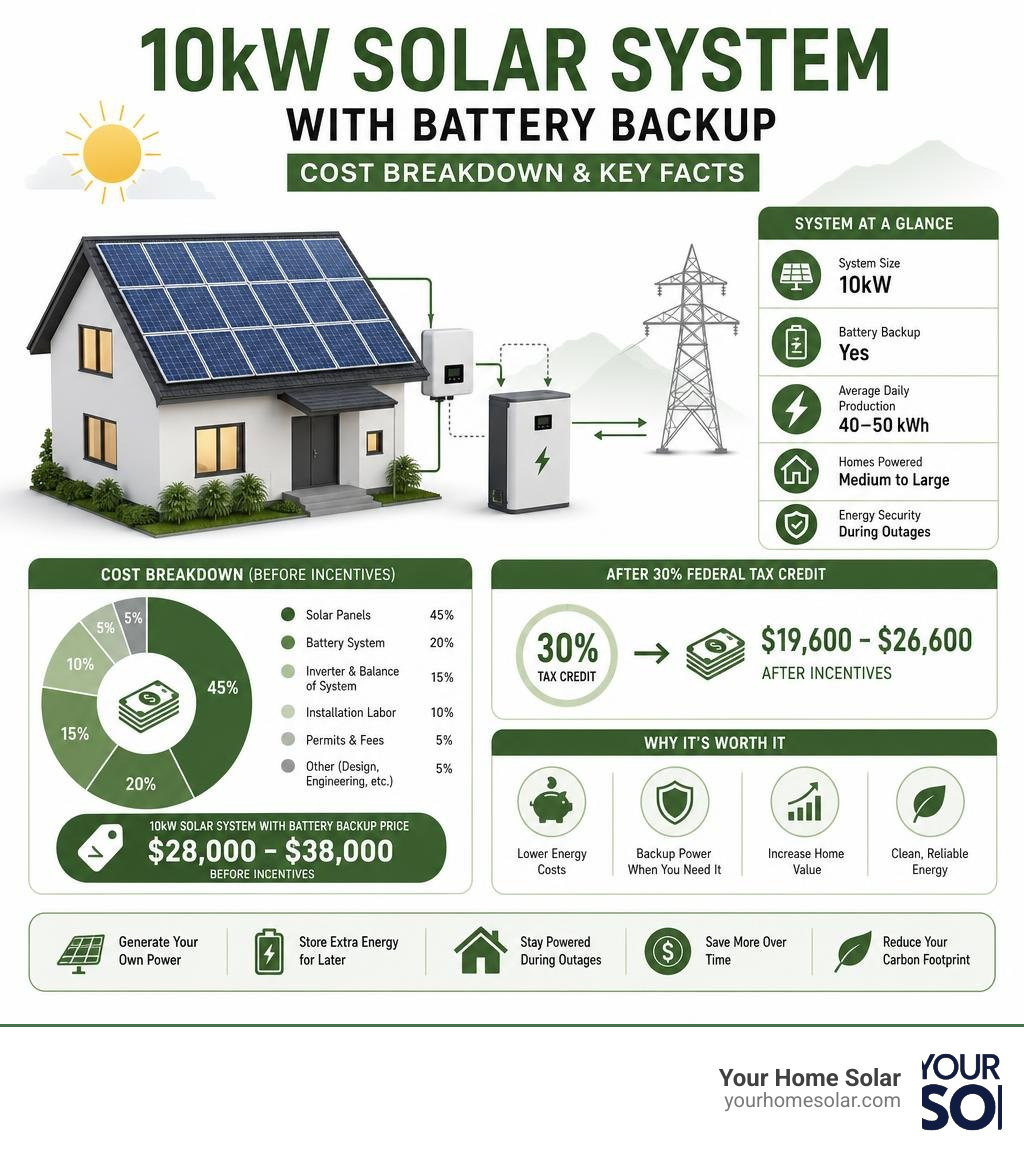
| 10kW hybrid with battery backup | $28,000 – $38,000 | $19,600 – $26,600 |
| 10kW off-grid with battery storage | $30,000 – $45,000 | $21,000 – $31,500 |
Note: DIY kit-only prices start as low as $8,000 – $15,000, but do not include installation labor, permitting, or professional design.
These numbers vary based on your location, battery size, equipment brand, and whether you’re going fully off-grid or staying connected to the utility grid. If you’ve been hit with rising energy bills or lost power during a storm, you already know why more East Tennessee homeowners are asking this question.
The good news: the federal solar tax credit currently covers 30% of your total system cost — panels and batteries included — which meaningfully changes the math.
I’m Ernie Bussell, founder of Your Home Solar and the #1 solar energy contractor in East Tennessee, and I’ve spent years helping homeowners navigate the real costs and real tradeoffs behind the 10kW solar system with battery backup price. In the sections below, I’ll walk you through everything you need to know — from components and performance to payback periods and local incentives.
Basic 10kw solar system with battery backup price vocab:
- 10kw solar system with battery storage
- Install home battery
- cost of backup battery for a residential solar systems
Understanding the 10kw Solar System with Battery Backup Price
When evaluating the 10kw solar system with battery backup price, it is helpful to look at the national averages alongside our regional numbers. Nationally, the average cost for a residential solar energy system ranges between $16,870 and $23,170 after federal tax incentives are applied. However, those figures represent standard grid-tied systems without any energy storage.
Adding a battery backup is what shifts the price into the $25,000 to $45,000 pre-incentive range. The physical battery bank itself is often the single most expensive component after the panels. If you are curious about the direct cost of adding storage to a home, our guide on Shocking or Saving What a Home Battery Backup Actually Costs breaks down standard equipment-only prices and why batteries carry a premium.
A complete, professional installation price reflects several distinct buckets:
- Equipment Costs: This includes the physical solar panels, the hybrid inverter, the battery bank, mounting racks, and electrical safety components.
- Labor and Engineering: Designing a system that safely integrates with your home’s main electrical panel and installing heavy equipment on a sloped roof requires specialized, certified solar technicians.
- Permitting and Utility Interconnection: Navigating local building codes and securing approval from local power distributors to connect your system to the grid.
While DIY kits exist online for under $15,000, they exclude the specialized labor, structural engineering, and utility coordination required to safely and legally activate a system. In East Tennessee, self-installing can even lead to utility disconnection if the system is not approved by local power companies.
What Factors Influence the 10kw Solar System with Battery Backup Price?
No two homes are identical, which is why solar quotes can vary even for homes on the same street. Several physical and technical factors will directly influence your final bottom line:
- Battery Capacity (kWh): How much energy do you want to store? A system with a modest 10kWh battery will cost significantly less than a system equipped with 20kWh or 30kWh of storage.
- Inverter Type: Standard string inverters are the most budget-friendly, but hybrid inverters and microinverters offer superior performance, individual panel monitoring, and easier future expansion.
- Roof Complexity and Pitch: A straightforward, south-facing roof with a gentle slope is fast and easy to install on. Roofs with multiple valleys, steep pitches, or clay tiles require extra safety gear, specialized mounting hardware, and more labor hours.
- Permitting and Local Codes: Electrical and building permits vary by municipality, and some local utilities require external disconnect switches or specific grid-protection hardware.
To explore how these individual elements stack up on an installation invoice, you can read our detailed guide on Powering Up The Ultimate Guide to Home Battery Installation and Costs.
Regional Cost Variations and the 10kw Solar System with Battery Backup Price
Where you live plays a major role in what you will ultimately pay. Solar equipment costs are relatively stable nationwide, but local labor rates, municipal permitting fees, and utility policies vary widely.
In East Tennessee, we enjoy a lower cost of living compared to the national average, which helps keep local installation labor rates competitive. However, because our local power distributors (such as KUB in Knoxville or BrightRidge in Johnson City) operate under the Tennessee Valley Authority (TVA) umbrella, interconnection policies and solar incentives are highly localized.
For up-to-date regional cost data and estimated payback timelines in our primary service areas, you can consult these resources:
- For the Knoxville metro area, see the Knoxville solar cost and payback (July 2026) – PowerOutage.us .
- For the Tri-Cities region, check out the Johnson City solar cost and payback (July 2026) .
These local guides show how regional utility rates and sun hours combine to dictate your long-term return on investment.
Key Components of a 10kW Solar Kit with Battery Storage
A 10kW solar system with battery backup is not just a single piece of machinery; it is an interconnected ecosystem of advanced energy hardware.
When you purchase a complete 10kW system, the kit typically includes:
- Monocrystalline Solar Panels: Usually between 25 and 40 panels, depending on their individual wattage and efficiency.
- Hybrid Inverter: The “brain” of the system. It converts the Direct Current (DC) electricity generated by your panels into the Alternating Current (AC) electricity used by your home, while simultaneously managing the flow of power to and from your battery bank.
- Lithium Battery Bank: Usually a LiFePO4 battery pack ranging from 10kWh to 20kWh or more.
- Racking and Mounting Hardware: Structural aluminum rails and clamps (such as IronRidge racking) that secure the panels to your roof or a ground mount.
- Balance of System (BOS): Heavy-duty electrical cables, DC/AC breakers, combiner boxes, and rapid-shutdown safety switches.
For a deeper look into how these parts interact to keep your household running smoothly, read our comprehensive resource: 10kw Solar System with Battery Storage Explained.
Solar Panels and Roof Space Requirements
A 10kW solar system represents 10,000 watts of Direct Current (DC) power. The physical footprint of this system depends on the efficiency of the panels you select. On average, a standard 10kW solar array requires 30 to 40 panels. However, if you choose premium, high-efficiency monocrystalline panels, you can achieve the exact same 10kW output with just 25 panels.
To find options and compare standard kit configurations, you can browse 10kW Solar Systems – GoGreenSolar.com .
In terms of physical space, a standard 10kW system requires approximately 575 to 650 square feet of unobstructed roof space.

When planning your layout, keep in mind:
- Orientation: Panels should ideally face south or west to capture the maximum amount of daily sunlight.
- Shading: Nearby trees, chimneys, or neighboring buildings can cast shadows that drastically reduce system output.
- Production Guarantees: Because physical placement is so critical to system performance, reputable installers offer performance guarantees. You can read more about how these protect your investment in The Ultimate Guide to Solar Production Guarantees.
Battery Storage Options: LiFePO4 vs. Lead-Acid
When choosing a battery backup, you will primarily choose between two chemical technologies: Lithium Iron Phosphate (LiFePO4) and traditional Sealed Lead-Acid (SLA).
| Feature | LiFePO4 (Lithium Iron Phosphate) | Sealed Lead-Acid (SLA) |
|---|---|---|
| Lifespan | 10 – 15+ years (6,000+ cycles) | 3 – 5 years (500 – 1,000 cycles) |
| Depth of Discharge (DoD) | Up to 95% | Up to 50% |
| Maintenance | Zero maintenance | Requires regular ventilation & checks |
| Upfront Cost | Higher | Lower |
| Efficiency | ~95% conversion efficiency | ~80% conversion efficiency |
While lead-acid batteries are cheaper upfront, they must not be discharged past 50% of their capacity without causing permanent damage. This means you have to buy twice as many lead-acid batteries to get the same usable storage as a lithium bank.
For modern residential installations, LiFePO4 has become the industry gold standard due to its safety, thermal stability, and long life. For a complete breakdown of chemical types and brand comparisons, explore Everything You Need to Know About Residential Solar Battery Types Whats Best.
System Performance: How Much Electricity Does a 10kW System Produce?
A 10kW solar system is a robust power plant. On average, it will produce between 30 and 45 kWh of electricity per day. Over the course of a month, assuming an average of 5 peak sun hours per day, a 10kW system produces around 1,350 kWh of AC electricity.
Because the average American household consumes approximately 29.53 kWh per day (about 893 kWh per month), a 10kW system is more than capable of covering 100% of the energy needs for an average home in East Tennessee.

During peak sunny hours, your system will likely produce more electricity than your home is actively using. Without a battery, that excess power is sent back to the utility grid. With a battery backup, that surplus is directed into your storage bank first, allowing you to power your home long after the sun goes down. To understand how these storage systems keep your home bright during grid failures, read Beyond the Grid How Solar Battery Banks Keep Your Lights On.
Off-Grid vs. Hybrid 10kW Solar Systems
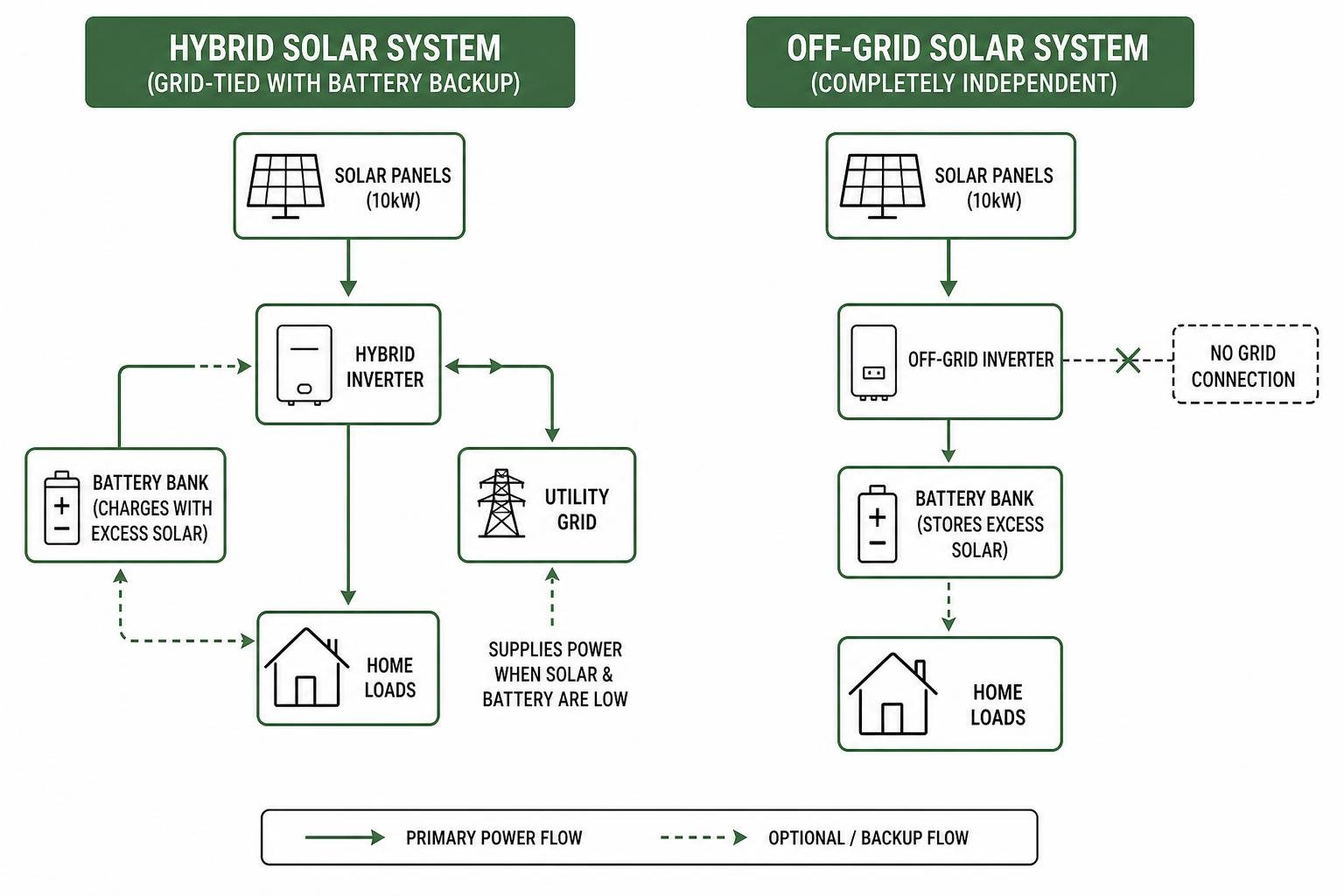
When designing your system, you must decide whether you want to remain connected to the local utility grid (a hybrid system) or cut ties completely (an off-grid system).
Hybrid Systems (Grid-Tied with Battery Backup)
A hybrid system remains connected to the utility grid. It uses solar power during the day, charges the battery with excess solar, and pulls from the grid only if the battery runs dry during prolonged cloudy weather.
- Pros: You have the grid as a ultimate safety net; you can participate in net metering programs where available; the equipment is less expensive because you do not need to massively over-size the battery bank.
- Cons: You still receive a basic monthly connection bill from your utility company.
Off-Grid Systems (Stand-Alone Power Systems)
An off-grid system is entirely physically disconnected from the utility grid. It relies solely on solar panels, large battery banks, and often a backup generator to supply 100% of the home’s power.
- Pros: Complete energy independence; zero utility bills; immune to grid-wide blackouts.
- Cons: Significantly higher upfront costs because you must size the battery bank and solar array to handle consecutive days of winter storms; if your system fails or runs out of stored energy, you have no backup power unless you run a gas/propane generator.
For a complete guide to choosing the right configuration for your family’s needs, read The Ultimate Guide to Choosing a Battery Backup for House Power Without Losing Your Mind.
Financial Return: Payback Period and Incentives
While the upfront 10kw solar system with battery backup price can seem substantial, the financial incentives and long-term utility savings turn it into a rewarding investment.
The most significant incentive available is the Federal Residential Clean Energy Credit (Section 25D). This tax credit allows you to deduct 30% of the total installation cost directly from your federal taxes. This incentive applies to both the solar panels and the battery storage system.
Average Payback Period
For a standard 10kW hybrid system in East Tennessee, the typical break-even or payback period is between 10 and 12 years. After this point, the system has completely paid for itself, and the electricity it generates is pure savings for the remainder of the panels’ 25-to-30-year lifespan.
| System Feature | Grid-Tied (No Battery) | Hybrid (With Battery) | Off-Grid (Stand-Alone) |
|---|---|---|---|
| Upfront Cost | Low ($16k – $23k) | Moderate ($28k – $38k) | High ($30k – $45k+) |
| Blackout Protection | No | Yes | Yes |
| Grid Reliance | 100% during non-sun hours | Minimal | 0% |
| Typical Payback | 7 – 9 Years | 10 – 12 Years | N/A (Utility-free) |
To see a detailed head-to-head financial comparison of different battery storage setups, you can read our In-Depth Guide to Solar Battery Backup Comparison.
Frequently Asked Questions about 10kW Solar Systems
How many solar panels do I need for a 10kW system?
A standard 10kW system requires between 30 and 40 panels on average. If you utilize premium, high-efficiency monocrystalline panels (ranging from 400W to 440W+ each), you can reduce the physical panel count down to 25 panels, which significantly reduces the overall footprint on your roof.
Can a 10kW solar system with battery backup run my entire house?
Yes, a 10kW system produces plenty of power to cover the daily needs of an average American home. However, during a utility outage, you must manage your energy consumption. While a 10kW system can easily run your refrigerator, lights, computers, and home electronics, running heavy high-draw appliances like central air conditioning or electric water heaters continuously will drain your battery backup quickly.
For tips on sizing your battery bank to protect your critical household loads, read our guide: Dont Get Left in the Dark A Guide to Battery Packs for Home Solar Systems.
How long do solar batteries last?
Modern Lithium Iron Phosphate (LiFePO4) solar batteries typically last between 10 and 15 years and are usually backed by a 10-year manufacturer warranty. Over time, like a smartphone battery, they will experience minor capacity degradation, but they will continue to reliably store and discharge power for thousands of cycles.
Conclusion
Investing in a 10kW solar system with battery backup is one of the most effective ways to secure long-term energy independence, protect your family from utility rate hikes, and keep your lights on when the grid goes dark. While the upfront 10kw solar system with battery backup price requires careful planning, the 30% federal tax credit and decades of lower utility bills make it a highly rewarding financial decision.
At Your Home Solar, we pride ourselves on providing East Tennessee homeowners with trusted expertise, transparent pricing, and 100% customer satisfaction. Whether you live in Knoxville, Johnson City, Kingsport, Sevierville, or the surrounding counties, our team is here to design a reliable, high-performance system tailored specifically to your home.
Ready to take the next step toward energy security? Explore our Ultimate Guide to Solar Batteries and Energy Storage Solutions or contact us today to schedule your custom home energy consultation!