
What Does Solar PV Battery Storage Actually Cost in 2026?
Understanding the cost of solar PV battery storage is the first step before calling a single installer. Here is what most homeowners in 2026 actually pay:
| System Size | Typical Installed Cost (Before Incentives) | Cost Per Usable kWh |
|---|---|---|
| 5 kWh | $6,000 – $10,000 | $700 – $1,000 |
| 10 kWh | $8,000 – $11,000 | $700 – $1,000 |
| 13.5 kWh | $12,000 – $18,000 | $800 – $1,300 |
| 20 kWh | $18,000 – $26,000+ | $900 – $1,300 |
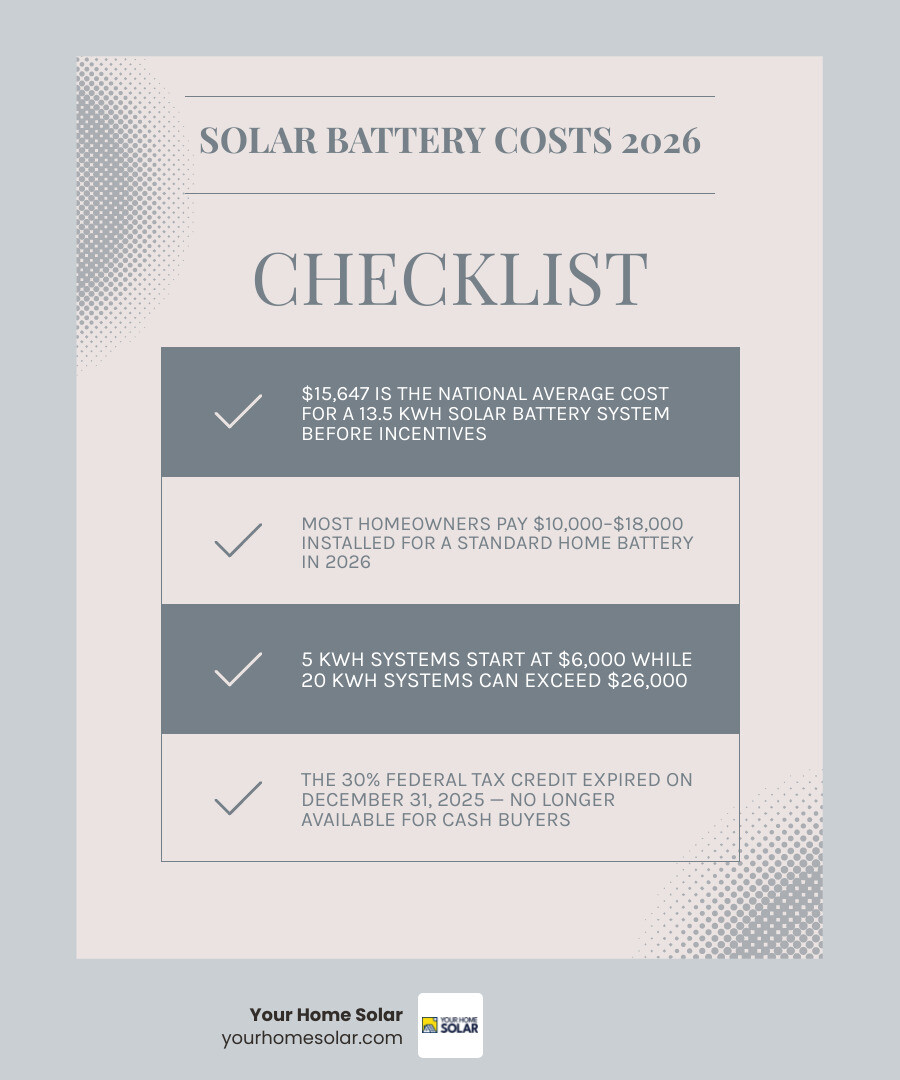
The short answer: Most homeowners pay between $10,000 and $18,000 installed for a standard home battery system before any incentives. The national average for a 13.5 kWh system sits around $15,647.
Important note for 2026: The 30% federal residential tax credit (Section 25D) expired on December 31, 2025. Cash buyers no longer receive that discount automatically. Leased or PPA systems may still benefit indirectly through a separate commercial credit.
The total you pay depends on several factors — battery size, chemistry, your existing solar setup, local labor rates, and whether your electrical panel needs an upgrade.
Picture this: a summer storm knocks out power across your neighborhood. Your neighbors are scrambling for flashlights. Your lights stay on, your fridge keeps running, and your WiFi never drops. That is the promise of home battery storage — but it comes at a real cost that deserves a clear, honest look.
This guide breaks down every dollar, so you know exactly what you are getting into before you sign anything.
I’m Ernie Bussell, founder and CEO of Your Home Solar, the #1 solar energy contractor in East Tennessee — and I’ve spent years helping homeowners navigate the real cost of solar PV battery storage, from the hardware to the hidden fees. In this guide, I’ll walk you through everything I’ve seen on actual installs so you can make a confident, pressure-free decision.
Terms related to cost of solar pv battery storage:
- battery backup for house power
- cost of backup battery for a residential solar systems
- battery storage for solar pv system
Average Cost of Solar PV Battery Storage in 2026
When evaluating the cost of solar PV battery storage, it helps to look at both national trends and local realities. According to comprehensive market data compiled by Solar Battery Storage Cost 2026: What You’ll Really Pay | Savolture, the national average to install a standard 13.5 kWh solar battery is $15,647 before incentives.
However, we have some fantastic news if you live here in East Tennessee. Our region enjoys some of the most competitive pricing in the entire country. In Tennessee, the average battery installation cost is about $720 per kWh. This means a standard 13.5 kWh system in Knoxville, Maryville, or Oak Ridge typically averages closer to $9,720 before local permitting and specific electrical panel variables are added.
While the upfront cost can feel like a major investment, many homeowners find that when they look at shocking or saving what a home battery backup actually costs, the value of continuous power during grid failures and storms quickly outweighs the initial expense.
Understanding the Cost of Solar PV Battery Storage by System Size
The capacity of your battery is the single largest driver of the final price. Sizing is measured in kilowatt-hours (kWh), which represents the total amount of electricity the battery can store.
To help you visualize how capacity translates to pricing, here is a detailed breakdown of residential installed price ranges in 2026:
- Small Systems (5 kWh): These typically cost between $6,000 and $10,000 installed. A 5 kWh battery is ideal for running critical loads—like your refrigerator, router, and a few LED lights—for a few hours during a brief blackout.
- Medium Systems (10 kWh to 13.5 kWh): Ranging from $8,000 to $18,000 installed, this is the sweet spot for the majority of Tennessee homes. Systems in this range can easily power essential household appliances overnight. If you are wondering how much does a 10kw solar system with battery backup actually cost, the battery portion itself represents roughly $8,000 to $11,000 of the total combined price.
- Large Systems (20 kWh+): Ranging from $18,000 to over $26,000 installed, these high-capacity setups are built for whole-home backup, powering heavy appliances like central air conditioning units, well pumps, and electric vehicle (EV) chargers.
Brand-by-Brand Comparison of Energy Storage Systems
Not all battery brands are created equal. Different manufacturers target different market segments, balancing price against performance, warranty terms, and integration options. Here is how the leading residential brands stack up in 2026:
- Tesla Powerwall 3: Offering 13.5 kWh of usable capacity, the Powerwall 3 is the most popular battery on the market. It costs between $11,500 and $16,500 fully installed. Its integrated hybrid inverter makes it incredibly cost-effective for new solar-plus-storage installations.
- Enphase IQ Battery 5P: This modular 5 kWh battery is highly regarded for its reliability and seamless integration with Enphase microinverters. A single unit costs between $5,500 and $8,500 installed. Most homeowners pair two or three together, bringing the total cost to $11,000–$18,000.
- FranklinWH aPower 2: A premium, heavy-duty option offering 15 kWh of usable capacity. It typically costs between $15,500 and $18,000 installed. It is highly valued for its robust build quality and superior management of high-surge loads like central air conditioning.
To see how these brands perform side-by-side on metrics like round-trip efficiency and warranty depth, check out our in-depth guide to solar battery backup comparison.
Key Cost Components of Residential Battery Systems
To understand why a quote is priced the way it is, we need to look at the capital expenditure (CAPEX) of the system. According to the engineering analysis in the Cost of Solar Power Battery Storage: A 2026 Engineering and Economic Deep-Dive, the hardware itself represents only a portion of your total invoice.
When you are unpacking solar costs what you need to know before you buy, you will find that a professional installation requires a mix of electrical hardware, structural components, and skilled labor.
Hardware vs. Soft Costs: Where Your Money Goes
A standard residential energy storage invoice is divided into several distinct buckets:
- The Battery Unit (40% to 60% of total cost): This is the physical enclosure housing the lithium cells and the Battery Management System (BMS).
- The Inverter/Gateway (10% to 15% of total cost): Batteries store DC electricity, but your home runs on AC electricity. An inverter is required to convert this power. If your existing solar system doesn’t have a hybrid inverter, a separate battery inverter or gateway (costing $1,000 to $3,500) must be installed.
- Balance of System (BOS) Hardware (5% to 10% of total cost): This includes the heavy-duty wiring, conduit, breakers, disconnect switches, and mounting brackets needed to safely tie the battery into your home’s electrical system.
- Labor and Engineering (25% to 40% of total cost): Professional installation labor typically ranges from $1,000 to $3,000. This covers the certified electricians who mount, wire, and program the system. For a closer look at these labor dynamics, read our guide on powering up the ultimate guide to home battery installation and costs.
- Permits, Inspections, and Interconnection Fees (3% to 5% of total cost): Local building departments and utilities charge fees to review electrical plans, issue building permits, and perform final safety inspections. These fees usually total between $300 and $1,000.
The Impact of Battery Chemistry: LFP vs. NMC vs. Lead-Acid
The chemical makeup inside your battery cells dictates its upfront cost, how long it will last, and how safe it is to operate. There are three main chemistries used in residential systems today:
- Lithium Iron Phosphate (LFP): This has become the gold standard for home energy storage in 2026. LFP batteries (used by Tesla, Enphase, and FranklinWH) are incredibly stable, highly resistant to thermal runaway (fire), and boast an exceptional lifespan of 6,000 to 10,000 cycles. While they are slightly more expensive upfront, their levelized cost of storage is the lowest because they routinely last 15 to 25 years.
- Nickel Manganese Cobalt (NMC): Once dominant in early home batteries (like the Tesla Powerwall 2), NMC chemistry is highly power-dense but has a shorter cycle life (typically 4,000 to 6,000 cycles) and lower thermal stability than LFP.
- Lead-Acid (AGM/Gel): Lead-acid batteries are the cheapest option upfront, but they are a classic example of “cheap now, expensive later.” They only last 500 to 1,500 cycles (requiring replacement every 3 to 5 years), have a low depth of discharge (50%), and require regular maintenance.
For a complete breakdown of these chemical trade-offs, explore our article everything you need to know about residential solar battery types whats best.
Technical Decisions That Impact Your Installation Quote
When you receive a quote for a home battery, the final number is heavily influenced by how the system is engineered. According to Solar Battery Storage Cost 2026: $6,000–$12,000 After Incentives (All Models), your system’s architecture and the physical layout of your home’s electrical system will dictate the complexity—and therefore the cost—of the installation.
Understanding these technical variables is key to learning how to choose the best battery storage for your solar pv system.
AC-Coupled vs. DC-Coupled Cost of Solar PV Battery Storage
One of the most important engineering decisions is whether to couple your battery system on the AC or DC side of your electrical system.
- DC-Coupled Systems: In a DC-coupled setup, both your solar panels and your battery feed into a single, shared hybrid inverter. This is highly efficient because the DC power generated by your panels can flow directly into the battery without undergoing multiple conversions. DC coupling is the most cost-effective path for a brand-new, combined solar-and-storage installation because you only have to buy one inverter.
- AC-Coupled Systems: In an AC-coupled setup, your solar panels and your battery have separate, dedicated inverters. The solar inverter converts DC to AC, and then the battery inverter converts that AC back to DC to store it. While this results in minor conversion efficiency losses (usually 2% to 4%), AC coupling is highly flexible. It is the cheapest and least complex option when retrofitting a battery onto an existing, functional solar array, as it avoids the expensive hassle of replacing your existing solar inverter.
Hidden Costs: Electrical Panel Upgrades and Permitting Fees
When budgeting for a home battery, you must look beyond the sticker price of the equipment. Several common “hidden” costs can quickly add $1,000 to $4,000 to an installation:
- Main Service Panel Upgrades: If your home’s main electrical panel is older (e.g., 100-amp service) or lacks physical space for new double-pole breakers, it must be upgraded to a 200-amp panel. This typically adds $1,500 to $3,000 to your project cost.
- Critical Load Panels: If you are not backing up your entire home, your electrician must install a separate subpanel and physically wire your critical circuits (fridge, lights, outlets) into it. This labor-intensive process adds $1,000 to $2,000.
- Smart Electrical Panels: Increasingly, homeowners are opting for smart panels (like Lumin or Span) to dynamically manage loads during an outage. While they add $2,500 to $4,500 upfront, they can eliminate the need for a physical critical load panel and allow you to back up more of your home with a smaller, less expensive battery.
- Safety Codes and Permitting (UL 9540 & NFPA 855): Modern safety standards require home batteries to be UL 9540 certified. Local jurisdictions in East Tennessee enforce strict rules regarding where batteries can be mounted (e.g., clearance distances from doors and windows, bollards in garages to prevent car impacts). Meeting these structural and electrical codes is essential, which is why we break it all down in the ultimate guide to choosing a battery backup for house power without losing your mind.
Financial Viability, Incentives, and Payback Periods
Is a home battery a sound financial investment, or is it purely an emotional purchase for emergency peace of mind? According to the data in Solar Battery Cost 2026: Real Price Per kWh, All Brands & Forecast, the answer depends on your local utility’s rate structure and how you plan to use the stored energy.
When analyzing the real price of never losing power again, the math changes significantly depending on whether you are chasing bill savings or grid independence.
Federal, State, and Utility Incentives in 2026
As of 2026, the incentive landscape has shifted:
- The Expiration of Section 25D: The federal 30% residential clean energy tax credit for outright cash or loan purchases expired on December 31, 2025. This means cash buyers in 2026 pay the full gross installed price.
- Section 48E Commercial Credit: While the residential credit is gone, the commercial clean energy credit remains active. If you choose a third-party ownership model—such as a solar-plus-storage lease or Power Purchase Agreement (PPA)—the leasing company can claim this 30% commercial credit and pass those savings to you in the form of lower monthly payments.
- Virtual Power Plants (VPPs): Some utilities across the country offer programs where they pay homeowners to discharge their batteries during periods of extreme grid stress. While these programs are still emerging in the Tennessee Valley Authority (TVA) territory, they represent a growing opportunity to monetize home storage.
Calculating Payback: TOU Arbitrage vs. Backup Resilience
In states with high electricity rates and dramatic Time-of-Use (TOU) pricing—where power costs three to four times more in the evening than during the day—homeowners can save $700 to $1,300 per year by charging their battery with solar during the day and discharging it during peak evening hours. In those markets, a battery can pay for itself in 7 to 12 years.
Here in East Tennessee, our electricity rates are relatively low and flat, and our local power distributors (like KUB, LCUB, or Alcoa Utilities) do not currently enforce aggressive TOU rates. This means the financial payback from daily energy arbitrage is minimal.
For our local clients, the value of a battery is not found in shaving pennies off a monthly bill; it is found in backup resilience. A battery acts as an insurance policy. It protects your home, your electronics, and your family from the disruption of grid failures. To understand how a battery keeps your household running when the grid goes dark, check out our guide on beyond the grid how solar battery banks keep your lights on.
Retrofitting Existing Solar vs. Installing a Combined System
If you already have solar panels on your roof, you might wonder how difficult—and expensive—it is to add storage. According to Solar Battery Storage System Cost 2026: Residential Prices, retrofitting a battery to an existing system typically costs between $10,000 and $14,000.
Why is retrofitting sometimes more expensive than installing everything at once?
- Inverter Compatibility: If your existing solar system uses a traditional string inverter or older microinverters that are not battery-compatible, we must install an AC-coupled battery system with its own separate battery inverter. This extra hardware increases the overall equipment cost.
- Permitting and Labor: Retrofitting requires a separate round of engineering plans, electrical permits, and utility interconnection agreements. You are essentially paying for a second complete installation project.
The Combined Advantage: If you do not have solar yet, installing your panels and battery at the same time is highly recommended. A combined installation allows us to use a single hybrid inverter, saving you $1,500 to $3,000 in hardware. Furthermore, our crew can complete all the electrical work, conduit runs, and mounting in a single visit, drastically cutting down on labor costs.
For a complete breakdown of how these combined systems operate, read our guide on 10kw solar system with battery storage explained.
Frequently Asked Questions About Solar Battery Costs
What is the average lifespan of a home solar battery?
Modern lithium iron phosphate (LFP) batteries are incredibly durable. Most premium brands offer a 10-year warranty that guarantees the battery will maintain at least 70% of its original capacity after a decade of daily cycling.
In a typical residential application, an LFP battery will last between 15 and 25 years (or 6,000 to 10,000 charge cycles) before its capacity degrades to the point of needing replacement. For a deeper dive into battery longevity and maintenance tips, check out dont get left in the dark a guide to battery packs for home solar systems.
Can I install a solar battery without solar panels?
Yes! Standalone battery systems can be installed without any solar panels. In this configuration, the battery charges directly from the utility grid when power is cheap or abundant, and holds that power in reserve to keep your home running during a blackout.
While a standalone battery is an excellent, clean alternative to a traditional gas generator, it performs best when paired with solar panels, as panels allow you to recharge the battery indefinitely during extended, multi-day outages. To explore standalone backup options, read our guide on dont be powerless top home battery backup solutions.
How does cold weather affect battery performance?
Like all electronics, solar batteries perform best in temperature-controlled environments, ideally between 60°F and 80°F. Extreme cold can slow down the chemical reactions inside lithium cells, temporarily reducing their capacity and charging efficiency.
Because East Tennessee winters can bring freezing temperatures, we typically recommend installing home batteries inside a garage, basement, or utility closet rather than on an exterior wall. If an outdoor installation is unavoidable, we select premium battery systems with built-in thermal management (internal heaters) to protect the cells and maintain optimal performance year-round.
Conclusion
Investing in home energy storage is a significant decision, but it is one of the most rewarding steps you can take toward securing your home’s energy independence. Sifting through the national averages and technical jargon can feel overwhelming, but you do not have to navigate it alone.
At Your Home Solar, we specialize in providing tailored, high-performance home energy solutions throughout East Tennessee—from Knoxville, Oak Ridge, and Maryville to Sevierville, Powell, and Farragut. Our trusted team of local experts is committed to delivering 100% customer satisfaction, ensuring your system is engineered perfectly for your home’s unique layout and your family’s backup needs.
Ready to take the next step toward reliable, worry-free backup power? Visit our pillar page for More info about energy storage solutions or reach out to our team today for a customized, pressure-free quote. We are here to help you power your home, your way.