What a Battery Backed Solar System Does for Your Home
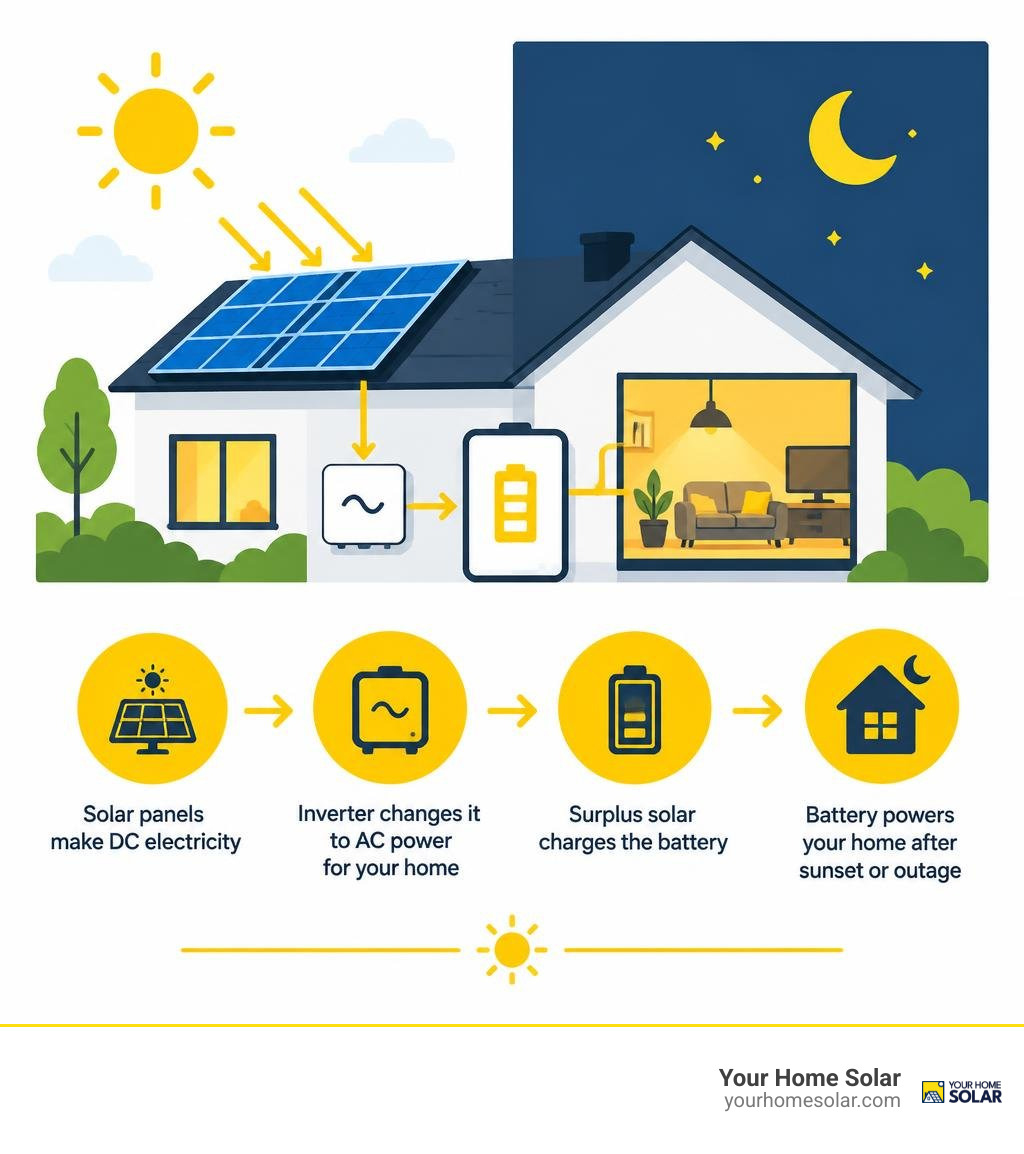
A battery backed solar system uses solar panels to power your home during the day and store extra electricity in a battery for later. When the grid goes down, the battery and inverter can keep selected essential loads running, such as lights, refrigeration, internet, medical devices, and some appliances. It can also reduce the power you buy during expensive evening hours.
The basic idea is simple:
- Solar panels make DC electricity.
- An inverter changes it into usable AC power for your home.
- Surplus solar charges a battery instead of being wasted or sent to the grid.
- At night, during high-rate periods, or during an outage, stored energy powers the loads your system is designed to support.
For East Tennessee households, the value is not just lower utility use. It is greater control when storms interrupt service. A properly designed system must match the battery capacity, inverter output, solar production, and backup loads to the way your family actually uses energy.
I am Ernie Bussell, founder and CEO of Your Home Solar. My background in solar operations, system design, and homeowner education helps me explain how a battery backed solar system can provide practical, dependable energy security without the confusion.
Basic battery backed solar system terms:
- Solar battery storage solutions
- Energy storage systems for solar power
- Deep cycle battery for solar storage
Anatomy of a Modern Battery Backed Solar System
To understand how clean energy keeps your lights on around the clock, you have to look at the system architecture. A modern backup setup coordinates several independent electrical subsystems to deliver smooth, uninterrupted electricity.
During full daylight, rooftop or ground-mounted solar panels absorb photons and produce Direct Current (DC) power. In a standard grid-tied setup without storage, any power your home does not immediately consume flows straight back to the local utility grid. When you integrate energy storage systems that store surplus energy, that dynamic changes completely.
Instead of offloading excess generation, intelligent control systems divert surplus DC electricity to your battery bank. If the grid fluctuates or drops out entirely, an automated transfer switch disconnects your home from the utility in milliseconds. This process—known as islanding—protects utility line workers while keeping your personal microgrid fully energized. This localized stability mirrors macro-level innovations, such as grid stability research from ORNL, demonstrating how responsive inverter-storage systems stabilize supply.
Core Components of a 48V Battery Backed Solar System
Modern residential and off-grid designs increasingly rely on a standardized 48V direct-current architecture. This setup balances high efficiency, modular flexibility, and personal safety.
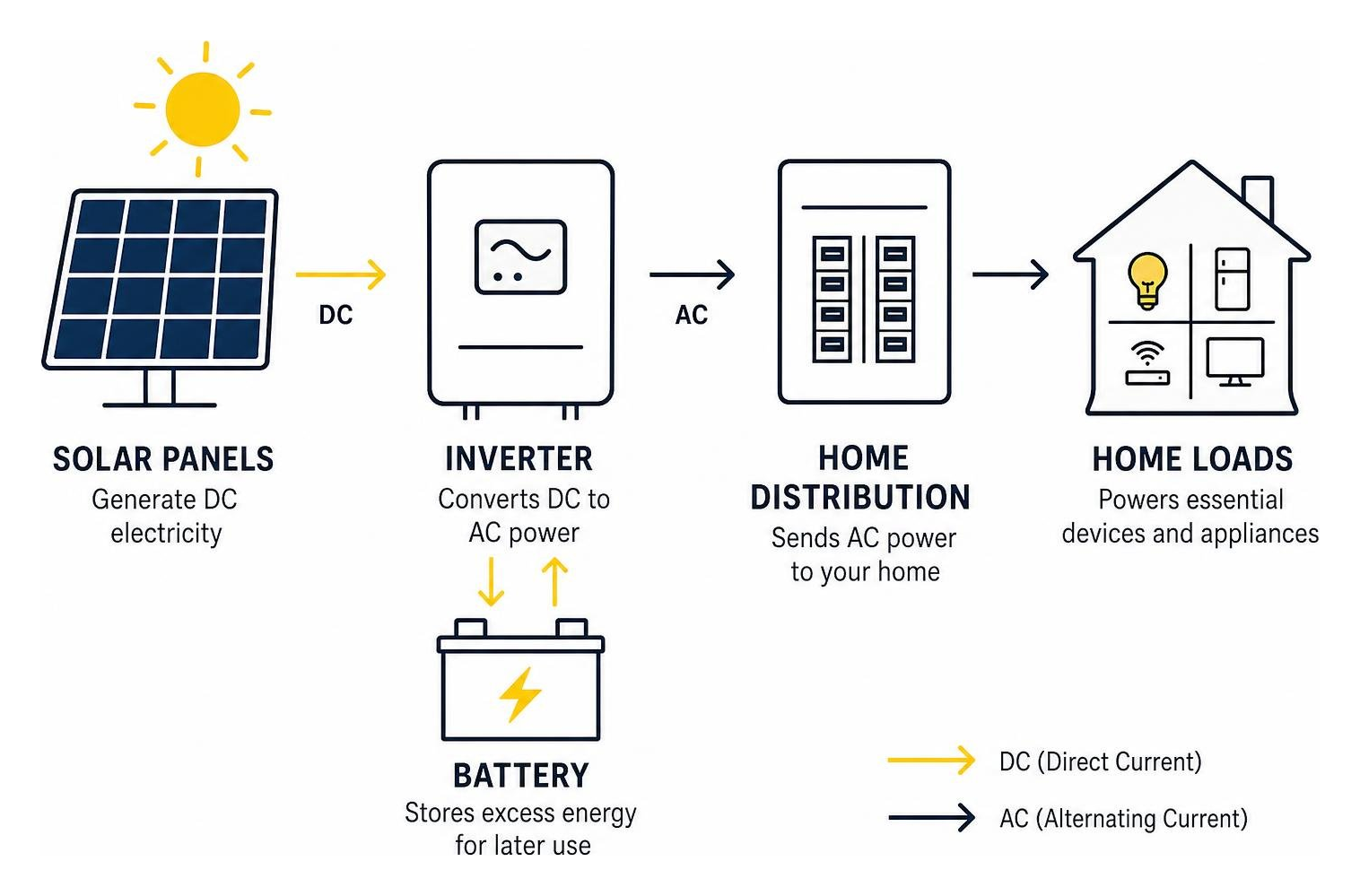
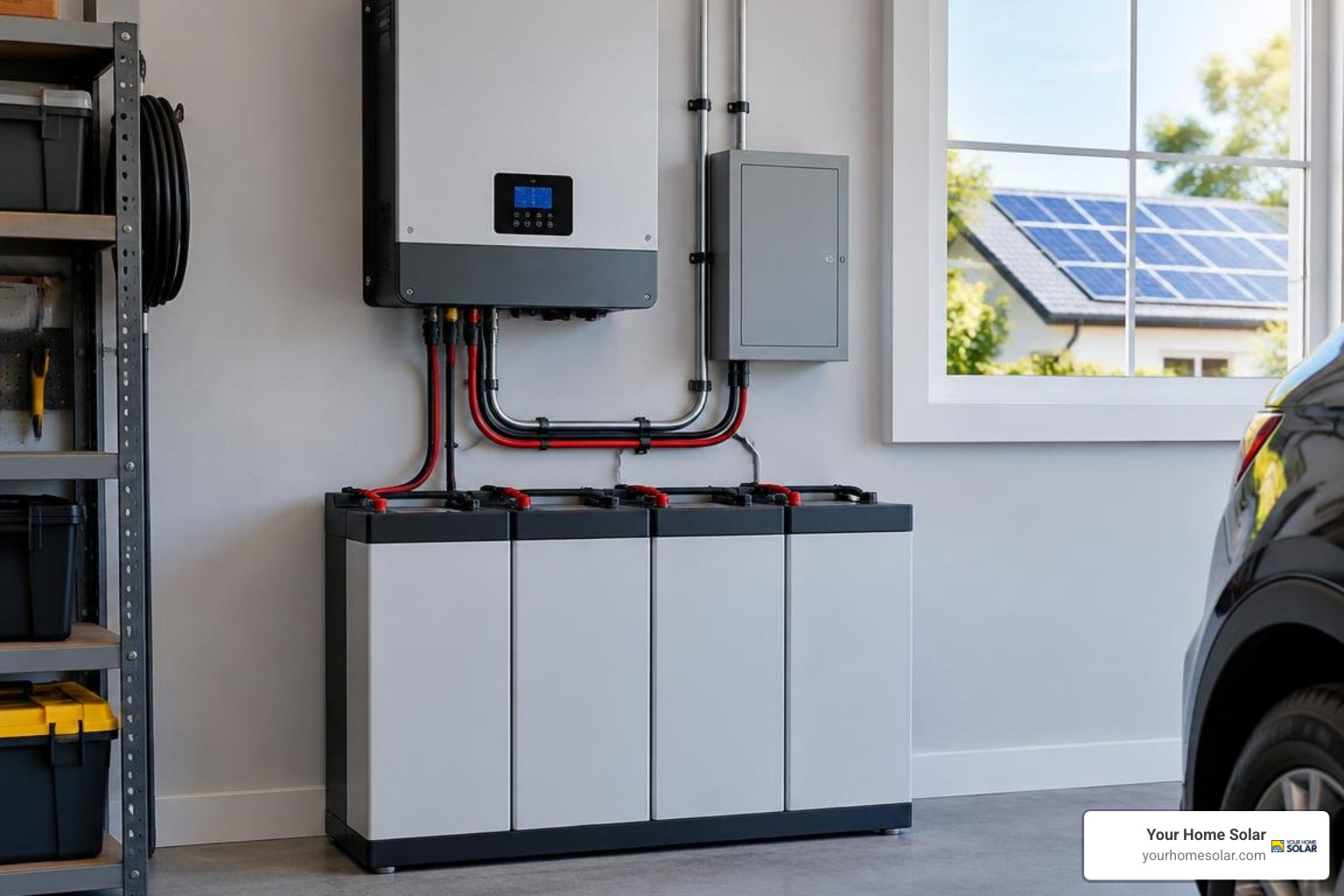
A standard 48V modular installation centers on four foundational hardware elements:
- Photovoltaic (PV) Array: High-efficiency solar modules wired in series and parallel strings to capture ambient sunlight and convert it into high-voltage DC electricity.
- 48V Lithium Battery Bank: A modular storage core built with units such as 48V 50Ah LiFePO4 modules. Each single battery offers 2,400Wh (48V × 50Ah) of energy capacity, supporting continuous charge and discharge currents up to 50A.
- Battery Management System (BMS): An integrated digital brain within each battery pack that monitors individual cell voltages, controls thermal limits, prevents over-discharge, and communicates with the central inverter.
- Hybrid Inverter Charger & Automatic Transfer Switch (ATS): The central hub that routes incoming power, charges the battery bank, and converts DC into 120V/240V Alternating Current (AC) for household appliances.
The Role of Pure Sine Wave Inverters and Built-In MPPT Controllers
Your home runs on alternating current, but solar panels and batteries operate exclusively on direct current. Bridging this divide requires a pure sine wave inverter charger. Standard modified sine wave inverters produce a choppy, blocky electrical signal that can overheat sensitive electronics, degrade motor windings, and cause audible humming in audio-visual gear. Pure sine wave inverters deliver a clean, smooth wave identical to or cleaner than the power supplied by the grid.
Modern all-in-one 48V 3,500W inverter chargers incorporate a Maximum Power Point Tracking (MPPT) charge controller. An MPPT controller constantly scans the voltage and current output of your solar array to find the exact electrical “sweet spot” where your panels generate their absolute maximum wattage under fluctuating weather conditions.
Units operating in this category feature high-end specifications designed for tough workloads:
- Peak Efficiency: Over 95% conversion efficiency, ensuring minimal energy loss as heat.
- PV Input Ceiling: Supports up to 4,400W of maximum PV input/output power.
- Dynamic Charging Management: Delivers up to 40A of maximum AC charging current from the grid or a generator and up to 120A (adjustable) of maximum solar battery charging current.
- Rapid Transfer Time: Typical 10ms conversion time between bypass mode and invert mode. When severe weather hits Knox County or Sevier County, your desktop computers, Wi-Fi routers, and refrigeration systems will not drop offline or restart during the switch.
Lithium Technology: Chemistry, Pouch Cells, and Cold-Weather Heating
Lead-acid batteries are obsolete for modern, high-cycle solar backup. Lithium Iron Phosphate (LiFePO4) has emerged as the definitive standard for residential solar installations due to its chemical stability, long operational life, and safety profile. When evaluating choosing the right battery storage, the structural construction of the internal cells is just as important as the chemistry.
Pouch Cells vs. Hard Metal Casings in LiFePO4 Chemistry
Lithium batteries generally use either rigid metal prismatic/cylindrical casings or laminated aluminum-polymer pouch cells. While both supply power, their physical behavior under heavy thermal and electrical loads differs.
Pouch cells replace heavy metal exteriors with a conductive, flexible aluminum-polymer film. This construction reduces pack weight and provides superior thermal dissipation across the surface area of the cell. If an internal short or severe overcharging event occurs, hard metal casings must vent through small, high-pressure mechanical relief valves—risking casing rupture if pressure builds too quickly. Pouch cells, by contrast, expand uniformly and release gas through sealed seams at much lower pressures, reducing thermal runaway risks.
| Feature / Metric | Laminated Pouch Cells | Hard Metal Casing (Prismatic) |
|---|---|---|
| Enclosure Material | Multi-layer aluminum-polymer film | Welded aluminum or steel canister |
| Weight Efficiency | High (minimal dead weight packaging) | Moderate (heavy outer metal casing) |
| Thermal Dissipation | Superior (broad flat surface cooling) | Moderate (thicker walls retain internal heat) |
| Overpressure Behavior | Controlled expansion along seams | High-pressure release via relief valve |
| Vibration Resistance | Excellent (flexible shock absorption) | Good (rigid structural exterior) |
| Cycle Degradation Rate | Low (uniform internal pressure) | Low to Moderate |
Self-Heating Technology for Sub-Zero Reliability
Standard lithium-ion batteries have a significant weakness: cold temperatures. While LiFePO4 cells can discharge safely in sub-freezing weather, charging a standard lithium battery below 32°F (0°C) causes irreversible damage known as lithium plating. During low-temperature charging, lithium ions fail to intercalate smoothly into the graphite anode, forming microscopic lithium metal dendrites that can permanently degrade capacity or cause short circuits.
Premium 48V LiFePO4 units include integrated, self-heating technology to solve this problem. When incoming solar or AC charge current is detected in cold weather, an internal algorithm in the BMS automatically diverts the incoming current to internal heating pads rather than the battery cells.
These heating elements bring the core cells up to a safe operational temperature (typically above 41°F / 5°C). Once reached, the system smoothly routes the full electrical current into storage. This feature is invaluable for off-grid cabins, workshops, or unconditioned garages in East Tennessee, where winter nights drop well below freezing.
Voltage Architecture and Inverter Power Capabilities
System voltage selection dictates the efficiency, safety, and physical footprint of your solar balance-of-systems hardware. Low-voltage configurations (12V and 24V) served as the historical standard for small off-grid setups, but modern high-demand systems require the efficiency of a 48V architecture. Understanding these dynamics is essential when sizing a deep cycle battery for solar storage.
Why Upgrading from 12V to 48V Architecture Maximizes Efficiency
The core physics of electrical wiring comes down to Ohm’s Law and the power formula ($P = V \times I$). Because power (watts) equals voltage multiplied by current (amps), doubling or quadrupling the system voltage slashes the amperage needed to deliver the same amount of power.
$$I = \frac{P}{V}$$
To deliver 3,500 watts of continuous power:
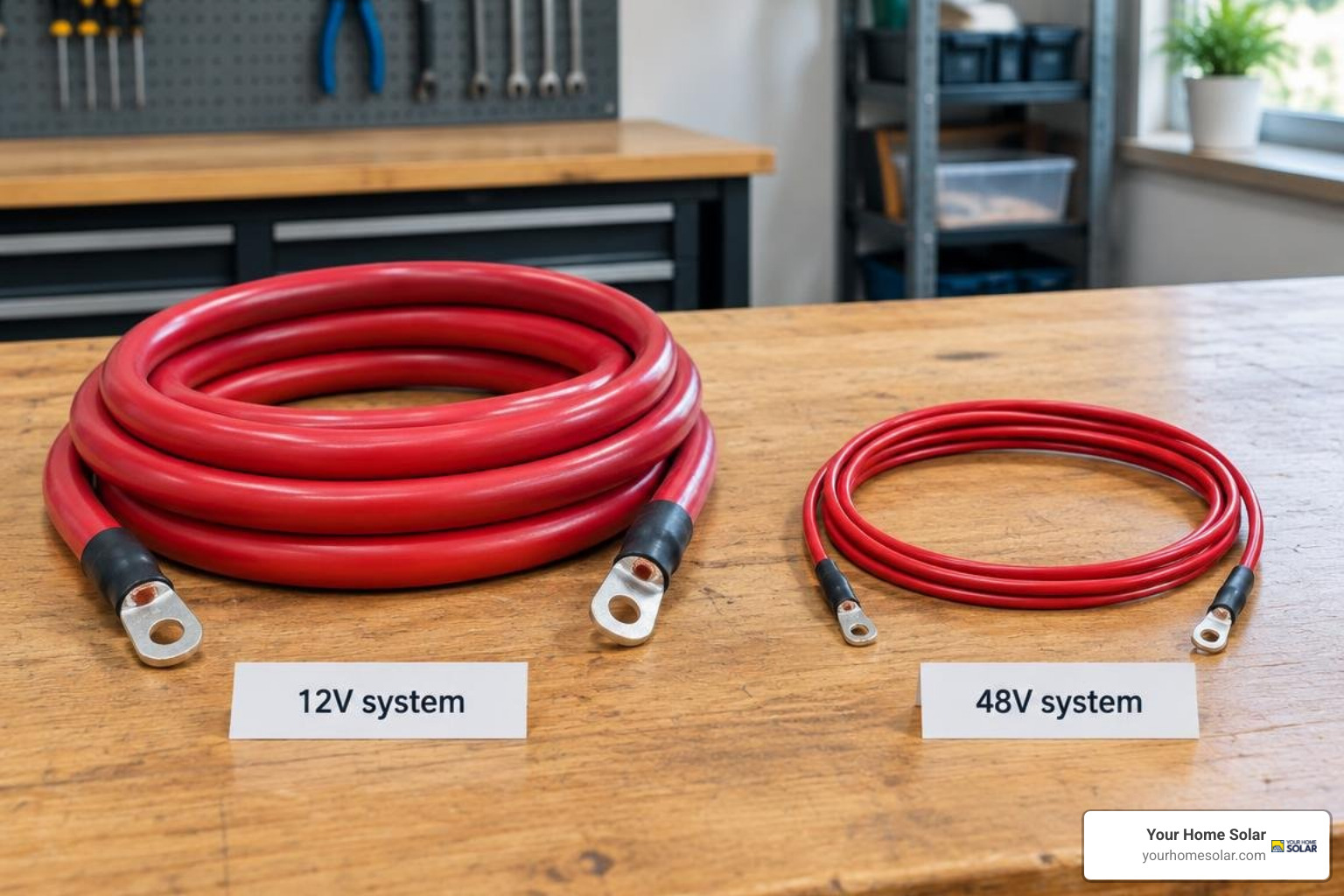
- A 12V system pulls nearly 292 Amps ($3500\text{W} / 12\text{V}$).
- A 48V system pulls only 73 Amps ($3500\text{W} / 48\text{V}$).
$$\text{Power Loss} = I^2 \times R$$
Because line losses and heat generation scale with the square of current ($I^2$), running 292 amps through a 12V system generates substantial resistance losses and requires massive 4/0 AWG copper cables. A 48V system cuts those thermal losses dramatically and operates safely using thinner, lighter, and more economical 4 AWG wiring.
This drop in amperage lowers operational temperatures, cuts balance-of-system hardware costs, and boosts real-world round-trip efficiency across the installation.
Load Capacity: What a 3500W Inverter Can Power in a Battery Backed Solar System
A pure sine wave inverter rated at 3,500W continuous output provides enough capacity to run critical household circuits simultaneously during extended grid failures.
Understanding what your system can support requires looking at both steady running wattage and temporary inductive surge requirements (such as electric motors starting up).
- Full-Size Refrigerator / Freezer: 150W to 300W running (1,200W surge)
- High-Efficiency Inverter Mini-Split Heat Pump / AC: 800W to 1,500W running
- Sump Pump (1/2 HP): 800W running (2,100W surge)
- Microwave Oven: 1,000W to 1,500W running
- Home Network, Starlink, & Laptops: 100W to 250W running
- CPAP / Essential Medical Equipment: 40W to 120W running
- Well Pump (1/2 HP, 120V): 1,000W running (2,500W surge)
- LED Lighting Circuits: 50W to 150W running
A 3,500W continuous inverter easily handles the refrigerator, living area lighting, communications gear, medical equipment, and a mini-split air conditioner simultaneously without triggering over-current shutoffs.
Longevity, Scalability, and Battery Management Best Practices
Solar storage is a long-term investment. Choosing equipment designed for high cycle counts and steady scalability ensures your home maintains backup security over years of daily cycling. Selecting from among tested home battery backup options means matching cycle life ratings to your daily energy consumption patterns.
Lifespan Optimization and Safe Parallel Expansion
A quality 48V 50Ah LiFePO4 battery offers exceptional longevity:
- Cycle Life: Over 6,000 cycles at 80% Depth of Discharge (DOD) to 80% End of Life (EOL). Even under daily full-cycle discharge and recharge conditions, the core cells retain 80% of their original nameplate capacity after more than 16 years.
- Deep Cycling Performance: Can withstand up to 4,500 full 100% charge-discharge cycles while retaining roughly 80% capacity.
System scalability allows homeowners to expand their backup capacity over time. Advanced 48V lithium systems allow up to 8 batteries connected in parallel.
- 1 Unit: 48V | 50Ah | 2.4 kWh capacity | 50A max continuous discharge
- 4 Units: 48V | 200Ah | 9.6 kWh capacity | 200A max continuous discharge
- 8 Units: 48V | 400Ah | 19.2 kWh capacity | 400A max continuous discharge
When expanding in parallel, the internal BMS network employs active auto-balancing circuitry. This feature equalizes voltage across all connected packs, preventing higher-voltage units from dumping uncontrolled current into lower-voltage units during startup or heavy loads.
Always look for safety certifications such as UL1973, UL9540A, and UN38.3, which verify that the battery cells and enclosure have passed rigorous impact, thermal stress, short-circuit, and overcharge safety tests.
Handling, Commissioning, and Long-Term Storage Protocols
Setting up your batteries properly ensures they deliver their full rated cycle life from day one. Follow these commissioning and storage best practices:
- Immediate Commissioning Charge: New lithium batteries ship from the factory at a partial State of Charge (SOC)—typically 30% to 50%—in compliance with international transport regulations. Charge the battery fully using the proper LiFePO4 charging profile before placing it under heavy household loads to avoid deep-discharge cell imbalance.
- One-Touch BMS Activation: Modern units feature a physical switch button that wakes the BMS from low-power hibernation, initiates communication handshakes, and allows easy isolation during system maintenance.
- Long-Term Storage Parameters: If taking the system offline or storing spare modules for seasonal use, isolate the pack at 30% to 50% SOC in a dry environment between 32°F and 95°F (0°C to 35°C). Avoid storing batteries at 100% charge or near 0% charge for extended periods.
- Quarterly Maintenance Checks: Every 90 to 180 days, check terminal torque specifications, verify communication cables, and cycle stored batteries back to the 30%–50% holding range to mitigate natural self-discharge.
Frequently Asked Questions
What makes a 48V lithium battery superior to traditional 12V configurations?
A 48V architecture runs at one-fourth the amperage of a 12V system when delivering the same wattage. This reduction in current minimizes resistive heat generation, improves total conversion efficiency, and allows the use of thinner, less expensive wiring (such as 4 AWG instead of thick 4/0 AWG). It also enables clean operation of high-demand household appliances like air conditioners, pumps, and power tools without massive line voltage drops.
How does the self-heating feature work during freezing winter months?
When temperatures fall below freezing (32°F / 0°C), attempting to charge a standard lithium battery can permanently damage the internal cells through lithium plating. A self-heating battery uses built-in thermal sensors. When incoming solar or grid power is detected, the BMS diverts this power to internal heating elements to warm the cells to safe levels before allowing charge current into the battery.
How many batteries can be connected in parallel for system expansion?
Up to 8 compatible 48V lithium-ion batteries can be wired in parallel. This expands storage from a baseline 2.4kWh (50Ah at 48V) up to 19.2kWh (400Ah at 48V). Built-in auto-balancing technology keeps the parallel string stable and ensures uniform charge and discharge rates across every connected module.
Conclusion
A modern battery backed solar system provides quiet, reliable, automated power security for your home. By pairing stable LiFePO4 pouch cell technology and self-heating cold-weather performance with an efficient 48V architecture, homeowners can run essential circuits through grid interruptions and seasonal storms alike.
At Your Home Solar, we provide customized, dependable clean energy systems for homeowners across East Tennessee. Whether you reside in Knoxville, Johnson City, Maryville, Oak Ridge, or anywhere in the surrounding region, our team designs each system to match your specific daily energy use and backup priorities.
To explore options for your property, read our comprehensive guide to solar batteries and energy storage solutions and take control of your home’s energy independence.