
Choose a Deep Cycle Battery That Fits Your Solar Goals
For most home solar backup systems, LiFePO4 is the best deep cycle battery for solar storage because it provides more usable energy, weighs far less than lead-acid, and commonly lasts thousands of charge cycles. AGM remains a sensible lower-cost option for smaller systems or occasional backup, but it offers less usable capacity and should usually stay above 50% charge.
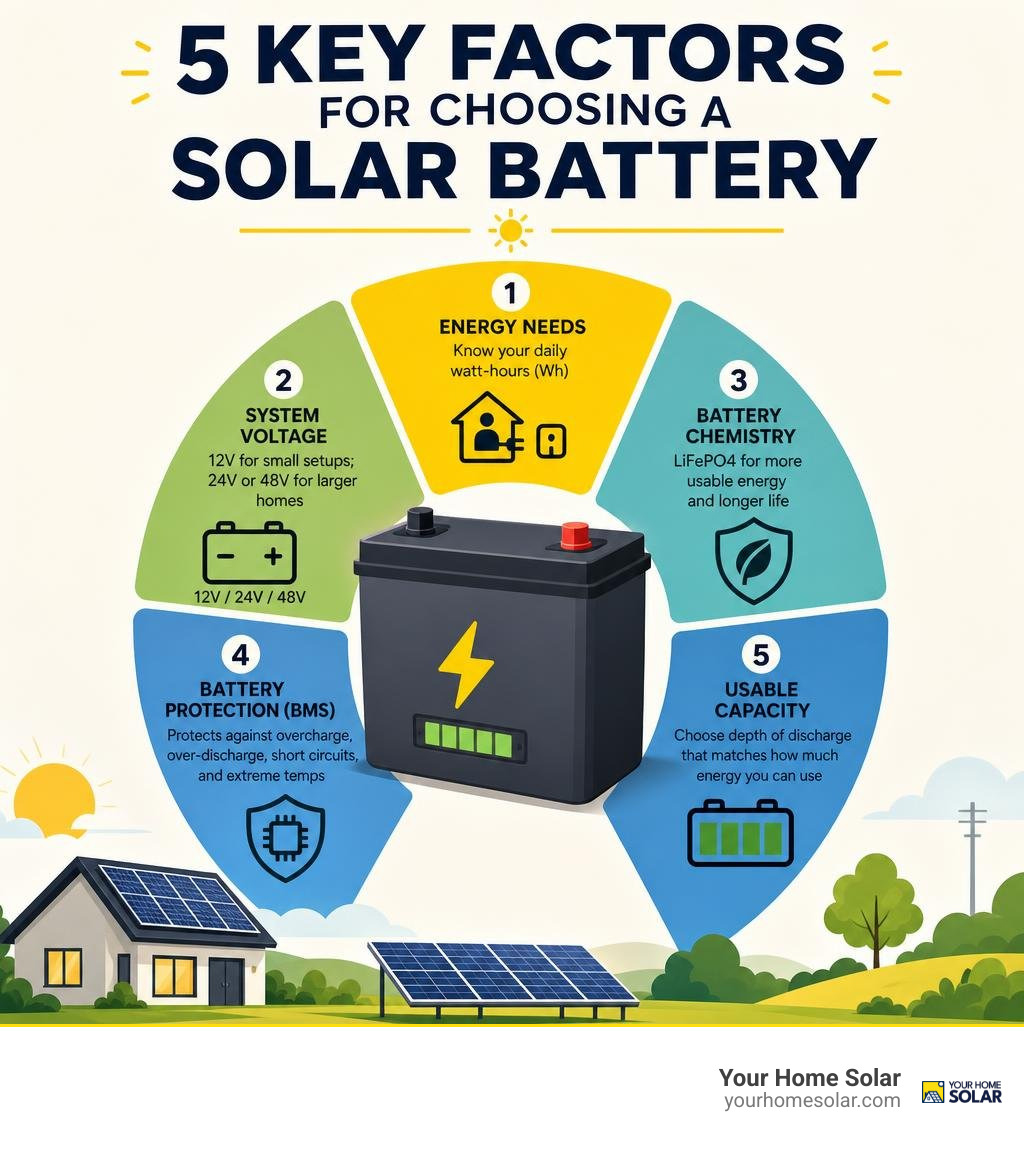
Choose your battery by checking three things first:
- Energy needed: Add up the watt-hours or kWh your essential loads use each day.
- System voltage: 12V works for small setups; 24V and 48V are usually better for larger home systems because they reduce current and cable size.
- Battery protection: Lithium batteries should include a Battery Management System (BMS) to guard against overcharging, over-discharging, short circuits, and unsafe temperatures.
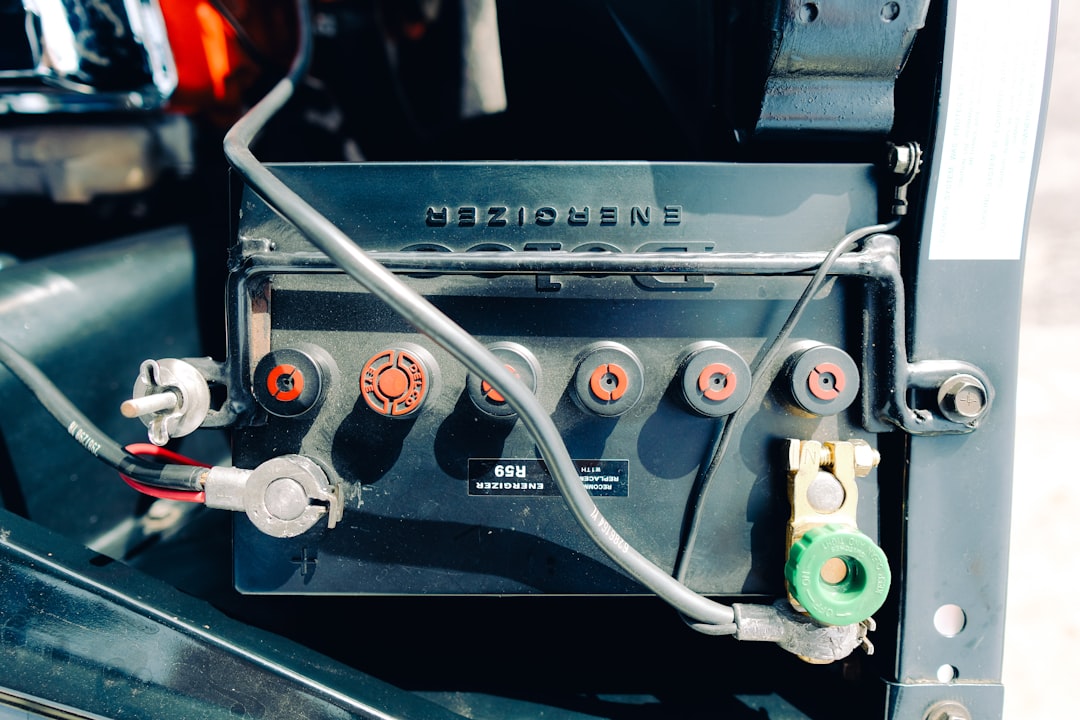
A deep cycle battery is built to release power steadily for hours and recharge repeatedly from solar panels. That is very different from a car battery, which is designed to deliver a short, powerful burst to start an engine. The right battery bank can keep essential loads running through an East Tennessee outage, while helping you use more of the solar energy your panels produce during the day.
I am Ernie Bussell, founder and CEO of Your Home Solar, with hands-on solar operations and system-design experience built through years of helping homeowners make clear energy decisions. In this guide, I will break down how to choose a deep cycle battery for solar storage based on capacity, chemistry, cost, safety, and the power your household actually needs.
Must-know deep cycle battery for solar storage terms:
Understanding Deep Cycle Battery Chemistries
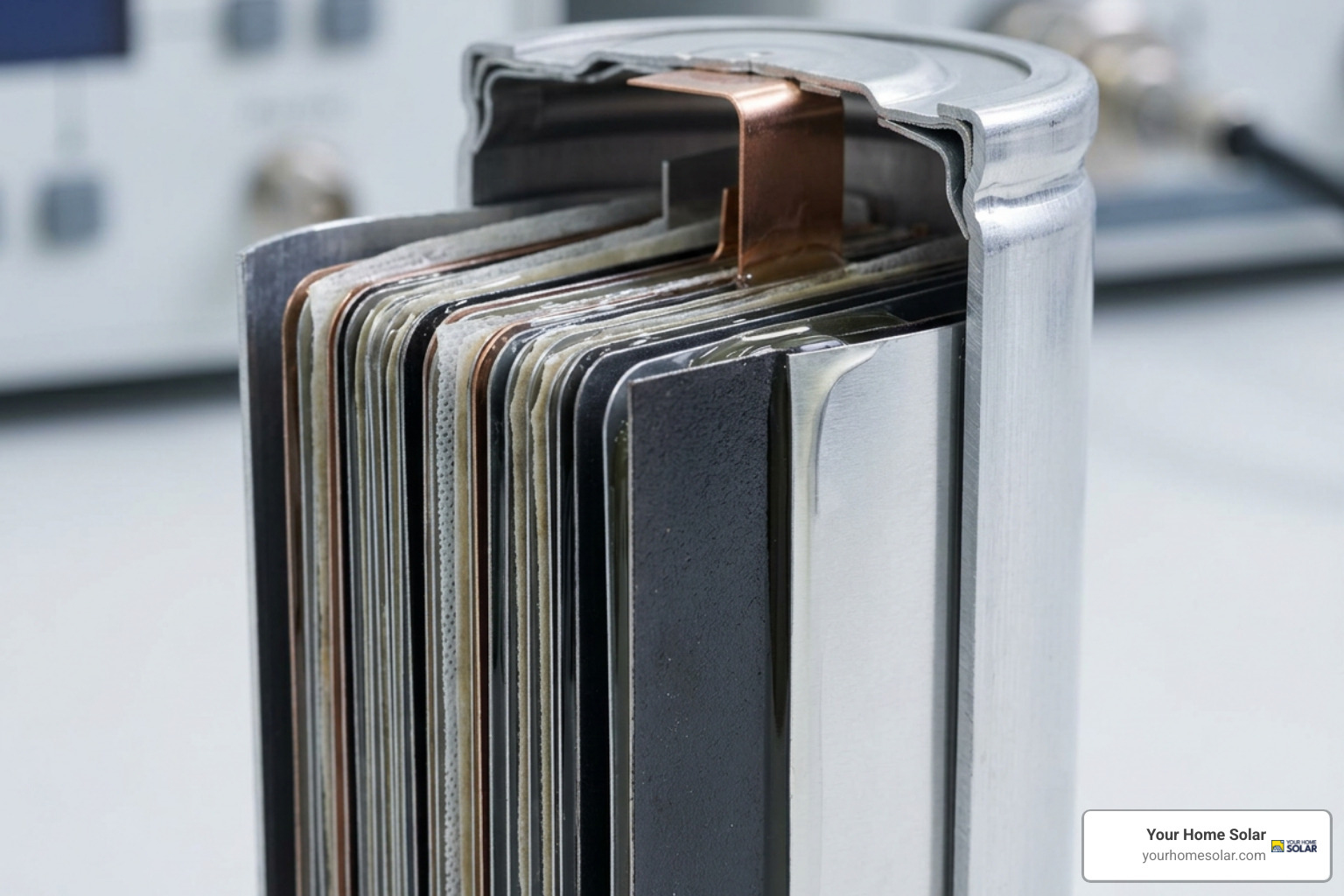
When designing an off-grid cabin or a dependable home energy backup, selecting the proper chemistry is the foundation of your investment. Unlike standard automotive starter batteries built with thin sponge-lead plates for momentary cranking power, deep cycle batteries use thick, solid active materials. This physical construction allows them to endure prolonged, steady discharges followed by complete recharges without structural collapse.
To find the right fit, we need to compare how lead-acid variants (Flooded, AGM, Gel) stack up against modern Lithium Iron Phosphate (LiFePO4) chemistry across key operational metrics.
| Specification / Feature | Flooded Lead-Acid | Sealed AGM (Absorbent Glass Mat) | Gel Lead-Acid | Lithium Iron Phosphate (LiFePO4) |
|---|---|---|---|---|
| Recommended Depth of Discharge (DoD) | 50% | 50% | 50% | 80% – 100% |
| Cycle Life (to 80% Retention) | 500 – 1,000 cycles | 500 – 1,200 cycles | 800 – 1,500 cycles | 4,000 – 15,000 cycles |
| Usable Energy Efficiency | 75% – 85% | 80% – 85% | 80% – 85% | 95% – 98% |
| Monthly Self-Discharge Rate | 5% – 15% | ~3% | ~2% – 3% | <2% |
| Maintenance Requirements | High (Distilled water refills) | Maintenance-Free | Maintenance-Free | Zero Maintenance |
| Energy Density (Wh/kg) | Low (~30 Wh/kg) | Low (~35 Wh/kg) | Low (~30 Wh/kg) | High (100–140+ Wh/kg) |
| Operating Temperature Range | 32°F to 110°F | -4°F to 122°F | -4°F to 104°F | 32°F to 131°F (Charge) / -4°F to 140°F (Discharge) |
| Upfront Cost per kWh | Lowest | Low to Moderate | Moderate | Moderate to High |
| Lifetime Cost per kWh | Higher ($0.20–$0.40) | Higher ($0.18–$0.35) | Higher ($0.18–$0.30) | Lowest (~$0.02–$0.05) |
Flooded, AGM, and Gel Lead-Acid Options
Lead-acid technology has powered electrical systems for over 160 years. While newer technologies exist, understanding the variations within the lead-acid family helps clarify when these traditional units still make sense.
- Flooded Lead-Acid (FLA): These traditional wet-cell batteries submerge lead plates in liquid sulfuric acid. While they have the lowest initial price tag, they emit hydrogen gas during charging and require dedicated exterior ventilation. Owners must regularly top off cells with distilled water and perform periodic equalization charges to break up plate crystallization.
- Absorbent Glass Mat (AGM): AGM batteries suspend the electrolyte solution inside fine fiberglass mat separators. This design makes them spill-proof, resistant to vibration, and fully maintenance-free. With a low self-discharge rate of roughly 3% per month, popular options like the Renogy 12V 100Ah AGM or Weize 12V 100Ah AGM are dependable choices for smaller seasonal cabins in Sevier County or basic solar backup kits.
- Gel Electrolyte: Gel batteries mix sulfuric acid with fumed silica, creating an immobile, jelly-like paste. They perform well in high ambient temperatures and recover better from deep discharges than AGM, but they require strict, lower charging voltages. If an improper charge profile causes bubbles in the gel matrix, permanent capacity loss occurs.
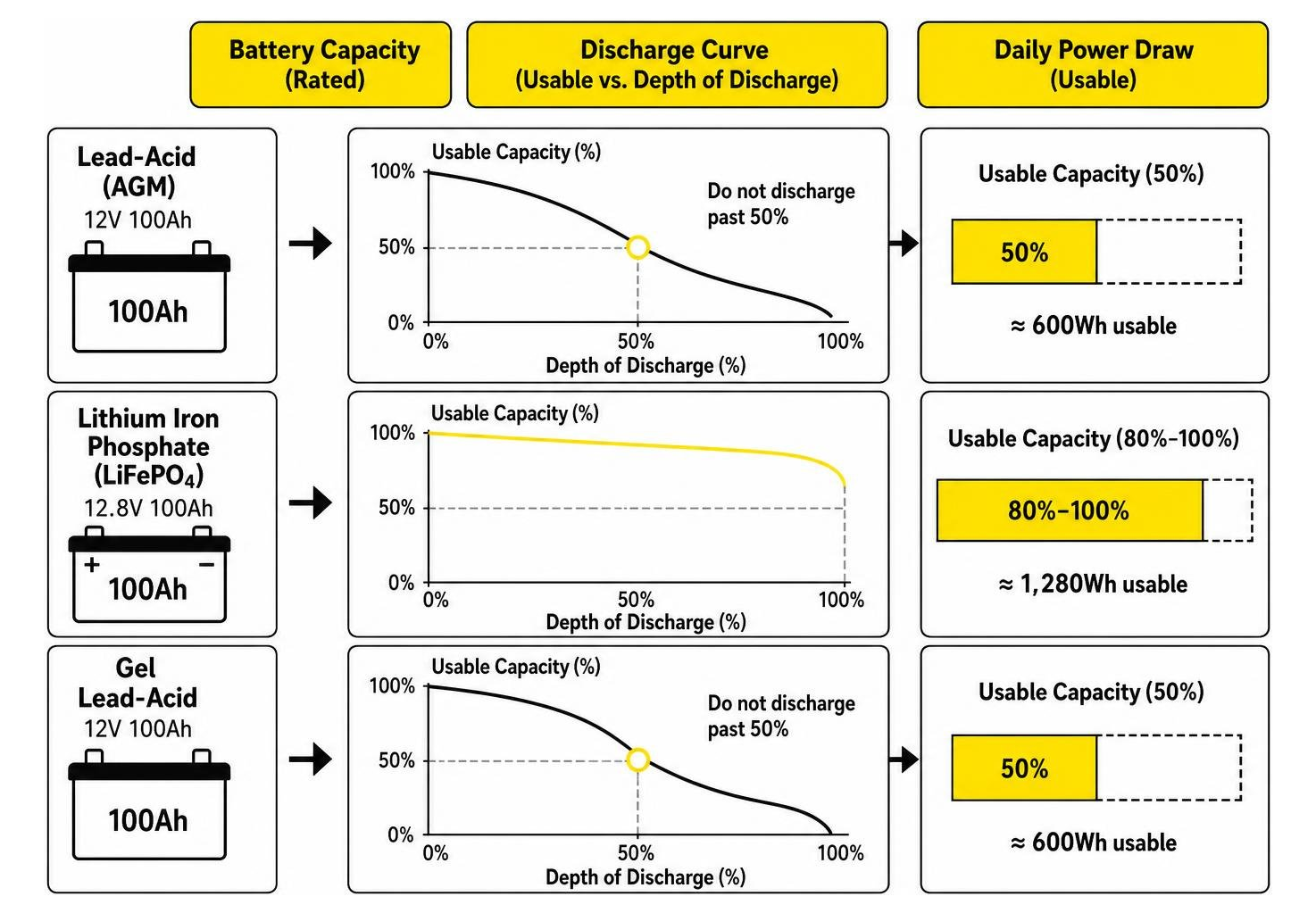
Regardless of design, all lead-acid options share a significant operating limit: they should never be discharged past 50% of their total capacity. Discharging lead-acid banks to empty causes rapid sulfation—where lead sulfate crystals harden across the active plate surface—permanently ruining the battery bank in a fraction of its intended lifespan. You can dive deeper into these variations in our breakdown of residential solar battery types.
Lithium Iron Phosphate (LiFePO4) Advantages
Lithium Iron Phosphate (LiFePO4) has become the gold standard for residential solar energy storage. Unlike standard consumer lithium-ion chemistries (such as NMC or cobalt-based cells), LiFePO4 chemistry is chemically stable, non-combustible, and inherently resistant to thermal runaway.
The primary advantage of LiFePO4 is its deep discharge capability. A quality LiFePO4 battery delivers 80% to 100% of its rated capacity day in and day out without shortening its service life. This means a single 12.8V 100Ah lithium battery delivers roughly 1,280Wh of usable power—nearly double the practical 600Wh delivered by an equivalent 100Ah AGM battery.
Furthermore, LiFePO4 units offer significant weight savings, weighing about two-thirds less than lead-acid equivalents. A 12V 150Ah LiFePO4 unit weighs just 22 lbs, compared to an 80-lb AGM battery of similar total capacity. With cycle lives stretching between 4,000 and 15,000 cycles (depending on depth of discharge), a lithium bank easily achieves a 10- to 15-year service life, making its levelized cost of energy (LCOE) as low as $0.02 to $0.05 per stored kWh over its lifespan.
Choosing the Best Deep Cycle Battery for Solar Storage
Sizing and selecting the right energy storage platform requires matching electrical loads, inverter specifications, and physical installation requirements.
When selecting hardware, consider both continuous power delivery and short-term surge handling. For example, if you plan to run heavy inductive loads such as well pumps, power tools, or air conditioners across Knoxville or Blount County homes, your battery bank must provide high continuous discharge rates (such as 200A to 300A) and robust surge headroom (up to 400A for 10 seconds) to prevent inverter brownouts. For a comprehensive look at how individual backup setups compare, review our solar battery backup comparison.
Key Features of a Deep Cycle Battery for Solar Storage
A modern deep cycle battery bank needs intelligent internal controls to operate smoothly alongside a solar array.
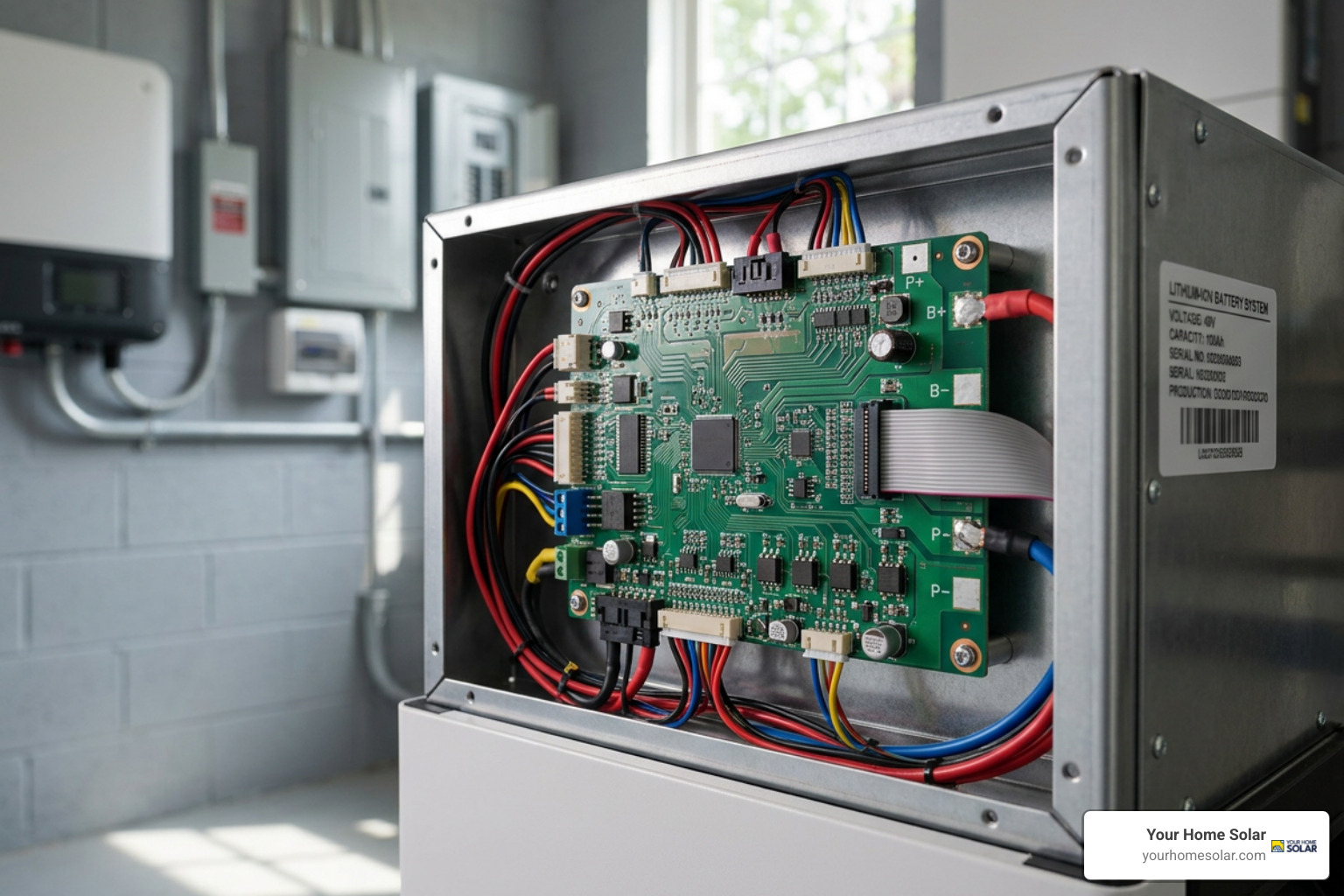
- Smart Battery Management System (BMS): A lithium battery is only as reliable as its BMS. This onboard micro-controller monitors cell-level voltages, balance, current, and temperature. The BMS automatically cuts off power during over-voltage, deep under-voltage, short circuits, or over-current conditions, protecting your investment from damage.
- Low-Temperature Charge Cut-Off and Self-Heating: Lithium cells cannot safely accept a charge when temperatures drop below freezing (32°F / 0°C), as charging in freezing conditions causes permanent lithium plating. Premium units (such as Core Series heated batteries) incorporate internal heating pads powered by incoming solar energy, warming the cells above freezing before allowing charge current to flow.
- Real-Time Bluetooth Monitoring: Integrated Bluetooth 5.0 wireless links allow you to monitor State of Charge (SoC), individual cell voltages, temperature, and live discharge rates directly from your smartphone, eliminating the need for an external shunt.
- Series and Parallel Scalability: Verify the battery manufacturer’s balance limitations. High-capacity setups allow up to 4S4P configurations (4 units in series, 4 in parallel), letting you scale up to 48V banks holding over 60kWh to 128kWh of total reserve energy.
Sizing and Voltage Configuration for Home Solar
Sizing a battery bank properly ensures your home remains powered through multiple days of cloudy weather without over-stressing the system.
Follow this simple, step-by-step formula to calculate your target capacity:
- Calculate Daily Watt-Hours (Wh): List your essential appliances, multiply each by its run hours, and sum the total. (Example: A refrigerator, LED lights, internet router, and small electronics total roughly 3,600 Wh/day).
- Account for Days of Autonomy: Multiply your daily usage by the number of overcast days you wish to reserve without solar production (typically 2 days of autonomy). $3,600\text{ Wh} \times 2 = 7,200\text{ Wh}$.
- Factor in Depth of Discharge (DoD) & Inverter Efficiency: For a LiFePO4 bank operating at 80% DoD with a 90% inverter efficiency: $$\text{Total Storage Needed} = \frac{7,200\text{ Wh}}{0.80 \times 0.90} = 10,000\text{ Wh (10 kWh)}$$
- Convert to Amp-Hours (Ah) Based on Voltage: Divide total watt-hours by your nominal system voltage:
- At 12V: $10,000\text{ Wh} / 12.8\text{ V} = 781\text{ Ah}$
- At 24V: $10,000\text{ Wh} / 25.6\text{ V} = 390\text{ Ah}$
- At 48V: $10,000\text{ Wh} / 51.2\text{ V} = 195\text{ Ah}$
Why choose higher voltages? Sizing a larger residential system at 48V keeps continuous current under 100A, which drastically reduces heat, lets you use manageable 2/0 or 4/0 AWG cabling, and maximizes efficiency. Discover how these dedicated configurations operate in our guide on how off-grid battery banks keep your lights on.
Maintenance, Charging, and Lifespan Optimization
Maximizing the lifespan of your solar storage bank requires proper charging controls and basic maintenance habits.
- Use an MPPT Charge Controller: Maximum Power Point Tracking (MPPT) controllers sweep solar panel voltage curves constantly, providing 15% to 30% more energy harvest than older PWM controllers. An MPPT unit converts high panel voltages down to match battery bank requirements smoothly.
- Match Charge Profiles Accurately: Never charge LiFePO4 batteries using standard lead-acid profiles. Lead-acid profiles include equalization modes (controlled over-voltage spikes up to 15.5V+) that will trip lithium BMS protection circuits. Ensure your charger provides a multi-stage profile matching your chemistry:
- LiFePO4: Bulk/Absorption at 14.2V–14.6V (for 12V nominal); Float at 13.5V–13.6V; No equalization.
- AGM: Bulk/Absorption at 14.4V–14.7V; Float at 13.6V–13.8V.
- Flooded: Bulk/Absorption at 14.6V–14.8V; Float at 13.4V–13.6V; Equalization at 15.2V–15.8V.
- Maintain Operating Clearances: Allow 2 to 4 inches of clearance above and around battery enclosures for passive airflow and heat dissipation.
- Storage Practices: If storing your system for the winter without solar input, disconnect the battery bank via a mechanical isolation switch. Store lithium batteries at 40% to 60% State of Charge (SoC) rather than fully charged or completely drained, and perform a maintenance top-off every six months.
Frequently Asked Questions About Solar Storage Batteries
How Does a Deep Cycle Battery for Solar Storage Compare to a Car Battery?
A standard automotive car battery is built to deliver high cold-cranking amps (CCA)—often 500A to 800A—for 3 to 5 seconds to spin an internal combustion starter motor. To deliver this burst, automotive batteries utilize thin, porous lead sponges that corrode quickly if drained deeply. Discharging a car battery below 80% SoC more than a dozen times will ruin it.
In contrast, a deep cycle battery uses thick, solid lead plates or lithium iron phosphate cells. It is engineered to discharge steady current over hours or days, handling hundreds or thousands of deep discharge cycles without physical degradation.
Can I Use the Same Deep Cycle Battery for RVs and Home Solar?
Yes. Deep cycle batteries (especially 12V and 24V lithium or AGM units) can be used across multiple applications, including off-grid cabins, mobile RVs, overland builds, and marine trolling motors. Because they provide stable, continuous DC voltage and handle vibration well, moving a battery bank between an RV solar setup and a home backup system is simple, provided you stay within inverter voltage and BMS current ratings. However, deep cycle storage units should never be used as engine-starting batteries.
How Many Years Will a Deep Cycle Solar Battery Last?
A battery’s operating lifespan depends on its chemistry, ambient temperature, and routine Depth of Discharge (DoD):
- Flooded Lead-Acid: 3 to 5 years (500–1,000 cycles at 50% DoD).
- Sealed AGM: 4 to 7 years (600–1,200 cycles at 50% DoD).
- LiFePO4 Lithium: 10 to 15+ years (5,000 to 15,000 cycles at 80% to 60% DoD).
Operating in extreme heat (routinely above 95°F) degrades lead-acid plates quickly, while freezing temperatures can prevent unprotected lithium from accepting a charge. Keeping batteries within moderate, climate-controlled environments ensures they reach their maximum potential lifespan.
Conclusion
Choosing the right deep cycle battery for solar storage comes down to balancing upfront budget, usable daily energy capacity, and long-term lifespan. While AGM batteries offer an affordable, maintenance-free entry point for occasional backup and modest solar setups, LiFePO4 lithium technology provides higher usable energy density, thousands of operational cycles, integrated smart BMS safety, and the lowest overall cost per kilowatt-hour over its lifetime.
At Your Home Solar, we specialize in engineering resilient, reliable solar, backup generator, and storage systems designed specifically for homeowners throughout East Tennessee—from Knoxville, Maryville, and Oak Ridge to Sevierville and Johnson City. Whether you are building an off-grid mountain retreat or protecting your family from grid outages, we are here to ensure your power system delivers complete peace of mind.
Ready to take control of your energy? Explore our comprehensive guide to solar energy storage solutions or reach out to our local team today for a customized home assessment.