
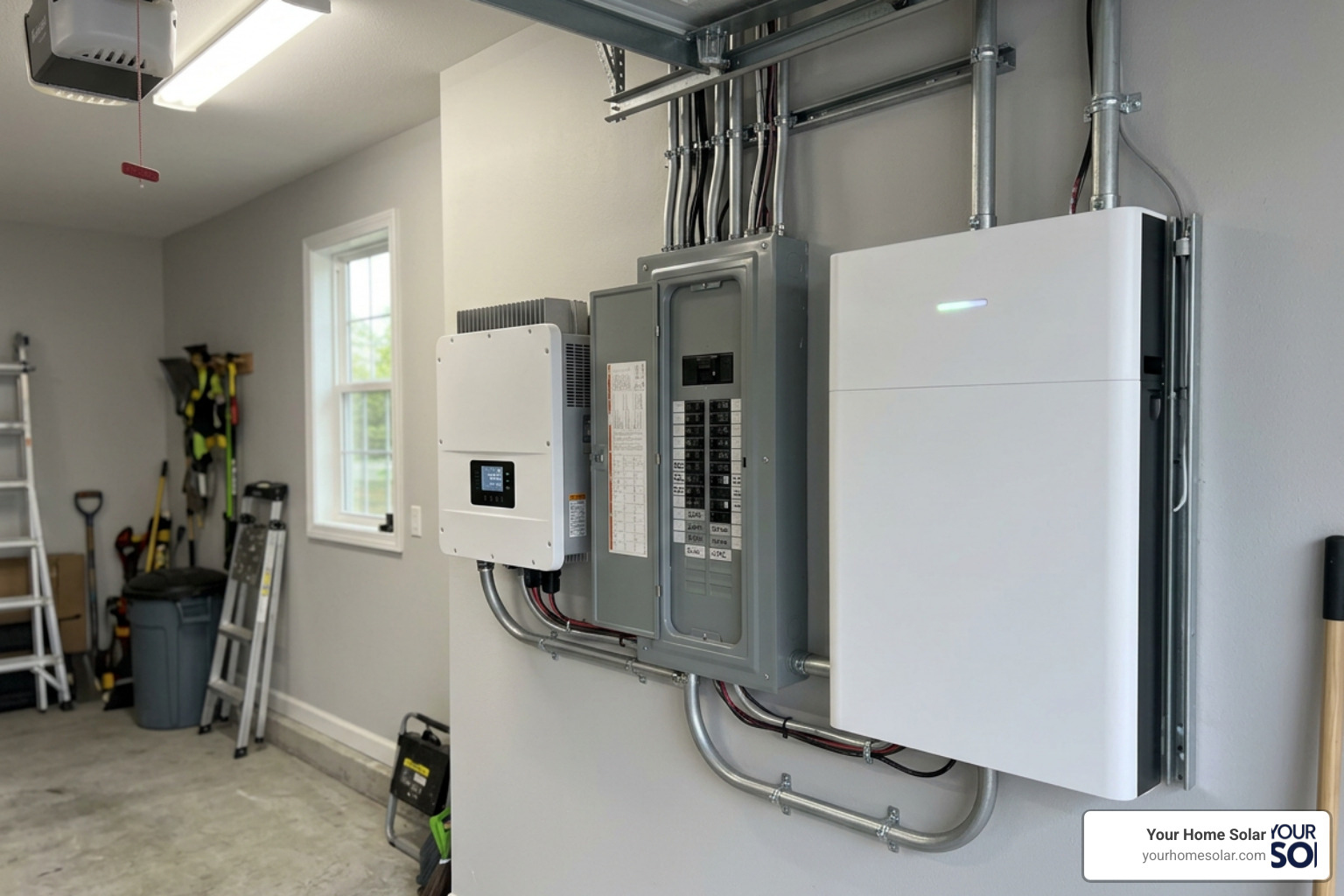
What Does a Backup Battery for a Residential Solar System Actually Cost?
The cost of backup battery for a residential solar system is one of the most common questions homeowners ask before going solar — and one of the most confusing to answer. Prices vary widely, and most quotes bundle together hardware, labor, permits, and electrical work into a single number that’s hard to decode.
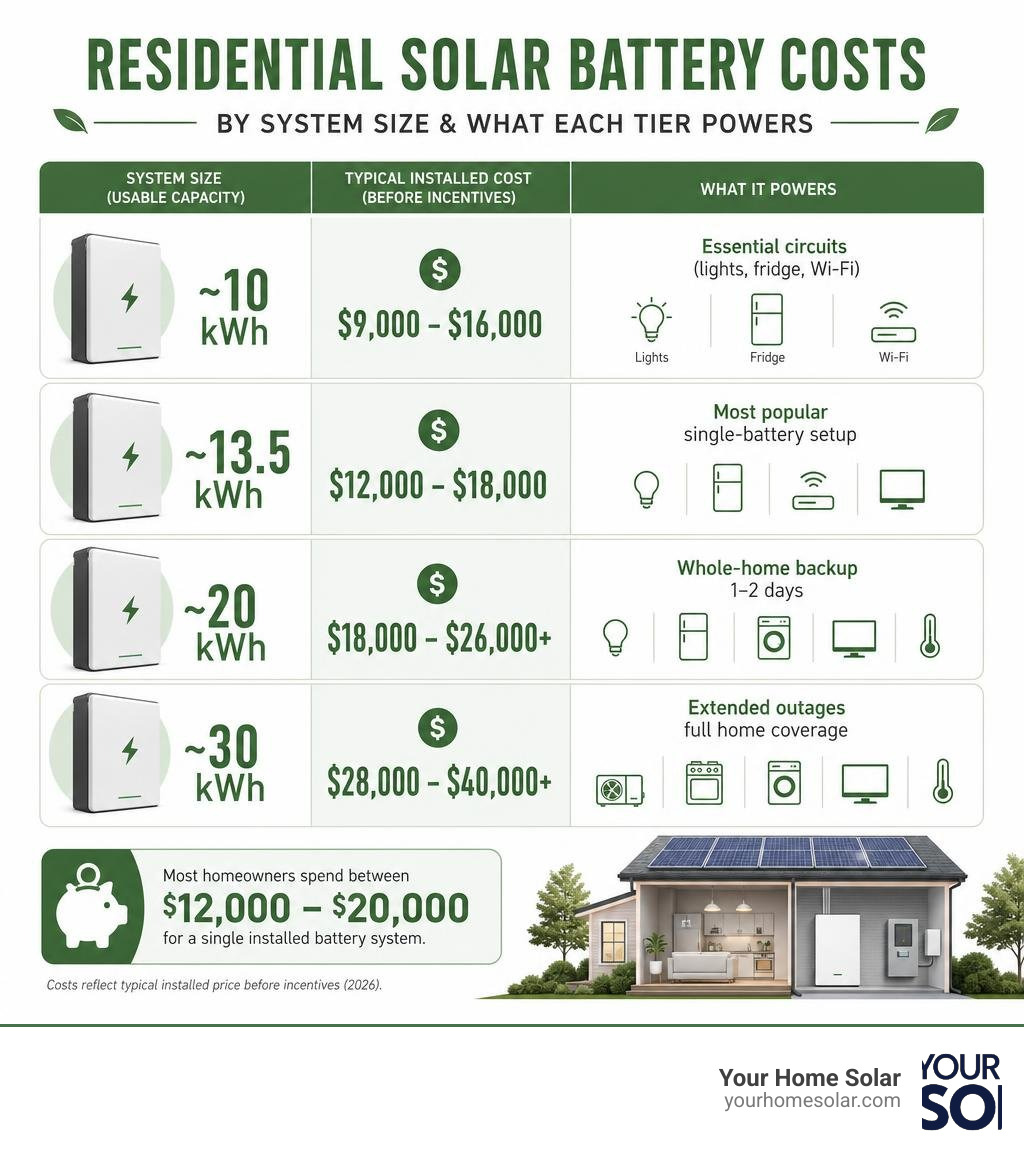
Here’s a quick snapshot of what most homeowners pay in 2026:
| System Size | Typical Installed Cost (Before Incentives) | Best For |
|---|---|---|
| ~10 kWh | $9,000 – $16,000 | Essential circuits (lights, fridge, Wi-Fi) |
| ~13.5 kWh | $12,000 – $18,000 | Most popular single-battery setup |
| ~20 kWh | $18,000 – $26,000+ | Whole-home backup, 1–2 days |
| ~30 kWh | $28,000 – $40,000+ | Extended outages, full home coverage |
The short answer: most homeowners spend between $12,000 and $20,000 for a single installed battery system, or roughly $1,000 to $1,600 per usable kilowatt-hour (kWh).
That’s a significant investment. And whether it’s worth it depends on your utility rates, how often the grid goes down in your area, and what incentives you can access.
In East Tennessee, those questions are very real. Storms knock out power. Utility rates are rising. And a lot of homeowners are wondering if adding battery storage to their solar system is the smart next move — or an expensive mistake.
I’m Ernie Bussell, founder and CEO of Your Home Solar, and after overseeing solar installations at scale and building East Tennessee’s most trusted solar company from the ground up, I’ve helped hundreds of homeowners think through the true cost of a backup battery for a residential solar system — and when it actually makes financial sense. In this guide, I’ll break down every cost component clearly so you can make a confident decision.
Simple cost of backup battery for a residential solar systems glossary:
The Real-World Cost of Backup Battery for a Residential Solar Systems in 2026
When evaluating the cost of backup battery for a residential solar systems, it is vital to distinguish between raw hardware costs and the actual, out-the-door installed cost. While you might see a battery module advertised online for $6,000, having that system safely integrated into your home’s electrical grid is a different story. In 2026, the typical installed cost for a residential solar battery backup system ranges from $11,500 to $18,000 for a single battery (typically 10 to 13.5 kWh of capacity).
If you are looking to scale up your storage to achieve true energy independence or back up a larger home in areas like Knoxville, Farragut, or Johnson City, those numbers adjust accordingly. A 20 kWh setup frequently exceeds $20,000 to $26,000, while a robust 30 kWh system can easily push past $30,000.
To help you visualize these differences, we have compiled a detailed breakdown of costs and real-world capabilities based on the latest data from the Solar Battery Storage System Cost 2026: Residential Prices guide:
| Usable Capacity (kWh) | Average Installed Cost Range (2026) | Backed-Up Load Scope | Outage Survival Time (Typical Loads) |
|---|---|---|---|
| 5 kWh | $6,000 – $10,000 | Critical essentials only (Wi-Fi, phone chargers, LED lights) | 6 to 12 hours |
| 10 kWh | $9,000 – $16,000 | Essential loads (Refrigerator, Wi-Fi, select lights, well pump) | 1 to 3 days (with active solar recharging) |
| 13.5 kWh | $12,000 – $18,000 | Standard home backup (Essentials + microwave + small medical devices) | 2 to 4 days (with solar) |
| 20 kWh | $18,000 – $26,000 | Partial-home backup (Essentials + some heating/cooling zones) | 3 to 5 days |
| 30 kWh | $28,000 – $40,000+ | Whole-home backup (Including central HVAC, water heater, laundry) | 5 to 10+ days (or near-indefinite with solar) |
Your cost per usable kWh installed typically sits between $1,000 and $1,600. However, the reason two neighbors in Knox County might receive wildly different quotes for the exact same battery brand comes down to installation complexity. A simple installation where the battery sits directly next to a modern 200A electrical panel in a spacious garage will cost significantly less than a project requiring trenching, subpanel installation, or a complete main service panel upgrade.
Breaking Down the Cost Components of Home Energy Storage
If you look at an itemized quote for a home energy storage system, you will quickly realize that the physical battery bank is only part of the equation. According to industry data, the battery hardware itself typically represents only 40% to 60% of the total invoice.
The remaining balance is distributed across several crucial system components:
- Battery Hardware ($5,500 – $11,000): The actual lithium-ion cells, integrated battery management system (BMS), and protective enclosure.
- The Inverter ($1,500 – $4,500): Batteries store direct current (DC) electricity, but your home runs on alternating current (AC). A specialized hybrid or battery-specific inverter is required to convert this power.
- Installation Labor ($1,000 – $3,000): High-voltage electrical work is not a DIY job. Certified professionals must mount the heavy battery enclosures, wire the inverter, and safely interface the system with your home’s main panel.
- Permitting, Engineering, and Interconnection ($300 – $2,000): Your local utility (such as KUB in Knoxville or BrightRidge in Washington County) and local municipal building departments require detailed single-line electrical drawings, structural reviews, permits, and a final inspection before granting Permission to Operate (PTO).
- Balance of System (BOS) Hardware ($500 – $1,500): This covers the physical conduits, wiring, disconnect switches, fuses, and smart monitoring gateways.
- Critical Loads Subpanel ($1,000 – $2,000): If you are not backing up your entire home, a separate subpanel must be installed. This physical panel houses only the breakers for the essential circuits you want to run during a blackout (like your kitchen outlets, well pump, and internet).
For a deeper look into selecting the right hardware components without overcomplicating things, read our Don’t Get Left in the Dark with a Guide to Battery Packs for Home Solar Systems resource.
How Chemistry and Coupling Affect the Cost of Backup Battery for a Residential Solar Systems
Under the hood of modern battery enclosures sit two primary lithium-ion chemistries: Lithium Iron Phosphate (LFP) and Nickel Manganese Cobalt (NMC).
LFP has rapidly become the gold standard for residential stationary storage. While LFP batteries can sometimes carry a slightly higher upfront equipment cost, they offer superior thermal stability (meaning they are incredibly safe) and can withstand 3,000 to 6,000 complete charge cycles before degrading to 80% capacity. NMC batteries are lighter and more energy-dense, making them popular for electric vehicles, but they typically offer a shorter cycle life (1,500 to 3,000 cycles) and carry a slightly higher risk of thermal runaway if damaged. Over the lifetime of the system, LFP almost always delivers a lower total cost of ownership.
Additionally, how your battery connects to your solar panels plays a massive role in system cost:
- AC-Coupled Systems: In this setup, the solar panels and the battery storage system have their own separate inverters. The electricity travels from the panels as DC, is converted to AC by the solar inverter, and is then converted back to DC by a battery inverter to be stored. While this double conversion introduces a minor efficiency loss (roughly 2% to 5%), AC coupling is highly flexible and remains the cheapest, easiest option for retrofitting an existing solar system.
- DC-Coupled Systems: Here, both the solar panels and the battery share a single, highly efficient “hybrid” inverter. The DC electricity generated by your panels feeds directly into the battery without any conversion steps. This is highly efficient and typically saves $500 to $1,500 in hardware costs when installing solar and storage together from day one.
To explore how these chemistries and configurations perform in real-world environments, you can check out our guide on Everything You Need to Know About Residential Solar Battery Types Whats Best.
Retrofitting an Existing Array vs. Installing Solar and Storage Together
If you already have solar panels installed on your East Tennessee roof and want to add a battery in 2026, you should prepare for some unique integration costs. Retrofitting is almost always more expensive than installing solar and storage at the same time.
When we install a “solar-plus-storage” system from scratch, we can use a single hybrid inverter, pull permits simultaneously, and do all the heavy electrical wiring in a single day. This saves hundreds in labor and administrative fees.
When retrofitting, we often have to install a separate AC-coupled battery system with its own inverter, which adds to the hardware bill. Furthermore, older solar installations may require a main electrical panel upgrade or a major rewiring of the existing inverter setup to allow the battery to safely isolate your home from the grid during an outage. If your existing system uses microinverters, a specialized retrofitting kit or critical loads panel will be required to manage the power flow.
For a complete breakdown of how retrofits compare to new systems, take a look at our In-Depth Guide to Solar Battery Backup Comparison.
Incentives, Utility Rates, and the Financial ROI of Solar Batteries
Understanding the economics of the cost of backup battery for a residential solar systems requires looking beyond the price tag to see how a battery interacts with your utility bill.
Historically, the return on investment (ROI) for home batteries was driven heavily by federal tax credits. However, 2026 has brought a massive shift to the regulatory landscape that every homeowner must understand before signing a contract.
According to the comprehensive market analysis at Solar Battery Cost: Are They Actually Worth It In 2026? – EnergySage, the financial return of a solar battery depends heavily on your local utility rate structure. If your utility offers “1-to-1 net metering”—meaning they buy your excess solar power at the exact same retail rate they charge you to buy it back—a battery will not save you much extra money on your monthly bill. In those areas, a battery is purely an investment in emergency backup power and peace of mind.
However, in areas with Time-of-Use (TOU) rates or Net Billing Tariffs (where the utility charges high rates during peak evening hours and pays very little for solar electricity exported to the grid), a battery becomes a powerful financial tool. By storing your excess daytime solar power and consuming it during expensive peak hours (a practice called “peak shaving” or “arbitrage”), a battery can shave thousands of dollars off your long-term energy bills.
Navigating the 2026 Incentive Landscape and Tax Credits
The landscape for solar and battery incentives has shifted dramatically. The most critical change for 2026 is that the popular Section 25D Federal Residential Clean Energy Credit (the 30% tax credit) expired on December 31, 2025.
This means that for direct cash or loan purchases of residential battery systems completed in 2026, the traditional 30% homeowner tax credit is no longer available. This change has caught many homeowners by surprise, sometimes costing them over $5,000 in expected savings simply because their installation was completed after the deadline.
Fortunately, there are still pathways to offset these upfront costs:
- Leasing and Power Purchase Agreements (PPAs): If you choose to lease your solar battery or enter into a PPA rather than buying it outright, the system developer can often still claim the Section 48E Commercial Clean Electricity Investment Tax Credit. These savings are typically passed down to you in the form of lower, predictable monthly payments.
- Utility-Sponsored Virtual Power Plants (VPPs): Many forward-thinking utilities offer programs where they pay homeowners to occasionally draw small amounts of stored power from their home batteries during extreme grid stress. These programs can pay out hundreds of dollars annually, acting as a recurring rebate that speeds up your payback period.
- Local and Regional Programs: While Tennessee does not currently have a statewide battery rebate program comparable to California’s SGIP, local cooperative utilities occasionally offer smart-energy rebates or solar-friendly rate structures. It is always wise to consult with a local expert who keeps a pulse on local utility rules in East Tennessee.
Calculating the Payback Period and Lifetime Cost of Backup Battery for a Residential Solar Systems
To find out if a battery makes financial sense, we have to look at the math. The simple payback period of a solar battery is calculated using this formula:
$$\text{Payback Period (Years)} = \frac{\text{Net Installed Cost} – \text{Upfront Rebates}}{\text{Annual Utility Savings} + \text{Annual VPP Revenues}}$$
Without any federal incentives, a battery backup system installed purely for utility bill savings in a flat-rate market can have a simple payback period of 20 to 35 years. Because this often exceeds the typical 10-to-15-year warranty period of the battery, we tell our customers honestly: if your only goal is to save money on a standard, flat-rate electric bill, a battery is not a purely financial investment.
However, if you live in an area with a steep TOU rate spread (for example, paying \$0.15/kWh off-peak but \$0.45/kWh during peak summer evenings) and you participate in a grid-sharing VPP program, your payback period can drop to 8 to 13 years.
Beyond pure numbers, you must also factor in the “resilience value.” What is it worth to you to keep your home comfortable, your food fresh, your well water pumping, and your home office running during a multi-day storm outage? For many families, avoiding just one major outage easily justifies the cost.
To dive deeper into the true financial value of energy security, check out our guide on The Real Price of Never Losing Power Again.
Is a Solar Battery Worth the Investment for Your Home?
Determining whether a home battery is worth the investment comes down to your personal energy goals, your geographic location, and your home’s infrastructure.
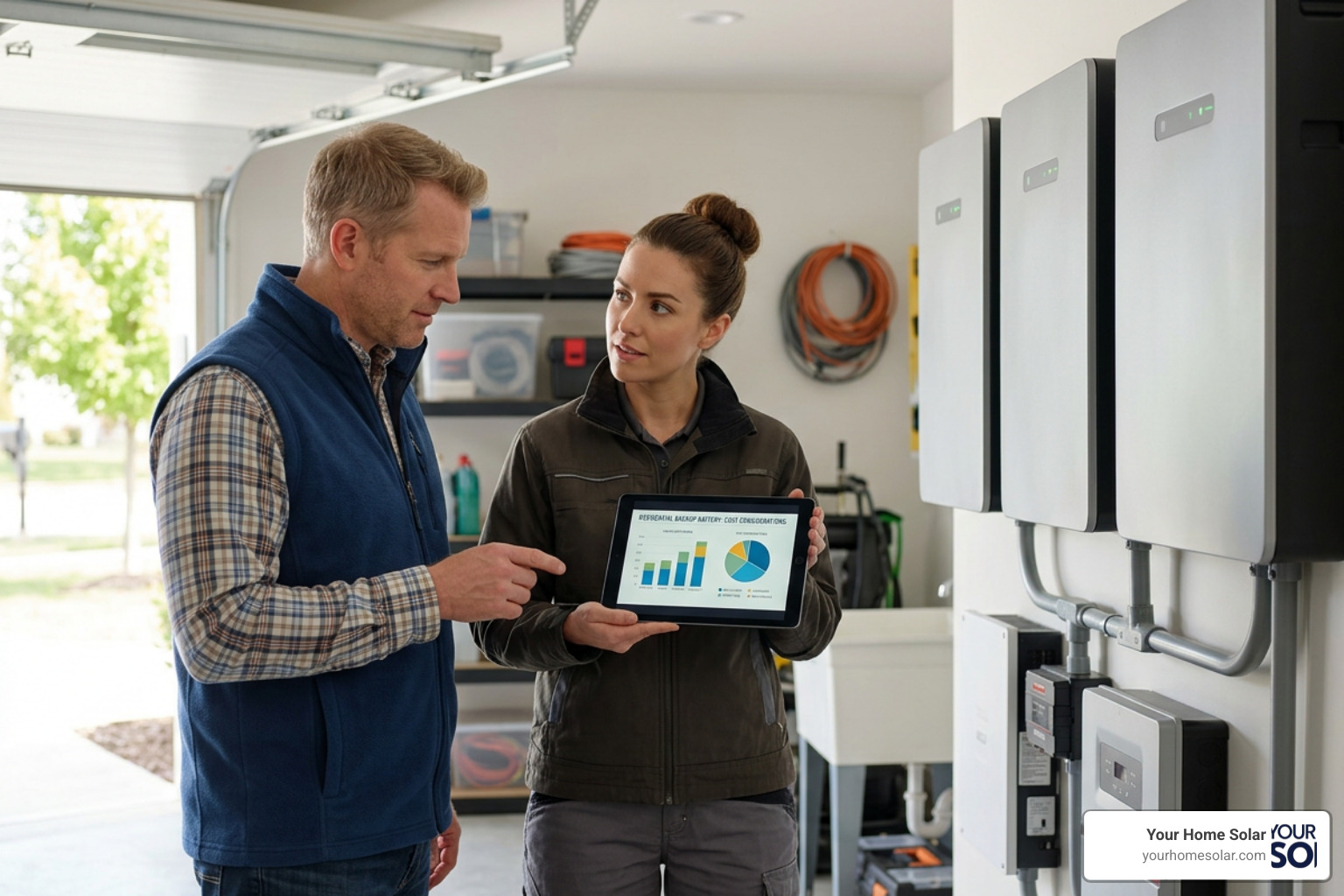
A solar battery is highly likely to be worth the cost if:
- You experience frequent grid outages: If winter storms, summer TVA grid strain, or falling trees frequently leave your East Tennessee home in the dark, a battery provides clean, silent, and instantaneous backup power.
- You have critical medical equipment or work from home: If a loss of power represents a threat to your health or your livelihood, a battery backup is invaluable.
- You are on a Time-of-Use or Net Billing rate structure: If your utility penalizes you for using power during peak evening hours, a battery allows you to bypass those high rates entirely.
- You want true energy independence: If your goal is to minimize your reliance on the traditional utility grid and maximize your usage of clean, self-generated solar energy.
Conversely, a battery may not be the best investment right now if:
- Your primary goal is purely financial ROI: In areas with flat utility rates and reliable grids, a standby generator is often a cheaper upfront alternative for emergency-only power.
- Your utility offers 1-to-1 net metering: If you can use the grid as a free, infinite “virtual battery” with full retail credits, a physical battery won’t add much to your monthly bill savings.
For a detailed analysis comparing battery systems to traditional backup generators, read our educational guide Beyond the Grid: How Solar Battery Banks Keep Your Lights On.
Frequently Asked Questions About Solar Battery Costs
Evaluating the cost of backup battery for a residential solar systems can feel overwhelming, so we have compiled quick, direct answers to the most common questions homeowners ask us.
How many batteries do I need to power my whole house?
To back up an entire modern home—including heavy-draw appliances like central air conditioning, electric clothes dryers, and water heaters—you will typically need 20 to 30 kWh of storage capacity (usually two to three standard batteries stacked together).
However, if you focus on an “essentials-only” backup plan, a single 10 to 13.5 kWh battery is more than enough. By installing a critical loads subpanel, you can isolate and power your most important appliances. Here is a list of the essential loads you should prioritize backing up first:
- Your Refrigerator and Freezer: To prevent hundreds of dollars in food spoilage.
- Your Well Pump: Crucial for homes in rural East Tennessee that rely on well water.
- Wi-Fi Router and Modem: To maintain communication and remote work capabilities.
- Select Lighting Circuits: Typically kitchen, living room, and bathroom LED lights.
- Charging Outlets: For phones, laptops, and essential medical devices (like CPAP machines).
- Heating System Fan/Pump: To run gas or oil furnace blowers during cold winter snaps.
How long do residential solar batteries last before needing replacement?
Most modern lithium-ion solar batteries (specifically LFP chemistry) have a physical lifespan of 10 to 15 years, though high-quality systems that are properly maintained can easily last up to 20 years.
Most manufacturers back their products with a 10-year warranty that guarantees the battery will still retain at least 70% of its original capacity at the end of the decade. Gradual capacity degradation is normal; just like your smartphone, a home battery will hold slightly less charge as the years go on, but it will continue to function safely and reliably.
Can I install a backup battery without having solar panels?
Yes, you can absolutely install a standalone battery backup system without solar panels. These are called standalone storage systems.
A standalone battery charges directly from the utility grid when power is cheap and available, and then stands ready to power your home during a blackout. In areas with Time-of-Use rates, you can also use a standalone battery for arbitrage—charging it overnight when electricity rates are lowest and discharging it to power your home during expensive peak afternoon hours.
Conclusion
Investing in a home energy storage system is a powerful way to secure your home’s energy future, protect your family from unpredictable grid outages, and gain true independence from rising utility rates. While the cost of backup battery for a residential solar systems represents a significant upfront investment in 2026, understanding the component costs, chemistry types, and your local utility rules will help you design a system that fits both your budget and your lifestyle.
At Your Home Solar, we specialize in delivering tailored, high-quality energy solutions across East Tennessee—from Knoxville and Oak Ridge to Johnson City and Kingsport. We believe in providing honest, transparent advice, trusted local expertise, and a commitment to 100% customer satisfaction.
If you are ready to explore how a battery backup system can bring security and savings to your home, check out our comprehensive Residential Solar Solutions Guide: The Ultimate Guide to Solar Batteries and Energy Storage Solutions or reach out to our local team today for a personalized, hassle-free evaluation.