
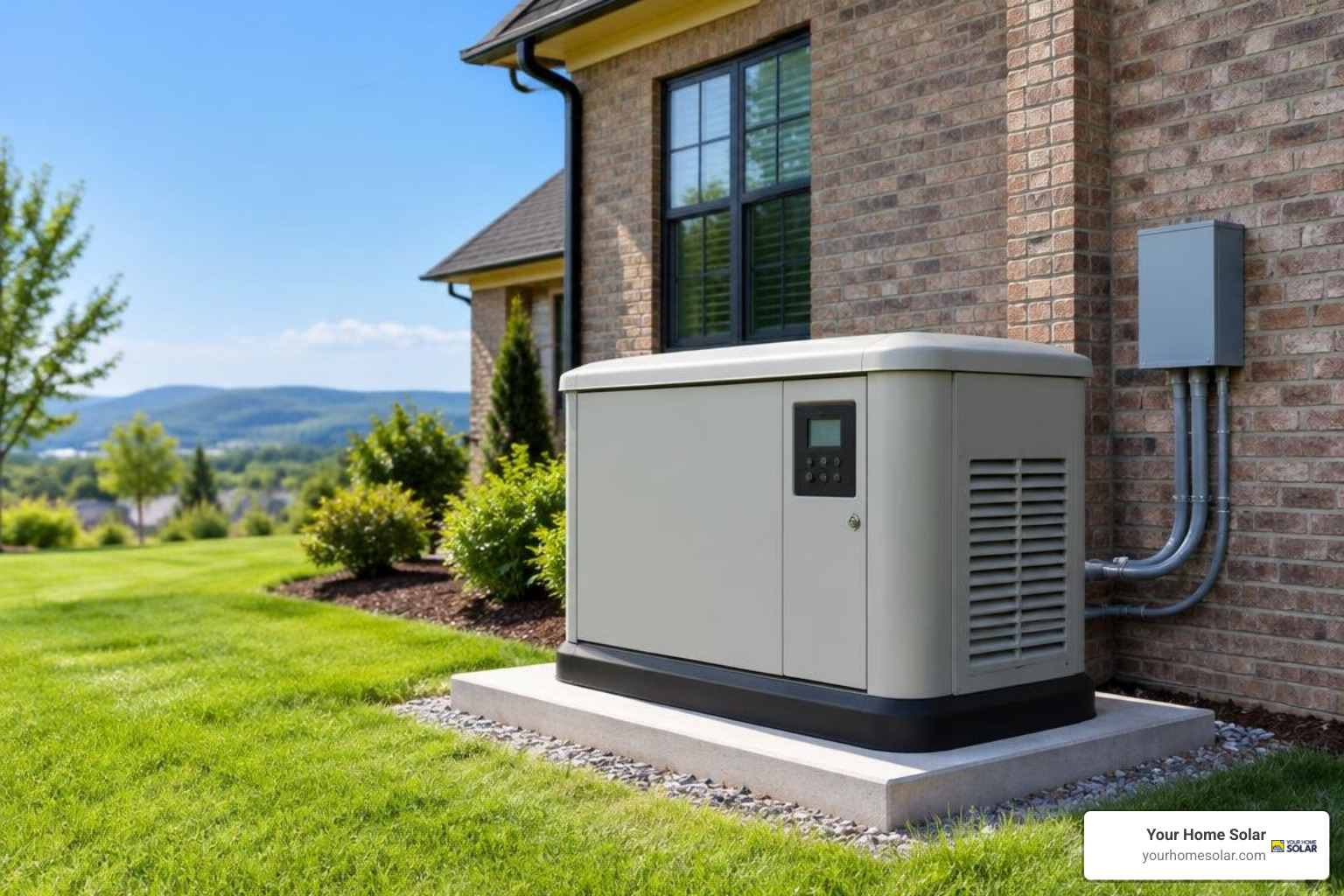
Backup Generator Installation in Knox County: Where to Start
Start with a licensed installer who can assess your electrical panel, the appliances you need to keep running, and your available fuel supply. Ask for a written quote that covers the generator, transfer switch, site work, permits, and inspection. In Knoxville, a whole-house installation may cost $5,000 to $25,000 and often takes two to three weeks, including permit and utility coordination. Your price and schedule will depend on your home.
A well-planned system can keep essentials powered during an outage without putting your household at risk. The key is choosing the right size and having the electrical and fuel connections installed correctly.
I’m Ernie Bussell, founder of Your Home Solar, and I wrote this guide to backup generator installation Knox County homeowners can use when hiring a pro. My background in solar operations and home energy systems shapes the practical questions we’ll cover next.
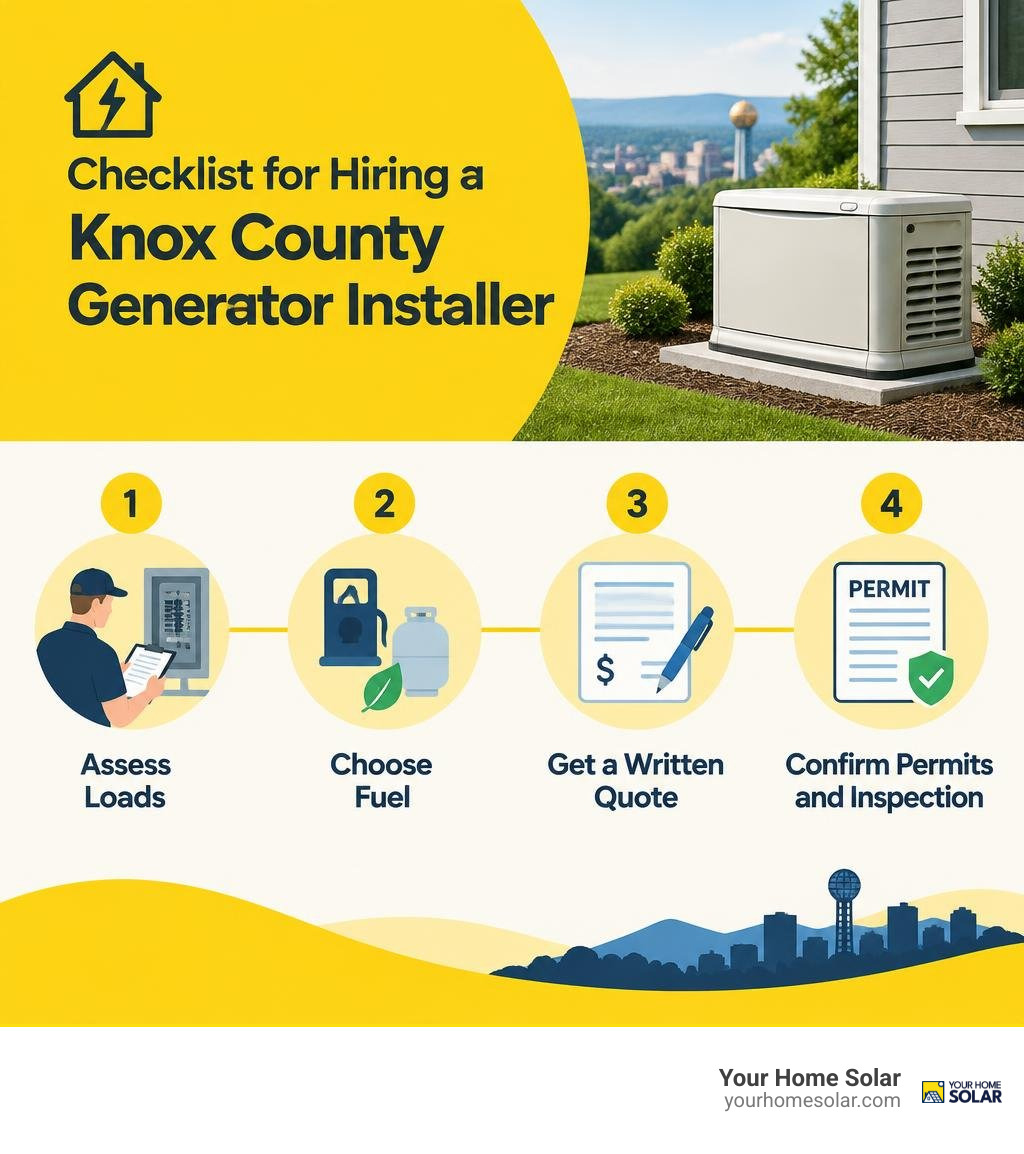
Handy backup generator installation knox county terms:
Why Backup Generator Installation in Knox County Is Essential for Homeowners
Living in East Tennessee means enjoying the rolling hills of the Ridge-and-Valley Appalachians, vibrant fall colors, and easy access to the Great Smoky Mountains. However, our regional landscape also creates significant vulnerabilities for the local electrical grid. Severe thunderstorms, winter ice storms, high ridge winds, and heavy tree canopies frequently knock out overhead power distribution lines across Knoxville, Farragut, Powell, and surrounding areas.
When the grid drops offline, life grinds to a halt. Sump pumps stop running, refrigerators warm up, medical devices lose primary power, and temperature control vanishes during blistering summers or sub-freezing winter nights. Professional storm preparedness for Tennessee residents is not just about stashing bottled water and batteries in a closet; it is about establishing true electrical resilience. A permanently installed standby generator detects a utility outage instantly, starts up automatically, and transfers your home’s electrical circuits within ten seconds. This ensures continuous, seamless power without you ever needing to step outside in pouring rain to pull a starter cord.
Outage Trends and Climate Risks in East Tennessee
Knox County homes and businesses face distinct seasonal weather patterns that put intense pressure on electrical infrastructure. In early spring, rapid frontal movements bring severe convective thunderstorms and microbursts that drop heavy oak and pine limbs across primary feeder lines. In the winter months, freezing rain coats power lines with thousands of pounds of ice, triggering widespread equipment failures that take days for utility crews to reach and repair.
These weather events translate into real, disruptive downtime for area residents. Looking at historical reliability patterns, widespread regional storms can cause hundreds of thousands of customer-hours of interrupted service in a single month, leaving tens of thousands of families without light, heat, or refrigeration simultaneously. Relying solely on utility restoration schedules leaves households vulnerable to food spoilage, frozen plumbing pipes, and security system failures. Learning about staying powered during grid blackouts helps homeowners understand why waiting for the utility truck is often a costly gamble.
What Public Infrastructure Teaches Us About Power Reliability
If you want to understand how critical continuous electrical power is in East Tennessee, look at how our local municipal utilities manage their own vital infrastructure. Critical operations never leave power continuity to chance. A prime example is the KUB booster pump station backup power project, where the Knoxville Utilities Board engineered and solicited robust standby systems at key facilities like the Mockingbird and Sherrod stations.
These municipal installations mandate strict engineering standards:
- Robust reinforced concrete mounting pads engineered for soil stability and vibration damping.
- Heavy-duty underground service lateral conduit runs to protect feeder wiring from weather and physical damage.
- Direct integration with automatic transfer switches (ATS) and supervisory control and data acquisition (SCADA) systems for remote monitoring and instantaneous failover.
When local utilities invest heavily in automatic standby power to keep municipal water flowing during regional blackouts, it sends a clear message: automated, code-compliant backup power systems are the gold standard for maintaining continuity against unforeseen grid disruptions.
Choosing the Right Backup Power System for Your Knoxville Home
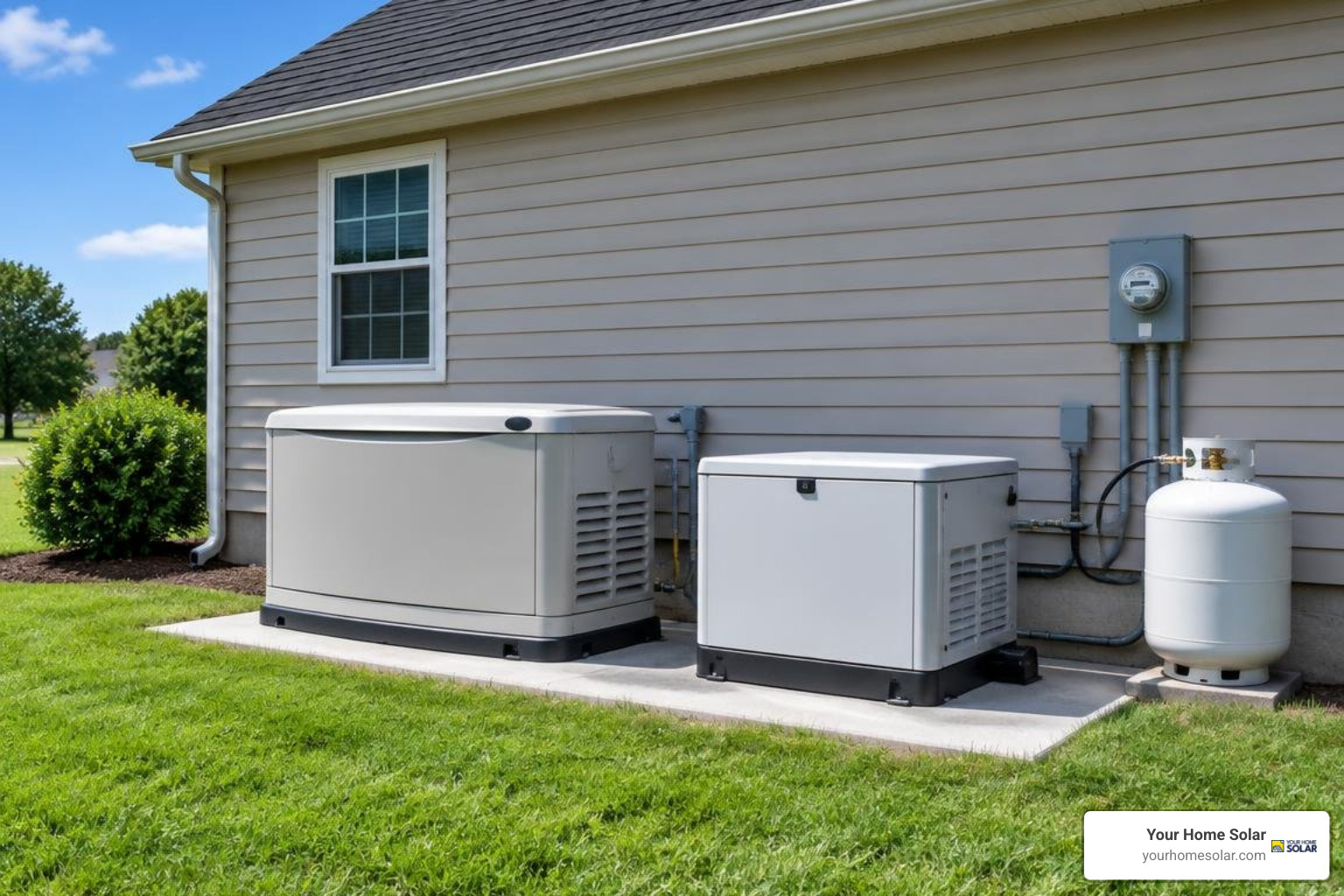
Selecting an auxiliary power solution requires balancing fuel availability, electrical demands, and operational convenience. Before purchasing equipment, review our ultimate guide to home backup power choices to match your property’s layout with the right system architecture.
Standby vs. Portable Generator Systems
Homeowners often ask whether they should invest in a permanently installed automatic standby generator or rely on a heavy-duty portable generator stored in the garage. While portable units cost less upfront, their operational limitations become obvious during an extended Tennessee blackout.
| Feature / Consideration | Whole-Home Standby Generator | Heavy-Duty Portable Generator |
|---|---|---|
| Start Mechanism | Automatic via ATS (within 10 seconds) | Manual recoil pull or push-button start |
| Fuel Source | Utility natural gas or on-site liquid propane (LP) | Stored gasoline or portable propane tanks |
| Fuel Delivery | Continuous, plumbed pipe connection | Manual refueling every 4 to 8 hours |
| Weather Operation | Weatherproof, sound-attenuated outdoor enclosure | Must run outside in rain/snow with a canopy |
| Electrical Transfer | Automatic 100A to 200A transfer switch | Manual transfer switch or interlock kit |
| HVAC & Large Loads | Runs central heat pumps, central AC, ovens, water heaters | Limited to select 120V circuits and small 240V loads |
| Carbon Monoxide Safety | Permanently sited 5+ feet away from windows/doors | High risk if placed too close to garage/eaves |
| Home Resale Value | Increases appraisal value and market appeal | Negligible impact on property value |
While portable generators can keep a refrigerator and a few lamps illuminated via extension cords, they cannot automatically protect your property while you are away at work or out of town. An automatic standby generator provides total peace of mind regardless of where you are when a storm strikes.
Sizing Your Generator for Critical vs. Whole-House Loads
Sizing a generator correctly is the most critical step in the engineering process. Sizing errors lead to two major issues: undersized units stall under heavy appliance startup surges, while oversized units waste fuel and can suffer from engine “wet stacking” due to light electrical loading.
When calculating electrical capacity, our licensed technicians evaluate both running wattage (the continuous power an appliance consumes while operating) and starting wattage (the momentary surge required to start electric motors, compressors, and pumps).
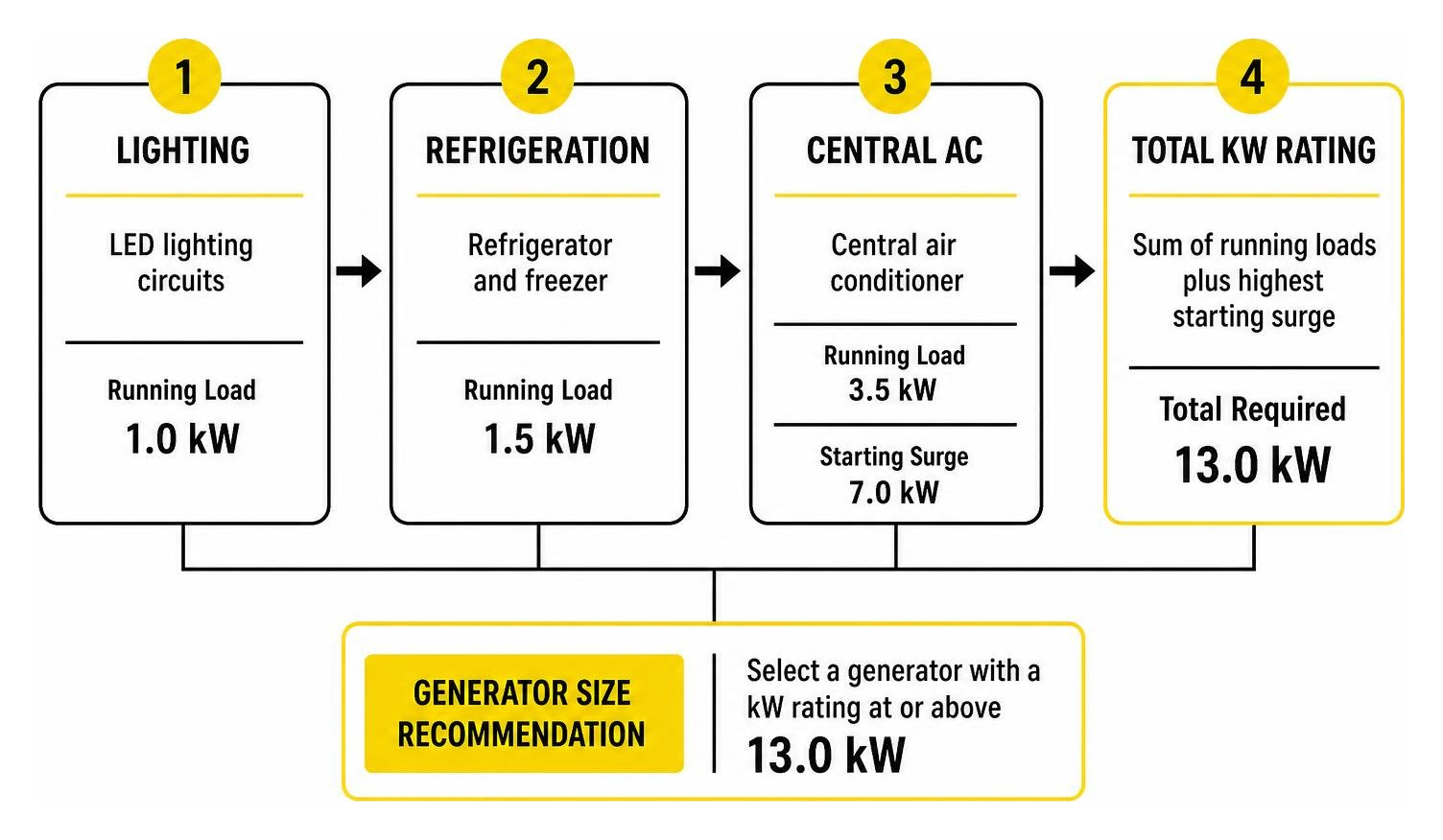
When reviewing reliable home generator options for blackouts, consider how these typical capacity ranges match standard home profiles:
- Essential Circuit Coverage (10 kW – 14 kW): Powers your refrigerator, freezer, internet router, security system, gas furnace blower, LED lighting circuits, and several general-use convenience outlets.
- Standard Whole-Home Coverage (18 kW – 22 kW): Supports all essential loads plus a 3-ton to 4-ton central air conditioner or heat pump, electric water heater, well pump, and kitchen appliances.
- Large Estate & High-Demand Coverage (24 kW – 26 kW+): Fully backs up 3,000+ square foot homes with dual HVAC units, electric vehicle chargers, pool pumps, and comprehensive 200-amp or 400-amp service panels without requiring load shedding.
Planning Costs, Permitting, and the Installation Process
A professional installation involves careful coordination between site preparation, gas utility plumbing, electrical service upgrades, and local municipal inspections. Working with our team for expert generator installation in Knoxville ensures every phase adheres strictly to the National Electrical Code (NEC), National Fire Protection Association (NFPA) standards, and local city or county building regulations.
Estimating the Cost of Backup Generator Installation in Knox County
A whole-house standby generator installation in Knox County typically ranges from $5,000 to $25,000, with the majority of suburban homes averaging around $12,000 to $15,000 for a turn-key natural gas system. The overall budget depends on several primary factors:
- Generator Capacity and Brand: Air-cooled units (10 kW to 26 kW) represent the most cost-effective option for residential properties, while larger liquid-cooled units (25 kW to 60 kW+) for commercial properties or large estates carry higher equipment price tags.
- Electrical Infrastructure: Homes requiring an upgraded 200-amp service panel or complex subpanel wiring will have higher labor and materials costs than homes with modern, easily accessible panels.
- Fuel Line Distance: Plumbed connections to a nearby KUB natural gas meter or an existing liquid propane tank keep costs down. Extending high-capacity gas piping over long distances, trenching through East Tennessee clay and rock, or installing dedicated underground LP tanks will increase the project budget.
Homeowners can explore our detailed breakdowns on understanding generator installation costs and the true cost of whole-home backup power to plan their investments effectively.
Step-by-Step Timeline for Backup Generator Installation in Knox County
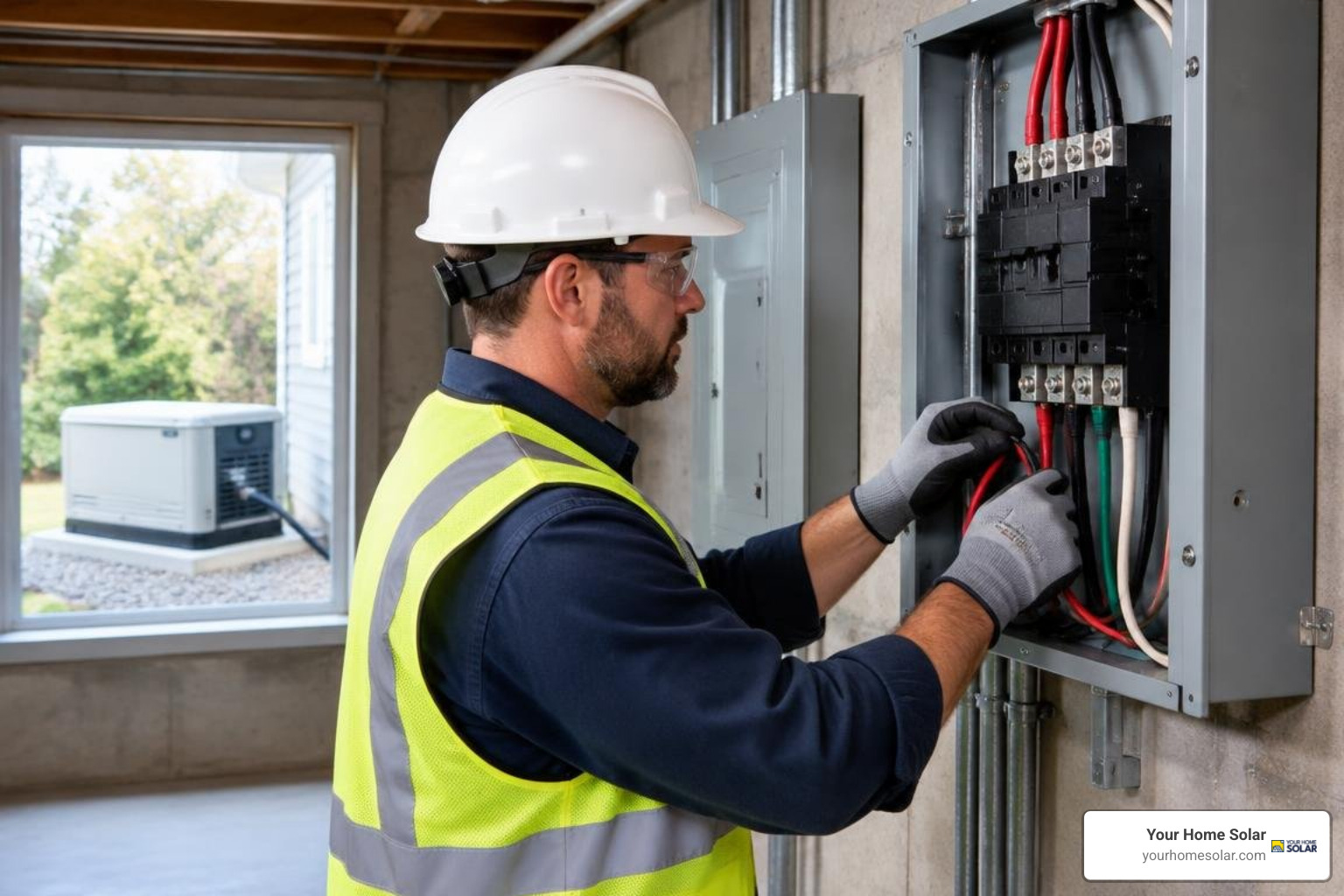
A standard standby generator project in Knox County typically takes two to three weeks from initial site evaluation to final operational sign-off. The physical installation work at your property is usually completed in just one to two days.
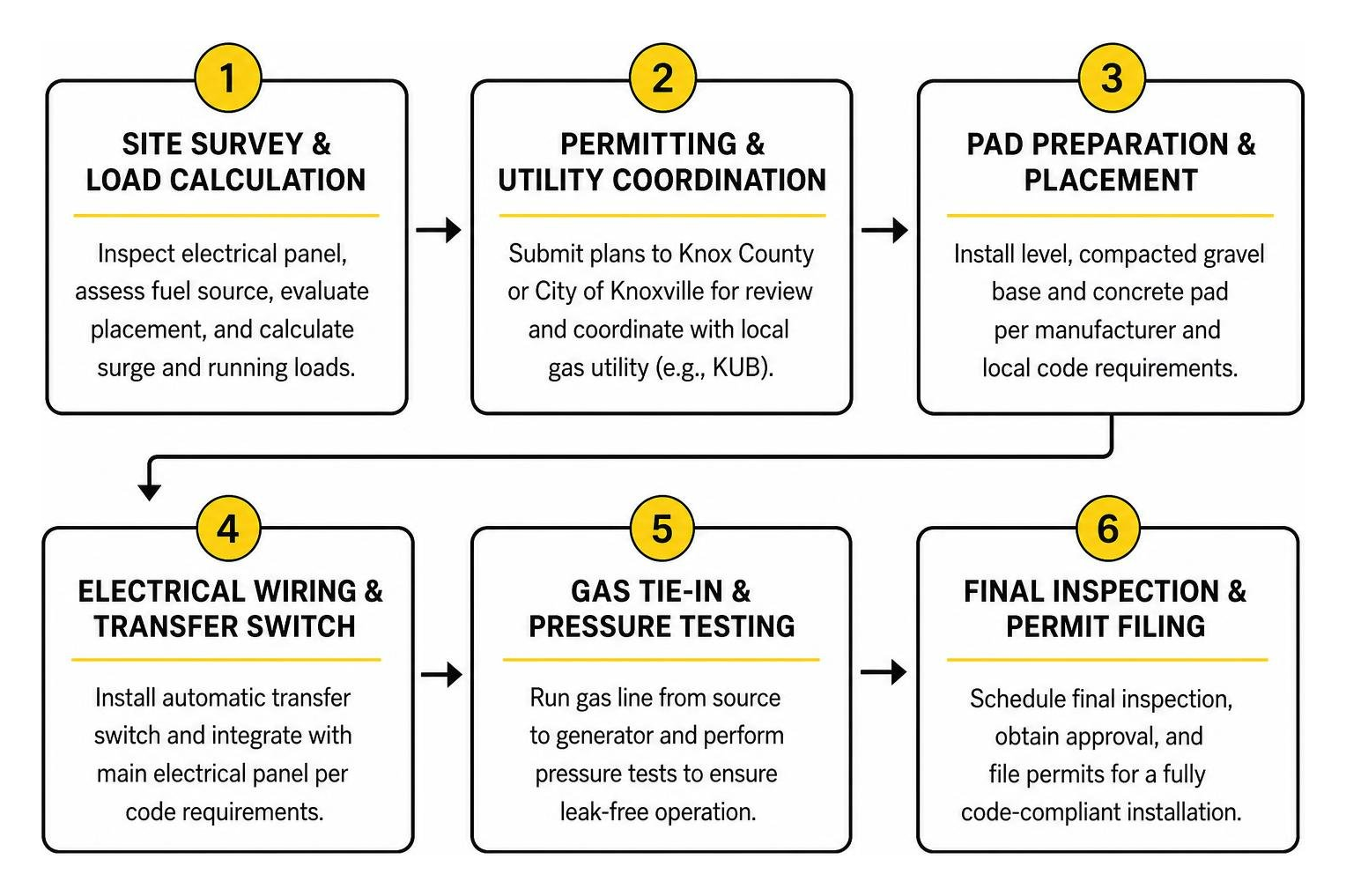
- In-Home Site Survey & Load Calculation: We inspect your main electrical panel, assess fuel meter capacity or LP tank sizing, evaluate outdoor placement clearances, and calculate exact surge and running loads.
- Permitting & Utility Coordination: We submit detailed mechanical and electrical plans to the Knox County Building Department or the City of Knoxville Plans Review & Inspections Department. We coordinate with local gas utilities (such as KUB) to verify meter pressure flow rates.
- Pad Preparation & Physical Placement: A level, compacted gravel base and pre-cast concrete equipment pad are placed according to manufacturer clearance specifications and local drainage codes.
- Electrical Transfer Switch Integration: Our licensed electricians mount the automatic transfer switch adjacent to your main distribution panel. For an inside look at this process, check out our 200-amp transfer switch installation guide and our breakdown on connecting a backup generator to your electrical panel.
- Fuel Plumbing & Pressure Testing: Certified gas technicians run rigid iron or coated flexible gas piping from the fuel source to the generator’s internal regulator, conducting thorough pressure tests to guarantee leak-free operation.
- Commissioning & Simulated Grid Failure: We power on the system, program the digital controller’s automatic weekly exercise cycle, and simulate a full utility power outage to confirm rapid ATS transfer, correct voltage output, and stable engine governing.
- Municipal Inspection & Final Approval: The local electrical inspector reviews all grounding, wire sizing, safety disconnects, and physical clearances, issuing the final certificate of completion.
Critical Maintenance and Common Installation Pitfalls to Avoid
Installing a standby generator is a long-term investment in your home’s security. Keeping it ready for unpredictable storms requires understanding seasonal maintenance needs and avoiding common installation errors. Pairing your system with smart power outage solutions and reviewing our essential guide to emergency home power helps keep your auxiliary electrical system in top operating condition.
Seasonal Generator Maintenance in East Tennessee
East Tennessee experiences hot, humid summers, heavy spring pollen, and damp winter freezes. Establishing a seasonal maintenance routine protects internal mechanical and electrical components from corrosion, moisture buildup, and thermal stress.
Keep these essential maintenance supplies and tools on hand:
- Digital multimeter (to verify output voltage and frequency at 60 Hz).
- Socket wrench set and spark plug gap gauge.
- High-grade synthetic motor oil (such as 5W-30 full synthetic for optimal cold-weather starting and high-temperature protection).
- OEM oil filters, heavy-duty air filter elements, and spare spark plugs.
- Non-conductive electrical contact cleaner and rust-preventative corrosion inhibitor spray.
- Spare automotive-style control panel fuses (typically 7.5A and 15A).
- Battery terminal cleaner and digital 12V battery load tester.
Seasonal Maintenance Checklist:
- Spring: Clear heavy tree pollen from intake louvers, check battery charging voltage, and inspect engine enclosures for rodent or insect nests.
- Summer: Verify engine cooling airflow clearances, check oil levels during extended runs, and inspect exterior painted surfaces for heat fatigue.
- Fall: Clear fallen leaves and organic debris from around the perimeter base, test transfer switch operation, and confirm all weather seals remain tight.
- Winter: Inspect the internal cold-start block heater or battery warmer, clear snow and ice buildup from intake and exhaust vents, and perform a monthly manual test run under electrical load.
Costly Generator Installation Mistakes Homeowners Make
Improper generator installation creates severe fire hazards, carbon monoxide risks, and premature equipment failure. Some of the most common pitfalls include:
- Undersized Fuel Lines: Modern standby generators require substantial fuel volume (measured in cubic feet per hour or British thermal units per hour) to handle heavy appliance startup surges. Using undersized piping starves the engine, causing voltage drops and automatic shutdowns during peak demands.
- Violating Exhaust Clearances: NFPA 37 and local building codes require generators to be located at least 5 feet away from operable windows, doors, dryer vents, and vinyl siding. Exhaust gases can enter living spaces or melt siding if placed incorrectly.
- Improper Grounding and Bonding: Failing to install dedicated grounding rods or miswiring the neutral-to-ground bond inside the automatic transfer switch creates dangerous ground loops and shock hazards.
- Unpermitted and Uninspected Work: Skipping county or city permits can void manufacturer warranties, violate homeowner insurance policies, and create hidden code violations that complicate future property sales.
- Neglecting Electrical Backfeed Protections: Attempting to connect a generator directly into a home’s distribution panel without a mechanically interlocked switch or certified transfer switch can backfeed high-voltage power onto the utility grid, endangering line workers repairing neighborhood storm damage.
Frequently Asked Questions About Knox County Generator Setups
How long does a whole-house generator installation take from start to finish?
The complete process generally takes two to three weeks. This window accounts for site engineering, equipment delivery, submitting permit applications to Knox County or City of Knoxville code offices, and scheduling utility meter checks with KUB or your local utility provider. The physical installation on your property—including setting the mounting pad, running fuel piping, and wiring the automatic transfer switch—is usually completed within one to two business days.
What permits and clearances are required for a standby generator in Knoxville?
Permit requirements include both an electrical permit and a mechanical/fuel piping permit issued by the municipal inspection authority. From a clearance perspective, the generator must sit at least 5 feet away from all operable building openings (such as windows and doors), at least 3 to 5 feet from exterior walls (depending on manufacturer fire ratings and NFPA 37 guidelines), and provide at least 3 feet of clear workspace around all access panels for maintenance technicians.
Can a backup generator run my entire home including central AC?
Yes, provided the system is sized correctly for your electrical loads. A 20 kW to 26 kW standby generator can easily run a modern central heat pump or air conditioning unit alongside high-draw appliances like water heaters, well pumps, and refrigeration. If you choose a mid-sized unit (14 kW to 18 kW), we install smart load-management modules within the transfer switch. These modules automatically cycle non-essential, heavy electrical loads when your central air compressor starts up, preventing engine stall while keeping your entire household comfortable.
Conclusion
Severe weather and unexpected power outages do not have to disrupt your family’s routine, spoil your food, or leave you sitting in the cold. A professionally installed automatic standby generator provides continuous, reliable power protection tailored to your home’s exact electrical profile.
At Your Home Solar, we take pride in delivering comprehensive, code-compliant home energy systems across Knoxville, Farragut, Powell, and East Tennessee. From precise load calculations and seamless gas tie-ins to clean transfer switch wiring and complete municipal permitting, our certified professionals handle every detail. Schedule a backup generator consultation in Knoxville with our team today, or visit our Knoxville home energy solutions hub to explore how we can help keep your home powered and protected through every season.