Is Building Your Own Solar System Worth It?
A solar power system DIY project can cut your installation costs nearly in half — but only if you go in with the right information.
Here’s the short answer on how to build a basic DIY solar system:
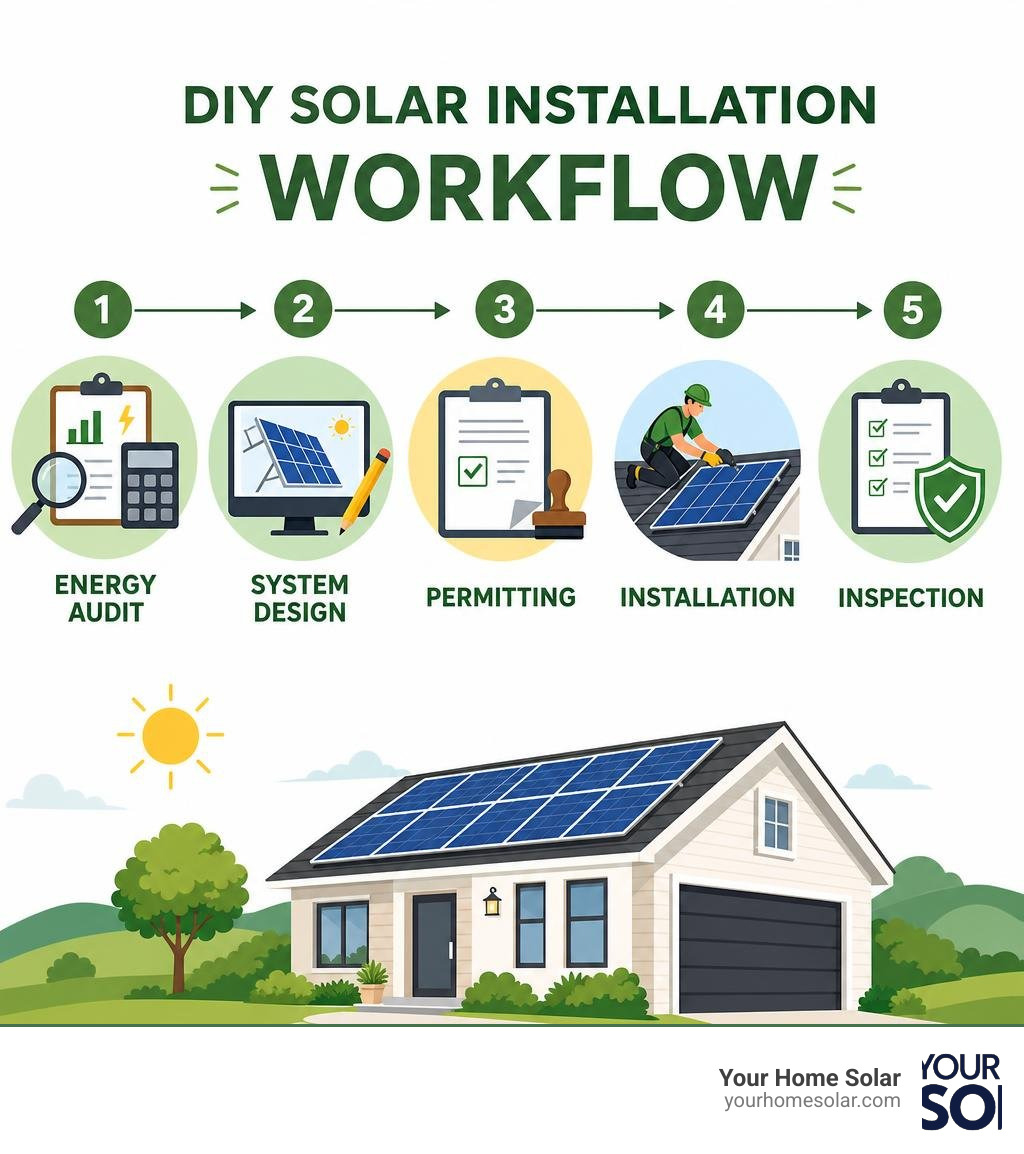
- Calculate your energy needs — pull 12 months of electric bills and find your average monthly kWh usage
- Choose your system type — grid-tied, hybrid, or off-grid
- Size your solar array — divide your daily watt-hour needs by your local peak sun hours, then add a 20–25% buffer
- Select your components — panels, inverter, racking, charge controller, and battery bank (if needed)
- Pull permits — most jurisdictions require electrical permits and utility approval before installation
- Install racking and panels — mount to roof rafters or ground frame, then wire panels together
- Wire and connect the system — connect to inverter, fuse every circuit, and ground all metal components
- Pass inspection and connect — schedule utility interconnection or final inspection before going live
That’s the framework. The details, however, matter a lot — and getting them wrong can mean fire hazards, voided warranties, or a system that underperforms for decades.
The savings potential is real. A professionally installed 8 kW system runs around $26,000. A DIY approach to the same system can bring that down to $6,500–$10,700 — a savings of $8,000 or more. But those savings come with real responsibilities: electrical safety, code compliance, and long-term performance all fall on your shoulders.
This guide walks you through every step — from choosing the right system type to pulling permits and avoiding the mistakes that trip up most first-timers.
I’m Ernie Bussell, founder and CEO of Your Home Solar, the #1 solar energy contractor in East Tennessee — and before building a company around solar, I spent years in operations management overseeing a $40 million per year solar installation business, which means I’ve seen every solar power system DIY success story and every costly mistake up close. Whether you’re planning to go fully independent or just want to understand what’s involved before deciding, this guide gives you the honest, straightforward breakdown you need.
Discover more about solar power system diy:
Grid-Tied, Hybrid, or Off-Grid: Choosing Your System Type
Before purchasing a single panel, you must decide how your system will interact with the local utility grid. This choice dictates your component selection, overall cost, and how you will handle power outages.
| Feature | Grid-Tied System | Hybrid System | Off-Grid System |
|---|---|---|---|
| Grid Connection | Yes | Yes | No |
| Battery Storage | No | Optional / Integrated | Required |
| Power in Outages | No (shuts down for safety) | Yes (via battery backup) | Yes (fully self-sufficient) |
| Relative Cost | Lowest ($0.80–$1.50/W DIY) | Moderate to High | Highest (due to battery sizing) |
| Complexity | Simple | Moderate | Complex |
Understanding Grid-Tied Systems and Net Metering
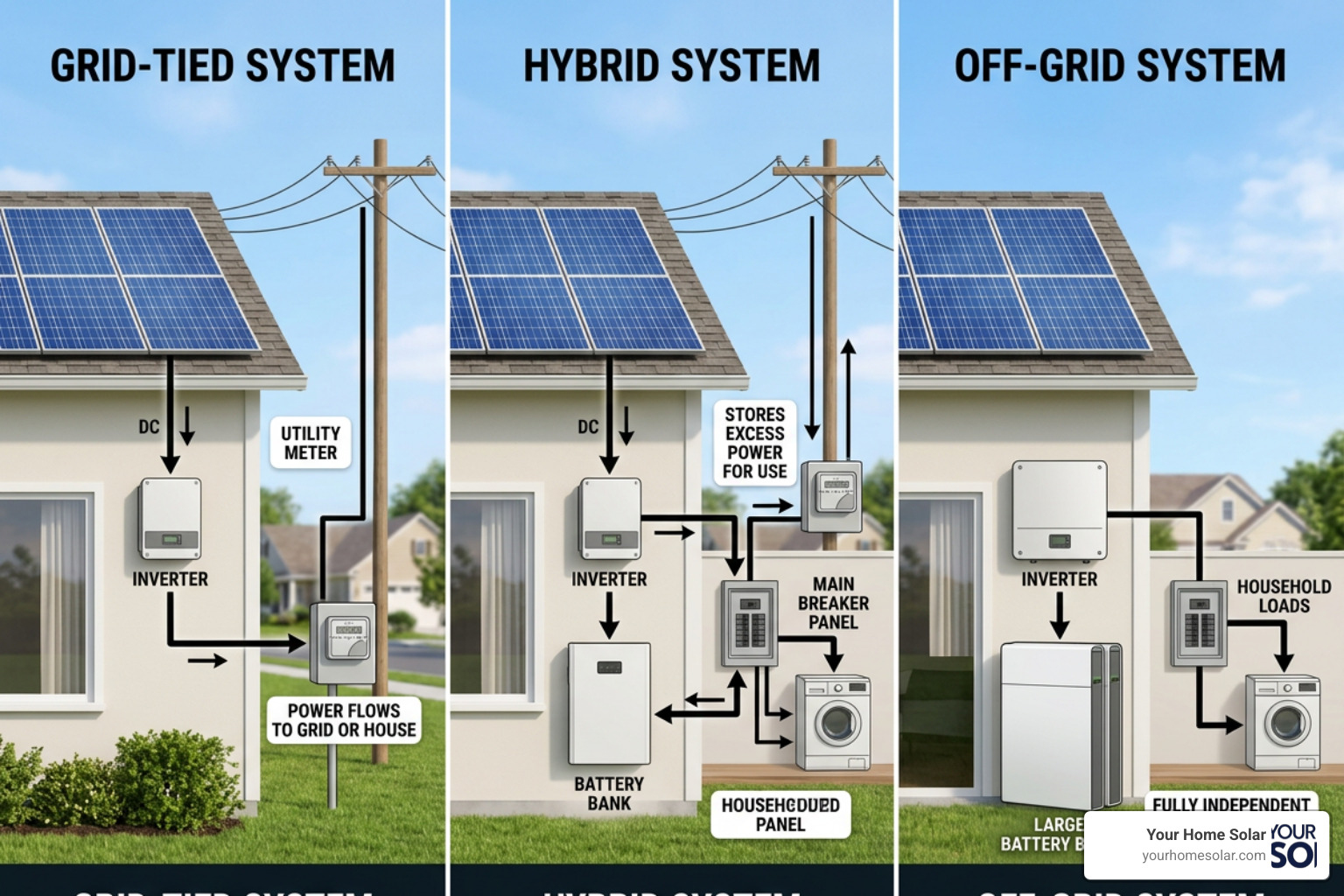
A grid-tied system is the most common and cost-effective option for residential properties. Your solar panels generate DC power, which is converted to AC power by an inverter to feed directly into your home’s electrical panel.
The magic of this setup lies in net metering. When your panels produce more electricity than your home is currently consuming (usually in the middle of a sunny day), the excess energy flows backward through your utility meter and onto the local grid. Your utility company credits you for this power. At night or on rainy days, you draw power back from the grid, using those credits to offset your bill.
It is important to understand that a standard grid-tied system will not provide power during a utility outage. To prevent “islanding”—which can send dangerous electricity back down down wires and injure utility technicians working to restore power—grid-tied inverters automatically shut down when the grid goes dark.
Grid-Tied vs. Hybrid vs. Off-Grid Systems
If you want power during an outage, you need a hybrid system. Hybrid setups remain connected to the utility grid but include a battery storage bank. During normal operation, they function like a grid-tied system, but when the grid goes down, they automatically isolate your home’s critical load panel from the grid and run your essential appliances on battery power.
An off-grid system is completely severed from the utility grid. This means you must generate 100% of your own power and store it in a substantial battery bank. Off-grid systems require careful daily load management; if your batteries run dry during a string of cloudy winter days, your lights go out unless you have a backup fuel generator. Because off-grid systems must be oversized to handle worst-case winter weather, they are considerably more expensive to design and build.
DIY vs. Professional Installation: Pros and Cons
Taking the DIY route is an excellent way to keep money in your pocket. Labor costs typically make up about 7% of a professional solar project, while installer overhead expenses—such as marketing, administrative costs, and profit margin—contribute another 20%. By eliminating these markups, a DIY install can save you roughly 27% to 50% of the total project cost.
However, those savings come with distinct trade-offs:
- Warranties: Many premium equipment manufacturers only honor their full warranties if the system is installed by a certified professional. Some DIY-specific brands do offer warranties to self-installers, but you must read the fine print carefully.
- Safety Risks: Working on a pitched roof carries fall risks, and handling high-voltage DC electricity (which can exceed 400V in string configurations) presents a severe risk of lethal shock and arc-flash fires.
- Support: When you install the system yourself, you are the service technician. If an inverter fails in three years, you have to diagnose the issue, coordinate the warranty replacement, and climb back onto the roof to swap the hardware.
Sizing and Designing Your Solar Power System DIY
A successful solar project starts with an accurate design. Sizing your system correctly ensures you do not waste money on excess equipment or find yourself short of power when you need it most. For a deep dive into the design phase, check out The Ultimate Guide to Designing Your Own Solar Panel System.
Sizing Your Solar Power System DIY Based on Monthly Usage
To find your target system size, look at your utility bills from the past year. Find the total annual kilowatt-hour (kWh) usage and divide it by 12 to find your average monthly consumption.
Let’s walk through a real-world sizing example:
- Determine Daily Usage: If your home uses 900 kWh per month, your average daily usage is 30 kWh (900 kWh ÷ 30 days).
- Account for Peak Sun Hours: Solar panels do not produce at 100% capacity for 12 hours a day. We use “peak sun hours” (PSH) to calculate actual production. In East Tennessee, we average roughly 4.5 peak sun hours per day over the course of the year.
- Calculate Required Array Wattage: Divide your daily kWh needs by your peak sun hours, and apply a 20% “derate factor” (multiply by 1.2) to account for real-world system inefficiencies like wire losses, dust, and temperature degradation: (30 kWh ÷ 4.5 PSH) × 1.2 = 8 kW array
- Determine Panel Count: If you use standard 400-watt solar panels, you will need 20 panels to build an 8 kW system (8,000 watts ÷ 400 watts per panel).
Selecting Components for Your Solar Power System DIY Kit
A complete solar power system DIY kit includes several key components that must be perfectly matched to work safely:
- Solar Panels: Monocrystalline panels are the industry standard for residential roofs due to their high efficiency and sleek look.
- Racking and Mounting: This is the structural hardware that secures your panels to your roof rafters or ground mount. Brands like IronRidge offer robust, engineered racking that can withstand extreme wind and snow loads.
- Inverter: The brain of your system, which converts DC electricity from the panels into usable AC power.
- Batteries (Optional): For hybrid or off-grid systems, batteries store excess daytime production for nighttime use.
- Balance of System (BOS): This covers the wires, fuses, disconnect switches, conduit, and junction boxes required to connect everything legally and safely.
Before buying individual parts, we highly recommend reading DIY Solar Kits: Everything You Need to Know for Home Installation to see how pre-packaged kits can simplify the purchasing process.
Microinverters vs. String Inverters
When choosing your inverter technology, you will generally face two options: string inverters or microinverters.
A string inverter connects a series of panels (a “string”) together, sending high-voltage DC power down to a single central inverter on the side of your house. While string inverters are highly efficient and cost-effective, they have a major weakness: if a single panel in the string is shaded by a tree branch, the output of the entire string can drop significantly.
Microinverters solve this by mounting a small inverter directly underneath every individual solar panel. This converts the power to AC right on the roof. If one panel is shaded, the rest of the array continues to produce at 100% capacity. Microinverters also eliminate high-voltage DC runs on your roof, making them much safer and simpler for DIYers to wire. Furthermore, they have built-in compliance with National Electrical Code (NEC) rapid shutdown requirements.
Sizing a Battery Bank for Backup or Off-Grid Use
If you are planning an off-grid setup or want robust emergency backup, you must size your battery bank carefully. For a complete look at this design process, check out this How to Build a DIY Off-Grid Solar System: Complete Guide (2026) .
To size a battery bank:
- Identify Critical Loads: List the essential appliances you must run during an outage (e.g., refrigerator, well pump, lights, internet router) and calculate their daily watt-hour draw. For example, a critical load of 4,000 Wh (4 kWh) per day.
- Determine Days of Autonomy: How many days do you want to run on battery power without any solar input (such as during a heavy storm)? A standard target is 2 to 3 days of autonomy.
- Choose Your Battery Chemistry: Lithium Iron Phosphate (LiFePO4) is the gold standard for residential solar. Unlike older lead-acid batteries, LiFePO4 batteries can be discharged up to 90% or 100% of their capacity without damage, and they are rated for 3,000 to 6,000+ charge cycles (lasting 10 to 15+ years of daily use).
- Calculate Usable Capacity: If you need 4 kWh per day and want 2 days of autonomy, you need a battery bank with at least 8 kWh of usable capacity.
Solar Generator Kits vs. Custom-Built Systems
For small-scale applications, cabin owners and RV enthusiasts often debate between a pre-packaged solar generator (an all-in-one “power station” that houses the battery, inverter, and charge controller in a single portable box) and a custom-built component system.
Solar generators are incredibly user-friendly and offer plug-and-play simplicity. However, they are highly restricted when it comes to expansion, and if one internal component breaks, the entire unit must be sent in for repair. Custom-built systems take more work to wire but allow you to swap out individual parts, expand your battery bank easily, and design a system tailored to your exact space and power needs.
Step-by-Step DIY Installation, Safety, and Electrical Best Practices
Once your design is finalized, it is time to transition from planning to hands-on installation.
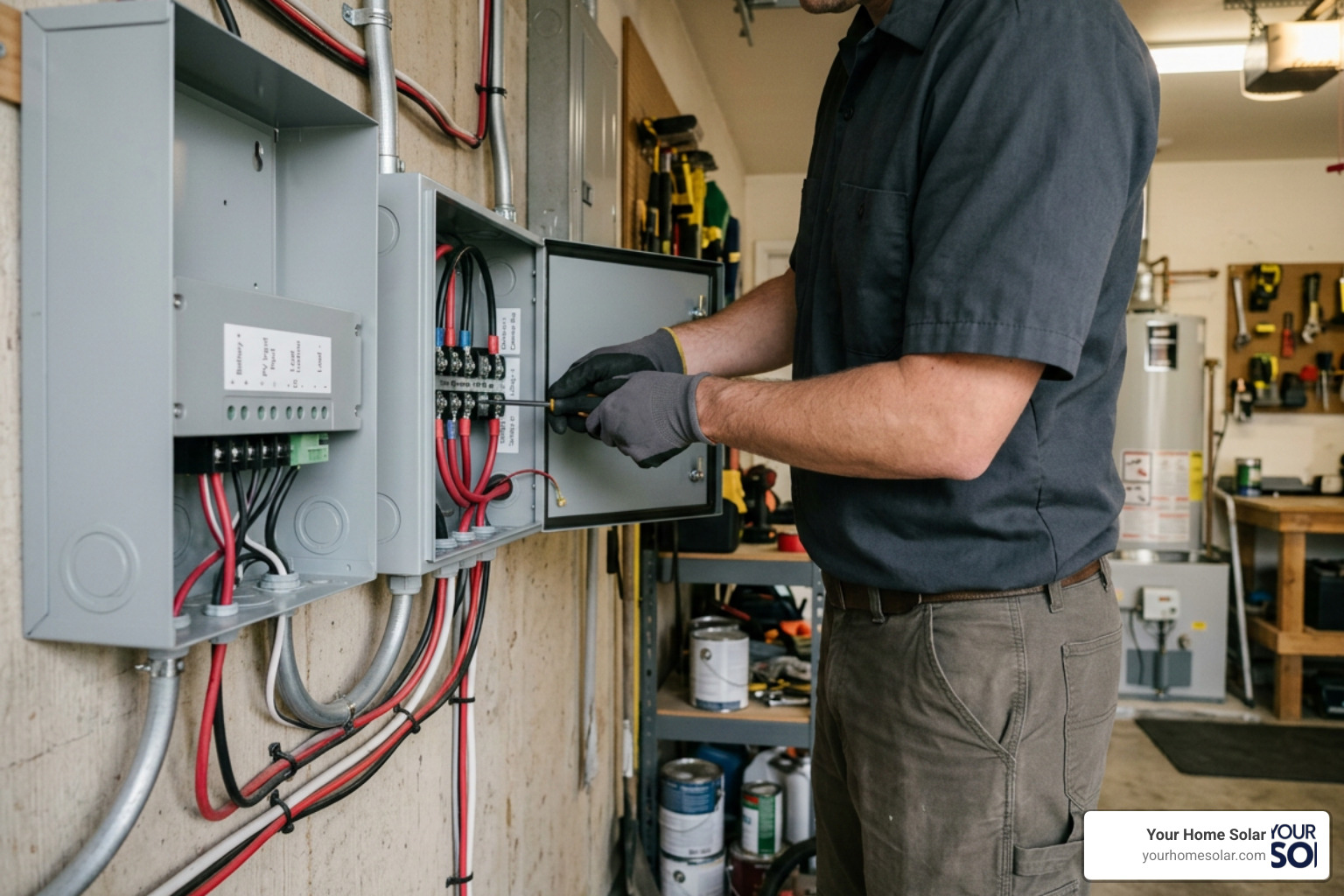
For a comprehensive walkthrough of the physical installation process, refer to DIY Solar Power: A Step-by-Step Installation Guide.
Permits, Codes, and Safety Requirements
Skipping the permitting phase is one of the most dangerous mistakes a DIYer can make. To legally connect a solar system to your home, you must comply with the National Electrical Code (NEC)—specifically NEC 690 (which governs solar photovoltaic systems) and NEC 705 (interconnection).
Before starting, you must submit a detailed single-line electrical diagram and structural plan to your local building department to obtain building and electrical permits. Additionally, you must apply for interconnection with your local utility company (such as Knoxville Utilities Board, Lenoir City Utilities Board, or BrightRidge in Johnson City).
A critical safety standard to keep in mind is NEC 690.12 (Rapid Shutdown). This code requires that your solar array can be de-energized down to safe voltage levels (less than 30 volts within 30 seconds) at the roof level with the flip of a single switch. This ensures first responders are safe from high-voltage shocks if they must vent your roof during an emergency. Using microinverters is the easiest way for DIYers to meet this code automatically.
Wiring, Fusing, and Grounding Best Practices
When handling electrical wiring, precision prevents fires. DC electrical arcs do not self-extinguish like AC arcs do, meaning a loose connection can easily heat up and ignite surrounding materials.
- Wire Sizing: Use PV-rated wire for all outdoor DC runs. Ensure your wire gauge (AWG) is sized correctly for the maximum current of your system to keep voltage drop below 3%. Undersized wire will overheat and waste energy.
- Fusing Rules: Install overcurrent protection (fuses or breakers) on every positive wire run. Fuses must be sized at 125% of the continuous current of the circuit. For lithium battery banks, you must install a high-interrupting-capacity fuse (like a Class T fuse) within 18 inches of the positive battery terminal to protect against massive short-circuit currents.
- Grounding: Ground all metal racking, panel frames, and inverter enclosures. Run a bare copper grounding wire from your roof array down to your home’s main grounding electrode system (grounding rod) to protect your equipment from lightning surges and static buildup.
- MC4 Connectors: Use a dedicated MC4 crimping tool when building solar cable extensions. Never use standard pliers to crimp MC4 connectors, as a loose crimp is a primary cause of solar fires.
DIY Solar Costs, Savings, and Payback Periods
Let’s look at the real-world numbers of going solar in East Tennessee. According to regional data, solar equipment prices have become highly competitive. For instance, you can find complete 12-panel (5.3 kW) DIY kits starting around $4,200, while a larger 40-panel (17.6 kW) DIY kit can run around $14,500.
If you are looking at local professional installations, resources like The cost of solar panels in Maryville, TN (2026) – EnergySage and Johnson City solar cost and payback (June 2026) – PowerOutage.us show that professional installations typically range from $2.50 to $3.30 per watt.
By utilizing resources such as GoGreenSolar: Solar Kits & Expert Support for equipment and taking the DIY route, you can expect to pay closer to $0.80 to $1.50 per watt installed.
Furthermore, DIY installations are eligible for the Federal Residential Clean Energy Credit, which allows you to claim 30% of your total equipment costs (including panels, inverters, racking, and batteries) as a credit on your federal tax return. This incentive significantly shortens your payback period, often dropping it to 6 to 9 years depending on your local utility rates.
For a broader look at DIY economics, you can read DIY solar installation – Survipedia .
Maintenance and Performance Monitoring
Once your system is up and running, it requires minimal daily care, but regular checkups keep it performing efficiently:
- Panel Cleaning: Dust, pollen, and leaves can degrade your system’s performance by 5% to 15%. Wash your panels with clean water and a soft squeegee once or twice a year. Avoid using harsh detergents or abrasive brushes.
- Winter Performance: Snow will naturally slide off pitched solar arrays, but in heavy winter storms, keeping the bottom edge of your array clear will allow the rest of the snow to slide off easily.
- Monitoring: Most modern inverters connect to your home Wi-Fi, allowing you to track daily, monthly, and lifetime energy production through a smartphone app. If you notice a sudden drop in production on one panel, you can quickly address shading or a potential equipment issue.
Common Beginner Mistakes to Avoid
Before you start climbing ladders, keep these five common pitfalls in mind:
- Skipping the Permitting Phase: Unpermitted systems can lead to fines, forced removal, and the voiding of your homeowner’s insurance policy in the event of a fire.
- Poor Roof Penetration Sealing: Every lag bolt driven into your roof rafters must be properly flashed and sealed with high-quality silicone sealant to prevent water damage.
- Ignoring Shading Analysis: Even minor shading from a chimney or nearby power line between 9 AM and 4 PM can slash your output. Map your roof’s sun exposure before mounting panels.
- Incorrect Wire Gauges: Using cheap or undersized wire causes power loss and represents a severe fire hazard.
- Forgetting Drip Loops: When running wires from the panels into a junction box, always leave a small downward loop in the cable. This prevents rainwater from running straight along the wire and into your electrical enclosures.
Frequently Asked Questions about DIY Solar
Is DIY plug-in solar legal in all 50 states?
While you can find various “plug-and-play” solar kits online that plug directly into a standard wall outlet, they are generally not legal to connect to the grid without utility approval and proper permitting. Most local utilities in East Tennessee require a dedicated, hardwired utility-grade disconnect switch and an interconnection agreement to ensure grid safety.
Will installing my own solar panels void my roof warranty?
It can. Standard roof warranties usually cover leaks and structural integrity, but if you penetrate your shingles to mount solar racking and cause a leak due to improper sealing, that portion of your roof warranty will be voided. If you are concerned about your roof warranty, we recommend having a professional roofing contractor handle the physical roof attachments and flashing, leaving the panel mounting and wiring to your DIY team.
Can I qualify for the federal solar tax credit with a DIY installation?
Yes! The Federal Residential Clean Energy Credit (Section 25D) does not require professional installation to qualify. You can claim the 30% credit on all eligible equipment costs, including panels, racking, inverters, wiring, and battery storage. However, you cannot claim a tax credit for the value of your own DIY labor. Keep all your equipment receipts and file IRS Form 5695 with your annual tax return.
Conclusion
Building your own solar system is a rewarding way to take control of your energy bills, learn a valuable skill, and achieve real energy independence on a budget.
However, dealing with high-voltage electricity, complex local permitting codes, and climbing onto steep roofs is not for everyone. If you read through the steps in this guide and feel that the electrical wiring, structural calculations, or permitting paperwork are a bit outside your comfort zone, you do not have to compromise on your clean energy goals.
At Your Home Solar, we provide comprehensive home energy solutions across East Tennessee—from Knoxville and Maryville to Johnson City and Morristown. We specialize in custom solar installations, whole-home backup generators, and EV chargers, backed by trusted local expertise and a 100% customer satisfaction guarantee.
If you want the maximum savings of solar without the safety risks, permitting headaches, or warranty concerns of a DIY project, we are here to help. Contact us today at Your Home Solar for a free, personalized solar consultation and let our team design a safe, reliable, and rewarding system for your home!