
How to Plan EV Charger Installation in Knox County
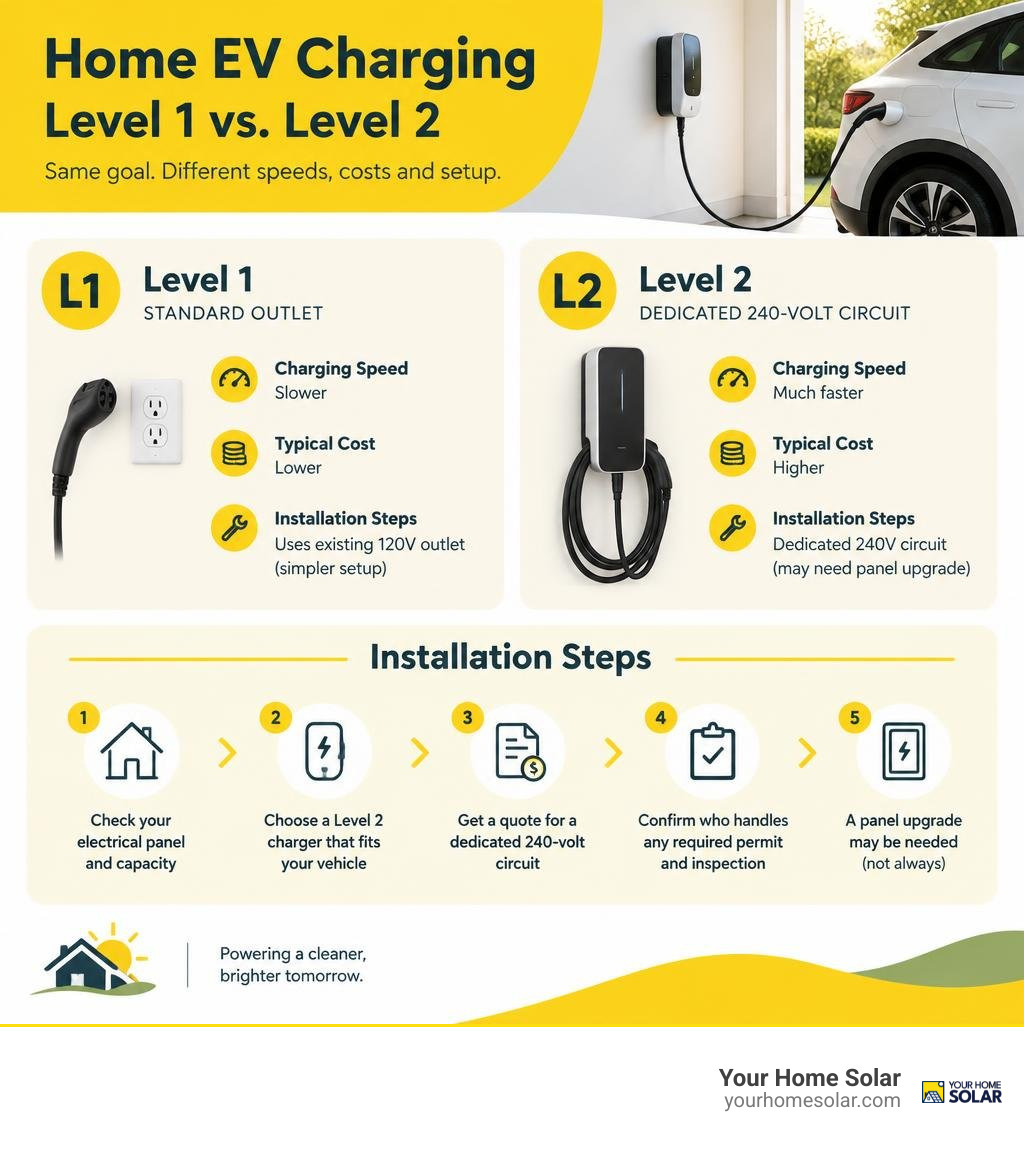
For EV charger installation in Knox County, Tennessee, start by asking a licensed electrician to check your electrical panel and calculate your home’s available capacity. Then choose a Level 2 charger that fits your vehicle, get a quote for a dedicated 240-volt circuit, and confirm who will handle any required permit and inspection. A panel upgrade may be needed, but panel size alone cannot tell you that.
Level 2 charging makes overnight charging practical for many drivers. Charging at home can also cost less than relying on public stations, depending on your electric rate and the station’s price. According to the U.S. Department of Energy, most EV drivers do the majority of their charging at home, where residential electricity rates are typically lower than public fast-charging fees. The Alternative Fuels Data Center provides additional guidance on home charging equipment and installation.
I’m Ernie Bussell, founder of Your Home Solar. My work in solar and home energy shapes this guide to EV charger installation Knox County homeowners can plan with confidence.
Must-know ev charger installation knox county terms:
Comprehensive Guide to EV Charger Installation Knox County
Electric vehicle adoption across East Tennessee is growing rapidly. Whether you are driving an all-electric crossover through West Knoxville or commuting down Pellissippi Parkway, relying on public charging infrastructure is not always ideal. Standard trickle charging using a regular wall outlet (Level 1) can leave you waiting days for a full battery.
Installing a dedicated Level 2 Electric Vehicle Supply Equipment (EVSE) system inside your garage or driveway delivers the convenience of waking up to a 100% charged battery every morning. When exploring an EV charger installation in Knoxville, it helps to understand how Level 1 and Level 2 options compare.
| Charging Feature | Level 1 Charging (Standard Outlet) | Level 2 Charging (Dedicated 240V Circuit) |
|---|---|---|
| Voltage Supply | 120 Volts AC | 240 Volts AC |
| Amperage Range | 12 – 16 Amps | 32 – 48 Amps (up to 80A for specialty units) |
| Charging Speed | 3 to 5 miles of range per hour | 25 to 45+ miles of range per hour |
| Full Charge Time | 24 to 40+ hours | 4 to 8 hours (overnight) |
| Electrical Requirement | Standard household 3-prong outlet | Dedicated 240V circuit breaker |
| Ideal Use Case | Emergency top-ups, plug-in hybrids | Daily commuting, all-electric battery vehicles |
Upgrading to a 240-volt system transforms your daily routine. Drivers can comfortably manage daily commutes, weekend trips to the Great Smoky Mountains, and errands without range anxiety.
Cost Efficiency of Home Charging
Charging at home provides major savings compared to public commercial stations. While DC fast charging hubs in public lots come with premium kilowatt-hour rates and idle fees, home charging allows you to take advantage of standard residential electric rates.
On average, charging an electric vehicle at home costs the equivalent of about $1.00 per gallon of gasoline. You can maximize these savings by opting for a smart EV charger installation in Knoxville. Smart chargers let you program schedules to take advantage of off-peak hours and track energy consumption directly from your smartphone.
Knox County EV Charger Costs and Electrical Requirements
Understanding the total financial investment helps you budget accurately. Most residential installations involve two primary components: the EVSE hardware unit itself and professional installation labor.
Equipment hardware generally ranges from $400 to $900 depending on amperage, cable length, and Wi-Fi features. Professional labor for a standard installation typically ranges from $500 to $1,500. Knowing the factors that influence your overall 240V EV charger installation cost ensures there are no surprises when you receive your estimate.
Key variables affecting your project cost include:
- Distance between your electrical breaker box and the charger location.
- Need for indoor versus outdoor weather-rated conduit.
- Hardwired configuration versus a high-grade 240V NEMA 14-50 receptacle.
- Capacity upgrades to your home’s electrical service.
Preparing Electrical Service for EV Charger Installation Knox County
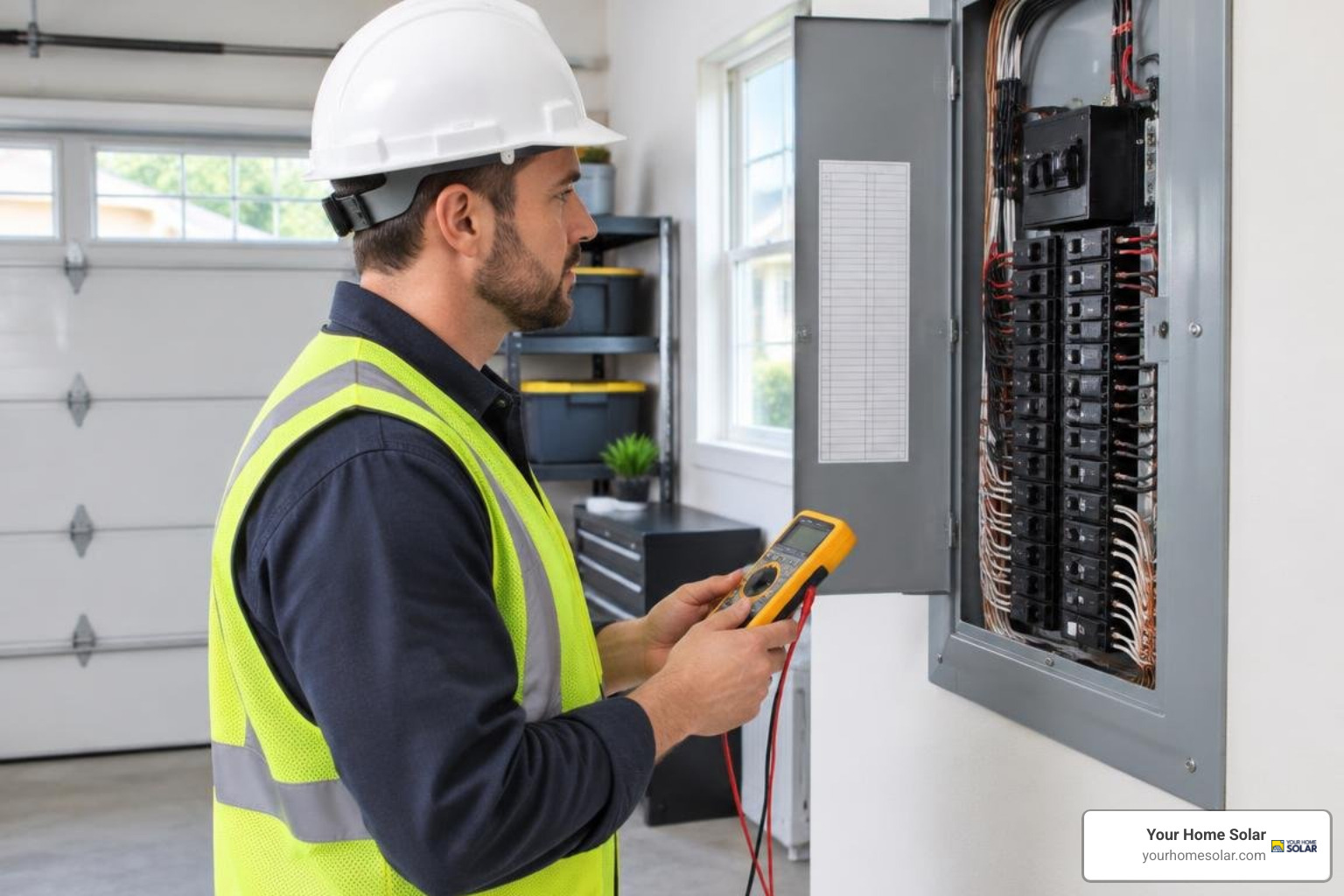
Before mounting hardware, an electrician must complete an electrical panel compatibility assessment and electrical load calculation.
A Level 2 charger requires a dedicated double-pole breaker, usually between 40 and 60 amps. Most modern homes equipped with a 200-amp main electrical panel have sufficient headroom to accommodate this added load alongside major appliances like HVAC units and electric ranges. However, older homes with 100-amp service often require a panel upgrade or dedicated load-management device to prevent overloads and ensure code compliance.
Selecting Level 2 Hardware for Your Vehicle
Choosing the right equipment depends on your daily driving habits, vehicle specifications, and garage layout.
- Hardwired vs. Plug-In (NEMA 14-50): Hardwired chargers connect directly to your home’s wiring, allowing for higher continuous output (up to 48A or more on a 60A breaker) and superior weather resistance. NEMA 14-50 plug-in units offer portability if you plan to move.
- Vehicle Compatibility: Many universal Level 2 units utilize the standard J1772 or modern NACS connectors. If you drive a Tesla, choosing the right Level 2 charger for your Tesla ensures seamless charging without separate adapters.
- Cable Management and Smart Controls: Look for units with durable 20- to 25-foot cords, integrated holster docks, and mobile apps that let you monitor energy use remotely.
Knox County Permitting, Code Compliance, and Safety Standards

Adding a high-amperage 240V continuous circuit is not a weekend DIY project. Continuous electrical loads generate substantial heat, meaning improper wire sizing, loose terminal connections, or incorrect breaker selection present serious fire hazards.
In Knox County and surrounding municipalities, electrical permits and inspections are required for high-voltage EVSE additions to ensure adherence to the National Electrical Code (NEC). When selecting an EV charger installation partner, choose a licensed and insured electrical contractor who manages all permitting, installs proper Ground Fault Circuit Interrupter (GFCI) protection, and arranges municipal inspections.
Professional Installation and Clean Energy Integration
For an unobstructed, standard setup where the electrical panel sits directly inside the garage, installation typically takes 2 to 4 hours. If your project requires running conduit through finished walls, underground trenching to a detached garage, or an electrical service panel upgrade, work may take a full day.
Many homeowners across East Tennessee maximize their energy independence by pairing home solar panel installation with EV charging. Generating your own clean electricity allows you to charge your vehicle straight from the sun, minimizing utility bills and protecting your household against energy rate increases.
Professional EV Charger Installation Knox County Workflow
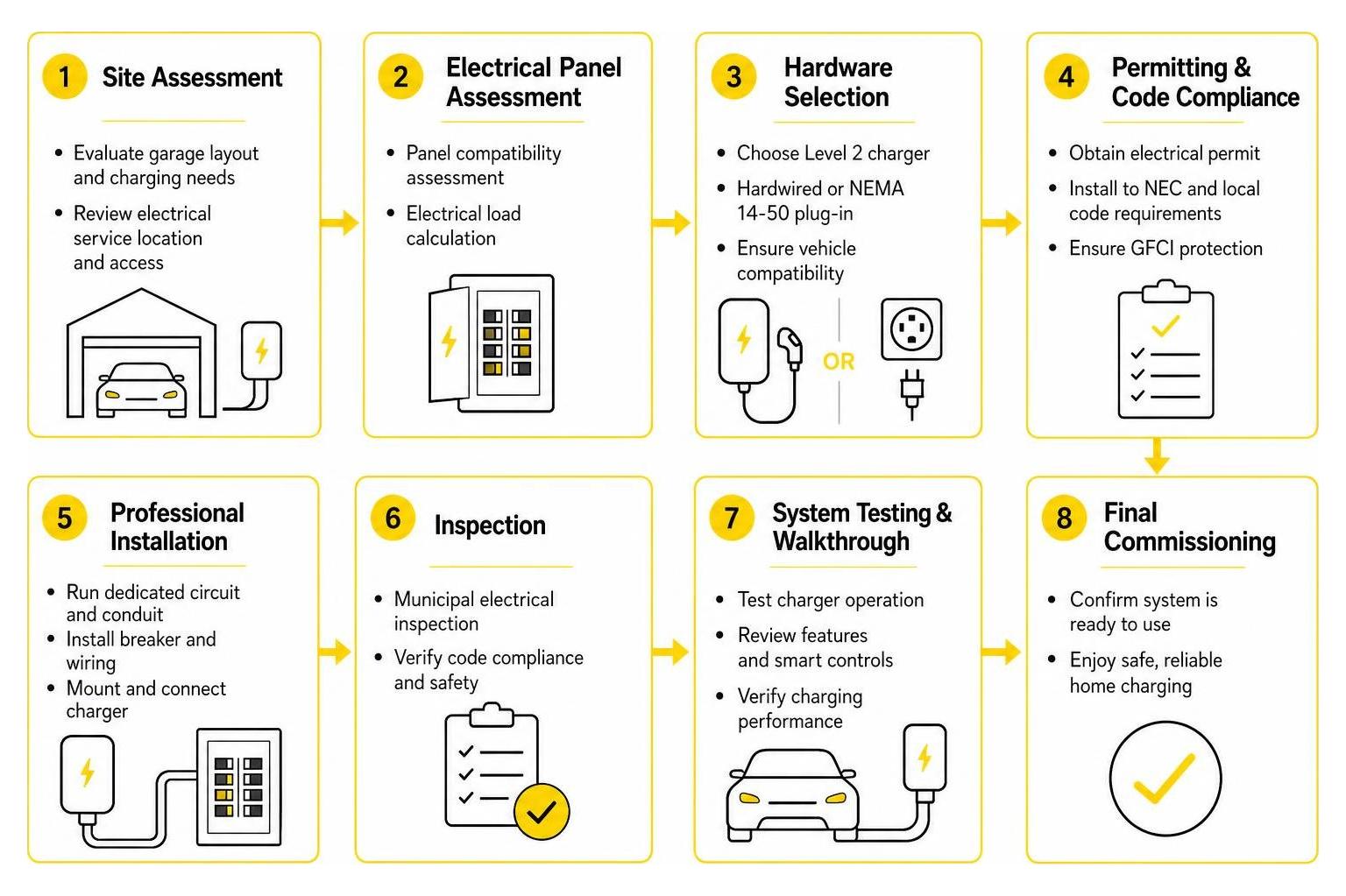
When you hire certified professionals, the installation process follows a structured, safety-first workflow:
- Site Assessment & Load Calculation: Evaluating your breaker box capacity, physical layout, and preferred mounting location.
- Permit Filing: Securing all required local electrical permits prior to starting work.
- Dedicated Circuit Run: Installing heavy-gauge copper wiring, durable conduit, and the appropriate double-pole circuit breaker.
- Unit Mounting & Wiring: Securely mounting the EVSE hardware and torquing electrical connections to manufacturer specifications.
- Testing & Commissioning: Verifying voltage balance, testing safety shutoffs, pairing Wi-Fi functionality, and conducting a test charge session.
Planning for Multiple Home EVs
As multi-EV households become more common, planning your electrical layout ahead of time prevents duplicate installation costs. Installing dual-port chargers or smart EVSE units that feature intelligent power sharing allows two vehicles to charge from a single circuit without overloading your electrical service.
Frequently Asked Questions About Knox County EV Charger Installation
How much does it cost to install a Level 2 EV charger in Knox County?
Most homeowners spend between $500 and $1,500 on professional labor for a standard Level 2 charger installation. Hardware costs typically add $400 to $900. Total pricing varies based on the distance between your breaker box and the charging location, conduit routing requirements, and whether your home needs an electrical service upgrade.
Will my home’s existing electrical panel support an EV charger?
Most homes with a modern 200-amp electrical panel have adequate capacity for a dedicated 40- to 60-amp EV circuit. Homes with 100-amp service or older fuse panels usually require an electrical panel upgrade or an automated load-management switch before a Level 2 EVSE can be safely added.
Is an electrical permit required for residential EV charger installation?
Yes. Knox County and local municipal building codes require an electrical permit and safety inspection when installing a new 240-volt circuit and EVSE system. A licensed electrical contractor will handle the entire permitting and inspection process on your behalf.
Conclusion
Upgrading your home with a dedicated Level 2 charging station provides unmatched convenience, faster speeds, and meaningful fuel savings. By choosing certified professionals, you ensure your equipment meets all safety codes, operates efficiently, and seamlessly integrates with your home’s electrical layout.
At Your Home Solar, we deliver turnkey home energy solutions across East Tennessee, including solar power, backup generators, and professional EV charger installations. Contact our team today for a free assessment and start charging your vehicle with complete confidence.