How to Size and Choose Backup Power for Outages
The best home electric generators depend on your specific household needs: dual-fuel portable inverters offer versatile high-output backup for essential circuits, indoor-safe lithium (LiFePO4) power stations provide silent, emissions-free power for electronics and small appliances, and whole-house standby generators deliver automated, seamless whole-home power during extended outages.
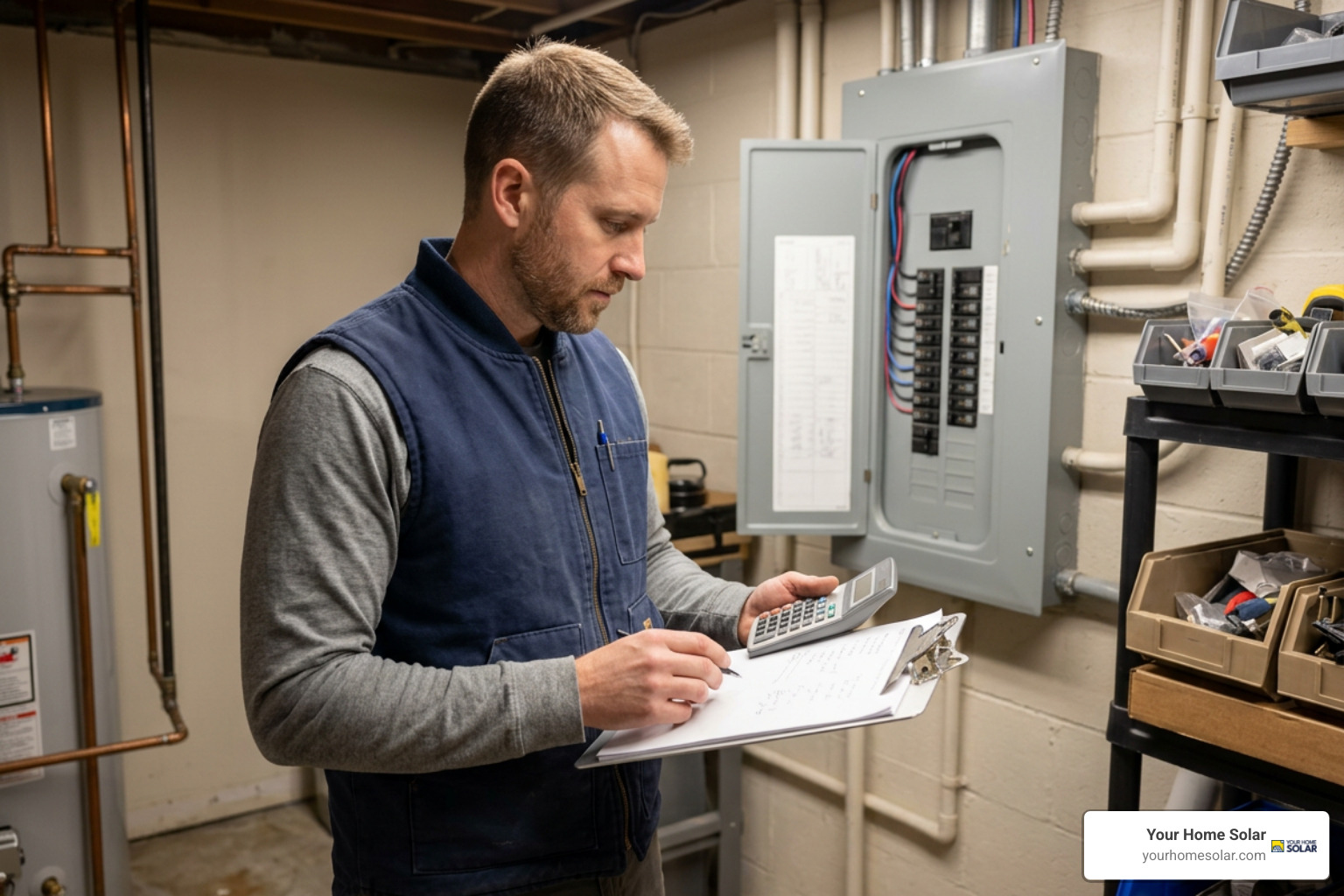
Selecting the right equipment comes down to matching your household’s peak electrical demand with a power source that operates reliably during severe weather. Sizing a system inaccurately can leave you sitting in the dark when an appliance trips the circuit breaker or, worse, damages delicate hardware.
Sizing Appliance Wattage and Starting vs Running Watts
Every electrical appliance requires a continuous amount of electricity to operate, known as running watts (rated watts). However, equipment with electric motors or compressors—such as refrigerators, sump pumps, well pumps, and central air conditioners—demands a temporary surge of extra electricity to start moving. This is called starting watts or surge watts.
A typical refrigerator might draw 600 running watts but can momentarily require 1,200 to 1,500 starting watts when the compressor kicks on. A standard submersible sump pump often draws 750 to 1,050 running watts while surging up to 1,500 to 2,100 starting watts.
To calculate your total wattage requirements:
- List all essential devices you intend to power simultaneously.
- Sum the continuous running watts of these appliances.
- Identify the single appliance with the highest starting wattage requirement and add its surge wattage difference to your total running load.
- Apply the 20 percent headroom rule: add a 20% safety margin to the overall number to prevent engine strain and avoid overloading the generator during unexpected spikes.
For an extensive step-by-step breakdown of managing critical circuits, check out The Ultimate Guide to Staying Powered When the Grid Goes Down.
Fuel Options: Gas, Propane, Natural Gas, and Battery Storage
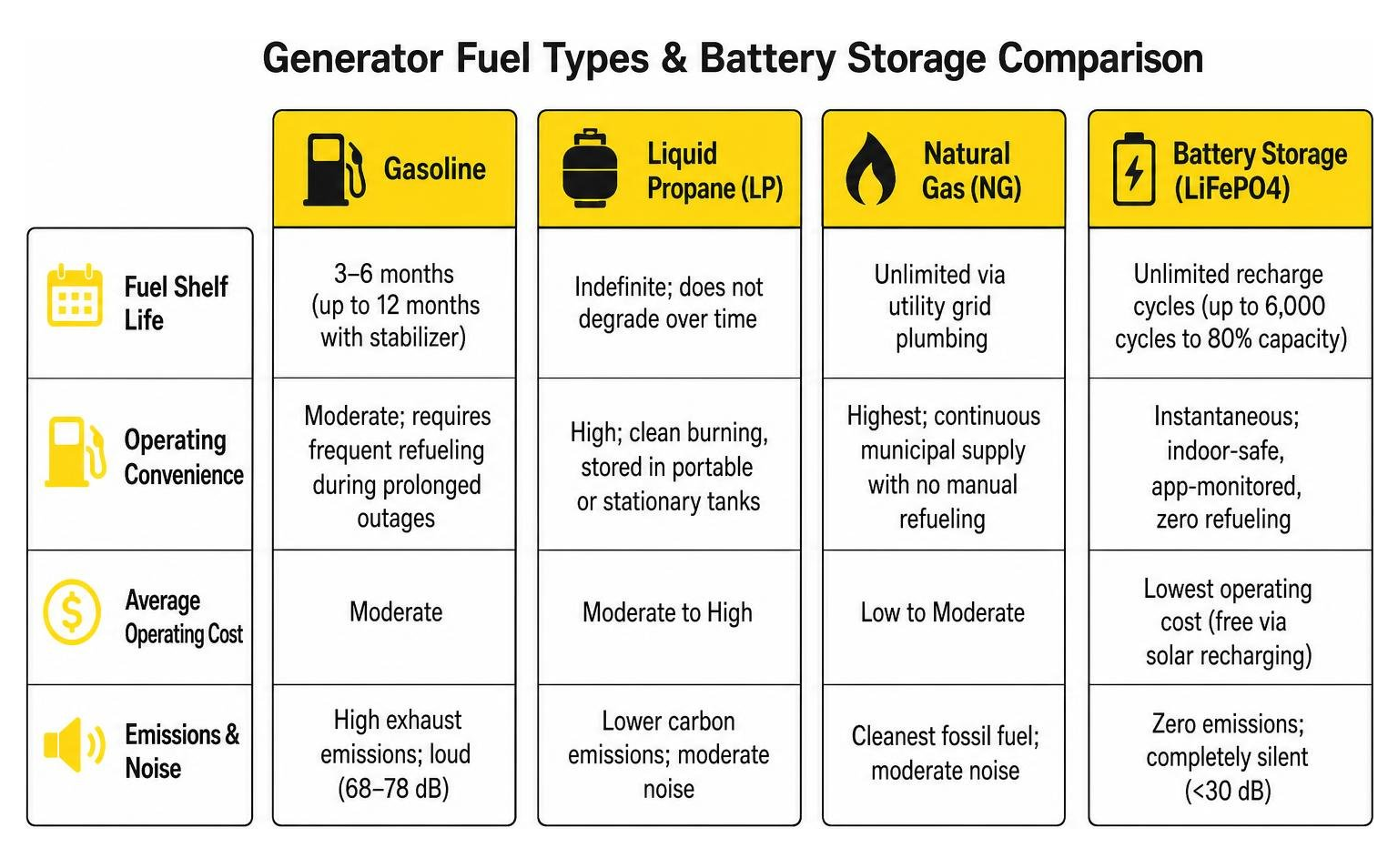
Choosing the best fuel depends heavily on local availability, storage capacity, and maintenance expectations. While traditional internal combustion generators rely on combustible fuels, modern lithium battery storage systems provide an emissions-free alternative. When assessing traditional fuels alongside renewable options, Comparing Solar with Traditional Gas Generators for East Tennessee Homes provides helpful regional cost comparisons.
| Fuel / Power Source | Fuel Shelf Life | Operating Convenience | Average Operating Cost | Emissions & Noise |
|---|---|---|---|---|
| Gasoline | 3–6 months (up to 12 months with stabilizer) | Moderate; requires frequent refueling during prolonged outages | Moderate | High exhaust emissions; loud (68–78 dB) |
| Liquid Propane (LP) | Indefinite; does not degrade over time | High; clean burning, stored in portable or stationary tanks | Moderate to High | Lower carbon emissions; moderate noise |
| Natural Gas (NG) | Unlimited via utility grid plumbing | Highest; continuous municipal supply with no manual refueling | Low to Moderate | Cleanest fossil fuel; moderate noise |
| Battery Storage (LiFePO4) | Unlimited recharge cycles (up to 6,000 cycles to 80% capacity) | Instantaneous; indoor-safe, app-monitored, zero refueling | Lowest operating cost (free via solar recharging) | Zero emissions; completely silent (<30 dB) |
Top-Rated Picks: The Best Home Electric Generators for Any Budget
From compact dual-fuel units to stationary whole-house installations and portable battery systems, modern backup equipment offers tailored capabilities for various household sizes.
Best Home Electric Generators for Portable and Dual-Fuel Backup
Portable dual-fuel inverter generators combine heavy-duty wattage capacity with clean electrical output. Modern electronics—such as laptops, smart TVs, and variable-speed HVAC controls—require electricity with Total Harmonic Distortion (THD) under 3% to prevent component degradation.
A leading model in this category is the DuroMax 11,000 Watt Portable Dual Fuel Inverter Generator w/ CO Alert – XP11000iH – DuroMax Power Equipment. This unit provides 11,000 peak watts and 9,000 running watts on gasoline (10,450 peak / 8,550 running watts on propane). Running at a quiet 61 dB at 25% load, it delivers clean inverter power alongside a heavy-duty 50-amp outlet suitable for powering a standard residential transfer switch. Dual-fuel capabilities allow homeowners to switch quickly to propane when neighborhood gas stations lose electricity or run out of fuel during widespread storms.
Best Home Electric Generators with Battery Inverter Storage
Portable power stations utilize advanced Lithium Iron Phosphate (LiFePO4) chemistry to supply instant, exhaust-free electricity. Because they produce zero toxic emissions, they are safe for indoor operation in apartments, basements, and living rooms.
- EcoFlow DELTA 2 Max: Offering a 2,048Wh base capacity expandable up to 6,144Wh, this unit outputs 2,400W continuous AC power (with surge capabilities up to 3,400W). Operating at a near-silent volume of roughly 30 dB, it is priced around $849 during promotions and pairs seamlessly with portable or rooftop solar panels for off-grid recharging.
- Jackery Explorer 1000 v2: A highly mobile option weighing only 23.8 lbs, it delivers a 1,070Wh LiFePO4 battery capacity with 1,500W continuous output (3,000W surge). It is well-suited for running medical devices like CPAP machines, keeping Wi-Fi networks active, and running compact energy-efficient refrigerators.
For households looking to combine quiet storage with uninterrupted power, exploring Power to the People with a Battery Generator Backup illustrates how battery storage excels during short-to-medium blackouts.
Whole-House Standby Generator Systems
For automated, hands-off operation, permanently installed home standby generators remain the gold standard. These units sit on an exterior concrete or composite pad, connect directly to the home’s natural gas or propane line, and interface with an automatic transfer switch (ATS).
According to independent lab evaluations such as 5 Best Whole-House Generators of 2026, Lab-Tested and Reviewed, standby units ranging from 18 kW to 26 kW can power an entire modern home seamlessly—including multi-ton central air conditioning, well pumps, and electric ranges—without requiring manual setup in the middle of a storm. Homeowners exploring permanent options can read The Ultimate Guide to Home Backup Generator Options to evaluate full home integration.
Portable vs. Standby Units: Cost, Installation, and Transfer Switches
Selecting between a portable unit and a standby setup involves balancing initial hardware investment against automation and convenience.
Safe Grid Connection: Transfer Switches vs. Interlock Kits
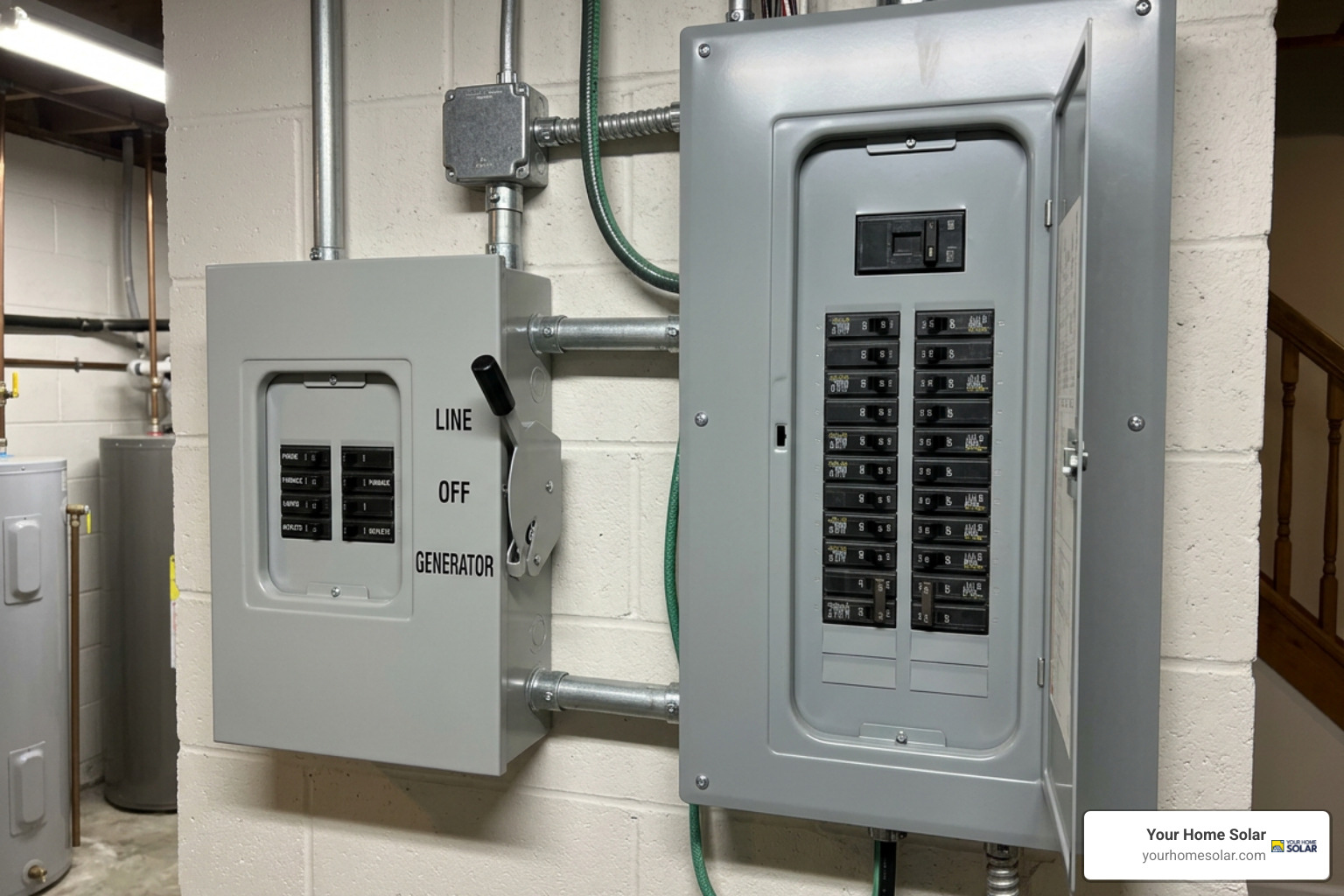
Connecting any high-output generator to your home electrical system requires an isolated connection method to prevent backfeeding—the dangerous reverse flow of electricity into utility lines, which poses a fatal electrocution hazard to utility line workers.
- Manual Transfer Switch: A dedicated subpanel that isolates selected circuits (typically 6 to 10 essential breakers) and allows you to switch them manually from utility power to generator input.
- Breaker Interlock Kit: A mechanical sliding plate installed directly on your main service panel. It prevents the main utility breaker and the generator backfeed breaker from being turned on simultaneously, allowing you to power any circuit on the main panel up to the generator’s capacity.
To understand the wiring and installation requirements for safe home integration, consult the Power Up Your Step-by-Step 200 Amp Transfer Switch Installation Guide.
Total Installation Costs and Realistic Upkeep
The total cost of ownership differs significantly across equipment tiers:
- Portable Fuel Generators: Hardware costs range from $400 to $3,000. Professional installation of an outdoor 30A or 50A power inlet box with a manual transfer switch or interlock kit typically adds $800 to $2,000.
- Portable Power Stations: Prices range between $800 and $4,000 depending on battery capacity and inverter output, requiring minimal to no electrical installation unless integrated with a home transfer panel.
- Standby Whole-Home Generators: Standby equipment costs between $2,000 and $7,000. Turnkey professional installation—including gas line plumbing, electrical trenching, ATS installation, and local permitting—typically ranges from $5,000 to $10,000+, bringing total installed costs between $8,000 and $17,000.
For a detailed breakdown of labor, equipment, and permitting fees, review our Generator Installation Cost Guide 2026.
Essential Safety Rules and Outage Preparedness
Operating high-voltage power generation equipment requires strict adherence to safety guidelines to prevent fire, mechanical failure, and carbon monoxide hazards.
Carbon Monoxide Safety and Placement Best Practices
The U.S. Consumer Product Safety Commission reports that an average of approximately 100 people in the United States die each year from carbon monoxide (CO) poisoning linked to portable generators. Carbon monoxide is an invisible, odorless, and deadly gas produced by all internal combustion engines.
- The 20-Foot Rule: Always position portable generators outdoors at least 20 feet away from all doors, windows, and fresh air intake vents, with the exhaust pipe directed away from the dwelling.
- Never Run Indoors: Never operate a fuel-powered generator inside a home, garage, basement, crawl space, or covered porch, even if doors and windows are open.
- CO Shutoff Sensors: Look for models certified to ANSI/UL2201 or ANSI/PGMA G300 standards, which feature built-in carbon monoxide sensors that shut down the engine automatically if dangerous gas concentrations build up.
- Install Alarms: Maintain battery-backed carbon monoxide detectors on every level of your home and outside sleeping areas.
For regional weather planning and storm safety advice, see Don’t Be Powerless Against Tennessee Storms.
Routine Maintenance and Safe Continuous Operation
Generators run under continuous heavy loads and demand regular service to maintain reliability:
- Engine Oil Changes: Most portable models require an initial oil change after the first 20 to 30 hours of break-in operation, followed by routine changes every 100 operating hours (or at least once per season).
- Fuel Maintenance: Untreated gasoline begins to oxidize and degrade within 3 to 6 months, gumming up carburetors. Always add a fuel stabilizer to stored fuel or run the carburetor dry before long-term storage.
- Operational Rest Cycles: Portable generators are air-cooled; during multi-day outages, shut the unit down every 8 to 12 hours for 30 minutes to check the oil level and allow the engine to cool before refueling.
- Monthly Exercise: Run standby generators on their automatic weekly self-test schedule, and exercise portable fuel units under a moderate electrical load every 1 to 2 months.
Frequently Asked Questions About Home Generators
What size generator is needed to run a typical whole house?
A 5,000 to 7,500-watt generator handles essential circuits for most homes, including lighting, refrigeration, electronics, and small pumps. Powering a whole house without load management—including central air conditioning (3 to 5 tons), electric water heaters, and laundry—generally requires an 11,000 to 14,000-watt portable unit or an 18,000 to 26,000-watt standby generator.
Can portable power stations safely run major appliances indoors?
Yes. Portable power stations use lithium batteries and solid-state inverters, producing no carbon monoxide or exhaust emissions. Units rated at 2,000 watts or higher can easily run modern refrigerators, freezers, CPAP machines, and internet routers indoors without noise or ventilation concerns.
Is a transfer switch mandatory when connecting a generator to a breaker panel?
Yes. The National Electrical Code (NEC) requires an approved transfer switch or mechanical interlock device whenever connecting an auxiliary generator to a residential electrical panel. This physically prevents electrical backfeeding onto utility lines and protects your generator from catastrophic damage when grid power returns.
Conclusion
Power outages can occur without warning, whether caused by severe winter freezes or summer thunderstorms. Preparing your home with the right backup generator keeps essential food cold, maintains medical equipment, powers necessary communications, and provides climate comfort for your family.
At Your Home Solar, we specialize in helping homeowners design safe, resilient, and customized backup energy systems. Whether you are seeking a dual-fuel portable system, a clean battery storage solution, or professional Generac Generator Installation in Knoxville and throughout East Tennessee, our team delivers the trusted expertise needed for complete outage peace of mind. Contact us today to tailor the ultimate emergency backup system for your home.