What Does 1 Solar Plate Price Cost in 2026?
A single residential solar panel, often called a solar plate, typically costs $150 to $350 in 2026 when bought on its own. Most 380W to 420W mid-tier panels land around $250 to $320, while premium high-efficiency models can exceed $350.
The better comparison is price per watt, not just the sticker price:
- Polycrystalline panels: about $0.70 to $0.90 per watt
- Monocrystalline panels: about $0.90 to $1.10 per watt
- Small DIY purchases: often $0.80 to $1.40 per watt because you do not get bulk system pricing
That gap is why 1 solar plate price can be surprising. A lower-priced panel may produce less power, take more roof space, or require separate shipping and equipment. Newer TOPCon, HJT, bifacial, and high-output monocrystalline panels can cost more upfront, but may make better use of a small East Tennessee roof.
Also, the panel itself is only one piece of the bill. Inverters, racking, wiring, permits, labor, and optional battery storage often cost more than the modules in a full rooftop installation. Recent module price increases tied to material costs and policy changes make it even more important to compare complete, itemized quotes rather than chase the cheapest single panel.
I am Ernie Bussell, founder and CEO of Your Home Solar, with solar operations and installation leadership experience since 2020. I help East Tennessee homeowners look beyond 1 solar plate price to understand the equipment, production, and long-term value behind a solar decision.

1 solar plate price word guide:
Understanding 1 Solar Plate Price in 2026

When homeowners across Knoxville, Maryville, and Oak Ridge begin researching solar energy, they often start by looking at unit costs online. Seeing individual price tags ranging from under $200 to well over $400 creates immediate confusion. Navigating this landscape requires exploring an essential guide to solar panels cost to see how single module tags fit into broader energy investments.
The retail pricing of an individual plate is determined by its physical footprint, silicon purity, and nominal wattage output. Standard residential panels generally measure roughly 65 by 39 inches, weighing around 40 to 45 pounds. However, the energy density packed inside that frame varies significantly.
Average Unit Costs for Residential Modules
For most modern residential setups in East Tennessee, standard panels produce between 380W and 420W. A mid-tier panel in this power class typically sells between $180 and $320 when purchased individually.
Smaller specialized modules exist for niche applications. For example, when unpacking the price how much for a 300W solar panel, you will find they offer lower total unit costs but deliver less energy per square foot than modern 400W+ options. Budget clearance panels can drop to around $150, whereas high-output residential modules from premium manufacturers reach $350 to $430 each.
Monocrystalline vs Polycrystalline Efficiency and Costs
Silicon cell manufacturing dictates both energy yield and price tags:
- Monocrystalline Modules: Built from single-crystal silicon structures, these panels feature a uniform dark aesthetic and achieve 19% to 23% efficiency. They perform exceptionally well in direct sunlight and diffuse lighting, costing between $0.90 and $1.10 per watt.
- Polycrystalline Modules: Created by melting multiple silicon fragments together, these recognizable blue-hued plates are cheaper to produce ($0.70 to $0.90 per watt) but offer lower efficiency (15% to 17%). They require considerably more roof surface to match the power generation of monocrystalline arrays.
- Bifacial Modules: Built with transparent backsheets or dual-glass layers, bifacial panels capture ambient light reflecting off the surface beneath them, producing up to 30% more energy in ground-mounted or light-colored roof settings.
| Panel Technology | Average Efficiency | Typical Unit Price (Standalone) | Price Per Watt | Primary Use Case |
|---|---|---|---|---|
| Polycrystalline | 15% – 17% | $150 – $220 | $0.70 – $0.90 | Large ground mounts, budget utility sheds |
| Monocrystalline PERC | 18% – 20% | $200 – $320 | $0.85 – $1.05 | Standard residential rooftops |
| TOPCon / HJT (N-Type) | 21% – 23% | $280 – $380+ | $1.00 – $1.25 | Space-constrained roofs, high-yield arrays |
| Bifacial Monocrystalline | 20% – 22%+ | $260 – $400 | $0.95 – $1.15 | Ground arrays, reflective surfaces |
Key Factors Driving Individual Solar Panel Costs
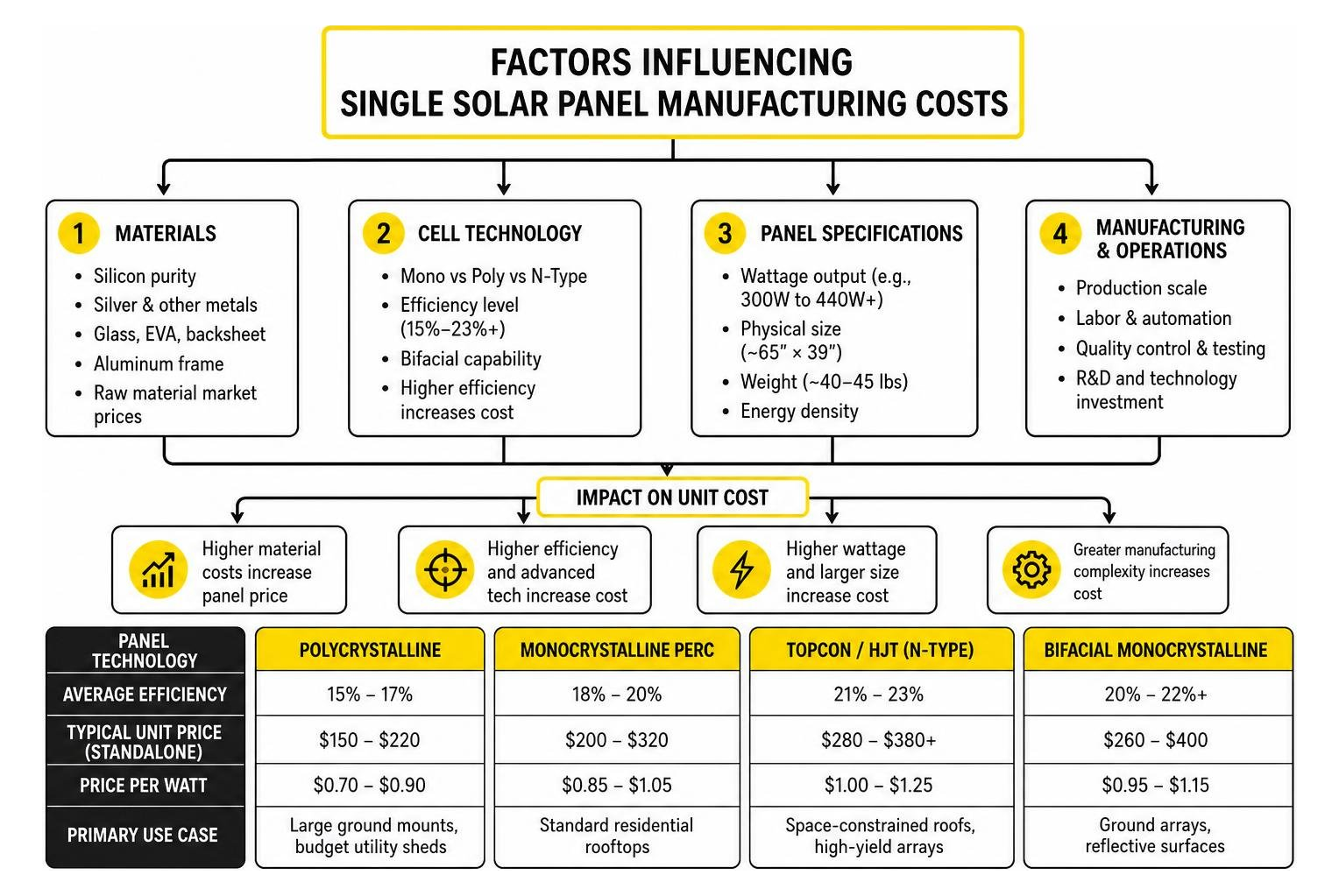
Solar panel prices fluctuate based on broader economic currents, international trade policies, and material markets. When homeowners evaluate solar panel costs in 2026, they discover that raw industrial inputs heavily influence per-plate tags.
How Cell Technology Shifts 1 Solar Plate Price
Solar manufacturing continues to transition from legacy P-type PERC cells to advanced N-type architectures. Technologies such as Tunnel Oxide Passivated Contact (TOPCon) and Heterojunction Technology (HJT) deliver lower temperature coefficients and superior low-light performance.
Reviewing shocking truths about 440W solar panel prices reveals how high-wattage residential modules command a modest premium while maximizing production on limited roof footprints. Furthermore, monitoring 2026 solar module price shifts helps track how manufacturer-level pricing filters into consumer markets.
Manufacturing and Raw Material Market Trends
Global supply chains experienced notable pricing adjustments across early 2026. Production costs for raw materials—specifically silver paste used in cell conductive contacts and high-purity silicon wafers—saw steep rises. N-type silicon wafer prices climbed over 9% across early 2026, while industrial silver hit record highs of $93 per ounce.
Simultaneously, adjustments to international export tax rebates prompted major manufacturers including Trina Solar, LONGi Green Energy, Jinko Solar, and JA Solar to raise base module quotes. Industry analyses detailing market trends for single solar plates highlight how commercial demand and material shifts impact both single-unit sales and utility-scale procurement.
Buying Individual Solar Plates vs Full Rooftop Systems

Purchasing an individual solar module off the shelf differs dramatically from investing in an engineered turnkey rooftop system. To understand this contrast, homeowners often reference the kilowatt crunch guide to average solar panel costs to compare retail markups against complete system installations.
DIY Standalone Units and Price Per Watt Metrics
Buying a single plate online or through a local supplier carries distinct retail costs. Standalone purchases miss out on bulk wholesale discounts, with freight charges adding $50 to $150 for fragile single-panel deliveries.
For small off-grid cabins or camper setups, standalone panels serve practical needs. Evaluating watts the deal for 180W solar panel price comparison illustrates how smaller 12V modules carry higher retail premiums per watt ($1.20 to $1.60/W) compared to full-sized residential units. Price per watt remains the ultimate equalizer:
$$\text{Price Per Watt} = \frac{\text{Retail Cost of Solar Plate}}{\text{Rated Output (Watts)}}$$
A $280 panel rated at 400W costs $0.70 per watt, providing greater value than a $200 panel rated at only 220W ($0.91 per watt).
Evaluating 1 Solar Plate Price vs Complete Solar Kits
Single panels cannot power standard household alternating current (AC) appliances alone. Connecting solar power to your home requires evaluating understanding installed panel prices to see how entire systems function together.
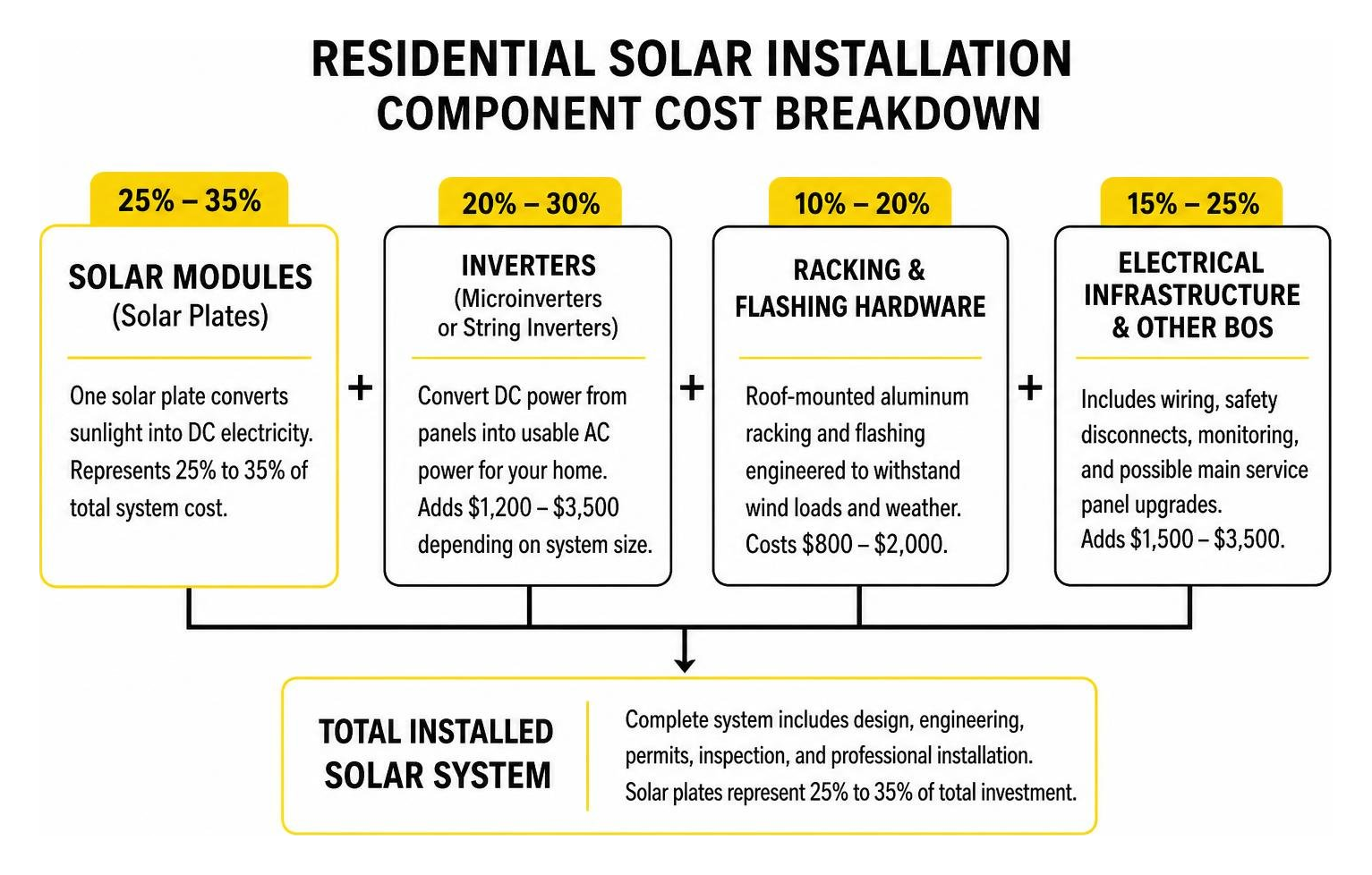
While solar plates represent only 25% to 35% of an installed system’s total investment, complete systems include structural engineering, mounting equipment, high-efficiency inverters, safety disconnects, and professional workmanship.
Additional Balance-of-System Expenses and Incentives
Rooftop solar requires specialized balance-of-system (BOS) components to safely convert raw DC electricity into usable household power. Our residential solar solutions guide provides detailed explanations of how these components interconnect.
Inverters, Mounting Hardware, and Labor
- Inverters (Microinverters vs. String Inverters): String inverters centralize conversion, while microinverters mount behind each panel to optimize production during shading. Inverters add $1,200 to $3,500 depending on system size.
- Racking and Flashing Hardware: Roof-mounted aluminum racking engineered to withstand Appalachian wind loads and seasonal weather costs $800 to $2,000.
- Electrical Infrastructure Upgrades: Homes across Sevier, Blount, and Knox counties may require main service panel upgrades ($1,500 to $3,500) to support solar input.
- Permitting, Utility Fees, and Labor: Interconnection applications, municipal inspections, and professional electrical installation ensure full compliance with regional safety codes.
Rebates and Long-Term Electricity Savings
Solar investments generate consistent returns over their 25- to 30-year operational lifespans:
- Utility Net Metering and Billing Credits: Grid-tied homes send surplus midday energy back into the local utility grid, securing electric bill credits.
- Property Value Appreciation: Modern solar arrays boost real estate value without triggering property tax spikes in many jurisdictions.
- Inflation Hedge: Generating your own clean power shields your household budget from rising regional electric utility rates.
- Predictable Payback Horizons: Most turnkey residential solar arrays in East Tennessee achieve full system payback within 7 to 12 years.
Frequently Asked Questions About Solar Plate Costs
How much does a single 400W solar plate cost on average?
A standalone 400W monocrystalline solar plate generally costs between $180 and $320 in 2026. Premium all-black architectural panels or high-output N-type modules can reach $350 to $430 before shipping and tax.
Can I run household appliances using just one solar panel?
A single 400W panel generates roughly 1.5 to 2.2 kilowatt-hours (kWh) of direct current electricity per day, depending on sunshine conditions. While this cannot power a whole house, central HVAC, or heavy heating elements, when paired with a charge controller and small battery station, it can easily recharge smartphones, power LED lighting, run laptops, or operate small 12V camping refrigerators.
Why is cost per watt more useful than single panel price?
Total panel price overlooks energy capacity. A $200 panel delivering 200W costs $1.00 per watt, while a $280 panel delivering 400W costs just $0.70 per watt. Measuring cost per watt allows you to evaluate true power value regardless of physical dimensions or rated capacity.
Conclusion
Understanding 1 solar plate price helps clarify the equipment quality and technology behind home solar energy. While individual panels have become highly accessible, converting raw solar energy into dependable home electricity requires careful balance-of-system engineering, proper mounting, and professional installation.
At Your Home Solar, we deliver comprehensive energy solutions tailored to homeowners throughout Knoxville, Johnson City, Kingsport, Morristown, Oak Ridge, and surrounding East Tennessee communities. Our mission is built around trusted expertise and 100% customer satisfaction, providing custom solar installations, whole-home backup generators, and EV charging stations designed for lasting reliability.
Take control of your household energy budget today. Contact us to explore solar system cost and financing options and receive a tailored home energy assessment.