

Key Factors Influencing the 15 Watt Solar Panel Price
A 15W solar panel is a compact, entry-level way to test small-scale solar power without committing to a full residential installation. These pocket-sized or briefcase-sized panels are commonly used for camping electronics, emergency USB charging, garden lighting, automatic gate batteries, remote cameras, RV battery maintenance, and marine trickle charging. The right choice depends less on wattage alone and more on how the panel will be used: a backpacking charger needs lightweight folding fabric and regulated USB ports, while a gate opener or stored vehicle needs a weather-resistant 12V panel paired with the correct battery protection. That is why the 15 watt solar panel price can vary so widely even though every option carries the same nominal watt rating.
Understanding what drives the 15 watt solar panel price comes down to materials, form factor, and conversion efficiency. While $30 to $140 represents the general retail range, specific design choices shift where a panel sits on that pricing spectrum. Advanced manufacturing processes, silicon purity levels, weather-resistant encapsulation, and electrical outputs all play key roles in determining final shelf prices. For a deeper breakdown of general solar equipment pricing and broader system dynamics, see our guide on an essential guide to solar panels cost.
| 15W panel type | Typical retail price range | Best suited for |
|---|---|---|
| Rigid 12V monocrystalline panel | $32 to $40 | Battery maintainers, gate openers, RVs, remote equipment |
| Rigid 12V polycrystalline panel | $34 to $40 | Budget trickle charging where space is not limited |
| Foldable 5V USB charger | $50 to $60 | Phones, power banks, GPS units, small camping electronics |
| Semi-flexible or marine-style kit | $100 to $140+ | Curved surfaces, vehicles, boats, plug-and-play installs |
To better understand underlying photovoltaic technology basics, it helps to evaluate how raw silicon wafers are transformed into low-wattage modules. Smaller solar panels require precise electrical trimming and custom encapsulation materials, meaning that while total material costs are low, processing costs per watt are often higher than standard residential rooftop modules.
Monocrystalline vs Polycrystalline 15 Watt Solar Panel Price
The internal cell technology plays a major role in pricing and physical footprint:
- Monocrystalline Panels: Built from single-crystal silicon ingots, these panels feature uniform cell structures that offer higher solar cell efficiency (frequently 22% to 24%). Products like the Newpowa 15W Monocrystalline Panel retail around $32.49. High-efficiency PERC (Passivated Emitter and Rear Cell) monocrystalline cells maximize power output in a significantly smaller physical footprint, making them ideal when mounting space on an RV roof, gate pole, or backpack is strictly limited.
- Polycrystalline Panels: Built from multiple melted silicon fragments, these cells generally deliver lower module efficiency (often around 10% to 12%). Rigid polycrystalline models like the ACOPOWER HY015-12P sell for roughly $33.90 to $40.00. While physically larger than monocrystalline alternatives producing the same power, they offer reliable budget power for basic battery maintainers where panel size is not a major constraint.
Rigid Glass vs Flexible 15 Watt Solar Panel Price
Physical build and materials create clear price differentials between traditional glass modules and semi-flexible configurations:
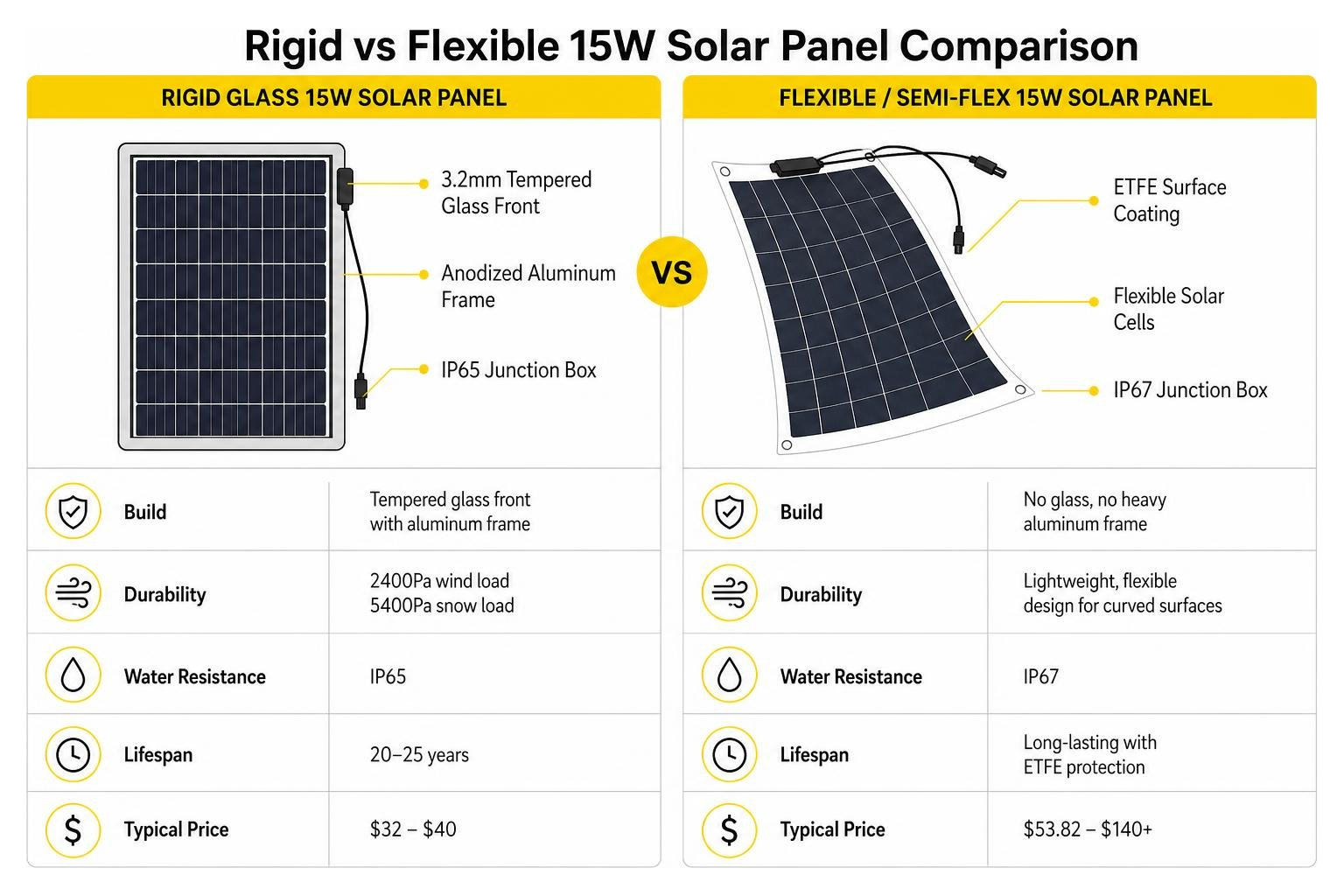
- Rigid Glass Panels: Constructed with a heavy-duty 3.2mm photovoltaic tempered glass front layer, an anodized aluminum alloy frame, and an IP65 or IP67 junction box. These panels are engineered to withstand heavy environmental stress (up to 2400Pa wind load and 5400Pa snow load) and provide long operational lifespans of 20 to 25 years at an accessible retail price point ($32 to $40).
- Flexible and Semi-Flex Panels: Designed without heavy glass or aluminum frames, relying instead on polymer backsheets. Flexible 5V models retail around $53.82, while semi-flexible 12V panels packaged for marine or vehicle mounting can reach $140 or more. Premium flexible options utilize ETFE (ethylene tetrafluoroethylene) outer coatings rather than standard PET (polyethylene terephthalate). ETFE coatings offer up to 95% UV permeability, superior heat tolerance, self-cleaning anti-aging properties, and IP67 splash resistance, justifying their premium pricing for harsh outdoor use.
Form Factor Comparison: Portable USB vs 12V Nominal Panels
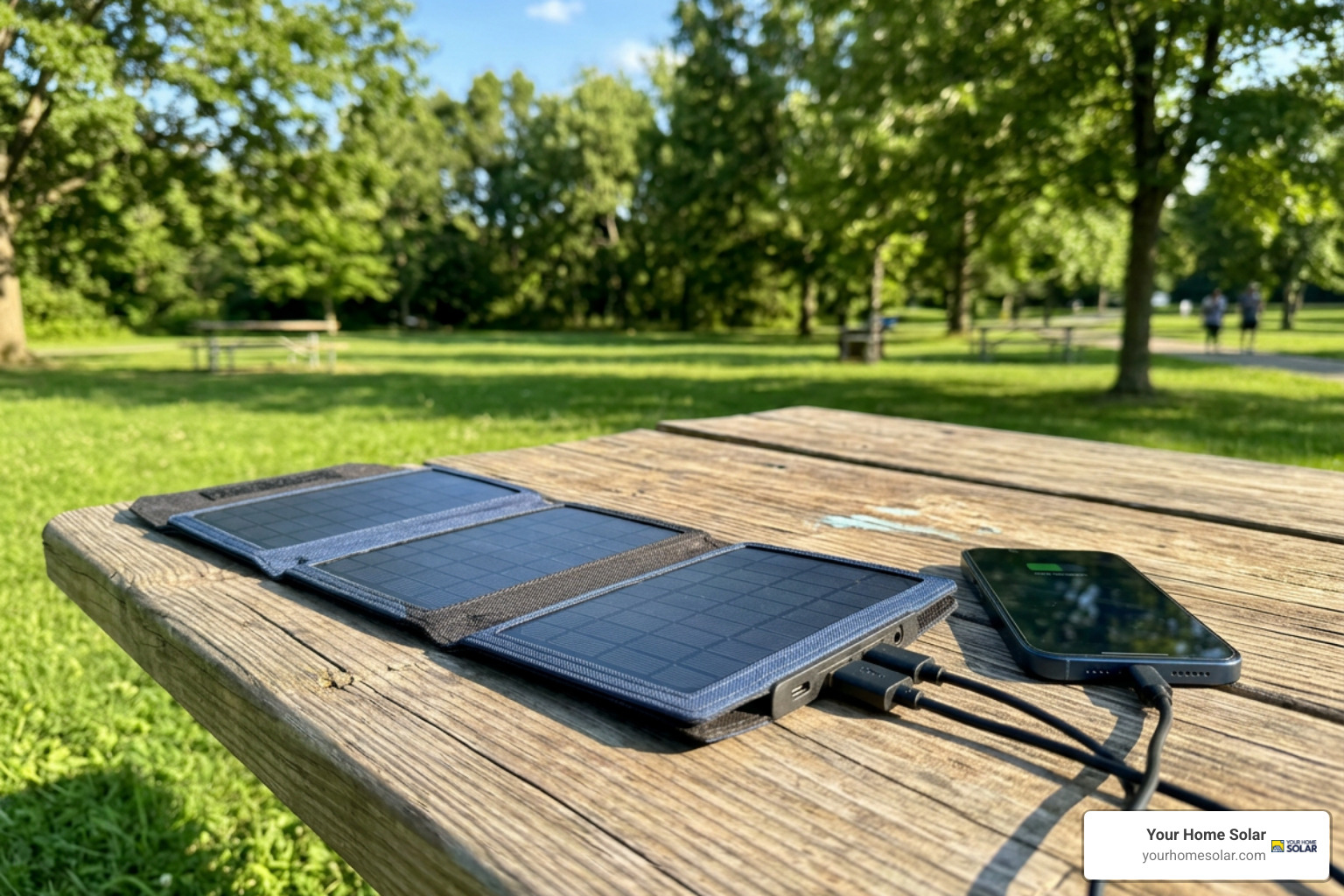
When reviewing a 15 watt solar panel price, note whether the panel outputs 5V DC regulated voltage via USB or 12V DC nominal voltage for battery bank charging. Choosing the correct voltage configuration prevents unnecessary conversion losses and eliminates the need for redundant adaptors. For more context on portable setups, read our guide on portable solar panels: your ultimate guide to off-grid power.
- 5V USB Portable Chargers: Products like the SunJack 15W Foldable Solar Charger (€52.95 EUR / ~$57 USD) or the Bivy 15W Solar Panel feature built-in smart USB regulation circuitry delivering up to 5V/3A output. These compact, foldable units (often under 1.5 lbs) feature auto-sensing IC technology to directly charge cell phones, satellite communicators, headlamps, and portable power banks without requiring external charge controllers or bulky battery systems.
- 12V Nominal Rigid Panels: Models like the XRSOLAR 15W or Newpowa 15W deliver an open-circuit voltage (Voc) around 20.5V–22.7V and an optimum operating voltage (Vmp) of 17.5V–19.8V. They are designed specifically to wire into 12-volt DC battery systems (such as lead-acid, AGM, gel, or lithium iron phosphate batteries) used in automatic driveway gate openers, RV auxiliary banks, marine vessels, and remote security equipment.
Complete Solar Kits and Integrated Accessories
A standalone panel cost differs significantly from a complete, turn-key kit. Buying a kit saves time spent sourcing compatible wiring and regulators, but increases the initial equipment investment:
- Bare Modules: Standard rigid panels ($32–$35) usually include a short pre-attached wire lead (e.g., 13ft) or standard solar connectors, requiring separate mounting brackets, inline fuses, and charge controllers to complete the installation.
- Complete Kits: The Nature Power 15-Watt Semi-Flex Solar Panel Kit ($142.30 at major retailers) includes an integrated charge controller designed specifically for 12V battery protection, mounting hardware, battery clamps, and connection cables. Adding integrated controllers, USB voltage regulators, quick-connect SAE wiring, and custom mounting hardware increases upfront hardware costs but ensures plug-and-play safety and immediate usability out of the box.
Channel Pricing, Warranties, and Hidden Costs

Where and how you buy a 15W solar panel influences the final total cost. Consumer retail outlets, online marketplaces, and B2B wholesale channels feature wildly different pricing models and warranty structures. To explore larger off-grid and backup gear setups, consult our in-depth guide to portable solar systems.
- Retail vs. Wholesale Pricing: Single-unit retail pricing ranges from $32 to $140 depending on brand and form factor. However, B2B wholesale suppliers (such as Couleenergy) offer 15W modules at $0.36 to $0.50 per watt (around $5.40 to $7.50 per module) when purchased in bulk with a Minimum Order Quantity (MOQ) of 100 units or more.
- Warranty Values: Commercial rigid panels often back their performance with multi-tier long-term warranties: a 2-year to 5-year material/workmanship warranty, a 10-year 90% power output warranty, and a 25-year 80% power output warranty. Lower-cost portable consumer electronics typically offer shorter 1-year to 2-year limited warranties due to the higher physical stress placed on portable gear.
- Hidden Costs: Always factor in shipping fees, specialized mounting brackets (such as aluminum Z-brackets, pole clamps, or tilt mounts), SAE adapter cables, inline safety fuses, and dedicated pulse-width modulation (PWM) charge controllers if you are keeping a 12V battery topped off long term.
Frequently Asked Questions About Small Solar Panels
How much power does a 15W solar panel generate per day?
In average outdoor conditions receiving approximately 4 to 5 peak sun hours per day, a 15-watt solar panel generates approximately 60 to 75 watt-hours (Wh) of daily electrical energy. Real-world power production depends on geographic location, seasonal sun angle, ambient operating temperature, and potential shading. A 60Wh to 75Wh yield provides enough power to fully recharge a modern smartphone 3 to 5 times, power a small outdoor LED light fixture for hours, or maintain a healthy trickle charge on a 12V vehicle or marine battery system.
Do I need a charge controller with a 15W solar panel?
If you are using a 5V USB panel, charge regulation is built directly into the integrated circuit output port. If you are using a 12V nominal panel (which delivers 17V–22V output in open circuit conditions) connected to a small 12V battery (under 20 Ah), a small PWM charge controller is strongly recommended to prevent overcharging, battery cooking, and reverse current drainage back through the panel overnight. However, when connected to very large 12V deep-cycle batteries (such as an 80 Ah or 100 Ah marine battery), a 15W panel’s maximum current (~0.86 amps) acts as a passive trickle charger where overcharging risk is minimal under normal conditions.
How long do 15 watt solar panels typically last?
Rigid tempered-glass 15W solar panels typically carry an operational lifespan of 20 to 25 years, suffering minimal efficiency degradation (around 0.5% to 0.8% per year). Flexible or foldable ETFE panels used outdoors for camping, hiking, and mobile applications generally feature an expected service life of 5 to 15 years, depending on mechanical flexing, UV exposure intensity, storage care, and ambient weather conditions.
Conclusion
Small-scale solar panels provide an accessible and highly affordable way to maintain off-grid electronics, trickle-charge vehicle batteries, and continuously power remote security cameras and automatic gate openers. Finding the right 15 watt solar panel price means balancing portability, rugged durability, cell efficiency, and included accessories against your project’s precise electrical requirements.
While 15-watt panels excel at keeping small electronics and standalone batteries running off the grid, powering an entire home or whole-house battery backup system requires tailored engineering and professional equipment installation. At Your Home Solar, we specialize in comprehensive residential clean energy solutions across East Tennessee, including solar arrays, battery backups, generators, and EV chargers. Whether you live in Knoxville, Oak Ridge, Maryville, Johnson City, or anywhere across the region, explore comprehensive financing and solar system pricing with our team to find the ideal solar design for your home.