What Is the Average Cost of Solar Panels for a House in 2026?
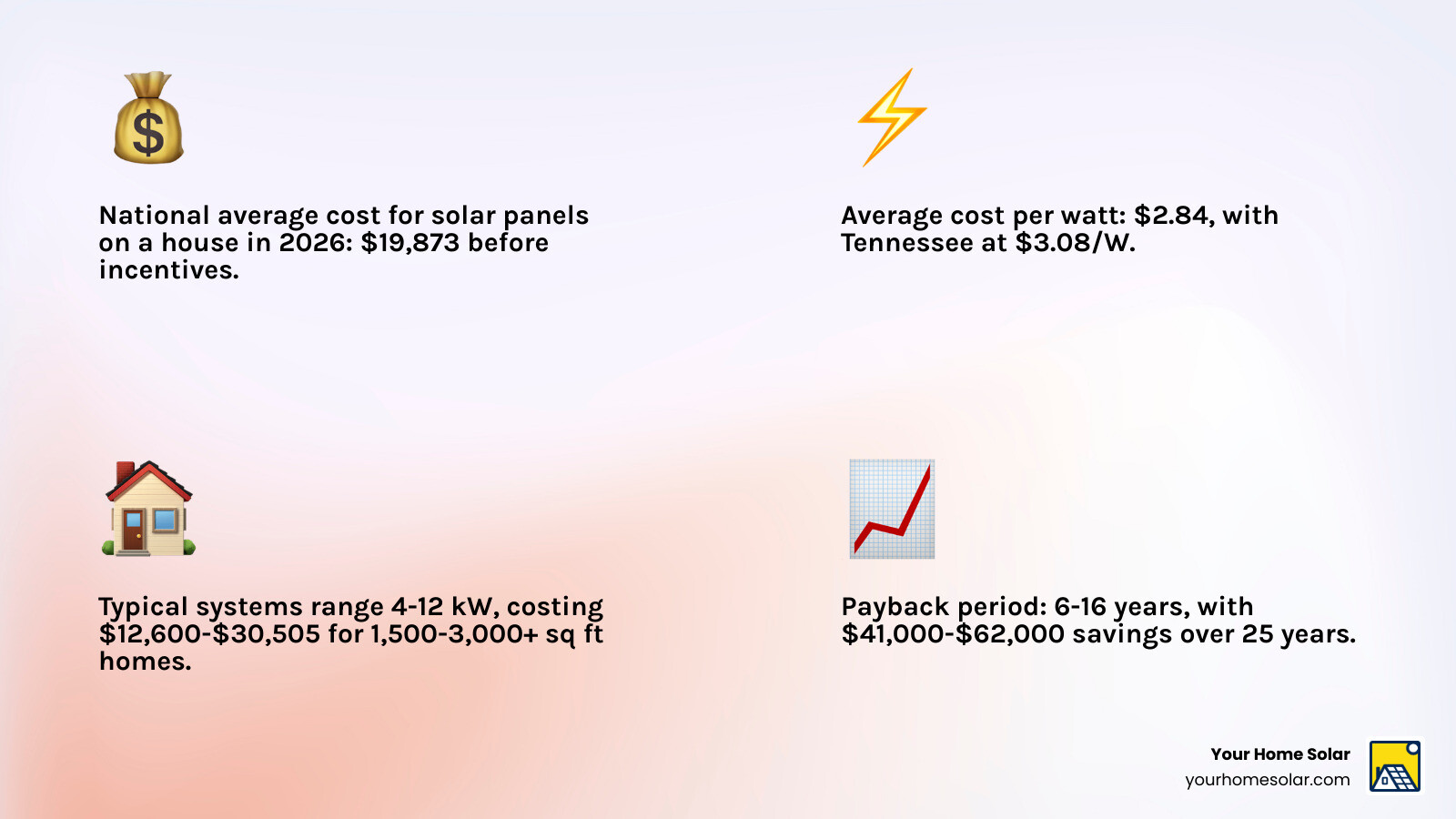
The average cost solar panels house owners pay in 2026 is $19,873 before incentives — but your actual number depends on where you live, how much energy you use, and what size system you need.
Here’s a quick snapshot to answer the most common questions right away:
| System Size | Average Cost (Before Incentives) | Cost Per Watt | Best For |
|---|---|---|---|
| 4-5 kW | $12,600 – $14,000 | ~$2.86/W | Small homes under 1,500 sq ft |
| 6-8 kW | $15,960 – $20,880 | ~$2.61-$2.66/W | Average homes, 1,500-2,500 sq ft |
| 9-12 kW | $22,950 – $30,505 | ~$2.52-$2.55/W | Larger homes, 2,500-3,000+ sq ft |
Key numbers to know:
- National average cost: $19,873 (range: $12,600 to $33,376)
- Average cost per watt: $2.84
- Tennessee homeowners average: ~$20,636 ($3.08/watt)
- Typical payback period: 6-16 years depending on location
- 25-year savings: $41,000 to $62,000 in avoided utility costs
If you’re worried about rising energy bills or losing power during storms, solar is worth a serious look. The upfront cost feels large. But for most homeowners, it’s one of the smartest long-term investments you can make in your home.
I’m Ernie Bussell, founder and CEO of Your Home Solar — the #1 solar energy contractor in East Tennessee — and after years leading operations for a $40 million solar installation company before starting my own, I’ve helped thousands of homeowners understand the average cost solar panels house owners actually pay versus what they expect. Let me walk you through everything you need to know.
Quick look at average cost solar panels house:
- average cost of solar panels per kilowatt
- average solar panel cost per watt
- 2 kilowatt solar system price
Breaking Down the Average Cost of Solar Panels for a House in 2026
When we look at the national landscape in April 2026, the average cost solar panels house owners encounter is approximately $19,873. However, this figure is a “gross” price before any state-specific incentives or tax strategies are applied. For many of our neighbors in Knoxville or Sevierville, the total investment typically ranges from $12,600 for a modest setup to over $33,000 for high-capacity systems.
One of the most important metrics we use to compare quotes is the cost per watt. In 2026, the national average sits at $2.84 per watt. Think of this like the “price per square foot” when buying a home—it allows you to compare different system sizes fairly. Interestingly, as your system gets larger, your cost per watt often goes down. This “bulk buy” effect means a 12 kW system might cost $2.52 per watt, while a smaller 4 kW system might be closer to $2.86 per watt.
For a deeper dive into these figures, you can explore this guide on solar installation costs or check out our specific breakdown for Solar Panel Installation Knoxville Cost/.
Estimating the Average Cost of Solar Panels for a House by Square Footage
While we always recommend sizing a system based on your actual kilowatt-hour (kWh) usage, square footage provides a helpful starting point for budgeting.
- 2,000 sq ft homes: Typically require a system between 7 kW and 9 kW. You can expect an investment range of $18,000 to $25,000.
- 3,000 sq ft homes: These larger properties often need 10 kW to 12 kW systems to offset 100% of their energy use, leading to costs between $25,000 and $30,500.
On average, the average cost solar panels house owners pay per square foot of living space is about $9.34. If you have a high-energy household with multiple HVAC units or an EV charger, these numbers may lean toward the higher end. For a full breakdown of how these sizes impact your wallet, visit our Residential Solar Solutions Guide/Cost And Financing Of Solar Systems/.
Regional Price Variations and the Tennessee Market
Location plays a massive role in your final bill. Labor rates, local permitting fees, and even the “sunniness” of your region affect the market price. In Tennessee, our average cost is slightly higher than the national median at $20,636, which breaks down to roughly $3.08 per watt.
Why the difference? Tennessee has specific permitting requirements and labor market dynamics that differ from states like Arizona or Florida. However, even with a slightly higher upfront cost, the long-term math still heavily favors solar due to our rising utility rates. You can see how we compare to other regions in this 2026 solar cost data report.
Key Factors Influencing Your Solar Investment
No two roofs are the same, which is why we don’t believe in “cookie-cutter” pricing. Several physical and lifestyle factors will swing your quote.
- Energy Usage: Your past 12 months of utility bills tell the real story. If you use 1,200 kWh a month, you’ll need a larger system than someone using 800 kWh.
- Roof Orientation and Pitch: A south-facing roof with a 30-degree slope is the “Goldilocks” zone for solar. If your roof faces north or has heavy shading from East Tennessee’s beautiful oak trees, we may need to install more panels to achieve the same energy output, increasing the cost.
- Panel Efficiency: We primarily use monocrystalline panels because they offer the highest efficiency (up to 24%) and longest lifespan. While polycrystalline panels are cheaper, they require much more roof space to generate the same power, which often isn’t practical for residential roofs.
For those looking for the best value in our area, check out our insights on Affordable Solar Installation In Knoxville Tn/.
Component Breakdown and Hidden Expenses
When you see a quote for $20,000, where is that money actually going? It isn’t just the glass on the roof.
- Hardware (Panels): Believe it or not, the panels themselves only account for about 12% of the total cost.
- Inverters: These are the “brains” that convert DC power to AC power for your home. These make up roughly 10% of the investment.
- Soft Costs: This is the largest chunk—about 50-60%—covering labor, permitting, inspections, and the installer’s overhead.
The “Hidden” Costs to Watch For:
- Battery Storage: Adding a battery like a Generac PWRcell or Tesla Powerwall provides energy security during outages but adds $7,000 to $18,000 to the project.
- Main Lug/Panel Upgrades: If your home has an older 100-amp electrical panel, you’ll likely need an upgrade to 200 amps (costing $1,500–$3,000) to handle the solar input.
- Roof Condition: Solar panels last 25–30 years. If your roof is more than 10 years old, we often recommend replacing it first so you don’t have to pay to remove and reinstall the panels later.
For more on these secondary costs, see the 2026 ConsumerAffairs solar guide.
Maximizing ROI: Incentives, Savings, and Payback Periods
The “sticker price” of solar is rarely what you actually pay. In 2026, the landscape for incentives has shifted, but the savings remain substantial.
While the federal tax credit (ITC) saw major changes at the end of 2025, many homeowners in 2026 are looking toward state-level programs and utility-specific rebates to bridge the gap. In Tennessee, we don’t have a state-wide income tax credit, but we do have property tax exemptions for solar installations—meaning your home value goes up, but your taxes don’t!
We’ve put together a comprehensive Solar Incentives Tennessee 2026 Guide/ and a deeper look at Tax Credits Incentives/ to help you find every available dollar.
Calculating Your Personal Payback Period
The “Payback Period” is the moment your solar system has paid for itself through avoided electricity bills.
- National Average: ~10 years.
- Tennessee Average: ~16.44 years.
While 16 years might sound long, solar panels are warrantied for 25 years and often last 30+. After that payback point, your electricity is essentially free. Over the life of the system, the average homeowner saves between $41,000 and $62,000. Plus, studies show that solar adds about 4% to your home’s resale value. For a $400,000 home in Maryville or Farragut, that’s a $16,000 boost in equity!
You can read more about why solar costs in 2026 might be lower than you think when factoring in these long-term gains.
Financing Your System: Cash vs. Loans vs. Leases
How you pay for your system changes your total ROI. We always want our customers to choose the path that fits their monthly budget.
- Cash Purchase: This offers the highest ROI. You own the system outright, get the quickest payback, and often receive a “cash discount” from installers.
- Solar Loans: This is the most popular option in East Tennessee. It allows you to go solar for $0 down. However, be wary of “dealer fees” which can add up to 19.99% to the principal of the loan. We help our customers find transparent Solar Home Energy Financing In East Tennessee/ that avoids these traps.
- Leases and PPAs: You don’t own the system; you just pay for the power it produces. While this has the lowest upfront cost, you lose out on the tax incentives and the long-term home value increase.
Frequently Asked Questions about Solar Costs
What is the average cost of solar panels for a house in 2026?
The national average cost solar panels house owners pay is $19,873 before incentives. This typically covers a 7 kW to 8 kW system. In Tennessee, the average is slightly higher at $20,636 due to local labor and permitting factors.
How do I determine the right system size for my home?
The easiest way is to look at your annual electricity usage in kWh. Divide that number by 1,200 (a rough estimate of how much 1 kW of solar produces in our region). For example, if you use 12,000 kWh per year, you need a 10 kW system. We always perform a detailed energy audit to ensure your system isn’t over- or under-sized.
Is the average cost of solar panels for a house worth the investment?
Yes. When you consider that utility rates in Tennessee rise by an average of 3-5% annually, solar acts as a “hedge” against inflation. With lifetime savings often exceeding $50,000 and a 4% increase in home value, the ROI is far better than most traditional savings accounts or even some stock market investments.
Conclusion
At Your Home Solar, we know that the average cost solar panels house owners face can feel overwhelming at first glance. But our mission is to make energy independence accessible and rewarding for every family in East Tennessee. Whether you are in Knoxville, Johnson City, or the quiet hills of Roane County, we provide tailored energy solutions that go beyond just panels.
We specialize in integrating solar with whole-home backup generators and EV chargers, ensuring your home is a fortress of reliability. Our 100% customer satisfaction guarantee means we aren’t happy until your meter is spinning backward and your bills are plummeting.
Ready to see your actual numbers? Find more info about solar costs and financing or reach out to us today for a personalized quote. Let’s build your energy future together.