What Does a 335 Watt Solar Panel Price Actually Look Like in 2026?
The 335 watt solar panel price ranges widely depending on where you buy, how many you need, and whether you’re pricing panels alone or a fully installed system.
Here’s a quick breakdown so you can compare at a glance:
| Buying Scenario | Price Per Watt | Estimated Panel Cost |
|---|---|---|
| Bulk/equipment market (truckload) | ~$0.23/W | ~$77/panel |
| Retail pallet (8–12 panels) | ~$0.23–$0.26/W | ~$230–$270/panel |
| Mid-range retail (single panel) | ~$0.55–$0.80/W | ~$185–$270/panel |
| Premium residential (e.g. LG NeON) | ~$1.24/W | ~$415/panel |
| Installed home solar system | $2.50–$4.00+/W | Varies by system size |
Note: Panel-only prices don’t include shipping, labor, permits, inverters, or racking — all of which add significantly to your real-world cost.
The 335W module was one of the most widely used panel sizes in residential and commercial solar installations for several years. While newer high-wattage panels have taken center stage, 335W panels remain available — and understanding their pricing helps you make a smarter decision, whether you’re replacing existing panels or evaluating a full system.
In this guide, we break down exactly what drives 335W panel prices, how they stack up against other wattages, and what East Tennessee homeowners should consider before buying.
I’m Ernie Bussell, founder and CEO of Your Home Solar, the #1 solar energy contractor in East Tennessee — and with over five years of hands-on solar operations and sales experience, I’ve helped hundreds of homeowners navigate the 335 watt solar panel price landscape to find what actually makes sense for their home and budget. Let’s dig in.
Easy 335 watt solar panel price glossary:
335 Watt Solar Panel Price in 2024–2026: What Buyers Should Expect
As of May 2026, 335W panels sit in an interesting part of the solar market. They are not usually the newest flagship residential modules anymore, but they are still common in replacement projects, off-grid systems, small arrays, pallet bundles, and discounted equipment inventories.
That means pricing can look surprisingly different depending on the buying channel.
| Buying Type | Typical 335W Price Per Watt | Approximate Cost Per 335W Panel | Best For |
|---|---|---|---|
| Commercial truckload or wholesale equipment | $0.23–$0.45/W | $77–$150 | Large orders, commercial procurement |
| Retail pallet bundles | $0.23–$0.80/W | $77–$270 | DIY, off-grid, small bulk orders |
| Single-panel retail | $0.40–$1.25/W | $135–$415 | Replacements, small projects |
| Complete off-grid kit with batteries/inverters | Around $1.69/W in one researched example | System-based | Cabins, backup, remote power |
| Installed residential solar | Often $2.50–$4.00+/W | System-based | Homeowners wanting turnkey solar |
The big lesson: do not compare a $77 wholesale panel to a professionally installed home solar quote and assume someone is hiding gold bars in the racking. Panel-only cost is only one slice of the system.
Average 335 watt solar panel price per watt for single panels
For single-panel retail purchases, the 335 watt solar panel price commonly lands around $0.40–$1.25 per watt, or roughly $135–$415 per panel.
Examples from the current and recent market include:
- Budget or clearance modules: often around $135–$185 per panel
- Mid-range retail modules: often around $185–$270 per panel
- Premium residential modules: around $400+ per panel in some listings
A premium 335W module such as an LG NeON 2 335W panel has been listed around $415, or about $1.24/W. That higher cost reflects residential aesthetics, stronger brand positioning, high efficiency around 19.6%, and long warranty coverage.
On the other hand, some 335W panels in bulk or pallet quantities price far lower per watt. For homeowners, though, freight matters. A panel that looks cheap online can become less exciting once shipping, liftgate delivery, taxes, and compatibility checks enter the chat.
Bulk-equipment 335 watt solar panel price per watt
Bulk-equipment pricing is where 335W panels can look almost suspiciously inexpensive.
Some commercial truckload listings for 335W panels have been around $0.23/W, or roughly $77 per panel. Rich Solar MEGA 335W pallet bundles have also appeared in multi-panel quantities at pricing that works out to roughly $0.23–$0.26/W in some cases, depending on quantity and promotion.
You can review examples of 335W product listings here:
- Rich Solar MEGA 335 Solar Panel
- Rich Solar MEGA 335 Solar Panel from Solar Guys Pro
- Rich Solar MEGA 335 Watt Monocrystalline Solar Panel from OffGrid Lux
- Rich Solar MEGA 335 Premium Grid-Tie or Off-Grid Option
Bulk pricing usually comes with catches:
- Minimum order quantities
- Freight delivery instead of parcel shipping
- Limited inventory windows
- Pallet or truckload purchase requirements
- Potentially older model years
- More responsibility on the buyer for storage, inspection, and compatibility
Our advice: compare the delivered cost, not just the advertised panel cost.
Installed 335W solar panel cost for homeowners
Installed solar costs more because you are buying a working power system, not just rectangles with wires.
A professionally installed system may include:
- Solar panels
- Roof attachment hardware
- Rails and racking
- Microinverters or string inverter equipment
- Rapid shutdown equipment
- Wiring and conduit
- Monitoring
- Permitting
- Engineering and design
- Utility interconnection
- Electrical labor
- Inspections
- Warranty support
That is why installed home solar is often priced in dollars per watt at the system level, not the panel level. A $150 panel does not equal a $150 solar installation. If only.
For a deeper breakdown, see our guide to installed solar panel prices.
How 335W Panels Compare With 300W, 400W, and 500W Solar Panels

335W panels are the middle child of modern solar: not tiny, not massive, and often very practical.
| Panel Wattage | General Market Position | Residential Fit |
|---|---|---|
| 300W | Older/smaller module class | Good for replacements and small arrays |
| 335W | Common legacy residential size | Good for replacements, additions, off-grid |
| 400W | Current common residential class | Often better for new home systems |
| 500W | Larger commercial-style class | Useful when layout and handling allow |
335W vs 300W panels
Compared with 300W panels, 335W panels provide about 12% more output per module. That means fewer panels for the same system size.
For example:
- 4,020W system with 300W panels: about 14 panels
- 4,020W system with 335W panels: about 12 panels
That can help when roof space is limited. If you are comparing older panel sizes, our guide on 300W solar panel prices is a helpful companion. Smaller specialty panels still have their place too, especially for RVs and compact systems, as we explain in our 180W solar panel price comparison.
335W vs 400W panels
For new residential systems in East Tennessee, 400W-class panels often make more sense than 335W panels because they produce more power per module and may reduce labor per installed watt.
A 6.7kW array would need:
- 20 panels at 335W
- 17 panels at 400W
That panel-count difference can matter on roofs with vents, dormers, chimneys, skylights, shade, or odd angles. In Knoxville, Maryville, Johnson City, Kingsport, and surrounding East Tennessee communities, roof layout often decides what works best.
However, 335W panels can still win when:
- You are matching an existing array
- A specific inverter has wattage limits
- You find verified, compatible inventory at a strong delivered price
- The project is off-grid or ground-mounted
For broader pricing trends, see solar panel costs in 2026.
335W vs 500W panels
500W panels produce more power, but they are usually physically larger and heavier. That can be great for commercial roofs, ground mounts, barns, and large open structures.
For many homes, though, bigger is not always better. Large modules can be harder to fit around roof obstacles and may require more careful handling. If the roof has limited usable sections, a slightly smaller module can sometimes create a cleaner layout.
For large-scale context, check out our guide to 100kW solar setup costs.
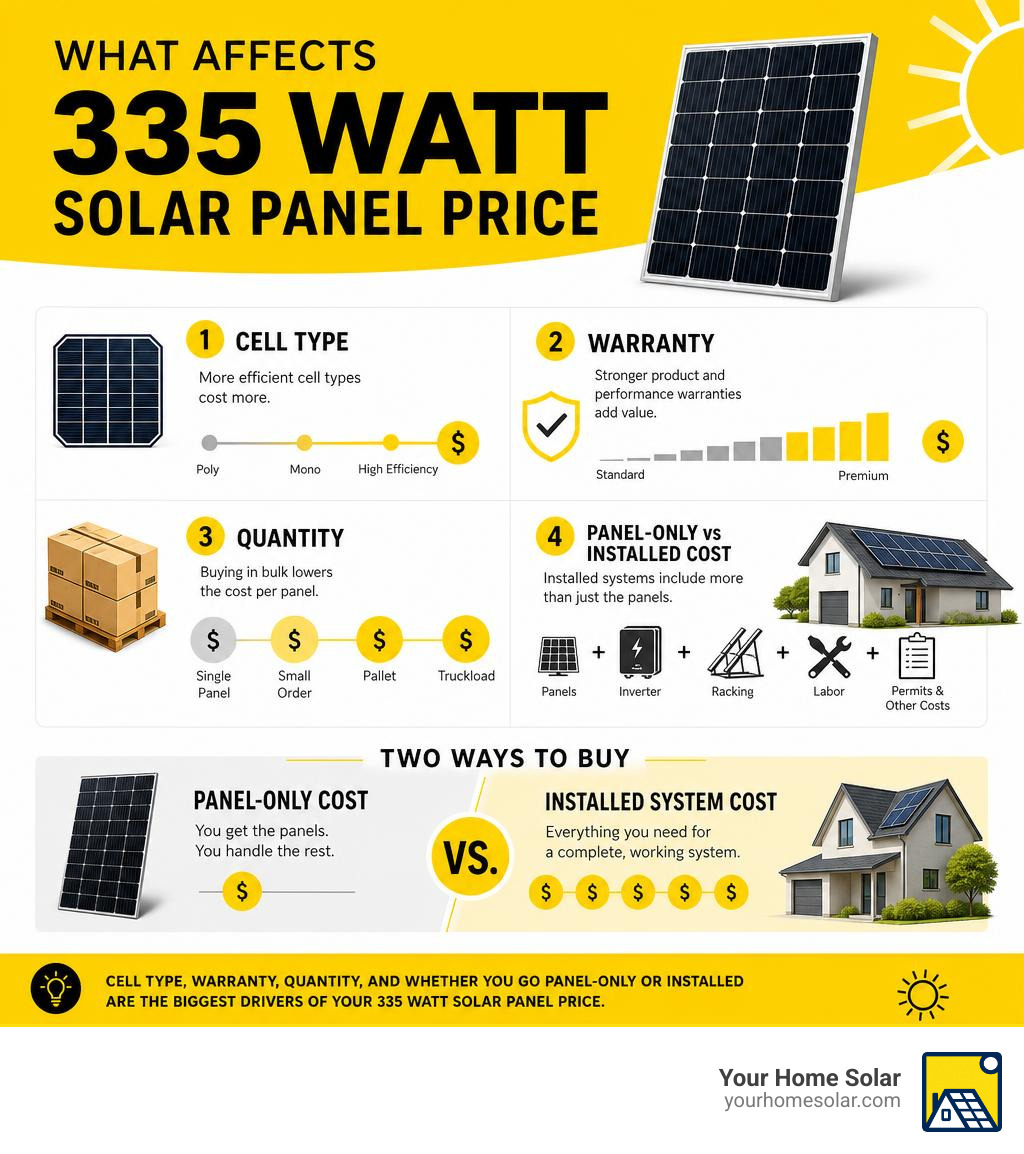
What Changes the Cost of a 335W Solar Panel?

A 335W panel is not automatically equal to every other 335W panel. Same wattage, different story.
The price changes based on:
- Brand tier
- Cell type
- Efficiency
- Warranty
- Degradation rate
- Frame color and aesthetics
- Certifications
- Voltage and system compatibility
- Durability ratings
- Availability and shipping
Cell type and efficiency
Common 335W cell technologies include:
- Polycrystalline: often lower cost, commonly around 17% efficiency
- Monocrystalline: usually better efficiency and stronger low-light performance
- Mono PERC: improved energy capture compared with older mono designs
- N-type or TOPCon: newer high-efficiency technology, less common in older 335W inventory
Research examples show the spread clearly:
- Adani 335W PERC commercial panels: about 17.09% efficiency
- Hyundai 335W modules: about 17.1% efficiency
- LG NeON 2 335W panels: about 19.6% efficiency
- Some Rich Solar MEGA 335 PRO listings claim very high maximum efficiency, tied to newer cell technology
Higher efficiency matters most when roof space is limited. If you have a wide-open ground mount, price per watt may matter more than squeezing every watt onto a roof plane.
Warranty and degradation
Typical 335W panel warranties include:
- 10-year product warranty on many standard modules
- 12-year product warranty on some premium residential modules
- 25-year product warranty on select higher-tier modules
- 25-year performance warranty on many panels
Performance warranties commonly guarantee roughly 80% or more of original output after 25 years. Some researched examples show:
- About 80% output after 25 years
- About 81.18% output after 25 years
- Annual degradation around 0.6% to 0.68% after the first year
This matters because your solar panels are not just a one-year purchase. A slightly more expensive panel with a stronger warranty and lower degradation may deliver better long-term value.
Temperature coefficient and real-world performance
Solar panels are tested at standard lab conditions, but East Tennessee roofs are not laboratories. They are hot, humid, pollen-dusted, storm-tested, real-world surfaces.
Temperature coefficient tells you how much output drops as panel temperature rises. One researched 335W PERC panel listed performance loss around -0.31% per degree Celsius equivalent above test temperature. That is solid.
In practical terms:
- Hot summer roofs reduce output somewhat
- Cooler sunny winter days can be surprisingly productive
- Shade still hurts production
- Low-light performance varies by cell type and module quality
For homes in Knoxville, Oak Ridge, Sevierville, Morristown, and the Tri-Cities, we design around seasonal sunlight, roof pitch, shade patterns, and utility interconnection rules.
System components that affect final installed price
The panel is only one component. Final installed price can change because of:
- Roof height and pitch
- Shingle, metal, or specialty roofing
- Main electrical panel condition
- Trenching for ground mounts
- Battery backup
- Generator integration
- EV charger integration
- Inverter type
- Monitoring features
- Permitting and inspection requirements
To understand the full picture, read our guide on what affects solar costs before you buy.
Best 335W Solar Panel Price Categories for Homeowners
Here is the practical way we group 335W panels for homeowners.
- Budget 335W panels: lowest equipment price, more availability and warranty questions
- Mid-range 335W panels: balanced cost, compatibility, and performance
- Premium 335W panels: higher price, better aesthetics, stronger specs
- Kit-based 335W systems: bundled with batteries, inverter, and hardware
- Replacement 335W panels: chosen to match existing electrical and physical specs
Budget 335W panels
Budget 335W panels may show up around $0.23–$0.45/W in equipment markets, especially in larger quantities or older inventory.
They can be useful for:
- Ground mounts
- Farms and workshops
- Backup systems
- DIY off-grid projects
- Replacing older panels when specs match
But homeowners should verify:
- UL or other relevant certification
- Voltage and current compatibility
- Connector type
- Dimensions
- Racking fit
- Warranty transferability
- Whether the model is still supported
A cheap panel that does not work with your inverter is not a bargain. It is garage decor.
Mid-range 335W panels
Mid-range 335W panels often land around $0.55–$0.80/W when purchased in smaller quantities. This category can include reliable monocrystalline modules suitable for small residential or off-grid systems.
Look for:
- Mono or mono PERC cells
- 25-year performance warranty
- Clear electrical specs
- Compatible Vmp and Voc ratings
- Good mechanical load ratings
- Reputable product documentation
Rich Solar MEGA 335 products, for example, are commonly positioned for grid-tie, off-grid, RV, agricultural, and residential-style use. Some listings include 25-year output warranties and pallet quantities.
Premium residential 335W panels
Premium 335W panels can cost around $1.00–$1.25/W, with single-panel prices near $400+ in some examples.
Premium features may include:
- Higher efficiency
- Black frame or better roof appearance
- Stronger product warranty
- Better degradation terms
- Better low-light performance
- Higher mechanical load ratings
Older premium 335W panels can be especially useful for replacing modules in an existing premium array where appearance and electrical matching matter.
Are 335W Solar Panels Still a Good Value?
Yes, but not for every project.
335W panels are still a good value when the price is right, the specs match the system, and the layout benefits from that module size. For brand-new residential systems, newer 400W-class panels often provide better overall economics.
For more general cost context, see our guide to average home solar costs.
Residential installations
For East Tennessee homeowners, 335W panels can still work well on:
- Smaller homes
- Detached garages
- Workshops
- Ground-mounted systems
- Cabin or backup systems
- Replacement projects
- Budget-conscious expansions
System size examples:
| System Size | Number of 335W Panels |
|---|---|
| About 2kW | 6 panels |
| About 4kW | 12 panels |
| About 6kW | 18 panels |
| About 10kW | 30 panels |
For more system-size examples, visit our guides on 4kW solar system prices and 2kW solar system prices.
Home system expansion and replacement panels
335W panels are especially valuable when replacing or expanding an older system.
Before adding panels, we review:
- Existing inverter limits
- String voltage
- Microinverter compatibility
- Roof attachment layout
- Panel dimensions
- Racking condition
- Electrical code updates
- Utility interconnection requirements
Mixing panels is possible in some designs, but it must be done carefully. A mismatch can reduce performance or create code and warranty headaches.
Panel-only pricing vs installed solar pricing
Panel-only pricing is tempting because it is simple. Installed pricing is more important because it tells you what the working system costs.
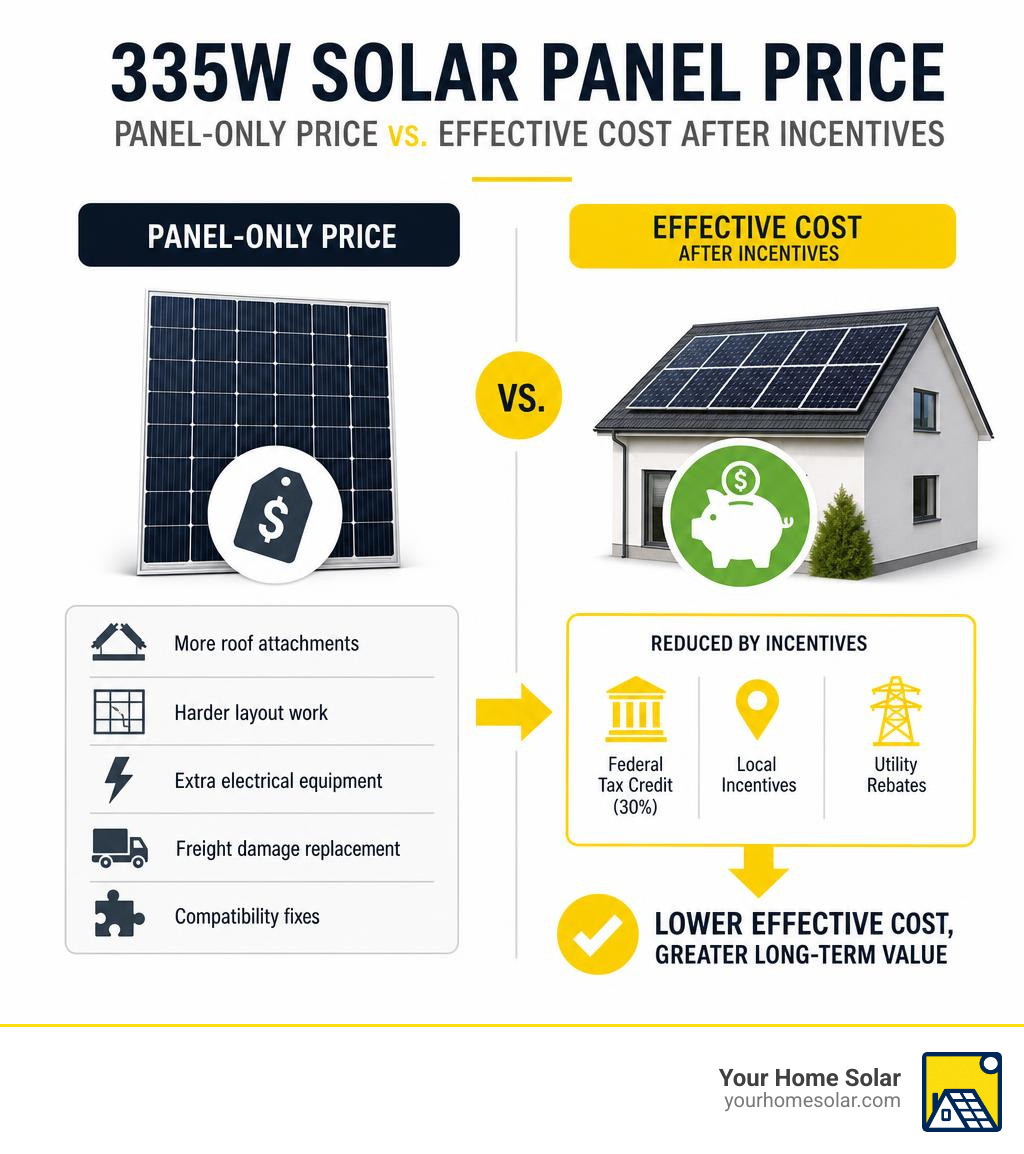
A low panel price may not lead to the lowest system price if it requires:
- More labor
- More roof attachments
- Harder layout work
- Extra electrical equipment
- Freight damage replacement
- Compatibility fixes
That is why we focus on total installed value. For more, see our installed panel price guide.
Incentives, Rebates, and Effective 335W Solar Panel Cost
Incentives can reduce the effective cost of a 335W-based solar system, especially when panels are part of a complete installed project.
Federal tax credit impact
As of 2026, the federal Residential Clean Energy Credit can cover 30% of eligible solar project costs for qualifying homeowners.
Eligible costs may include:
- Solar panels
- Inverters
- Racking
- Wiring
- Permitting
- Installation labor
- Battery storage, if it qualifies under current rules
Important note: a tax credit reduces tax liability. It is not the same as an instant rebate check. We always recommend speaking with a qualified tax professional about your specific situation.
Local and utility incentives
In East Tennessee, local utility policies can vary by service territory. Interconnection rules, net billing structures, meter requirements, and rebate availability are not identical everywhere.
That is why homeowners in Knoxville, Farragut, Powell, Maryville, Oak Ridge, Johnson City, Kingsport, Morristown, Sevierville, and nearby counties should confirm:
- Utility interconnection process
- Export credit structure
- Metering requirements
- Permitting rules
- Battery backup options
- Any local rebate or financing programs
Our solar cost and financing guide explains the major options.
Financing and payback considerations
The best financial choice depends on your goals.
Common paths include:
- Cash purchase: highest long-term ownership value
- Solar loan: lower upfront cost, monthly payment structure
- Solar plus battery: higher cost, better backup capability
- Solar plus generator or EV charger: whole-home energy planning
When comparing quotes, ask whether the price is close to market norms. Our guide, Is $3 per watt a fair solar price?, can help.
Frequently Asked Questions About 335 Watt Solar Panel Price
What is the average 335 watt solar panel price in 2026?
In 2026, the average 335 watt solar panel price ranges from about $135–$415 per panel for retail single-panel purchases. On a price-per-watt basis, that is roughly $0.40–$1.25/W.
Bulk-equipment pricing can be much lower, around $0.23–$0.45/W in some cases, but usually requires larger orders and freight shipping. Installed residential solar costs more because it includes design, permitting, racking, inverters, labor, inspection, and utility approval.
Is a 335W solar panel better than a 400W panel?
Not usually for a brand-new residential system. A 400W panel often produces more energy per module, reduces panel count, and can improve roof-space efficiency.
A 335W panel may be better when:
- It matches an existing system
- The delivered price is excellent
- The roof layout fits smaller modules better
- The project is off-grid or ground-mounted
- Replacement compatibility matters more than maximum wattage
How many 335W panels do I need for a home solar system?
It depends on your energy usage and available sun exposure.
Quick estimates:
- 2kW system: about 6 panels
- 4kW system: about 12 panels
- 6kW system: about 18 panels
- 10kW system: about 30 panels
A typical home may need more or fewer panels depending on monthly kWh usage, roof orientation, shade, and whether batteries or EV charging are included. For more pricing basics, see our essential guide to solar panel cost.
Should I buy 335W solar panels myself or work with an installer?
If you are buying one replacement panel and know the exact specs you need, buying directly can make sense.
For a home solar system, we recommend working with an installer. Professional design helps ensure:
- Code compliance
- Roof safety
- Utility approval
- Correct inverter matching
- Proper racking
- Warranty support
- Long-term performance
At Your Home Solar, we help homeowners compare equipment, incentives, backup options, and installed cost so the system fits the home, not just the shopping cart.
Conclusion
The 335 watt solar panel price can look low, high, or confusing depending on whether you are comparing wholesale panels, retail pallet bundles, premium single modules, off-grid kits, or complete installed systems.
Here is the simple buying checklist:
- Compare price per watt
- Check delivered cost, not just advertised cost
- Verify warranty and degradation terms
- Confirm electrical compatibility
- Consider roof space and layout
- Compare against newer 400W-class panels
- Include inverters, racking, permits, labor, and inspections
- Apply available tax credits and incentives correctly
335W panels can still be a smart choice for replacements, expansions, small systems, off-grid projects, and budget-sensitive installations. For many new residential projects, however, newer higher-wattage panels may provide better installed value.
If you are in East Tennessee and want a clear answer for your roof, your utility, and your budget, we can help you sort the numbers without the solar jargon headache.
Ready to compare real options? Explore solar cost and financing options.