What Does a 440 Watt Solar Panel Actually Cost in 2026?
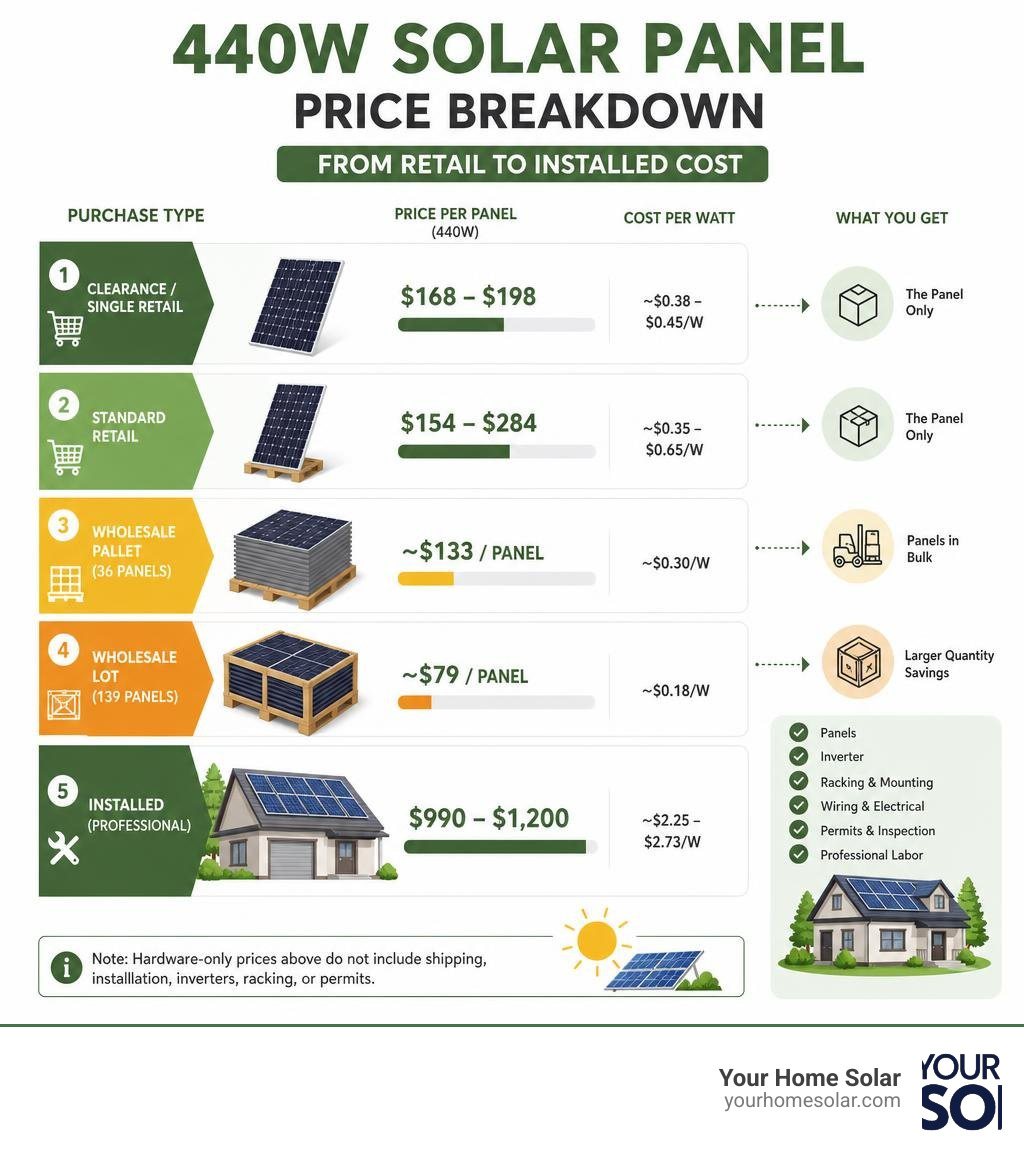
The 440 watt solar panel price varies widely depending on where you buy, how many you order, and what technology you choose. Here’s a quick snapshot so you can compare at a glance:
| Purchase Type | Price Per Panel | Cost Per Watt |
|---|---|---|
| Clearance / Single Retail | $168 – $198 | ~$0.38 – $0.45/W |
| Standard Retail | $154 – $284 | ~$0.35 – $0.65/W |
| Wholesale Pallet (36 panels) | ~$133/panel | ~$0.30/W |
| Wholesale Lot (139 panels) | ~$79/panel | ~$0.18/W |
| Installed (professional) | $990 – $1,200/panel | ~$2.25 – $2.73/W |
Note: Hardware-only prices above do not include shipping, installation, inverters, racking, or permits.
The gap between a bare panel price and a fully installed system price surprises a lot of homeowners. A panel that costs $172 at an online retailer can cost $990 or more per panel once a certified installer adds labor, racking, wiring, permits, and equipment. That’s not a markup — that’s the real cost of a system that works safely and qualifies for incentives.
I’m Ernie Bussell, Founder and CEO of Your Home Solar, and after leading operations for a $40 million per year solar company and building East Tennessee’s top-rated solar contractor, I’ve seen how confusing 440 watt solar panel prices can be for homeowners trying to make a smart decision. In the sections below, I’ll break down every layer of cost so you know exactly what you’re paying for.
440 watt solar panel price definitions:
Understanding the Average 440 Watt Solar Panel Price
When you start shopping for solar equipment in July 2026, you will notice that the raw hardware costs are lower than ever before. However, the price you pay depends heavily on how you buy. A single panel purchased for a DIY project, a replacement, or an RV setup has a completely different cost structure than buying panels by the pallet or hiring a professional team for a turn-key residential installation.
For individual panels, the average retail price ranges from $168.96 to $238.39, depending on the brand and technology. If you are hunting for a bargain, you can find a Sunpro Power 440W Solar Panel Clearance deal online for around $172.99 to $198.00 per panel. Alternatively, budget-friendly options like the ZnShine 440W Bifacial Solar Panel can be found for as low as $154.00.
On the premium end, highly specialized modules or those with extensive aesthetic upgrades (like all-black frames and backsheets) can reach up to $283.67, as seen with the VSUN Solar VSUN440N-108BMH-BB 440W Bifacial Solar Panel.
Understanding these raw hardware costs is the first step in planning your budget. But remember, the panels themselves represent only a portion of your total project cost. To get a realistic picture of your overall budget, it is helpful to look at More info about average solar panel costs to see how these hardware prices fit into a complete system design.
Retail vs. Wholesale 440 Watt Solar Panel Price Breakdown
If you are planning a large-scale installation, buying individual panels at retail prices is the least economical route. The solar industry operates on massive volume, meaning wholesale purchasing can slash your hardware costs by more than half.
Let’s look at how the numbers change when you scale up your order:
- Single Retail Panels: $154 to $284 per panel ($0.35 to $0.65 per watt). This is ideal for small off-grid setups, marine applications, or replacing a damaged panel in an existing array.
- Wholesale Pallets: Buying a standard pallet (typically 36 panels) drops the price significantly. For example, a pallet of Talesun 440W panels might cost around $4,766.40, which translates to roughly $132.40 per panel, or $0.30 per watt.
- Container/Truckload Lots: For massive commercial projects or community solar arrays, buying by the container load offers the absolute lowest price floor. A wholesale lot of 139 Talesun 440W panels can be purchased for $11,008.80, bringing the cost down to an astonishing $0.18 per watt. If you are looking at utility-scale volume, a Seraphim 440W TOPCon Bifacial Container Wholesale order of 792 panels per container (truckload) represents the peak of bulk purchasing power.
While these wholesale numbers look incredibly enticing, DIY buyers must beware of the hidden logistics. Individual panels are too large and fragile for standard parcel shipping (like UPS or FedEx Ground). They must ship via freight, which typically carries a minimum charge of $199 to $250.
Additionally, many online wholesale distributors enforce strict minimum order quantities (such as a 2-panel or 10-panel minimum) and may require you to have a forklift or loading dock at the delivery site. If you are trying to calculate the true cost of sourcing your own hardware, make sure to read this guide on Unpacking solar equipment costs to avoid expensive shipping surprises.
Key Factors That Influence 440W Solar Panel Costs
Why does one 440W panel cost $154 while another costs $284? It isn’t just arbitrary brand markup. The price is driven by the underlying technology, cell architecture, efficiency ratings, and the strength of the manufacturer’s warranty.
When evaluating panels, the main technical drivers of cost include:
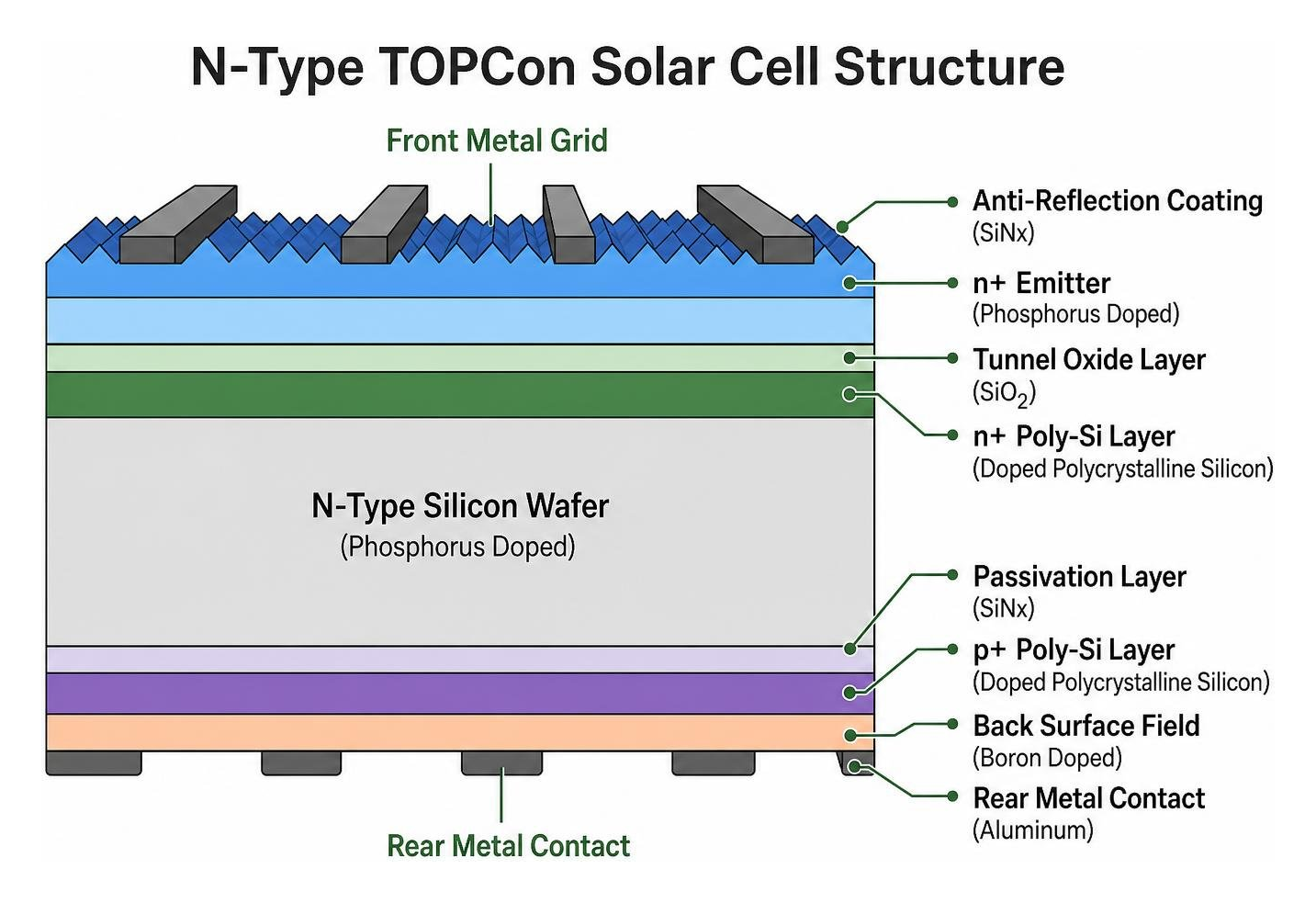
- Cell Technology (N-Type TOPCon vs. P-Type): Most modern 440W panels in July 2026 utilize N-Type TOPCon (Tunnel Oxide Passivated Contact) technology. N-type cells are chemically superior to older P-type cells because they suffer from far less Light-Induced Degradation (LID) and perform much better in hot weather. This advanced chemistry carries a slight price premium but ensures the panel degrades at a slower rate (often just 0.4% per year compared to 0.7% for older technologies).
- Module Efficiency: Efficiency measures how much of the sunlight hitting the panel is converted into usable electricity. Premium 440W panels boast efficiencies up to 22.53% or higher, allowing them to pack more power into a smaller physical footprint.
- Temperature Coefficient: Solar panels actually lose efficiency as they get hot. A panel’s temperature coefficient tells you how much power it loses for every degree above 77°F (25°C). Premium panels have a low temperature coefficient (around -0.28% to -0.29% per °C), meaning they keep producing high power even during scorching East Tennessee summers.
- Warranty Terms: A budget panel might only offer a 12-year product warranty. Premium brands like REC, Maxeon, or Qcells offer 25-year, 30-year, or even 40-year product and performance warranties. These guarantees ensure that the panels will still produce 85% to 92% of their original rated power after three decades.
When you look at top-tier brands quoted on platforms like EnergySage, the average cost per watt for a fully installed system using premium 440W panels ranges from $2.25/W (for highly efficient budget-friendly options like the Hyundai NF(BK)) to $2.73/W (for ultra-premium options like the Maxeon 6).
If you are trying to decide whether to pay a premium for top-tier brands or save money with budget hardware, it helps to read this analysis on Understanding your solar investment to see how equipment quality impacts your long-term return on investment. If you want a closer look at a premium, highly durable double-glass option, check out the VSUN 440W Bifacial Black Frame Solar Panel specifications to see what premium engineering looks like under the hood.
How Technology Impacts the 440 Watt Solar Panel Price
The battle between different solar technologies has a direct impact on the 440 watt solar panel price. The most significant technological choice you will face is choosing between monofacial (single-sided) and bifacial (double-sided) panels.
- Monofacial Panels: These are traditional solar panels that only absorb light on the front side. They are generally cheaper and have a solid, opaque backsheet (often white or black).
- Bifacial Panels: These panels have a transparent backsheet or double-glass design, allowing the solar cells to absorb light that reflects off the ground or roof onto the backside of the panel. This backside absorption is known as the albedo effect.
Bifacial panels like the Hanersun Hitouch 5N 440W (priced around $0.39/W) or the Sunpro Power 440W TOPCon Bifacial panel can generate up to 15% to 30% more energy than their nominal rating when installed correctly. Under optimal conditions, a 440W bifacial panel can behave like a 506W to 542W powerhouse!
However, this extra rear-side power gain is only realized if the panels are mounted over a highly reflective surface (like light-colored gravel, a white flat roof membrane, or snowy ground) and have enough space beneath them for light to bounce. If you are flush-mounting panels flat against a dark shingle roof, a bifacial panel will act just like a monofacial panel, meaning the extra cost for the double-glass design is not justified.
To see how these technological shifts have lowered the cost of high-efficiency equipment over time, check out our Guide to solar panel costs in 2026.
Hidden Costs and Balance of System Equipment
If you are planning a DIY project, buying a 440W panel for $170 is only the tip of the iceberg. To turn that panel into a safe, functioning power source for your home, you must account for the Balance of System (BOS) equipment and professional installation costs.

Here are the real-world costs and equipment you need to factor in:
- Inverters: Solar panels produce Direct Current (DC) electricity, but your home runs on Alternating Current (AC). You will need a string inverter or individual microinverters (like Enphase) to convert the power. This typically adds $0.40 to $0.60 per watt to your system cost.
- Racking and Mounting: Your panels must be securely fastened to your roof or ground mount to withstand heavy winds (up to 2400 Pa) and snow loads (up to 5400 Pa). Standard aluminum racking, mid-clamps, end-clamps, and flashing kits add $0.15 to $0.25 per watt.
- Wiring, Combiner Boxes, and Safety Disconnects: Electrical safety hardware, heavy-duty outdoor wiring, and junction boxes are essential for a code-compliant installation.
- Shipping and Logistics: Because of their size (typically 68″ x 45″ x 1.38″) and weight (around 46 to 54 lbs per panel), shipping a small order of panels requires freight delivery, which starts at $199 to $250.
- Permitting and Interconnection: Before you can turn your system on, you must submit electrical drawings to your local utility, pay for building permits, and pass a professional inspection.
For DIY enthusiasts, complete kits are sometimes sold to simplify the process. For example, the Nature Power 440-Watt Polycrystalline Solar Panel kit at The Home Depot retails for $647.64. While this sounds convenient, it utilizes older, less efficient polycrystalline technology and only includes a basic 750W inverter and 30 Amp charge controller designed for off-grid RV or marine use — not for powering a modern home.
For residential installations in East Tennessee, we strongly advise against the DIY route. In our region, local power companies (such as BrightRidge, Knoxville Utilities Board, or other municipal providers connected to the Tennessee Valley Authority) have strict policies. In most areas, utilities may disconnect power to homes with self-installed, uncertified solar systems due to safety risks like grid feedback.
Furthermore, major solar manufacturers will completely void their 25-to-30-year warranties unless the equipment is installed by a certified professional holding credentials like a NABCEP PVIP (Board Certified PV Installation Professional) certification.
To understand the full scope of what goes into a professional, code-compliant residential installation, explore our Essential guide to solar panel costs and read our breakdown of Your home’s solar investment and installation prices.
Comparing 440W Panels to Other Residential Sizes
How does a 440W solar panel compare to other common sizes on the market? The main difference comes down to physical size and power density (how many watts of power you can generate per square foot of roof space).
Let’s look at how 440W panels stack up against other popular capacities:
- 180W Panels: These are much smaller, highly portable panels. They are fantastic for camping, boats, and small off-grid cabins, but their low power density makes them completely impractical for residential roofs. You would need more than double the amount of racking, wiring, and roof penetrations to match the output of a single 440W panel. Read our 180W solar panel price comparison for more details.
- 300W to 335W Panels: A few years ago, 300W to 335W panels were the industry standard for residential roofs. While they are still widely available, they utilize older cell designs and lower efficiencies. Choosing these means you will need to buy and install more physical panels to meet your household energy goals, cluttering your roofline. You can compare their costs in our 300W solar panel price guide and our 335W solar panel price guide.
- 440W Panels: Utilizing 108 half-cut or 144 half-cut N-type cells, 440W panels represent the “sweet spot” for modern residential and light commercial roofs in July 2026. They offer incredible power density, meaning you need fewer total panels, fewer roof attachments, and less labor time to build a high-performing system that looks sleek and uncluttered.
Frequently Asked Questions About 440W Solar Panels
How many 440W solar panels do I need for my home?
The number of panels you need depends on your daily electricity consumption (measured in kilowatt-hours, or kWh) and the average Peak Sun Hours (PSH) in your area.
For example, let’s say your home consumes 30 kWh of electricity per day, and you live in an area of East Tennessee that receives an average of 4.5 Peak Sun Hours per day. To find your required system size:
- Divide your daily consumption by peak sun hours: 30 kWh / 4.5 PSH = 6.67 kW (or 6,670 Watts) of solar capacity needed.
- Account for standard system losses (roughly 20% for inverter efficiency, temperature losses, and wiring resistance) by dividing by 0.8: 6,670 Watts / 0.8 = 8,337 Watts.
- Divide the total required wattage by the panel capacity (440W): 8,337W / 440W = 19 panels.
What can a single 440W solar panel run?
A single 440W solar panel producing power under 5 peak sun hours will generate approximately 2,200 watt-hours (or 2.2 kWh) of electricity per day. This is enough daily energy to run:
- A standard Energy Star refrigerator (approx. 1,200 Wh/day)
- Charge your smartphone and laptop multiple times (approx. 150 Wh)
- Run a modern LED TV for 6 hours (approx. 600 Wh)
- Power a few LED light bulbs for the evening (approx. 250 Wh)
While a single panel cannot power high-draw appliances like a central air conditioner or an electric clothes dryer, a small array of three or four 440W panels is perfect for powering off-grid cabins, tiny homes, or RVs.
Are bifacial 440W panels worth the extra cost?
Yes, but only if your installation design allows the backside of the panel to receive reflected light. Bifacial panels are highly worth the investment for:
- Ground-mounted arrays: Especially when placed over light-colored gravel, sand, or areas that receive winter snow cover, which reflects massive amounts of light (high albedo).
- Flat commercial roofs: When mounted on racking over light-colored, reflective white TPO roof membranes.
If you are installing panels flush against a dark shingle residential roof, save your money and opt for high-efficiency monofacial panels instead.
Conclusion
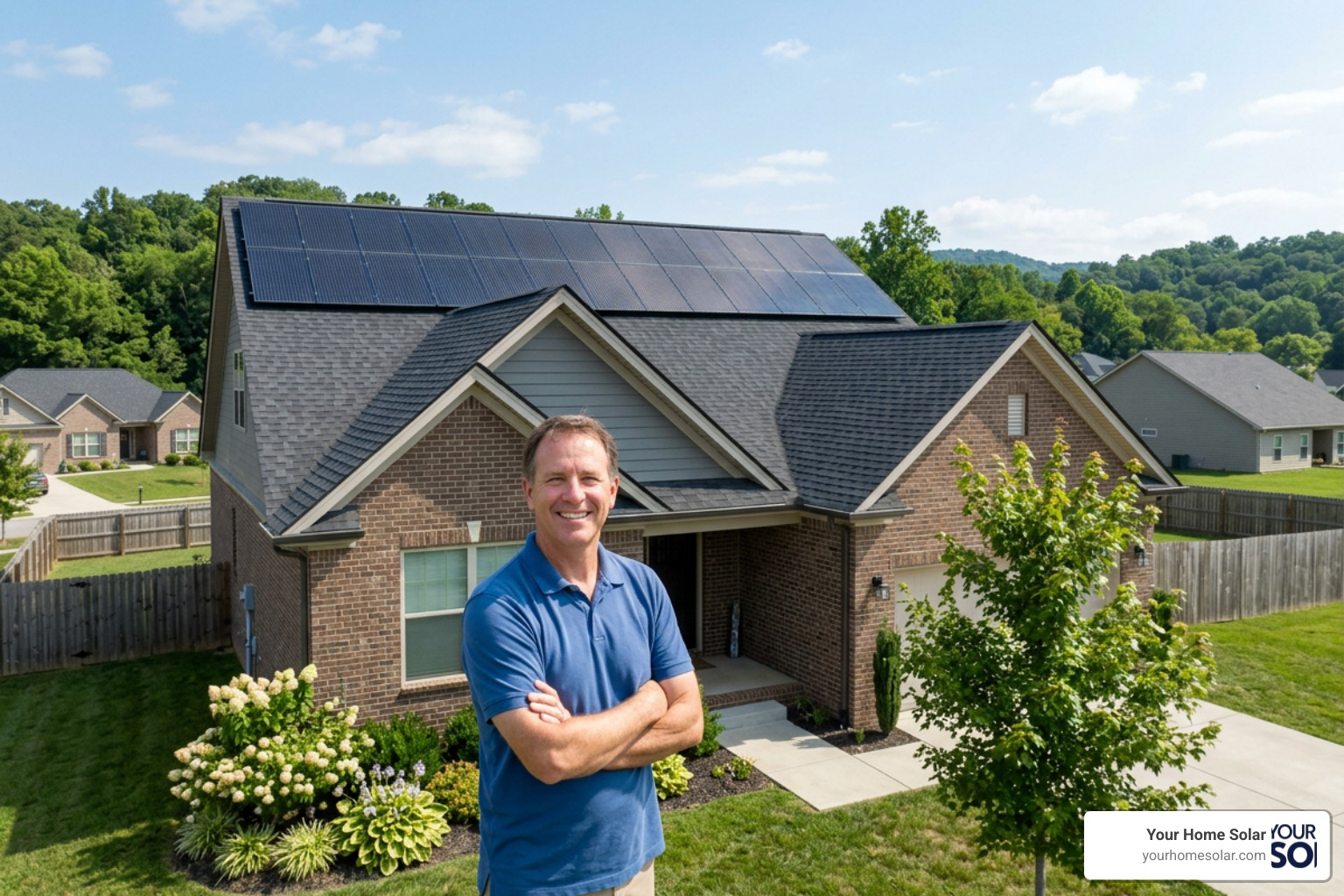
Navigating the 440 watt solar panel price landscape in July 2026 doesn’t have to be overwhelming. While the allure of cheap, $170 clearance panels online is strong, building a safe, reliable, and high-performing home energy system requires looking at the complete picture — including quality inverters, durable racking, proper permitting, and professional installation that preserves your 30-year warranty.
At Your Home Solar, we specialize in providing tailored, turn-key solar installations, backup generators, and EV chargers across East Tennessee. From Knoxville and Maryville to Johnson City, Kingsport, and Morristown, our team is dedicated to delivering 100% customer satisfaction through trusted local expertise and reliable engineering.
We don’t believe in high-pressure sales pitches or unrealistic promises. We design systems that maximize your long-term savings and protect your home from grid outages.
Ready to see how much you can save by transitioning to high-efficiency 440W solar technology? Explore solar cost and financing options or contact our friendly team at Your Home Solar today for a complimentary, personalized home energy assessment!