Understanding What You’ll Pay for a 4kW Solar System
For homeowners ready to take control of their energy bills, the 4kw solar panel system cost is a critical question. Here’s a quick overview:
Quick Answer: 4kW Solar System Cost Breakdown
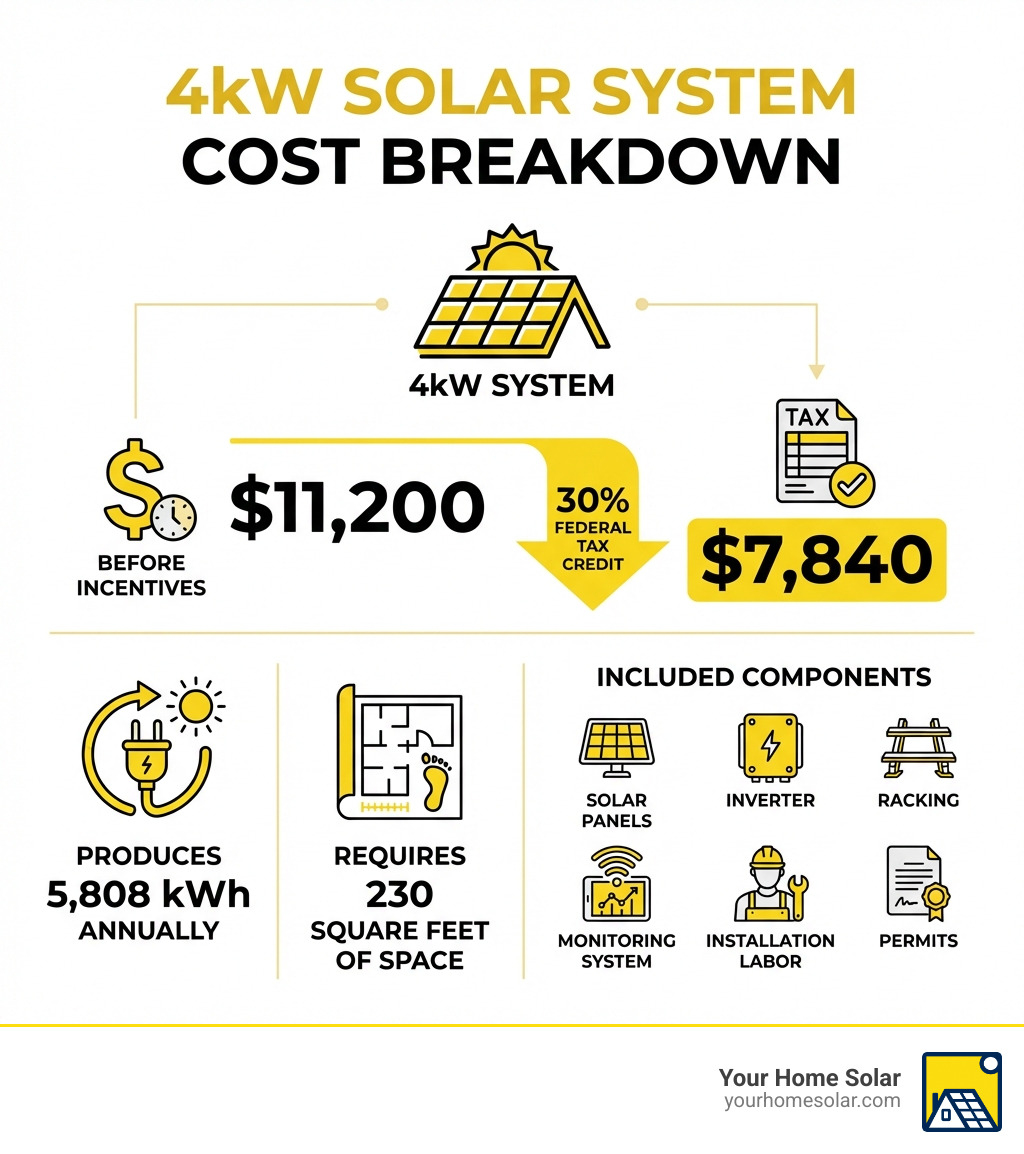
- Average Total Cost: $11,200 before incentives in 2025
- Cost Per Watt: $2.50 to $3.50 (typical range)
- After Federal Tax Credit: Around $7,840 (with 30% credit)
- Typical Monthly Production: 300 to 750 kWh
- Annual Energy Production: Approximately 5,808 kWh
If you’re an East Tennessee homeowner watching electricity bills climb, a 4kW solar panel system might be the solution. It’s sized right for smaller homes or to offset a significant portion of your energy use. A 4kW system requires about 230 square feet of space and can produce enough electricity to substantially cut your monthly bill, sometimes eliminating one-third of a typical household’s energy consumption.
However, the upfront price tag raises questions. What drives that cost, what’s included, and how do incentives change the math?
Time is also a factor. The federal solar tax credit offers a 30% return on your investment, but it’s scheduled to end for systems installed after December 31, 2025. This gives homeowners a limited window to secure around $3,360 in savings on a 4kW system.
I’m Ernie Bussell, founder and CEO of Your Home Solar. I’ve spent years helping East Tennessee families understand the real 4kw solar panel system cost. This guide breaks down every component, from equipment choices to installation and incentives, so you can make a confident decision.
Let’s decode the dollars together.
Breaking Down the 4kW Solar Panel System Cost
When we talk about the 4kw solar panel system cost, we’re looking at a comprehensive investment that includes equipment, professional installation, permitting, and other services. Understanding these components is key to grasping the overall value.
The average cost of residential solar is about $2.50 to $3.50 per watt. For a 4kW system (4,000 watts), this places the average upfront cost around $11,200 before any incentives are applied, based on 2025 estimates.
Installation labor is a significant part of the total. According to the National Renewable Energy Laboratory (NREL), labor accounts for a notable portion of project costs, reflecting the specialized skills required for electrical work, roofing, and system design. The quality of equipment, complexity of your roof, and local permitting fees also play substantial roles. A simple, unobstructed roof in East Tennessee will incur lower installation costs than a complex roof with shading challenges.
We offer transparent cost breakdowns and can help you explore financing options. For a deeper dive into how costs are structured, visit our guide on the Cost and Financing of Solar Systems. You can also review valuable data from NREL to understand cost trends at Data via NREL..
What is the average 4kW solar panel system cost before incentives?
The average 4kw solar panel system cost before incentives in 2025 is estimated to be around $11,200. This is a national average, and prices in East Tennessee can vary. Broken down by cost per watt, a 4kW system generally falls within the $2.50 to $3.50 per watt range. At $2.80/watt, a 4,000-watt system would be $11,200. This metric is excellent for comparing quotes, but ensure you’re comparing similar equipment quality and services.
While solar costs have been falling, market fluctuations and supply chain issues can impact prices. We always recommend getting a personalized quote for your home in Knoxville, Oak Ridge, Maryville, or our other service areas for the most accurate estimate. For more local insights, check our page on Solar Panel Installation Knoxville Cost.
What factors influence the final 4kW solar panel system cost?
The $11,200 average is a starting point; your final 4kw solar panel system cost will be influenced by several factors:
- Equipment Brand and Quality: Premium monocrystalline panels are more efficient and have better warranties than polycrystalline panels but cost more. The brand of your inverter and racking also plays a role.
- Panel Efficiency: More efficient panels generate the same power with fewer panels, reducing labor costs and roof space needs, which is useful for smaller roofs.
- Inverter Type: Your choice between string inverters and microinverters impacts performance and cost, as we’ll discuss next.
- Roof Condition and Complexity: A simple, south-facing roof in good condition is ideal. Roof repairs, structural upgrades, or complex layouts with dormers and shading will increase labor and material costs.
- Labor Costs: Local labor rates in East Tennessee can vary. Our expert installers ensure a safe, code-compliant installation, which is an investment in your system’s longevity.
- Permitting and Interconnection Fees: Securing permits from your county (like Knox or Sevier County) and coordinating with your utility (like TVA) involves fees and administrative costs. We handle all this paperwork for you.
Understanding these factors helps us design a system that meets your energy needs and budget. For tips on system sizing, see our guide on Properly Sizing a Solar System for Your East Tennessee Home: Expert Tips.
What’s Included in a 4kW Solar Kit?
When you invest in a 4kW solar system from Your Home Solar, you’re getting a complete, integrated energy solution designed to work seamlessly for your East Tennessee home.
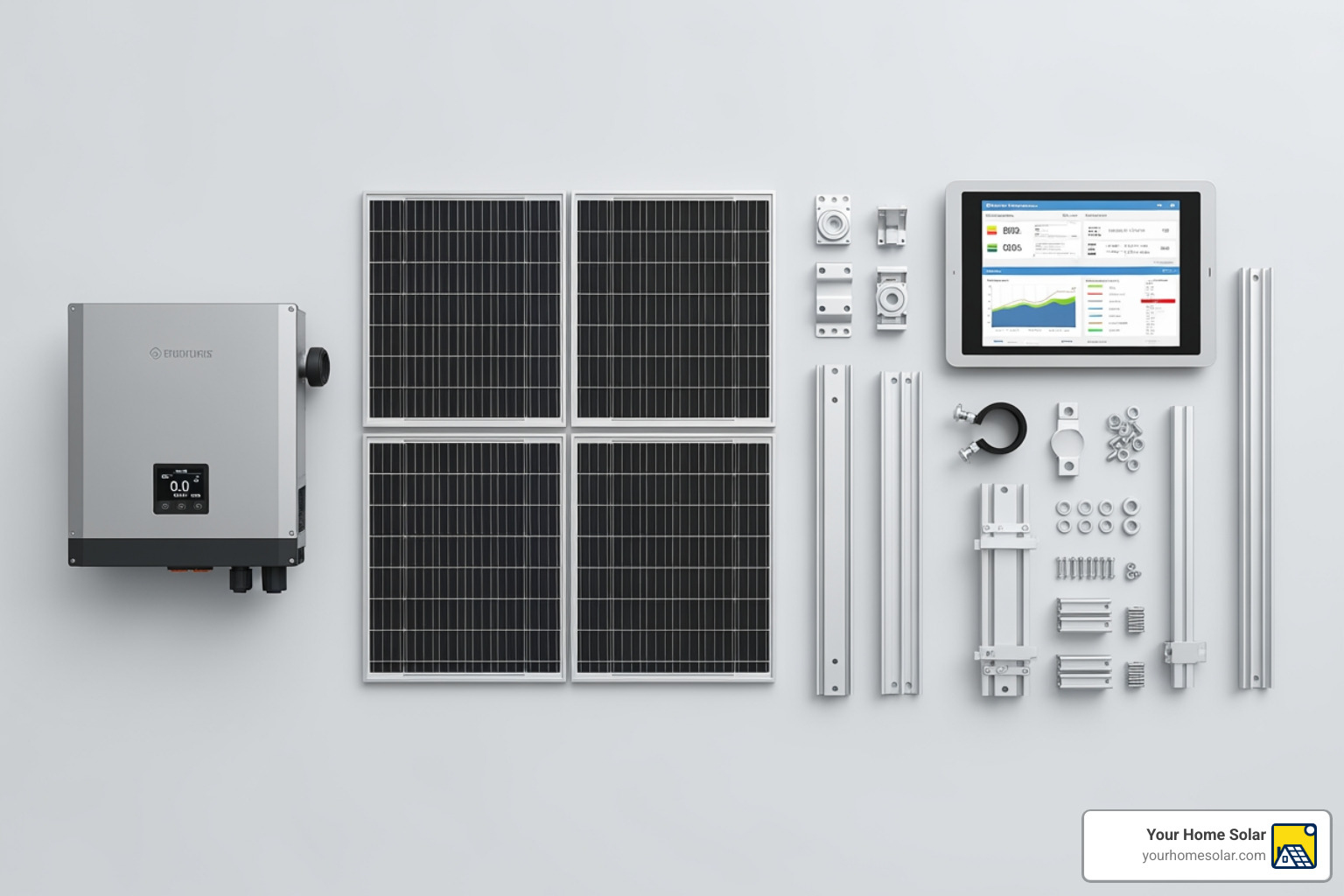
A typical 4kW solar kit includes several key components:
- Solar Panels: For a 4kW system, you’ll need 10 to 13 panels, depending on their wattage. We use Tier 1 monocrystalline panels for their high efficiency and robust 25-year warranties.
- Inverter(s): This device converts the DC electricity from your panels into AC electricity for your home. The type of inverter is a significant factor in system performance and cost.
- Racking and Mounting System: This hardware securely attaches the panels to your roof or a ground-mount structure, designed to withstand East Tennessee weather.
- Monitoring System: Every system includes monitoring, allowing you to track energy production in real-time via a smartphone app.
- Balance of System (BOS) Components: This includes all wiring, conduits, circuit breakers, and disconnects needed for safe, code-compliant operation.
To learn more about how these components work together, explore our Residential Solar Solutions Guide: Comprehensive Guide to Understanding Solar Panels and our detailed explanation of How Solar Panels Work: A Comprehensive Guide.
Inverter Options: What Should You Know?
The inverter is the brain of your solar system. We offer two main types: string inverters and microinverters.
| Feature | String Inverter | Microinverter |
|---|---|---|
| Optimization | System-level (panels wired in series) | Individual panel optimization |
| Shading Impact | Shading on one panel can reduce output of entire string | Shading on one panel does not affect others |
| Monitoring | Typically string-level or system-level | Panel-level monitoring |
| Expandability | Can be less flexible for small additions | Highly flexible for future expansion |
| Upfront Cost | Generally lower | Generally higher |
| Ideal For | Unshaded, uniformly oriented roofs | Shaded roofs, complex rooflines, future expansion |
- String Inverters: A cost-effective and reliable option for roofs with consistent, unobstructed sunlight. Panels are wired in a “string” to a single inverter. This is a highly efficient and economical choice for many East Tennessee homes.
- Microinverters: Installed under each panel, allowing them to operate independently. This is a game-changer for a few reasons:
- Individual Panel Optimization: If one panel is shaded, it won’t affect the others, maximizing energy production on complex or partially shaded roofs.
- Improved Monitoring: Provides panel-level data, making troubleshooting precise.
- Flexibility: Makes it easy to expand your system in the future.
While microinverters may have a slightly higher upfront cost, the long-term value from increased energy production often outweighs it, particularly for homes in varied East Tennessee landscapes. We’ll help you weigh these options based on your home’s specific needs.
Maximizing Your Return: Savings, Incentives, and Payback
Investing in a 4kW solar system is a smart financial decision that offers substantial returns. It’s a way to transform your energy expenses into long-term savings and energy independence.

The average 4kW solar system produces about 5,808 kWh of electricity annually, directly offsetting what you’d buy from the grid. With utility rates rising, going solar helps you control electricity costs and hedge against inflation. Over its lifespan, a solar system can save most homeowners around $50,000. The typical payback period is 5 to 10 years, after which the electricity your system generates is essentially free.
If you’re still on the fence, consider the financial implications of rising utility bills. Our article, Why Skipping Solar Panels Could Be Costing You, digs deeper into the benefits you might be missing.
How Incentives Drastically Reduce Your Net Cost
The upfront 4kw solar panel system cost is made much more affordable by powerful incentives. The most impactful is the Federal Solar Tax Credit, or Investment Tax Credit (ITC), which allows you to deduct 30% of your solar installation cost from your federal taxes. For an average $11,200 system, that’s a $3,360 credit.
Here’s the critical part: The 30% federal solar tax credit is scheduled to end for systems installed after December 31, 2025. This gives homeowners a limited window to secure this substantial saving. Missing this deadline could mean paying thousands more.
Beyond the federal credit, local programs like TVA Green Power Providers may offer additional benefits. We stay up-to-date on all available incentives in your specific East Tennessee county and help you steer the application process. For a comprehensive overview, check our Solar Incentives Tennessee 2026 Guide and our general page on Tax Credits & Incentives.
Calculating Your System’s Production and Payback Period
Understanding your system’s production and payback period is essential. A 4kW system produces about 5,808 kWh annually on average, but actual output depends on several factors:
- Geographic Location: We use tools like PV Watts to estimate production based on local sunlight hours in East Tennessee.
- System Efficiency: The quality of your panels and inverters directly impacts output.
- Panel Orientation and Tilt: South-facing panels tilted at an optimal angle maximize sun exposure.
- Shading: Any shading from trees or chimneys can reduce production. Microinverters help mitigate this impact.
Once we estimate production, we can calculate your potential savings by comparing it to your current electricity rates. The payback period is the time it takes for your savings and incentives to equal your initial investment, typically 5 to 10 years. After that, your system generates free electricity, turning your investment into pure profit. We provide a detailed analysis of your estimated production, savings, and payback period customized for your home.
Installation & Maintenance: What to Expect
Once you decide to move forward with a 4kW solar system, our professional team ensures a seamless installation process that minimizes disruption while maximizing safety and efficiency.
A professional installation by our expert team in Knoxville, Maryville, or our other East Tennessee service areas guarantees your system is installed to the highest standards. This includes site assessment, roof structural checks, electrical wiring, and final commissioning. We handle all permits and inspections, ensuring full compliance with local codes. Learn more about What to Expect During a Solar Installation for Your East Tennessee Home.
Our team of trained and certified electricians and roofers understands the nuances of solar installation. Our commitment to excellence is why we’re considered Expert Solar Installers in Knoxville, TN.
How Much Space Do You Need for a 4kW System?
For a 4kW solar system, you’ll generally need about 230 square feet of usable space. This can vary slightly based on the specific panels used.
- Roof-Mount: The most common method. We assess your roof’s area, integrity, and orientation, ideally using a south-facing plane for optimal sun exposure.
- Ground-Mount: An excellent alternative if your roof isn’t suitable. This involves a freestanding structure in your yard, allowing for precise angling to maximize sun capture.
- Panel Orientation and Shading Analysis: Our design process includes a detailed analysis of your property’s sun path to create a layout that maximizes energy harvest, ensuring your 4kW system performs at its best.
For more insights into system sizing, check out our Properly Sizing a Solar System for Your East Tennessee Home: Expert Tips.
Long-Term Maintenance and System Lifespan
One of the best features of solar energy is its low maintenance. Once installed, your 4kW system quietly generates clean power for decades.
Solar panels are incredibly durable, built to withstand East Tennessee’s weather, and come with 25- to 30-year performance warranties. They are built to last even longer, potentially generating electricity for 40 years or more. For example, one 40-year-old panel was found to be still producing at 92% of its original capacity.
In terms of maintenance:
- Panel Cleaning: Natural rainfall is usually sufficient. If you notice significant buildup, a simple rinse with a garden hose is all that’s needed.
- Annual Inspection: We recommend a professional inspection every few years to check wiring and ensure optimal performance. Our monitoring systems often alert us to any issues proactively.
For a deeper dive into panel longevity, visit our article on Solar Panel Durability: How Long Do They Last?.
Frequently Asked Questions about 4kW Solar Systems
We get a lot of great questions from homeowners in East Tennessee about 4kW solar systems. Here are some of the most common ones:
Is a DIY 4kW solar kit a good idea?
The idea of a DIY solar kit can be tempting, as it can cut installation costs. However, we generally advise caution due to several significant downsides:
- Voided Warranties: Many manufacturers require professional installation for their warranties to be valid.
- Safety Risks: Installation involves working at heights and with high-voltage electricity, posing substantial risks without proper training.
- Permitting Complexity: Navigating local building codes and utility interconnection agreements is complex and can lead to delays or fines if done incorrectly.
- Lower-Quality Equipment: DIY kits often use lower-quality equipment, which can impact long-term performance and lifespan.
- No Professional Expertise: Professional installers bring years of experience to ensure optimal design, safety, and compliance.
While DIY offers cost savings, the risks often outweigh the benefits. For most homeowners, hiring a professional solar company provides a better return on investment and peace of mind. For a more in-depth discussion, read our guide on whether DIY solar is worth it.
Can a 4kW system power my entire house?
This depends on your energy consumption. A 4kW system is generally sufficient to power a small home or significantly offset the electricity usage of an average-sized home. It produces about 5,808 kWh annually, while the average U.S. household uses around 10,000 kWh per year. So, a 4kW system could cover about 50-60% of an average home’s needs.
Consider the following:
- Energy Consumption Audit: We analyze your utility bills to determine your average energy usage and recommend the right system size.
- Offsetting Usage: For many homes, a 4kW system is a budget-friendly way to reduce a large portion of their utility bill without aiming for a 100% offset.
- High-Draw Appliances: Homes with electric heating, central AC, or EV chargers have higher energy demands that a 4kW system may not fully cover.
- Battery Storage: Pairing your system with battery storage provides backup power during outages and allows you to use solar energy at night. However, going 100% off-grid with a 4kW system is challenging. We explore this in Can My East Tennessee Home Be 100% Off-Grid? It Depends..
How does a 4kW system increase my home’s value?
Beyond bill savings, a 4kW solar system is a smart investment that significantly increases your home’s value. Studies show that homes with solar panels sell for more and often faster than comparable homes without them.
Here’s why a 4kW system boosts your property value:
- Lower Utility Bills: This is a huge draw for prospective buyers, as it means predictable, lower monthly expenses.
- Modern Appeal: Solar panels add a modern, high-tech aesthetic to your home.
- Environmental Benefits: For eco-conscious buyers, a solar system is a major selling point.
- Energy Independence: The promise of greater energy resilience is powerful, especially with rising utility rates and occasional outages.
The value added by solar typically exceeds the initial 4kw solar panel system cost, especially after incentives. To learn more, read our article on How Solar Panels for Homes Can Increase Your Property Value.
Conclusion: Is a 4kW System a Smart Investment for You?
We’ve covered the 4kw solar panel system cost, from equipment and incentives to long-term benefits. It’s clear that a 4kW system is an investment in your financial security and a cleaner planet.
The average $11,200 upfront cost is significantly reduced by the 30% federal tax credit, bringing the net cost to around $7,840. This investment offers a payback period of 5-10 years and can lead to over $50,000 in savings over the system’s lifespan. With minimal maintenance and a boost to your home’s value, it’s an asset that keeps on giving.
For homeowners throughout East Tennessee, now is an opportune time to consider solar. The impending deadline for the 30% federal tax credit means that waiting could cost you thousands.
At Your Home Solar, we provide trusted expertise and a commitment to 100% customer satisfaction. We tailor reliable installations that meet your unique energy needs and budget, handling every aspect of the process for a stress-free transition to solar.
Ready to take control of your energy future? Contact us today for a personalized consultation. We’ll provide a precise quote and design a 4kW solar system perfectly suited for your East Tennessee home.
Get a precise quote and explore your financing options today