Why Choosing the Right Solar Panel Installers Matters in 2026
Finding trustworthy solar panel installers is one of the most important decisions you’ll make as a homeowner. The right installer saves you money, protects your home, and keeps the lights on when the grid goes down. The wrong one can leave you with a poorly designed system, voided warranties, and no one to call for help.
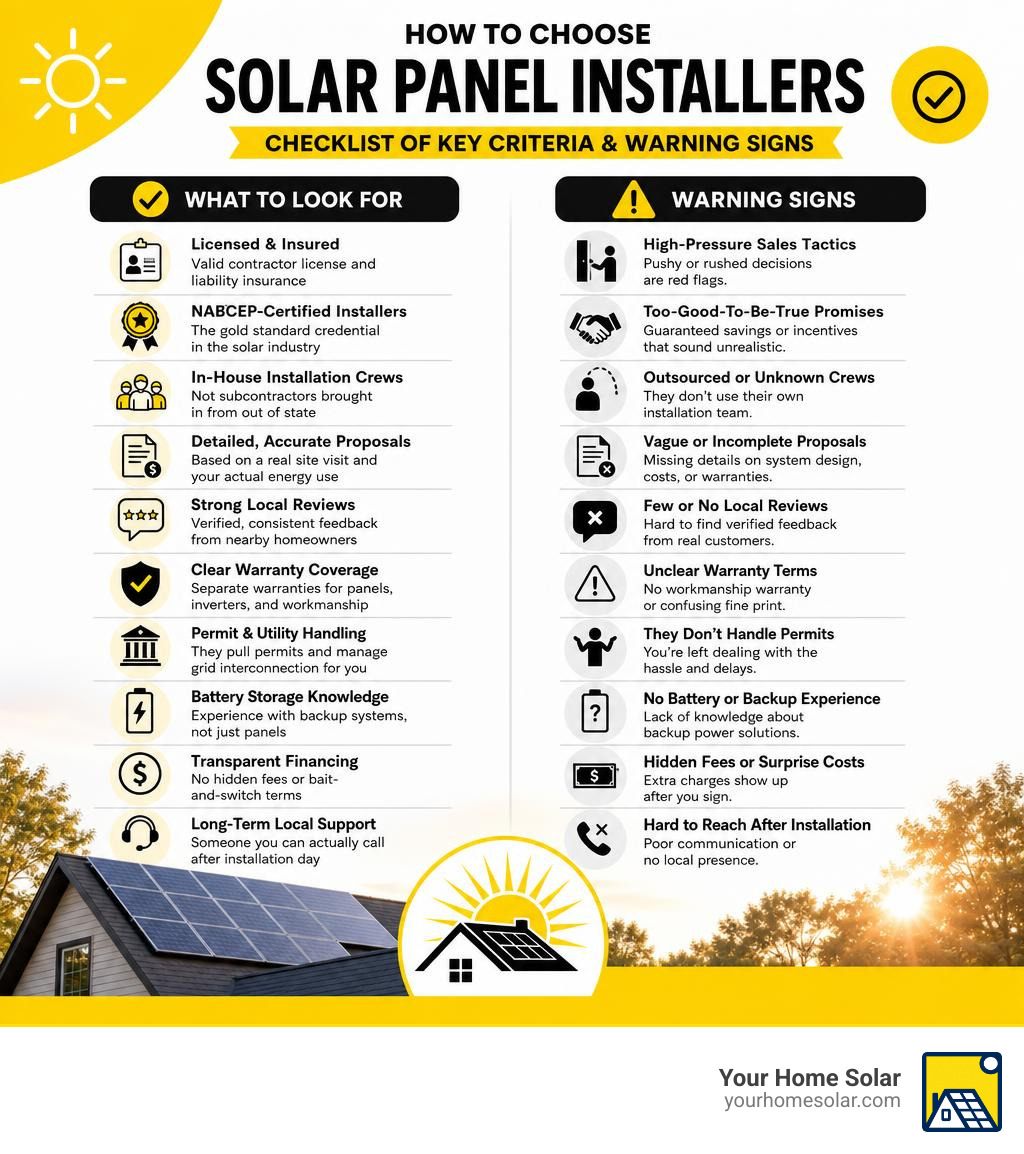
Here’s a quick snapshot of what to look for in a solar installer:
- Licensed and insured – Valid contractor license and liability insurance
- NABCEP-certified installers – The gold standard credential in the solar industry
- In-house installation crews – Not subcontractors brought in from out of state
- Detailed, accurate proposals – Based on a real site visit and your actual energy use
- Strong local reviews – Verified, consistent feedback from nearby homeowners
- Clear warranty coverage – Separate warranties for panels, inverters, and workmanship
- Permit and utility handling – They pull permits and manage grid interconnection for you
- Battery storage knowledge – Experience with backup systems, not just panels
- Transparent financing – No hidden fees or bait-and-switch terms
- Long-term local support – Someone you can actually call after installation day
The solar industry is growing fast. Employment of solar photovoltaic installers is projected to grow 42% from 2024 to 2034 — far faster than almost any other trade. With that growth comes a flood of new companies, some excellent and some not. In East Tennessee, where power outages and rising utility bills are real daily concerns, the stakes are even higher.
This guide reviews what separates professional solar installers from sales-only operations, so you can make a confident decision.
I’m Ernie Bussell, Founder and CEO of Your Home Solar — the #1 solar energy contractor in East Tennessee — and I’ve spent years working across solar operations, installation management, and homeowner education to help families find solar panel installers they can actually trust. In this guide, I’ll walk you through everything you need to know before signing anything.
Top 10 Things to Review Before Hiring Solar Panel Installers
Before you commit to a 25-year solar investment, you need to look past the shiny sales pitches. Many solar companies operating today are actually marketing organizations that sell contracts and then outsource the physical work to local subcontractors. To ensure you are working with true professionals, we recommend using a strict vetting process.
To help you navigate this, we have put together an extensive installer vetting guide to help you spot predatory sales practices. You can also look at public platforms like the Knoxville installer marketplace example to compare local ratings and market trends.
Here is a quick-reference table comparing the signals of a high-quality installer versus a company you should avoid:
| Strong Installer Signals (Green Flags) | Weak Installer Signals (Red Flags) |
|---|---|
| In-house, local installation crews | Out-of-state subcontractors brought in for the day |
| NABCEP PVIP Board Certified professionals | No industry-specific certifications |
| Physical local office in East Tennessee | Out-of-state call center or P.O. Box |
| Custom 12-month energy modeling | “One-size-fits-all” pricing without looking at your bills |
| Detailed workmanship and roof-penetration warranties | Vague warranties that only cover the manufacturer’s parts |
| Transparent, itemized financing options | High-pressure “sign today or lose the deal” tactics |
The Top 10 Review Criteria That Separate Professionals From Sales-Only Companies
When evaluating local solar panel installers in Knoxville, Maryville, Johnson City, or anywhere else in East Tennessee, use these ten criteria to grade them:
- Credentials & Licensing: They must hold a valid Tennessee contractor’s license with an electrical classification.
- In-House Crews: Ask directly: “Will your employees install my system, or do you use subcontractors?” In-house crews ensure accountability.
- Comprehensive Roof Assessment: A reputable team will physically or digitally inspect your roof’s age, orientation, and structural integrity before finalizing a design.
- Energy Modeling Accuracy: Proposals should be based on your actual 12-month utility history, not a generic estimate.
- Local Code & Utility Compliance: They must have direct experience working with local utilities like Knoxville Utilities Board (KUB), BrightRidge, or Sevier County Electric System.
- Written Scope of Work: Every detail, from the exact panel model to the inverter type and battery capacity, must be written down.
- Premium Equipment Selection: Look for Tier-1 solar panels and proven inverter systems (like Enphase microinverters or Tesla Powerwall 3).
- Subcontractor Policies: If they do use external help for specialized tasks, they must fully disclose who is stepping onto your roof.
- Verified Customer Reviews: Look for consistent 5-star feedback across platforms, such as Best Solar Companies Tennessee Reviews.
- Workmanship Warranties: A professional company will stand behind their installations with a workmanship warranty of 10 to 25 years, protecting your roof from leaks.
Questions to Ask Solar Panel Installers Before Signing
Never sign a solar contract on your first meeting. Instead, print out our questions checklist and ask these direct questions:
- “Are your on-site installers NABCEP PVIP Certified?” (The North American Board of Certified Energy Practitioners is the gold standard).
- “Can you show me proof of your general liability and worker’s compensation insurance?”
- “How do you handle the utility interconnection process with my local power distributor?”
- “What happens if my roof leaks where you made the roof penetrations?”
- “Is the system you designed battery-ready if I want to add storage later?”
- “Will I have full access to a mobile app to monitor my system’s daily production?”
- “Who do I call if a panel stops producing electricity five years from now?”
Red Flags Homeowners Should Not Ignore
If you run into any of these warning signs during your consultation, it is time to walk away:
- High-pressure sales tactics: Claims that “this program ends tonight” or “the government will pay for 100% of your system” are flat-out lies.
- Vague savings claims: Promising you will “never pay an electric bill again” without explaining how net metering works in East Tennessee.
- Skipping the site visit: Offering a final contract without ever checking your electrical panel or roof condition.
- No local presence: Companies that list out-of-state phone numbers or lack a physical office in Tennessee. If they go out of business or leave the state, your workmanship warranty goes with them.
What Qualified Solar Photovoltaic Installers Do, Earn, and Need to Know
Solar photovoltaic (PV) installers are highly skilled tradespeople. Their job is a unique blend of construction, roofing, and advanced electrical work. It is physically demanding, technically precise, and requires a deep commitment to safety.

Main Job Duties on a Solar Installation
A typical day for a solar installation crew involves several critical phases:
- Site Prep & Safety Setup: Setting up safety ladders, securing harnesses, and laying out fall-protection systems on the roof.
- Racking Installation: Measuring, leveling, and securing the heavy-duty aluminum racking system to the roof rafters. This requires applying high-grade weather sealant to every single roof penetration to prevent leaks.
- Electrical Wiring: Running conduit, pulling electrical wires from the roof down to the main service panel, and installing the system’s inverters.
- Module Placement: Lifting and securing the solar panels onto the racking, connecting them in series or parallel, and completing polarity checks.
- System Testing & Grounding: Ensuring the entire system is safely grounded, verifying electrical connections, and testing the system to make sure it produces the expected voltage.
Education, Training, Certifications, and Career Path
Most solar installers start with a high school diploma or equivalent and receive extensive on-the-job training. Many choose to attend technical colleges or complete structured apprenticeships in electrical work or solar technology.
To reach the top of the profession, installers pursue NABCEP (North American Board of Certified Energy Practitioners) certifications. The NABCEP PV Installation Professional (PVIP) credential is the highest certification available, requiring years of active installation experience, advanced training hours, and passing a rigorous national exam. For example, when looking at local options, homeowners often seek out companies with long-standing board-certified professionals to ensure their manufacturer warranties remain fully valid.
Pay, Employers, and Job Outlook for Solar PV Installers
According to the U.S. Bureau of Labor Statistics, the career outlook for this trade is incredibly strong:
- Median Annual Wage: The median annual wage for solar photovoltaic installers was $51,860 in May 2024. The highest 10% in the trade earned more than $80,150.
- Job Growth: Employment is projected to grow 42% from 2024 to 2034, which is considered much faster than the average for all occupations.
- Annual Openings: About 4,100 openings for solar installers are projected each year over the decade.
- Primary Employers: Electrical contractors and wiring installation contractors employ the largest share of installers, accounting for 44% of all jobs in the industry.
From Consultation to Activation: What a Professional Solar Installation Includes
Going solar is not an overnight event. It is a structured process that takes several weeks from your first phone call to the day you flip the switch.

If you are planning your project, reviewing a local East Tennessee solar guide can help you understand the regional timeline and utility-specific steps.
How Solar Panel Installers Evaluate Your Roof, Electrical Panel, and Energy Use
A professional installation starts with a deep dive into your home’s infrastructure. We analyze your past 12-month kWh usage to design a system that matches your lifestyle.
Next, we inspect your roof. We look at its age (ideally, your roof should be less than 5 to 10 years old, or you should replace it before installing solar), its structural load capacity, and its southern exposure. If trees block the sun, we perform a shading analysis to position the panels for maximum solar production. Finally, we inspect your main electrical panel to see if it has the physical space and electrical capacity (typically 200 amps) to handle the solar power input, or if we need to perform a service panel upgrade first.
Typical Solar Installation Timeline
The actual physical installation only takes 1 to 3 days, but the administrative steps around it take longer:
- Initial Assessment & Design (1-2 weeks): Analyzing your energy bills and creating a custom 3D model of your home.
- Permitting & HOA Approvals (2-4 weeks): Filing engineering plans with your local building department (such as in Knoxville or Maryville) and submitting designs to your HOA if necessary.
- Utility Interconnection Application (2-3 weeks): Submitting paperwork to your local power distributor to get approval to connect to their grid.
- Physical Installation (1-3 days): Our crew mounts the racking, runs the electrical conduit, installs the panels, and mounts your battery backup.
- Inspection & Permission to Operate (1-2 weeks): Local building inspectors and utility engineers visit your home to verify the system meets all electrical codes. Once approved, the utility issues your Permission to Operate (PTO), and you can turn the system on!
Residential vs Commercial Solar Installation Differences
While the core technology is the same, residential and commercial solar installations have distinct differences:
- Scale & Mounting: Residential installations are typically mounted on sloped shingle roofs. Commercial projects are often much larger, installed on flat commercial roofs using non-penetrating ballasted racking systems, or set up as ground mounts on commercial properties.
- Electrical Systems: Homes use single-phase electrical systems, whereas commercial buildings use complex three-phase systems.
- Financial Structure: Commercial solar installations are driven by business overhead reduction, tax depreciation (such as MACRS), and protecting the business from “demand charges” imposed by utilities.
Costs, Incentives, Benefits, Batteries, and Long-Term Support
Understanding the financial side of solar is key to calculating your return on investment (ROI). With the right incentives, solar is not just an environmental choice—it is a smart financial decision.
How Incentives and Tax Credits Affect the Cost of Going Solar
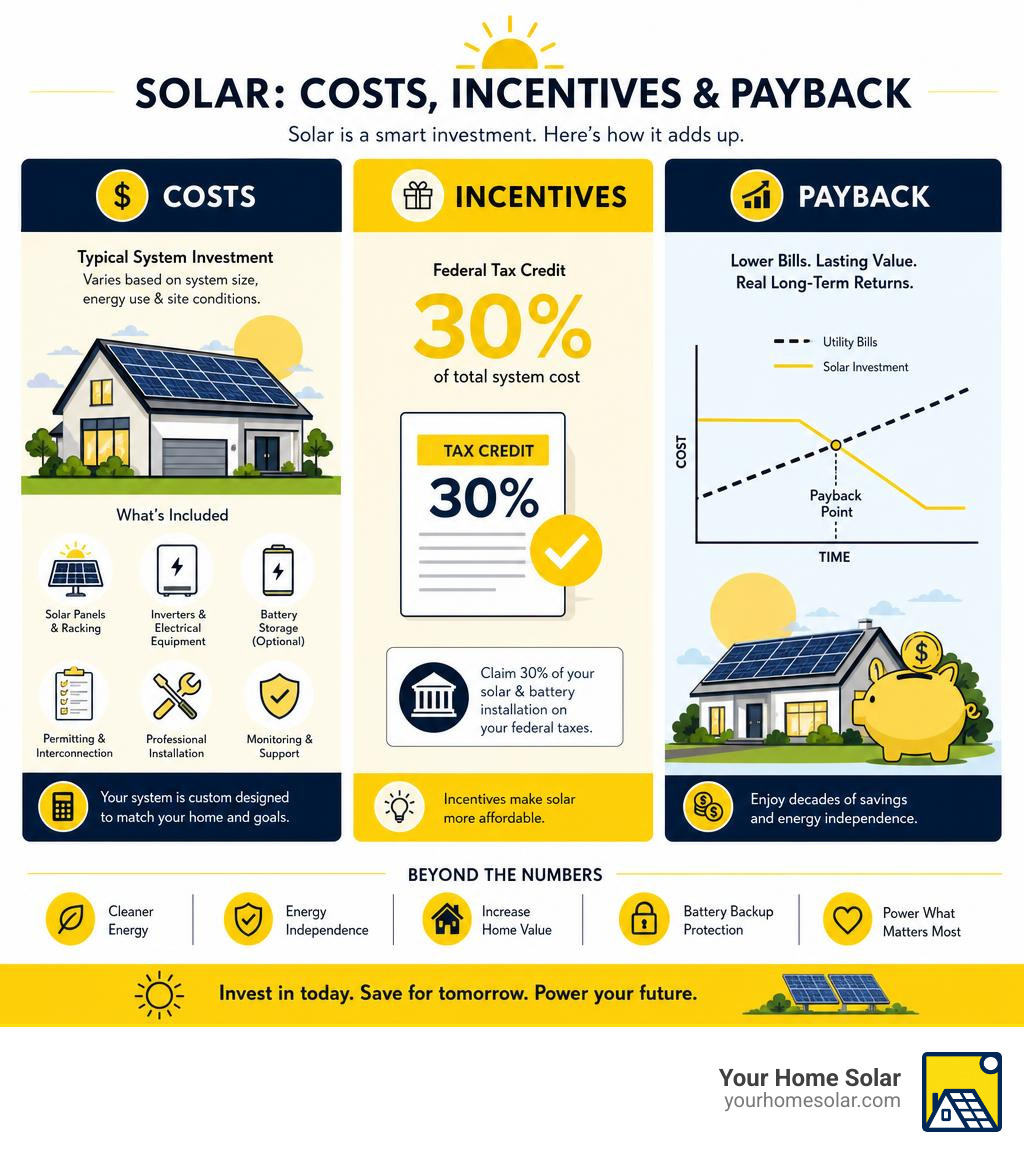
The single greatest financial tool for going solar in 2026 is the Federal Residential Clean Energy Credit (Section 25D). This incentive allows you to deduct 30% of the total cost of your solar panel and battery installation from your federal taxes.
- How it works: If your system costs $20,000, you qualify for a $6,000 federal tax credit. This is a dollar-for-dollar reduction of your federal tax liability, not just a deduction.
- Battery Storage: The 30% credit also applies to standalone battery storage systems, making backup power far more affordable.
- Local Dynamics: In East Tennessee, net metering policies vary by utility. Some local power companies offer credit for your excess generation, while others use dual-metering systems. For a closer look at local markets, you can review the Johnson City solar marketplace example to see how homeowners in Washington County maximize their savings.
Key Benefits for Homeowners and Businesses
Why are so many families making the switch? The benefits are clear:
- Lower Utility Bills: You generate your own free electricity from the sun, shielding yourself from utility rate hikes.
- Outage Protection: When paired with a battery, your home stays powered during major storms and grid failures.
- Increased Home Value: Studies show that solar panels can increase a home’s value by an average of 4.1% to 6.8% across the United States.
- Sustainability: You are actively reducing your carbon footprint by generating clean, emission-free energy right on your roof.
Battery Storage and Backup Systems
Solar panels alone cannot power your home during a blackout; for safety reasons, grid-tied systems automatically shut down during an outage. To keep your lights on, you need a backup battery.
Modern systems, like the Tesla Powerwall 3, act as an intelligent energy hub. During the day, your panels power your home and charge your battery. At night, or during an outage, your home seamlessly pulls power from the battery. You can choose to back up your entire home or select “critical loads” (like your refrigerator, well pump, HVAC, and medical devices) to extend your battery’s runtime.
Warranties, Maintenance, and Ongoing Support
A solar energy system is a long-term investment, which is why we emphasize working with installers who offer comprehensive warranties:
- Equipment Warranties: Premium panels come with a 25-year to 30-year manufacturer warranty guaranteeing their performance and physical durability.
- Inverter Warranties: Inverters typically carry a 10-year to 25-year warranty.
- Workmanship Warranties: This is provided by the installer and covers the physical installation work, including roof penetrations, for 10 to 25 years.
Solar panels require very little maintenance because they have no moving parts. However, you should monitor your system’s performance weekly via your mobile app. If you ever need roof repairs or a complete roof replacement down the road, you will need to coordinate with professional solar installation services to safely remove and reinstall your panels.
Frequently Asked Questions About Solar Panel Installers
How do I know if a solar installation company is reputable?
A reputable company will have a physical office in your region, hold a valid Tennessee contractor’s license, employ NABCEP-certified professionals, and have a proven track record of positive local reviews. They will never pressure you to sign a contract, and they will provide a highly detailed, customized proposal based on your actual energy usage.
How long does solar panel installation take?
While the physical installation on your roof typically takes just 1 to 3 days, the entire process—including custom engineering, HOA approvals, municipal permits, utility interconnection applications, and final inspections—usually takes 4 to 8 weeks from start to finish.
What maintenance do solar panels need after installation?
Solar systems are incredibly low-maintenance. Rain naturally washes away most dust and pollen in East Tennessee. However, we recommend checking your system’s monitoring app regularly to ensure all panels are producing power. It is also wise to have a professional perform a visual inspection every few years to check the wiring, racking, and battery health.
Conclusion: Choose a Local Solar Partner Built for Long-Term Support
At Your Home Solar, we believe in providing comprehensive, honest, and reliable home energy solutions to our neighbors across East Tennessee—from Knoxville and Oak Ridge to Maryville, Johnson City, Kingsport, Morristown, and Sevierville. We don’t use high-pressure sales tricks or outsource our installations to out-of-state crews.
Our team is dedicated to 100% customer satisfaction, offering tailored solar systems, backup generators, and EV chargers designed to give you true energy independence. If you are ready to take control of your energy future with a team you can trust, schedule a solar consultation with us today!