Why Solar Battery Backup is Essential for East Tennessee Homeowners
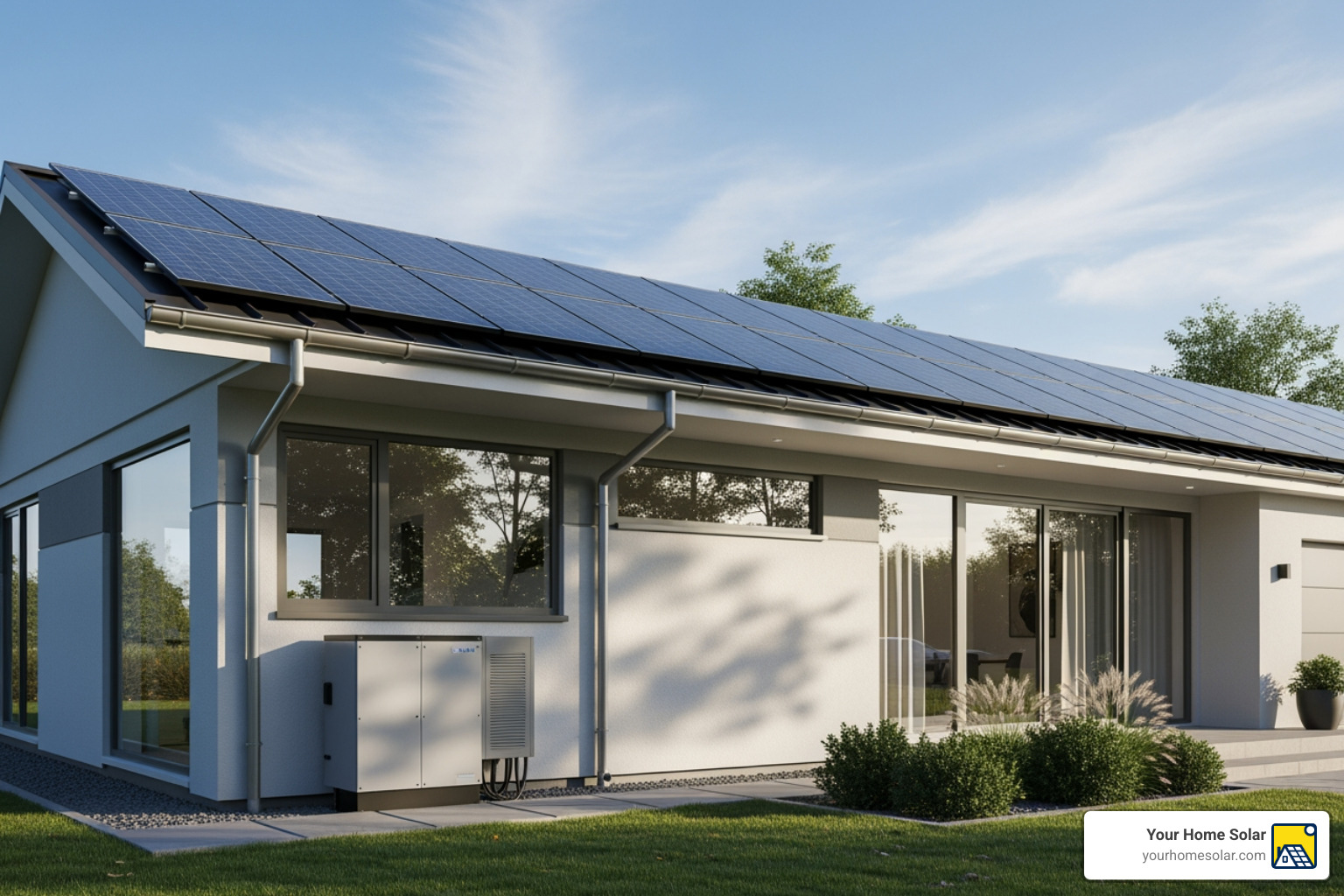
A solar battery backup is a system that stores excess energy generated by your solar panels (or grid electricity) so you can use it later—during power outages, at night, or when electricity rates are highest. Here’s what you need to know:
What it does:
- Stores solar energy produced during the day for use after the sun goes down
- Provides backup power during grid outages, keeping your essential appliances running
- Reduces electricity bills by letting you avoid peak rate hours
- Works with or without solar panels, though pairing with solar maximizes savings
Why it matters now:
- Weather-related power outages in the US have doubled from 2000-09 to 2014-23
- 28% of residential solar projects installed in 2024 included battery storage—up from just 13% in 2023
- Rising electricity costs and grid instability make energy independence more valuable than ever
If you live in East Tennessee, you’ve probably experienced storms that knocked out power for hours or even days. You’ve also likely noticed your electricity bills creeping up year after year. Between an aging grid, more extreme weather, and utilities cutting back compensation for solar energy you send back to the grid, now is the time to take control of your home’s energy future.
A solar battery backup system gives you three core benefits: energy resilience (power when the grid goes down), financial savings (lower bills and protection from rate spikes), and environmental impact (using more clean energy and less fossil fuel power). About 60% of grid energy in the US still comes from fossil fuels, so every kilowatt-hour you store and use from your own solar system reduces your carbon footprint.
I’m Ernie Bussell, founder and CEO of Your Home Solar, and I’ve spent years helping East Tennessee homeowners understand and implement reliable solar battery backup solutions. After managing operations for a $40 million solar company and founding Your Home Solar more than three years ago, I’ve seen how the right battery system can transform a home’s energy security and monthly costs.
Why Invest in a Solar Battery? The Core Benefits
Investing in a solar battery backup system for your East Tennessee home isn’t just about embracing cutting-edge technology; it’s about securing your peace of mind, optimizing your finances, and contributing to a healthier planet. We’ve seen the increasing demand for these systems, with 28% of residential solar projects in 2024 including battery storage, a significant jump from 13% in 2023. This trend reflects a growing understanding of the profound advantages that battery storage offers.
Energy Resilience: Power When You Need It Most
One of the most compelling reasons to install a solar battery is the unparalleled energy resilience it provides. Power outages, often driven by increasingly severe weather events, are on the rise across the US. The number of weather-related power outages in the US between 2014-2023 was approximately double the amount seen from 2000-2009. Here in East Tennessee, we’re no strangers to severe storms that can leave us in the dark.
Imagine a scenario like the February 2021 winter storm, which caused power outages for over 4 million Texans, where electricity rates soared by more than 7,000% in a matter of days for those who did get power back. While we hope to never experience such extremes, having a solar battery backup system for emergency power backup means your home can remain powered and comfortable, regardless of what’s happening on the grid. It offers security against unpredictable grid failures and escalating costs during emergencies.
Financial Savings: Taking Control of Your Energy Bills
A solar battery isn’t just a shield against outages; it’s a tool for significant financial savings. Modern utilities often employ time-of-use (TOU) rates, where electricity costs more during peak demand hours (typically evenings). With a solar battery backup, you can store the excess solar energy generated during the day and discharge it during these expensive peak times, effectively reducing your reliance on the grid when prices are highest.
This strategy, known as “load shifting,” allows you to unlock your home’s potential savings and significantly lower your monthly electricity bills. Some programs, like Massachusetts’ Mass Save Battery Storage Program, even allow participants to earn over $1,000 annually for sharing stored power with the grid during peak demand. While specific programs vary by region, the principle of using your stored energy to avoid high rates or even contribute to grid stability can be incredibly rewarding.
Environmental Impact: A Greener Footprint for East Tennessee
Choosing a solar battery backup system is a powerful step towards a more sustainable future for East Tennessee. By storing and using more of the clean electricity generated by your solar panels, you reduce your reliance on grid energy, much of which is still produced by fossil fuels. In 2023, about 60% of grid energy in the US was generated by fossil fuel resources.
Every kilowatt-hour of solar energy you consume from your battery helps to offset this, leading to a tangible reduced carbon footprint. It’s a direct way to contribute to using clean energy and promoting a healthier environment for our communities.
How Solar Battery Backup Systems Work
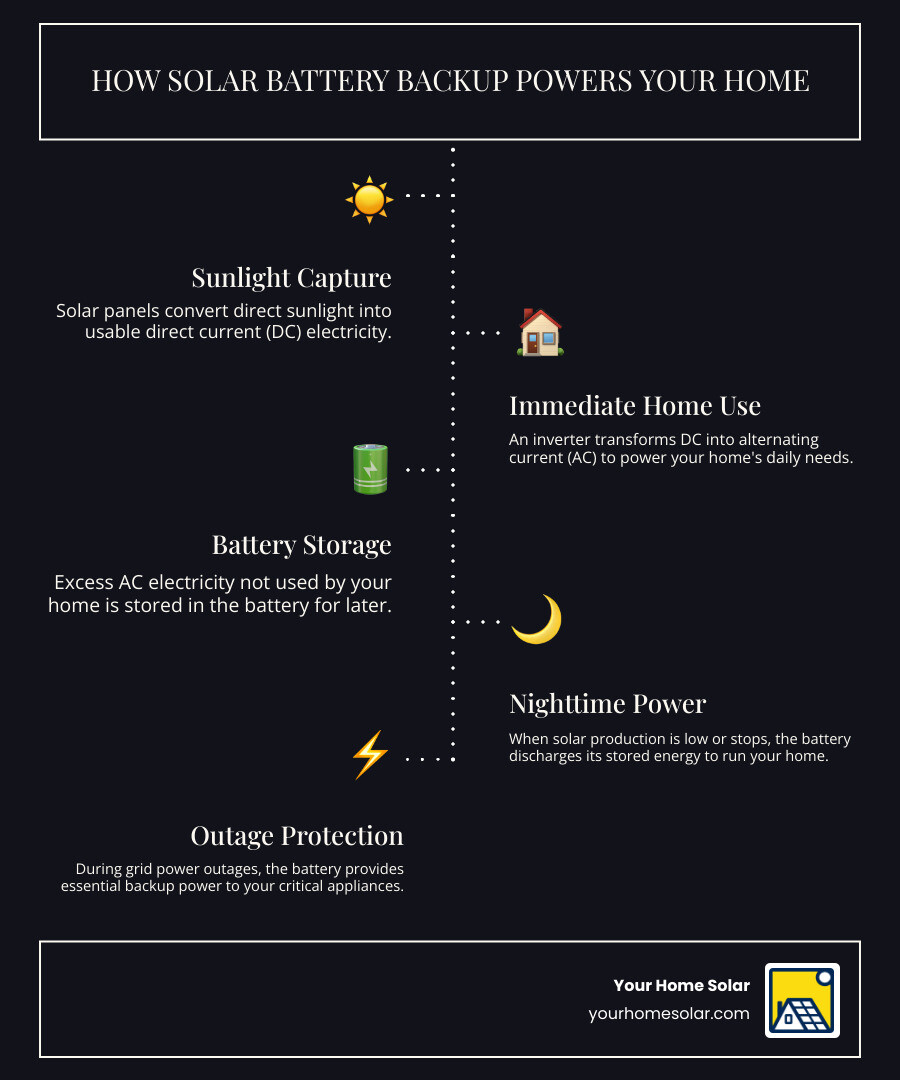
At its core, a solar battery backup system acts like a sophisticated energy bank for your home. During the day, your solar panels diligently convert sunlight into electricity. If your home isn’t using all that power instantaneously, instead of sending the excess back to the grid for minimal credit (especially with changing net metering policies), the battery stores it. This stored energy then becomes available for your use when the sun isn’t shining—at night, on cloudy days, or during a power outage.
While most commonly paired with solar panels, a battery backup system can also function independently, charging directly from the grid during off-peak hours when electricity is cheaper, and then discharging during peak times or outages. This flexibility is a key advantage.
The interaction with the grid is crucial. In a grid-tied system, your battery can intelligently manage energy flow. It can help you maximize self-consumption of your solar power, reducing your reliance on grid electricity. This interaction also plays a vital role in managing grid stability. For example, batteries can help manage the “duck curve”—a phenomenon where solar generation peaks midday, causing a dip in demand for traditional power plants, followed by a sharp ramp-up in demand as the sun sets. Batteries can absorb this midday solar surplus and release it later, helping to smooth out demand and make the grid more stable.
Understanding how East Tennessee utilities handle buy-back for excess solar energy is important, as it influences the financial benefits of a battery. With a battery, you’re less dependent on these buy-back rates, giving you more control over your energy.
AC-Coupled vs. DC-Coupled Systems
When considering a solar battery backup, you’ll encounter two primary ways these systems integrate with your solar panels: AC-coupled and DC-coupled. The choice between them often depends on whether you’re adding a battery to an existing solar setup or installing a brand-new system.
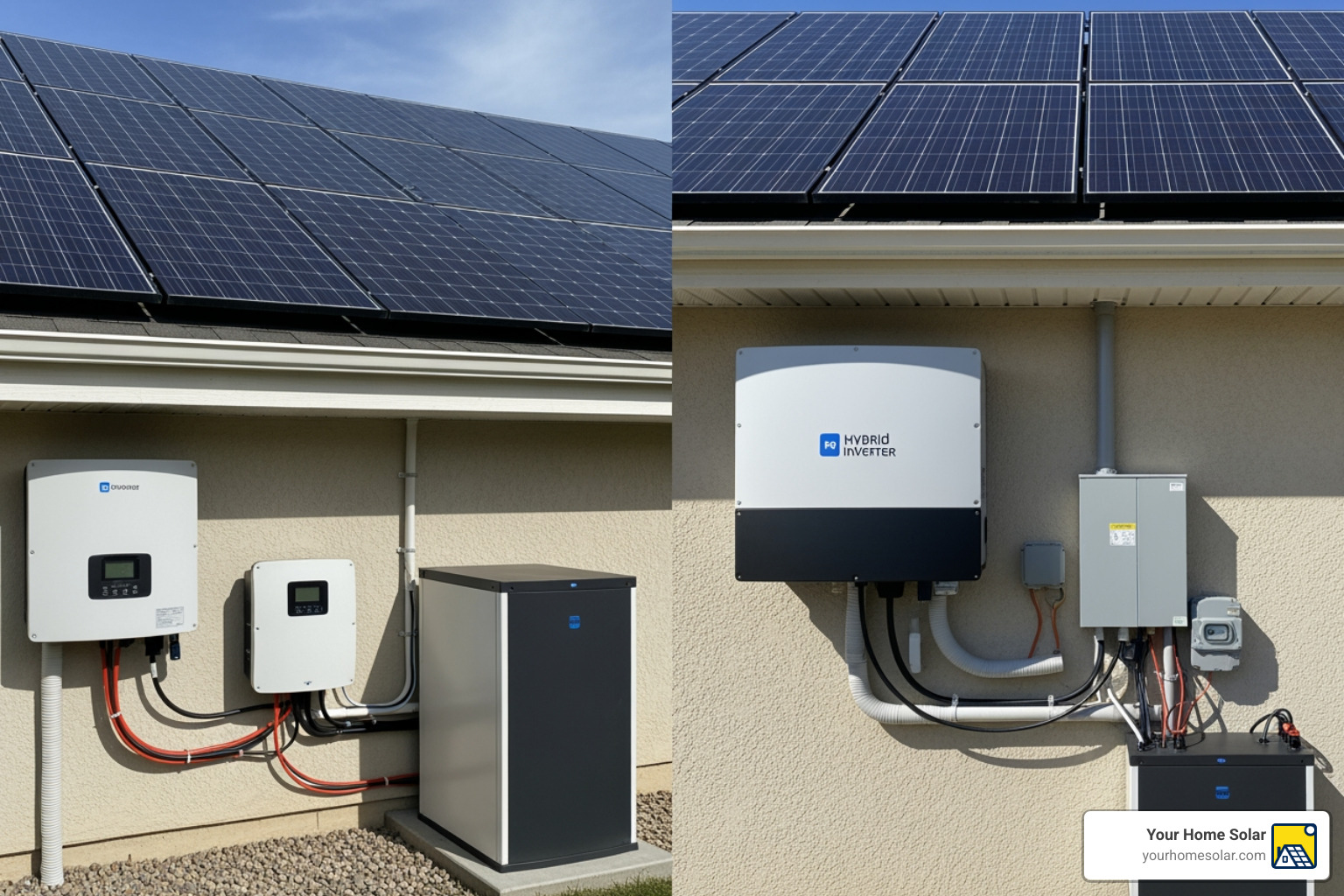
AC-Coupled Systems: These systems are typically chosen for retrofitting existing solar installations. Here’s how they work:
- Solar panels produce DC (direct current) electricity.
- A solar inverter converts this DC power into AC (alternating current) power for your home’s use or the grid.
- If you have excess AC power, a separate battery inverter then converts it back to DC to charge the battery.
- When discharging, the battery’s DC power is converted back to AC by its inverter for home use. The advantage of AC coupling is its simplicity for existing systems, as it integrates seamlessly with your current solar inverter.
DC-Coupled Systems: These are generally more efficient and cost-effective for new solar-plus-storage installations.
- Solar panels produce DC electricity.
- This DC power flows directly to a hybrid inverter, which can either convert it to AC for immediate home use or send it (still as DC) to charge the battery.
- When the battery discharges, its DC power is converted to AC by the same hybrid inverter for home use. The primary benefit of DC coupling is fewer energy conversions. By keeping the power in DC form for storage, you avoid the losses associated with multiple DC-to-AC and AC-to-DC conversions, making it a more efficient option overall. The role of solar inverters is central to both systems, acting as the brain that manages power flow and conversion.
Choosing the Right Solar Battery: A Homeowner’s Checklist
Selecting the ideal solar battery backup system for your East Tennessee home involves more than just picking a brand. It requires a thoughtful assessment of your energy needs, budget, and long-term goals. We’re here to help you steer these choices, ensuring you get a system that truly serves you.
Key Performance Metrics for Your Solar Battery Backup
Understanding these technical specifications will empower you to make an informed decision:
- Battery Capacity (kWh): This measures how much energy the battery can store. Residential solar batteries typically range from 5-20 kilowatt-hours (kWh). The larger your home’s energy consumption and the longer you want to power critical loads during an outage, the higher capacity you’ll need.
- Power Rating (kW): This indicates how much power the battery can deliver at any given moment. Measured in kilowatts (kW), it tells you how many appliances the battery can run simultaneously. A battery with a 5 kW power rating can run fewer high-demand appliances than one with an 11.5 kW rating, like the Powerwall 3.
- Depth of Discharge (DoD): This is the percentage of a battery’s total capacity that can be safely used before it needs recharging. A higher DoD means you can use more of the stored energy. For most modern lithium-ion batteries, a standard DoD is 90%, meaning you can use 90% of its capacity. Discharging a battery too deeply or to 0% can damage it and shorten its lifespan.
- Round-Trip Efficiency: This metric tells you how much energy is lost during the charging and discharging process. For example, a battery with 80% efficiency means that for every 10 kWh put in, only 8 kWh can be retrieved. High-quality solar batteries can boast round-trip operating efficiencies of 90% or higher, minimizing energy waste.
- Lifespan and Cycles: Battery lifespan is often expressed in years and/or charge cycles. A “cycle” is one full charge and discharge. Lithium-ion batteries typically offer between 4,000 to 6,000 cycles, which translates to roughly 10 to 16 years of daily use. Some warranties guarantee performance for 10 years or 5,000 cycles at a certain capacity retention (e.g., 70%).
For a deeper dive into understanding different battery types and their performance, consult our guides.
Common Solar Battery Technologies
The market for solar battery backup is primarily dominated by lithium-ion technology, similar to what you find in electric vehicles and laptops. Lithium-ion is the most common technology installed today due to its high efficiency, long lifespan, and decreasing costs. Within lithium-ion, two chemistries stand out:
- Lithium Iron Phosphate (LFP): Known for its excellent safety profile, longer cycle life, and thermal stability. LFP batteries are robust and a popular choice for residential solar storage.
- Nickel Manganese Cobalt (NMC): Offers higher energy density, meaning more power in a smaller package. While generally good performers, they might have a slightly shorter cycle life and different thermal characteristics compared to LFP.
Here’s a quick comparison of these popular chemistries:
| Feature | Lithium Iron Phosphate (LFP) | Nickel Manganese Cobalt (NMC) |
|---|---|---|
| Safety | Very high; less prone to thermal runaway | Good; higher energy density can mean higher thermal risk |
| Lifespan (Cycles) | Generally longer (e.g., 6,000+ cycles) | Good (e.g., 4,000-6,000 cycles) |
| Cost | Often slightly lower per kWh, but improving | Can be higher, but also improving |
| Performance | Stable discharge; good for daily cycling | High energy density; good for compact designs |
| Temperature Range | Excellent performance in a wider temperature range | Performs well; sensitive to extreme heat |
Beyond lithium-ion, you might hear about:
- Lead-acid batteries: These are older, cheaper, but significantly less efficient, have a much shorter lifespan, and require more maintenance. We generally don’t recommend them for modern home solar applications.
- Saltwater batteries: An emerging, environmentally friendly option, but primarily used for large-scale applications rather than residential backup at this time.
To determine how many batteries your home needs, you can use online tools or, better yet, let us help you find out how many batteries your home needs through a personalized assessment. We also provide guidance on properly sizing a system for your home to ensure it meets your specific demands. Modern systems also come with smart features and mobile monitoring apps, allowing you to track energy consumption, battery levels, and system performance from your phone, giving you ultimate energy management control.
The Financials: Costs, Incentives, and Lifespan
Understanding the financial aspects of a solar battery backup system is crucial for any East Tennessee homeowner. While the initial investment might seem significant, various factors contribute to its long-term value, including costs, available incentives, and the battery’s expected lifespan.
Typical System Cost
The cost of a solar battery backup system can vary widely based on capacity, brand, and installation complexity. Generally, a single home solar battery can cost anywhere from $5,000 to $10,000, including hardware and installation expenses. For a full-home backup system requiring multiple batteries, the total storage costs could reach up to $20,000 or more. It’s often more cost-effective to install battery storage as part of a new solar system installation rather than adding it later.
Financial Incentives
Fortunately, several incentives can significantly offset these costs:
- Federal Solar Tax Credit (Residential Clean Energy Credit): This is a major financial boost. Solar batteries can qualify for the Residential Clean Energy Credit, also known as the federal solar tax credit. It’s worth up to 30% of the total purchase and installation costs, redeemable as a credit against your federal income taxes owed, with no limit on the total amount that can be claimed. This credit extends to qualifying batteries installed before the end of 2025.
- State and Local Incentives: While federal incentives are consistent, state and local programs can vary. We stay up-to-date on Tennessee solar incentives and can help you identify any specific rebates or programs available in your East Tennessee community. Some utility rebates or battery sharing incentives (where you allow your utility to draw from your battery during peak demand) can also provide ongoing financial benefits.
Battery Lifespan and Warranty
The longevity of your solar battery is a key factor in its overall value. High-quality lithium-ion batteries typically have a lifespan between 4,000 to 6,000 cycles, which translates to about 10 to 16 years of daily use. However, how you use the battery impacts its life: a battery used daily for load shifting might last 10 to 15 years, while one primarily reserved for emergency backup could last 25 to 30 years.
Manufacturer warranties typically cover batteries for 5 to 15 years, often guaranteeing a certain capacity retention (e.g., 70%) after a specified number of cycles or years. Understanding these terms is crucial. We provide comprehensive information on understanding residential solar warranties to ensure you’re fully protected.
Installation: Professional vs. DIY
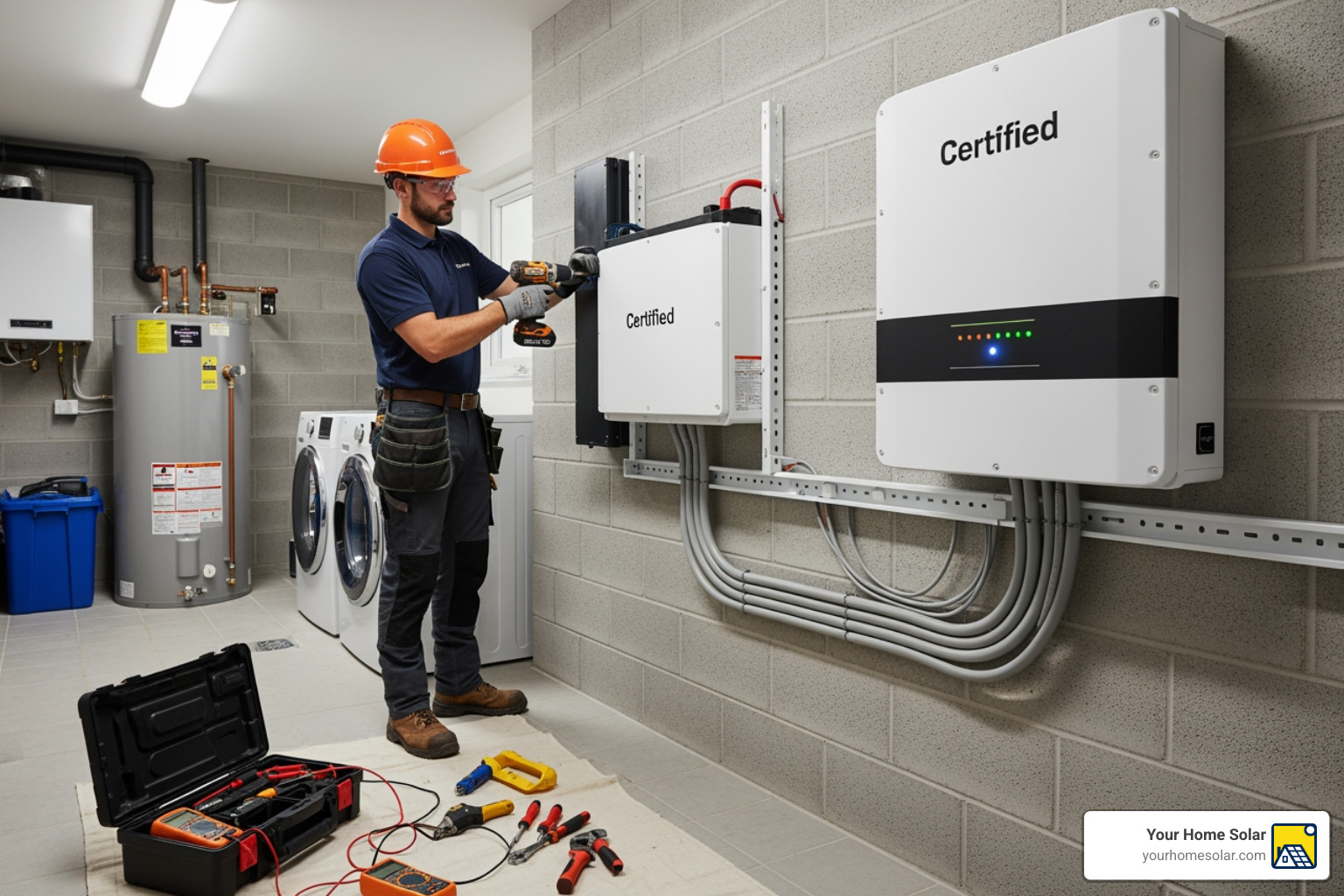
Once you’ve decided on a solar battery backup system, the next critical step is installation. While the DIY spirit is admirable, especially in East Tennessee, we strongly recommend professional installation for solar battery systems. This isn’t just about convenience; it’s about safety, compliance, and ensuring your system operates optimally for years to come.
The Case for Professional Installation
- Safety and Compliance: Working with high-voltage electrical systems and heavy battery units carries inherent risks. Our certified technicians are trained to handle these components safely, adhering to strict electrical codes and local regulations specific to East Tennessee. Improper installation can pose serious hazards, including fire and electrocution.
- Electrical Codes and Utility Interconnection: Solar battery systems must comply with complex electrical codes and local permitting requirements. Navigating these, along with the utility interconnection process, can be daunting for homeowners. Professionals ensure your system is compliant, passes inspections, and safely connects to the grid.
- Warranty Validation: Many manufacturers require professional installation for their product warranties to remain valid. Attempting a DIY installation could void your warranty, leaving you without coverage if issues arise.
- Optimal Performance: A professionally designed and installed system is optimized for your home’s unique energy profile, ensuring maximum efficiency and savings. Our experts know how to correctly size components, configure the system, and integrate it seamlessly with your existing electrical infrastructure.
- Expertise and Support: When you choose us, you’re not just getting an installation; you’re gaining a partner. We provide ongoing support, maintenance, and peace of mind. As we emphasize, the importance of professional installation cannot be overstated.
The Risks of DIY
While some might consider a DIY approach for cost savings, the technical complexity and potential pitfalls often outweigh the perceived benefits. DIY battery backup systems can lead to:
- Safety hazards: Incorrect wiring or handling of batteries can be extremely dangerous.
- Inefficient operation: Improper sizing or configuration can lead to underperformance or premature battery degradation.
- Voided warranties: As mentioned, manufacturers often require professional installation.
- Lack of support: If something goes wrong, you’re on your own for troubleshooting and repairs.
- Compliance issues: DIY systems might not meet local codes, potentially leading to fines or requiring costly re-installation by a professional.
While the desire to build your own system is understandable, for a complex and critical component like a solar battery backup, the expertise and assurance of a professional installation are invaluable.
Frequently Asked Questions about Solar Battery Backup
We often hear similar questions from East Tennessee homeowners considering a solar battery backup system. Here are some of the most common inquiries, answered directly:
How many solar batteries are needed to power a house?
The number of solar batteries your home needs depends on several key factors, not a one-size-fits-all answer. We consider:
- Average energy consumption: How much electricity does your household use daily (in kWh)?
- Critical loads: What essential appliances (refrigerator, well pump, lights, medical equipment) do you need to power during an outage?
- Desired backup duration: Do you want backup for a few hours, overnight, or several days?
- Solar panel output: How much energy do your panels generate?
- Budget: More batteries mean more storage and more cost.
For example, if your home uses 40 kWh per day and you want 8 hours of backup for essential loads, you’d need a minimum battery bank of around 16 kWh, allowing for some buffer. Many of our customers find that one or two batteries suffice for essential backup and daily energy optimization. However, some might opt for more for extended independence. The good news is that most systems are scalable, allowing you to add more batteries later as your needs or budget evolve.
Can a solar battery power my home completely off-grid?
Yes, a solar battery backup system can absolutely power your home completely off-grid, but it requires careful planning and significant investment. Achieving true off-grid living with solar means your system must be sized to generate and store all the electricity your home needs, even during periods of low sunlight (e.g., several cloudy days).
For complete energy independence, especially in East Tennessee’s varied weather, we typically recommend a robust solar array paired with a substantial battery bank. Additionally, many off-grid homeowners integrate a backup generator (gas, propane, or diesel) for times when solar generation is insufficient for extended periods. This generator can charge your batteries, providing an extra layer of security. We can help you with comparing solar with traditional gas generators and integrating them into a comprehensive off-grid solution. Proper system sizing for independence is paramount to ensure you’re never left without power.
How long do solar batteries last?
The lifespan of a solar battery is a common concern, and it’s an excellent question! Here’s what you can generally expect:
- Typical Lifespan: For daily cycling (charging and discharging every day for load shifting or self-consumption), most high-quality lithium-ion solar batteries are designed to last between 10 to 15 years.
- Cycle Life: As mentioned earlier, batteries are rated for a certain number of charge/discharge cycles, typically 4,000 to 6,000 cycles. If you use one cycle per day, that translates to 10 to 16 years.
- Depth of Discharge (DoD) Impact: Consistently discharging a battery to its maximum DoD (e.g., 90%) is fine, but repeatedly pushing it to 0% can accelerate degradation. Most modern systems manage this automatically to protect the battery.
- Temperature Effects: Batteries perform best within a specific temperature range, usually between 68°F and 77°F. Prolonged exposure to extreme heat (above 85°F) can degrade batteries faster, which is why proper placement and ventilation are important.
- Manufacturer Warranties: Warranties generally align with the expected lifespan, often covering 10 years or a specific number of cycles, guaranteeing a certain percentage of original capacity.
Batteries used primarily for emergency backup, rather than daily cycling, can last even longer—sometimes up to 25 to 30 years—because they experience fewer cycles.
Conclusion
Embracing a solar battery backup system is a forward-thinking decision for any East Tennessee homeowner. It’s a strategic investment that offers a powerful trifecta of benefits: improved energy security during outages, significant financial savings on electricity bills, and a tangible contribution to environmental sustainability.
We believe in empowering you with energy independence. That’s why we’re committed to providing custom, reliable, and rewarding solar battery installations backed by trusted expertise and 100% customer satisfaction. Let us help you design a custom system that perfectly fits your home’s needs and aspirations.
To learn more, we invite you to explore our ultimate guide to solar batteries and energy storage solutions. When you’re ready to take the next step towards a more resilient and sustainable home, don’t hesitate to get a free estimate for your home. We’re here to illuminate your path to a brighter energy future.