Which Fronius String Inverter Fits Your Home?
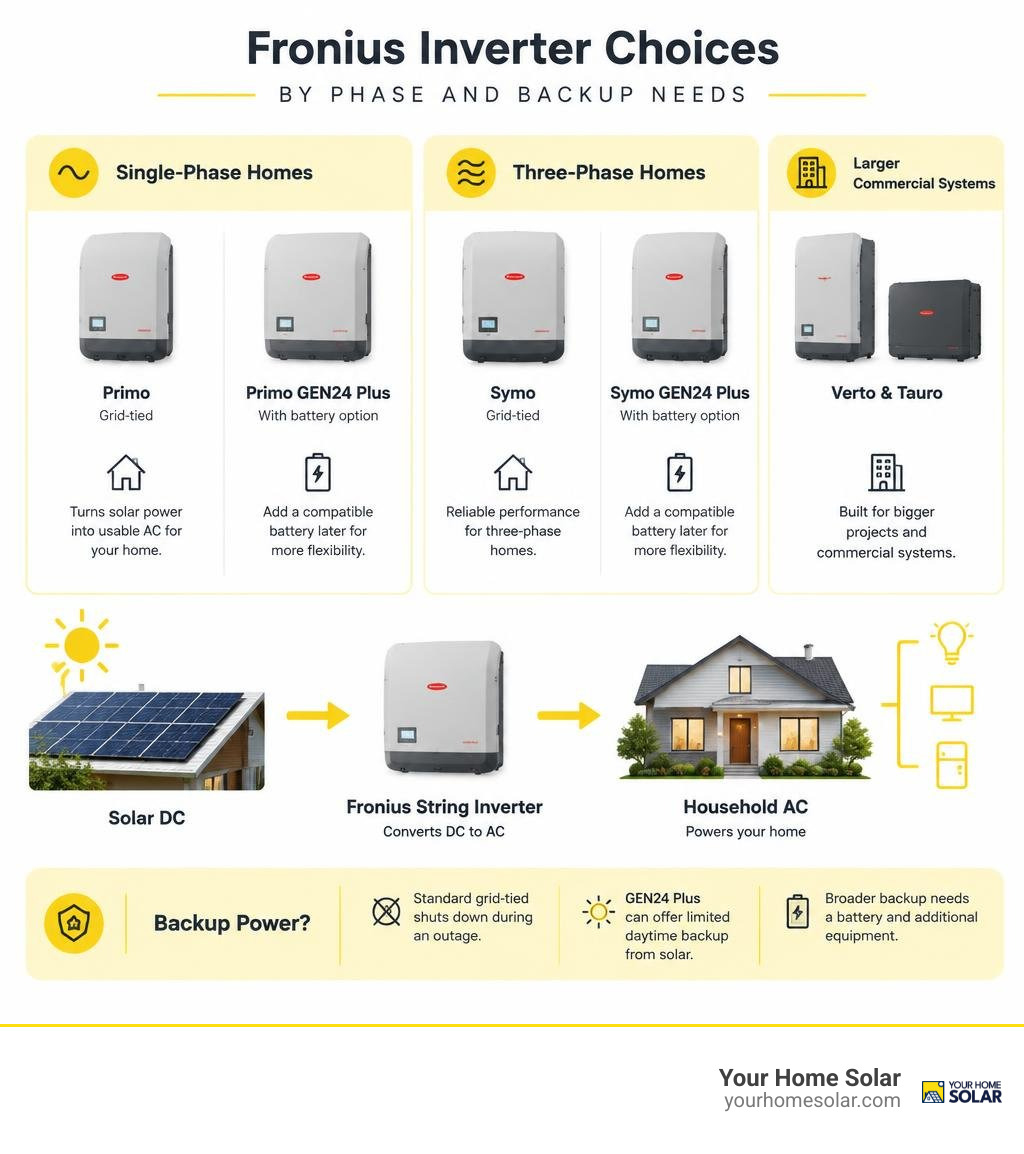
For most single-phase homes, the Fronius Primo is a straightforward choice for turning solar power into electricity the home can use. Choose the Primo GEN24 Plus if you want the option to add a compatible battery later. If your property has three-phase power, look at the Symo or Symo GEN24 Plus instead. Verto and Tauro are built for larger commercial systems.
The key question for an East Tennessee homeowner is whether you want backup power. A standard grid-tied Primo shuts down during an outage. A compatible GEN24 Plus setup can offer limited daytime backup from solar panels, while broader backup needs a battery and additional equipment.
I’m Ernie Bussell, founder of Your Home Solar, and I’ve worked in solar operations since 2020. I use that experience to help homeowners decide whether a Fronius string inverter fits their roof, budget, and backup goals.
Key fronius string inverter vocabulary:
The Fronius String Inverter Lineup: Residential to Commercial Solutions
Fronius has manufactured power conversion equipment since 1945, bringing Austrian engineering and active thermal management to residential rooftops and utility-scale projects alike. Their modular hardware ecosystem allows systems to scale smoothly across different grid configurations, whether you need single-phase residential power or heavy industrial three-phase output.
| Model Series | Phase Type | Power Classes | MPPT Trackers | Primary Application |
|---|---|---|---|---|
| Primo (SnapINverter) | Single-Phase | 3.0 kW – 8.2 kW | 2 | Standard residential grid-tied systems |
| Primo GEN24 Plus | Single-Phase | 3.0 kW – 6.0 kW | 2 | Hybrid residential with flexible backup storage |
| Symo (SnapINverter) | Three-Phase | 3.0 kW – 8.2 kW | 2 | Small commercial or large residential three-phase |
| Symo GEN24 Plus | Three-Phase | 6.0 kW – 10.0 kW | 2 | Hybrid three-phase residential & light commercial |
| Verto | Three-Phase | 25.0 kW – 33.3 kW | 4 | Medium-to-large commercial and agricultural roofs |
| Tauro | Three-Phase | 50 kW – 100 kW | Up to 3 (or direct) | Large-scale commercial & industrial ground mounts |
Understanding the distinction between single-phase and three-phase architecture is critical when designing your PV array. Single-phase systems power typical residential homes, while three-phase power distributes electrical loads across three alternating currents, reducing line losses for heavier commercial equipment. To explore the wider catalog of hardware, review available inverters & energy solutions that fit various architectural needs.
Single-Phase Power with the Fronius Primo String Inverter
For homeowners building a reliable grid-tied array without immediate battery storage, the Fronius Primo SnapINverter series remains a gold standard. A standout model in this family is the Primo 6.0-1 (model number 4,210,062,800), which retails around $2,097.72 and provides 6,000 watts of continuous AC output.
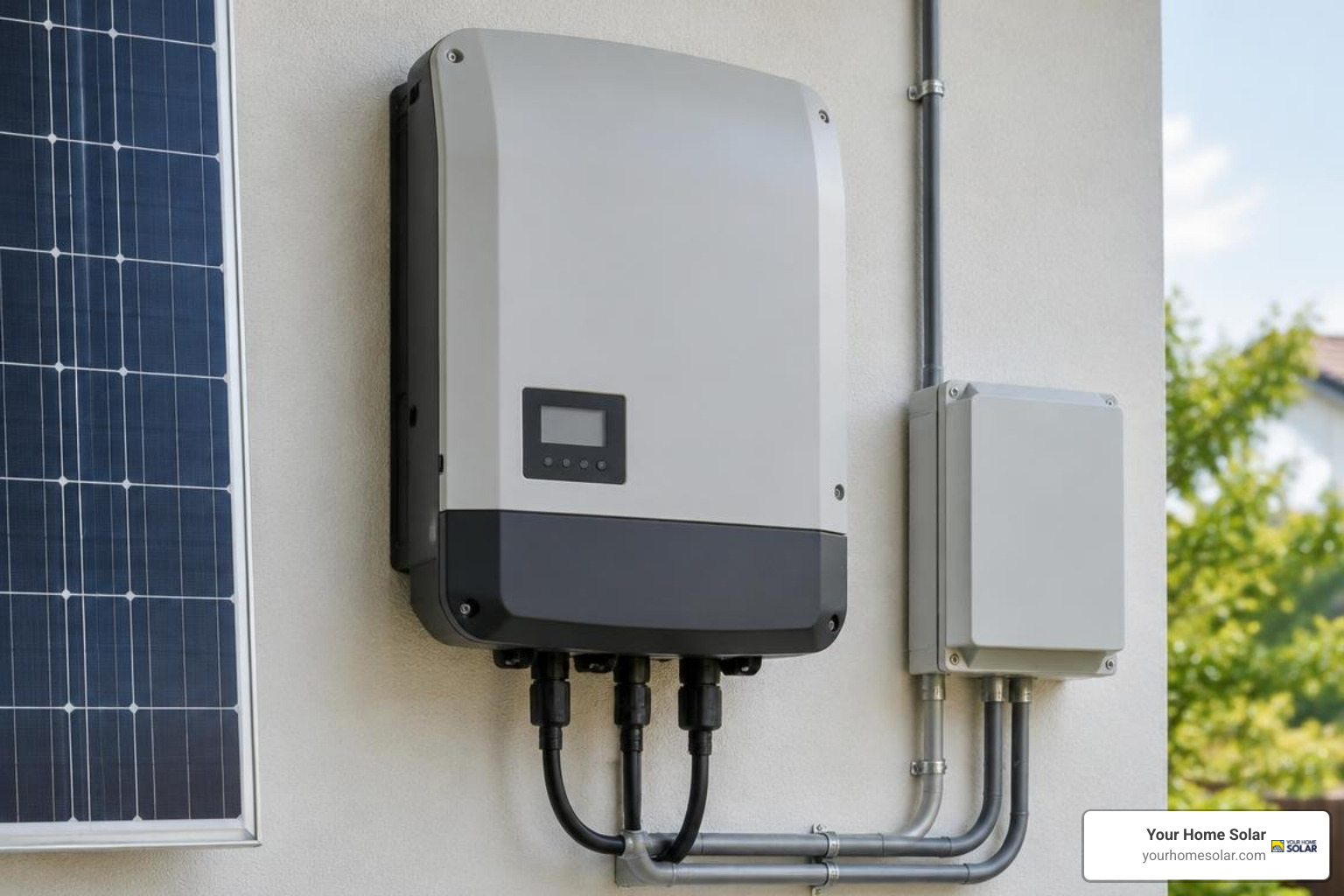
When evaluating modern home inverters, efficiency and mounting simplicity are essential. The Primo 6.0-1 achieves a 96.9% peak efficiency and a 96.0% CEC efficiency across both 208V and 240V grid connections. Weighing just 47.29 pounds (21.45 kg), its lightweight, non-isolated transformerless build utilizes Fronius’s signature SnapINverter hinge system, allowing the mounting bracket and connection area to be secured to the wall first before the power stage set simply snaps into place.
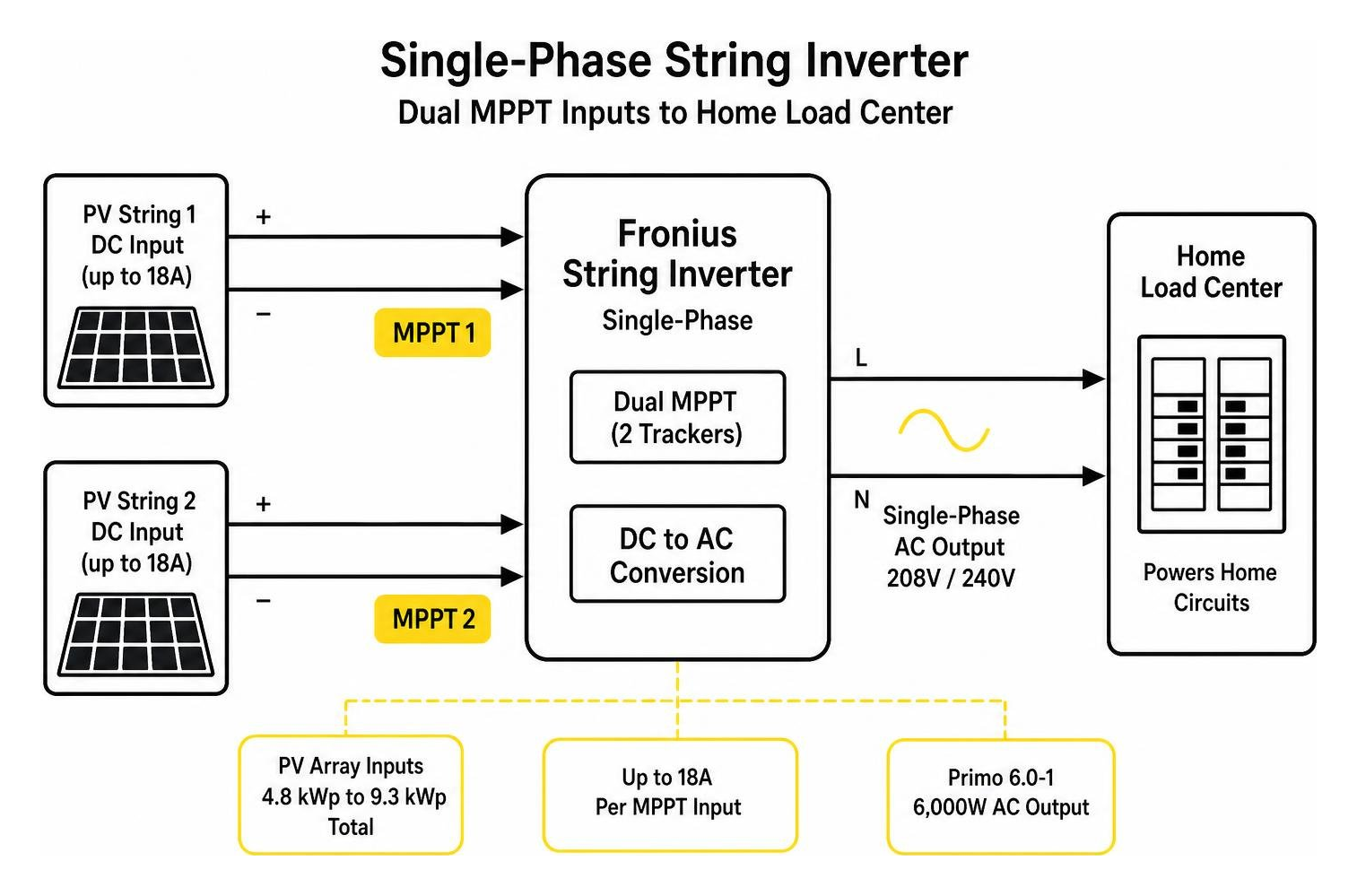
The Primo 6.0-1 handles PV array inputs ranging from 4.8 kWp up to 9.3 kWp across dual independent MPPT channels (up to 18A per input), giving installers exceptional layout flexibility across east-west or split roof planes. Encased in a rugged NEMA 4X enclosure, it operates in extreme ambient conditions from -40°F to 131°F (-40°C to +55°C).
Choosing a Hybrid Fronius String Inverter: Primo GEN24 Plus
Homeowners preparing for future energy independence often step up to the Primo GEN24 Plus hybrid string inverter (with the 6.0 kW unit priced at roughly $1,815.00 for the bare core unit before auxiliary storage components). The GEN24 series integrates Multi Flow Technology, allowing simultaneous DC and AC energy distribution. This means energy can flow straight from the panels into the home, into a battery bank, or out to the grid at the exact same moment.
The GEN24 Plus features the innovative PV Point—an integrated, dedicated backup power outlet that provides up to 3 kW of daytime emergency power directly from your solar panels during a grid outage, even if you have not installed a battery yet. When paired with high-voltage battery storage, such as BYD Battery-Box Premium HVS/HVM units, it unlocks comprehensive whole-home backup. Adopting this hybrid architecture provides cost-effective grid-tied solar power while protecting you against future utility rate hikes and grid instability.
Three-Phase Performance: Fronius Symo, Verto, and Tauro Series
Commercial projects and large rural properties require three-phase power delivery to manage high electrical loads. The standard Fronius Symo line spans 3.0 to 8.2 kW, functioning as the three-phase equivalent of the Primo SnapINverter.
For larger commercial rooftops, the newly engineered Fronius Verto series provides power classes from 25.0 to 33.3 kW. With an IP66 protection rating, up to 98.03% maximum efficiency, and four high-current MPPT trackers (each handling up to 28A), the Verto accommodates complex roofs with high-wattage modern modules.
At the industrial level, the high-efficiency Fronius TAURO 50-3-D inverter delivers 50 kW of nominal three-phase capacity at up to 98.6% efficiency. Weighing 92 kg, the Tauro uses double-wall construction and active cooling to withstand extreme outdoor conditions, providing long-term reliability when evaluating complete solar system investments.
Safety Standards, Active Cooling, and Technical Architecture
Fronius separates itself from passively cooled string inverters through its active cooling technology. Variable-speed internal fans continuously circulate airflow across internal heat sinks, preventing hot spots and keeping power electronics running well within optimal thermal thresholds. Active cooling keeps the inverter operating smoothly without aggressive power derating when outdoor temperatures soar.
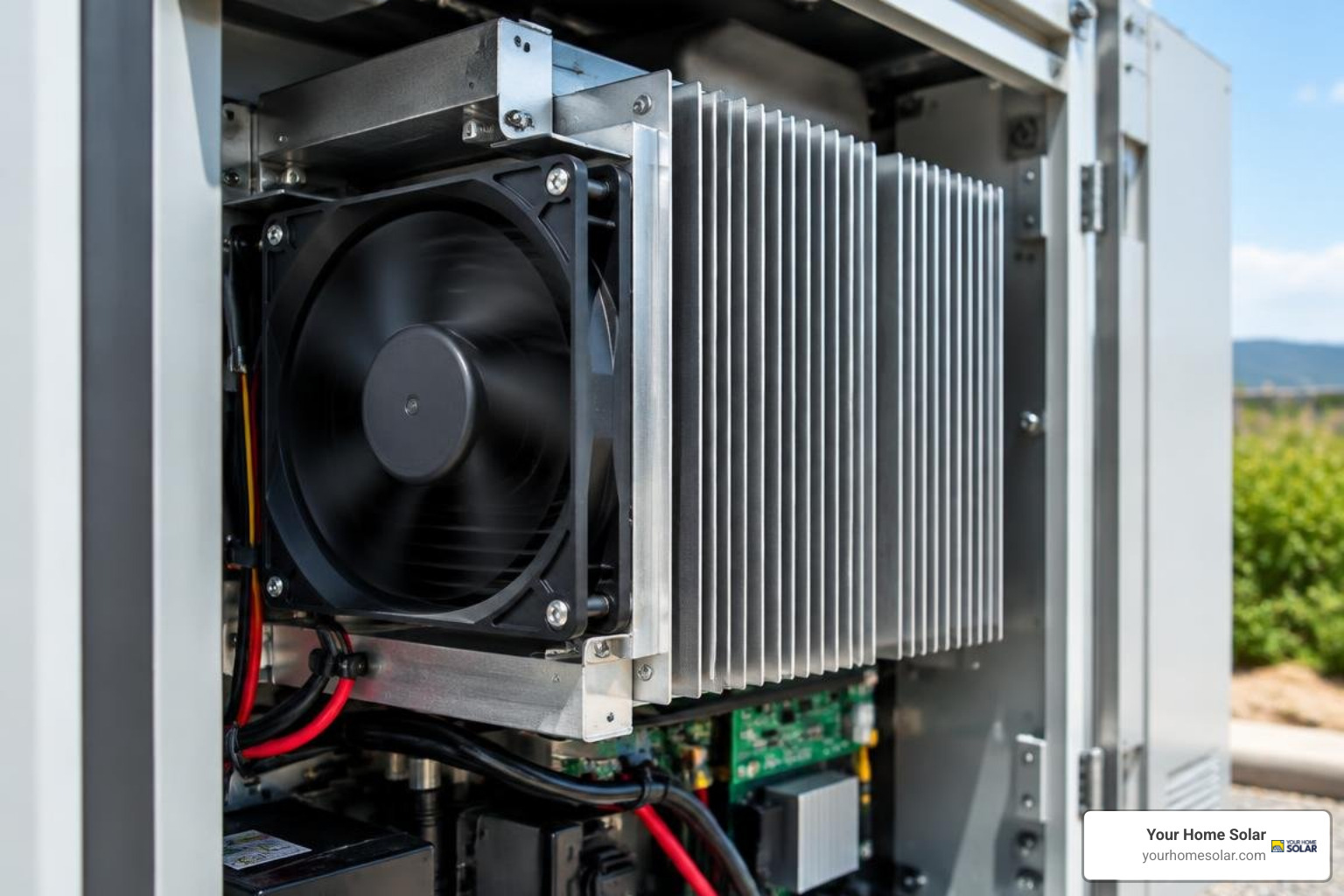
Modern electrical codes demand robust safety systems. Fronius integrates comprehensive protection layers directly into their hardware:
- Arc Fault Circuit Interruption (AFCI): Integrated Fronius Arc Guard continuously monitors DC wiring for electrical arcing, extinguishing faults instantly in full compliance with UL 1699B and IEC 63027 standards.
- Surge Protection Devices (SPD): Built-in or retrofittable Type 1+2 surge arrestors protect delicate DC and AC electronics from transient overvoltages and nearby lightning strikes.
- Integrated DC Disconnect: Built-in DC switches allow technicians to isolate PV strings safely without adding external standalone disconnect enclosures.
- Wide MPPT Voltage Range: A wide operating window from 80V to 600V (and up to 1,000V DC maximum input on commercial series) ensures strings start generating early in the morning and continue until dusk.
Applying these engineering standards represents one of the core best practices for designing a home solar panel system.
Smart Monitoring, Modbus TCP, and Energy Management Integration
Visibility into system performance is critical for maximizing your return on investment. The Fronius Datamanager 2.0 gateway connects your inverter to the Fronius Solar.web platform via integrated Wi-Fi or Ethernet. Solar.web offers real-time tracking of PV production, household consumption, self-sufficiency percentages, and automated fault alerts.
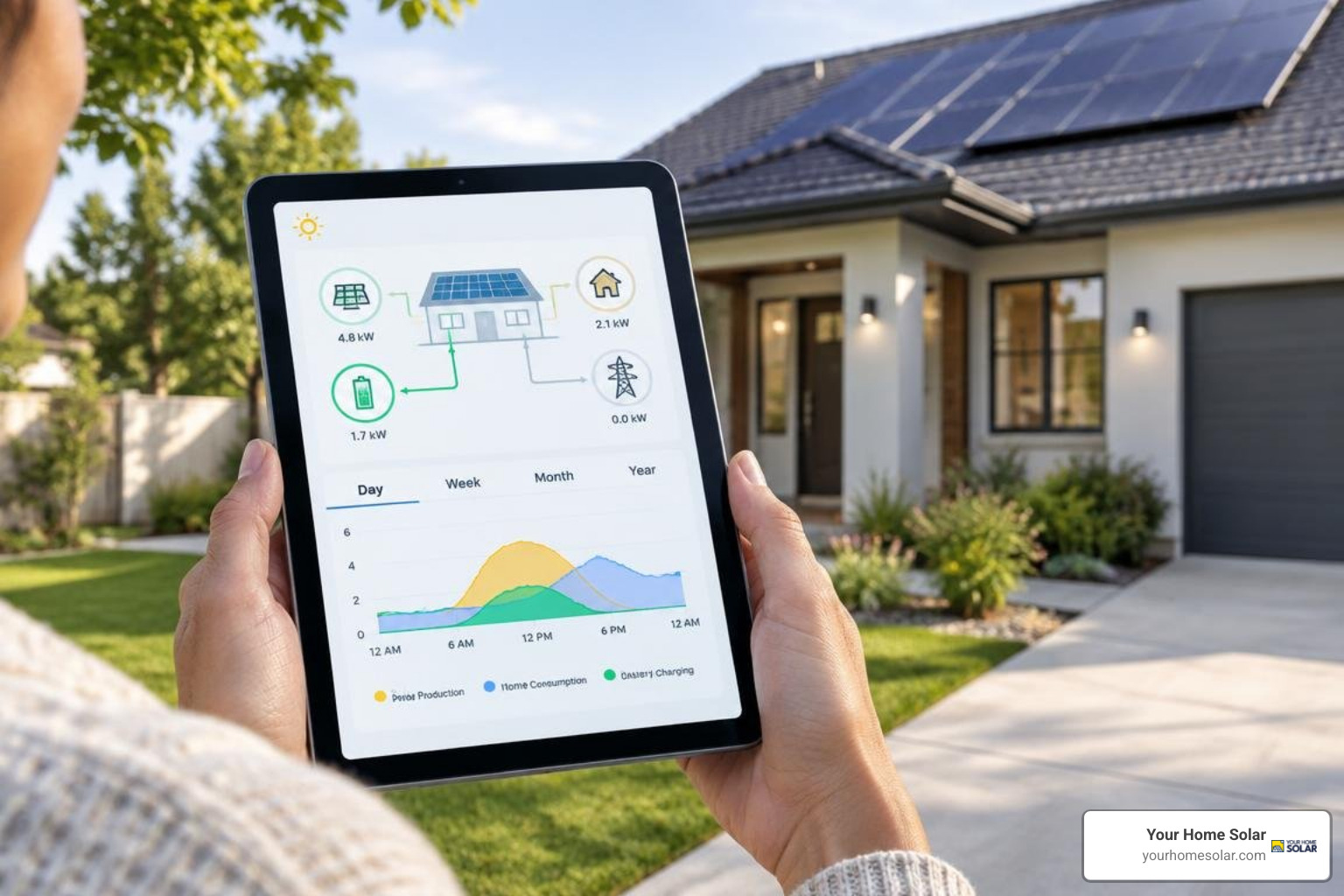
For smart home enthusiasts and commercial facility managers, Fronius open communication protocols allow seamless local network control:
- SunSpec Modbus TCP/RTU: Standardized communication runs over port 502 using the int+SF (integer with scale factor) model type, outputting precise data points such as AC real power, grid frequency, power factor, and string-level DC voltages.
- Third-Party Automation: By integrating the Fronius Symo with smart home automation platforms like TapHome, you can trigger EV chargers, water heaters, or HVAC units whenever excess solar generation is detected.
- Dynamic Peak Manager: This built-in MPPT tracking algorithm scans the entire power-voltage curve at regular intervals, bypassing shaded cells to maintain maximum global power output without requiring proprietary module-level optimizers on every panel.
Maintenance Protocols, Diagnostic Codes, and Warranty Terms
Fronius hardware is built for component-level serviceability, meaning individual circuit boards and fan units can be replaced in the field without scrapping the entire inverter casing. When an issue occurs, the inverter display or Solar.web portal will show an operating state and diagnostic code.
Follow this protocol if your inverter encounters an error:
- Record Status Codes: Note any 3-digit error numbers (e.g., Code 102 for AC grid voltage variations or Code 301 for overcurrent) and LED status colors.
- Perform an AC/DC Power Cycle: Switch off the AC breaker inside your main panel, turn the inverter’s DC disconnect to the ‘Off’ position, wait 5 minutes for internal capacitors to discharge, and then turn the AC breaker back on followed by the DC switch.
- Inspect Local Connectivity: If monitoring drops offline after a home Wi-Fi update, access the Datamanager local web UI via an Ethernet cable or by activating the inverter’s temporary Wi-Fi access point (AP mode), ensuring the IP address is configured correctly.
- Update Firmware via USB or Over-the-Air: Regular firmware updates ensure grid compliance and fix software bugs. SnapINverter units can be updated using a FAT32-formatted USB drive plugged into the internal Datamanager card under Setup to USB to Software Update.
Fronius offers a standard 5-year warranty that extends to 10 years at no cost when homeowners register their unit on Solar.web within two years of commissioning. Commercial hardware like the Verto series carries up to a 7-year extendable warranty. Factoring in equipment durability alongside transparent inverter installation charges and labor costs gives you a clear financial picture of your solar investment.
Frequently Asked Questions About Fronius Inverters
What is the expected lifespan and warranty coverage for a Fronius inverter?
Fronius string inverters have an engineered operating lifespan of 10 to 15 years, with many properly ventilated units exceeding 15 years of continuous service. Their standard 5-year warranty can be extended to 10 years for free by simply registering the serial number on Solar.web. Active cooling plays a major role in preserving internal capacitors and semiconductors over this lifespan.
What are typical pricing ranges for Fronius residential and commercial inverters?
Installed hardware costs for standard single-phase Fronius Primo string inverters typically range between $1,500 and $3,500 depending on system wattage and electrical panel preparation. The Primo GEN24 Plus hybrid units generally range from $2,500 to $4,500 installed, reflecting their hybrid storage and backup capabilities. Commercial three-phase units like the Verto and Tauro scale economically based on total DC capacity and site infrastructure requirements.
Conclusion
Choosing the right inverter forms the operational foundation of any high-performing solar array. Fronius string inverters deliver an outstanding blend of European build quality, intelligent thermal management, advanced grid safety, and open monitoring integration. Whether you install a Primo for direct single-phase rooftop generation or a GEN24 Plus for versatile battery readiness, pairing quality hardware with expert installation engineering guarantees decades of reliable clean power.
To learn more about finding the right electrical design for your home, explore our ultimate guide to residential solar inverters or contact Your Home Solar to start planning your custom project.