
Why Your Grid-Tie Solar System Goes Dark During Outages (And What to Do About It)
An AC coupled inverter is a battery-based inverter/charger that connects to your existing grid-tie solar system on the AC side — letting you add battery backup without replacing your current solar equipment.
Here’s a quick breakdown:
| Question | Answer |
|---|---|
| What does it do? | Lets your existing solar inverter keep running during a grid outage |
| Who is it for? | Homeowners with grid-tie solar who want backup power |
| How efficient is it? | Solar-to-AC load efficiency of 95–99% |
| Do I need new solar panels? | No — your existing panels and inverter stay in place |
| What’s the main rule to know? | The Factor 1.0 rule limits solar array size to inverter/charger VA rating |
Picture this: the grid goes down during a storm. Your neighbor fires up a generator and enjoys cold drinks while your house sits dark — even though you have solar panels on your roof. This is the frustrating reality for most grid-tie solar owners. Standard grid-tie systems are required by law to shut down during outages to protect utility workers from backfed power. Your panels produce nothing. Your investment sits idle.
That’s exactly the problem AC coupling solves.
This guide breaks down how AC coupling works, what the Factor 1.0 rule means for your system, and whether it’s the right move for your home.
I’m Ernie Bussell, founder and CEO of Your Home Solar, and my background spans nuclear weapons systems in the U.S. Navy, a decade in education, and several years leading solar operations for a $40 million per year installation company — experience that gave me a deep, practical understanding of how AC coupled inverter systems perform in real-world residential installations. I’ll walk you through everything you need to know so you can make a confident, informed decision.
What is an AC Coupled Inverter and How Does It Work?
To understand an AC coupled inverter system, it helps to look at how we route power. In a traditional solar setup, your solar panels generate Direct Current (DC) electricity. However, your home appliances run on Alternating Current (AC).
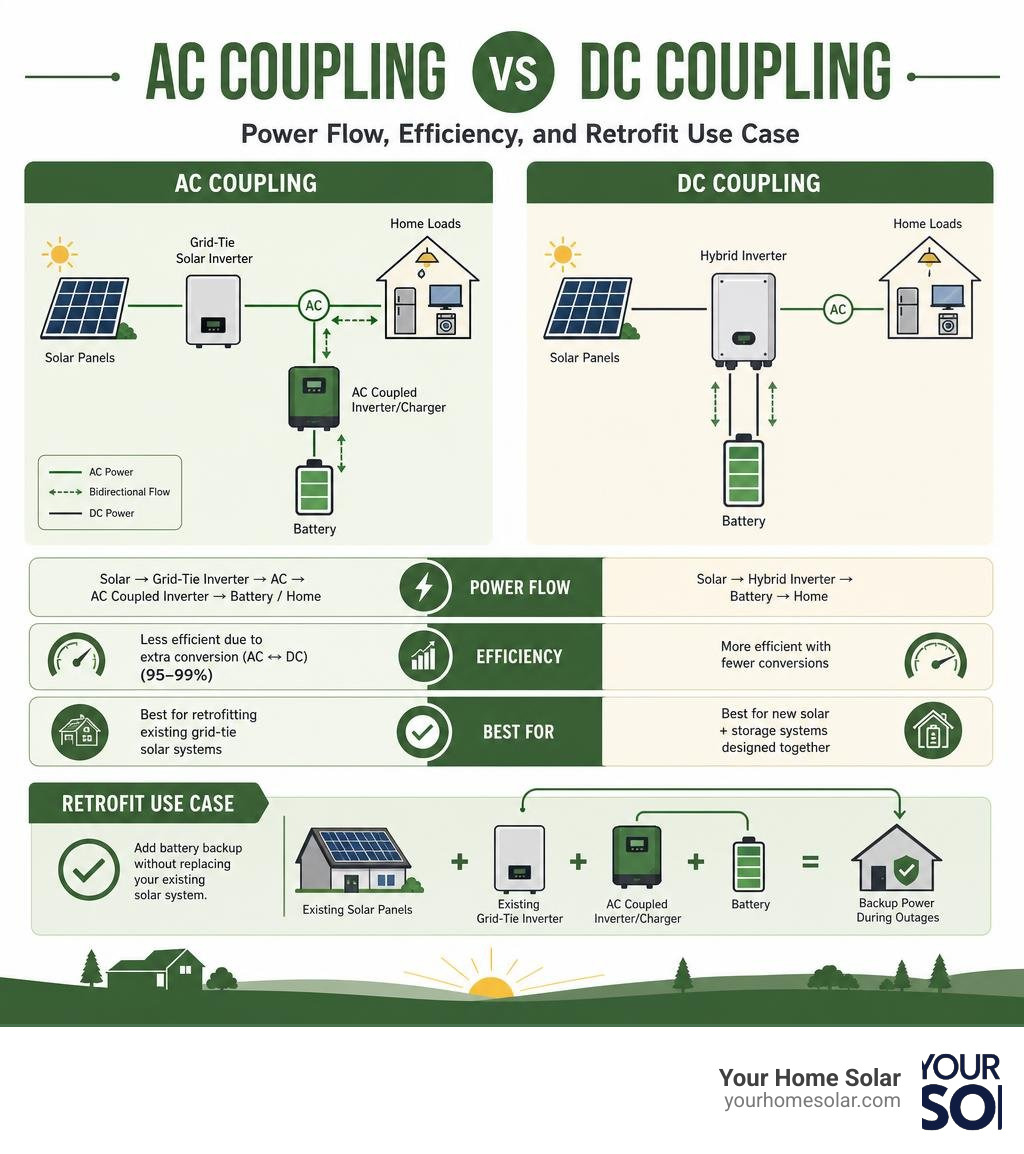
In a standard DC-coupled battery system, the solar panels feed DC power directly into a charge controller, which charges the battery bank (also DC). The power is only converted to AC when it is drawn out of the battery to run your home.
With AC coupling, the process is flipped. Your existing solar panels feed DC power into your standard grid-tie inverter (like an Enphase microinverter system or a SolarEdge string inverter). This inverter immediately converts that power into high-quality AC electricity. This AC electricity is then routed directly to your home’s main service panel.
So, where does the battery come in? We integrate a specialized battery-based inverter/charger—the AC-coupled storage inverter—into your home’s AC wiring. When your solar panels produce more AC power than your home is using, this storage inverter takes the excess AC electricity, converts it back to DC, and stores it in your battery bank.
To help you visualize the differences, here is a detailed comparison of the two topologies:
| Feature | AC-Coupled System | DC-Coupled System |
|---|---|---|
| Primary Connection Point | AC Output Side (Microinverters/String Inverter) | DC Input Side (Charge Controller/Solar Panels) |
| Best Suited For | Retrofitting existing grid-tied solar systems | Brand-new off-grid or hybrid solar installations |
| Daytime Load Efficiency | 95% to 99% (Direct PV-to-load path) | 85% to 90% (Requires DC-to-DC-to-AC conversion) |
| Battery Charging Efficiency | Low 80s to low 90s% (Multiple conversion steps) | 97.5% (Direct DC-to-DC charging) |
| System Complexity | Moderate (Relies on frequency shifting for control) | Low (Direct physical control over charge current) |
| Component Replacement | Keep your existing grid-tie inverter | Often requires replacing or upgrading existing inverters |
As you can see, AC coupling is highly efficient when you are consuming solar power immediately during the day. Because the power goes straight from your solar panels to your household loads, it achieves an incredible 95% to 99% conversion efficiency.
This makes AC coupling an exceptional choice for homes with high daytime energy demands, such as running central air conditioning, pool pumps, or medical equipment. To understand how these components fit into your broader electrical architecture, you can read more about The Heart of Your Solar System: Understanding Home Inverters.
If you are looking to retrofit your existing grid-tied solar array with energy storage, you do not have to rip out your current equipment and start over. Specialized hardware solutions, such as the AC Coupled Inverter – GivEnergy or pre-configured options like an AC Coupled Pre-Wired Inverter System – EcoDirect.com , make it easier than ever to add battery storage to your existing system. For a deeper look at the hardware options available on the market in 2026, check out this AC Coupled Inverter: Comprehensive Review with Buying Tips .
The Mechanics of AC Coupling During Grid Outages
Under normal grid-connected conditions, your grid-tie solar inverter and your AC-coupled storage inverter work in harmony alongside the utility grid. But what happens when a severe storm knocks out power in East Tennessee?
Normally, your grid-tie inverter would immediately shut down to satisfy strict utility anti-islanding regulations. It does this because it needs to detect an active grid voltage and frequency to synchronize its AC output. Without that reference signal, it goes to sleep.
In an AC-coupled system, the storage inverter steps up to save the day. When the utility grid fails, an internal high-speed automatic transfer switch (ATS) inside the storage inverter opens. This physically disconnects your home’s backed-up electrical circuits from the utility grid, ensuring no power can backfeed into the downed power lines.
Once isolated, the storage inverter instantly transitions into “grid-forming” mode. It uses its internal battery power to create a local, highly stable AC voltage and frequency signal. It projects this “micro-grid” signal onto your home’s critical loads panel.
To your existing grid-tie solar inverter, this local signal looks exactly like the utility grid. It wakes up, synchronizes with the storage inverter’s signal, and begins producing solar power again. This power is routed directly to your critical loads panel to run your essential appliances, and any excess is used by the storage inverter to recharge your battery bank. If you want to explore how to design your home’s emergency backup circuits, refer to The Ultimate Guide to Staying Powered When the Grid Goes Down.

How Frequency Shifting Regulates an AC Coupled Inverter
When you are off-grid, managing the balance of power is critical. If your solar panels are producing 8,000 watts of power, but your home is only consuming 2,000 watts, that extra 6,000 watts must go somewhere. The storage inverter directs that excess power into your batteries.
But what happens when your batteries are 100% full?
In a traditional DC-coupled system, a charge controller simply opens the circuit or detours the power to prevent battery damage. In an AC-coupled system, the storage inverter cannot physically disconnect the solar panels because they are wired to a completely separate grid-tie inverter. If the solar panels keep pumping out AC power with nowhere for it to go, the system voltage will spike, potentially destroying your batteries or your inverter.
To prevent this, AC-coupled systems use a process called frequency shifting.
When the storage inverter detects that the batteries are reaching their maximum state of charge (or that the charging current is exceeding safe limits), it begins to artificially raise the frequency of the local AC micro-grid. In the United States, our standard grid frequency is 60 Hertz (Hz). The storage inverter will gradually shift this frequency upward—for example, to 60.5 Hz, 61 Hz, or up to 64.5 Hz.
Grid-tie inverters are programmed to monitor grid frequency closely. When they detect the frequency rising above normal operating limits, they respond in one of two ways:
- Abrupt Trip (Legacy Systems): Older grid-tie inverters (which only comply with basic UL 1741 standards) will view any frequency above 60.5 Hz as a grid anomaly and shut down completely. They will then wait a mandatory five minutes before attempting to reconnect, repeating this on-and-off cycle as power demands fluctuate.
- Frequency-Watt Curtailment (Modern Systems): Modern grid-tie inverters (compliant with UL 1741 SA or SB, or IEEE 1547-2018 standards) support “Freq-Watt” mode. Instead of shutting down abruptly, they gradually feather or curtail their power output in direct proportion to the rising frequency. If the frequency rises to 61 Hz, the solar inverter might reduce its output to 50%. If it rises to 62 Hz, it might reduce to 10%, perfectly matching your home’s load and keeping your batteries safe.
This advanced power modulation is made possible by cutting-edge power electronics. For example, research into high-frequency conversion, such as the 600W GaN-Based Single-Phase Cycloconverter Reference Design , demonstrates how gallium nitride (GaN) semiconductor technology can achieve peak efficiencies of 96.1% and rapid switching speeds to handle these dynamic load transitions.
Additionally, researchers continue to refine control strategies for hybrid systems. Publications like the Analysis, Control, and Design of a Hybrid converter and developments featured by the Oak Ridge National Laboratory in their article on how a Hybrid inverter integrates distributed energy resources, supports … highlight the ongoing innovation in smart-grid and micro-grid controls that keep AC-coupled systems running smoothly.
Sizing Your Battery Bank for an AC Coupled Inverter
Because frequency shifting relies on the battery bank to act as a physical buffer for sudden electrical surges, you cannot pair a massive solar array with a tiny battery. Doing so will cause severe voltage instability and system shutdowns.
As a general engineering rule of thumb, you must respect these minimum battery capacity requirements when designing an AC-coupled system:
- Lithium Iron Phosphate (LFP) Batteries: You need at least 4.8 kWh to 5.0 kWh of battery capacity for every 1.0 kW to 1.5 kW of installed grid-tie PV power.
- Lead-Acid Batteries: You need at least 5.0 kWh of battery capacity (typically rated at 100 Ah at 48V) per 1.0 kW of installed PV power.
If your battery bank is too small, a sudden drop in household load (like your air conditioner compressor cycling off) will cause a massive surge of solar power to rush into the battery before the storage inverter has time to shift the frequency and curtail the solar output. A properly sized battery bank absorbs this transient energy safely.
To explore battery chemistries, capacities, and lifespan expectations, dive into our Residential Solar Solutions Guide: The Ultimate Guide to Solar Batteries and Energy Storage Solutions.
Demystifying the Factor 1.0 Rule in System Design
If you are planning an AC-coupled system, the most critical design constraint you must follow is the Factor 1.0 Rule (sometimes referred to as the 1:1 Rule).
Simply put, the Factor 1.0 Rule states that the maximum AC power output of your grid-tie solar inverter must be equal to or less than the continuous power rating (VA) of your battery-based storage inverter.
For example, if you have a Victron MultiPlus-II rated at 3,000 VA, the maximum capacity of the grid-tie solar inverter you can connect to its AC-output side is 3,000 Watts (3.0 kW).
Why is this rule so strict? It comes down to basic physics and the protection of your equipment.
If you have a 10 kW solar array connected to a 5 kW storage inverter, and your home is drawing very little power, the solar array can easily overwhelm the storage inverter’s internal battery charger. If a heavy household load suddenly disconnects, the massive surplus of AC power will backfeed through the storage inverter.
Because the storage inverter cannot react instantly to shift the frequency, this surplus power will cause an immediate DC over-voltage spike on the battery bus. This can trigger a high-voltage alarm, shut down your system, leave you in the dark, or even damage sensitive electronics.
To prevent these high-voltage transients, engineers design advanced magnetic and power conversion topologies. For instance, research on A Trans-Inverse Magnetic Coupling Single-Phase AC-AC Converter explores how specialized magnetic coupling can achieve high voltage gains and continuous input currents to mitigate voltage spikes.
In the real world, different manufacturers handle these limits in unique ways:
- Sol-Ark Inverters: The maximum AC-coupled input on Sol-Ark inverters is capped at 9.6 kW on their standard models. However, on their heavy-duty 15K model, you can combine up to 19.2 kW of AC-coupled solar with 17 kW of direct DC-coupled solar, reaching an incredible combined limit of 36.2 kW.
- OutBack Power Mojave: The Mojave inverter can support up to 7.6 kVA of AC-coupled input, with a maximum combined grid-dependent inverter and PV array size of 8.0 kW. It features a specialized “nulling circuit” that uses a battery shunt to zero out current flow when the battery is full, offering superior overcharge protection.
By respecting the Factor 1.0 Rule and choosing the right inverter hardware, you ensure your system remains stable, safe, and online when you need it most. To learn more about how batteries buffer your system and keep your home safe, read Beyond the Grid: How Solar Battery Banks Keep Your Lights On.
Frequently Asked Questions About AC Coupling
What is the difference between AC and DC coupling?
The primary difference is where the solar panels connect to the battery storage system. In an AC-coupled system, the solar panels connect to a standard grid-tie inverter that immediately converts DC to AC power. This AC power is used by the home, and any excess is converted back to DC by a storage inverter to charge the batteries.
In a DC-coupled system, the solar panels connect directly to a charge controller that charges the batteries using DC power, which is only converted to AC when your home demands it. AC coupling is highly efficient (95–99%) for powering daytime household loads directly, while DC coupling is more efficient (around 97.5%) for storing solar energy in batteries for nighttime use.
Can I add a battery to my existing microinverter system?
Yes! This is one of the greatest benefits of an ac coupled inverter. If you have an existing microinverter system (such as an Enphase array), you do not need to replace your microinverters or rewire your roof.
We simply install an AC-coupled storage inverter and a critical loads panel. Your existing microinverters are re-routed to feed into this new backup panel. When the grid is up, everything operates normally. When the grid goes down, the storage inverter forms a local grid to keep your microinverters producing power to run your backed-up appliances and charge your batteries.
What happens to my solar panels when the grid goes down?
In a standard grid-tie system without a battery, your solar panels will shut down immediately during a grid outage due to anti-islanding safety regulations (UL 1741).
However, in an AC-coupled system, your solar panels will continue to generate power. The AC-coupled storage inverter acts as a “grid-forming” source. It disconnects your home from the utility grid using an automatic transfer switch and creates a local AC signal. Your solar panels detect this local signal, stay online, and continue to power your home and charge your battery bank throughout the outage.
Conclusion
Adding battery backup to an existing solar array doesn’t require a complete system overhaul. By utilizing a high-quality ac coupled inverter and carefully adhering to design principles like the Factor 1.0 Rule, you can transform your standard grid-tie system into an independent micro-grid.
At Your Home Solar, we specialize in designing and installing custom energy storage solutions across East Tennessee—from Knoxville and Maryville to Oak Ridge, Sevierville, and the surrounding counties. We are committed to delivering trusted expertise, reliable installations, and 100% customer satisfaction.
Whether you want to retrofit an existing array or design a new hybrid system, we are here to help you secure true energy independence. Ready to take the next step? Explore our Residential Solar Solutions Guide: The Ultimate Guide to Solar Inverters or contact us today to schedule your custom system consultation!