What Does a 200-Watt Solar Panel Cost?
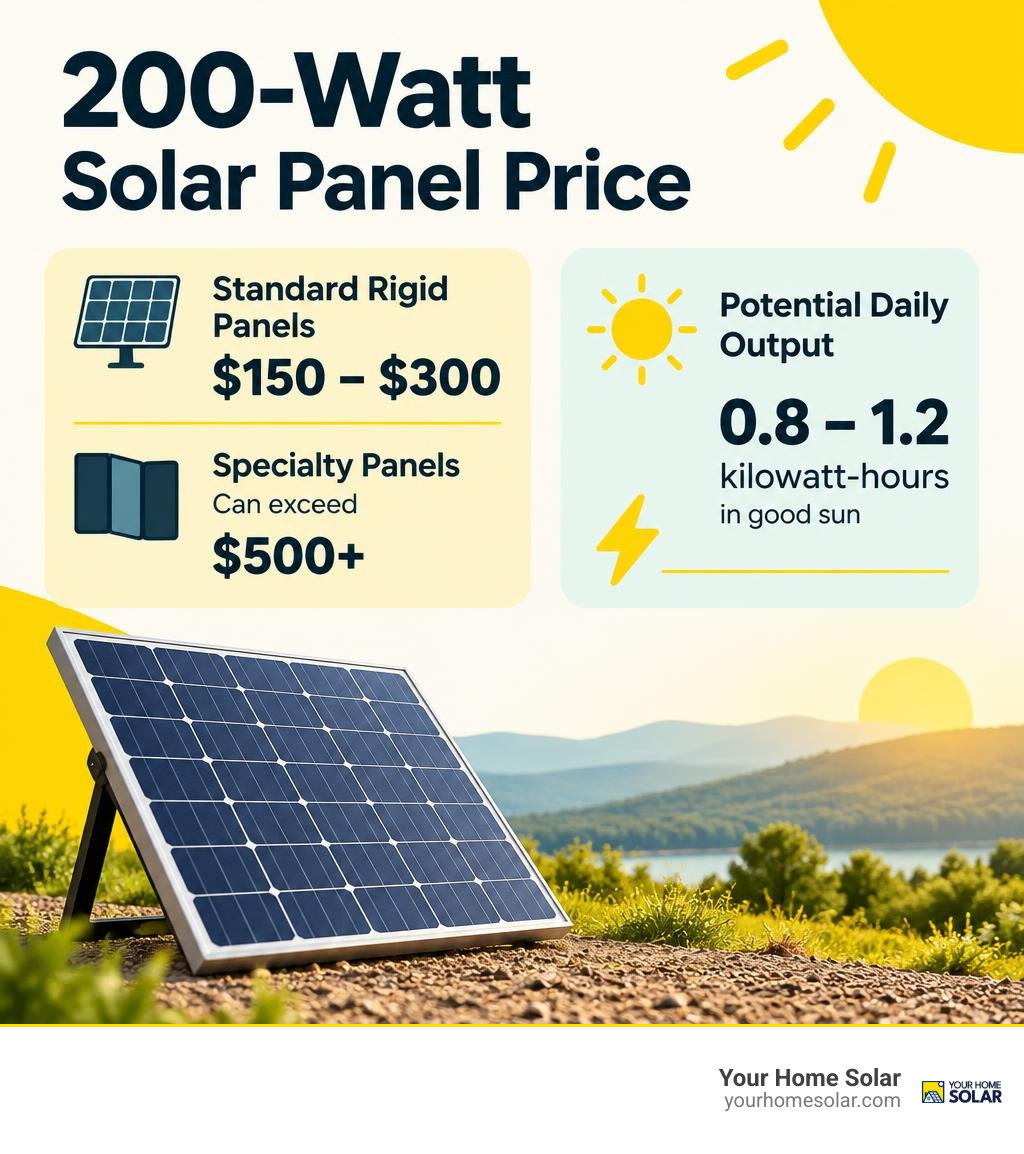
A standard rigid 200-watt solar panel costs about $150 to $300. Folding and specialty panels can cost more, sometimes over $500. That is the panel price, not the cost of a working system: mounting, wiring, and battery-charging equipment may be extra. Understanding the full 200-watt solar panel price means looking beyond the sticker price on the module itself.
In good sunlight, a 200-watt panel might generate roughly 0.8 to 1.2 kilowatt-hours in a day. It is useful for small off-grid loads, but one panel will not power a typical East Tennessee home.
I’m Ernie Bussell, founder of Your Home Solar, and my experience leading solar operations helps me explain what a search for 200-watt solar panel price often leaves out: the cost and performance of the full setup.
200-watt solar panel price terms you need:
Current 200-Watt Solar Panel Price Overview and Average Costs

When evaluating standalone hardware in November 2026, the retail market offers a wide spectrum of choices. Entry-level budget modules start around $120 to $165, while heavy-duty commercial designs sit in the $210 to $315 bracket. If you look at high-end specialty modules—such as flexible thin-film or military-grade folding kits—the cost can climb past $500.
Understanding these numbers requires separating standalone hardware from installed systems. If you review the wider market trends for solar panel costs in 2026, hardware manufacturing improvements have brought down per-watt production expenses significantly. However, smaller format panels (100W to 200W) carry a slight manufacturing premium per watt compared to massive 400W+ residential rooftop slabs because they require similar framing, junction boxes, and packaging for half the power output.
Average 200wat Solar Panel Price Breakdown by Category
The physical construction and intended application dictate where a panel falls on the price scale:
| Panel Category | Typical Price Range | Average Efficiency | Common Warranty | Best Practical Use |
|---|---|---|---|---|
| Standard Rigid Monocrystalline | $150 – $240 | 20.0% – 21.5% | 10 to 25 Years | RV roofs, off-grid sheds, cabins |
| Next-Gen N-Type Rigid | $120 – $180 | 24.0% – 25.4% | 5 to 25 Years | Compact vehicle roofs, high-heat areas |
| Bifacial Monocrystalline | $160 – $250 | 20.5% – 22.0% | 10 to 25 Years | Ground mounts, light-colored flat roofs |
| Portable Folding Suitcase | $230 – $400 | 21.0% – 23.0% | 2 Years | Car camping, overlanding, temporary backup |
| Flexible CIGS Thin-Film | $500 – $600 | 14.0% – 16.0% | 5 to 10 Years | Curved boat decks, uneven camper roofs |
A standard rigid monocrystalline unit typically retails around $165, offering reliable performance with a 25-year warranty. Meanwhile, high-density N-type options have pushed entry costs down to roughly $119.99 during promotional cycles while delivering cell efficiency ratings above 25%.
If you want rugged portability with integrated kickstands and Anderson connectors, folding kits sit around $230 to $400. For marine applications where foot traffic or curved hulls rule out rigid glass, specialized flexible CIGS panels command top-tier pricing near $520 to $600.
Price Per Watt: How 200W Panels Compare to Market Averages
Price per watt (cost divided by rated wattage) is the standard metric used to compare solar equipment value:
- 200W Rigid Mono Panels: $0.60 to $1.20 per watt
- 200W Portable Folding Kits: $1.15 to $2.00 per watt
- 200W Flexible Thin-Film: $2.50 to $3.00 per watt
To put this in perspective, our guide to average solar panel costs explains how full-sized residential modules (400W and above) often drop well below $0.80 per watt at wholesale volume. You can also explore how 300W solar panel prices compare to see how scaling up to mid-sized modules affects balance-of-system economics.
For small, off-grid applications, paying $0.60 to $1.00 per watt for a standalone 200W panel offers excellent value because it avoids the complex racking and permitting associated with utility-tied systems.
Key Factors Influencing 200W Solar Panel Costs
Two panels with identical 200W ratings can vary in price by hundreds of dollars. The difference comes down to internal materials, cell manufacturing, and mechanical durability.
Cell Technology: N-Type, Mono PERC, and Polycrystalline
The underlying silicon technology determines how effectively the module converts photons into usable direct current:
- Polycrystalline: Older, blue-hued cell technology. Cheaper to produce, but less efficient (15% to 17%), requiring a larger physical frame to reach 200W. Mostly phased out for premium portable setups.
- Monocrystalline PERC (Passivated Emitter and Rear Cell): The industry workhorse. PERC cells reach 20% to 22% module efficiency, maintaining steady output in mixed weather conditions.
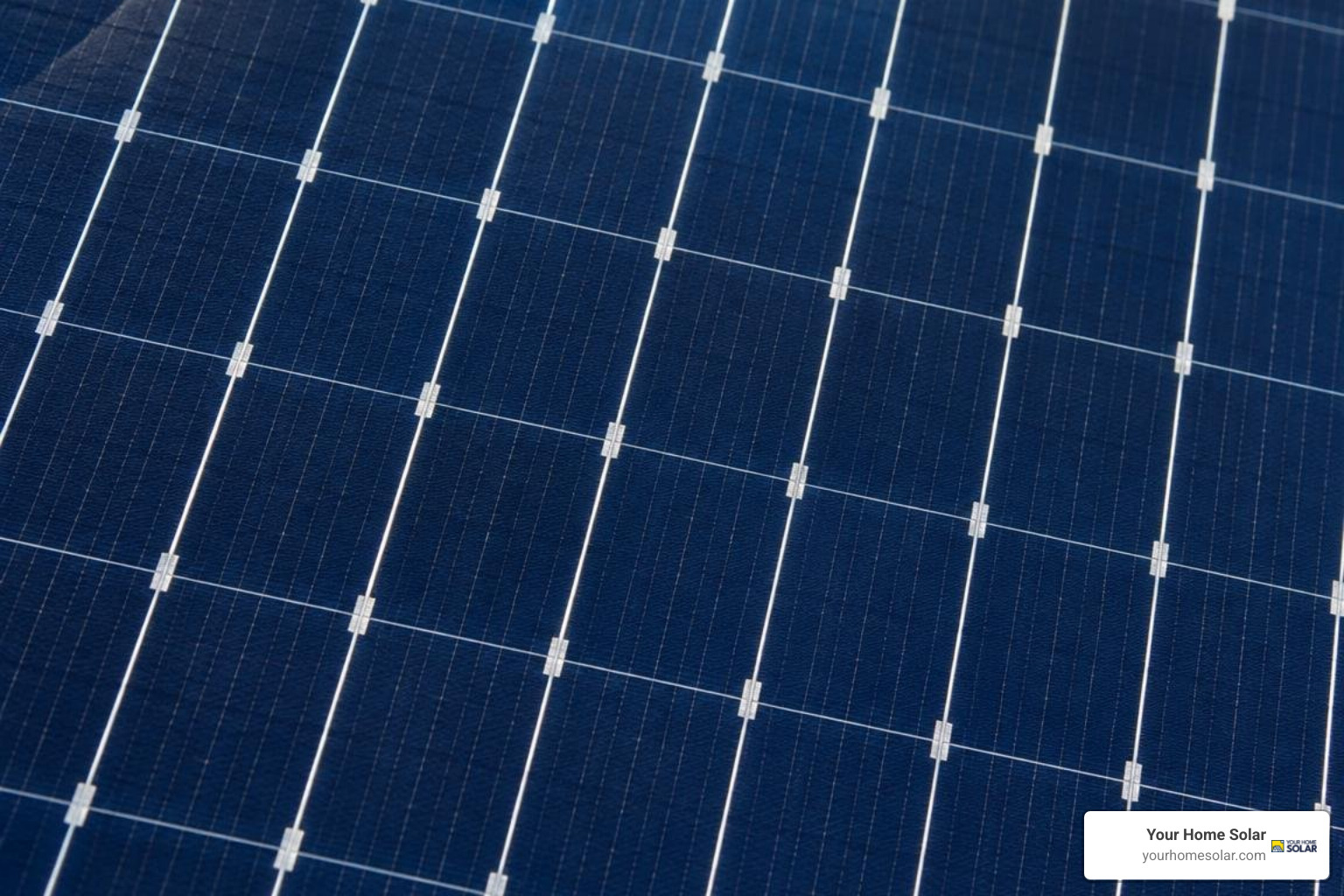
- N-Type 16BB (16 Busbars): Next-generation monocrystalline architecture. Using 16 ultra-thin busbars reduces electrical resistance and micro-crack vulnerability. N-type cells achieve up to 25.4% cell efficiency, suffer virtually zero light-induced degradation (LID), and boast better temperature coefficients (less power loss as the panel heats up on a hot summer afternoon).
Because N-type cells are more efficient, modern 200W N-type panels reduce physical dimensions by 10% to 13% compared to older PERC panels while delivering the same 200-watt punch.
Rigid vs. Portable vs. Thin-Film Flexible Designs
Form factor directly influences engineering costs:
- Rigid Panels: Built with low-iron tempered glass encased in a heavy-duty, anodized aluminum frame. They handle 2400 Pa wind resistance and 5400 Pa snow loads effortlessly, making them the most cost-effective choice for permanent mounting.
- Portable Folding Panels: Built with lightweight ETFE (ethylene tetrafluoroethylene) laminates and canvas backing. You pay extra for portability, built-in kickstands, carry handles, and Anderson or MC4 quick-connect wiring. If you are comparing mobile setups, reviewing the best 200W camping solar panel options will help you balance weight against durability.
- CIGS Thin-Film Flexible Panels: Copper Indium Gallium Selenide (CIGS) cells are ultra-thin and semi-rigid. They feature dozens of bypass diodes (often 24 or more), allowing the panel to keep producing power even if partially shaded, punctured, or stepped on. This specialized engineering drives their price above $500.
Warranty Length and Long-Term Durability Value
A panel’s warranty tells you how confident the manufacturer is in its lamination and cell longevity.
- Product Workmanship Warranty: Covers physical defects, frame corrosion, and junction box failure. Portable panels usually carry 2- to 5-year warranties, whereas rigid panels often offer 10 to 12 years.
- Linear Power Output Warranty: Guarantees that the panel will retain a specific generation capacity over time. A standard 25-year performance warranty ensures at least 95% output after year 5, 90% after year 10, and 80% to 87% after year 25.
Investing a few extra dollars up front in a panel backed by a 25-year warranty provides significantly lower lifetime costs than buying ultra-cheap, unbranded modules that may suffer moisture ingress or delamination within three seasons. To dive deeper into long-term financial planning, check out our essential guide to solar panel costs.
Hidden System Costs and Practical Value Considerations
A standalone solar panel cannot power household electronics or charge a battery safely by itself. The raw DC voltage fluctuates constantly with sunlight intensity. To build a functioning off-grid setup, you must factor in the “Balance of System” (BOS) components.
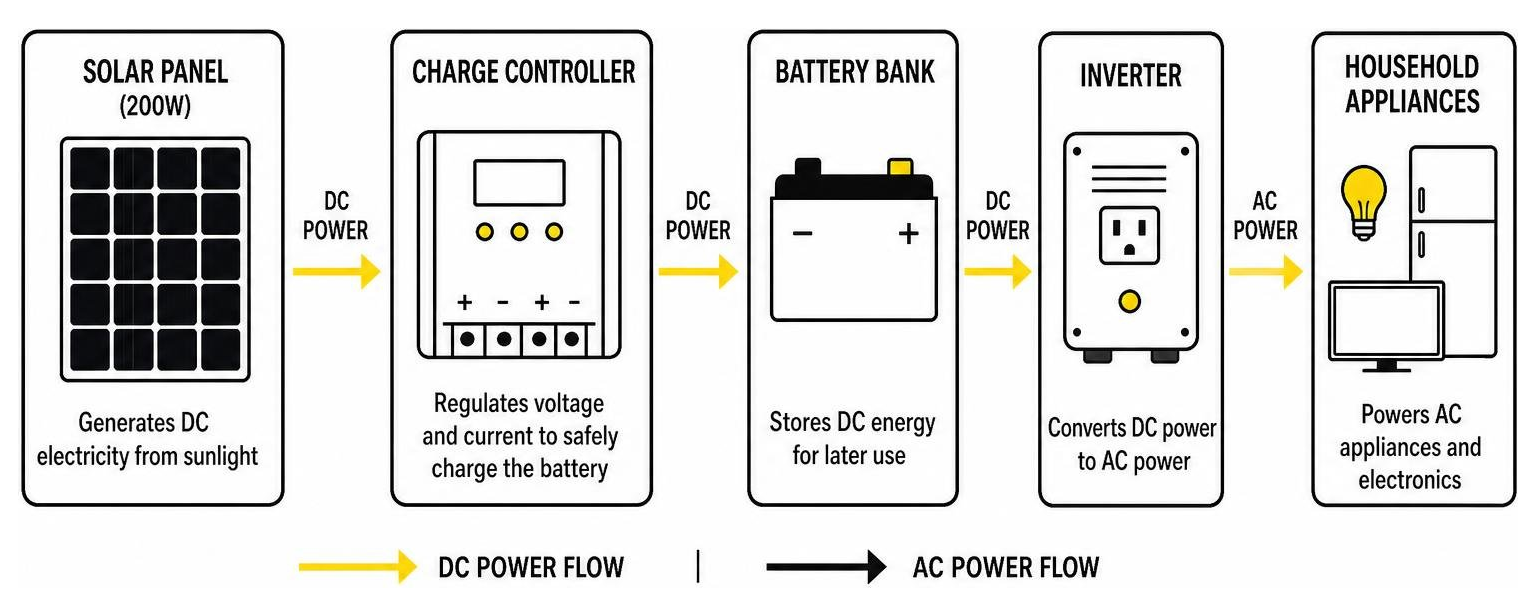
Essential Balance of System Equipment (Controllers, Batteries, Mounting)
Here is what is required to turn raw solar energy into safe, usable electricity:
- Solar Charge Controller ($25 – $150): Prevents the panel from overcharging your battery during peak sun and stops reverse current from draining the battery at night.
- PWM (Pulse Width Modulation): Low cost ($25–$45), but loses 20% to 30% of potential energy by stepping down panel voltage to match the battery.
- MPPT (Maximum Power Point Tracking): Higher cost ($70–$150), but extracts maximum wattage by actively matching voltage and amperage, delivering up to 30% more daily energy.
- Battery Storage ($150 – $500+): You need a deep-cycle battery to store power for nighttime use. A 12V 100Ah Lithium Iron Phosphate (LiFePO4) battery provides roughly 1,280 Wh of usable capacity—an ideal match for a single 200W panel.
- Power Inverter ($50 – $250): If you only charge phones and run 12V DC lights or camper fans, you can wire directly to the battery. If you want to plug in standard 110V AC household appliances (like a laptop charger or TV), you need a pure sine wave inverter.
- Mounting Brackets & Cables ($30 – $60): Heavy-duty aluminum Z-brackets, UV-resistant 10 AWG or 12 AWG copper tray cables, and IP67 waterproof MC4 connectors ensure physical stability and weatherproofing.
Even if you explore smaller micro-systems, such as those covered in our pocket-sized 15W panel guide, matching controller ratings to open-circuit voltage remains essential.
Single 200W Panel vs. Dual 100W Panels: Which Is More Cost-Effective?
Many DIYers debate whether to buy one 200W panel or two 100W panels.
- Hardware Costs: Two 100W panels typically cost $180 to $220 combined, whereas a single 200W panel averages $150 to $190.
- Mounting Footprint & Hardware: One 200W panel requires one set of four Z-brackets and four roof penetrations. Two 100W panels require eight brackets, eight roof penetrations, and branch connectors (or extra series wiring).
- Installation Time: A single panel cuts installation labor and wiring complexity roughly in half.
Unless your roof has awkward structural obstructions (such as vents, AC units, or curved ribs) that physically prevent mounting a single 55-by-27-inch frame, choosing one 200W panel is almost always more economical and cleaner to wire.
Frequently Asked Questions About 200-Watt Solar Panel Pricing
What is the typical 200wat solar panel price for off-grid setups?
A standalone rigid 200-watt monocrystalline solar panel typically costs between $150 and $300. Budget N-type or PERC panels on sale can dip to $120 to $165, while heavy-duty folding portable kits run between $230 and $400. Premium flexible CIGS thin-film models reach $500 to $600.
How much daily electricity does a 200-watt panel generate?
On an average sunny day with 4 to 5 peak sun hours, a 200W panel produces approximately 800 to 1,000 watt-hours (0.8 to 1.0 kWh). Under ideal summer conditions with 6+ peak sun hours, production can reach 1,200 Wh per day. In winter or under heavy overcast skies, output drops to 300 to 500 Wh daily.
Regional sunlight availability directly shapes these totals. For example, reviewing solar cost and production data for Johnson City illustrates how local sun hours impact seasonal generation across East Tennessee.
What appliances can you run with a 200-watt solar panel?
When paired with a 1,000 Wh (approx. 100Ah 12V) battery bank, a single 200W panel can comfortably power:
- 12V DC Portable Car Fridge (45W–70W): Runs continuously (cycling on/off) for 14 to 18 hours.
- Laptop Recharges (60W): Fully recharges a standard work laptop 12 to 15 times.
- Smartphone Charging (15W–20W): Provides 40 to 50 complete mobile phone charges.
- LED Camp Lighting (10W): Runs 4 to 5 overhead LED bulbs for 20+ hours.
- 40-Inch LED TV (50W): Powers roughly 16 to 20 hours of viewing time.
It is not designed to run power-hungry heating or cooling loads such as central air conditioning, space heaters, electric water heaters, or standard kitchen ovens.
Conclusion
A 200-watt solar panel offers an accessible, highly capable entry point into off-grid power. Whether you are outfitting a camper van, powering an off-grid workshop in Cocke County, or setting up a reliable emergency battery station, a quality 200W module delivers dependable energy in a manageable footprint for roughly $150 to $300.
While a 200W panel is ideal for recreational and small off-grid use, powering an entire home requires an engineered residential array scaled in kilowatts. At Your Home Solar, we provide comprehensive home energy solutions across East Tennessee—including residential solar installations, whole-home backup generators, and Level 2 EV chargers. From Knoxville and Farragut to Maryville, Oak Ridge, and Johnson City, our team is dedicated to trusted expertise, transparent pricing, and 100% customer satisfaction.
If you are ready to evaluate a permanent solar energy system tailored to your property, explore our guide on the cost and financing of residential solar systems to discover how clean energy can lower your monthly utility expenses.