
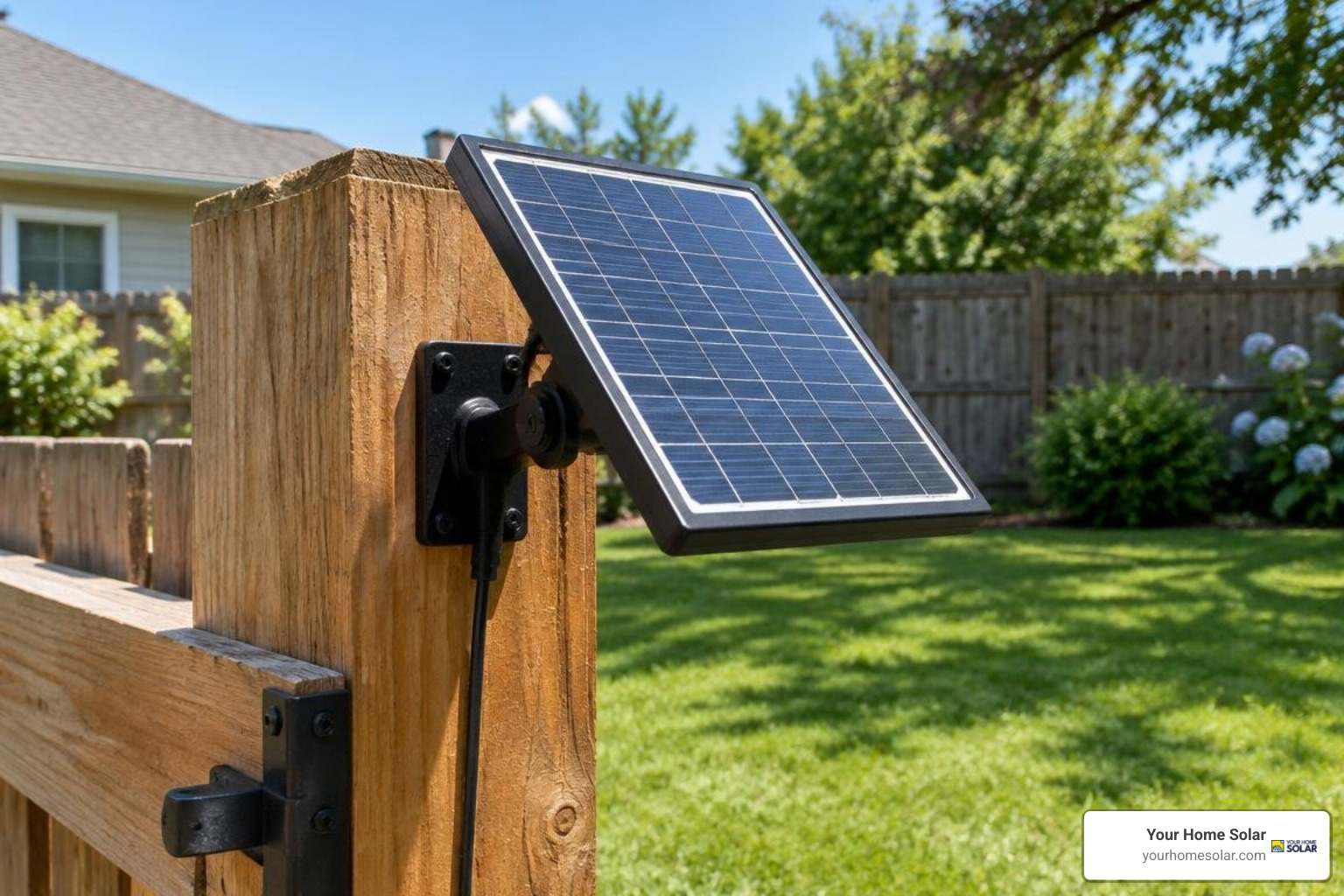
What Does a 10W Solar Panel Cost in 2026?
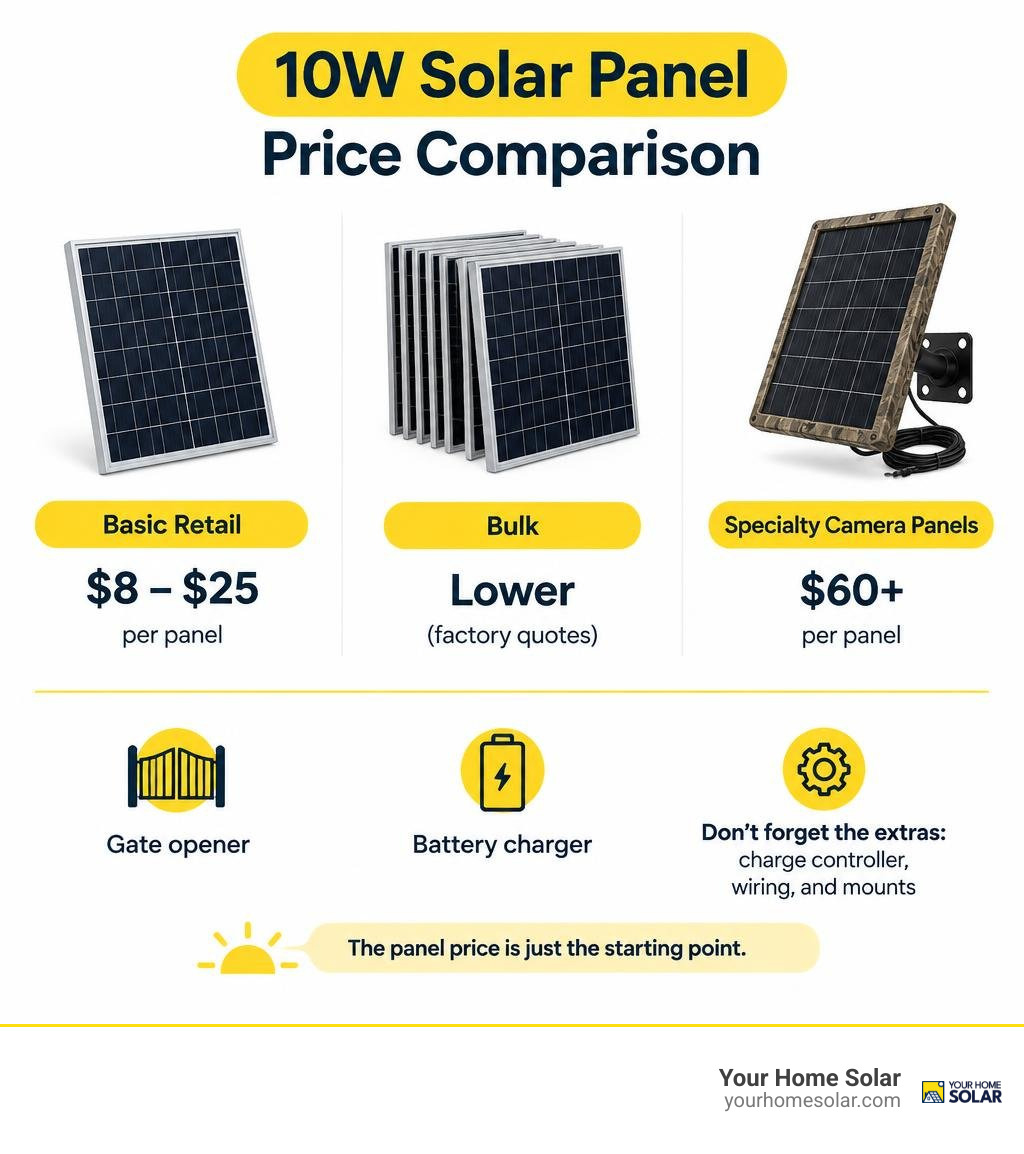
A basic 10W solar panel typically costs about $8 to $25 when bought one at a time, based on the listed prices compared here. Specialized panels for trail cameras can cost $60 or more. Bulk factory quotes can be much lower, but shipping and minimum order sizes change the math.
For a gate opener or battery charger, the panel price is only the starting point. Check the required voltage and budget for a charge controller, wiring, and mounts before choosing the cheapest listing.
I’m Ernie Bussell, founder of Your Home Solar, and I’ve spent years leading solar operations and helping homeowners weigh energy costs. I’ll use that experience to put the 10w solar panel price in context as we compare panels and the parts needed to use them.
Quick 10w solar panel price definitions:
Global 10W Solar Panel Price Comparison by Region and Cell Type
When sizing up micro-solar modules, understanding geographic market conditions and cell architecture helps clarify the wide spread in retail prices. While residential rooftop arrays are measured in kilowatts, 10-watt panels inhabit the realm of small off-grid hardware, IoT monitors, automated gate actuators, and trickle maintainers.
Across international markets, manufacturing hubs, and domestic retail channels, pricing reflects cell grade, housing construction, and distribution overhead. For context, when assessing the cost of a single solar plate, lower wattage units carry a higher cost per watt due to the fixed packaging, framing, and handling costs that don’t scale down linearly.
| Region / Market | Panel Type | Typical Retail Price (USD) | Cost Per Watt | Common Use Cases |
|---|---|---|---|---|
| Global / China (Bulk Export) | Polycrystalline | $1.50 – $3.00 (bulk) | $0.15 – $0.30 | OEM components, bulk battery kits |
| India | Polycrystalline | $7.90 – $9.00 (₹656 – ₹738) | $0.79 – $0.90 | 6V/12V small batteries, farm lighting |
| Brazil | Monocrystalline (PERC) | $15.80 – $23.80 (R$ 79 – R$ 119) | $1.58 – $2.38 | Remote monitoring, security systems |
| United States | Monocrystalline (Rigid) | $18.00 – $28.00 | $1.80 – $2.80 | Driveway gate openers, RV battery maintainers |
| Specialized Global Retail | Integrated Micro-Charger | $45.00 – $65.00 | $4.50 – $6.50 | Cellular trail cameras, outdoor security hubs |
Polycrystalline vs. Monocrystalline 10W Modules
The choice between monocrystalline and polycrystalline silicon at the 10W scale comes down to size limitations, environmental conditions, and budget.
- Monocrystalline Panels: Built with single-crystal silicon, these units reach conversion efficiencies between 17% and 22%. Many modern units incorporate Passivated Emitter and Rear Cell (PERC) architecture to capture more light in low-angle or overcast conditions. Because of this higher energy density, a monocrystalline 10W panel is physically smaller (roughly 270 x 240 mm). If you have tight mounting dimensions on a fence post or outdoor junction box, monocrystalline is the logical pick.
- Polycrystalline Panels: Sliced from multi-faceted silicon blocks, poly modules offer efficiencies in the 14% to 17% range. They require slightly more surface area (roughly 350 x 255 mm) to produce identical wattage. However, they remain an exceptionally economical option for budget installations. You can learn more about standard configurations with a dedicated 10W Polycrystalline Panel: Best for Off-Grid Use.
What Is the Expected 10W Solar Panel Price in Bulk vs. Retail?
Purchasing micro-panels in volume reveals an enormous divergence between factory-gate costs and retail pricing. B2B manufacturers quote 10W polycrystalline panels at $0.15 to $0.70 per watt for high-volume orders. That puts bare-bones modules at $1.50 to $7.00 per unit when ordering hundreds or thousands of pieces.
For an individual homeowner or farm manager buying one or two units, retail pricing absorbs logistics, protective retail packaging, regional compliance testing, distributor margins, and local support. In the broader context of solar panel costs in 2026, small modules carry higher retail markups than full-sized 400W residential panels.
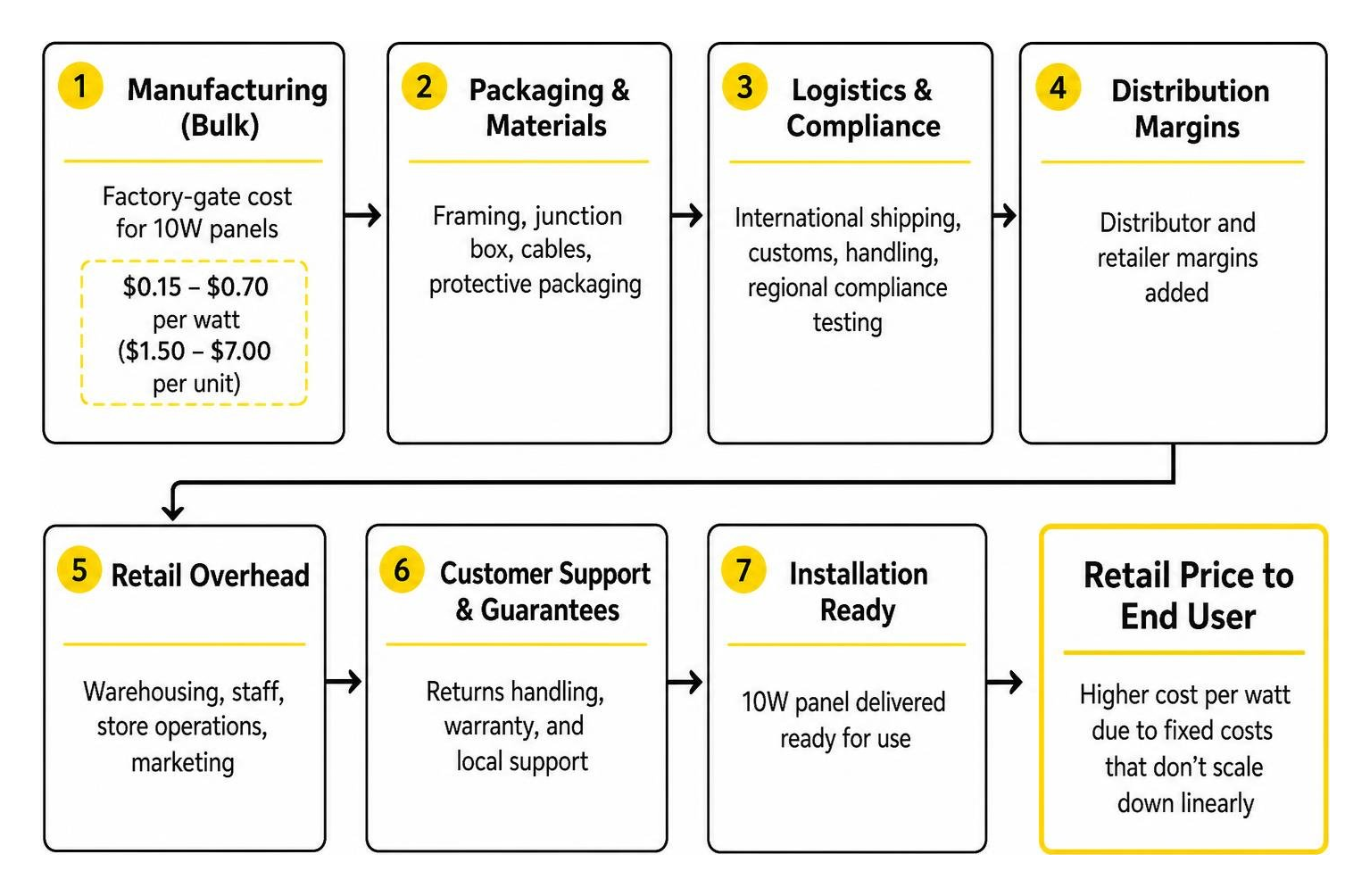
When buying retail, domestic suppliers also build in return guarantees and customer support. Single-unit imports directly from overseas marketplaces may boast low sticker prices, but unexpected customs handling, prolonged shipping times, and the risk of receiving uncertified junction boxes often outweigh the upfront savings.
Total Setup Costs: Key Applications from Gate Openers to 12V Battery Trickle Chargers
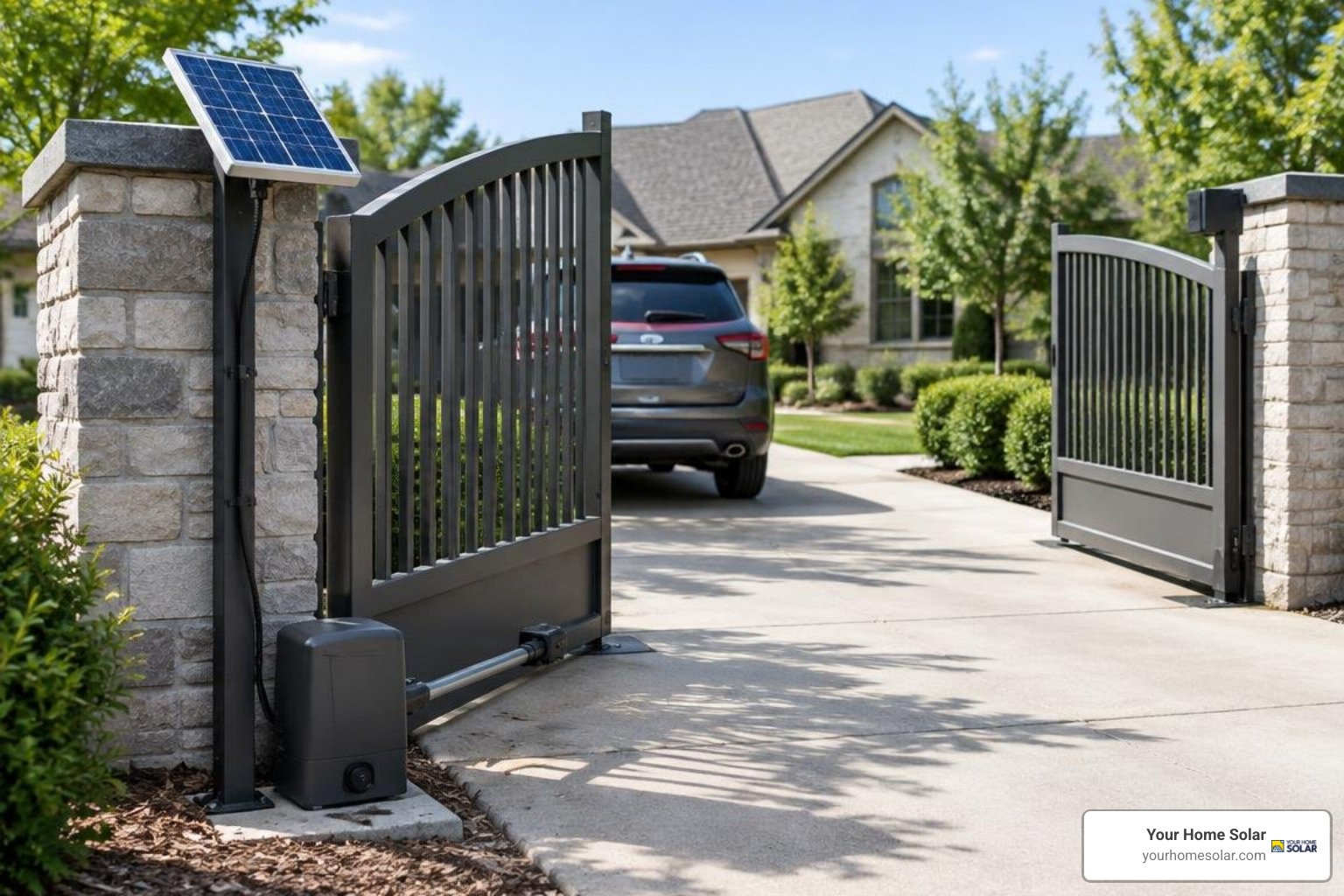
A bare 10W solar module cannot power an automated system alone. To build an operating setup, the panel must be paired with appropriate energy storage, mounting brackets, and charge regulation hardware. Evaluating total costs requires looking at complete operational packages across standard use cases, much like evaluating portable solar panels for off-grid power needs.
| Application | Bare Panel Cost | Required Accessories | Typical Battery Needed | Total Estimated Setup Cost |
|---|---|---|---|---|
| Driveway Gate Opener | $20 – $28 | 5A–10A PWM controller, Z-brackets, 10 AWG wire | 12V 7Ah – 18Ah SLA / AGM | $75 – $140 |
| 12V Vehicle Trickle Charger | $18 – $25 | Inline blocking diode or mini-controller, alligator clips | Existing vehicle battery | $28 – $45 |
| 6V/12V Trail & Game Camera | $45 – $65 | Integrated mounting arm, DC barrel plug, built-in Li-ion | Internal camera battery | $60 – $90 |
| Remote IoT / Sensor Node | $15 – $22 | 3.7V / 6V step-down regulator, weatherproof box | 3.7V 18650 Li-ion pack or 6V SLA | $40 – $75 |
Automatic Gate Openers and Security Systems
Automatic driveway gates represent the most widespread application for 10W solar panels in rural and suburban homesteads.
A 12V gate actuator motor draws substantial amperage (often 3 to 5 amps) during the 15 to 30 seconds it takes to swing or slide open. However, its standby consumption—powering radio receivers, loop detectors, and optical sensors—remains very low (under 50 milliamps).
Under typical weather conditions in East Tennessee and surrounding areas, a 10W panel produces between 30 and 45 watt-hours per day. This energy replenishes the standby draw and accommodates 8 to 15 gate cycles daily.
Using an aluminum-framed, weather-hardened module like the 10W Monocrystalline 12V Solar Panel – Newpowa ensures that the 12V AGM or gel battery maintains a full float charge throughout the winter months, preventing dead gate batteries during cold snaps.
12V and 6V Battery Maintenance and Trail Cameras
Leaving lead-acid batteries uncharged leads to internal sulfation, which degrades performance and causes premature cell failure. A 10W panel acts as an ideal trickle maintainer for:
- Parked boats, utility trailers, and emergency backup generators
- Riding lawnmowers and seasonal farm machinery
- Remote electric fence energizers
- Off-grid agricultural monitoring equipment
For specialized outdoor monitoring, cellular game cameras require continuous, high-reliability power to transmit video and high-resolution images across cellular networks. Tailored camera solar chargers package a 10W mono panel with an articulated 360-degree tree mount, an IP65 or IP66 weatherproof enclosure, and internal lithium power banks.
While standalone industrial panels cost under $25, these all-in-one cellular-ready kits cost $60 to $80. For basic battery maintenance setups, using cheap portable solar panels provides a practical, low-cost off-grid alternative.
Hidden Costs and Component Requirements for Small-Scale Solar
Before purchasing a micro-panel, it is essential to budget for the auxiliary components that complete the circuit. If you are comparing smaller units with slightly larger portable modules, reviewing a breakdown of 15W solar panel costs and performance will show that system-level hardware costs remain virtually identical across the 10W to 20W range.
Factors That Influence 10W Solar Panel Price and Performance
Not all 10W panels are constructed to the same quality standards. Several engineering details directly influence the price tag:
- Ingress Protection (IP Rating): Modules with IP65, IP67, or IP68 junction boxes use silicone potting and sealed rubber gaskets. These prevent moisture from corroding the electrical terminals during heavy downpours.
- Glass Quality & Framing: Premium panels feature low-iron, anti-reflective tempered glass encased in an anodized, corrosion-resistant aluminum frame. Budget panels often substitute PET or epoxy coatings, which can yellow, delaminate, and degrade within two to three years of direct UV exposure.
- Regulatory Testing and Certifications: Panels carrying international certifications such as IEC 61215, IEC 61730, or Brazil’s INMETRO standard undergo rigorous testing for thermal cycling, mechanical load limits, and hail impact. These certifications reflect higher manufacturing quality and longer product lifespans.
- Warranty Terms: Basic unbranded panels carry 30-to-90-day return windows, whereas commercial-grade modules offer 5-year materials warranties paired with 10-to-25-year linear power output warranties.
Essential Accessories: Charge Controllers, Mounts, and Wiring
To make a 10W panel functional, you will need a few supporting components:
- Pulse Width Modulation (PWM) Charge Controller ($10 – $20): A 10W module nominal 12V panel delivers an open-circuit voltage around 18V to 22V. Connecting this directly to a small 7Ah or 12Ah battery can cause overcharging and boil off electrolyte. A compact 5A or 10A PWM controller stabilizes charging voltage and prevents nighttime back-discharge.
- Mounting Brackets ($8 – $15): Anodized aluminum Z-brackets or adjustable tilt pole mounts allow you to orient the panel southward at an angle matching your latitude, maximizing solar harvest.
- UV-Resistant Wiring and Connectors ($5 – $12): Standard indoor wiring deteriorates quickly when exposed to weather. Photovoltaic-rated wiring with waterproof barrel plugs, spade terminals, or pre-attached clips ensures safe and stable power delivery.
Frequently Asked Questions About 10W Solar Panels
How much power does a 10W solar panel actually generate per day?
On average, a 10W solar panel produces between 30 and 50 watt-hours (Wh) of electricity per day.
In practical terms, solar production depends on geographic location, sun angle, and cloud cover:
- In areas receiving 4.5 peak sun hours daily, a 10W panel operating at standard 80% field efficiency yields approximately 36 watt-hours per day (calculated as 10 watts × 4.5 peak sun hours × 0.8 system efficiency).
- For a 12V battery system, this equals about 2.5 to 3.0 amp-hours (Ah) of charge delivered to your battery bank daily.
- During overcast winter days, daily output may drop to 10 to 15 Wh, while clear summer days can push yield above 50 Wh.
Can a 10W solar panel overcharge a 12V battery without a controller?
It depends entirely on the size of your battery bank.
A 10W panel produces a peak current of roughly 0.55 amps.
- Large Batteries (50Ah to 100Ah or larger): The continuous trickle current of 0.55A is small enough relative to the total capacity that overcharging is unlikely, provided an inline blocking diode prevents battery drain at night.
- Small Batteries (7Ah to 18Ah, such as gate or scooter batteries): Connecting a 10W panel directly can push battery voltage above 14.8V on bright sunny days, causing dangerous overheating, electrolyte loss, and shortened battery life. In these systems, you should always install a low-cost 5A or 10A charge controller.
How long does a typical 10W panel last before losing efficiency?
A quality 10W panel built with tempered glass and an anodized aluminum frame has an operational lifespan of 15 to 25 years.
Standard crystalline silicon cells degrade at an average rate of 0.5% to 0.8% per year:
- After 10 years, the panel will typically produce 90% to 92% of its original rated output.
- After 20 years, it will still generate over 80% of its rated capacity (around 8 watts).
Budget panels encapsulated in PET or epoxy resins without protective tempered glass have a significantly shorter lifespan, often showing noticeable degradation and water ingress within 3 to 5 years.
Conclusion
A 10W solar panel offers a dependable, low-cost power source for small off-grid applications. Whether you are maintaining a remote driveway gate, running wildlife tracking cameras, or keeping a seasonal utility battery charged, modern micro-modules deliver long-term reliability for a modest initial investment.
While small 10W systems handle localized DC loads, whole-home resilience requires a more comprehensive approach. If you are exploring broader energy independence across Knoxville, Johnson City, Maryville, or anywhere across East Tennessee, our team at Your Home Solar is here to help. We design and install custom, high-efficiency residential systems backed by lifetime support.
To explore options for scaling up your home’s energy independence, review our comprehensive guide on financing and overall system costs to find the right fit for your household budget.