
How to Find a Solar Energy System Installer You Can Trust
Start with three written quotes. Check each installer’s electrical license and insurance, ask who will do the work, and compare the equipment, cost per watt, warranties, and projected savings. A good installer will inspect your roof and explain how local utility rules affect your bill. If someone pushes you to sign before answering those questions, keep looking.
I’m Ernie Bussell, founder of Your Home Solar. My experience managing solar installation teams taught me what homeowners should expect from a solar energy system installer: clear answers, careful work, and support after the system turns on.
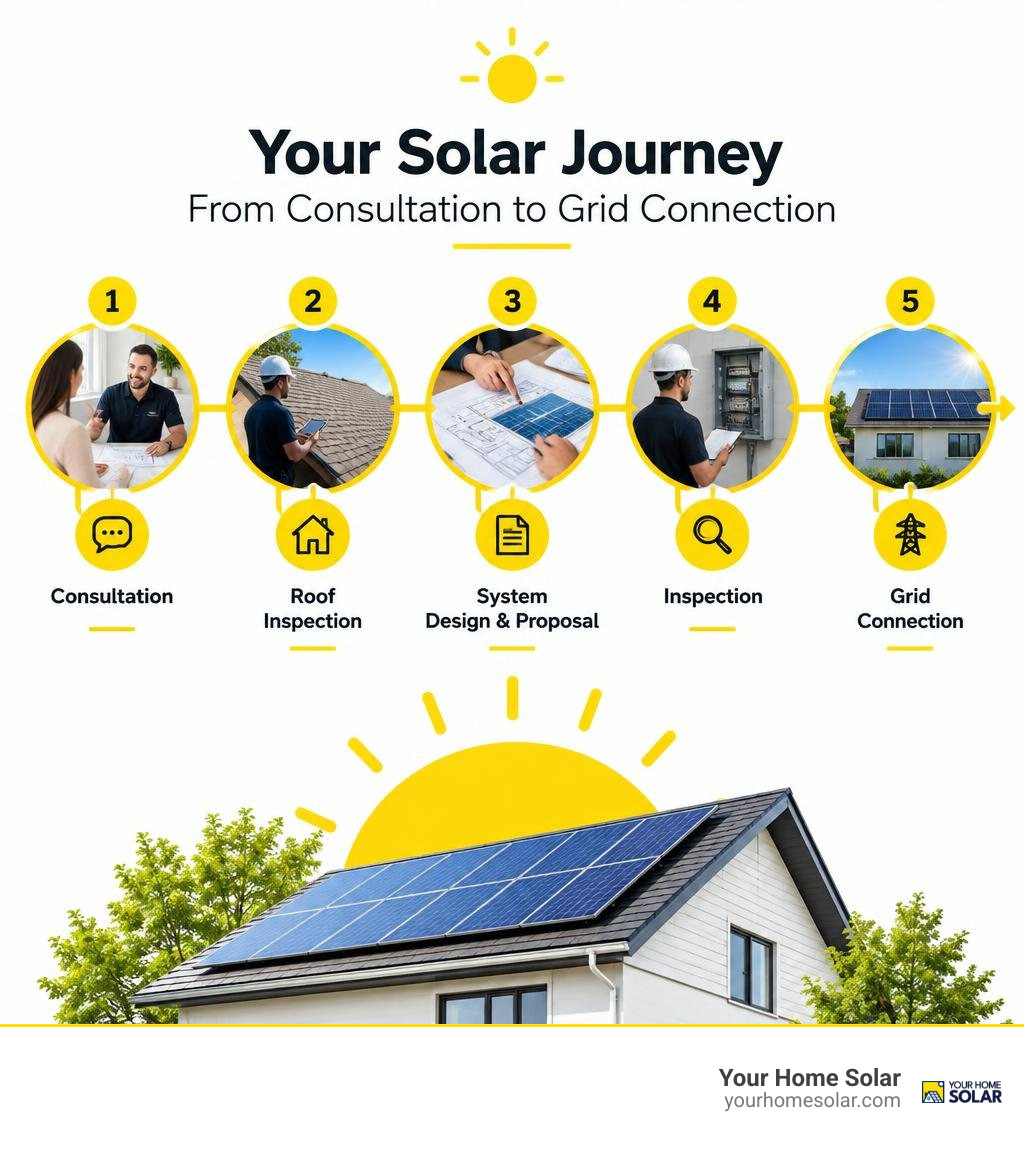
Solar energy system installer terms at a glance:
How to Choose a Qualified Solar Energy System Installer
Switching your home to clean electricity is one of the most rewarding home improvements you can make, but the contractor you choose dictates whether your project is seamless or stressful. Solar panels are built to generate power for 25 to 30 years—longer than most celebrity marriages! Because this is a multi-decade asset attached directly to your roof and tied into your home’s electrical service, finding a qualified partner is critical.
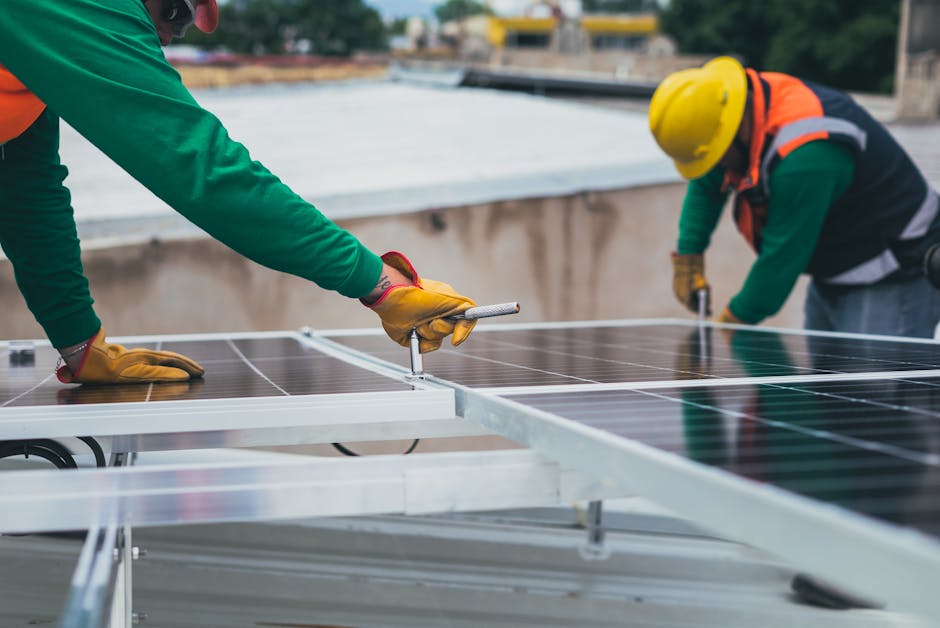
When vetting contractors, you need to look beyond flashy marketing slogans. You can protect your investment by learning how to spot and select professional solar installers who prioritize engineering standards over aggressive commission checks.
Evaluating Local vs. National Solar Installation Companies
One of the first decisions you will face is whether to hire a massive national corporation or an established regional company. While national brands advertise heavily, local installers consistently provide superior long-term value, accountability, and project execution.
- Permitting and Code Nuances: Local companies work daily with municipal building departments across Knox County, Blount County, Sevier County, and Washington County. They understand specific local wind load criteria and regional utility interconnection paperwork.
- Direct Accountability: National firms frequently sell contracts and then outsource the physical labor to third-party subcontractors. When issues arise, the salesperson points to the contractor, and the contractor points to the corporate office. A local installer employs their own crews, giving you a single point of contact.
- Long-Term Service Support: If an inverter trips or an alert appears on your monitoring app five years down the road, a local contractor can send a service truck within 24 to 48 hours. Researching the top solar installation contractors in Johnson City, TN demonstrates that regional knowledge and community reputation lead to significantly higher customer satisfaction.
Taking the time to research your options by finding the best residential solar installers in your immediate community ensures your investment is backed by technicians who live where you live.
Essential Certifications and Credentials Every Solar Energy System Installer Should Have
You should never let an uncertified crew climb onto your roof or tap into your main breaker panel. Before signing any contract, verify that your contractor holds these core industry credentials:
- NABCEP Certification: The North American Board of Certified Energy Practitioners (NABCEP) is the gold standard in the solar industry. Certification proves that the lead designer and installation supervisors have mastered rigorous technical standards.
- Electrical Contractor Licensing: Solar arrays generate high-voltage direct current (DC) that is converted into alternating current (AC). Your contractor must hold an active state electrical license.
- Comprehensive Insurance Coverage: Demand proof of general liability insurance and active workers’ compensation. If a worker is injured on your property or a heavy tool damages your gutters, you must be fully protected.
- Manufacturer Accreditations: Top equipment manufacturers (such as Tesla, Enphase, and SolarEdge) certify installers who pass specialized training programs. Certified installers can offer extended manufacturer warranties that unaccredited contractors cannot match.
Make sure to prepare an itemized list of questions to ask Knoxville solar installers during your initial site evaluation.
Navigating Solar Costs, Incentives, and Financing Options
Every home has unique energy consumption habits, roof architecture, and sun exposure. Understanding how systems are priced and how different financing paths work gives you the leverage to make a confident financial decision for your residential solar setup.
Solar systems are priced on a “dollar per watt” ($/W) basis. This standard metric allows you to compare quotes directly, regardless of system sizing. A typical residential system ranges from 7 kW to 10 kW (7,000 to 10,000 watts). Across standard markets, gross installation costs before incentives generally run between $2.50 and $3.50 per watt, translating to an initial price of $17,500 to $30,000 depending on panel efficiency, inverter architecture, and site complexity.
Understanding Net Metering, NEM 3.0, and Battery Rebates
How your utility company credits your excess solar generation dictates your monthly return on investment. Under traditional net energy metering, your meter spins backward when your panels produce more electricity than your home consumes, giving you full retail credit for every kilowatt-hour (kWh) sent to the grid.
However, many utilities across the country have transitioned toward time-of-use (TOU) rate structures or modified billing structures (like NEM 3.0 frameworks in progressive markets). Under these policies, power exported during sunny midday hours receives a lower wholesale credit, while power consumed during evening peaks carries a premium rate.
To maximize savings under modern grid rules, pairing solar with home battery storage allows you to bank excess daytime generation and discharge it during peak-rate evening hours. Gaining a solid grasp of these billing dynamics is a vital step in understanding the basics of solar panel installation.
Comparing Cash, Solar Loans, Leases, and PPAs
How you fund your system dramatically impacts your long-term return. Here is how the most common financing structures compare:
| Financing Option | System Ownership | Eligible for 30% Tax Credit? | Maintenance Responsibility | Typical 25-Year Net Savings |
|---|---|---|---|---|
| Cash Purchase | Homeowner | Yes (Direct) | Homeowner (Under Warranty) | Maximum (Highest ROI, 0% Interest) |
| Solar Loan | Homeowner | Yes (Direct) | Homeowner (Under Warranty) | High (Offsets bill immediately; modest interest) |
| Solar Lease | Third-Party Financier | No (Claimed by Financier) | Leasing Company | Moderate (Fixed monthly payment) |
| Power Purchase Agreement (PPA) | Third-Party Financier | No (Claimed by Financier) | PPA Provider | Moderate (Pay per kWh generated at set rate) |
When you own your system through cash or a solar loan, you retain all federal tax credits and state incentives. Owning the asset also adds immediate equity to your home without increasing your property tax liability under standard clean energy exclusions. Reviewing expert tips for solar installation will help you calculate your exact payback timeline based on your current utility rates.
The Step-by-Step Installation Process from Site Audit to Activation
A professional solar installation is a structured, engineering-driven process. While the physical installation on your roof usually takes only one to three days, the entire journey from design to final utility activation spans four to eight weeks due to engineering reviews and municipal permitting.
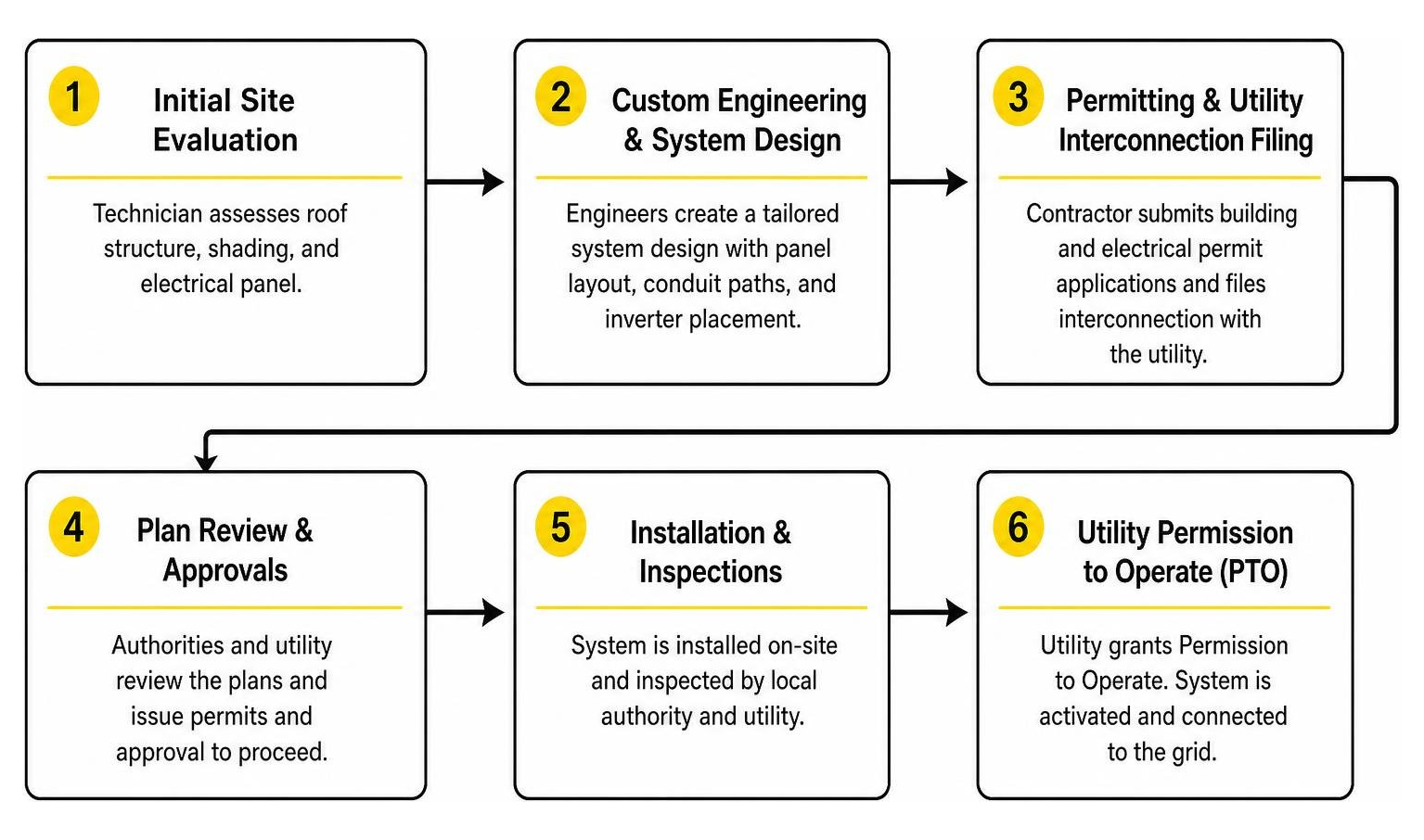
To help you track each milestone, follow a practical guide to the solar installation process through each phase:
- Initial Site Evaluation: A solar technician conducts a physical and aerial assessment of your roof, checks your structural rafters, scans for shading obstacles using LiDAR mapping tools, and inspects your main electrical service panel.
- Custom Engineering & System Design: Engineers draft an architectural blueprint outlining panel layouts, conduit paths, inverter placement, and structural attachments tailored to your roof’s azimuth and tilt.
- Permitting & Utility Interconnection Filing: Your contractor submits plans to your local city or county codes administration for building and electrical permits, while simultaneously filing an interconnection application with your regional electric utility.
What to Expect from Your Solar Energy System Installer During Physical Setup
Once permits are approved, the installation crew arrives to complete the physical work. You can ensure everything goes smoothly by preparing your home for solar installation—clearing driveway access, securing pets, and making sure the main electrical panel is accessible.
The installation crew begins by securing structural mounts directly into your roof rafters, sealing every penetration with advanced flashing systems. Next, aluminum racking rails are fastened to the mounts, followed by the installation of the microinverters or DC optimizers.
The photovoltaic panels are then mounted and wired in clean, organized arrays. Technicians route conduit neatly along your roofline and down to your inverter and main service panel, integrating safety disconnect switches and whole-home battery backup units if selected.
Final Inspection, Grid Interconnection, and PTO
After the hardware is fully installed, the project reaches its compliance stages, which complete the ultimate solar panel installation procedure:
- Municipal Code Inspection: A city or county electrical inspector visits your home to examine the wiring, grounding, structural attachments, and rapid shutdown safety switches.
- Utility Meter Swap: Your utility company reviews the final passed inspection report and installs a bi-directional utility meter that measures power coming from the grid as well as surplus solar energy sent back to it.
- Permission to Operate (PTO): The utility grants formal Permission to Operate. Your installer turns on your breakers, configures your mobile monitoring app, and your system begins generating clean, independent power.
Equipment Selection: Maximizing Performance and Longevity
The hardware installed on your roof determines your energy yields, system resilience in extreme weather, and performance over decades. Choosing premium equipment ensures your system continues producing power efficiently even through hot summers and freezing winters.
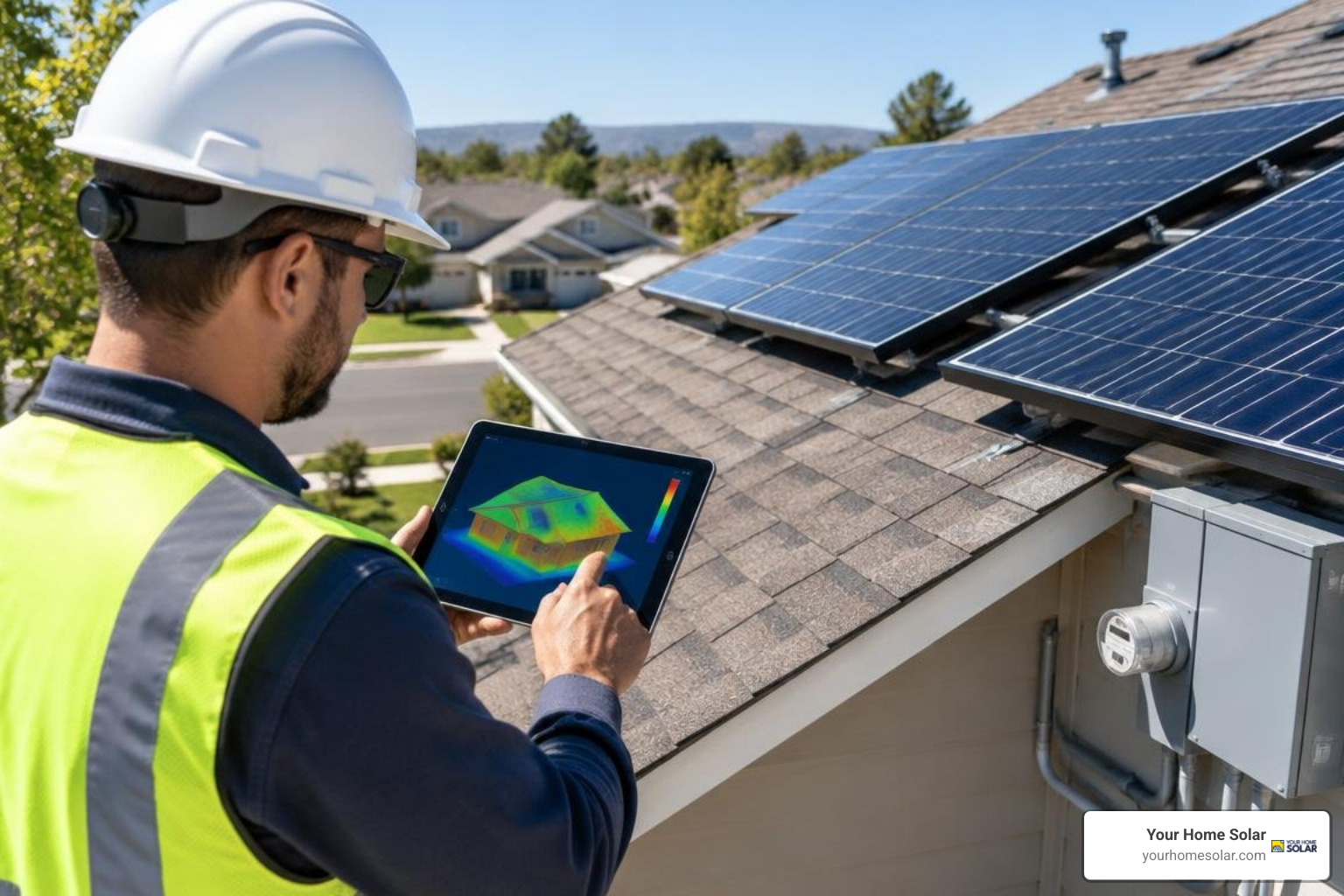
A comprehensive look at residential solar equipment and system design reveals how the primary components work together:
| Component Category | Preferred Technology | Key Advantages | Typical Warranty | Expected Degradation / Lifespan |
|---|---|---|---|---|
| Solar Panels | Monocrystalline Silicon (Tier-1) | 20% to 22.8% efficiency, sleek black aesthetic, superior heat tolerance | 25-Year Product & Performance | <0.5% annual degradation; 85%+ output at Year 25 |
| Inverter Architecture | Microinverters (e.g., Enphase) | Panel-by-panel optimization, no single point of failure, independent monitoring | 25-Year Warranty | Matches panel lifespan; easy modular expansion |
| Inverter Architecture | String Inverter + DC Optimizers | High efficiency, cost-effective, centralized storage integration | 10 to 12-Year Warranty (Extendable) | Inverter may require replacement at Year 12–15 |
| Battery Storage | Lithium Iron Phosphate (LFP) | High thermal stability, non-toxic chemistry, long cycle life (>6,000 cycles) | 10 to 15-Year Warranty | 70%+ capacity retention after 10+ years |
Roof Integrity, Racking, and Watertight Guarantees
Homeowners are often concerned about roof penetrations. High-quality racking systems (such as IronRidge or SnapNrack) utilize heavy-duty all-black aluminum rails engineered to withstand heavy snow loads and high wind gusts.
Every roof attachment point must feature heavy-gauge aluminum flashing tucked directly under your shingles, backed by exterior-grade adhesive sealants. Reputable contractors never use cheap lag bolts with basic rubber washers, which can degrade under UV exposure. Researching the best solar companies in Morristown, NJ and other established regional markets highlights how top installers always provide dedicated 10-year to 25-year watertight roof penetration warranties.
Red Flags and High-Pressure Sales Tactics to Avoid
The solar industry has seen an influx of aggressive sales organizations that prioritize closing fast deals over sound engineering. Knowing what to watch for helps you separate trustworthy contractors from deceptive sales operations.
- “Free Solar Panels” Claims: No solar installation is entirely free. Companies advertising “government funded zero-cost solar” are typically pitching long-term solar leases or PPAs where they collect the tax credits and lock you into a 25-year contract with escalating monthly payments.
- Unrealistic Utility Rate Projections: Deceptive sales reps frequently show financial models assuming utility rates will climb by 8% to 12% every year to make their projected savings look inflated.
- Aggressive “Sign Today Only” Discounts: If a salesperson tells you a $5,000 discount expires the moment they leave your living room, show them the door. Quality engineering quotes remain valid for at least 30 days.
- Subcontractor Blame Shifting: Always ask: “Will your company employees install these panels, or do you hire third-party subcontractors?” Working with an in-house crew ensures direct accountability.
Learning to spot the difference between real solar companies and commission-driven sales dealers will keep you from getting locked into bad contracts with hidden cancellation fees.
Frequently Asked Questions About Solar Energy System Installers
How much does residential solar panel installation typically cost?
A standard 7 kW to 10 kW residential solar array generally costs between $17,500 and $30,000 before federal tax incentives and utility rebates. With the 30% Residential Clean Energy Credit, your net investment drops by thousands of dollars. You can explore a detailed breakdown of solar panel installation costs in Knoxville to see how system size and components affect total pricing.
How do I know if my roof is suitable for solar panels?
An ideal roof has south- or west-facing planes, minimal tree shading between 9:00 AM and 3:00 PM, and sturdy structural rafters. Asphalt shingle, standing seam metal, and concrete tile roofs are all well-suited for solar mounting. If your roof is older and nearing the end of its lifespan, it is best to replace shingles before installing solar. Review these key tips before you go solar to assess your home’s setup.
What warranties should a reliable solar contractor offer?
A complete solar warranty package should include four key protections:
- 25-Year Panel Performance Warranty: Guarantees panels will produce at least 80% to 88% of their rated output at Year 25.
- 25-Year Equipment Warranty: Covers mechanical defects on panels and microinverters.
- 10-Year Workmanship Warranty: Covers the installer’s labor, conduit work, and electrical connections.
- 10- to 25-Year Roof Penetration Guarantee: Protects against roof leaks at all mounting attachment points.
Conclusion
Switching to clean, renewable energy gives you control over rising utility bills, boosts your property value, and delivers quiet, reliable backup power when the electric grid goes down. Choosing the right partner makes all the difference. When you work with certified, local professionals who use in-house installation crews and provide transparent, itemized quotes, going solar is a straightforward and rewarding investment.
If you are ready to explore clean energy for your home without aggressive sales tactics, partner with a premier solar installer in Knoxville TN for a customized home energy assessment. Our team at Your Home Solar is dedicated to delivering durable systems, unmatched engineering standards, and complete peace of mind across East Tennessee.