What Does Solar Power Home Installation Cost in 2026?
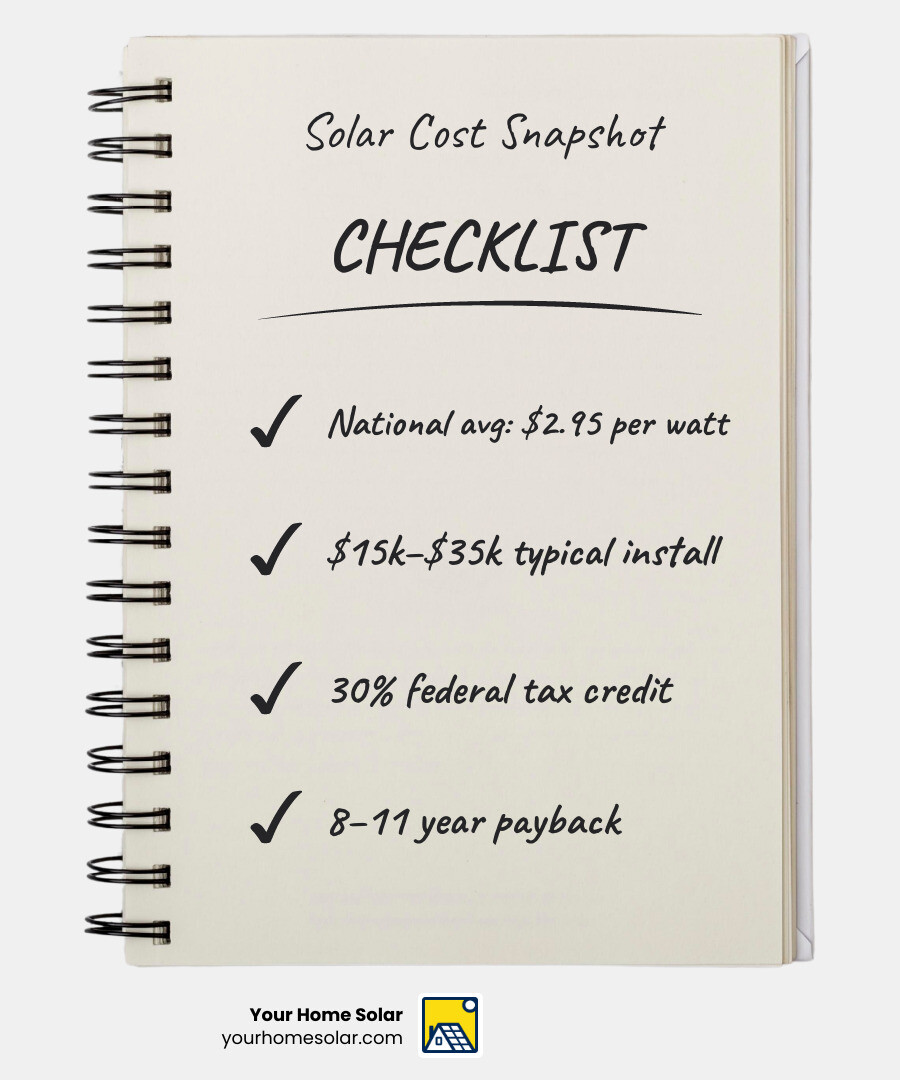
Solar power home installation cost typically falls between $15,000 and $35,000 before incentives, depending on your home’s energy needs and location. Here’s a quick snapshot:
| System Size | Average Cost (Before Incentives) | After 30% Federal Tax Credit |
|---|---|---|
| 6 kW | ~$14,460 | ~$10,122 |
| 8 kW | ~$19,280 | ~$13,496 |
| 10 kW | ~$24,100 | ~$16,870 |
| 12 kW | ~$28,920 | ~$20,244 |
- National average cost per watt: ~$2.95 before incentives
- Most homeowners pay: $15,000–$35,000 before incentives
- Typical payback period: 8–11 years
- 25-year savings: $37,000–$154,000
If you’ve ever looked up solar pricing online, you’ve probably run into a frustrating problem: every source quotes a different number. One site says $22,000. Another says $30,500. A third throws out a per-watt figure that doesn’t seem to connect to anything else. It’s genuinely confusing — and that confusion can make a major financial decision feel impossible.
Here’s the truth: solar pricing varies because a lot of real factors influence the final number. Your roof, your energy usage, your location, the equipment chosen, and even how you pay all move the needle. None of those variables are the same for every home.
This guide cuts through the noise. By the end, you’ll know what a fair price looks like, what drives costs up or down, and how to make a confident decision for your home in East Tennessee.
I’m Ernie Bussell, founder and CEO of Your Home Solar, and I’ve spent years inside the solar industry — from managing operations for a $40 million per year installation company to building a business rooted in honest education around solar power home installation cost. That hands-on experience across sales, operations, and installation is exactly what shapes every piece of guidance in this article.
Glossary for solar power home installation cost:
- residential solar panel design
- residential solar power systems installation
- solar energy installation for home
The National Average Solar Power Home Installation Cost in 2026
When looking at the big picture, the national average for a residential solar system installation sits around $2.95 per watt before incentives. For most homeowners, this translates to an average total investment of $22,000, with typical project ranges falling between $15,000 and $35,000.
If your home requires a larger system, such as a 12 kW setup, you can expect the average cost to run about $28,920 to $30,505 before applying tax credits.
To help you visualize how these costs scale, we have put together a quick comparison table below. For a deeper dive into how these sizes break down, check out The Kilowatt Crunch: Your Guide to Average Solar Panel Costs.
| System Size | Average Price Per Watt | Total Cost (Before Incentives) | Out-of-Pocket Cost (After 30% ITC) |
|---|---|---|---|
| 4 kW | ~$3.00 | $12,000 | $8,400 |
| 6 kW | ~$2.95 | $17,700 | $12,390 |
| 8 kW | ~$2.95 | $23,600 | $16,520 |
| 10 kW | ~$2.90 | $29,000 | $20,300 |
| 12 kW | ~$2.85 | $34,200 | $23,940 |
As you can see, the price per watt typically decreases slightly as the system size increases. This is because certain fixed costs — like permitting, engineering, and basic labor mobilization — remain relatively constant regardless of whether we are mounting 12 panels or 30 panels on your roof.
How System Size and Location Affect Your Pricing
Your specific energy consumption is the primary driver of system sizing. If you run multiple air conditioning units, heat a swimming pool, or charge an electric vehicle daily, your system will naturally need to be larger to offset your utility bill.
However, where you live plays an equally massive role in your final solar power home installation cost. Solar pricing is highly localized due to regional labor rates, municipal permitting fees, and local utility interconnection policies. For a broad look at national variations, you can reference the Solar Panel Cost by State 2026: Real Prices for All 50 States.
Here in East Tennessee, we enjoy highly competitive pricing compared to the national average. Let’s look at what homeowners are actually paying across our local service areas:
- Knoxville & Knox County: Homeowners here benefit from streamlined local permitting and competitive regional rates. To see localized pricing trends, check out the Knoxville, TN Solar Panel Cost: 2026 Prices and Savings.
- Oak Ridge: Known for its scientific heritage, Oak Ridge residents expect highly precise engineering. You can read more about local guidelines in the Solar Panel Cost Guide in Oak Ridge, TN (2025 Update) – EcoWatch.
- Maryville & Blount County: A growing hub for residential solar, Maryville offers fantastic solar exposure. See local data at Maryville, TN Solar Panel Cost: 2026 Prices and Savings.
- Johnson City & Washington County: Nestled in the Blue Ridge Mountains, Johnson City homeowners are rapidly adopting clean energy. Learn about local providers via Best Solar Companies in Johnson City, TN – EnergySage.
- Kingsport & Sullivan County: Industrial heritage meets modern clean energy. Check out the regional landscape at 4 Best Solar Companies in Kingsport, TN – Today’s Homeowner.
- Sevierville & Sevier County: Tourism and mountain cabins make backup power and solar a highly popular combination here. See local insights at Sevierville, TN Solar Panel Cost: 2026 Prices and Savings.
- Farragut: High-end residential properties in Farragut often require custom aesthetic designs. Read the local guide at Solar Panel Cost Guide in Farragut, TN (2025 Update) – EcoWatch.
For those with smaller homes or lower energy bills who might only require a modest setup, we recommend reading our detailed guide on Decoding the Dollars: A Comprehensive Look at 4kW Solar Panel System Prices.
Key Factors Influencing Your Solar Budget

When we build a custom proposal for your home, we look at several physical and logistical variables. The final price tag isn’t just about the physical panels; it is a combination of equipment choices, physical labor, structural engineering, and administrative “soft costs.”
How Equipment Quality Impacts Your Solar Power Home Installation Cost
Not all solar panels are created equal. Premium monocrystalline panels (typically 400W to 450W each) are the modern standard for residential installations because they offer the highest efficiency and longest lifespans.
Beyond the panels, your choice of inverter technology is crucial:
- Microinverters: Installed behind each individual panel, these ensure that if one panel is shaded by a tree, the rest of the system keeps producing at 100% capacity.
- Power Optimizers: A hybrid system that pairs a central inverter with individual panel-level optimization.
While premium equipment carries a slightly higher upfront cost, it drastically improves your system’s long-term energy yield and comes with robust 25-year warranties. To understand how to weigh these equipment costs fairly, read our analysis: Is $3 Per Watt a Fair Price? Understanding Your Solar Investment.
How Labor and Soft Costs Shape Your Solar Power Home Installation Cost
“Soft costs” refer to the non-hardware expenses associated with your installation. These include:
- Engineering & Design: Ensuring your roof can support the structural load of the array.
- Permitting & Interconnection: Working with municipal offices and local utilities (like TVA, KUB, or LCUB) to secure permission to connect to the grid.
- Labor & Overhead: Hiring NABCEP-certified professionals who know how to install systems safely without compromising your roof’s integrity.
- Dealer Fees: If you finance your system, lenders often charge hidden upfront fees that are rolled into the contract price.
We believe in complete transparency. To see exactly where every dollar of your investment goes, explore our guide: Unpacking Solar Costs: What You Need to Know Before You Buy.
Incentives, Tax Credits, and Long-Term ROI
The financial return on solar is stronger than ever in 2026. The most significant financial tool available to homeowners is the Federal Residential Clean Energy Credit (ITC), which allows you to deduct 30% of your total installation cost from your federal taxes. This credit applies to the entire system cost, including panels, inverters, racking, labor, and even qualifying battery storage systems.
With this incentive factored in, a typical East Tennessee home enjoys:
- Average Payback Period: 8 to 11 years (depending on your local utility rates and sun exposure).
- 25-Year Lifetime Savings: $37,000 to $154,000 in avoided utility bills.
Because utility rates in Tennessee continue to rise, every kilowatt-hour your system produces represents immediate, tax-free savings. For a detailed look at why solar is more affordable than you might think this year, read Solar Panel Costs in 2026: Are They Lower Than You Think?.
Cash vs. Financing: Choosing the Right Payment Method
How you choose to pay for your system has a massive impact on your long-term return on investment. Here is how the primary options compare:
- Cash Purchase: This option offers the highest lifetime value. By paying upfront, you avoid interest charges and dealer fees, allowing you to pocket 100% of your monthly energy savings immediately.
- Solar Loans: A popular option that allows you to go solar with $0 down. Your monthly loan payment is often lower than your previous utility bill, resulting in immediate positive cash flow. However, be sure to ask about interest rates and embedded dealer fees.
- Solar Leases & Power Purchase Agreements (PPAs): While these options offer low upfront costs, you do not own the system. This means the third-party owner receives the 30% federal tax credit, and the long-term savings are significantly lower than owning the system outright.
To compare these options side-by-side and determine which path fits your family’s budget, read our Residential Solar Solutions Guide: Cost and Financing of Solar Systems.
Frequently Asked Questions about Solar Installation Costs
What is the average payback period for home solar?
For most homeowners in East Tennessee, the payback period ranges from 8 to 11 years. This timeline is determined by your local electricity rates, your household’s energy consumption, and how much direct sunlight your roof receives. Once the system pays for itself, the electricity it generates is pure profit for the remainder of its 25- to 30-year lifespan.
Does the 30% federal tax credit still apply in 2026?
Yes! The federal residential clean energy credit remains at 30% throughout 2026. It applies to cash purchases and financed systems owned by the homeowner. It is always a good idea to consult with a tax professional to ensure you have the tax liability to take full advantage of the credit.
How much does adding battery storage increase the total cost?
Adding a solar battery backup typically adds $8,000 to $15,000 to the total project cost. While it increases your initial investment, a battery provides invaluable peace of mind by keeping your lights, refrigeration, and medical equipment running during grid outages.
Conclusion
Investing in solar is one of the smartest financial and environmental decisions you can make for your home. While the upfront solar power home installation cost can seem significant, federal incentives and long-term utility savings make it a highly rewarding investment that pays for itself several times over.
At Your Home Solar, we specialize in helping East Tennessee homeowners navigate this transition with absolute confidence. We don’t believe in high-pressure sales tactics or hidden fees — just honest, local expertise and a commitment to 100% customer satisfaction.
Ready to see what solar would look like on your roof? Get a customized quote from Your Home Solar today, and let us design a system tailored perfectly to your home and budget.