Why More Homeowners Are Choosing Battery Storage for Their Solar PV System
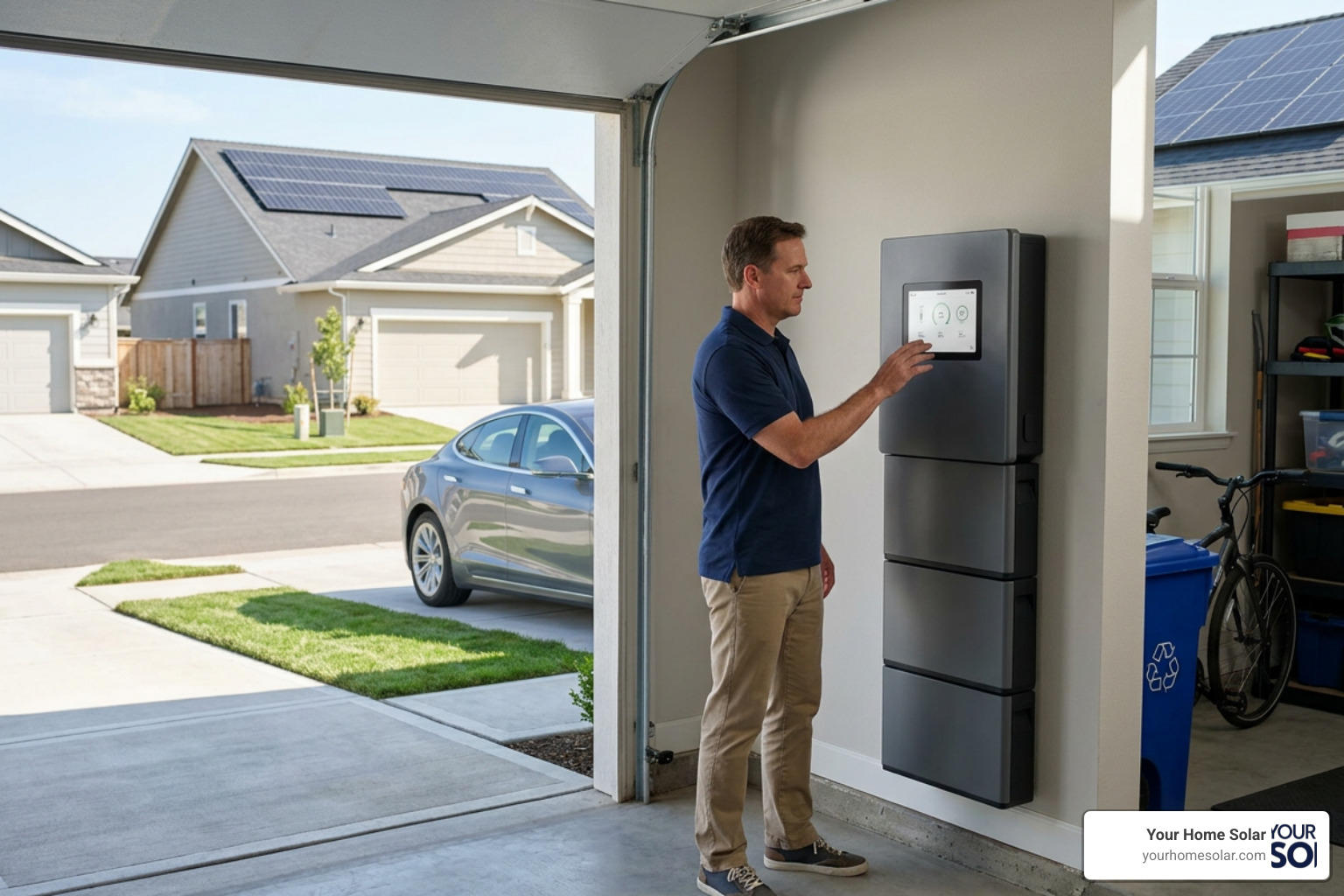
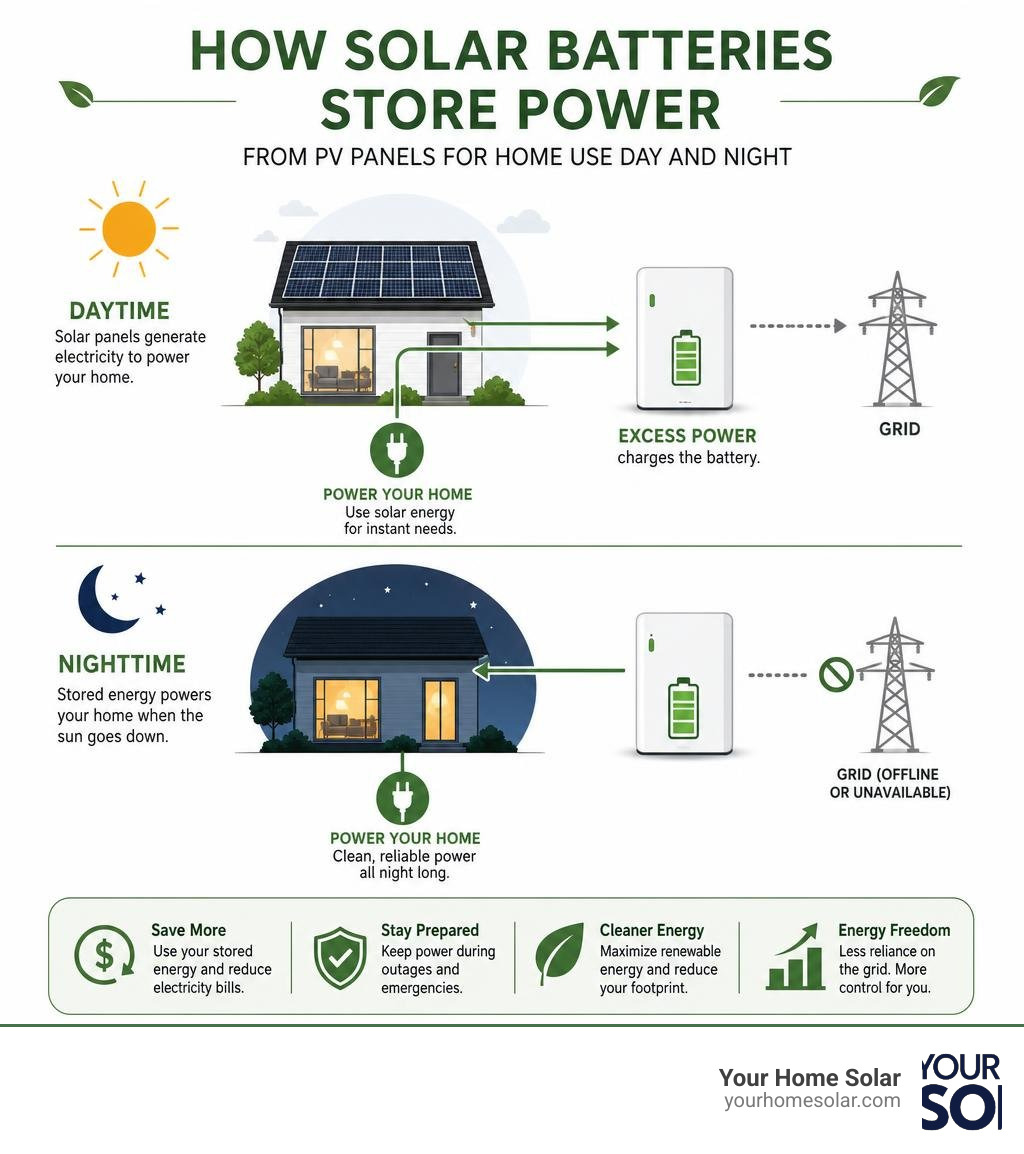
Battery storage for a solar PV system lets you save the electricity your panels produce during the day and use it later — at night, during a storm, or whenever the grid goes down.
Here is a quick snapshot of what you need to know:
| Question | Quick Answer |
|---|---|
| What does a solar battery do? | Stores excess solar energy for use at night or during outages |
| Best battery type for homes? | Lithium Iron Phosphate (LFP) — safest, longest-lasting |
| Typical cost per battery? | $5,000–$10,000 installed |
| How long do they last? | 10–15 years, 6,000–8,000+ charge cycles |
| Do they work during blackouts? | Yes, if configured for backup power |
| How much storage do I need? | 10–20 kWh for partial backup; 20–40+ kWh for whole-home |
In 2023, only 13% of residential solar installations included a battery. That number has tripled since 2018 — and it is expected to double again by 2028. The reason is simple: solar panels alone only help when the sun is shining. A battery changes that.
For homeowners in East Tennessee, where storms can knock out power for hours or even days, that reliability matters. Pair that with rising electricity rates and the appeal of using your own clean energy around the clock, and the case for adding storage becomes hard to ignore.
I’m Ernie Bussell, founder and CEO of Your Home Solar, and I’ve spent years helping East Tennessee homeowners navigate battery storage for solar PV system decisions — from sizing and chemistry to installation and long-term performance. In this guide, I’ll walk you through everything you need to know to choose the right system with confidence.
Battery storage for solar pv system terms explained:
- 10kw solar system with battery backup price
- cost of backup battery for a residential solar systems
- solar battery backup
Why Invest in Battery Storage for Solar PV System Integration?
When you install a solar panel array, it acts as your personal power plant. However, without a way to store that power, any electricity you do not use immediately is sent straight back to the utility grid. Adding a dedicated battery storage system allows you to capture that clean energy and save it for when you actually need it.
If you want to understand how these systems keep your household running smoothly, our guide on Beyond the Grid: How Solar Battery Banks Keep Your Lights On dives deep into the mechanics of energy independence.
Grid-Tied vs. Off-Grid Systems
How your battery functions depends largely on whether your home remains connected to the local utility grid:
- Grid-Tied with Battery Backup (Hybrid): This is the most popular setup for homeowners in areas like Knoxville, Maryville, and Farragut. You remain connected to the grid, but you have a battery to protect against local power failures and optimize your utility bills. Under traditional net metering, you could freely send power back to the grid for a 1-to-1 credit. However, as utilities nationwide shift toward net billing frameworks—similar to California’s landmark NEM 3.0—storing your own energy for self-consumption and rate arbitrage is becoming the most financially viable path forward.
- Off-Grid Systems: Common in more remote parts of East Tennessee, such as Cumberland County or Monroe County, off-grid systems require robust battery banks. Because there is no utility grid to fall back on, you must size your battery storage to handle multiple consecutive days of poor weather.
AC-Coupled vs. DC-Coupled Battery Storage for Solar PV System
When designing your system, you must choose how your solar panels and battery communicate. This is called “coupling,” and it fundamentally impacts your system’s overall efficiency.
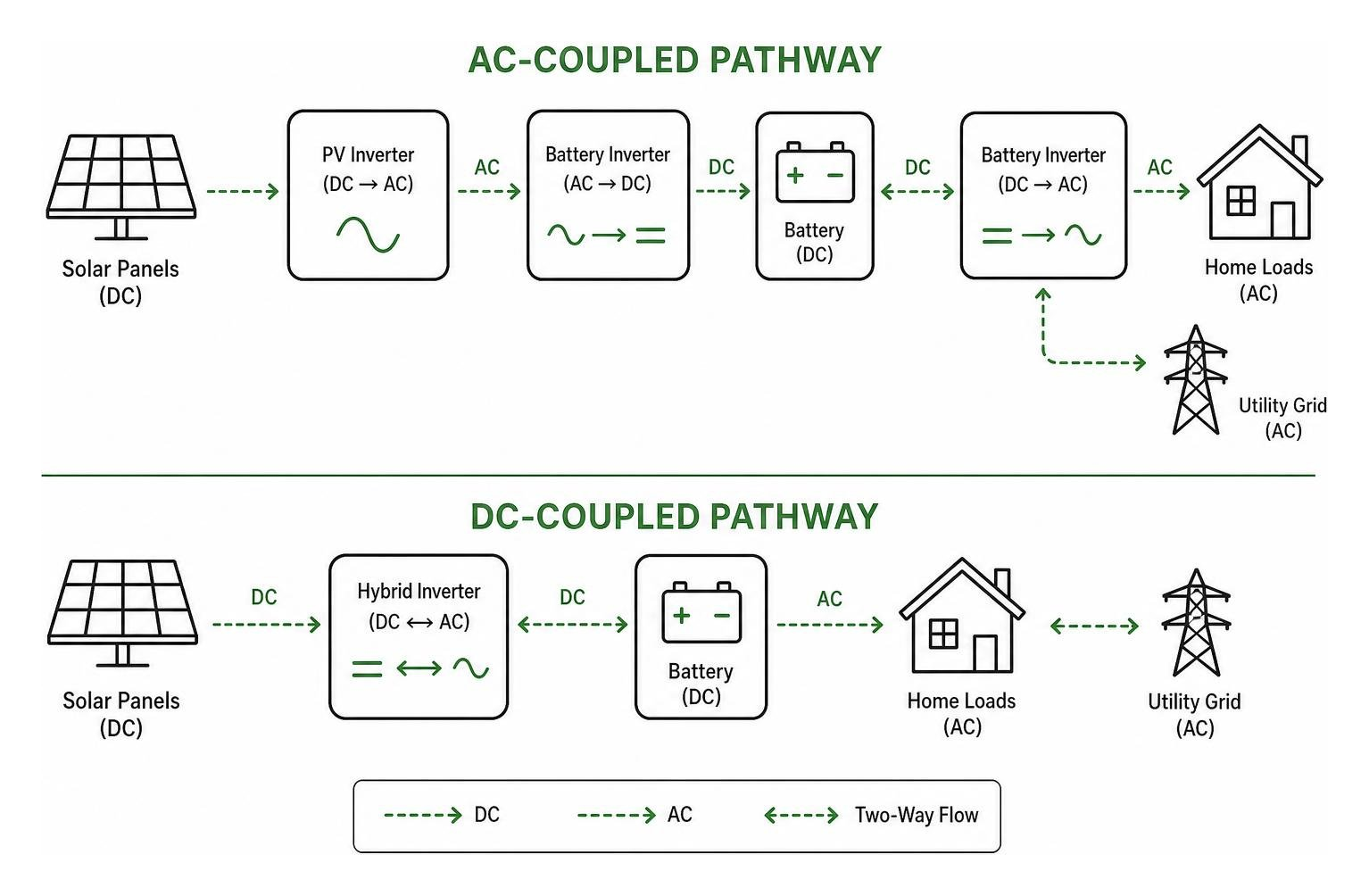
- DC-Coupled Systems: In a DC-coupled setup, the direct current (DC) electricity generated by your solar panels flows directly into your battery without any intermediate conversions. It only converts to alternating current (AC) when you pull power from the battery to run your home appliances. Because it avoids the “triple conversion penalty” (converting DC to AC, back to DC to charge, and back to AC to discharge), it is highly efficient. For example, the DC-coupled SolarEdge Home Battery achieves an industry-leading 94.5% round-trip efficiency, saving homeowners up to 10 days of free power every year compared to equivalent AC-coupled systems.
- AC-Coupled Systems: In an AC-coupled setup, the panels and battery have separate inverters. The solar energy is converted to AC first, and then converted back to DC to charge the battery. While this introduces minor conversion losses, AC-coupled systems are incredibly flexible and are the gold standard for retrofitting a battery onto an existing solar panel array. Brands like Duracell Energy: Solar battery storage and Solar Battery Backup NJ | Enphase Energy Storage Systems offer excellent options for these types of installations.
Key Benefits of Adding Storage to Your Solar Array

A solar PV system is an excellent investment on its own, but adding battery storage unlocks its full potential. If you are preparing your home for unpredictable weather, our resource on The Ultimate Guide to Staying Powered When the Grid Goes Down is a great place to start.
Bill Optimization and Load Shifting
Depending on your local utility provider in East Tennessee—whether it is Knoxville Utilities Board (KUB), Brightridge in Johnson City, or local electric cooperatives—your electric rate structure may vary.
If your utility uses Time-of-Use (TOU) rates, electricity is significantly more expensive during peak evening hours. A battery allows you to engage in “load shifting” or “rate arbitrage.” You charge your battery using free solar energy during the day, and then discharge it to power your home during expensive evening hours, keeping your utility bills as low as possible. To see how these savings offset your initial investment, read our detailed analysis on Shocking or Saving: What a Home Battery Backup Actually Costs.
Emergency Backup Power During Outages
East Tennessee is no stranger to severe weather. From heavy winter snows in the Smoky Mountains to intense summer thunderstorms in Sevierville and Oak Ridge, power outages are a regular occurrence.
When the grid goes down, standard grid-tied solar systems automatically shut off for safety reasons. With a battery backup system, your home instantly isolates itself from the grid (a process called “islanding”) within milliseconds, keeping your lights, refrigerator, medical equipment, and internet running uninterrupted. For a closer look at protecting your property from regional weather hazards, check out our guide: Don’t Be Powerless Against Tennessee Storms.
Comparing Solar Battery Types and Chemistries
Not all batteries are built the same way. The chemical composition of your battery dictates its lifespan, safety, and how much usable power you can draw from it. If you want to dive deeper into these technologies, see Everything You Need to Know About Residential Solar Battery Types: What’s Best.
| Battery Chemistry | Lifespan (Years) | Cycle Life | Depth of Discharge (DoD) | Best For |
|---|---|---|---|---|
| Lithium Iron Phosphate (LFP) | 10–15+ | 6,000–8,000+ | 95% | Home backup & daily cycling (Safest & most efficient) |
| Nickel Manganese Cobalt (NMC) | 8–12 | 3,000–4,000 | 90% | Space-constrained indoor installations |
| Lead-Acid (Sealed/Flooded) | 3–5 | 500–1,000 | 50% | Budget-conscious, low-use off-grid cabins |
Understanding Battery Storage for Solar PV System Chemistry
For residential energy storage, lithium-ion is the undisputed industry leader. Within the lithium-ion family, there are two primary contenders:
- Lithium Iron Phosphate (LFP): LFP is the gold standard for home energy storage. It offers exceptional thermal stability (meaning it is highly resistant to overheating and thermal runaway), contains no toxic heavy metals like cobalt, and boasts an incredibly long cycle life. High-quality modular LFP systems, such as the Pylontech US2000C/3000C series, offer over 8,000 cycles at a 95% Depth of Discharge (DoD).
- Nickel Manganese Cobalt (NMC): NMC batteries are highly energy-dense, meaning they pack a lot of power into a smaller, lighter package. However, they have a shorter cycle life than LFP and are more sensitive to high operating temperatures.
In addition to these standard options, exciting local research is paving the way for the future of energy. For instance, the scientists at Oak Ridge National Laboratory have even explored Carbon-capture batteries developed to store renewable … energy, highlighting East Tennessee’s role at the forefront of global battery innovation.
Lead-Acid vs. Lithium-Ion Options
While lead-acid batteries (both flooded and sealed AGM variants) have been used for decades in off-grid applications, they are rapidly declining in popularity for modern residential systems.
Lead-acid batteries are cheaper upfront, but they must not be discharged past 50% of their capacity without causing permanent damage. They also require regular physical maintenance and typically last only 3 to 5 years, meaning you will end up replacing them multiple times over the lifespan of your solar panels.
Crucial Factors to Consider When Choosing Your Battery
Before purchasing a battery, it is vital to understand the technical specifications. Comparing these metrics side-by-side will help you find the most reliable option. For a comprehensive breakdown, check out our In-Depth Guide to Solar Battery Backup Comparison.
Capacity and Power Output
- Usable Capacity (measured in kilowatt-hours, or kWh): This is the total amount of electricity the battery can store. For example, the 16kWh Residential LiFePO4 Battery for Whole Home Backup-BST POWER provides 16 kWh of usable energy in a single unit.
- Power Output (measured in kilowatts, or kW): This is the amount of electricity the battery can deliver at any single moment. Continuous power is what the battery can deliver steadily, while peak power is the brief surge capacity needed to start heavy motor-driven appliances, like your well pump or air conditioner.
- Modular Scalability: Many modern systems are designed to stack. The EPEVER RLS Series, for example, supports parallel operation of up to 9 units, allowing you to scale your system up to 54 kW of power and 276.18 kWh of capacity as your household needs grow.
Lifespan, Cycle Life, and Warranties
A battery’s lifespan is typically defined by its “cycle life”—the number of times it can be fully charged and discharged before its capacity drops below a certain percentage (usually 70% or 80% of its original capacity).
Most major manufacturers provide a standard 10-year warranty. However, premium LFP batteries often exceed this. The BST POWER PB-5.1 battery, for example, offers a 6,000+ cycle life, while the Pylontech US3000C boasts over 8,000 cycles and a design life of up to 15 years under optimal conditions.
Safety Certifications and Weatherproofing
Always look for key industry safety standards when choosing your hardware:
- UL9540A: This is a rigorous fire-safety standard that tests the battery’s resistance to thermal runaway. Choosing a UL9540A-certified battery ensures maximum safety for indoor or garage installations.
- IP65 and IP67 Ratings: These ratings define how well the battery’s enclosure protects against dust and moisture. An IP65-rated battery, like the BST POWER PB-5.1, is perfectly suited for covered outdoor or garage installations. An IP67-rated enclosure, featured on the BST POWER PB-16, is completely dust-tight and highly waterproof, allowing it to withstand harsh outdoor elements. This weatherproofing is especially valuable in East Tennessee, where winter temperatures can drop below freezing.
Sizing and Cost: How Much Storage Do You Need?
Finding the right balance between capacity and cost is the most critical step in your solar journey. Sizing your system correctly ensures you do not overpay for storage you will never use, while still providing ample backup when you need it most. For a closer look at the numbers, read our guide on How Much Does a 10kw Solar System with Battery Backup Actually Cost.
Sizing Your Battery Storage for Solar PV System
To determine your ideal battery size, you must first decide what you want to power during an outage:
- Partial Home Backup (10–20 kWh): This configuration is designed to power your “critical loads” during a blackout. This typically includes your refrigerator, home router, LED lighting, phone chargers, and perhaps a few select outlets. If you want to see how this works in practice, our article on 10kw Solar System with Battery Storage Explained outlines a typical setup.
- Whole-Home Backup (20–40+ kWh): If you want to run heavy loads—such as your central HVAC system, electric water heater, well pump, or clothes dryer—without changing your energy consumption habits during an outage, you will need a larger, multi-battery setup.
Upfront Costs and Installation Expenses
The cost of adding battery storage depends on the capacity, chemistry, and installation complexity:
- Single Battery System: Typically costs between $5,000 and $10,000 for hardware and professional installation.
- Whole-Home Multi-Battery System: Can range from $15,000 to $20,000+ depending on how many units are stacked together.
Fortunately, the federal government offers a 30% Residential Clean Energy Credit (formerly known as the ITC). This tax credit applies directly to both the hardware and installation costs of qualifying battery storage systems, significantly lowering your net investment. To learn more about budgeting for your installation, check out Powering Up: The Ultimate Guide to Home Battery Installation and Costs.
Frequently Asked Questions about Solar Battery Storage
Is it worth getting a solar battery if I already have solar panels?
Absolutely. Retrofitting a battery to an existing system is a highly popular option. If you live in an area with frequent storm-related blackouts or if your utility provider does not offer favorable net metering rates, a battery is the only way to protect your home from outages and maximize your self-consumption. To help you decide if it is the right move for your home, read Don’t Get Left in the Dark: A Guide to Battery Packs for Home Solar Systems.
How many solar batteries do I need to power my home?
For most standard residential homes, one to two batteries (providing 10 to 20 kWh of storage) are more than enough to cover critical household needs during an outage. If you want a detailed, step-by-step process for calculating your exact power needs, check out The Ultimate Guide to Choosing a Battery Backup for House Power Without Losing Your Mind.
How long do solar batteries last?
Modern lithium iron phosphate (LFP) batteries are incredibly durable. You can expect a high-quality solar battery to last between 10 and 15 years with minimal degradation. Most manufacturers guarantee that the battery will retain at least 70% of its original capacity at the end of its 10-year warranty period.
Take Control of Your Energy with Your Home Solar
Choosing the right battery storage for solar PV system integration is one of the smartest steps you can take toward long-term energy independence. Whether you are looking to lower your monthly electric bills, protect your family from unpredictable East Tennessee weather, or completely disconnect from the utility grid, a properly sized battery system is the key to unlocking your solar potential.
At Your Home Solar, we are dedicated to helping our neighbors throughout East Tennessee—including Knoxville, Oak Ridge, Johnson City, Kingsport, and the surrounding counties—achieve reliable, clean energy independence. We pride ourselves on providing trusted local expertise, clean installations, and a 100% customer satisfaction guarantee.
If you are ready to explore your options, read our comprehensive The Ultimate Guide to Solar Batteries and Energy Storage Solutions or contact our team of local energy experts today to design the perfect system for your home!