What Is a Portable Solar System — and Is It Right for You?
A portable solar system is a self-contained setup that uses solar panels to capture sunlight and convert it into usable electricity — without being permanently installed on a roof or structure.
Quick answer: Here’s what you need to know at a glance:
| Question | Short Answer |
|---|---|
| What is it? | Solar panels + battery storage + charge controller you can move and deploy anywhere |
| Who is it for? | Campers, RV travelers, homeowners wanting backup power |
| How much power? | Ranges from 50W (phone charging) to 1,000W+ (home essentials) |
| How efficient? | Expect ~75% of rated wattage in real-world conditions |
| How long do they last? | Up to 25 years with quality panels (IP68 rated) |
| Can it power a home? | Partially — best for essentials, not whole-home loads |
For East Tennessee homeowners, a portable solar system can mean the difference between sitting in the dark during a storm outage and keeping your fridge, lights, and devices running. Power outages in the region are real, and fuel-based generators come with noise, fumes, and the frustration of finding gas when everyone else needs it too.
This guide walks you through everything — how these systems work, what types exist, how to size one for your needs, and what to watch out for before you buy.
I’m Ernie Bussell, founder and CEO of Your Home Solar, East Tennessee’s #1 solar energy contractor, and my background spans nuclear weapons systems in the U.S. Navy, a decade in education, and years leading operations for a $40 million solar installation business — all of which inform how I evaluate a portable solar system for real-world reliability and value. I’ll share what I’ve learned so you can make a confident, pressure-free decision.
Understanding the Mechanics of a Portable Solar System
At its heart, a portable solar system operates on the exact same fundamental science as a massive, utility-scale solar farm. It all starts with the photovoltaic (PV) effect.
When sunlight hits the silicon cells inside a portable solar panel, it knocks electrons free from their atoms. This movement of electrons generates direct current (DC) electricity. Because more than 90% of solar PV cells are made from crystalline silicon, the quality of this silicon determines how effectively your panels convert those Tennessee sunbeams into raw electrical energy.
Once generated, this DC electricity cannot safely charge your devices or power your home directly without some serious regulation. That is where a coordinated team of system components comes into play. If you want to understand how this compares to fixed installations, you can learn more about off-grid solar panel systems to see how scale alters the design.
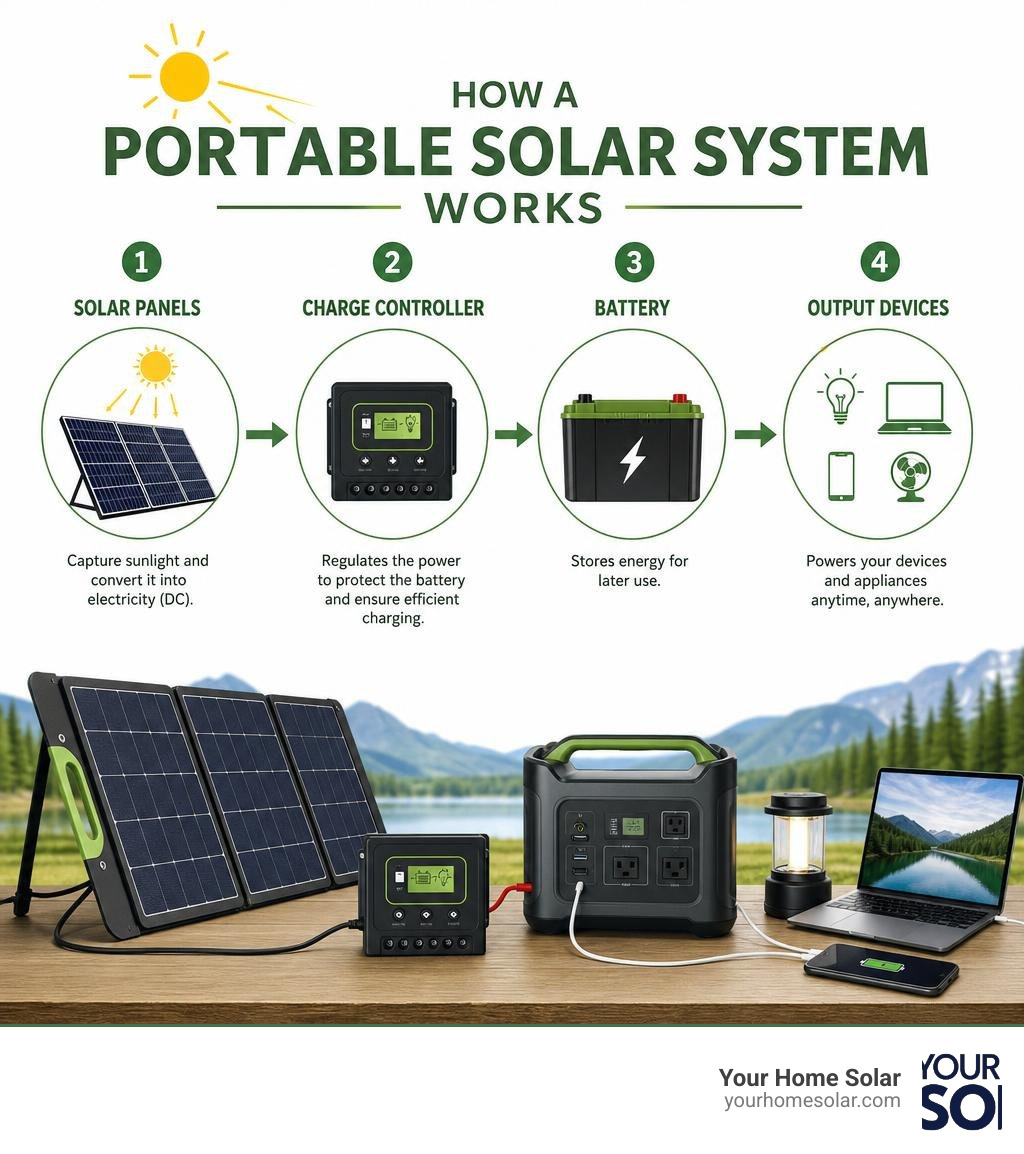
Core Components of a Portable Solar System
To build a fully functional mobile power plant, you need several components working in perfect harmony:
- Portable Solar Panels: These are the collectors. They capture sunlight and output DC power. To find the right fit for your travel style, you can explore portable solar panels designed specifically for mobile use.
- Charge Controller: Think of this as the traffic cop. It regulates the voltage and current coming from the panels to prevent overcharging and damaging your batteries.
- Portable Power Station (Battery Storage): This is the heart of the system. Most modern setups use Lithium Iron Phosphate (LiFePO4) batteries because they are lighter, safer, and hold their charge far longer than old lead-acid batteries.
- Inverter: This component converts the stored DC power into alternating current (AC) power, which is the standard “wall plug” electricity your household appliances require. Quality systems use a pure sine wave inverter to provide clean, stable power that won’t damage sensitive electronics like laptops or medical equipment.
Whether you are looking at a pre-assembled kit like the Anker SOLIX F2000 + BP2600 Expansion Battery + 2x 400W Solar Panel – Anker SOLIX US or building a custom setup, these four parts must be sized to match one another.
What accessories are required for a complete portable solar system?
While the core components do the heavy lifting, a few critical accessories tie the whole system together:
- High-Quality Cables and Connectors: Standard MC4 cables or proprietary quick-connect cords are necessary to link your panels to your power station without suffering major voltage drops.
- Alligator Clips and Fuses: If you are charging a standard 12V RV or marine battery directly, a plug-and-play kit like the 100 Watt 12 Volt Portable Solar Suitcase with Voyager| Renogy Solar | Renogy US includes alligator clips equipped with inline fuses to keep the connection safe.
- Expansion Batteries: If your power needs grow, high-end power stations allow you to daisy-chain extra battery packs to double or triple your storage capacity without buying a whole new system.
- Kickstands and Mounts: Adjustable tilt legs are vital for keeping your panels angled toward our East Tennessee sun.
If you enjoy a hands-on approach to your energy needs, check out our DIY solar kits guide for a breakdown of how to safely assemble these components.
Types of Portable Solar Panels and Their Key Differences
Not all portable panels are created equal. The materials used to manufacture the PV cells dictate how much space they take up, how heavy they are, and how they perform on a hot summer afternoon in Knoxville.
| Cell/Panel Type | Average Efficiency | Best For | Key Pros | Key Cons |
|---|---|---|---|---|
| Monocrystalline | 21% – 23% | General portable use, camping | High efficiency, compact | Higher cost, rigid |
| N-Type (TOPCon) | 23% – 25% | Maximum power in limited space | Industry-leading efficiency, great heat tolerance | Premium price point |
| Polycrystalline | 15% – 18% | Budget-friendly stationary setups | Lower upfront cost | Bulky, less efficient in high heat |
| Thin-Film / Flexible | 10% – 13% | Curved surfaces (RV roofs, boats) | Ultra-lightweight, flexible | Low efficiency, shorter lifespan |
Monocrystalline vs. Polycrystalline Panels
When shopping for a portable solar system, you will quickly notice that monocrystalline panels dominate the market, and for good reason. Monocrystalline cells are sliced from a single, pure crystal of silicon. This uniform structure allows electrons to move with minimal resistance, resulting in efficiency ratings of 23% to 25% for top-tier N-Type cells.
Polycrystalline panels, on the other hand, are made by melting multiple silicon crystals together. While cheaper to make, they are less space-efficient and have a worse temperature coefficient—meaning their performance drops off more sharply when the summer heat climbs in places like Maryville or Sevierville.
Foldable Suitcases vs. Flexible Solar Blankets
The physical design of your panels impacts how you store and transport them:
- Foldable Solar Suitcases: These feature rigid panels protected by aluminum frames and heavy-duty tempered glass. They fold in half like a suitcase and often include integrated kickstands. While heavier, they are exceptionally durable and can handle being set up on rocky terrain. A prime example is the 100/200W Portable Solar Panel Suitcase Kit with PWM Controller | Renogy US .
- Flexible Solar Blankets: These panels use thin-film or lightweight monocrystalline cells sewn into a rugged canvas backing. They can be folded or rolled up into tiny spaces, making them the ultimate option for backpacking or packing into a tight trunk. However, they lack built-in stands and are more susceptible to damage if stepped on.
To weigh your options further, you can view portable solar panels for camping to find the ideal balance between weight and durability.
Key Benefits, Applications, and Sizing of Portable Solar
Whether you are preparing for emergency outages in Johnson City, heading out for a weekend at the Great Smoky Mountains National Park, or looking to lower your carbon footprint, a portable solar system delivers clean, silent, and reliable energy. Unlike gas generators, they produce no carbon emissions, require no fuel, and run completely silent. For example, using a high-capacity system like the Anker SOLIX F2000 can eliminate up to 2,654 kg of carbon emissions over its product lifespan.
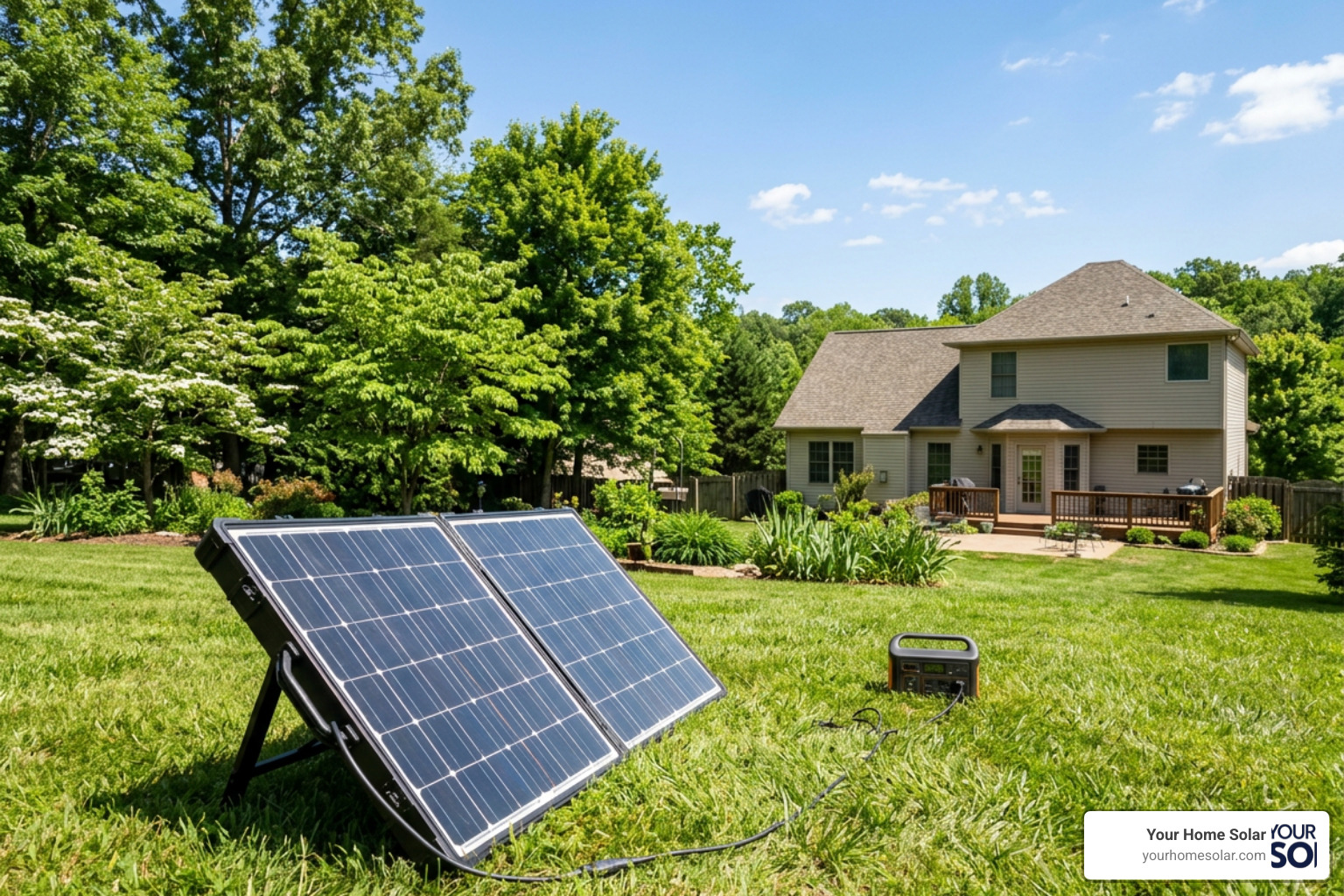
To get a realistic idea of what these mobile power plants can do, you can read about powering off-grid adventures to see how much gear a standard 1kW station can support.
Can a portable solar system fully power a home or RV?
The short answer is: partially, but with strict limitations.
A portable system is fantastic for running essentials. It can easily handle your refrigerator, microwave, Wi-Fi router, fans, and medical devices. However, heavy-duty 240V household appliances—like your central air conditioning, electric clothes dryer, or water heater—require far more continuous power and startup surge current than a portable system can provide.
If your goal is to tie temporary solar power directly into your home’s electrical panel during an emergency, you will need to learn the basics of hooking solar panels to your house safely to avoid backfeeding the grid.
Camping, RV Travel, and Mobile Living
For van-lifers and boondockers parking their rigs in the beautiful valleys of East Tennessee, portable solar is a game-changer. It allows you to camp in remote, off-grid locations without listening to the constant hum of a gas engine.
Instead of permanently mounting panels on your roof—which requires drilling holes and limits you to parking in direct sunlight—a portable suitcase like the OptiSolex 440W 220W Portable SolarBag (Kit) lets you park your RV in the cool shade of the trees while placing your panels out in the bright sun. If this lifestyle appeals to you, check out solar kits for mobile living to find the best configuration for your camper or van.
Calculating Your Daily Energy Needs
Before investing in a system, you must calculate exactly how much power you need. Sizing your system incorrectly will leave you sitting in the dark with a dead battery.
Here is the simple, step-by-step formula to calculate your daily energy consumption:
- Identify the wattage of each device: Look at the label on your phone charger, laptop brick, or refrigerator.
- Estimate the running hours per day: How long will each device run? (Note: A refrigerator compressor only runs about 30-50% of the day).
- Multiply Watts by Hours to get Watt-Hours (Wh):
- Laptop: 60W x 4 hours = 240 Wh
- LED Light: 10W x 6 hours = 60 Wh
- Portable Fridge: 50W x 12 hours (effective run time) = 600 Wh
- Total Daily Need: 900 Wh
To ensure your system survives a cloudy day, we recommend choosing a battery capacity that is at least 1.5 to 2 times your daily calculated need. For a deeper dive into sizing calculations and building your setup from scratch, read our guide on how to build your own home solar system.
Factors Affecting Real-World Performance and Charging Times
If there is one thing we want to emphasize, it is this: solar panels rarely produce 100% of their rated wattage in the real world.
Manufacturer ratings are established under Standard Test Conditions (STC) in a controlled laboratory. In the real world, you can generally expect quality portable panels to produce about 75% of their rated wattage during peak daylight hours. This discrepancy is caused by several factors:
- Atmospheric Haze and Humidity: Moisture in the air scatters sunlight, reducing the intensity of the light reaching your PV cells.
- Temperature Degradation: Solar cells actually lose efficiency as they get hot. High-end N-Type cells handle this heat better, but performance still drops on scorching summer days.
- Partial Shading: Even a tiny amount of shade from a single overhanging branch can cut a panel’s output in half if it lacks bypass diodes.
Understanding these real-world limitations is the first step toward successful off-grid living. For a broader look at what to expect when cutting the cord, learn about living off the grid.
Optimizing Angle and Sun Tracking
Because sunlight strikes the earth at different angles depending on the season and time of day, keeping your panels perpendicular to the sun’s rays is crucial. Simply laying a panel flat on the ground can reduce its energy harvest by 20% to 30%.
Using integrated kickstands to angle your panels between 30° and 60° makes a massive difference. If you want to take things a step further, next-generation tracking systems like the robotic pSolBot R2 – Smarter Solar, Wherever You Go actively follow the sun throughout the day, capturing up to 30% to 40% more energy than a fixed panel.
For more tips on squeezing every drop of power out of your setup, check out our resource on how to build your own home solar power system.
Estimating Battery Charging Times
How long will it take to top off your battery? Let’s look at some real-world examples:
- The Heavy Hitter: Pair an Anker SOLIX F2000 + BP2600 Expansion Battery + 2x 400W Solar Panel – Anker SOLIX US system together. With its support for up to 1000W of max solar input, you can recharge its massive 2048Wh capacity in just a few hours of good, direct East Tennessee sunlight.
- The Mid-Range Setup: A Goal Zero Yeti 1500 Power Station paired with a 200W Nomad panel will take at least 10.5 hours of ideal, sunny conditions to fully recharge from empty.
- The Direct Battery Charger: The OptiSolex 440W SolarBag can charge a standard 200Ah (12V) deep-cycle battery in about 5 to 6 hours under ideal sunlight.
If you want to compare these charge rates to larger, permanently installed systems, learn more about off-grid solar panel systems.
How durable and weather-resistant are portable solar panels?
Because portable panels spend their lives outdoors, they have to be built tough. When shopping, look for an IP68 rating, which means the panel is completely dust-tight and can survive being temporarily submerged in water.
To protect the fragile silicon cells, manufacturers use advanced coatings:
- ETFE (Ethylene Tetrafluoroethylene): This high-strength polymer is stain-resistant, self-cleaning, and highly transmissive, allowing maximum light to pass through while protecting the panel from UV degradation and scratches.
- Tempered Glass: Used in rigid suitcase panels, tempered glass offers maximum impact resistance against hail or accidental drops, though it adds significant weight.
Maintenance is simple: Keep the panels clean by wiping them down with a damp microfiber cloth to remove dust, pollen, and bird droppings. Avoid using abrasive cleaners or harsh chemicals, and never pack your panels away while they are still damp to prevent mildew from forming on the canvas backing.
Conclusion
A portable solar system is an incredible tool for gaining immediate energy independence, whether you are camping in the Cherokee National Forest, prepping your home in Farragut for storm season, or living the off-grid dream. While they may not fully power a large modern home on their own, their ability to keep your absolute essentials running without noise, fumes, or fuel costs makes them worth every penny.
If you are inspired by the idea of solar and want to see what a full-scale, permanent home system can do for your utility bills and long-term energy security, we are here to help. At Your Home Solar, we provide tailored, reliable, and rewarding installations across East Tennessee—from Knoxville and Oak Ridge down to Chattanooga and up to the Tri-Cities.
Ready to take your power security to the next level? Explore comprehensive off-grid solar panel systems or reach out to us today to design a custom energy solution that fits your home and budget perfectly!