Is a 5000W Solar Inverter Right for Your Home?
A solar power inverter 5000w sits in the sweet spot for whole-home backup power — powerful enough to run your most critical appliances, yet practical enough to install without a commercial-grade electrical overhaul.
Quick answer: What is the best 5000W solar inverter for your situation?
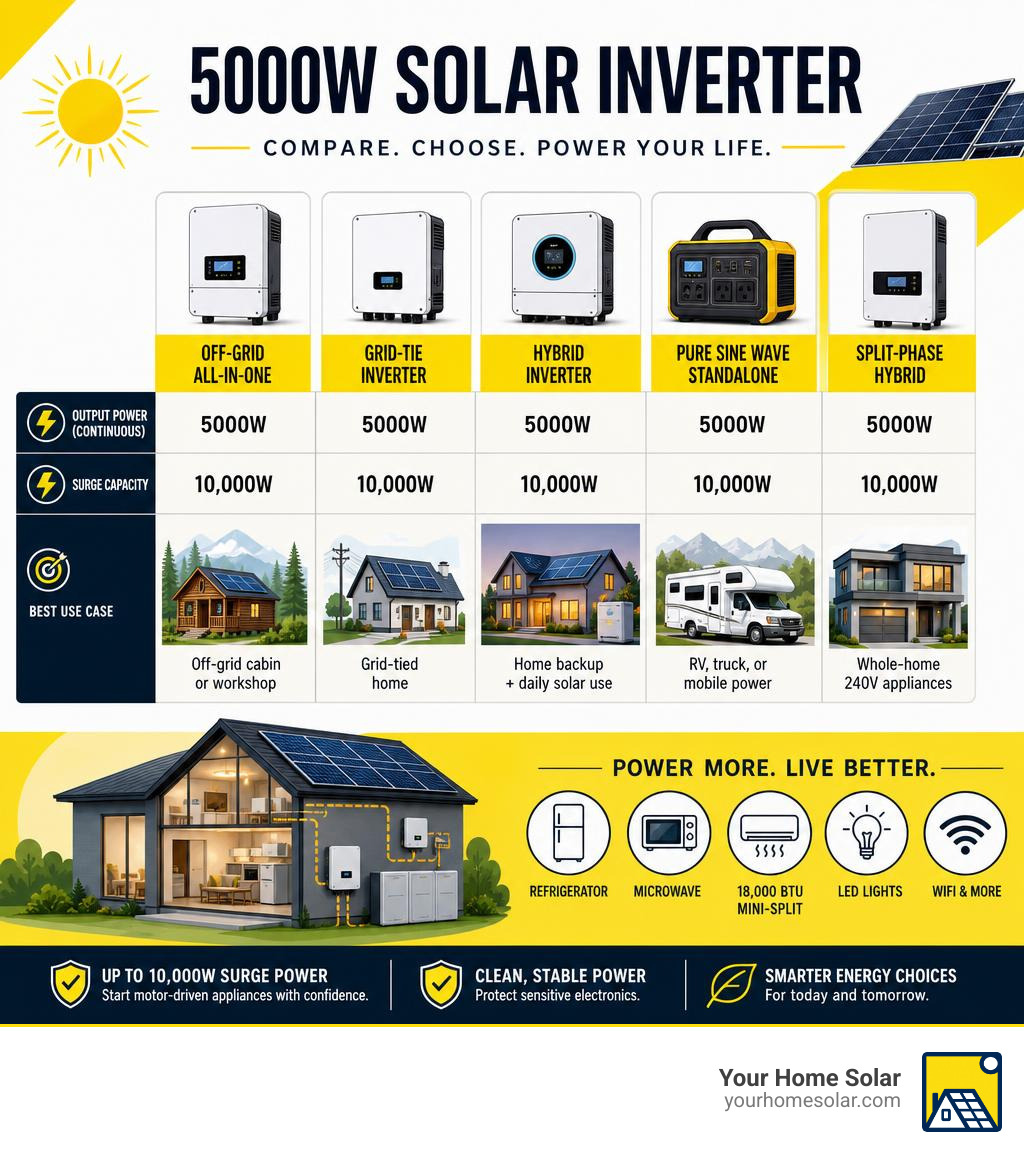
| Your Situation | Best Inverter Type | Key Benefit |
|---|---|---|
| Off-grid cabin or workshop | Off-grid AIO (all-in-one) | No utility required; battery + solar combined |
| Grid-tied home | Grid-tie inverter | Feed excess power back to the grid |
| Home backup + daily solar use | Hybrid inverter | Battery backup + grid connection + solar |
| RV, truck, or mobile power | Pure sine wave standalone | Portable, clean power for sensitive devices |
| Whole-home 240V appliances | Split-phase hybrid | Powers both 120V and 240V loads |
At 5,000 watts continuous output, these inverters can run a refrigerator, LED lights, WiFi, a microwave, and even an 18,000 BTU mini-split — all at the same time. They also deliver up to 10,000 watts of surge power, which means motor-driven appliances like well pumps and compressors can start without tripping the system.
But not all 5,000-watt inverters are built the same. Efficiency ratings range from 85% to 97%. Some carry UL1741 safety certifications; many don’t. Prices span from under $300 to over $3,000. And the wrong choice can mean overheating, BMS conflicts, or a voided warranty.
This guide cuts through the noise and compares the leading options side by side.
I’m Ernie Bussell, founder and CEO of Your Home Solar — East Tennessee’s #1 solar energy contractor — and I’ve spent years helping homeowners choose the right solar power inverter 5000w setup for their specific energy needs, budget, and property. My background spans Navy-level quality assurance, a decade in education, and hands-on operational leadership scaling a $40 million solar installation business, so when I walk through these specs, it’s from real-world experience — not a spec sheet.
Solar power inverter 5000w helpful reading:
What Is a Solar Power Inverter 5000W and Who Is It For?
A 5000W solar inverter converts direct current (DC) from solar panels or batteries into alternating current (AC) used by household appliances.
A solar power inverter 5000w is commonly used for:
- Essential home backup during outages
- Off-grid cabins and workshops
- RVs, trailers, and mobile power systems
- Small whole-home solar systems
- Battery backup systems with 48V LiFePO4 batteries
Most modern 5000W units are pure sine wave inverters, producing clean AC power safe for sensitive electronics, motors, and medical devices.
If you are new to inverter basics, we recommend starting with The Ultimate Guide to Solar Inverters.
How a Solar Power Inverter 5000W Works
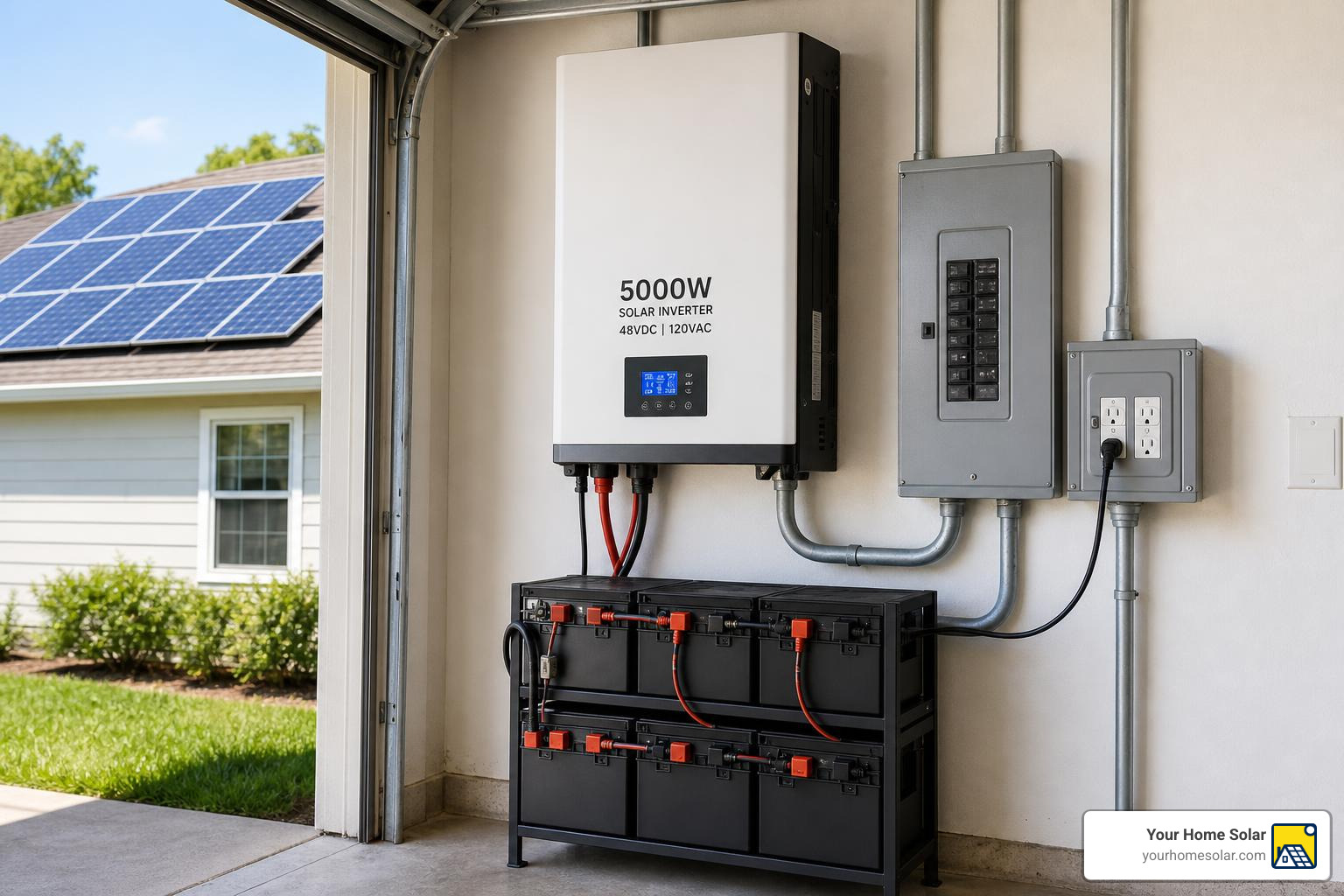
A 5000W solar inverter system usually has five major pieces:
- Solar panels produce DC electricity.
- An MPPT charge controller optimizes solar input.
- A battery bank stores energy, usually at 48V for this size.
- The inverter converts DC battery power to AC household power.
- A transfer switch or load panel sends power to selected circuits.
Hybrid and all-in-one inverters combine the inverter, solar charge controller, battery charger, and transfer switch logic in one box. Grid-tie inverters work differently, converting solar DC directly into grid-synchronized AC and exporting excess energy. They include anti-islanding protection, which shuts the inverter down during a grid outage to protect utility workers.
What Can a 5000W Inverter Actually Run?
A 5000W inverter can run a lot, but not everything at once. The key is managing startup surge.
Typical loads a 5000W inverter can support include:
| Appliance or Load | Typical Running Watts | Notes |
|---|---|---|
| Refrigerator | 150-800W | Startup surge matters |
| Freezer | 100-600W | Compressor surge |
| LED lights | 50-300W | Very inverter-friendly |
| WiFi and electronics | 20-300W | Best with pure sine wave |
| Microwave | 1000-1800W | High short-term draw |
| Sump pump | 800-1500W | High startup surge |
| Window AC | 800-1800W | Compressor load |
| 18,000 BTU mini-split | 1200-2500W | Depends on model and speed |
| Washer | 500-1500W | Motor load |
| Power tools | 500-2500W | Startup varies widely |
Some 5000W inverters provide 10,000W surge capacity to handle motor-driven appliances like well pumps and compressors. Always compare continuous watts, surge watts, and surge duration.
5000W vs 3000W vs 6000W Inverters
Here is the practical difference:
| Inverter Size | Best For | Main Tradeoff |
|---|---|---|
| 3000W | Small cabins, RVs, refrigerators, lights, electronics | Less surge headroom |
| 5000W | Essential home backup, workshops, pumps, mini-splits | Needs serious batteries and wiring |
| 6000W+ | Larger homes, heavier 240V loads, expansion | Higher cost and more complex install |
A 3000W unit is excellent for small cabins. But once you add a microwave, pump, or mini-split, the 5000W class makes sense. A 6000W inverter gives more headroom but increases battery current, wiring size, and cost.
Best 5000W Solar Inverter Types for Different Use Cases
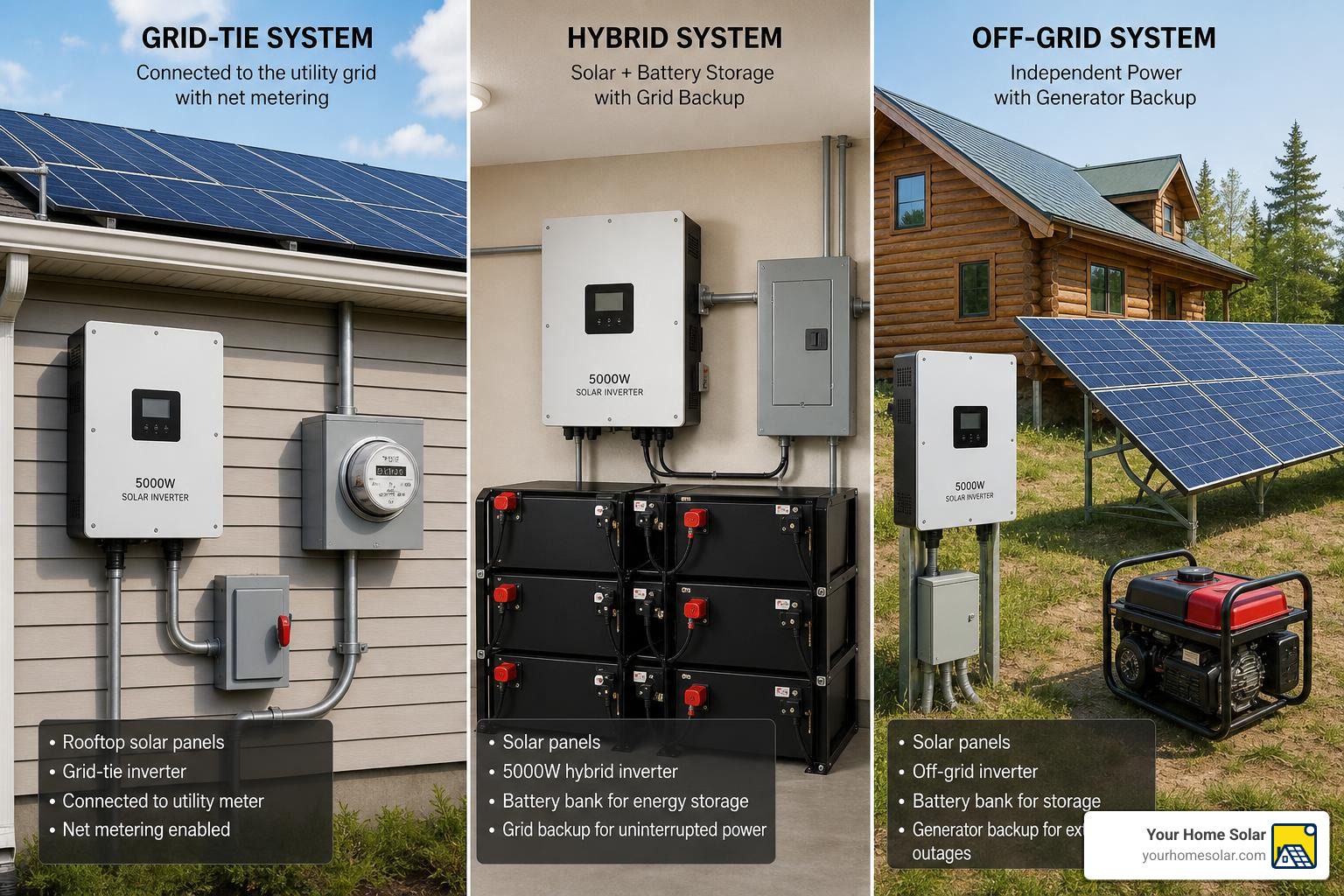
Not every 5000W inverter is built for the same job.
| Inverter Type | Best Use | Strengths | Limits | Typical Buyer Fit |
|---|---|---|---|---|
| Pure sine standalone | RVs, trucks, mobile power, simple battery systems | Clean AC power, simple, affordable | Usually no solar MPPT built in | Mobile users and simple backup |
| Off-grid AIO | Cabins, workshops, farms, remote buildings | Solar charger and inverter in one unit | Not ideal for utility export | Off-grid owners |
| Grid-tie | Grid-connected solar without batteries | High efficiency, export capable | Usually no backup during outage | Net metering customers |
| Hybrid | Solar plus batteries plus grid backup | Most flexible | More setup and permitting | Home backup systems |
| Split-phase hybrid | 120V and 240V home loads | Can support pumps and larger appliances | Requires careful design | Whole-home or partial-home backup |
Best Solar Power Inverter 5000W for Off-Grid Cabins and Workshops
For off-grid cabins and workshops in East Tennessee, a 48V all-in-one (AIO) inverter is usually the cleanest setup.
A typical 5000W off-grid AIO includes:
- 5000W pure sine wave AC output (10,000W peak)
- Up to 5500W PV input with high-voltage solar input up to 500V DC
- MPPT charging around 80A to 100A
- Battery voltage range around 40V to 60V
These example 5000W off-grid AIO specifications show the kind of feature set common in this category. The big advantage is simplicity: one box handles solar charging, battery charging, and AC output. The downside is serviceability; if the unit fails, both charging and inversion go offline, making proper installation and ventilation critical.
Best Solar Power Inverter 5000W for Grid-Tied Homes
For grid-tied homes, a 5000W grid-tie inverter converts solar panel power into AC that synchronizes with the utility grid.
A quality 5000W grid-tie inverter offers:
- Rated AC output of 5000W (Max DC input around 5400W)
- Maximum efficiency near 97% (MPPT efficiency around 99.5%)
- MPPT voltage range around 180V to 500V DC
- IP65 outdoor-rated enclosure and anti-islanding protection
You can see a representative spec set here: example 5000W grid-tie specifications.
Grid-tie systems are excellent for lowering electric bills, but standard units shut down during outages unless paired with approved backup equipment. For outage protection, look at hybrid systems instead.
Best 5000W Hybrid Inverter for Backup Power
A hybrid inverter works with solar panels, batteries, the grid, and generators. For home backup, look for:
- 5000W continuous output with 10,000VA surge for motor loads
- Fast transfer time (around 10 milliseconds)
- LiFePO4 battery settings and generator input support
Some 5000W hybrid units support very high PV input (up to 9750W) with wide MPPT ranges, allowing you to oversize the solar array for better winter production. For battery planning, see The Ultimate Guide to Solar Batteries and Energy Storage Solutions and compare product specs like the 5000W Hybrid Inverter PowerBase I5.
Best 5000W Pure Sine Wave Inverter for RVs, Trucks, and Mobile Power
For RVs, work trucks, and mobile power, a standalone pure sine wave inverter is the best choice. Look for:
- Pure sine wave output with low THD (under 3% to 5%)
- 10,000W surge capability and smart fan cooling
- Strong terminals and good vibration resistance
At 5000W, a 12V system is highly demanding, drawing over 400 amps and requiring massive cables. A 24V or 48V platform is much more efficient. For standalone examples, compare the 5000W Pure Sine Wave Solar Inverter RBP 5000W, the 5000W Heavy Duty Pure Sine Wave Power Inverter DC to AC, or the MWXNE 5000W Power Inverter Pure Sine Wave 12V to 110V 120V Heavy Duty Inverter.
Key Specs That Separate a Beast from a Bargain Bin Inverter
A 5000W label is only the beginning. The real story is in the technical specifications.
Input Voltage: Why 48V Is Usually Best at 5000W
At 5000W, battery current gets serious fast. Approximate current before efficiency losses:
| Battery Voltage | Current at 5000W |
|---|---|
| 12V | 417A |
| 24V | 208A |
| 48V | 104A |
After inverter losses, the current is even higher. That is why 48V is the standard platform for a solar power inverter 5000w. It offers lower current, smaller cable requirements, less voltage drop, less heat, and better compatibility with server-rack LiFePO4 batteries.
MPPT, PV Input, and Solar Panel Sizing
MPPT (maximum power point tracking) helps the inverter harvest more power from solar panels. Key solar input specs to compare include:
- Maximum PV input watts and MPPT voltage range
- Maximum PV open-circuit voltage (Voc)
- Number of MPPT trackers and maximum solar charge current
Many 5000W off-grid inverters support around 5500W of PV input. Because solar panel voltage rises when temperatures drop, your string voltage must stay below the inverter’s maximum PV voltage on cold East Tennessee mornings. For a deeper solar panel primer, read How Solar Panels Work: A Comprehensive Guide.
Surge Capacity, Motor Loads, and Real-World Appliances
Continuous watts tell you what the inverter can run steadily; surge watts tell you what it can start. Motor loads (refrigerators, well pumps, mini-splits, air compressors) can require 3 to 7 times their running watts at startup. Look for an inverter with at least a 10,000W surge capacity to handle these demanding inductive loads.
Parallel Capability and Split-Phase Power
Some 5000W inverters can be paralleled (up to 6 or 12 units) for higher output and split-phase 120/240V power. For East Tennessee homes, split-phase capability is essential if you want to power 240V appliances like well pumps, electric dryers, or HVAC equipment.
Efficiency, Heat, Noise, and Standby Draw
Efficiency ratings vary widely: standalone units range from 85% to 90%, while hybrid and grid-tie units can reach 95% to 97%. Lower efficiency means more wasted heat. Check the operating temperature range, fan noise (measured in dB), and no-load standby draw, which can drain batteries overnight if too high.
Reliability, Safety, Certifications, and Real-World Limitations
A 5000W inverter handles enough power to cause serious shock hazards or electrical fires if installed incorrectly.
Certifications to Look For Before You Buy
Before buying, check for certifications and compliance markings that match your application:
- UL1741 / UL1741 SA: Standard for inverter safety and grid support
- UL1973 / UL9540A: Battery safety and fire testing standards
- IEEE 1547: Grid interconnection compliance
- NEMA / IP Ratings: Enclosure protection for outdoor installations
For grid-tied homes, utility approval is mandatory. Interconnection rules vary across Tennessee utilities, so we design systems to meet local requirements.
Common 5000W Inverter Problems Owners Report
Common issues include:
- Overheating from poor ventilation
- Nuisance shutdowns under motor surge
- Battery BMS tripping from capacitor inrush current (sparking)
- Voltage sag from undersized battery cables
- WiFi or app connection loss
Battery BMS Compatibility and Pre-Charge Concerns
Lithium batteries use a Battery Management System (BMS) for protection. For a 5000W inverter, ensure your battery bank can handle the continuous and peak discharge current. A single 48V 100Ah battery (5.12kWh) may not supply enough current; a 200Ah bank or multiple batteries in parallel is highly recommended. Using a pre-charge resistor during installation prevents high inrush current from tripping the BMS.
All-in-One Hybrid vs Separate Inverter and Charge Controller
There is no single winner; it depends on your goals.
All-in-One Hybrid Pros:
- Lower equipment cost and fewer boxes on the wall
- Built-in MPPT solar charger and AC charger
- Simplified monitoring and installation
Separate Component Pros:
- Higher reliability and redundancy (if one part fails, the other still works)
- Easier to upgrade individual components
- More flexible solar array design and advanced monitoring
Installation, Wiring, and System Sizing for a 5000W Setup
A 5000W inverter system should be designed like a small power plant. We recommend a licensed, qualified installation for home systems. For a step-by-step overview, see The Ultimate Guide to Residential Solar Installation: From Panels to Power.
Battery Sizing for a 5000W Inverter
At full 5000W output, a 48V system draws about 110A to 125A after efficiency losses. Battery capacity should match your runtime goals:
| Battery Capacity | Approximate Use Case |
|---|---|
| 5-10kWh | Essentials: fridge, lights, WiFi, small loads |
| 10-20kWh | Partial-home backup with careful load management |
| 20kWh+ | Realistic whole-home backup for longer outages |
We prefer LiFePO4 batteries for home backup due to their safety, long lifespan, and stable discharge rates.
Solar Panel Sizing for Daily Energy Needs
Your solar array size depends on daily energy consumption, not just inverter capacity. A common pairing is a 5kW to 5.5kW solar array. In East Tennessee, winter production is lower, so shading, roof pitch, and orientation (south-facing is ideal) must be factored in. For panel planning, read The Ultimate Guide to Home Solar Energy Panels.
Breakers, Fuses, Cables, and Disconnects
A safe installation requires proper overcurrent protection:
- Class T fuse near the battery bank
- DC-rated breakers and rapid shutdown equipment
- Properly sized battery cables (typically 2/0 to 4/0 AWG)
- Correctly sized AC output wiring (around 6 AWG)
- Grounding and bonding per local electrical codes
Installation Mistakes That Can Void Warranties
Avoid these common installation errors:
- Undersized battery cables or lack of proper fusing
- Incorrect neutral-ground bonding
- Poor ventilation leading to thermal derating
- Exceeding maximum PV input voltage in cold weather
- Unpermitted electrical work or DIY grid-tie connections
Price, Value, and Buying Checklist for a Quality 5000W Inverter
In 2026, the 5000W inverter market ranges from budget mobile units to premium hybrid systems.
What a 5000W Solar Inverter Should Cost in 2026
Typical equipment-only price ranges:
| Inverter Category | Typical 2026 Price Range |
|---|---|
| Budget standalone pure sine inverter | Under $500 to $900 |
| Better pure sine mobile inverter | $800 to $1,500 |
| Off-grid all-in-one hybrid | $900 to $2,000 |
| Grid-tie 5kW inverter | $1,000 to $2,500 |
| Premium hybrid or battery-ready system | $2,000 to $3,500+ |
Popular options include the PowMr 5000W Solar Inverter 48V to 120V, Pure Sine Wave Power. Total installed cost will be higher, factoring in batteries, panels, racking, permits, and professional labor.
Features Worth Paying More For
Invest in features that ensure safety and longevity:
- UL safety listings (UL1741)
- Split-phase 120/240V output
- Dual MPPT trackers and high-voltage PV input
- Closed-loop battery communication
- Generator integration and remote monitoring
- A robust 5 to 10-year warranty
Red Flags When Comparing 5000W Inverters
Be cautious of:
- No clear continuous wattage rating (only peak advertised)
- Lack of UL or safety certifications
- Undersized terminals for high-current connections
- Poorly translated manuals or lack of technical support
- Extremely lightweight units claiming high power output
Frequently Asked Questions About 5000W Solar Inverters
Can a 5000W inverter power a whole house?
Yes, but as a managed backup system rather than for unlimited whole-home use. It can easily power essential loads like a refrigerator, lights, WiFi, a microwave, and a well pump. However, it will struggle with high-draw 240V appliances like central HVAC, electric water heaters, and clothes dryers running simultaneously.
Can a 5000W inverter run without batteries?
Some can. Grid-tie inverters run directly from solar panels when the grid is active. Certain hybrid and off-grid inverters support batteryless solar operation during peak daylight. However, for true outage protection and nighttime use, batteries are required.
Is a 5000W inverter better as grid-tie, hybrid, or off-grid?
It depends on your goals:
- Grid-tie is best for lowering electric bills via net metering without battery costs.
- Hybrid is ideal for home backup, combining solar, battery, and grid power.
- Off-grid is designed for remote cabins, workshops, or RVs where utility power is unavailable.
Conclusion
A solar power inverter 5000w offers an excellent balance of power and practicality, making it ideal for home backup, off-grid cabins, workshops, and RVs.
The best choice depends on your specific application:
- Off-grid cabin: 48V all-in-one inverter
- Grid-tied home: Certified 5kW grid-tie inverter
- Backup power: Hybrid inverter with batteries
- RV or truck: Pure sine standalone inverter
At Your Home Solar, we help homeowners across Knoxville, Oak Ridge, Maryville, Johnson City, Kingsport, Morristown, Sevierville, Farragut, Powell, and throughout East Tennessee design safe, reliable, and tailored solar backup systems.
Ready to design your system? Start with the Residential Solar Solutions Guide.