How Much Does Solar Power Plant Installation Cost in 2026? (Quick Answer)
Solar power plant installation cost is one of the most searched questions by East Tennessee homeowners right now — and for good reason. Energy bills keep climbing, and outages are becoming more common.
Here is what most homeowners pay in 2026, before incentives:
| System Type | Typical Cost Per Watt | Example Total Cost |
|---|---|---|
| Residential (home) | $2.55 – $3.45/W | ~$30,500 for a 12 kW system |
| Commercial (business) | $1.40 – $3.80/W | ~$280,000 for a 100 kW system |
| Utility-scale (1 MW+) | ~$0.98/W | ~$980,000 for a 1 MW farm |
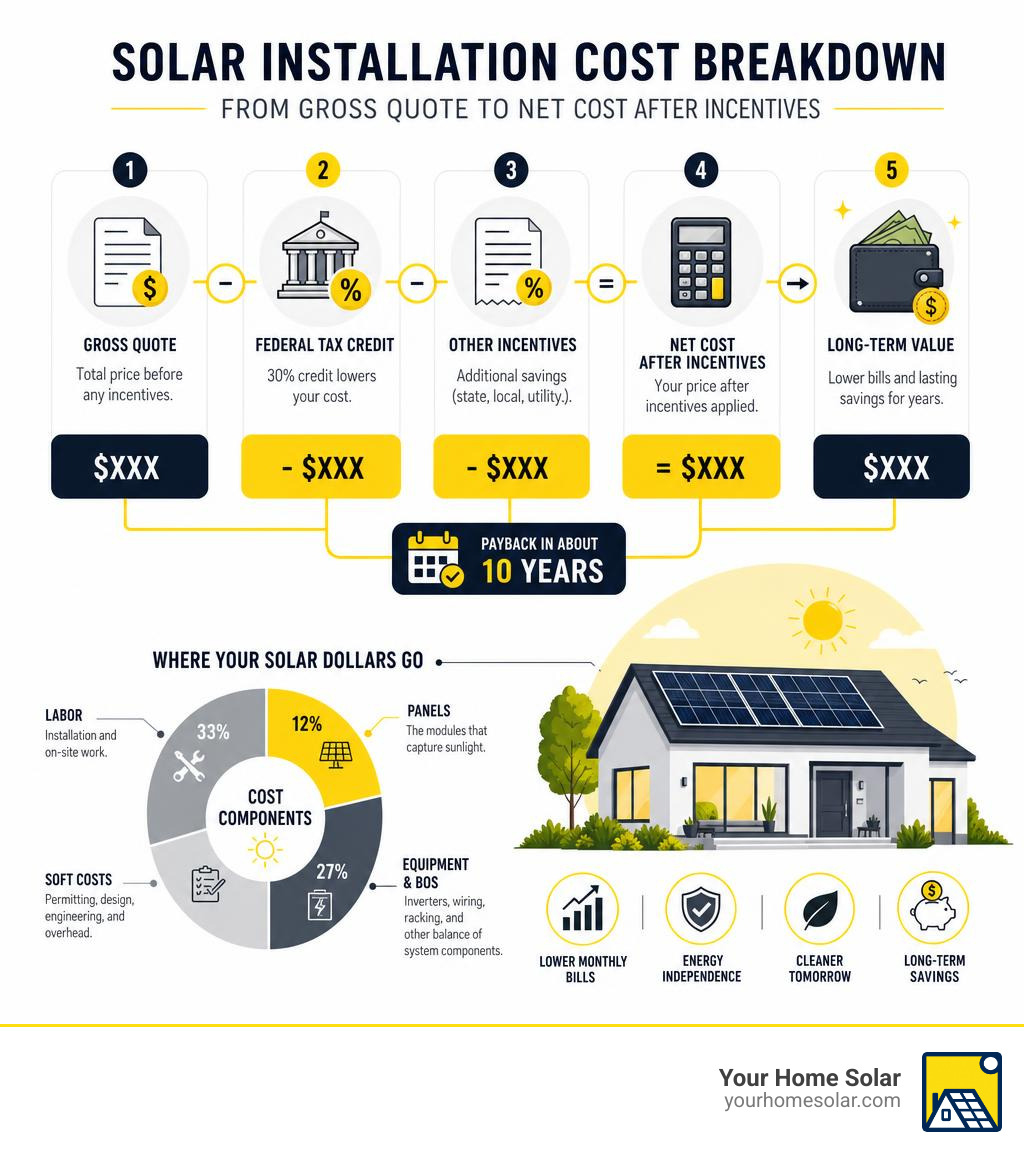
After the 30% federal tax credit, a typical residential system drops to roughly $21,000 – $24,000 out of pocket. Most homeowners recover that cost in about 10 years — and save $37,000 to $154,000 over 25 years.
Two things to know right away:
- Solar panels themselves are only about 12% of your total installation cost. Labor, permitting, and soft costs make up the rest.
- Utility-scale farms cost far less per watt than home systems — but home solar still makes strong financial sense thanks to the retail electricity rates you avoid paying.
I’m Ernie Bussell, founder and CEO of Your Home Solar, the #1 solar energy contractor in East Tennessee — and I’ve spent years inside the solar industry, from managing $40 million annual installation operations to helping individual homeowners navigate solar power plant installation cost with confidence. In this guide, I’ll walk you through every number you need to make a smart decision for your home.
What the Average Solar Power Plant Installation Cost Means for Homeowners in 2026
When homeowners ask about “solar power plant installation cost,” they usually mean, “What will it cost to put solar on my home?”
In 2026, a realistic residential solar price range is about $2.55 to $3.45 per watt before incentives. A commonly cited national average is around $2.58/W, with a 12 kW system averaging about $30,505 before incentives.
For East Tennessee homeowners in Knoxville, Oak Ridge, Maryville, Johnson City, Kingsport, Morristown, Sevierville, Farragut, Powell, and surrounding counties, your final price depends on your roof, utility requirements, equipment, electrical panel, and whether you add batteries or backup power.
Utility-scale solar is much cheaper per watt. Large projects are often around $0.98/Wdc, not including land acquisition. Berkeley Lab’s utility-scale solar cost trends show that large solar project costs have fallen dramatically over the past decade. But a 1 MW solar farm is not the same animal as a rooftop system. One is a herd of cattle in a field; the other is a goat on a roof. Both are useful. One is just trickier to install.
For more homeowner-focused pricing basics, see our guide to average home solar costs.
Residential Solar vs Utility-Scale Solar: Why Home Systems Cost More per Watt
Home solar costs more per watt because every house is different.
A utility-scale project may install hundreds of thousands of panels on open land using repeatable designs, bulk equipment purchasing, centralized interconnection planning, and large construction crews. Residential solar is customized around:
- Roof pitch and roof material
- Shading from trees, chimneys, dormers, and neighboring structures
- Attic access and structural conditions
- Main electrical panel capacity
- Utility interconnection rules
- Local permitting and inspection requirements
- Fire setbacks and rapid shutdown requirements
- Customer-specific design and financing
Residential systems are also smaller, so fixed costs get spread over fewer watts. A permit, truck roll, engineering review, design package, project manager, and inspection all cost money whether the system is 6 kW or 16 kW.
That is why home solar usually sits around $2.55 to $3.45/W, while utility-scale solar can be near $0.98/W.
2026 Cost Benchmarks by System Size
Bigger systems usually cost less per watt because fixed costs are spread across more equipment. Here is a simplified 2026 planning table:
| System Size | Typical Use | Approx. 2026 Cost/Watt | Approx. Gross Cost |
|---|---|---|---|
| 8 kW | Smaller home | $2.55 – $3.45/W | $20,400 – $27,600 |
| 10 kW | Average-to-large home | $2.55 – $3.35/W | $25,500 – $33,500 |
| 12 kW | Larger home, EV, heat pump | ~$2.58 – $3.25/W | ~$30,500 – $39,000 |
| 100 kW | Small commercial | $2.40 – $3.20/W | $240,000 – $320,000 |
| 1 MW | Solar farm / large site | ~$0.98 – $1.40/W | ~$980,000 – $1.4M |
| 10 MW | Utility project | Lower than 1 MW | Varies by site |
| 100 MW | Utility-scale benchmark | Around $0.98/Wdc modeled benchmark | ~$98M |
| 500 MW+ | Very large utility project | Lowest per-watt range | Site-specific |
These are planning ranges, not final quotes. A simple roof in Maryville may price differently than a steep, shaded roof in Sevierville or a long ground-mount trench in rural Anderson County.
How to Estimate Your Home’s Solar Power Plant Installation Cost
Here is the simple homeowner formula:
- Find your annual electricity use in kWh.
- Estimate the system size needed to offset that use.
- Multiply system size by cost per watt.
- Subtract incentives.
- Compare annual savings to net cost.
Example:
| Item | Example |
|---|---|
| Annual electricity use | 14,000 kWh |
| Estimated solar size | 11 kW |
| Cost at $2.80/W | $30,800 |
| 30% federal tax credit | -$9,240 |
| Estimated net cost | $21,560 |
To estimate payback, divide your net cost by your expected annual utility savings. If the system saves $2,200 per year, the simple payback is about 9.8 years.
For more on quote math, see our solar cost basics.
The Real Cost Breakdown: Equipment, Labor, Permits, and Soft Costs

A solar quote is not just panels. In fact, panels are often only about 12% of the total installed cost on a home system.
A typical residential cost stack includes:
| Cost Category | What It Includes |
|---|---|
| Solar modules | Panels, clamps, module-level electronics if used |
| Inverters | String inverter, microinverters, optimizers, rapid shutdown |
| Racking | Rails, attachments, flashing, ground-mount structure if applicable |
| Electrical BOS | Wire, conduit, disconnects, breakers, combiner boxes, labels |
| Labor | Roof work, electrical work, commissioning |
| Engineering | Design, structural review, electrical drawings |
| Permitting | Local permit fees, application work, inspection coordination |
| Interconnection | Utility application, meter changes, approval steps |
| Soft costs | Sales, overhead, project management, financing, administration |
| Contingency | Unforeseen roof, electrical, or utility issues |
Solar Panels, Inverters, Racking, and Electrical Balance of System
Solar panels get the attention, but the “supporting cast” matters just as much.
Major hardware items include:
- Modules: Higher-efficiency panels can produce more power in limited roof space, but may cost more.
- Inverters: String inverters are common and cost-effective. Optimizers or microinverters can help with shading or complex roof planes.
- Racking: Rails, roof attachments, flashing, and clamps secure the array against wind and weather.
- Electrical balance of system: Wiring, conduit, disconnects, breakers, labels, and monitoring equipment make the system safe and code-compliant.
- Transformers and service equipment: More common on larger commercial or farm-style systems, but sometimes relevant for larger residential or ground-mounted projects.
The cheapest equipment is not always the lowest-cost choice over 25 years. A reliable inverter, quality roof attachments, and clean electrical work help protect your home and your savings.
Labor, Engineering, Permitting, and Inspection Costs
Labor is a major part of solar power plant installation cost because safe installation takes trained people. A good solar project includes:
- Site evaluation
- Solar design
- Electrical drawings
- Structural review when needed
- Permit submission
- Utility interconnection paperwork
- Roof installation
- Electrical installation
- Inspection coordination
- Commissioning and monitoring setup
In East Tennessee, terrain and home styles vary widely. A straightforward roof in Farragut is different from a steep mountain-view roof near Sevierville or a rural ground mount in Greene County. Those details change labor time.
We recommend choosing qualified, experienced installers who understand solar electrical codes, utility requirements, roof protection, and long-term workmanship. Certification, training, and experience matter.
Soft Costs and Why They Matter More in Residential Solar
Soft costs are the non-hardware costs of solar. They include:
- Permitting administration
- Design revisions
- Project management
- Sales and customer support
- Financing fees
- Insurance and overhead
- Inspection coordination
- Utility paperwork
Residential solar has a higher soft-cost share than utility-scale solar because each project is custom. Research shows non-hardware costs can account for more than 65% of residential installation cost. Permitting and related delays can add meaningful cost, sometimes approaching $1/W when direct and indirect burdens are included.
That is why a smooth process matters. A well-run project saves more than headaches; it can save real money.
For more detail, read our installed panel price breakdown.
What Changes Your Solar Power Plant Installation Cost From One Home to Another?
No two homes use energy the same way. No two roofs install the same way. Solar pricing changes from one home to another because of design, construction, electrical, and utility factors.
Site, Roof, and Electrical Factors That Drive Price

The biggest home-specific cost drivers are:
- Roof age: If your roof is near the end of its life, replacing it before solar may be smarter than removing panels later.
- Roof material: Asphalt shingles are usually simpler than tile, slate, or specialty metal roofs.
- Roof pitch: Steeper roofs require more safety equipment and labor time.
- Shading: Trees, chimneys, and roof features can reduce production or require extra electronics.
- Orientation and tilt: South-facing roof planes usually produce well in East Tennessee, but east/west arrays can also make sense.
- Electrical panel capacity: Some homes need a main panel upgrade, often to support solar, EV charging, or battery backup.
- Service equipment: Older service entrances, meter bases, or grounding systems may need upgrades.
- Ground-mount distance: Long trenching runs add labor, wire, conduit, and equipment cost.
- Structural conditions: Weak rafters, limited attic access, or unusual framing can require engineering work.
- Backup integration: Batteries, generators, and critical-load panels add complexity.
A main panel upgrade alone can add several thousand dollars depending on site conditions. Tree trimming, trenching, and roof work can also change the final number.
Regional and State Cost Differences
Within East Tennessee, cost differences are usually driven by:
- Local permitting requirements
- Utility territory and interconnection rules
- Travel distance and rural access
- Roof types common in the area
- Local labor availability
- Inspection timelines
- Terrain and trenching conditions
- HOA review requirements, where applicable
For example, homes in Knoxville or Oak Ridge may have different inspection processes than homes in rural counties. A ground mount in Campbell County, Monroe County, or Washington County may require more trenching than a rooftop system in Maryville or Farragut.
State policy also matters. Incentives, net metering structures, interconnection rules, and utility programs can affect savings just as much as installed price.
Hidden Solar Costs That Often Become Change Orders
The best solar quote is not the lowest number. It is the most complete number.
Watch for these possible adders:
- Roof replacement before installation
- Roof decking or rafter reinforcement
- Structural engineering review
- Main electrical panel upgrade
- Meter base or service entrance repair
- Long conduit runs
- Trenching for ground mounts
- Tree trimming or removal
- Utility transformer upgrade
- Backup loads panel for batteries
- Generator integration
- Revenue-grade monitoring for certain projects
- Additional disconnects or utility-required equipment
- Internet or monitoring hardware
- Pest guards
- Snow, wind, or site-specific structural requirements
- Battery wiring and protected loads work
A good rule: set aside a 5% to 10% contingency until the site visit, utility review, and design are complete.
Incentives, Financing, and Net Cost After Tax Benefits
The gross price is not the number that matters most. The net cost after incentives and financing is what affects your wallet.
Federal Solar Tax Credit and Residential Savings
The federal Residential Clean Energy Credit is still 30% in 2026 for eligible residential solar projects. It can apply to:
- Solar panels
- Inverters
- Racking
- Labor
- Permitting
- Electrical work tied to the solar installation
- Eligible battery storage
If your 12 kW system costs $30,505, the 30% credit is about $9,152, bringing the estimated net cost to about $21,353, assuming you can use the full credit.
Important notes:
- It is a tax credit, not an instant rebate.
- You need enough tax liability to use it.
- Unused credit may be carried forward under current rules.
- Always confirm your situation with a tax professional.
For payment options, see our residential solar financing guide.
Business and Large-Project Incentives: ITC, MACRS, Bonus Depreciation, and C-PACE
Commercial and large solar projects may qualify for more tools than residential projects, including:
- Federal Investment Tax Credit
- 5-year MACRS depreciation
- Bonus depreciation, subject to current tax rules
- C-PACE financing where available
- USDA grants for eligible rural businesses or agricultural operations
- Utility or state programs where offered
- Power purchase agreement structures
Commercial solar is often evaluated by after-tax return, depreciation value, demand charge reduction, and operating savings. A 100 kW system may cost $240,000 to $320,000 gross, but tax benefits can reduce the effective cost substantially for businesses with tax appetite.
Cash, Loans, PPAs, and Leases: Which Payment Method Costs Less?
The best payment method depends on your goals.
| Payment Method | Pros | Watchouts |
|---|---|---|
| Cash | Highest lifetime savings, no interest | Highest upfront cost |
| Solar loan | Own the system, lower upfront payment | Interest and dealer fees can raise total cost |
| Lease | Low upfront cost | Usually lower savings; no tax credit for homeowner |
| PPA | Pay for power, not equipment | Rate escalators and contract terms matter |
Ownership usually gives the strongest long-term savings because you may claim incentives and keep more of the energy value. Loans can work well if the payment is lower than your old utility bill, but always compare the cash price with the financed price.
For business-scale pricing, see our commercial cost per watt guide.
Performance, O&M, Batteries, and Long-Term Economics
A cheap solar system that underperforms is not cheap. The real economics depend on production, durability, maintenance, and how much utility power you avoid buying.
Capacity Factor, Inverter Loading Ratio, and Mounting Type
Capacity factor measures how much energy a solar system produces compared with running at full power all the time. Utility-scale PV plants have shown median capacity factors around 24%, with plant-level ranges from about 7% to 37% depending on location, design, and performance.
Residential systems are different because roof pitch, shading, and orientation limit design options.
Key terms:
- Capacity factor: Annual output divided by theoretical maximum output.
- Inverter loading ratio (ILR): DC panel capacity divided by AC inverter capacity.
- Clipping: When panels produce more DC power than the inverter can convert at that moment.
- Fixed tilt: Most home rooftop systems.
- Single-axis tracking: Common in utility-scale projects; Berkeley Lab reports tracking is used in the vast majority of new utility PV capacity.
Utility solar often uses tracking to follow the sun. Rooftop solar usually uses the roof you already have. Unless your house rotates, which would be exciting but probably not code-compliant.
For historical benchmarks, see utility-scale historical benchmarks.
O&M Costs for Residential, Commercial, and Utility-Scale Solar
Solar has low operating costs, but it is not “install it and forget it forever.”
Typical O&M items include:
- Monitoring system performance
- Inspecting wiring and roof penetrations
- Cleaning panels when pollen, dust, or debris reduce production
- Checking inverter operation
- Managing vegetation around ground mounts
- Reviewing production against expected output
- Handling warranty claims
- Replacing inverters if needed over the system life
Utility-scale O&M has been reported around $19/kWAC-year, or about $11/MWh, based on historical project data. Residential O&M is usually less formal, but homeowners should still monitor production and schedule inspections if output drops unexpectedly.
Panels degrade slowly over time. Modern systems are often designed for 25 to 30 years of production, with warranties supporting long-term performance.
How Batteries Change Solar Economics
Batteries add cost, but they also add value that panels alone cannot provide.
Battery storage can help with:
- Backup power during outages
- Keeping refrigerators, lights, internet, and medical devices running
- Critical-load panel support
- Generator integration
- Time-of-use savings where rates apply
- Demand charge management for some businesses
- Greater use of your own solar energy
Hybrid PV-plus-battery projects are growing quickly. In large interconnection queues, more than half of queued solar capacity has been paired with storage. That shows where the grid is heading: solar plus flexibility.
For homes in East Tennessee, batteries are usually a resilience decision first and a financial decision second. If outages are your main concern, a battery or a solar-plus-generator plan can be worth considering.
LCOE, PPA Prices, and Wholesale Market Value
LCOE stands for levelized cost of energy. It is the lifetime cost of a system divided by the energy it produces, usually shown in dollars per megawatt-hour.
For utility-scale solar, recent industry data has shown:
- Incentive-adjusted LCOE around $31/MWh
- New PPA prices around $35/MWh
- Solar market value around $45/MWh in some analyses
For homeowners, the comparison is different. You are not usually competing with wholesale power prices. You are avoiding retail electricity charges on your utility bill. That makes residential solar valuable even though it costs more per watt than a solar farm.
What Utility-Scale Solar Pipelines Mean for Future Home Solar Prices
Large solar pipelines affect home solar in three big ways:
- They help drive equipment scale and lower module prices.
- They create demand for transformers, inverters, labor, and grid equipment.
- They can slow interconnection timelines when utilities and suppliers are overloaded.
At the end of 2023, more than 1,085 GW of solar capacity was reported in U.S. interconnection queues, with 53% paired with storage. That is a giant pipeline. It suggests solar deployment will keep growing, but it also means grid upgrades, transformer supply, and permitting capacity matter.
Permitting, Interconnection Studies, and Grid Upgrades
For homeowners, interconnection is the utility approval process that allows your system to operate with the grid.
It can involve:
- Application forms
- System design review
- Net metering or billing setup
- Meter replacement
- Inspection approval
- Permission to operate
- Export limits in some cases
- Transformer or service review
For larger systems, utilities may require impact studies, protection studies, transformer upgrades, feeder upgrades, or additional equipment. These can add cost and time.
Even for homes, sequencing matters. A project typically moves through design, permit, installation, inspection, utility approval, and activation. If one step stalls, the whole project waits in line like everyone at the DMV pretending not to sigh.
What Homeowners Can Learn From Large Solar Project Economics
Big solar developers are disciplined because small mistakes become expensive at scale. Homeowners can use the same mindset:
- Confirm site conditions early.
- Understand interconnection before installation.
- Compare quotes by line item, not just total price.
- Budget for contingencies.
- Model production realistically.
- Choose equipment for lifetime value, not just upfront price.
- Plan for maintenance.
- Think carefully about whether batteries solve a real need.
- Review financing terms closely.
That is how you reduce surprises and protect long-term savings.
Frequently Asked Questions About Solar Power Plant Installation Cost
What is the average solar power plant installation cost for a home in 2026?
Most home solar systems cost about $2.55 to $3.45 per watt before incentives in 2026. A 12 kW system averages around $30,505 before incentives.
After the 30% federal tax credit, that example could drop to roughly $21,000 to $24,000, depending on final design, eligible costs, and your tax situation.
Your quote may vary based on roof complexity, electrical upgrades, battery storage, utility rules, and equipment choices.
Is $3 per watt a fair solar price?
Yes, $3/W can be a fair solar price in 2026 if it includes quality equipment, proper permitting, good workmanship, monitoring, warranty support, and no major hidden adders.
But context matters. A simple cash quote at $3/W may be fair. A financed quote at $3/W with large dealer fees hidden in the loan may not be as attractive. A complex roof with batteries excluded is different from a simple roof with everything included.
For a deeper look, read our fair solar price guide.
How much does a 1 MW solar farm cost compared with home solar?
A 1 MW solar farm may cost roughly $980,000, or about $0.98/W, not including land acquisition. A home solar system is usually $2.55 to $3.45/W.
Solar farms are cheaper per watt because they use bulk purchasing, repeatable engineering, large-scale labor, and open land. Home systems cost more because rooftops are customized, smaller, and more labor-intensive.
But home solar offsets retail electric rates, which are much higher than wholesale power values. That is why rooftop solar can still deliver strong savings even at a higher installed cost per watt.
Conclusion
Solar pricing in 2026 is more affordable than many homeowners expect, but the real number depends on more than panels.
To recap:
- Residential solar usually costs $2.55 to $3.45/W before incentives.
- A typical 12 kW system is around $30,505 before incentives.
- The 30% federal tax credit can reduce net cost significantly.
- Panels are only about 12% of total installed cost.
- Labor, permitting, electrical work, and soft costs matter.
- Hidden costs like roof work, panel upgrades, trenching, and batteries should be discussed early.
- Utility-scale solar is cheaper per watt, but home solar saves against retail electric rates.
At Your Home Solar, we help East Tennessee homeowners design systems that fit their roof, budget, utility needs, and long-term goals. Whether you are in Knoxville, Oak Ridge, Maryville, Johnson City, Kingsport, Morristown, Sevierville, Farragut, Powell, or one of the surrounding counties, we are here to make the process clear, reliable, and rewarding.
Ready to see what solar could cost for your home? Start your residential solar plan.