Why the Average Cost Per Watt Commercial Solar Matters for Your Business Investment
Average cost per watt commercial solar is the primary metric businesses use to estimate solar installation expenses. Here’s what you need to know:
- US Average: $1.83 per watt for systems between 10 kW and 2 MW
- Small Systems (100-500 kW): Approximately $2.50 per watt
- Medium Systems (500 kW – 1 MW): Approximately $2.00 per watt
- Utility-Scale Systems (>2 MW): $1.06 per watt on average
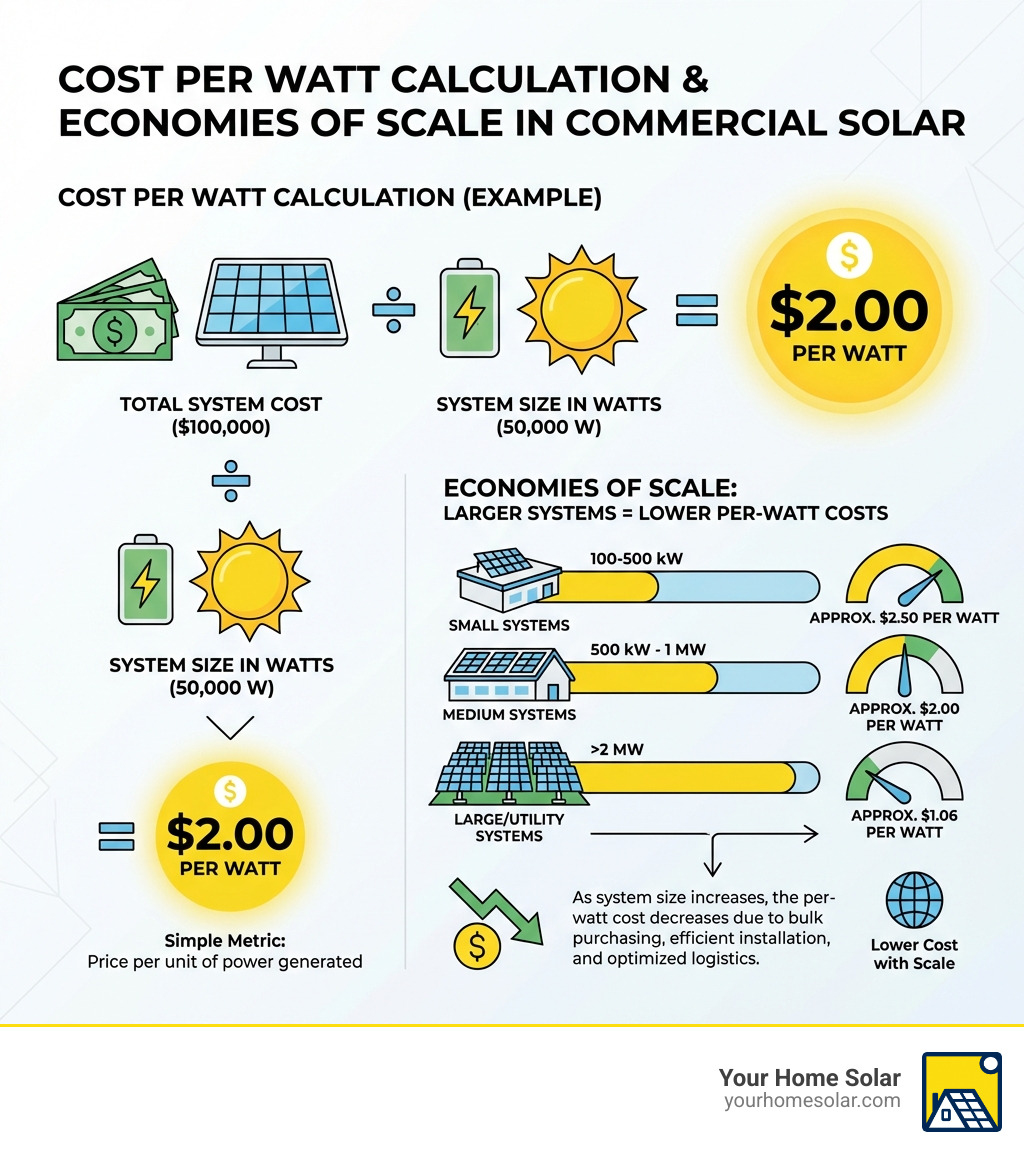
How to Calculate: Total System Cost ÷ System Size in Watts = Cost per Watt
Solar energy has become one of the smartest financial moves a business can make. Costs have dropped by 78% since 2010, making commercial solar more accessible than ever. But when you’re evaluating quotes and trying to understand what you’ll actually pay, one number matters most: cost per watt.
This metric tells you how much you’re paying for each unit of power your system can generate. It’s like the “price per square foot” when buying a building—a simple way to compare different proposals and understand if you’re getting a fair deal.
But cost per watt is just the starting point. The true cost of your commercial solar installation depends on your system size, equipment choices, roof type, location, and available incentives. Some businesses pay $1.50 per watt. Others pay $3.00 per watt for the same-sized system. Why? That’s what this guide will explain.
I’m Ernie Bussell, founder and CEO of Your Home Solar. Over the past three years, I’ve helped East Tennessee businesses understand the average cost per watt commercial solar and steer the complexities of solar investments. My background in operations management within the solar power industry, including overseeing a $40 million per year operation, has given me deep insight into what drives these costs and how businesses can make informed decisions.
Understanding the Average Cost Per Watt for Commercial Solar in 2024
The average cost per watt commercial solar in the U.S. for 2024 is dynamic, influenced heavily by project size. However, there are strong benchmarks to guide expectations.
On average, commercial solar systems (10 kW to 2 MW) cost around $1.83 per watt before incentives. As system size increases, the per-watt cost decreases due to economies of scale:
- 100-500 kW systems: Approximately $2.50 per watt.
- 500 kW – 1 MW systems: Approximately $2.00 per watt.
The largest utility-scale projects (>2 MW) show the most efficiency, averaging around $1.06 per watt. Data from the Utility-Scale Solar, 2024 Edition report reveals that median installed costs for these projects have fallen 75% since 2010. In 2023, the average installed cost was $1.43/W (or $1.08/W), highlighting a downward trend that makes commercial solar an increasingly attractive investment.
The Difference Between Commercial and Residential Solar Costs
Businesses often notice that commercial solar has a lower cost per watt than residential installations. While residential solar in the US averages $2.53 to $3.15 per watt (and can be as low as $1.30 to $1.97 per watt in East Tennessee), commercial systems are significantly cheaper on a per-watt basis.
This difference is due to economies of scale. For larger commercial projects, we benefit from bulk material purchasing and more efficient labor. Fixed costs like design and permitting are spread across more watts, driving down the per-watt price. So, while the total project cost is higher for a commercial system, the cost for each unit of power is lower.
For more information on residential solar and how it compares, explore our Residential Solar Solutions Guide.
What’s Included? A Breakdown of Commercial Solar System Costs
The average cost per watt commercial solar covers more than just panels. It’s a complex system of hardware, labor, and design.
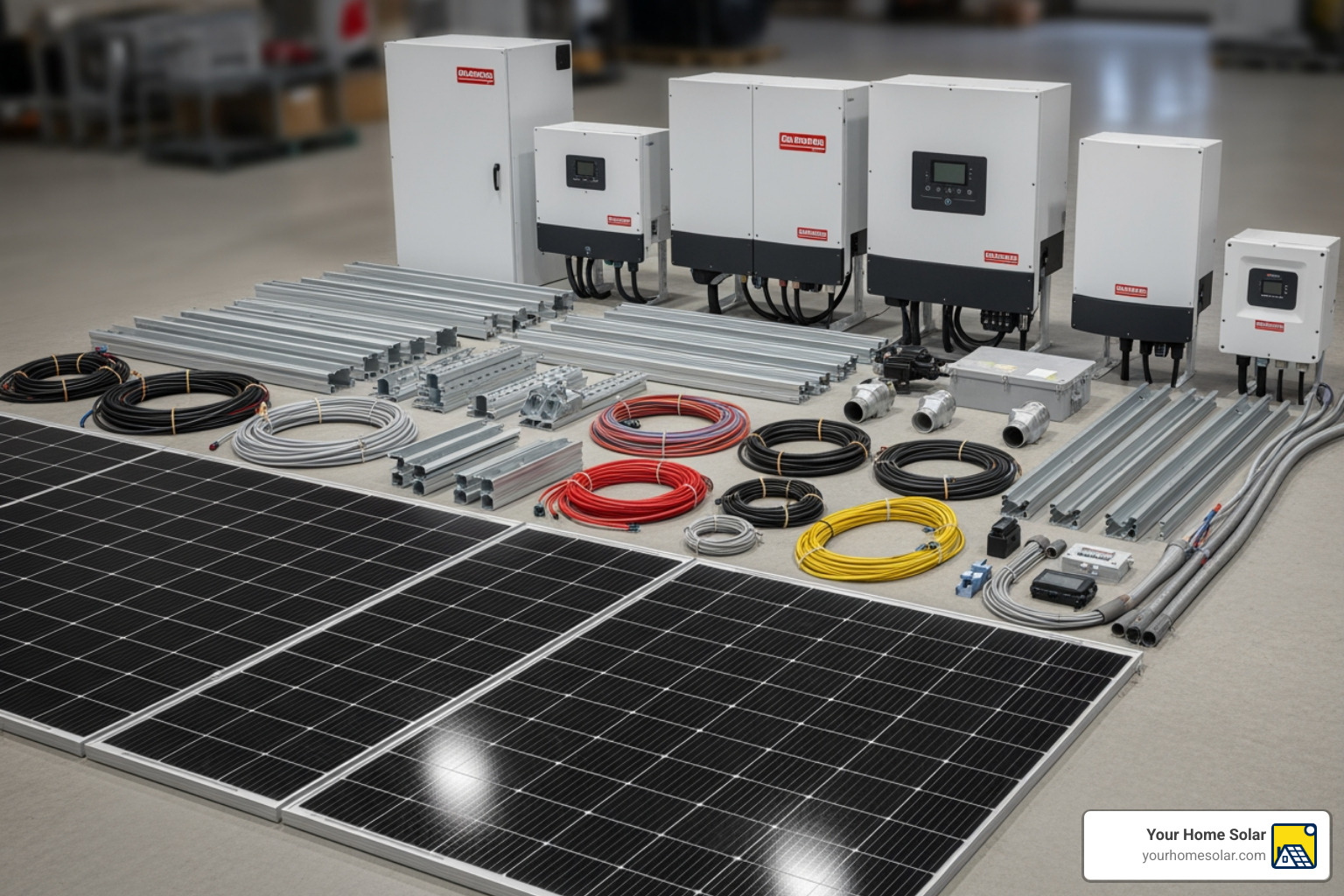
Here’s a typical cost breakdown for a commercial solar power system:
- Solar panels: 35-40% of the total system cost.
- Inverters: 20-25% of the cost.
- Racking and miscellaneous equipment: 20-25% of the cost.
- Engineering/design: ~5% of the cost.
- Labor/logistics: 15-20% of the total.
- Permitting: 1-2% of the cost.
Hardware Costs: Panels, Inverters, and Racking
The quality and type of hardware significantly influence the overall average cost per watt commercial solar.
Solar Panels: Panel choice affects price and performance.
- Monocrystalline panels: The most efficient and durable option. They cost more but perform better, especially where space is limited.
- Polycrystalline panels: A budget-friendly choice that is slightly less efficient but offers excellent value.
- Thin-film panels: The most affordable but least efficient option with shorter lifespans, making them less suitable for most commercial projects. We typically guide our East Tennessee clients toward monocrystalline or high-quality polycrystalline panels. For a deeper dive, check out Architizer’s Architects guide to Photovoltaics.
Inverters: These convert DC electricity from panels to usable AC electricity.
- String inverters: A cost-effective choice where panels are wired in a “string.” Shading on one panel can affect the entire string’s output.
- Microinverters: Installed on each panel, allowing them to operate independently. This maximizes energy harvest, especially with shading. While they increase the initial cost per watt commercial solar, they often lead to greater long-term savings.
Racking and Mounting Systems: These securely hold your panels. The type needed depends on your roof (flat, pitched, metal) or if you choose a ground-mount system. High-quality racking is essential for durability, especially with Tennessee’s weather.
Soft Costs: Labor, Permitting, and Design
A significant portion of the average cost per watt commercial solar comes from non-hardware “soft costs.”
Engineering and Design (5%): Our engineers assess your facility’s energy needs and site to design a system for maximum power production and long-term performance.
Labor and Logistics (15-20%): This covers the skilled technicians, equipment transportation, and project management. Commercial installations are complex and require experienced installers for a safe, high-quality result.
Permitting Fees (1-2%): We handle the critical process of securing local building and electrical permits in East Tennessee. This ensures your system is legal, safe, and compliant.
Interconnection Costs: This covers the application and approval process to connect your system to the local utility grid (like KUB or TVA). Costs include the utility’s review and net metering equipment installation.
Choosing an experienced installer who manages these costs efficiently is key. Our team at Your Home Solar has the expertise to steer these complexities for businesses across East Tennessee. You can Find qualified solar installers near you through us.
Key Factors That Influence the Cost Per Watt
While the average cost per watt commercial solar is a useful benchmark, your project’s final cost will vary based on system size, equipment quality, installation complexity, and your location in East Tennessee.
How System Size Impacts the Average Cost Per Watt Commercial Solar
System size is the biggest driver of the per-watt cost. Due to economies of scale, the larger your solar installation, the lower your cost per watt will be.
Consider these benchmarks:
- 100-500 kW systems: ~$2.50 per watt.
- 500 kW – 1 MW systems: ~$2.00 per watt.
- >2 MW systems: As low as $1.06 per watt.
This trend occurs because:
- Bulk Purchasing: We buy equipment in larger quantities for bigger projects, securing lower prices.
- Fixed Cost Distribution: Soft costs like design and permitting are spread over more watts, reducing the per-watt price.
- Labor Efficiency: Crews work more efficiently on larger projects, which lowers the per-watt labor cost.
For a business in East Tennessee, understanding that a larger system often means a better average cost per watt commercial solar is a crucial insight.
The Impact of Equipment Choice and Installation Complexity
Your component choices and property characteristics also sway the cost per watt commercial solar.
Premium vs. Standard Panels: Premium panels (like monocrystalline) are more efficient and ideal for limited roof space, justifying a higher initial cost. Standard panels can offer better upfront value if you have ample space.
Inverter Technology: Microinverters add to the initial investment but can offset their price through increased energy harvest, especially on complex rooftops with shade. String inverters are a more cost-effective upfront choice.
Roof Type and Condition: Installation on pitched roofs can be more complex and costly than on flat roofs. An old roof should be replaced before solar installation; removing panels later for roof repairs adds significant cost and disruption.
Structural Upgrades: Some buildings may require structural upgrades to support the weight of the solar array, which can impact your overall cost.
Ground-Mount Systems: If roof space is unsuitable, a ground-mount system is an option. They involve additional costs for trenching and foundation work but offer flexibility in orientation.
At Your Home Solar, we conduct a thorough assessment of your East Tennessee property to recommend the most cost-effective solutions.
The Financial Equation: Incentives, Payback Period, and ROI
Investing in commercial solar isn’t just about reducing your carbon footprint; it’s a strategic financial decision with tangible returns. The average cost per watt commercial solar is just one piece of the puzzle; understanding the incentives, payback period, and overall return on investment (ROI) paints the full picture.

How Incentives Reduce the Effective Average Cost Per Watt Commercial Solar
Government incentives and tax credits play a massive role in significantly reducing the effective average cost per watt commercial solar for businesses in East Tennessee. These programs are designed to accelerate solar adoption and make the investment even more attractive.
The most impactful federal incentive is the Federal Solar Investment Tax Credit (ITC). This allows businesses to claim a significant percentage (currently 30%) of the total cost of their solar energy system as a tax credit. This credit directly reduces your federal tax liability, effectively lowering your upfront investment by a substantial amount. For example, a 100 kW system costing $238,600 before incentives could see its effective cost reduced by nearly a third thanks to the ITC.
In addition to the ITC, businesses can often benefit from MACRS (Modified Accelerated Cost Recovery System) depreciation. This allows businesses to deduct a large portion of the solar system’s cost from their taxable income over a shorter period than traditional depreciation schedules. This accelerated depreciation can provide significant tax savings, further improving the financial viability of your commercial solar project.
While specific state and local rebates can vary, we encourage our East Tennessee clients to explore potential programs. The Inflation Reduction Act (IRA) also introduced tax credit adders for projects located in “Energy Communities” or those that meet domestic content requirements, further enhancing the financial benefits. We stay up-to-date on all applicable incentives to ensure our clients maximize their savings.
To dig deeper into how these powerful financial tools can benefit your business, we recommend visiting our page on Tax Credits & Incentives.
Payback Period and Levelized Cost of Electricity (LCOE)
Understanding the financial benefits of commercial solar goes beyond initial cost and incentives. We also look at the payback period and the Levelized Cost of Electricity (LCOE).
Payback Period: This is the time it takes for your energy savings and incentives to recoup your initial investment in the solar system. For commercial solar installations, the typical payback period in the US ranges from 5 to 12 years. This can vary based on your system’s actual cost, the amount of electricity your business consumes, local electricity rates, and the incentives you qualify for. Considering that solar power systems typically last 30 years or more, a 5-12 year payback means decades of free or heavily reduced electricity costs for your East Tennessee business.
Levelized Cost of Electricity (LCOE): This sophisticated metric provides a clearer picture of the true cost of your solar energy over its entire lifespan. LCOE essentially calculates the average revenue per unit of electricity generated that would be required to recover all the costs of the solar panels (initial investment, operation, maintenance) over their life expectancy. It allows you to compare the cost of solar-generated electricity (e.g., $0.06 to $0.08 per kilowatt-hour for commercial or utility-scale solar) directly with the price you pay your utility for grid electricity. For example, if your LCOE is $0.05 per kWh and your grid power costs $0.09 per kWh, you’re saving $0.04 for every kWh your system generates. This makes LCOE a powerful tool for evaluating the long-term economic value of your investment. You can find more comprehensive information on LCOE from sources like the EIA.
A Tale of Two Markets: Commercial Solar Costs in the US vs. Canada
While we focus on East Tennessee, it’s insightful to see how the average cost per watt commercial solar in the U.S. compares to Canada.
| Metric | United States (Commercial) | Canada (Commercial) |
|---|---|---|
| Average Cost Per Watt | ~$1.83/W | ~$3.00/W |
| Typical System Size Range | 10 kW – 2 MW | Varies, often similar |
| Utility-Scale Cost Per Watt | ~$1.06/W | N/A (less prevalent data) |
Note: US figures are general averages for commercial systems. Canadian figures are general commercial estimates from available research.
The average cost per watt commercial solar is typically lower in the U.S. than in Canada due to several factors:
- Market Scale: The larger, more mature U.S. market fosters greater competition and economies of scale, lowering costs.
- Incentives: Robust U.S. federal incentives like the Investment Tax Credit (ITC) and MACRS depreciation significantly reduce effective costs.
- Regulations: Different permitting and interconnection standards in Canada can influence project costs.
- Climate: Higher average sunlight hours in many U.S. regions can lead to more efficient energy production and better economics.
These comparisons highlight the competitive nature of the US solar market, making now an excellent time for East Tennessee businesses to invest.
Frequently Asked Questions about Commercial Solar Costs
We hear many questions from East Tennessee businesses about the average cost per watt commercial solar. Here are the most common ones.
How long does it take for commercial solar panels to pay for themselves?
The typical payback period for commercial solar is 5 to 12 years. This is the time it takes for energy savings and incentives to cover your initial investment. The exact timeframe depends on your system cost, local energy rates, energy consumption, and available incentives. With systems lasting 30+ years, a 5-12 year payback means decades of low-cost electricity and a powerful ROI.
Why is the cost per watt lower for larger commercial solar systems?
This is due to economies of scale. As system size increases, the average cost per watt commercial solar decreases. Larger projects benefit from bulk equipment discounts, more efficient labor, and the distribution of fixed costs (like design and permitting) over more watts.
What are the main “soft costs” in a commercial solar project?
“Soft costs” are all non-hardware expenses required for a successful installation. The main soft costs include:
- Labor and Installation: Wages for the installation crew and project management.
- Permitting and Inspection: Fees for local and state permits and inspections to ensure safety and code compliance.
- Engineering and Design: Costs for site assessment, system design, and structural analysis.
- Interconnection Fees: Charges from your utility (like TVA or KUB in East Tennessee) to connect to the grid.
- Customer Acquisition: Costs for marketing, sales, and consultations.
- Financing Costs: Fees and interest associated with solar loans or Power Purchase Agreements (PPAs).
We manage these carefully to provide clear, transparent pricing for our East Tennessee clients.
Conclusion
Understanding the average cost per watt commercial solar is your first step towards a smarter energy future for your business. We’ve seen that while the national average for systems between 10 kW and 2 MW stands around $1.83 per watt, this figure is a starting point. Your final cost will be a unique reflection of your system’s size, the quality of equipment you choose, the complexities of your installation site in East Tennessee, and the powerful financial incentives available.
The good news? Solar costs have plummeted over the last decade, and with federal incentives like the ITC and MACRS depreciation, the effective cost is even lower. This makes the typical 5-12 year payback period incredibly attractive, followed by decades of reduced or free energy.
At Your Home Solar, we pride ourselves on being your trusted experts in East Tennessee. We offer comprehensive, custom solutions, guiding you through every step from initial assessment to final installation. Our goal is 100% customer satisfaction, ensuring your commercial solar investment is reliable, rewarding, and perfectly suited to your business needs.
Ready to explore how solar can transform your business’s energy consumption and bottom line? Let’s discuss your specific needs and open up the full potential of commercial solar for your East Tennessee enterprise.