
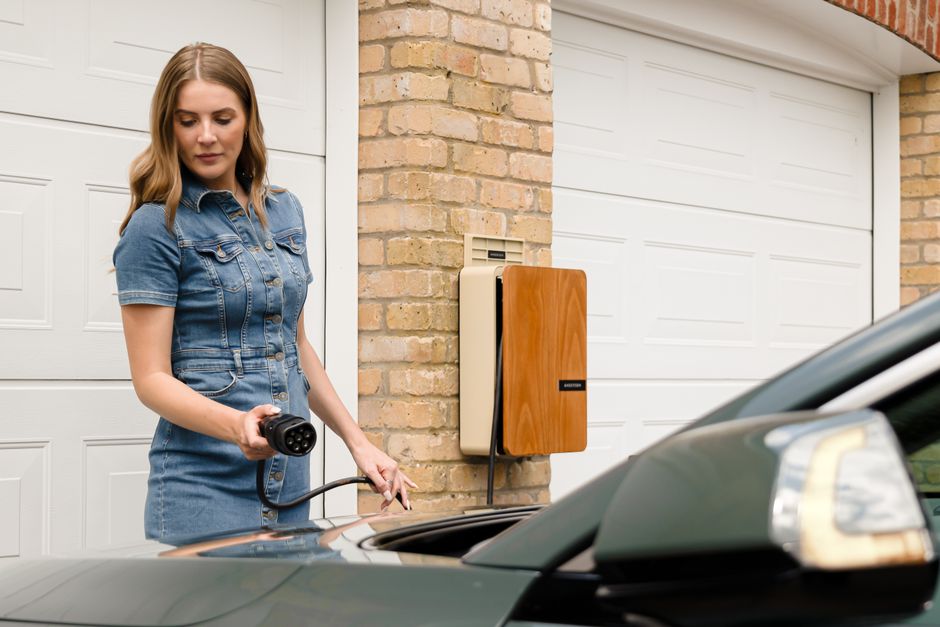
EV Charging Levels at a Glance
Understanding ev charging levels starts with one question: How long can your car stay plugged in?
- Level 1 uses a standard 120-volt outlet and adds about 3–5 miles of range per hour. It can work for short daily drives.
- Level 2 uses a 240-volt circuit and adds roughly 15–50 miles per hour. It is the practical choice for most home charging.
- Level 3, also called DC fast charging, can bring many EVs to 80% in about 20–60 minutes. It is best suited to road trips and quick stops.
Your actual speed depends on the car, battery temperature, and how full the battery is. This guide will help you match a charging level to your daily driving and understand what a home setup requires.
I’m Ernie Bussell, founder of Your Home Solar, which helps East Tennessee homeowners make informed choices about EV chargers and other home energy systems. My background in solar operations shapes how I explain ev charging levels: start with what your household needs, then choose equipment that fits.
Ev charging levels terms made easy:
Understanding the Three Main EV Charging Levels
To understand how electric vehicles replenish their battery packs, it helps to distinguish between Alternating Current (AC) and Direct Current (DC). The electrical grid delivers AC power to our homes and businesses. However, EV battery cells store energy exclusively as DC power.
When you plug into an AC source, such as a residential wall outlet or a standard wallbox, the vehicle relies on an internal component called the onboard charger. This unit converts incoming AC electricity into DC electricity before routing it into the battery pack. Because onboard chargers are constrained by weight, physical size, and heat management inside the vehicle, they have strict limits on how much power they can process simultaneously.
Direct Current Fast Charging (DCFC) bypasses the onboard charger entirely. The massive conversion equipment is built directly into the public charging station on the ground. The station takes high-voltage AC from the utility grid, converts it to DC internally, and feeds Direct Current straight into your car’s traction battery at significantly higher rates (Saraswathi & Ramachandran, 2024). For a broader look at grid-side power conversion, see this comprehensive review on EV charger technologies.
The table below outlines the core differences across the three charging tiers:
| Charging Level | Power Supply Type | Typical Voltage | Common Amperage | Power Output (kW) | Added Driving Range Per Hour |
|---|---|---|---|---|---|
| Level 1 | Single-Phase AC | 120V | 12A – 16A | 1.0 kW – 1.9 kW | 2 – 5 miles |
| Level 2 | Split-Phase / 3-Phase AC | 208V – 240V | 16A – 80A | 3.3 kW – 19.2 kW | 12 – 50 miles |
| Level 3 (DCFC) | Direct Current (DC) | 400V – 1,000V | Up to 500A+ | 50 kW – 500 kW | 100 – 250 miles (in 30 mins) |
How EV Charging Levels Differ by Speed and Power Output
The charging rate of any electric vehicle comes down to a straightforward relationship: power in kilowatts equals voltage multiplied by amperage, divided by 1,000. Higher voltage and higher current deliver more kilowatt-hours (kWh) of energy to the battery pack in less time.
- Level 1 (120-Volt Trickle Charging): Operating on a standard residential three-prong outlet, Level 1 delivers between 1.0 kW and 1.9 kW of continuous power. Because the output is low, fully recharging an empty 60 kWh to 80 kWh battery electric vehicle (BEV) takes anywhere from 40 to over 50 hours. For a plug-in hybrid electric vehicle (PHEV) with a compact 10 kWh to 15 kWh battery, Level 1 takes roughly 5 to 6 hours.
- Level 2 (240-Volt Residential & Commercial Charging): By drawing power from a dedicated 240-volt circuit—identical to what an electric clothes dryer or oven uses—Level 2 charging supplies between 6.0 kW and 19.2 kW. A standard 240-volt, 32-amp or 48-amp residential station adds 20 to 35 miles of range per hour, allowing a depleted BEV to reach 80% charge in 4 to 10 hours, while a PHEV tops off in 1 to 2 hours.
- Level 3 (DC Fast Charging): Found along major highways and public transit corridors, DC fast chargers operate at 400 to 1,000 volts, supplying anywhere from 50 kW to 350 kW (and up to 500 kW on the newest hardware). These high-voltage systems push an EV battery from 10% or 20% up to 80% state-of-charge in just 20 to 45 minutes.
Connectors and Ports Across Different EV Charging Levels
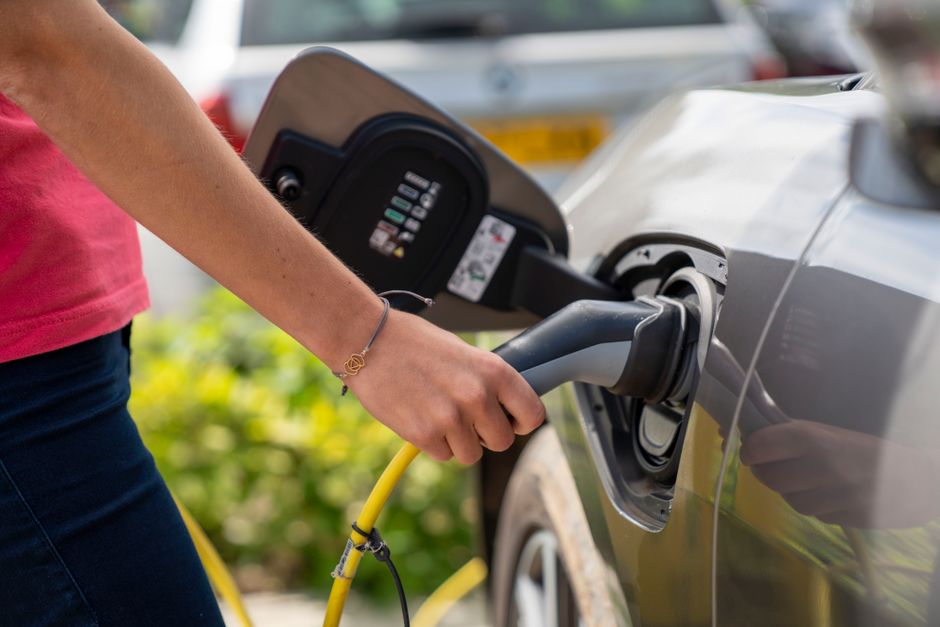
EV connectors have evolved rapidly to handle increasing power demands while standardizing the driver experience across public networks. Drivers encounter four primary connector interfaces:
- SAE J1772 (Type 1): The long-standing standard for Level 1 and Level 2 AC charging across North America. Found on almost all non-Tesla electric vehicles built before 2025, this round five-pin plug handles single-phase AC electricity safely up to 19.2 kW.
- North American Charging Standard (NACS / SAE J3400): Originally Tesla’s proprietary design, NACS is now the standardized inlet across North America. It uses a single, compact connector head for both AC Level 2 charging and high-output DC fast charging.
- Combined Charging System (CCS1): Built by adding two high-capacity DC pins beneath an upper J1772 inlet, the CCS connector allows a vehicle to accept standard AC charging at home and DC fast charging on highway corridors using the same physical charge port area.
- CHAdeMO: An early Japanese fast-charging standard found primarily on older models like the Nissan Leaf. CHAdeMO uses a separate, bulky inlet alongside a standard J1772 port. While still active at many older public sites, CHAdeMO is steadily being phased out of new station deployments.
You can learn more about state-level infrastructure and connector standards through regional initiatives such as the Drive Green NJ charging guide.
When using adapters between different formats—such as plugging an older CCS-equipped EV into a NACS Supercharger post—ensure you only utilize manufacturer-certified, UL-listed hardware designed to handle continuous high-amperage loads safely.
Residential Charging: Why Level 2 Is the Standard for Homeowners
While Level 1 trickle charging can replenish around 30 to 40 miles over a 10-to-12-hour overnight period, it leaves little margin for error. If you return home with an empty battery after a long drive or have a busy weekend running errands across Knox County or Blount County, a standard household wall outlet simply cannot restore your vehicle’s full driving range by morning.
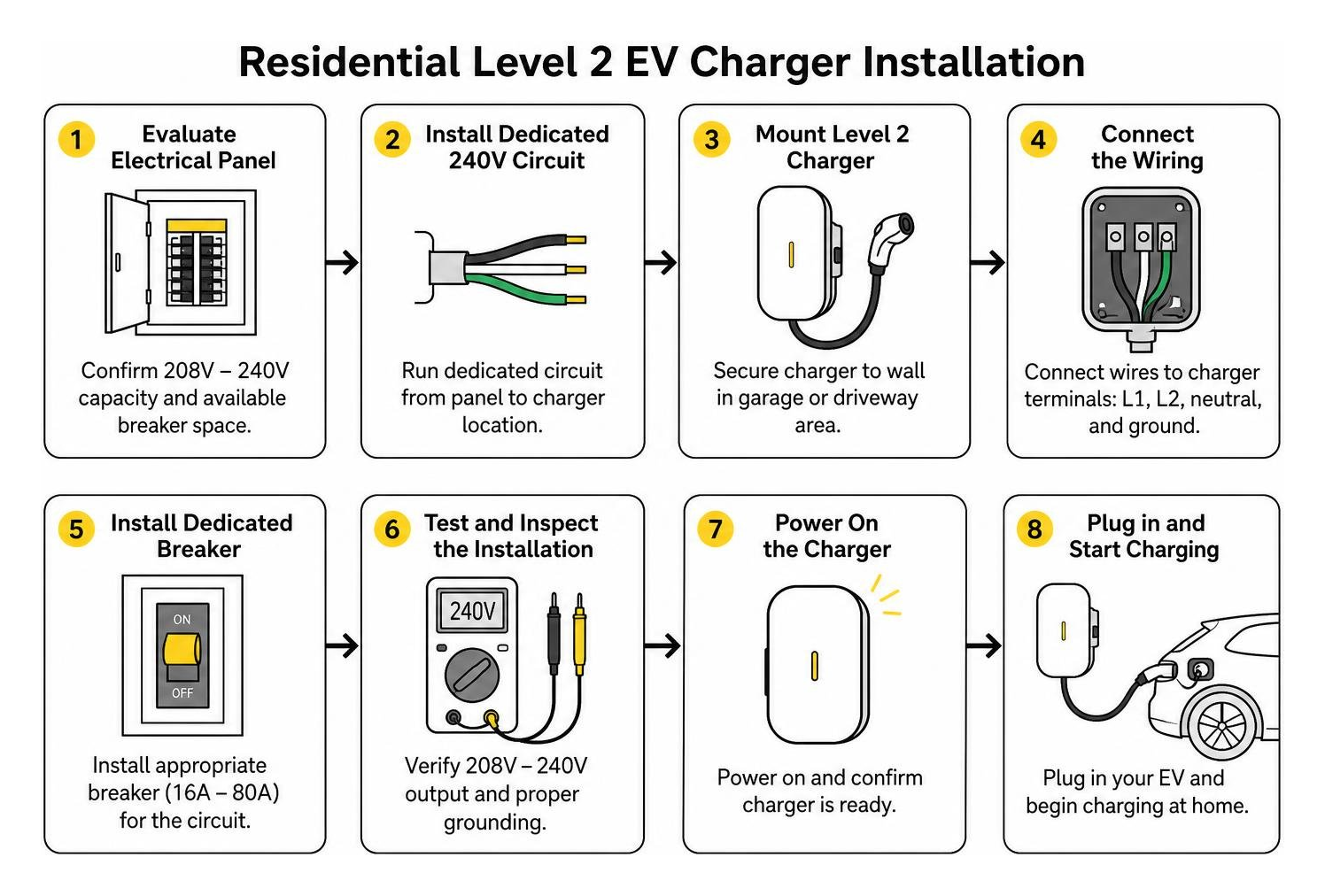
This is why installing a Level 2 EV charger at home is the gold standard for EV owners. Operating on a 240-volt circuit, a Level 2 unit functions like a private fueling station in your garage or driveway. You plug in at night and wake up every morning to a completely replenished battery.
Before installing, it is helpful to review 240V EV charger installation costs to understand the variables involved, including breaker capacity, panel distance, and conduit routing.
Electrical Requirements and Panel Upgrades
A residential Level 2 installation requires careful evaluation of your home’s electrical service panel. According to the National Electrical Code (NEC), EV charging is categorized as a continuous load. This rule mandates that a circuit must never run at more than 80% of its rated breaker capacity for extended charging periods.
- A 40-amp breaker supports a continuous charging rate of 32 amps (delivering roughly 7.7 kW, adding about 25–30 miles of range per hour).
- A 50-amp breaker supports a continuous charging rate of 40 amps (delivering roughly 9.6 kW, adding about 30–35 miles of range per hour).
- A 60-amp breaker (hardwired) supports a continuous charging rate of 48 amps (delivering roughly 11.5 kW, adding up to 40–45 miles of range per hour).
Many older homes throughout East Tennessee operate on 100-amp or 150-amp main service panels. If your panel already powers central air conditioning, an electric water heater, and an electric stove, adding a high-draw 50-amp breaker may require a service panel upgrade or a dedicated load management device. Choosing a professional smart EV charger installation ensures your equipment balances household demand automatically without nuisance breaker trips.
Home Charging Costs vs Public Stations and Gasoline
Charging at home is the most economical way to operate an electric vehicle. In Tennessee, residential electricity rates typically range from $0.11 to $0.13 per kWh. Driving an EV that achieves 3.0 to 3.5 miles per kWh costs roughly 3 to 4 cents per mile.
By contrast, fueling a traditional internal combustion vehicle getting 25 miles per gallon costs between 12 and 16 cents per mile when gasoline sits around $3.00 to $3.50 per gallon.
Home charging costs about a third of gasoline fueling. Public DC fast charging networks, on the other hand, frequently bill between $0.35 and $0.50 per kWh to cover capital equipment, commercial demand charges, and operating overhead. Charging at home delivers the largest long-term operational savings.
Public Fast Charging and Real-World Charging Dynamics

Public DC fast chargers are designed for speed during road trips and commercial operations. These commercial installations step down high-voltage three-phase power directly into DC electricity ranging from 50 kW to 350 kW.
While older vehicles operate on 400-volt battery architectures, modern EVs are increasingly adopting 800-volt systems. Higher voltage enables the station to push power into the pack at lower current (amperage), reducing heat buildup in charging cables and vehicle wiring while supporting 10% to 80% charging times in under 20 minutes. Exploring future-proofing with 800V charging architectures explains how these electrical systems interact with next-generation chargers. For technical data on vehicle charge acceptance curves, review the EVKX analysis on charging performance.
Understanding the DC Fast Charging Curve and the 80% Rule
A common misconception among new EV owners is that a 150 kW or 350 kW charger will deliver its maximum rated speed for the entire duration of a session. In reality, charging follows a dynamic “charging curve” managed by the vehicle’s onboard Battery Management System (BMS).

- Ramp-Up & Constant Current (10% to 50% SOC): When you plug in with a depleted battery, the BMS initiates safety handshakes, stabilizes pack temperature, and ramps up quickly to peak power.
- Thermal Regulation & Initial Taper (50% to 80% SOC): As lithium ions saturate the battery anode, internal electrical resistance climbs and heat builds up. The BMS gradually steps down the amperage to protect individual cells from degradation.
- The 80% Cliff (80% to 100% SOC): Once the battery reaches roughly 80% state-of-charge, the charging speed drops significantly—often down to Level 2 speeds (7 kW to 15 kW).
Because topping off that final 20% can take just as long as charging from 10% to 80%, unplugging at 80% on long trips saves time and keeps public fast-charging stalls open for other drivers.
How Weather and Battery Temperature Affect Charge Speeds
Lithium-ion batteries operate best within a comfortable temperature window of roughly 68°F to 85°F (20°C to 30°C). Extreme outdoor temperatures directly impact charging speeds:
- Cold Weather Dynamics: Freezing winter temperatures increase internal electrolyte resistance and slow the chemical movement of lithium ions. If you connect a cold battery to a DC fast charger without warming it up first, the vehicle’s BMS will restrict input power to just 20 kW to 40 kW until the pack reaches operating temperature. Utilizing your vehicle’s built-in battery preconditioning feature (by routing to a fast charger via your car’s navigation) warms the pack in advance, allowing you to hit peak speeds immediately.
- High Heat Overhead: In hot summer weather, fast charging generates substantial heat inside the battery. The vehicle must divert energy to run high-output cooling fans and refrigerant chillers, which can trigger thermal throttling to prevent cell overheating.
Best Practices for Battery Health Across All Charging Levels
To maximize the life and range of your electric vehicle’s battery pack over years of ownership, incorporate these foundational charging habits:
- Follow the 20% to 80% Rule for Daily Driving: Keep your battery between 20% and 80% state-of-charge for everyday commuting. Avoid leaving your vehicle parked at 100% full or below 10% empty for extended periods.
- Rely on Level 2 AC Power for Routine Charging: AC charging generates minimal heat and places very low mechanical stress on lithium-ion cells. Reserve DC fast charging for road trips and urgent top-offs.
- Precondition Before Charging and Driving: When parked at home during freezing winters or sweltering summer afternoons, use your vehicle app to precondition the cabin and battery while still plugged into your Level 2 station. This draws climate-control energy directly from the grid rather than depleting your battery.
- Charge During Off-Peak Hours: Schedule your home charger to start after 9:00 PM. This reduces strain on the local electrical grid and takes advantage of off-peak power rates.
Frequently Asked Questions About EV Charging Levels
Can I use a regular household outlet to charge my EV daily?
Yes, but it depends on your daily mileage. A standard 120-volt Level 1 outlet supplies 3 to 5 miles of range per hour of charging. Over a 10-hour overnight period, that adds roughly 30 to 50 miles. If your daily round-trip commute is under 30 miles, Level 1 trickle charging can meet your basic needs.
However, if you drive longer distances, take unexpected evening trips, or experience cold winter weather that reduces efficiency, Level 1 will struggle to keep up. Installing a Level 2 home charger provides reliable overnight recovery regardless of daily driving demands.
Why does DC fast charging slow down dramatically after 80%?
DC fast charging slows down after 80% due to internal battery physics and protective limits set by the vehicle’s Battery Management System. Think of your battery pack like a parking lot: when empty, incoming cars (lithium ions) can find open spots quickly at high speeds.
As the lot fills to 80% capacity, finding the remaining open spaces without causing collisions (dendrite formation or excessive thermal buildup) requires cars to slow down significantly. The BMS reduces current to prevent cell overheating and preserve long-term battery health.
Can I safely use third-party adapters at public charging stations?
You can safely use third-party adapters only if they are engineered to strict industry safety standards and carry third-party safety certifications (such as UL or ETL listings). High-voltage DC charging channels massive amounts of continuous power.
Low-quality, uncertified third-party adapters purchased online can overheat, weld themselves to vehicle charge ports, or trigger electrical faults. Always choose adapters produced by your vehicle manufacturer or established equipment brands that meet North American Charging Standard (SAE J3400) guidelines.
Conclusion
Understanding the tiers of electric vehicle charging helps you spend less time waiting for a charge and get the most out of your vehicle. While Level 1 handles occasional low-mileage days and Level 3 provides rapid top-offs during highway road trips, a dedicated Level 2 setup remains the core of practical, cost-effective daily EV ownership.
At Your Home Solar, we provide comprehensive home energy solutions across East Tennessee—from Knoxville and Maryville to Oak Ridge, Sevierville, and beyond. Whether you need a dedicated 240-volt charging circuit, a service panel upgrade, or a complete residential solar and backup system, our team delivers tailored, reliable installations backed by our commitment to 100% customer satisfaction.
Explore our complete guide to home EV charging to find the ideal charging setup for your home and lifestyle.
References
Saraswathi VN, Ramachandran VP. “A comprehensive review on charger technologies, types, and charging stations models for electric vehicles..” Heliyon, 2024. PMCID PMC11620053.