

Choose an EVSE Level 2 Charger That Fits Your Car and Home
The best EVSE Level 2 charger is one that matches your EV’s connector and maximum charging rate, your home’s available electrical capacity, and where you plan to park. For most East Tennessee homes, that means a UL-listed 240-volt unit rated at 40 or 48 amps, installed on a dedicated circuit by a qualified electrician.
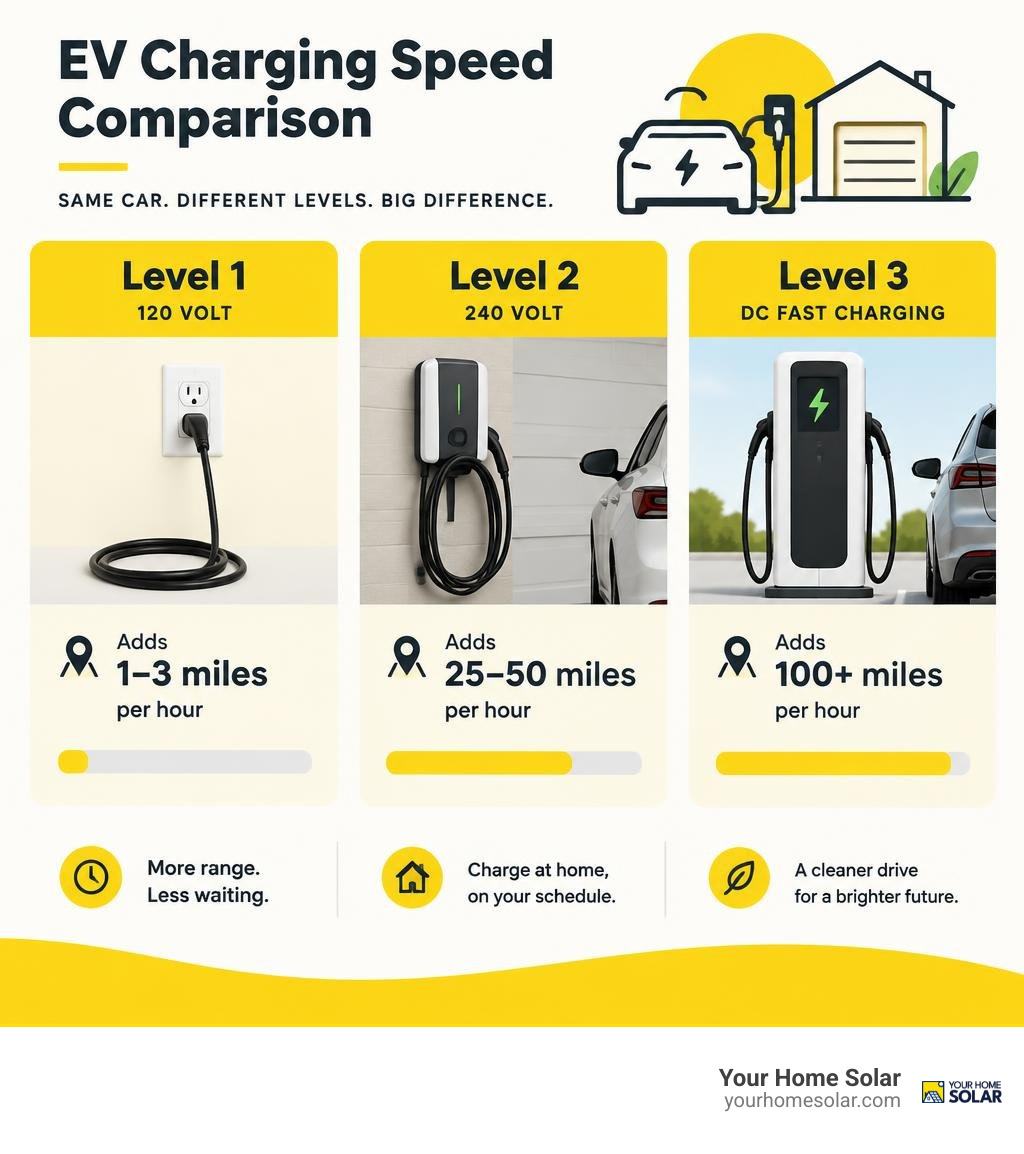
A Level 2 charger can typically add 25 to 50 miles of driving range per hour. That is a major step up from a standard 120-volt Level 1 outlet, which often adds only 1 to 3 miles per hour. Instead of waiting all night and still coming up short, many EVs can recharge in roughly 4 to 8 hours.
In this guide, we compare reliable 2026 options for basic charging, smart scheduling, outdoor installs, and homes with two EVs. We will also cover the details that matter before you buy: J1772 versus NACS, plug-in versus hardwired wiring, safety ratings, load management, installation cost, and available incentives.
I am Ernie Bussell, founder and CEO of Your Home Solar. My background in technical operations, home energy systems, and practical homeowner education helps me evaluate an EVSE Level 2 charger as part of the larger electrical system it will depend on every day.
Simple evse level 2 charger glossary:
EV Charging Tiers: Understanding How Level 2 Delivers Faster Power
Electric vehicle supply equipment (EVSE) comes in three primary tiers: Level 1, Level 2, and Level 3 direct current (DC) fast charging. Understanding how these tiers operate helps you see why dedicated 240V equipment is the sweet spot for residential charging.
Level 1 charging relies on a standard 120-volt household outlet. Delivering roughly 1.0 to 1.9 kW of power, Level 1 is painfully slow. If you drive more than 20 miles per day around Knoxville or Maryville, relying on Level 1 will leave your battery perpetually drained by morning.
Level 2 charging uses a 240-volt alternating current (AC) circuit—the same voltage used by heavy residential appliances like electric clothes dryers and water heaters. Operating between 16 and 48 amps (delivering 3.8 kW to 11.5 kW), Level 2 equipment adds 25 to 50 miles of range per hour. When you compare Level 2 chargers, you will find they supply more than enough power to take almost any modern EV from near-empty to 100% full overnight while you sleep.
Level 3 DC fast chargers operate at 400 to 800 volts, pushing anywhere from 50 kW to 350+ kW directly into the battery pack. While essential for road trips along Interstate 40 or I-75, these high-voltage commercial units require industrial three-phase power feeds that are not practical for typical homes. Furthermore, when looking beyond Level 2 DC fast charging costs, Level 3 equipment is extraordinarily expensive to install and operate. Home charging at Level 2 is roughly one-third the cost per kilowatt-hour of public DC fast charging.
| Charging Tier | Input Voltage | Power Output (kW) | Range Added per Hour | Typical Full Charge Time | Best Use Case |
|---|---|---|---|---|---|
| Level 1 | 120V AC | 1.0 – 1.9 kW | 1 – 3 miles | 40 – 60+ hours | Emergency top-ups, plug-in hybrids |
| Level 2 | 208V / 240V AC | 3.8 – 11.5 kW | 25 – 50 miles | 4 – 8 hours | Overnight residential & workplace charging |
| Level 3 (DCFC) | 400V – 800V DC | 50 – 350+ kW | 100 – 300+ miles (in 20-30 min) | 20 – 45 minutes (to 80%) | Highway travel, commercial fleet hubs |
Charging Time Calculations and Efficiency Loss
Calculating your home charging duration is straightforward: divide your battery pack capacity (in kilowatt-hours, or kWh) by the effective delivery rate of your charging station, and account for thermal and conversion losses.
During AC charging, your vehicle’s onboard charger converts AC electricity from your home into DC power for the battery cells. This conversion process experiences an efficiency loss of roughly 5% to 8%, generating slight heat.
$$\text{Charging Time (Hours)} = \frac{\text{Usable Battery Capacity (kWh)}}{\text{Charger Output (kW)} \times 0.93}$$
For example, recharging a 75 kWh battery from 10% to 80% requires approximately 52.5 kWh of energy. On a standard 9.6 kW Level 2 unit (40 amps at 240 volts) running at 93% efficiency (8.93 kW net delivery), the charge takes just under 5.9 hours. Understanding these values from manufacturer specifications allows you to set realistic expectations for your overnight routine.
Choosing the Right EVSE Level 2 Charger for Your Home
Selecting an EVSE involves balancing physical hardware compatibility, cord management, and connectivity features to match your garage setup.
Connector Types: J1772 vs. NACS
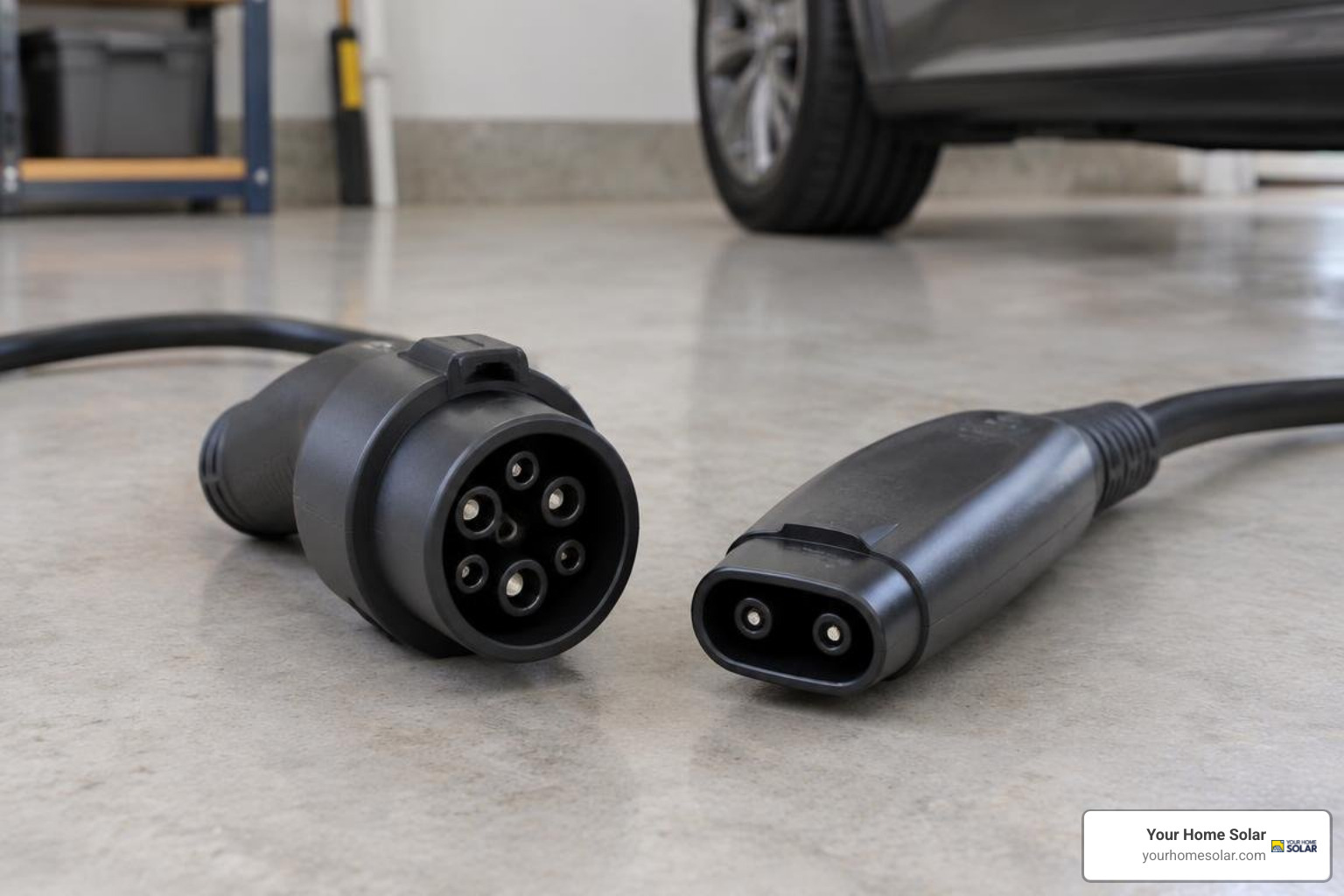
The North American electric vehicle landscape currently features two connector types:
- SAE J1772: The long-standing North American standard used by non-Tesla EVs produced through the early 2020s.
- NACS (SAE J3400): Originally developed by Tesla and now adopted across the industry by major automakers for modern models.
If your household has vehicles with different ports, universal chargers equipped with integrated mechanical adapters eliminate the clutter of loose dongles.
Cable Length and Garage Ergonomics
We strongly recommend choosing a charging station with a 24-foot or 25-foot cable (the maximum length allowed by electrical code). A longer cable provides the flexibility to reach your charge port regardless of whether you back in or pull in front-first. In tight two-car garages, looking into ceiling-mounted EV charger options or wall-mounted retractors keeps heavy cords off the floor and prevents tripping hazards.
Smart Connectivity
Many Level 2 chargers feature built-in Wi-Fi and smartphone apps. While a basic “dumb” charger simply supplies power when plugged in, a smart charger lets you monitor electricity consumption, receive push alerts if a session is interrupted, and schedule charging windows automatically.
EVSE Level 2 Charger Power Output: Amps and Speed
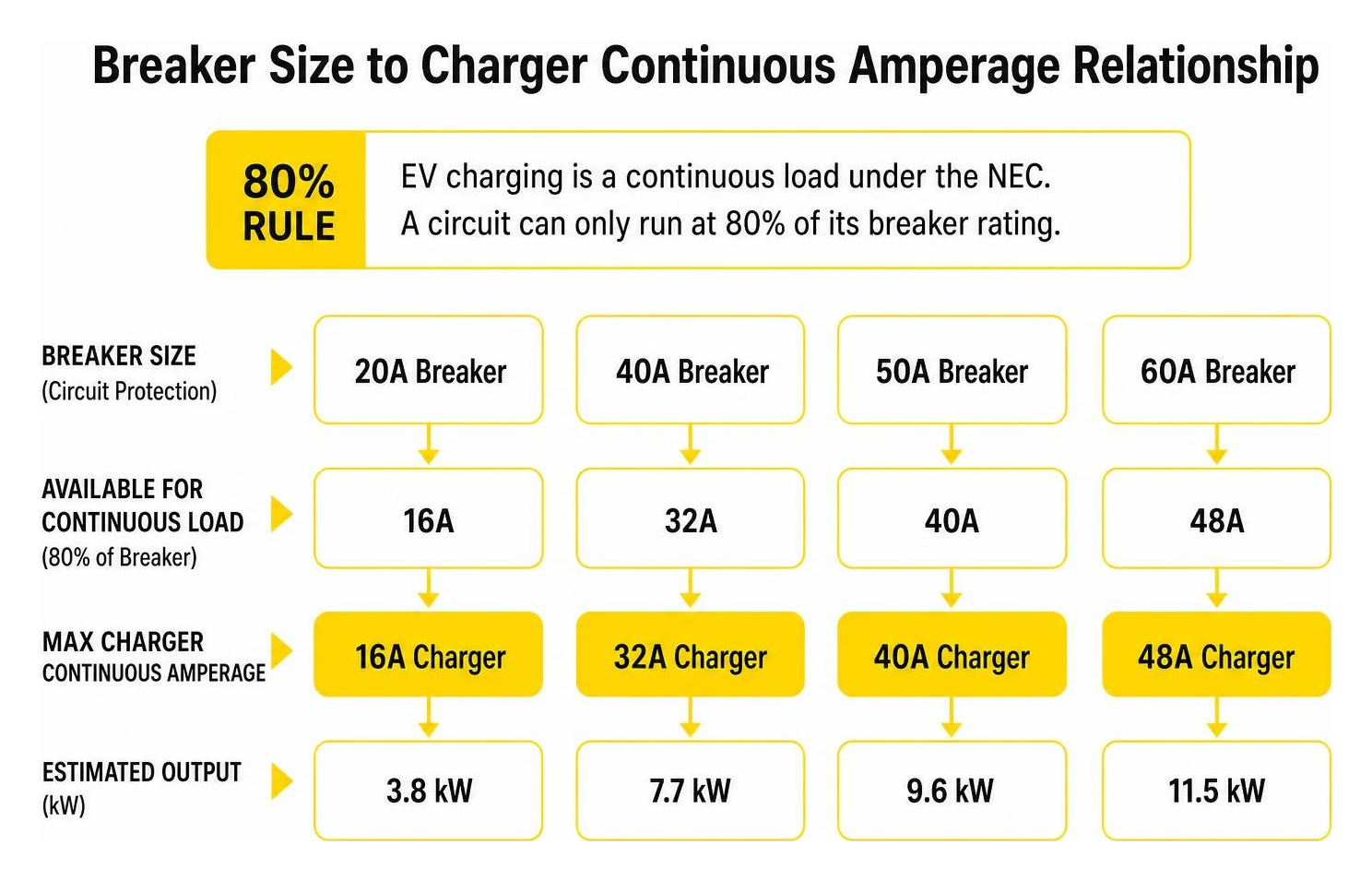
Residential Level 2 chargers range from 16 to 48 amps. Under the National Electrical Code (NEC), EV charging is classified as a continuous electrical load. This triggers the 80% rule, meaning an electrical circuit can only run at 80% of its breaker rating continuously:
- 16-amp charger: Requires a 20-amp breaker (3.8 kW output)
- 32-amp charger: Requires a 40-amp breaker (7.7 kW output)
- 40-amp charger: Requires a 50-amp breaker (9.6 kW output)
- 48-amp charger: Requires a 60-amp breaker (11.5 kW output)
A 40-amp or 48-amp unit delivers peak efficiency for modern battery architectures, which is a major factor when future-proofing for 800V EV charging systems that accept higher sustained AC charging rates.
Hardwired vs Plug-In Setup: Which Fits Your Garage?
When installing a Level 2 unit, you can choose between a plug-in setup (using a 240V NEMA 14-50 receptacle) or a permanent hardwired installation.
While plug-in units offer portability, many electrical safety codes require ground fault circuit interrupter (GFCI) circuit breakers for 240V garage receptacles. Because the EVSE has its own internal GFCI safety monitoring, pairing it with a GFCI breaker can cause “nuisance tripping.”
A dedicated hardwired connection eliminates this issue, supports higher power (up to 48 amps), and provides superior outdoor durability. To understand the complete installation process, check our DIY or pro 240V installation guide. For plug-in installations, high-quality units like a UL certified 40A NEMA 14-50 EV charger provide reliable plug-and-play capability when wired with an industrial-grade receptacle.
Top Picks: The Best Level 2 EV Chargers for 2026
The 2026 residential charging market offers durable options tailored to different budgets and garage requirements:
- Universal Connector Models (Best Versatility): Many modern units deliver up to 48 amps (11.5 kW) and feature an integrated adapter system, allowing seamless charging for both NACS and J1772 vehicles with zero adapter hassle.
- Value-Focused Smart Chargers (Best Value & Smart Monitoring): Affordable 48-amp hardwired / 40-amp plug-in stations with real-time energy tracking are widely available. When paired with a home energy monitor, these units can offer automated panel overload protection.
- Heavy-Duty Dual-Plug Units (Best Durability & Multi-Vehicle): Built inside heavy-duty cast aluminum enclosures rated for extreme weather, these offer reliable dual-plug power sharing without app complications.
- Solar-Integrated Chargers (Best Solar Integration): Certain units feature seamless communication with home solar arrays and dynamic phase switching to direct excess solar generation straight into your vehicle.
Best Overall and Dual EV Charging Solutions
For households running two electric vehicles, installing two independent 50-amp circuits is often limited by main electrical panel capacity. Dual-vehicle chargers solve this with power sharing (dynamic load balancing).
A dual-port unit connects to a single 50-amp or 60-amp circuit. When one vehicle is plugged in, it receives the full charging capacity. When a second vehicle plugs in, the smart EVSE automatically splits the available current (for example, supplying 24 amps to each vehicle) so the circuit is never overloaded. This works smoothly when fast charging hybrid and EV models at home alongside full-battery electric vehicles. Commercial and multi-family setups can scale even further using dynamic power coordination across multiple vehicles on shared infrastructure.
EVSE Level 2 Charger Safety Standards: UL 2594 and Beyond
Never cut corners on electrical safety. EV chargers sustain heavy electrical loads for hours at a time, making third-party testing essential. Always ensure your equipment carries safety certifications from recognized testing laboratories:
- UL 2594: The North American safety standard specifically covering Electric Vehicle Supply Equipment up to 1,000V AC.
- UL 2231: Outlines requirements for personnel protection systems (ground fault protection) in EV supply circuits.
- NEMA / IP Weather Ratings: For outdoor mounting, choose enclosures rated NEMA 3R, NEMA 4, IP65, or IP66. These ratings ensure your equipment remains sealed against rain, sleet, snow, and summer heat across East Tennessee.
Home Electrical Requirements, Installation Costs, and Rebates
Equipment costs for a quality Level 2 charger generally range from $400 to $700. Professional electrical installation typically adds $800 to $2,000, depending on distance from the breaker panel, wire conduit paths, and permit requirements. You can read our detailed breakdown of typical 240V EV charger installation costs to prepare your project budget.
Before installation, an electrician must evaluate your main service panel. Modern homes with 200-amp service can generally accommodate an added 40A or 50A dual-pole breaker without issue. However, older 100-amp or 150-amp panels may require a service upgrade or a smart energy management subpanel. Consult our consumer unit compatibility guide to see how existing electrical infrastructure interacts with continuous EV loads.
Electric Bill Impact and Smart Time-of-Use Savings
Adding an EV to your home will increase your kilowatt-hour usage, but it significantly reduces your overall transportation expenses compared to gasoline. Charging an EV that travels 1,200 miles a month uses roughly 350 to 400 kWh of electricity.
You can minimize this cost by taking advantage of Time-of-Use (TOU) rate plans from local utilities. By using your smart charger’s scheduling feature to draw power during off-peak hours (typically midnight to 6:00 AM), you can lock in the lowest electricity rates.
Local initiatives and public charging infrastructure—such as the municipal programs coordinated through the City of Knoxville EV charging programs—continue to expand regional electric vehicle support across Knox, Blount, and Anderson counties. Additionally, homeowners in eligible rural and low-income census tracts can take advantage of the federal Section 30C Alternative Fuel Vehicle Refueling Property Credit, which provides a tax credit of 30% of hardware and installation costs (capped at $1,000) through its program lifecycle.
Frequently Asked Questions About Level 2 EVSE
How much faster is a Level 2 charger than a Level 1 household outlet?
A Level 2 charger is roughly 5 to 15 times faster than a standard 120V household outlet. While a Level 1 outlet adds just 1 to 3 miles of range per hour, a 240V Level 2 charger delivers 25 to 50 miles of range per hour, fully restoring depleted batteries in 4 to 8 hours.
Do I need to upgrade my electrical panel before installing a Level 2 charger?
Not necessarily. Homes equipped with 200-amp service usually have sufficient capacity. If you have a 100-amp or 150-amp panel, a certified electrician can perform an NEC load calculation. If capacity is tight, you can install an energy management system or dynamic load-balancing EVSE to avoid a full service panel upgrade.
Can I install an EVSE Level 2 charger outdoors in harsh weather?
Yes, provided the unit is rated for outdoor use. Look for enclosures with a NEMA 4, NEMA 3R, IP65, or IP66 rating. These chargers operate safely in driving rain, freezing snow, humidity, and high summer temperatures.
Conclusion
Upgrading to an EVSE Level 2 charger transforms your EV ownership experience, delivering dependable overnight charging that keeps your vehicle ready every morning. By choosing a UL-listed unit that matches your vehicle’s connector and charging rate, you protect your battery and your home’s electrical system for years to come.
At Your Home Solar, we help homeowners across Knoxville, Oak Ridge, Maryville, Sevierville, and surrounding East Tennessee communities design clean energy systems, install home backup power, and complete professional EV charger installations. If you are ready to power your drive with confidence, explore our comprehensive guide to home EV charging or contact our team today for a tailored installation quote.