
How to Choose a Portable Level 2 Charger
A portable level 2 charger lets you charge an EV from a compatible 240V outlet, then take the charger with you. To compare models, start with three things: your car’s connector, your outlet type, and the circuit’s safe charging limit. A 30-amp circuit, for example, can support no more than 24 amps of continuous EV charging. An adjustable charger can work at that lower setting, while a 40-amp setting needs a properly installed 50-amp circuit.
Portable Level 2 charging is faster than charging from a standard 120V outlet. Unlike a hardwired charger, it can move between suitable locations, but it still needs a safe, compatible outlet.
I’m Ernie Bussell, founder of Your Home Solar. My work helping East Tennessee homeowners plan reliable home energy and EV charging setups shapes this guide to choosing a portable level 2 charger.
Portable level 2 charger further reading:
What Is a Portable Level 2 Charger and Why Choose One?
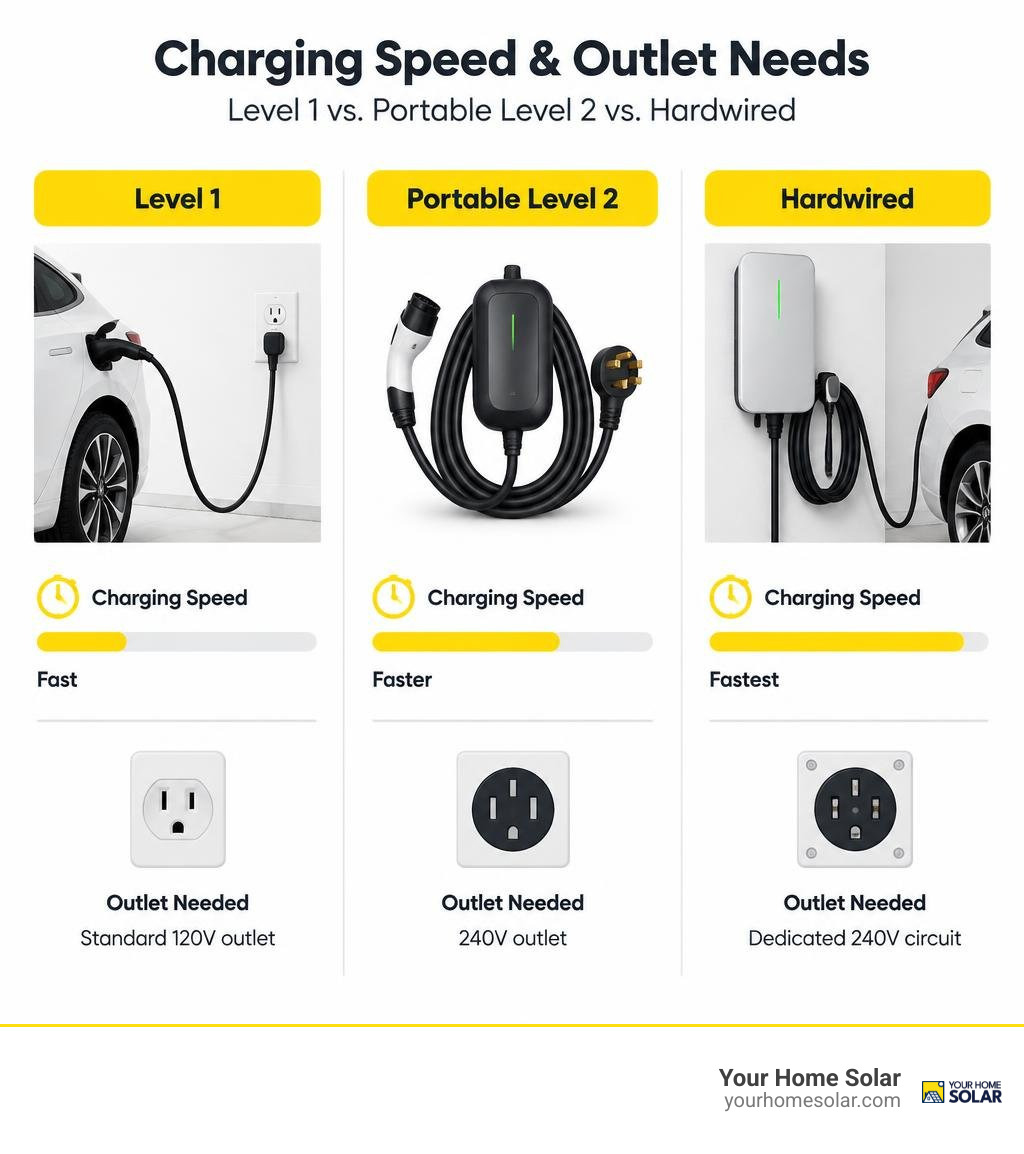
A portable Level 2 charger is a mobile electric vehicle supply equipment (EVSE) unit that delivers 240-volt alternating current (AC) power directly to your vehicle’s onboard charger. When drivers switch from a standard 120V Level 1 wall trickle charger to a 240V setup, the primary change is power throughput and recovery time.
Standard 120V wall charging provides roughly 1.2 to 1.4 kilowatts (kW), which adds a modest 3 to 5 miles of range per hour of charging. In contrast, 240V systems provide between 3.3 kW and 9.6 kW depending on amperage draw, replenishing 14 to 32 miles of range per hour. Our level 2 EV charging overview explains how stepping up to 240V cuts a 24-hour full replenishment down to an easy overnight session.
Portable Units vs. Hardwired Home Chargers
Hardwired wall chargers are permanently bolted and spliced into a dedicated electrical junction box, commonly supporting high continuous outputs up to 48A or 50A on a 60A circuit breaker. While powerful, hardwired units cannot leave your wall without an electrician disconnecting them.
Portable units balance high power delivery with lightweight, plug-and-play mobility:
- Weight and Form Factor: Modern portable units weigh between 12 and 30 lbs, making them easy to coil and store inside a trunk organizer.
- Detachable Adaptability: Many models include swappable plugs or standard 240V NEMA configurations, allowing flexible connectivity.
- Cable Flexibility: Premium portable cords maintain bend flexibility even in sub-freezing temperatures down to -22 degrees Fahrenheit.
- Plug-and-Play Operation: You simply plug the unit into an existing 240V wall receptacle—such as a NEMA 14-50 or NEMA 10-30—connect it to the vehicle, and charge immediately without permanent modifications.
Key Benefits for Renters, Travelers, and Flexible Garages
For tenants, renters, and seasonal travelers, installing permanent wall hardware is rarely an option. A portable EVSE solves this roadblock:
- Tenant Flexibility: You can plug into an existing heavy-appliance outlet without altering landlord property or leaving expensive hardware behind when moving.
- Road-Trip & RV Readiness: Campgrounds, cabin rentals, and RV parks across the region provide 240V NEMA 14-50 utility pedestals. Packing a portable unit gives you Level 2 charging outside urban centers.
- Multi-Home and Work Flexibility: If you split time between properties or have access to a heavy-duty receptacle at a workshop or job site, a portable charger moves with you seamlessly.
- Local Commuting Assurance: Drivers navigating local routes can leverage community utility infrastructure while keeping a mobile 240V backup in the trunk. Check local resources like the municipal Knoxville EV Charging network for public top-offs during daily commutes.
Top Portable Level 2 EV Chargers Compared
Choosing among market models requires matching connector standards, maximum current draw, safety enclosures, and interface options. The table below outlines major portable units:
| Charger Model | Max Amperage | Max Power (kW) | Primary Plug | EV Connector | Weather Rating | Approximate Price |
|---|---|---|---|---|---|---|
| 40A Universal Portable | 40A (10A–40A) | 9.6 kW | NEMA 14-50 | SAE J1772 | IP66 | $259.95 |
| 40A NACS Portable | 40A (10A–40A) | 9.6 kW | NEMA 14-50 | NACS (Tesla) | IP66 | $202.90 |
| 24A NEMA 10-30 Portable | 24A (10A–24A) | 5.8 kW | NEMA 10-30 | NACS (Tesla) | IP66 | $269.99 |
| 32A J1772 Portable | 32A (10A–32A) | 7.68 kW | NEMA 14-50 | SAE J1772 | IP66 | $279.99 |
| 40A Smart App Portable | 40A (Smart App) | 9.6 kW | NEMA 14-50 | NACS / J1772 | IP65 / IP66 | $279.00 |
For more insights on evaluating hardware features, check out our guide on comparing level 2 chargers.
Selecting the Right Portable Level 2 Charger for Your Vehicle
When shopping, verify your vehicle’s physical inlet standard and internal onboard charger limits:
- SAE J1772: The standard circular connector used by most non-Tesla vehicles.
- NACS (SAE J3400): The compact connector standard native to Tesla vehicles and increasingly integrated into new electric vehicles.
- Adapters: High-amperage adapters allow J1772 chargers to power NACS vehicles, and vice versa. Keep a certified adapter in your travel bag to maintain universal compatibility across any outlet you encounter.
- Vehicle Acceptance Limits: If your vehicle has an onboard limit of 7.2 kW (30A at 240V), purchasing a 40A charger is completely safe—the vehicle will simply draw its maximum 30A limit—while giving you headroom for future vehicles.
Best All-Around High-Power Pick: 40A NEMA 14-50 Charger
A heavy-duty Level 2 NEMA 14-50 40A charger delivers up to 9.6 kW of continuous output. Typically priced around $259.95, it comes equipped with a 25-foot heavy-duty cable and a standard SAE J1772 coupler.
With adjustable charging increments between 10A and 40A, it can fully charge a standard 60 kWh to 75 kWh EV battery pack in approximately 3 to 5 hours when connected to a properly installed 50-amp branch circuit.
Best for Tesla and NACS Vehicles: 40A Portable EV Charger
A dedicated 40A NACS portable EV charger ($202.90) features a native NACS connector designed for direct plug-in to Tesla Model Y, Model 3, Model S, Model X, and Cybertruck models.
It provides a power range from 1.44 kW up to 9.6 kW via 10A to 40A adjustments. The built-in LCD screen displays real-time voltage, current draw, session kilowatt-hours, and temperature metrics. It also features a delay timer (1 to 12 hours) to schedule charging during off-peak rate windows.
Best Dryer Outlet Solution: 24A NEMA 10-30 Charger
Homes built before 1996 often feature 3-prong NEMA 10-30 240V outlets for electric clothes dryers. A dedicated NEMA 10-30 Level 2 portable charger ($269.99) is designed specifically for these existing circuits.
Operating at a maximum current of 24A, it delivers approximately 5.8 kW of charging power without exceeding the National Electrical Code’s continuous load limit for a 30A circuit breaker. It features a vivid real-time TFT color display and native NACS connectivity, allowing homeowners to tap into an existing laundry circuit without costly main panel upgrades.
Best Budget Smart Option: 32A Smart Charger
A 32A Level 2 smart charger ($279.99) offers adjustable current from 10A (adding approximately 7.5 miles of range per hour) up to 32A (adding roughly 24 miles per hour).
Similarly, smart-enabled portable chargers ($279) integrate Wi-Fi smartphone app control. Smart connectivity allows you to throttle amperage remotely and automate charge schedules to sync with off-peak electricity rates, avoiding peak demand charges.
Essential Buying Factors: Amperage, Outlets, and Weatherproofing
Selecting a portable unit requires matching its technical specifications to your electrical system’s physical limits.

How Adjustable Amperage Protects Your Portable Level 2 Charger Setup
The National Electrical Code (NEC) continuous load rule mandates that an EVSE load must not exceed 80 percent of the branch circuit breaker’s maximum rated capacity:
- A 50-amp circuit breaker supports a continuous draw of up to 40 amps (9.6 kW).
- A 40-amp circuit breaker supports a continuous draw of up to 32 amps (7.68 kW).
- A 30-amp circuit breaker supports a continuous draw of up to 24 amps (5.76 kW).
- A 20-amp circuit breaker supports a continuous draw of up to 16 amps (3.84 kW).
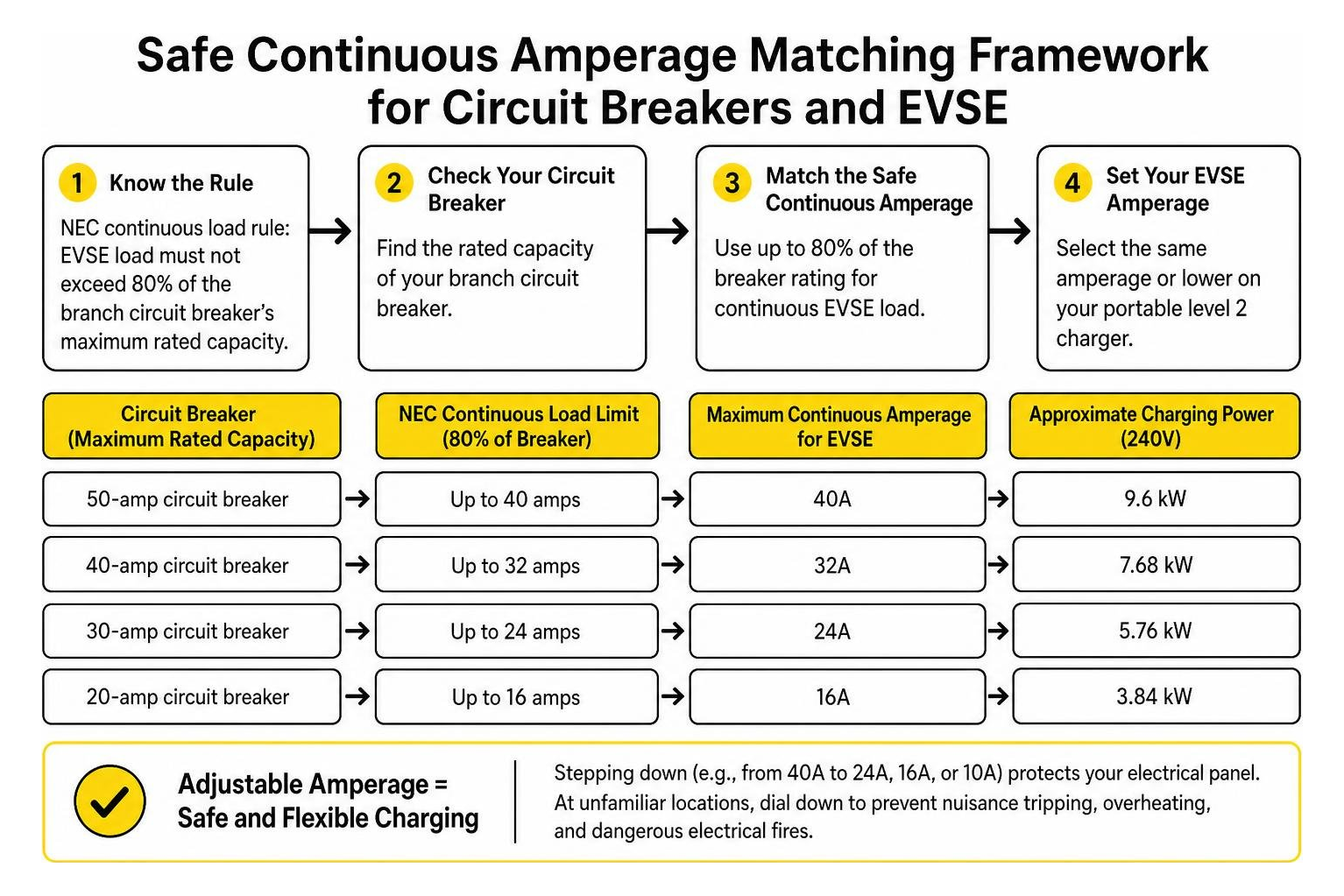
Adjustable current selection (such as stepping down from 40A to 24A, 16A, or 10A) protects your electrical panel. If you plug into an unfamiliar circuit at a vacation rental or workshop, dialing the charger down prevents nuisance tripping, overheating, and dangerous electrical fires.
Electrical Outlet Requirements and NEMA Types
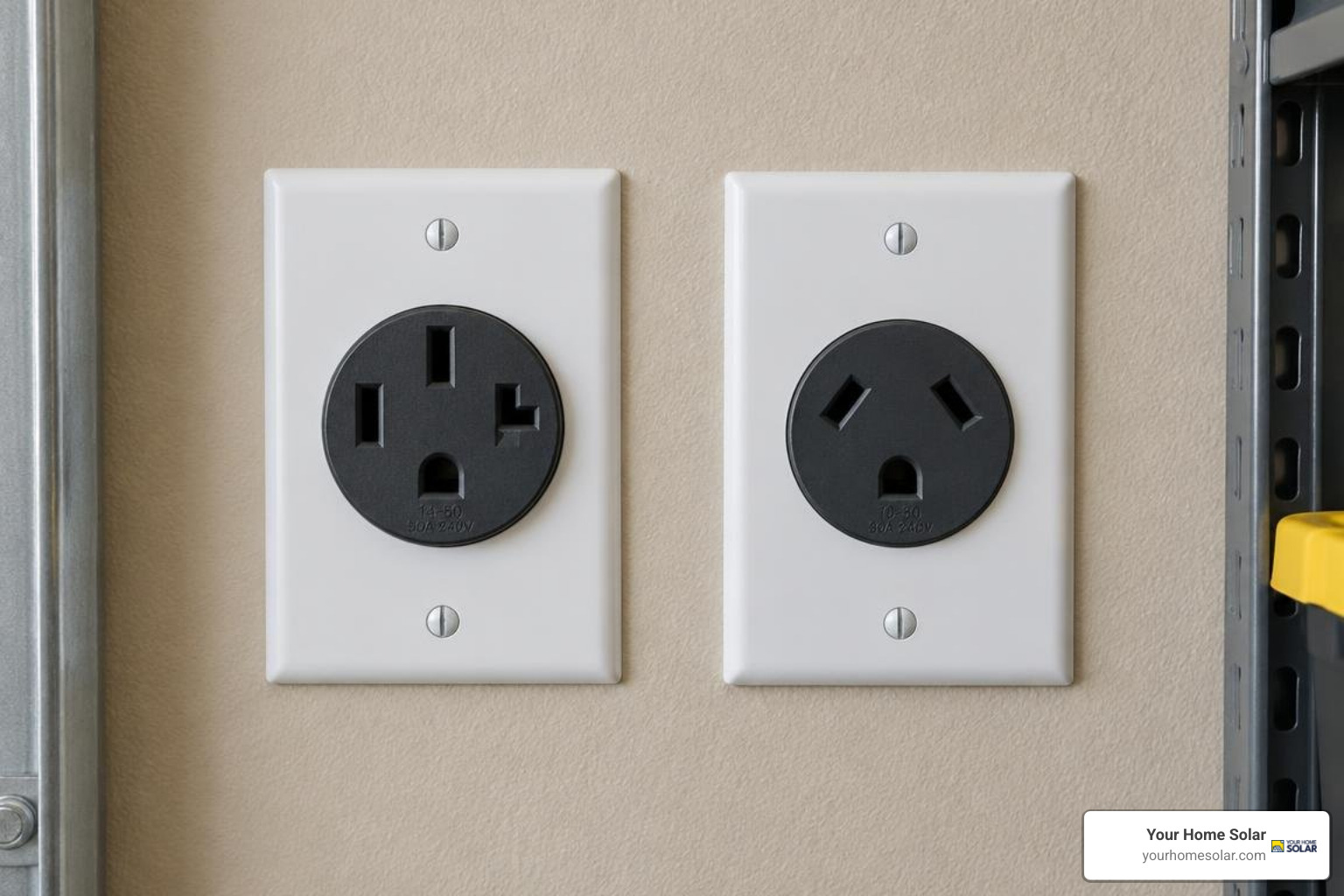
Understanding your receptacle type ensures a safe, direct connection:
- NEMA 14-50 (50A, 240V, 4-prong): The standard modern high-power outlet found in newer garages, RV parks, and workshops. Features two hot wires, one neutral, and one safety ground.
- NEMA 10-30 (30A, 240V, 3-prong): Common legacy clothes dryer outlet found in older residences. Contains two hot wires and a shared neutral/ground conductor.
- NEMA 6-50 (50A, 240V, 3-prong): Commonly installed for heavy-duty electric welders. Contains two hot wires and a dedicated safety ground.
- NEMA 5-15 (15A, 120V, 3-prong): Standard household wall outlet used for Level 1 trickle charging when paired with a dual-voltage portable adapter.
Review our technical breakdown on 240V installation questions answered for details on dedicated branch lines.
Safety Certifications and Outdoor Weather Ratings
Because portable chargers operate in varied and demanding environments, prioritize models with verified testing and robust protective systems:
- Ingress Protection (IP66): An IP66 rating certifies complete protection against dust ingress and high-pressure water jets, ensuring safe operation during heavy downpours.
- Operating Temperature Range: Look for units certified from -22 degrees Fahrenheit to 122 degrees Fahrenheit to ensure reliable performance during severe winter freezes and summer heat waves.
- Flammability Rating: Enclosures rated UL 94V-0 self-extinguish within 10 seconds, preventing flame spread in the event of an internal short.
- Nationally Recognized Testing Laboratory (NRTL) Marks: Look for ETL, UL, or CSA safety certification marks indicating compliance with rigorous North American electrical safety standards.
- Integrated Hardware Protections: Quality units include thermal sensors inside both the wall plug and main control box, auto-shutoff for overcurrent/undervoltage, lightning protection, and ground fault circuit interrupter (GFCI) electronics.
Electrical Costs, Payback Period, and Installation Requirements
Investing in a portable 240V charging setup provides substantial financial advantages over purchasing commercial gasoline or relying entirely on public DC fast chargers. Review our guide on the cost of installing a Level 2 charger to evaluate your home configuration.
Fuel Savings vs. Level 2 Installation Costs
Let us analyze the numbers for a typical driver covering 1,000 miles per month:
- Gasoline Vehicle: Averaging 25 miles per gallon with gasoline priced at $3.40 per gallon requires 40 gallons of fuel, totaling $136.00 per month.
- Electric Vehicle: Averaging 3.3 miles per kilowatt-hour requires roughly 303 kWh of energy. At regional residential electricity rates of approximately 11 to 12 cents per kWh, charging at home costs roughly $55.00 per month.
- Net Fuel Savings: $81.00 saved every month.
Within half a year, your monthly fuel savings completely pay off the entire hardware and outlet installation cost. For public charging alternatives around the region, check the Oak Ridge, Tennessee EV Charging Stations Info.
Dedicated Circuit and Outlet Setup Considerations
While portable chargers plug directly into wall receptacles, the receptacle itself must be powered by a dedicated circuit with correctly sized wiring. Continuous electrical loads generate persistent heat, making professional installation essential. Read our walkthrough on installing a Level 2 charger at home to understand electrical load demands.
A licensed electrician will evaluate your main breaker panel, run appropriately sized copper wire (such as 6 AWG copper for a 50A circuit or 10 AWG copper for a 30A circuit), install an industrial-grade commercial receptacle, and install a dedicated 2-pole GFCI breaker.
Frequently Asked Questions About Portable Level 2 EV Chargers
Can I plug a portable Level 2 EV charger into a regular dryer outlet?
Yes, provided you match the charger plug to the outlet type and respect continuous load safety ratings. Older dryer receptacles use the 3-prong NEMA 10-30 standard, which is wired to a 30-amp circuit breaker.
Under the 80% continuous load rule, you must set your portable charger to no more than 24 amps. Attempting to draw 32A or 40A from a 30A dryer outlet will overheat wiring and trip your breaker. Always verify that the receptacle is in good physical condition with no signs of scorch marks or loose contacts.
How fast does a portable 240V charger replenish EV battery range?
Replenishment speed depends directly on the amperage setting and your vehicle’s efficiency:
- 40 Amps (9.6 kW): Adds 28 to 32 miles of driving range per hour.
- 32 Amps (7.68 kW): Adds 22 to 25 miles of driving range per hour.
- 24 Amps (5.76 kW): Adds 15 to 18 miles of driving range per hour.
- 16 Amps (3.84 kW): Adds 10 to 12 miles of driving range per hour.
- 10 Amps (2.4 kW): Adds 6 to 7.5 miles of driving range per hour.
For most modern EVs, a 32A or 40A portable charger will replenish an empty battery to 80% or 100% overnight in 4 to 8 hours.
Is it safe to leave a portable EV charger outside in the rain?
Quality portable chargers with an IP66 rating feature sealed control modules and heavy-duty silicone gaskets that are designed to handle falling rain, blowing dust, and snow.
However, you must ensure that the 240V wall receptacle itself is housed inside a certified weatherproof in-use cover (NEMA 3R or 4X box) to prevent water from entering the electrical wall connection. Keep the plug interface elevated above puddles and standing water.
Conclusion
A portable Level 2 charger combines fast charging speeds with the flexibility to take your power setup anywhere. Whether you are charging in your garage, packing for a weekend camping trip, or plugging in at a rental property, a quality portable unit delivers reliable 240V power on your own terms.
By matching your vehicle’s connector, selecting an adjustable amperage range, and using a properly installed 240V circuit, you can enjoy fast, hassle-free charging wherever the road takes you. To explore comprehensive home energy systems and high-efficiency setups, check out our guide to home EV charging.