
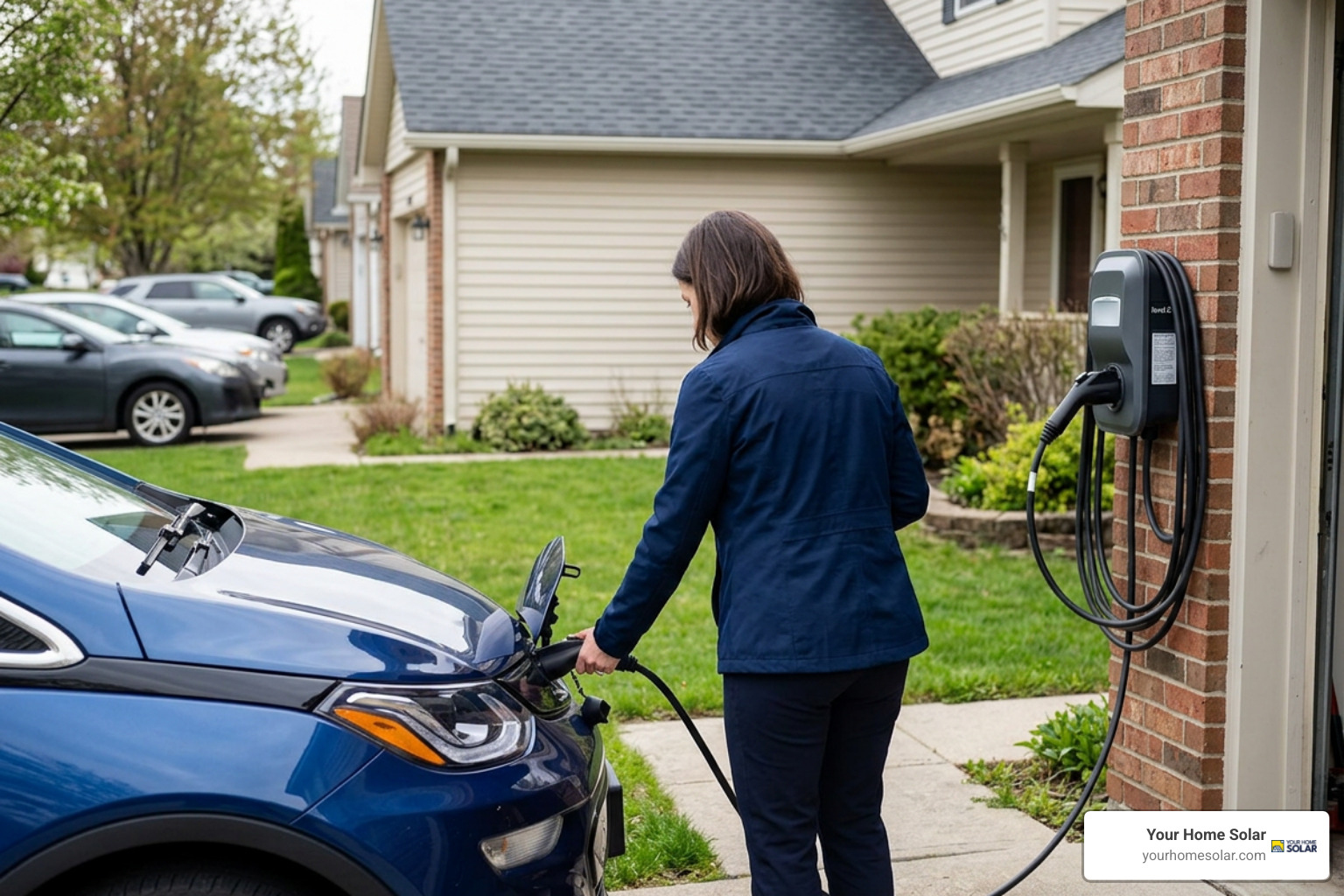
The Best Level 2 Charger for Your Chevy Bolt
Start with your Bolt’s model year. For a 2017-2021 Bolt, the rugged Grizzl-E Classic is a strong pick: the car tops out at 32 amps, so a faster charger will not speed it up. For a 2022 or newer Bolt EV or EUV, consider an adjustable Emporia or ChargePoint Home Flex. These can support the car’s 48-amp maximum when hardwired to a properly sized 60-amp circuit.
A 240-volt Level 2 setup can make overnight charging routine instead of leaving you waiting on a 120-volt outlet. If you have a 2027 Bolt, check the connector before you buy: it has a native NACS port, unlike earlier J1772-equipped Bolts.
I’m Ernie Bussell, founder of Your Home Solar. My work in solar operations and home energy helps me guide homeowners choosing a Level 2 charger for Chevy Bolt charging, with the electrical setup in mind.
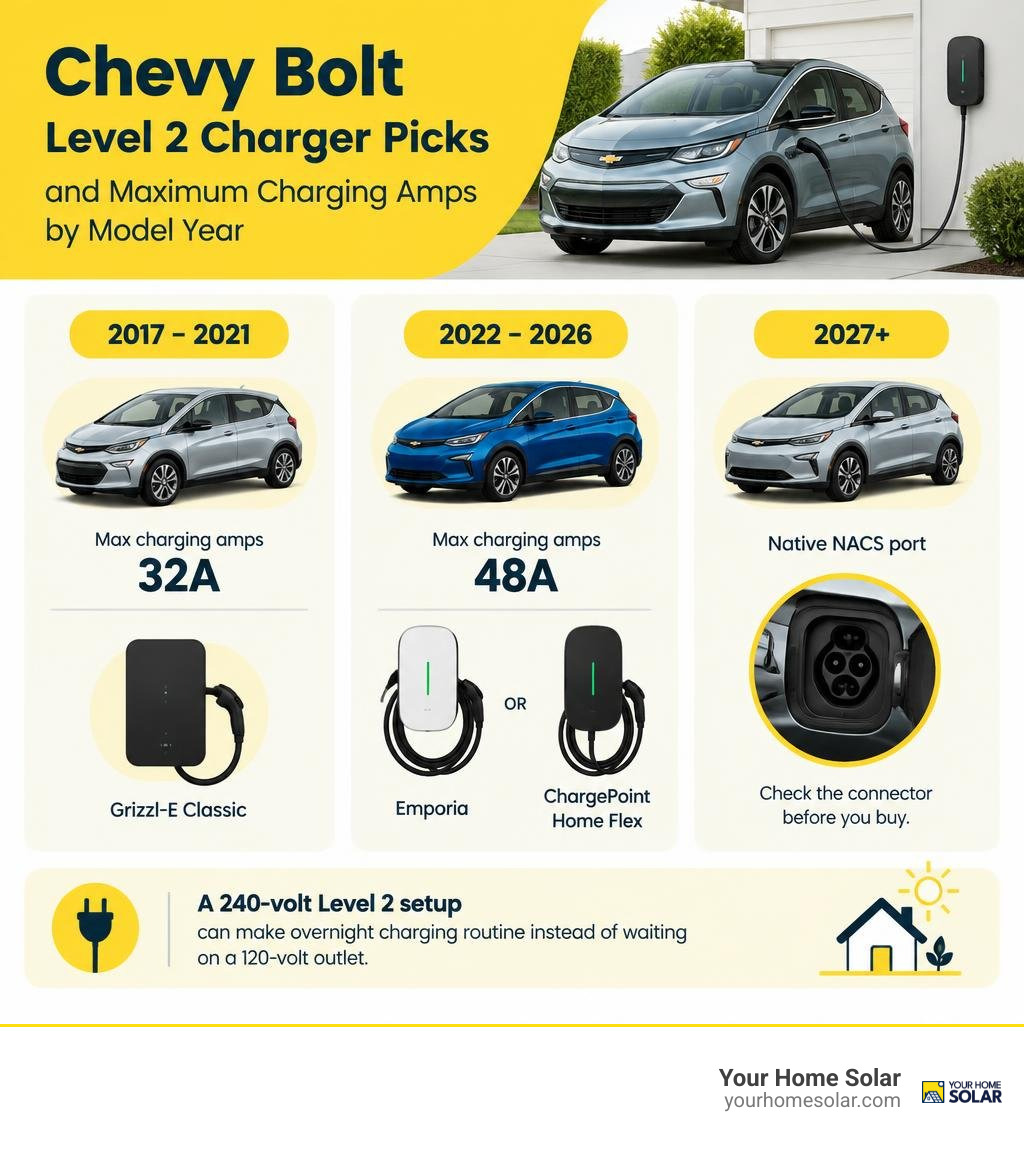
Level 2 charger for chevy bolt basics:
Plugging your Chevrolet Bolt into a standard 120-volt household wall outlet (Level 1 charging) gives you roughly 3 to 4 miles of range per hour. If you run the battery down to empty, fully recharging it on Level 1 can take over 48 hours. That feels a bit like trying to fill a swimming pool with a garden hose!
Upgrading to a 240V Level 2 charging setup cuts that recharge window down to a single overnight session—letting you wake up every morning with a full battery and over 250 miles of driving range ready to go.
Chevy Bolt Acceptance Rates, Battery Sizes, and Charging Speeds
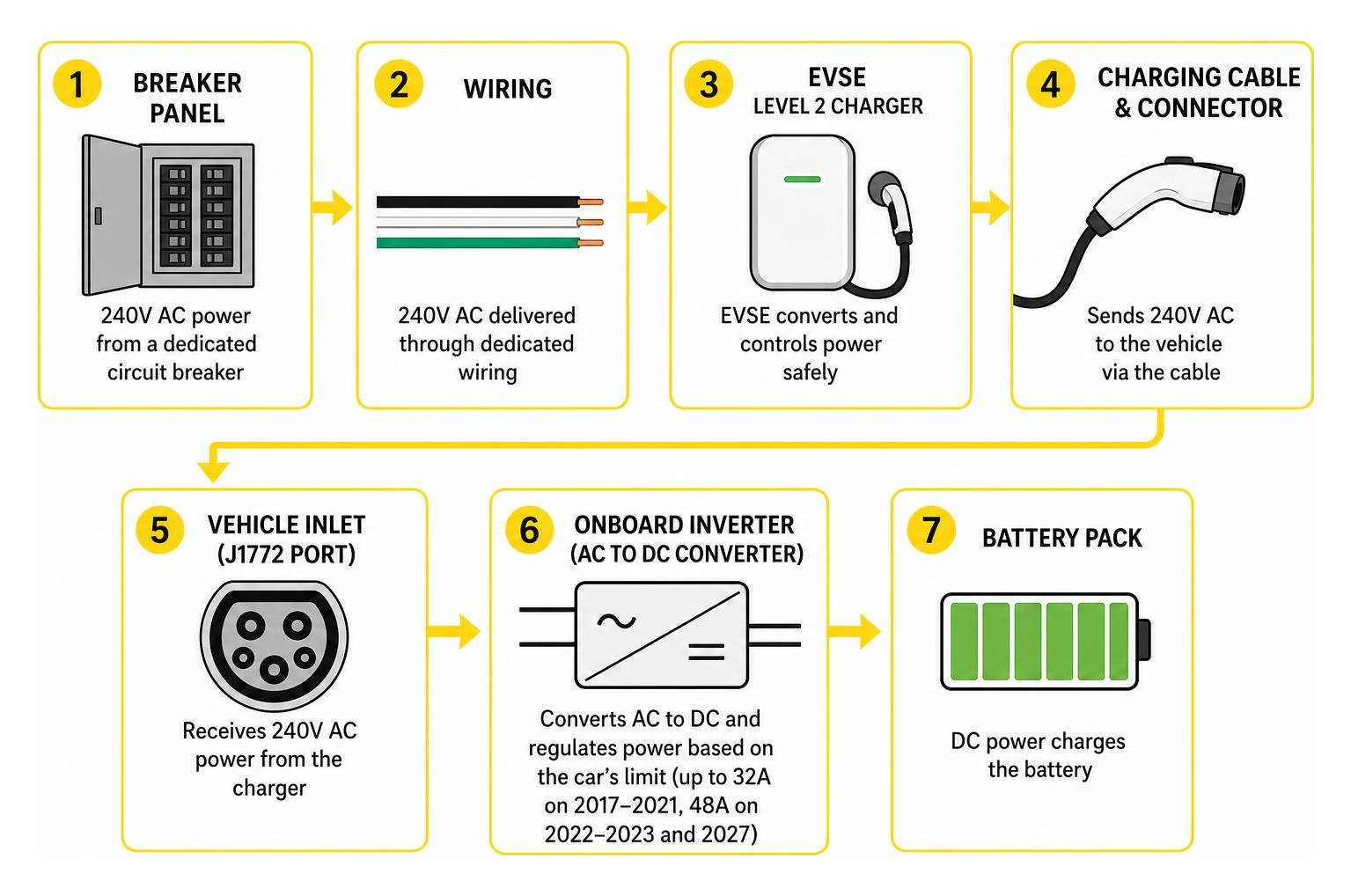
Understanding how fast your car charges starts with the equipment under the hood. Your Chevy Bolt features an onboard AC-to-DC converter that regulates how much power it can pull from a home charging station.
| Chevy Bolt Generation | Battery Capacity (Usable) | Max AC Acceptance (Amps / kW) | Optimal Level 2 Charge Time (0–100%) | Native Port Standard |
|---|---|---|---|---|
| 2017–2021 Bolt EV | 60–66 kWh | 32A / 7.2 kW | ~9.5 to 10 hours | SAE J1772 |
| 2022–2023 Bolt EV / EUV | 65–66 kWh | 48A / 11.5 kW | ~6.5 to 7 hours | SAE J1772 |
| 2027 Redesign Bolt | 65 kWh (LFP) | 48A / 11.5 kW (10.3 kW net) | ~6 hours 17 minutes | NACS (SAE J3400) |
When you plug into a 240V circuit, charging efficiency is remarkably high. In real-world testing, Bolt owners have recorded charging throughputs ranging between 91.8% and 96.4%. Interestingly, measured charging efficiency data across amperage settings reveals that 16-amp and 32-amp charging rates hit a practical sweet spot for thermal management and power conversion. Understanding these numbers is part of the core residential Level 2 charging fundamentals that ensure you get the most out of every kilowatt-hour.
Matching Amperage and Speed to Your Level 2 Charger for Chevy Bolt
When choosing an EVSE (Electric Vehicle Supply Equipment), you want to match the output to your vehicle’s physical limit without overpaying for hardware your car cannot use:
- 2017–2021 Models: These first-generation Bolts max out at 32 amps (7.2 kW). Even if you connect a 48-amp charger, the car will strictly pull 32 amps. A reliable 32A or 40A station is plenty for these model years.
- 2022+ Bolt EV and EUV Models: GM upgraded the onboard charger on later models to accept up to 48 amps (11.5 kW). Moving from a 32A charger to a 48A charger cuts your full charge time down from roughly 9.5 hours to around 6.5 hours.
Under the National Electrical Code (NEC), EV charging is categorized as a continuous electrical load. This means your circuit breaker must be rated for 125% of the charger’s continuous draw (also known as the 80% rule).
- A 32-amp charger requires a 40-amp breaker.
- A 40-amp charger requires a 50-amp breaker.
- A 48-amp charger requires a 60-amp breaker.
Following these electrical safety thresholds aligns directly with official Chevrolet home charging recommendations for worry-free daily operation.
2027 Redesign: Native NACS Ports and Ultium Architecture
The 2027 Chevrolet Bolt introduces major modernization, shifting to a durable Lithium Iron Phosphate (LFP) 65 kWh battery pack and GM’s updated electrical architecture. Most notably, the 2027 Bolt comes standard with a native North American Charging Standard (NACS) inlet instead of the legacy J1772 port.
On Level 2 home charging, the 2027 Bolt draws up to 48 amps, completing a full 0 to 100% charge in about 6 hours and 17 minutes. When you hit the highway, its DC fast-charging ceiling increases from the older 50 kW limit up to 150 kW, enabling a 10% to 80% road-trip boost in just 25 minutes. Furthermore, the 2027 redesign supports bidirectional charging through GM Energy PowerShift hardware, unlocking Vehicle-to-Home (V2H) backup power during grid outages. For full performance figures, see the 2027 Chevrolet Bolt charging specifications.
Top Level 2 Charger for Chevy Bolt Home Setups
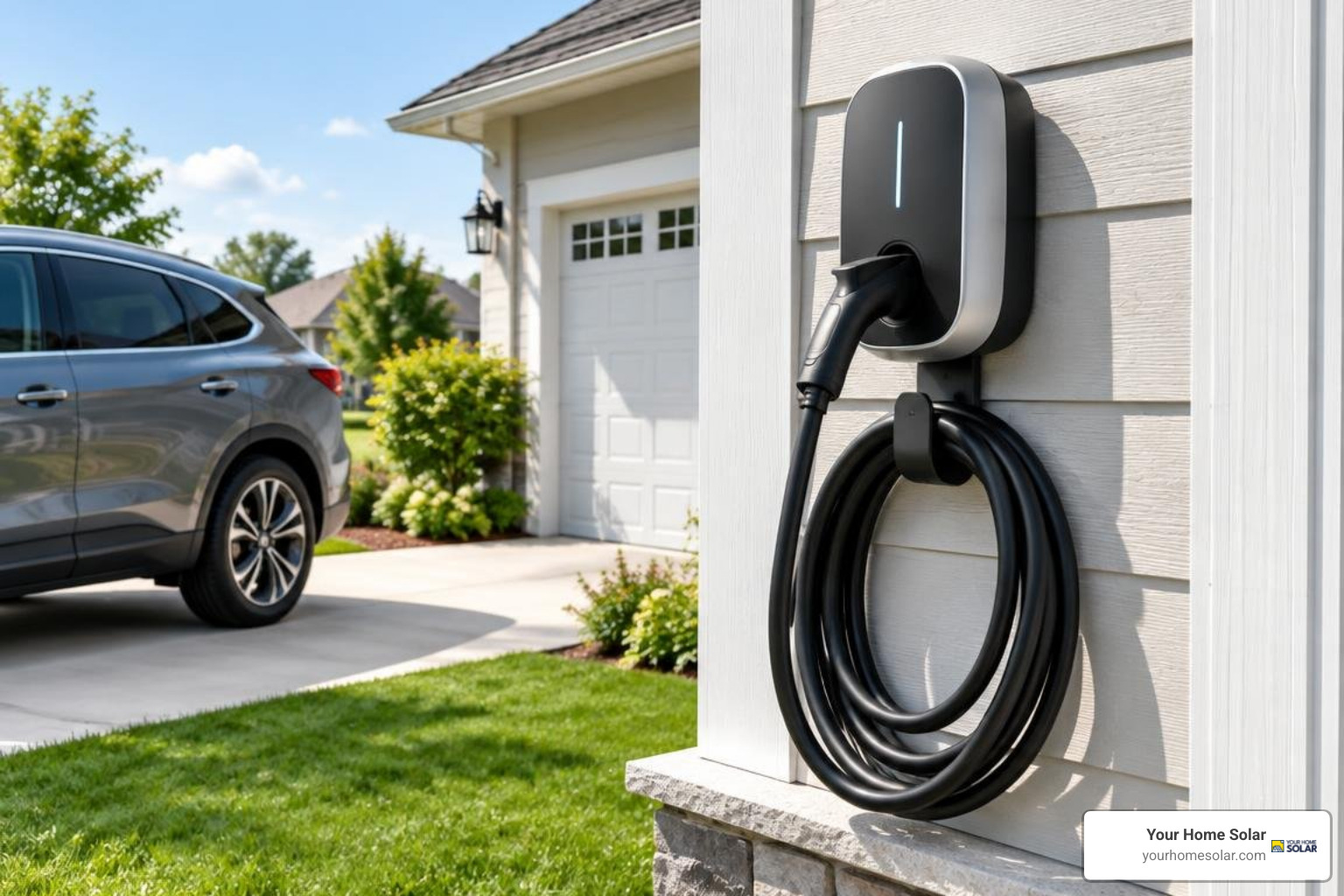
Finding the right charger depends on whether you value rugged simplicity or smart connectivity. Features like Wi-Fi scheduling let you align charging with off-peak utility hours, while certifications like Energy Star and UL (Underwriters Laboratories) ensure electrical efficiency and fire safety. If you are comparing hardware, take time to review our guide comparing top Level 2 EVSE units.
Best Overall and Heavy-Duty Picks
- Grizzl-E Classic (40 Amp): Built like a tank with a heavy-duty cast aluminum enclosure, this unit is legendary in the Chevy Bolt community. It offers internal physical DIP switches to adjust output between 16A, 24A, 32A, and 40A. It is simple, non-smart, weather-sealed, and priced under $400.
- ChargePoint Home Flex (Up to 50 Amp): A premium, highly flexible smart charger. It can deliver 40 amps via a standard NEMA 14-50 plug or up to 50 amps when hardwired. Its mobile app provides detailed energy tracking, utility program integration, and automated off-peak scheduling.
- Emporia EV Charger (48 Amp): One of the best value-to-feature options on the market. It supports hardwired 48A charging (or 40A plug-in), includes Energy Star certification, and pairs seamlessly with home energy monitors for load-management and solar-optimized charging.
Best Budget-Friendly and Portable EVSE Options
- LENZ Home EV Charger (40 Amp): Priced around $298.99, this unit delivers up to 9.6 kW of power over a NEMA 14-50 plug. It provides reliable Level 2 charging speeds for 2022+ Bolts without charging you extra for smart features you might never use.
- EVIQO Level 2 EV Charger (48 Amp): At approximately $479.99, this model supports full 48A hardwired charging, features a 25-foot heavy-duty cable, and offers a clean mobile app for remote monitoring and charging timers.
- Dual-Voltage Portable Chargers (e.g., Tera P01 / OEM Dual-Level Cord): Many Bolt owners prefer keeping a dual-voltage 16A or 32A portable unit in the lower trunk organizer. Using interchangeable adapters for standard 120V (NEMA 5-15) and 240V (NEMA 14-50 or 6-20) outlets, these units serve as fantastic emergency road-trip backups. Check out our curated list of tested Level 2 charger picks for further portable and wall-box options.
Electrical Requirements and Installation Guidelines

Installing a 240V Level 2 charging station requires a dedicated circuit run directly from your main electrical service panel. Because EV charging draws sustained continuous power for hours at a time, cutting corners on breaker sizing or wire gauge is never an option.
- 40-Amp Breakers: Used for 32-amp continuous charging (7.2 kW to 7.7 kW). Requires 8 AWG copper wire.
- 50-Amp Breakers: Used for 40-amp continuous charging (9.6 kW). Requires 6 AWG copper wire.
- 60-Amp Breakers: Required for full 48-amp charging (11.5 kW). Requires heavy-gauge 6 AWG or 4 AWG copper wire depending on wire insulation ratings (such as THHN vs. Romex NM-B) and conduit run length.
Before pulling permits or purchasing wire, review the primary cost factors for 240V charger installation to plan your project budget accurately.
Hardwired vs Plug-In Level 2 Charger for Chevy Bolt Installation
Homeowners generally choose between two setup styles: a plug-in unit using a NEMA 14-50 receptacle or a permanently hardwired station.
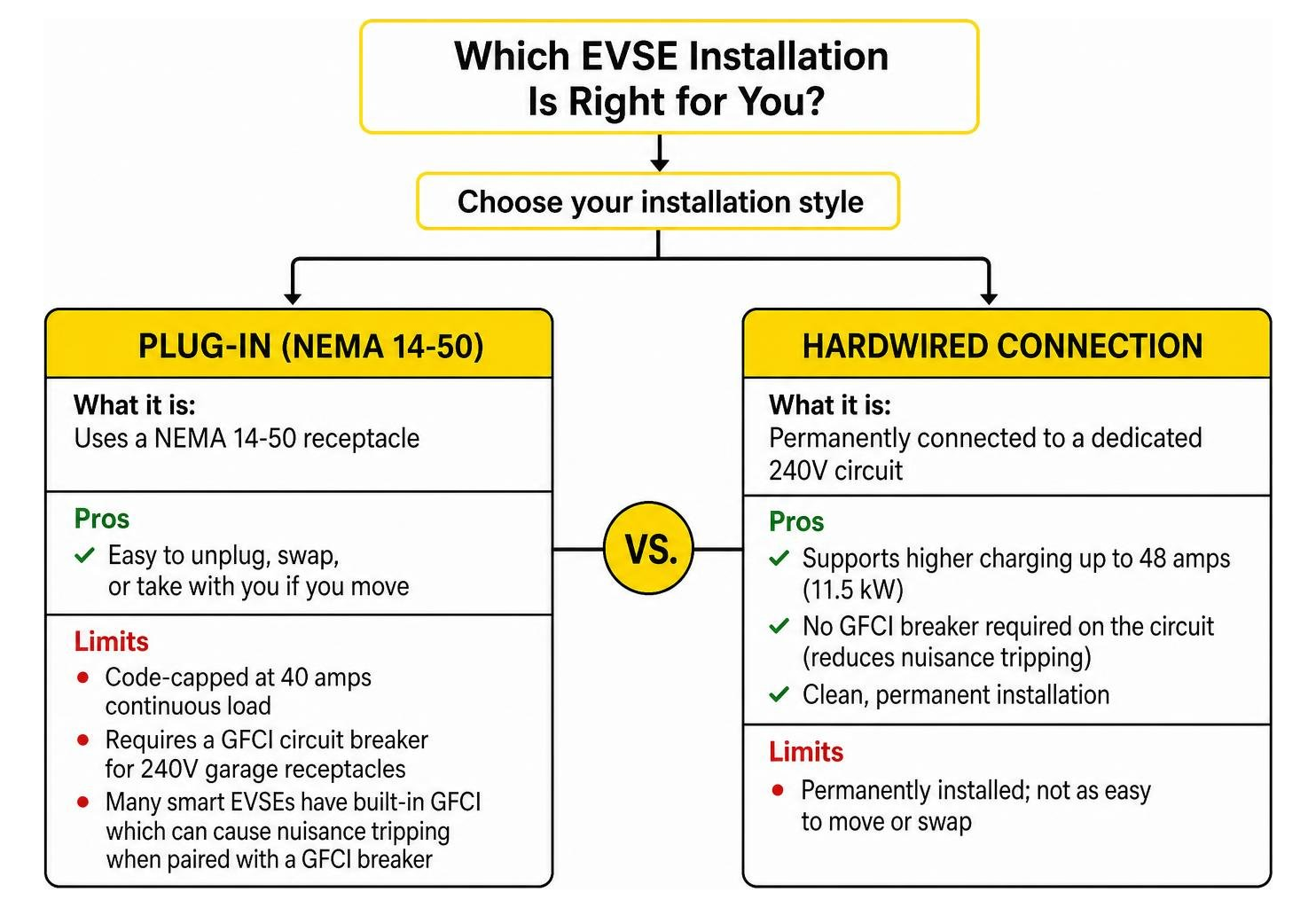
Plug-In (NEMA 14-50):
- Pros: Easy to unplug, swap, or take with you if you move.
- Limits: Modern electrical codes require a GFCI circuit breaker for 240V garage receptacles. Many smart EVSEs have built-in GFCI circuitry, which can cause annoying “nuisance tripping” when paired with a GFCI breaker. Plug-in units are also code-capped at 40 amps continuous load.
Hardwired Connection:
- Pros: Required for maximum 48-amp (11.5 kW) charging. Eliminates the receptacle connection point, which reduces electrical resistance and heat buildup. Hardwired installations do not require upstream GFCI breakers in many jurisdictions, avoiding nuisance trips.
- Limits: Fixed in place; requires an electrician to disconnect if replacing the unit.
For a comprehensive breakdown of the physical setup, read our guide on residential EV charger installation steps.
Outdoor Mounting, Adapters, and Compatibility
If your Bolt parks in a driveway or car port rather than an enclosed garage, pick a charger with a NEMA 4 or NEMA 4X enclosure rating (such as the Grizzl-E). These enclosures protect internal electronics against driving rain, blowing dust, sleet, and freezing snow.
Outdoor charging in cold winter months also triggers the Chevy Bolt’s internal battery thermal management system. The vehicle will use up to 7.5 kW of power just to warm the battery cells to safe operating temperatures before accepting standard charge rates. Having a robust 240V Level 2 connection ensures that heating the battery doesn’t rob you of your driving range replenishment.
If your household charges both a J1772 vehicle (like a 2017–2023 Bolt) and a NACS vehicle (like a Tesla or 2027 Bolt), an approved NACS to J1772 charging adapter lets your J1772 Bolt plug into any Tesla Wall Connector or Universal EVSE with ease. Always keep your charging cables off the ground using a dedicated wall holster to avoid physical wear or water ingress.
Frequently Asked Questions About Charging the Chevy Bolt
Can I charge my Chevy Bolt at a fast-charging network or Level 2 destination charger?
Yes! For AC Level 2 destination charging (such as hotels or shopping centers), earlier Bolts plug directly into standard J1772 plugs, or use an adapter at Tesla destination stations.
For DC fast charging on public networks, 2017–2023 Bolts equipped with the orange CCS1 fast-charge flap can charge at standard CCS stations, or at Tesla Supercharger locations using an approved NACS-to-CCS1 adapter. The redesigned 2027 Chevrolet Bolt features a native NACS port, allowing direct connection to the Supercharger network without any separate adapter.
Can the factory dual-level cord serve as a permanent home charger?
The factory dual-level charge cord included with 2022+ Bolt EUV and EV models can deliver up to 32 amps (7.7 kW) when plugged into a 240V NEMA 14-50 outlet. While it is fully capable of serving as a daily charger, it lacks smart app scheduling, power-metering capabilities, and the heavy-duty weatherproofing found on dedicated wall boxes.
Many owners mount a dedicated Level 2 wall unit in their garage and keep the OEM dual-voltage cord neatly packed in the trunk for road trips and emergency charging.
What does it cost per month to charge a Chevy Bolt at home on Level 2?
Charging at home is significantly cheaper than buying gasoline or relying on commercial DC fast chargers. At an average residential electric rate of $0.18 per kWh, driving 15,000 miles per year (roughly 1,250 miles per month at 3.5 to 3.9 miles per kWh) costs approximately $62 per month in electricity—or about $5.00 per 100 miles of range.
You can lower this cost further by enrolling in your local utility’s Time-of-Use (TOU) off-peak billing rates and claiming EV equipment rebates. To run the numbers for your own vehicle, explore our detailed breakdown of home EV charging costs and budgeting.
Conclusion
Upgrading from slow 120V trickle charging to a dedicated 240V Level 2 charging station unlocks the full daily utility of your Chevy Bolt. Whether you are driving a 2017 commuter or taking delivery of the latest 2027 NACS-equipped model, matching your EVSE to your vehicle’s electrical acceptance rate ensures fast charging, high electrical efficiency, and dependable morning range.
At Your Home Solar, we take the guesswork out of home electrification. From panel capacity evaluations and dedicated 240V circuit installations to solar integration and battery backup, we deliver tailored, high-quality electrical work built for long-term safety and performance.
Ready to transform your daily EV routine? Explore the ultimate guide to home EV charging or reach out to our licensed team today to schedule your custom home charging installation!