Choose a Level 2 Charger for Faster Pacifica Charging
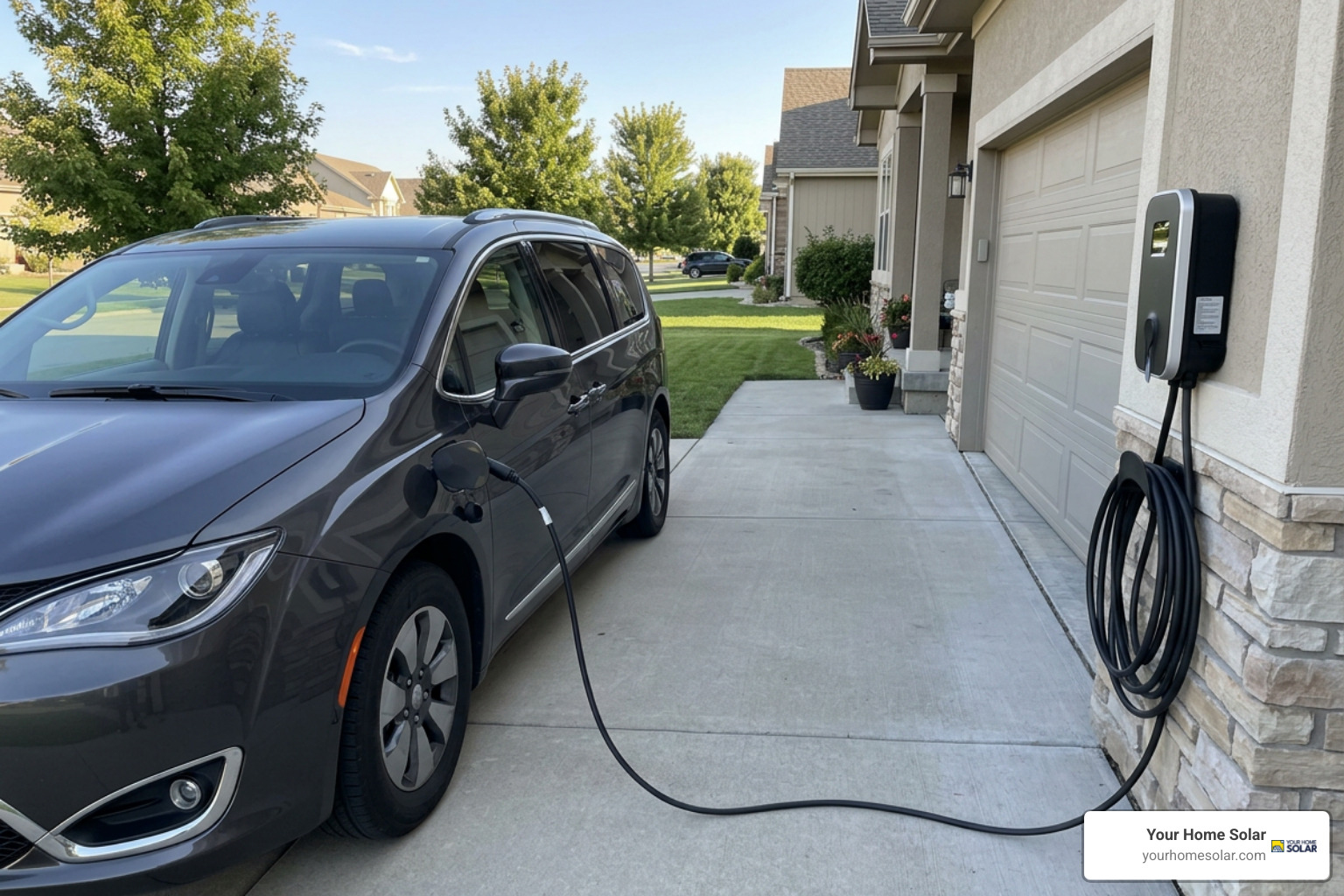
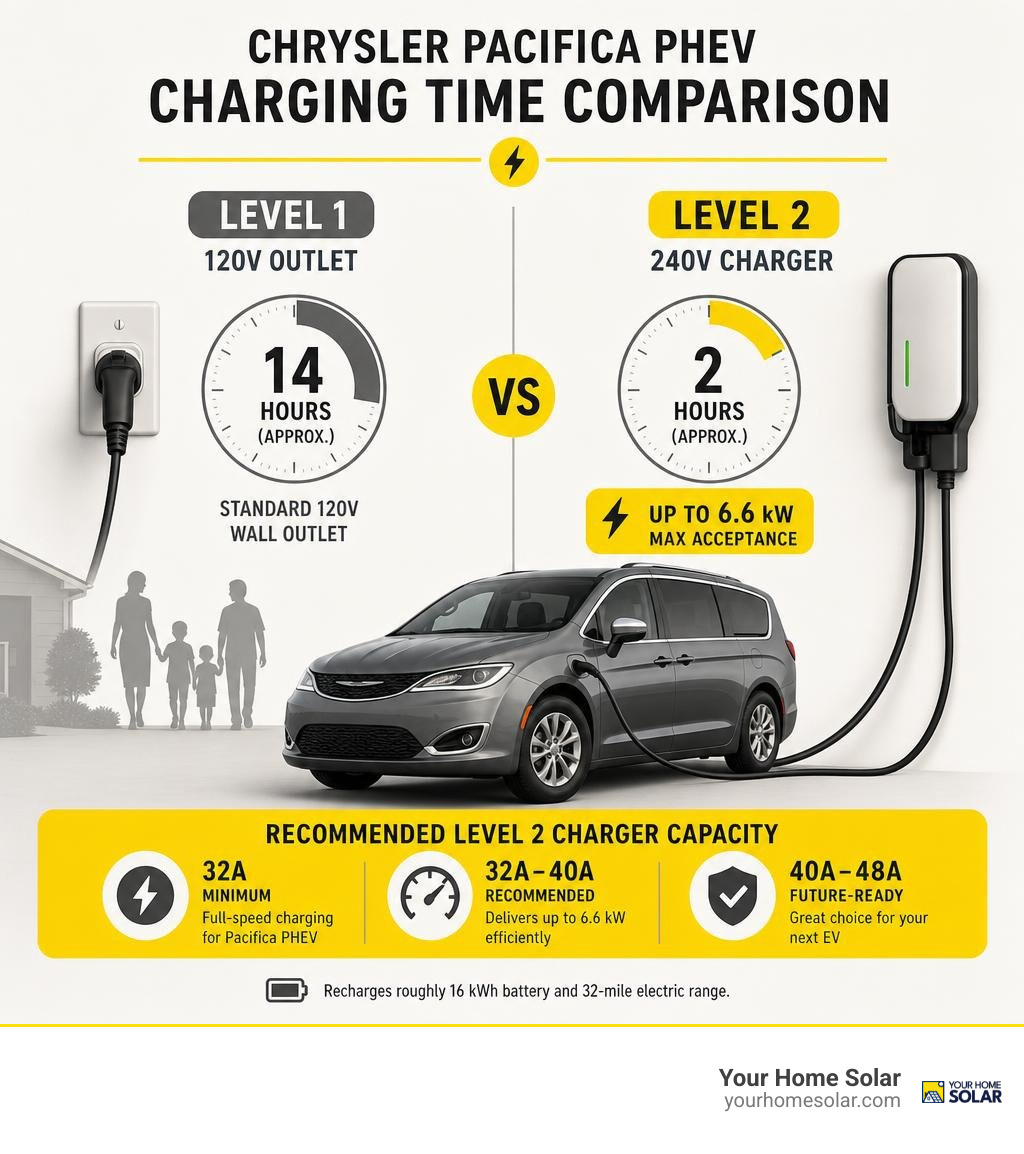
A Level 2 charger for Chrysler Pacifica should use the standard J1772 connector and deliver at least 32 amps on a dedicated 240V circuit. The Pacifica PHEV can accept up to 6.6 kW, so a reliable 32A to 40A unit provides full-speed charging without overspending on power the minivan cannot use.
It can recharge the Pacifica’s roughly 16 kWh battery and 32-mile electric range in about 2 hours, versus about 14 hours from a standard 120V Level 1 outlet. A 40A or 48A charger can still make sense if you want a unit that is ready for a future full-electric vehicle.
I am Ernie Bussell, Founder and CEO of Your Home Solar. My background in technical quality control, operations, and home energy systems helps East Tennessee homeowners choose and install a Level 2 charger for Chrysler Pacifica with safety, cost, and long-term value in mind.
Level 2 charger for chrysler pacifica further reading:
Understanding Chrysler Pacifica Hybrid Charging: Level 1 vs Level 2
The Chrysler Pacifica Plug-in Hybrid is a powerhouse for busy families. With seating for up to seven passengers, an EPA-estimated 82 MPGe efficiency rating, and a 16 kWh lithium-ion battery pack, it delivers an EPA-rated electric range of up to 32 miles before seamlessly engaging its 3.6-liter Pentastar V6 gas engine for a total driving range of roughly 520 miles.
When you bring your Pacifica home from the dealership, it comes equipped with a standard Level 1 charging cord (such as OEM Mopar part 5185142AB) that plugs into a traditional 120V three-prong household outlet. While convenient in a pinch, charging at 120V takes approximately 14 hours to replenish an empty battery. That is longer than most overnight sleep schedules! If you get home from soccer practice at 6:00 PM and need to head out for an early morning commute at 6:30 AM, you will rarely start the day with a fully charged pack on Level 1.
Upgrading to a 240V Level 2 charging station slashes that downtime to just about 2 hours. Level 2 power allows you to drive electric on morning errands, plug in during lunch, and head back out with a full battery for afternoon school pickups—effectively doubling or tripling your daily zero-emission miles.
Every Pacifica PHEV utilizes the North American standard SAE J1772 charge port. While driving, the vehicle also recovers kinetic energy through its regenerative braking system and selectable “Max Regeneration” mode to stretch battery efficiency. However, the Pacifica PHEV does not support Level 3 DC fast charging. Because its battery pack is relatively compact and protected by an onboard thermal management system, high-voltage direct current cannot be fed directly to the cells. Detailed Chrysler Pacifica PHEV charging capabilities confirm that Level 2 AC charging represents the absolute fastest, most efficient charging method available for this vehicle.
Top Options for a Level 2 Charger for Chrysler Pacifica
When selecting a home charging station for your minivan, safety and testing certifications should always come first. Make sure any unit you install is certified by Underwriters Laboratories (UL) or Intertek (ETL), meets UL 2594 standards, and carries an ENERGY STAR® rating for standby power efficiency. To gain a deeper understanding of equipment standards and system layouts, explore The Ultimate Guide to Home EV Charging.
Choosing the Best Level 2 Charger for Chrysler Pacifica Owners
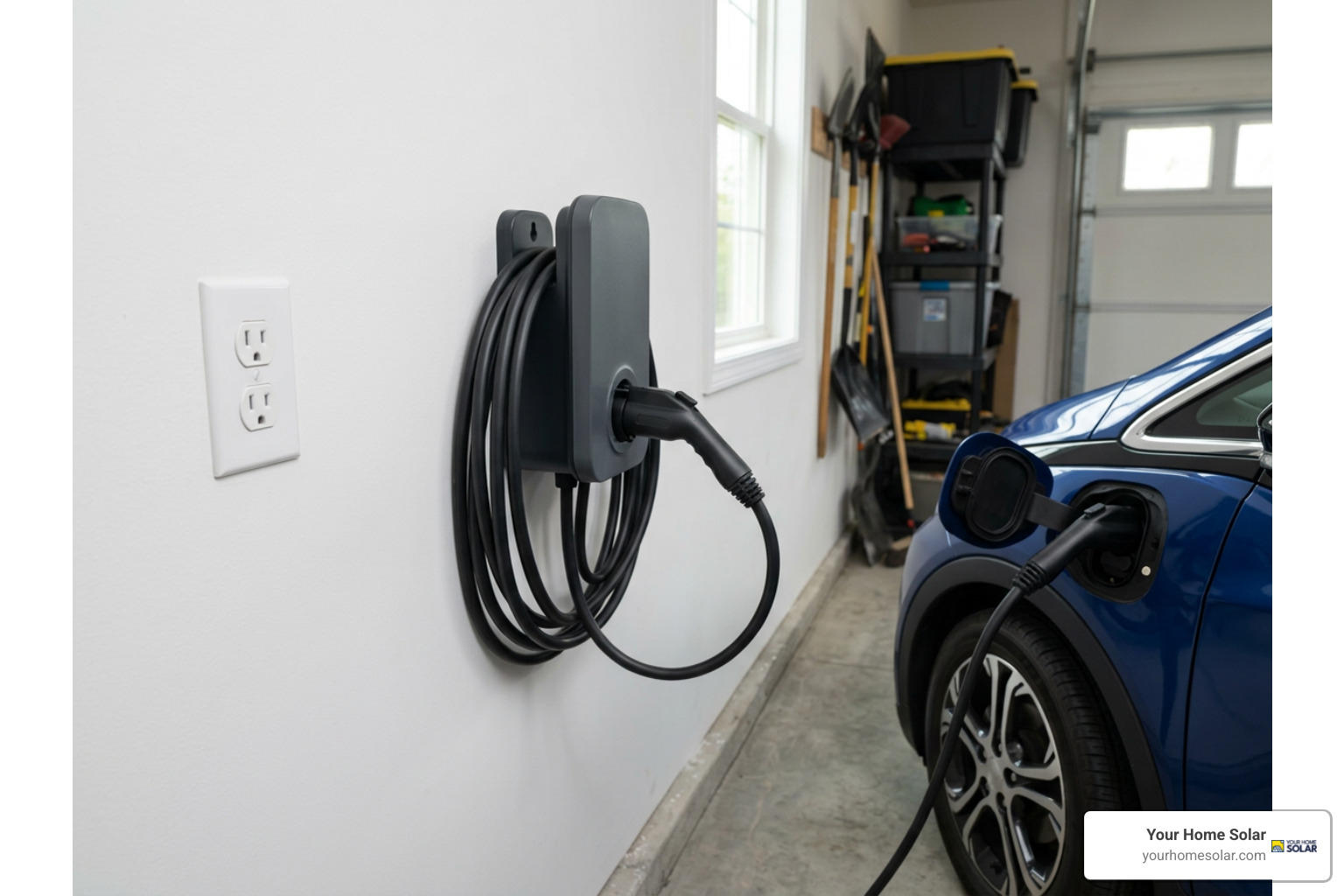
The Chrysler Pacifica’s internal onboard charger caps incoming alternating current at 6.6 kW (which draws 27.5 amps at 240V, calling for a 30A or 32A continuous power supply). While the van cannot draw more than 6.6 kW, pairing it with a higher-amperage EVSE will simply charge the Pacifica at its maximum rate without harming the battery. You can easily compare Level 2 chargers: a practical guide to choosing the best to see how specific hardware matches your household needs.
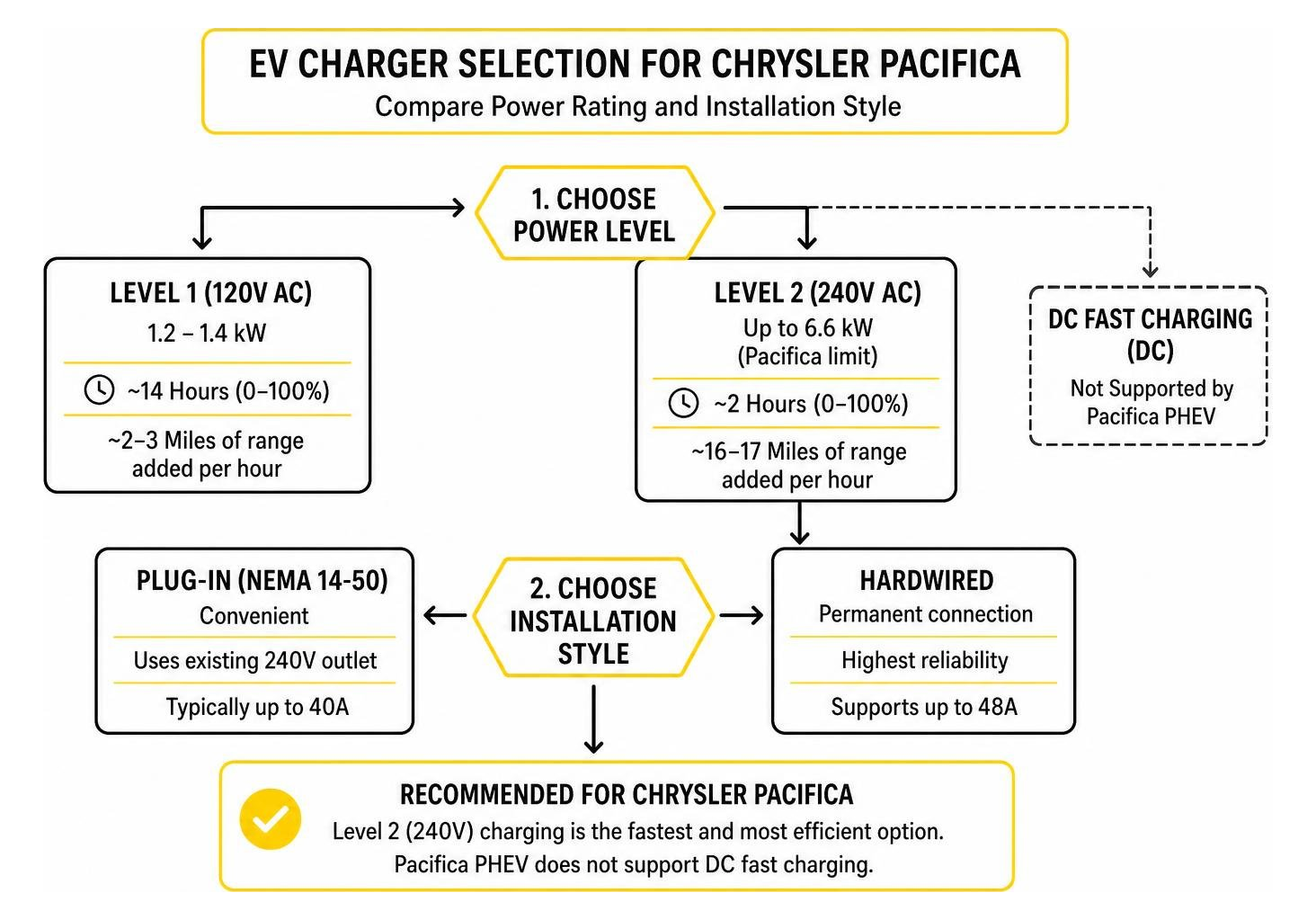
Here are the premier Level 2 options currently on the market:
- Mopar Free2move Charge 40A & 48A: Stellantis offers genuine OEM Free2move home units. The 40A version retails for approximately $639 and supports either a NEMA 14-50 plug or hardwiring. The 48A unit (around $689) features a heavy-duty 25-foot cable and requires a permanent hardwired connection. While both carry full factory warranties and Wi-Fi capability, they carry a slight brand-name price premium.
- ChargePoint Home Flex: Priced around $550–$800, this premium smart charger can be set anywhere from 16 to 50 amps. Its intuitive smartphone app tracks energy spending, lets you schedule charging during off-peak utility hours, and syncs seamlessly across public and residential charging data.
- Grizzl-E Classic 40A: Ranging from $350 to $400, this Canadian-built charger is celebrated across driver forums as an indestructible “tank.” Encased in a rugged NEMA 4 cast-aluminum enclosure, it shrugs off freezing Appalachian winters and humid East Tennessee summers without needing fussy Wi-Fi setups.
- Lectron 32A / V-BOX: Coming in around $229 to $300, Lectron offers a budget-conscious, ETL-listed charging solution. Delivering 32 amps (7.6 kW) on a standard 40-amp circuit, it matches the Pacifica’s 6.6 kW charge limit perfectly at a fraction of OEM equipment costs.
- Schumacher SC1455: A reliable, UL-listed, no-frills dual-voltage alternative available for under $300 that provides plug-and-play simplicity on 240V circuits.
Portable vs Dedicated Wall Charging Stations
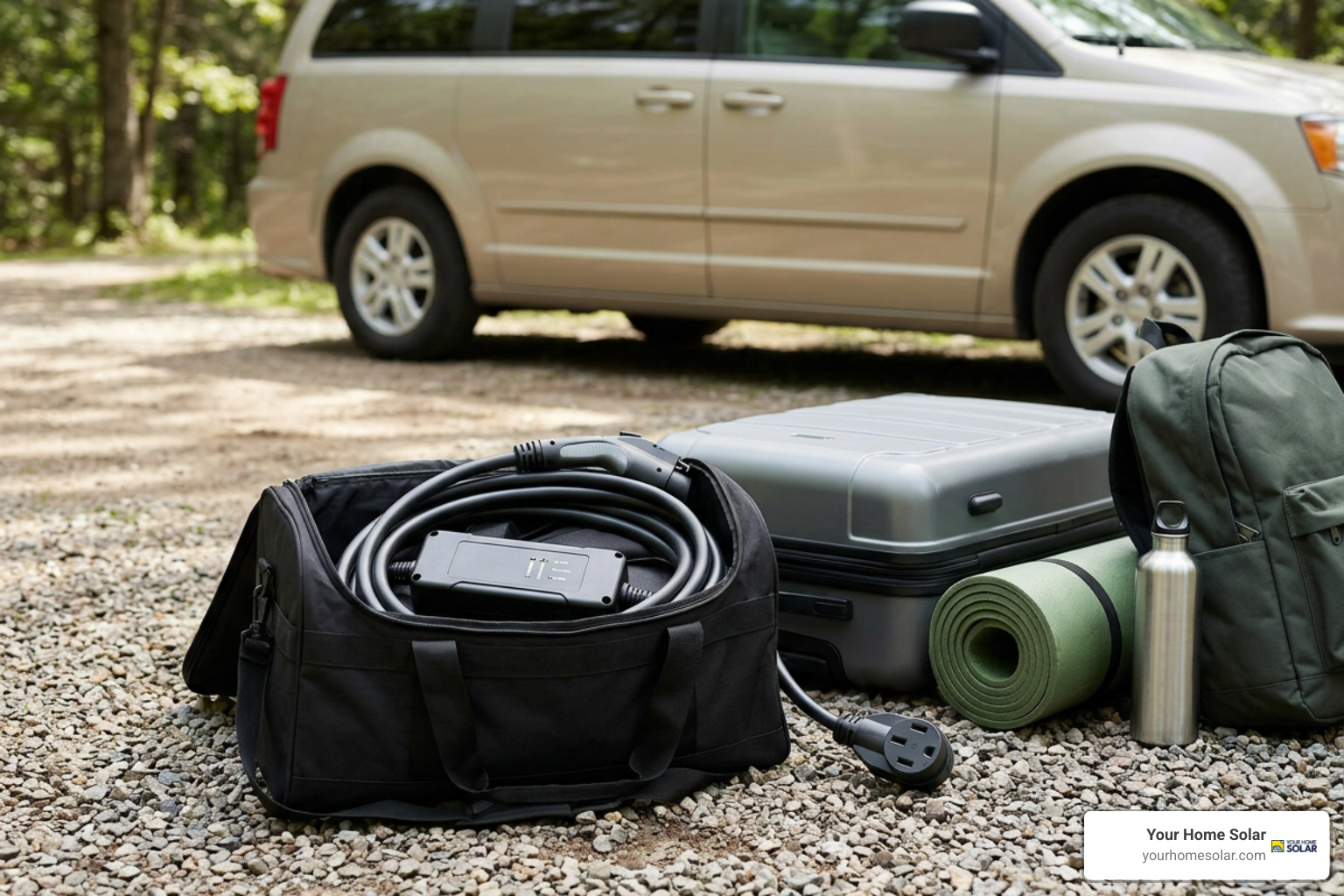
If your family frequently visits campgrounds in the Great Smoky Mountains or takes road trips across Tennessee, a dual-voltage portable Level 2 charging cable is a versatile accessory. According to real-world Pacifica owner charging experiences, portable units equipped with a NEMA 14-50 plug allow you to tap into 240V / 50A hookups at RV parks and campsites, recharging your minivan from zero to full in just two hours while you relax around the campfire.
However, portable chargers are generally meant for occasional travel. For day-in, day-out home use, a dedicated, wall-mounted charging station offers superior cable management, integrated safety sensors, weather-sealed enclosures, and robust strain relief designed for thousands of plug cycles.
Electrical Requirements and Installation Considerations
Installing a Level 2 charging station requires a dedicated 240V circuit running directly from your home’s main electrical panel to your garage or driveway. For an in-depth breakdown of panel prep, check out our guide on power up your ride: installing a Level 2 EV charger at home.
Under the National Electrical Code (NEC), EV charging is defined as a continuous electrical load. To maintain safety and prevent overheating, circuit breakers must be rated at 125% of the charger’s continuous draw (often called the 80% rule):
- 16-Amp Charger (3.8 kW): Requires a 20-Amp dedicated 240V breaker.
- 32-Amp Charger (7.6 kW): Requires a 40-Amp dedicated 240V breaker (matches the Pacifica’s maximum 6.6 kW rate).
- 40-Amp Charger (9.6 kW): Requires a 50-Amp dedicated 240V breaker.
- 48-Amp Charger (11.5 kW): Requires a 60-Amp dedicated 240V breaker (hardwired only).
Your home’s service panel must have adequate remaining capacity (measured in amps) to support this new load. While older homes with 100-amp panels may require a subpanel or a main service upgrade, homes with 200-amp service can usually accommodate a 40A or 50A EV circuit without issue.
How to Install a Level 2 Charger for Chrysler Pacifica at Home
When setting up your station, you must decide between a plug-in installation (using a heavy-duty NEMA 14-50 receptacle) or a permanent hardwired connection. Detailed analysis in The Definitive Guide to 240V EV Charger Installation Cost illustrates the trade-offs between both methods:
- Plug-In Installation (NEMA 14-50): Offers portability, allowing you to unplug the EVSE if you move. However, recent NEC revisions require a GFCI breaker on 240V garage outlets. Because modern EV chargers have their own internal GFCI safety monitoring, “double GFCI” setups can occasionally cause nuisance tripping.
- Hardwired Installation: The charging station is connected directly to home wiring via a junction box. Hardwiring bypasses external GFCI breaker conflicts, creates an airtight, corrosion-proof connection suitable for outdoor mounting, and is required by code for charging speeds at 48 amps and above.
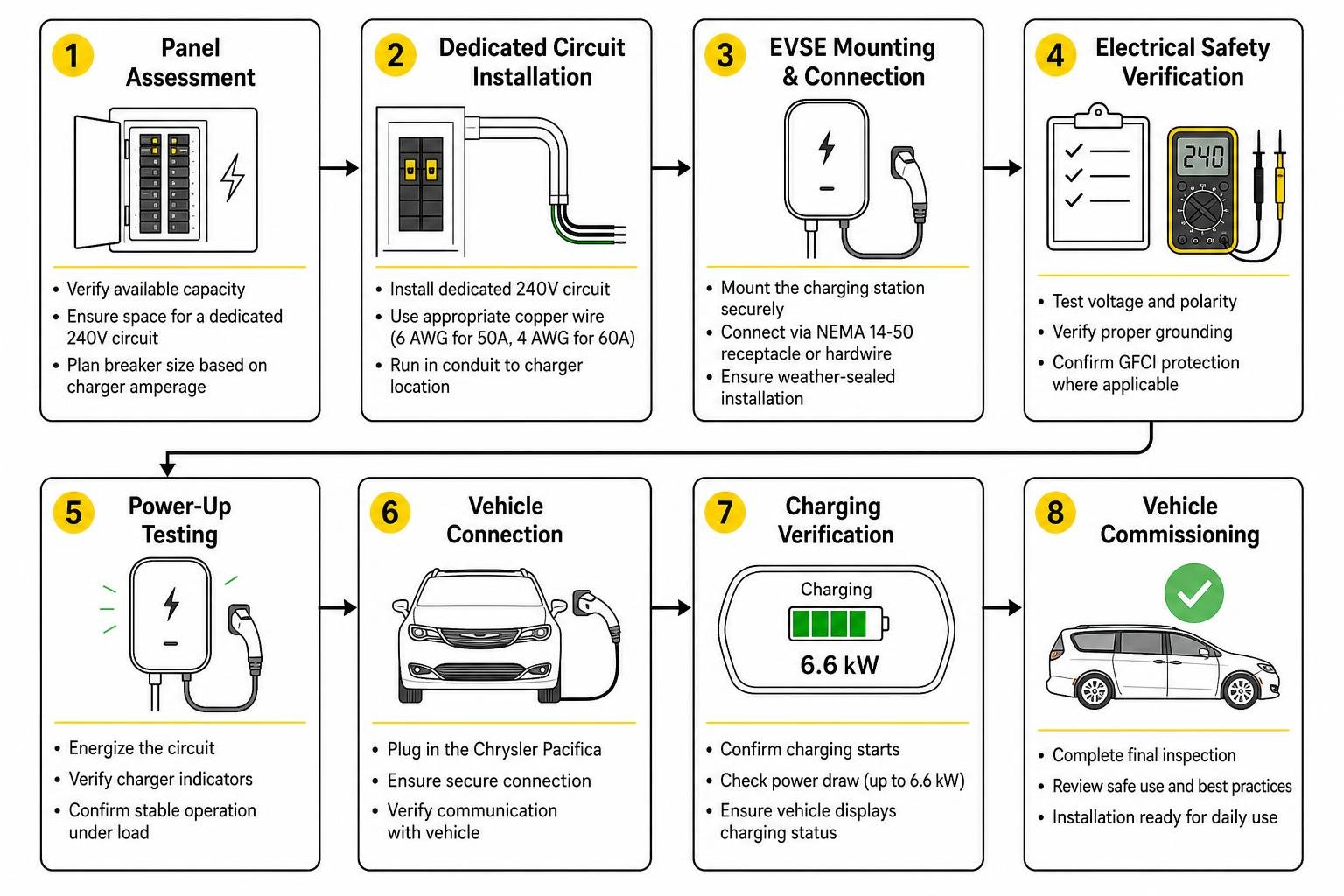
A professional installation includes assessing panel capacity, pulling appropriate copper wire (typically 6 AWG for 50A circuits or 4 AWG for 60A circuits), mounting the EVSE, and testing grounding safety under active load.
Costs, Tax Credits, and Long-Term Value
Purchasing a reliable Level 2 charger typically costs between $200 and $800, depending on whether you choose a simple, rugged unit or a feature-packed smart model. Professional installation by a licensed electrician generally ranges from $1,000 to $1,500, depending on the distance between your breaker panel and the charging location. Reviewing unplugging the mystery: how much to install a Level 2 EV charger helps you budget accurately for labor, conduit, and permits.
You can often offset these expenses through the Section 30C Federal Alternative Fuel Vehicle Refueling Property Credit, which can cover 30% of equipment and installation costs up to $1,000 for eligible residential locations.
If you drive less than 32 miles per day, you might wonder if Level 2 charging is worth the investment. While Level 1 trickle charging can replenish the battery during a long 14-hour overnight stay, Level 2 charging gives you complete flexibility. You can recharge during a brief midday stop, maximize your electric miles across multi-leg family schedules, and take full advantage of off-peak electric utility windows. Installing a robust 40A or 48A circuit also completely future-proofs your garage for whenever your household adds a secondary, long-range all-electric vehicle.
Frequently Asked Questions About Pacifica Charging
Does the Chrysler Pacifica PHEV support DC fast charging?
No. The Chrysler Pacifica Plug-in Hybrid is not equipped with Level 3 DC fast-charging ports (such as CCS or NACS). Its onboard charging system handles up to 6.6 kW AC through a standard J1772 connector. On long cross-country road trips, fast charging is unnecessary because the hybrid gasoline engine provides uninterrupted driving range and quick 5-minute fuel stops.
What is the difference between a 40A and 48A charger for the Pacifica?
When charging a Pacifica PHEV, there is zero difference in charging speed between a 40A and a 48A charger. Because the Pacifica’s internal inverter is capped at 6.6 kW (27.5 amps), both units will fully charge the battery in approximately 2 hours. The primary differences lie in the installation and future usability: a 40A charger can be plugged into a NEMA 14-50 outlet, whereas a 48A charger mandates a hardwired connection on a 60-amp breaker and can deliver up to 11.5 kW to future all-electric vehicles.
Can I charge my Pacifica at RV campgrounds with a portable charger?
Yes. Most modern RV campgrounds provide 50-amp, 240-volt service through standard NEMA 14-50 receptacles. By using a portable J1772 Level 2 charging cable equipped with a 14-50 plug, you can charge your Pacifica in about 2 hours while camping. Always verify that campground receptacles are in sound condition, properly grounded, and weather-protected before plugging in.
Conclusion
Upgrading to a dedicated Level 2 charging system turns the Chrysler Pacifica Plug-in Hybrid into an exceptionally practical, fuel-saving family vehicle. By shrinking charge times from 14 hours down to just 2 hours, you unlock the ability to tackle multiple electric trips every day without relying on gasoline.
Whether you choose a rugged plug-and-play unit or a high-output hardwired smart station, proper electrical design and professional installation ensure years of safe, dependable operation. For step-by-step equipment advice and system planning, explore our complete home EV charging guide and power up your daily drive with confidence.