
What Does a Level 3 Charging Station Actually Cost?
The cost of a level 3 charging station spans a wide range — and the numbers can be surprising if you’re used to thinking about home EV charging.
Here’s a quick breakdown of what to expect:
| Cost Component | Low End | Average | High End |
|---|---|---|---|
| Hardware (equipment) | $8,000 | $18,000–$50,000 | $150,000+ |
| Installation & electrical upgrades | $10,000 | $20,000–$50,000 | $100,000+ |
| Total project cost | $18,000 | $31,000–$83,500 | $350,000+ |
Note: Costs vary significantly based on power output (kW), site conditions, and electrical infrastructure requirements.
Most homeowners are not candidates for Level 3 installation — these stations are built for commercial use. But understanding the costs matters whether you’re a business owner, a fleet manager, or simply an EV driver trying to make sense of what you pay at a public fast charger.
I’m Ernie Bussell, founder and CEO of Your Home Solar, East Tennessee’s leading solar and home energy contractor, and my background in solar infrastructure, electrical systems, and home energy planning gives me a practical lens for breaking down the real cost of a level 3 charging station — without the jargon. In the sections below, I’ll walk you through every major cost driver, from hardware to installation to ongoing fees, so you can make a confident, informed decision.
Cost of a level 3 charging station terms to know:
- 240 volt charging station installation
- Residential EV charging solutions
- Trusted EV charger installer
What is a Level 3 Charger and Why Does It Cost More?
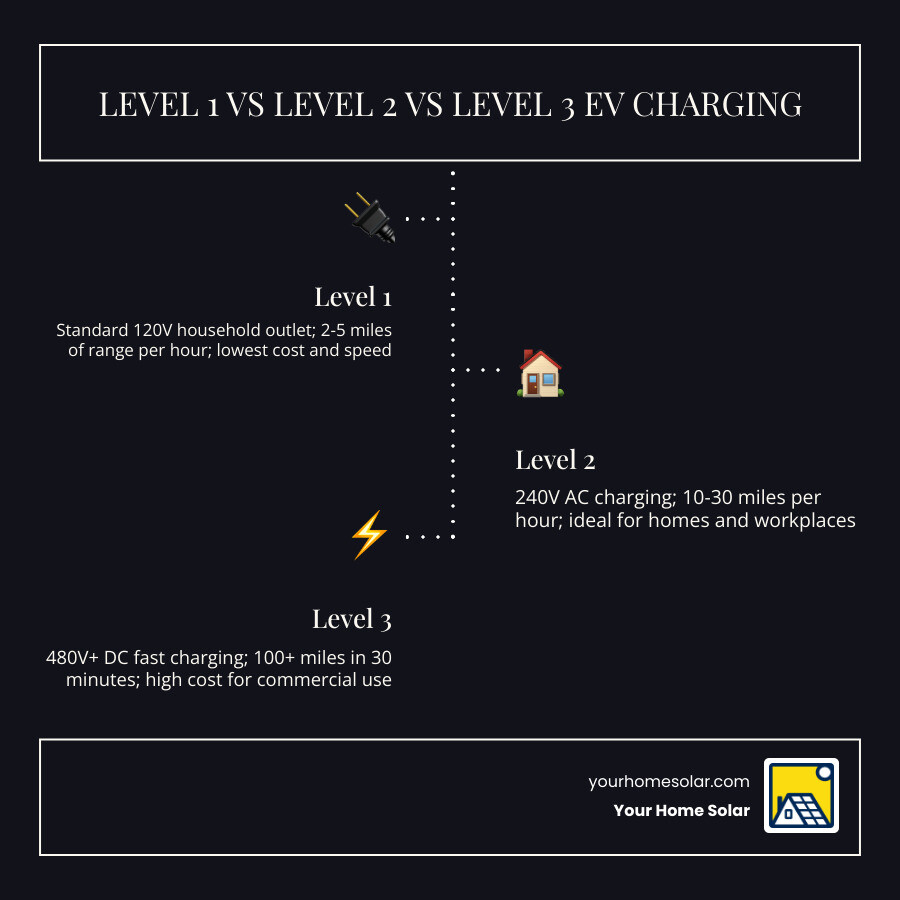
To understand the cost of a level 3 charging station, we first have to look at what’s happening under the hood. Most of us are familiar with Level 1 (the slow trickle from a wall outlet) and Level 2 (the 240V “dryer plug” style). These provide Alternating Current (AC) to your car. The car then has to use its own “onboard charger” to convert that AC into Direct Current (DC) for the battery. This conversion takes time and limits how fast you can charge.
A Level 3 charger, often called a DC Fast Charger (DCFC), changes the game. It does the heavy lifting of converting AC to DC outside the vehicle, pumping high-voltage direct current straight into the battery. This allows for massive power delivery — usually ranging from 50kW to 350kW or more. According to How Much Does A Level 3 EV Charger Cost? Your Complete Guide, this can take a battery from 10% to 80% in as little as 20 to 30 minutes.
The reason it costs so much more is the sheer complexity of the machinery. While a Level 2 unit is essentially a smart switch, a Level 3 station is a massive power converter that requires 480V three-phase power — something you’ll find at a factory or a large commercial plaza, but almost never in a residential neighborhood. You can learn more about the basics in our Ultimate Guide to Home EV Charging.
AC vs. DC Charging Specifications
| Feature | Level 1 | Level 2 | Level 3 (DC Fast) |
|---|---|---|---|
| Voltage | 120V AC | 208V/240V AC | 480V+ DC |
| Power Output | 1.4 kW | 3.8 kW – 19.2 kW | 50 kW – 350+ kW |
| Range per Hour | 3–5 miles | 12–30 miles | 100–250+ miles |
| Best Use Case | Overnight / Emergency | Daily Home Charging | Road Trips / Fleets |
Breaking Down the Hardware cost of a level 3 charging station
When we talk about hardware, we are looking at a massive range: anywhere from $15,000 to $150,000 per unit. Why such a huge gap? It mostly comes down to “juice.” A 50kW unit is significantly cheaper than a 350kW “ultra-fast” station. As of May 2026, the market has seen a push toward higher voltages to support newer vehicles. You can read about this evolution in our article on What 800V Charging Means for Your Garage.
Based on a Level 3 DC Fast Charger Cost Overview, the average hardware-only cost for a standard 50kW-150kW unit sits around $18,000 to $50,000. If you want the premium, liquid-cooled 350kW units that can charge a truck in minutes, you’re looking at the $100,000+ territory.
Connector types also play a role. Most stations now feature CCS (Combined Charging System) or NACS (North American Charging Standard/Tesla). Some older units still carry CHAdeMO, but that is becoming less common in new installations across East Tennessee.
Factors Influencing the Base cost of a level 3 charging station
Several technical features can drive the price up:
- Modular Design: Some units allow you to start at 50kW and add power modules later as demand grows. This flexibility usually carries a higher upfront hardware price.
- Liquid Cooling: High-speed charging generates intense heat. Premium cables are often liquid-cooled to keep them thin and manageable for the user, which adds significantly to the Level-3 Charging Station Costs.
- User Interface & Networking: Commercial stations need touchscreens, RFID readers, and cellular connectivity for payment processing.
- OCPP Compliance: Software that allows different charging networks to talk to each other (Open Charge Point Protocol) is a must for public stations but adds to the licensing and hardware costs.
Comparing the cost of a level 3 charging station to Level 2 Home Units
We often get asked in Knoxville or Maryville if someone can just “put a fast one in the garage.” The short answer is: you probably don’t want to. While a high-quality Level 2 installation might cost you $1,200 to $2,000, a residential Level 3 setup is estimated to cost upward of $80,000. Standard homes simply don’t have the electrical capacity to handle it without a dedicated utility transformer. For most homeowners, Level 2 remains the “sweet spot.” Check out our Definitive Guide to 240V EV Charger Installation Cost and our Guide to 240V EV Charging Costs for a more realistic residential perspective.
Installation and Infrastructure: The Hidden Expenses

The hardware is only half the battle. In fact, installation and infrastructure often account for 40% to 50% of the total project budget. According to Qmerit, installation for a single Level 3 port typically ranges from $20,000 to $100,000, but complex projects can easily soar higher.
The biggest “gotcha” is the power supply. These chargers require 480-volt, three-phase power. If your site doesn’t already have this, you’re looking at a major utility upgrade. This involves:
- Transformer Upgrades: Working with local utilities (like KUB in Knoxville or BrightRidge in Johnson City) to install a new transformer.
- Trenching and Conduit: Running heavy-duty wiring through concrete or asphalt.
- Switchgear: Installing industrial-grade electrical panels to manage the massive load.
For a deeper dive into the technical side, see our article on EV Charger Wiring Schematics.
Total Project Costs and Site Complexity
The total cost of a level 3 charging station project can reach $350,000+ per port for high-traffic, premium sites. Labor costs in urban areas like Knoxville can be 10-20% higher than in rural Tennessee counties. Permitting and utility interconnection studies can also add months to the timeline and thousands to the bill. This is why Selecting Your EV Charger Installation Partner is so critical — you need someone who knows the local grid and code requirements.
Maximizing ROI with Incentives and Rebates
The numbers might look scary, but there is help. The federal government and state programs are pouring money into infrastructure. Programs like NEVI (National Electric Vehicle Infrastructure) can cover up to 80% of the costs for stations located along designated highway corridors.
Additionally, federal tax credits can offer up to 30% of the installation costs (up to $1,000 for individuals, but much higher for commercial entities in designated areas). According to How Much Does a Level 3 Charging Station Cost?, most businesses see a return on investment (ROI) within 3 to 5 years.
For local businesses, the benefit isn’t just the charging fee. It’s the “dwell time.” While a car is charging for 30 minutes, that driver is likely buying coffee, groceries, or a meal. We’ve seen mid-range installations in the Midwest increase average customer ticket values by over 20% just by adding fast charging. To see how this works on a smaller scale, check out our page on Smart EV Charger Installation in Knoxville.
Operational Costs and Public Charging Fees
Once the station is in the ground, the costs don’t stop. You have to pay for the electricity, which often includes “demand charges” — extra fees utilities charge for huge spikes in power usage. Public charging typically costs the driver between $0.40 and $0.60 per kWh. For a 60kWh battery, that’s about $24 to $36 for a “fill-up.”
Maintenance is another factor. Annual software subscriptions and physical maintenance contracts usually cost between $1,000 and $2,000 per year per unit. You can learn more about managing these services in our Guide to Residential EV Charging Services.
Frequently Asked Questions about Level 3 Charging
Can a Level 3 charger be installed at a residential home?
We get this one a lot! Technically, if you have enough money, anything is possible. However, it is entirely impractical. You would need to pay for a dedicated industrial-grade utility transformer and 480V service. Between the $40,000 hardware and the massive electrical work, you’d be looking at an $80,000+ bill. For 99.9% of homeowners, a Level 2 charger is the right choice. If you’re wondering about the DIY route for Level 2, check our DIY or Pro FAQ.
How much does it cost to charge an EV at a public Level 3 station?
Generally, you’ll pay $10 to $30 for a significant charge (bringing a 60 kWh battery from 20% to 80%). Some stations bill by the kWh, while others bill by the minute. Watch out for “idle fees” — many stations will charge you $0.40 per minute or more if you leave your car plugged in after the charging has finished.
What is the typical ROI timeline for businesses?
Most commercial operators target a 3-5 year ROI. This is achieved through a combination of charging fees, government incentives, and increased customer traffic. In East Tennessee, as EV adoption grows, the “first-mover advantage” for hotels, shopping centers, and dealerships is significant. Adding a charger can literally put your business on the map (the digital map inside every EV’s dashboard). Learn more about Leveling Up Your Home or Business Charging.
Conclusion
The cost of a level 3 charging station is a major investment, but it’s the backbone of the future of transportation in East Tennessee. From the bustling streets of Knoxville to the scenic routes in Sevierville and the growing hubs in Johnson City, high-speed charging is what keeps our region moving.
At Your Home Solar, we specialize in making sense of these complex energy transitions. Whether you are looking for a high-end residential Level 2 setup or exploring solar-integrated charging for your business, we bring trusted expertise and a commitment to 100% customer satisfaction. We’ve helped neighbors across Knox, Blount, and Sullivan counties future-proof their homes and businesses with tailored, reliable energy solutions.
Ready to take the next step in your EV journey? Whether it’s solar, backup power, or charging infrastructure, we’re here to help. Contact us for EV Charger Installation in Knoxville and the surrounding East Tennessee area today. Let’s build a more reliable, rewarding energy future together.