Choosing a Battery Generator for Home Backup
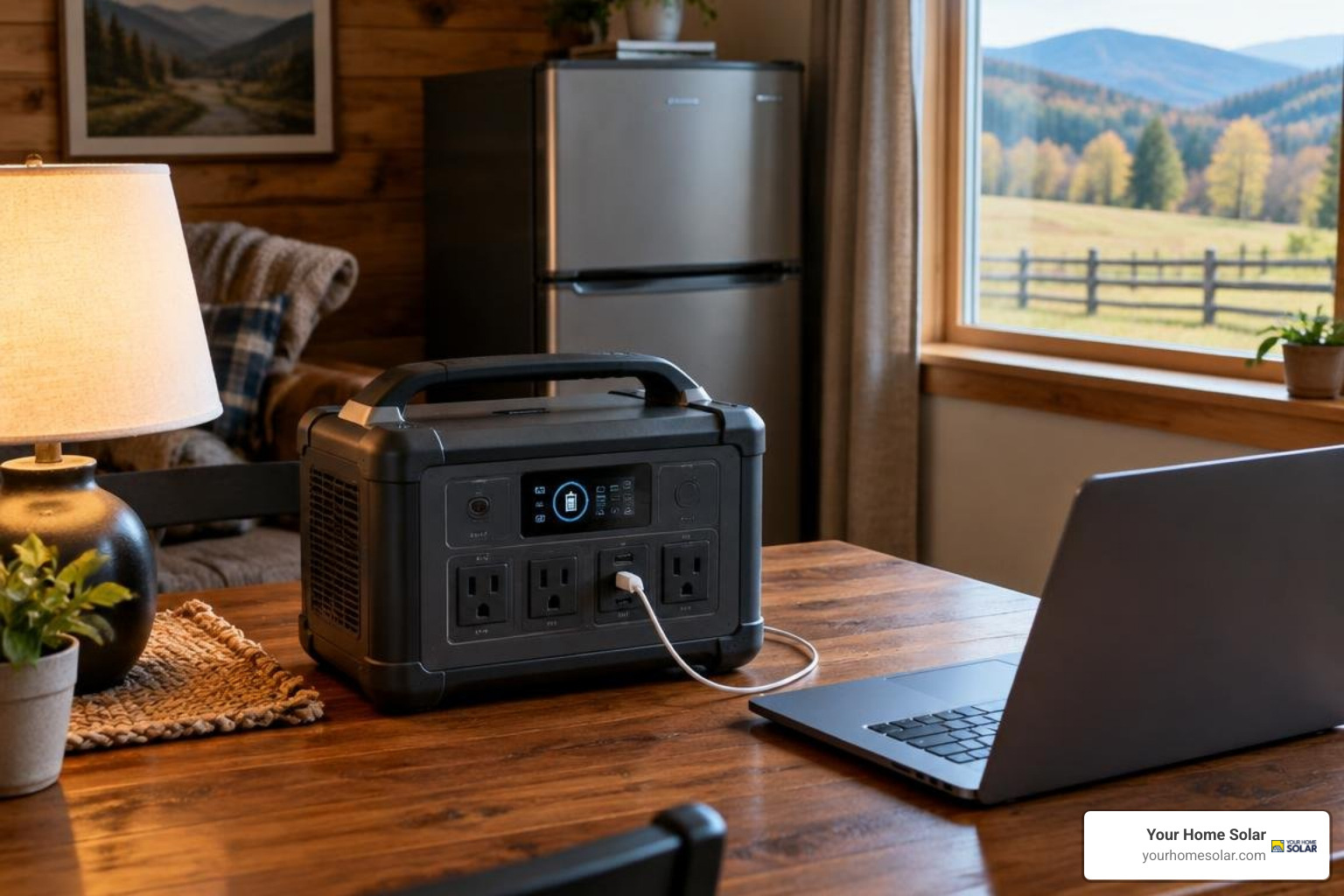
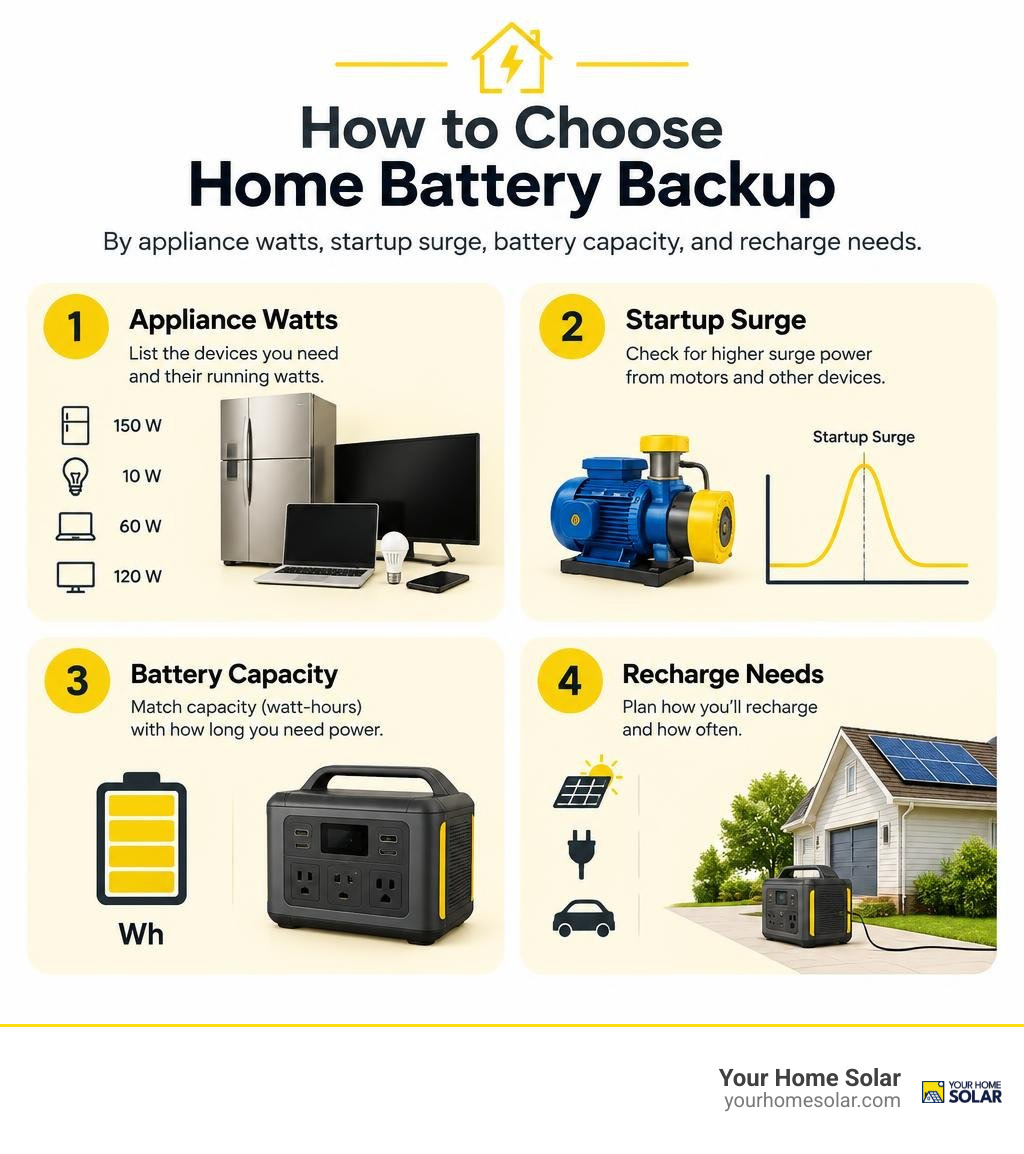
To choose a battery generator for home backup, list the appliances you need during an outage. Add their running watts, check for startup surges from motors, and choose a unit with enough output to handle both. Then compare battery capacity in watt-hours with how long you need power. A small portable unit can cover essentials for a short outage; powering an entire house takes much more storage and the right connection to your home’s electrical system.
Battery backup provides indoor power without the exhaust or fuel storage of a gas generator. But a battery has a limit: during a long outage, you will need enough stored energy, a way to recharge it, or a plan to use less power.
I’m Ernie Bussell, founder of Your Home Solar. My work leading solar operations and helping East Tennessee homeowners make energy decisions shapes this practical guide to choosing a battery generator for home backup.
Know your battery generator for home terms:
Understanding Indoor Battery Generators and Core Technology
A modern battery generator, often called a portable power station or home energy storage unit, combines high-capacity rechargeable battery cells, an advanced battery management system (BMS), and an internal bidirectional power inverter. Instead of burning fossil fuels to turn an alternator, these systems store electrical energy as chemical energy, discharging it instantly on demand.
When a storm rolls through Knox County or Blount County and knocks out the utility grid, a battery backup system delivers seamless, push-button electricity. You do not need to pull a starter cord, check oil levels, or hunt down an open gas station in the middle of the night. Learning why battery backup for home power outages outshines traditional generators helps clarify why so many homeowners are moving toward clean, solid-state indoor power.
Battery Chemistry: LiFePO4 vs. NMC Longevity
The heart of any battery generator is its cell chemistry. Most modern units designed for residential reliability use Lithium Iron Phosphate (LiFePO4 or LFP), though some older or ultra-lightweight models still use Nickel Manganese Cobalt (NMC).
LiFePO4 chemistry has become the gold standard for residential backup because of its exceptional thermal stability and lifespan. An LFP battery typically delivers 3,000 to 4,000 full charge-and-discharge cycles before dropping to 80% of its original capacity. If you discharge the battery completely every single day, it will last nearly a decade. In contrast, standard NMC batteries often degrade after 500 to 800 cycles. Furthermore, LiFePO4 cells are virtually immune to thermal runaway, making them remarkably safe to store and operate inside your living room, kitchen, or basement.
Inverter Performance and Clean Power Delivery
The built-in inverter converts stored direct current (DC) power from the battery cells into 120-volt or 240-volt alternating current (AC) power, which matches your standard household wall outlets.
High-grade battery generators use pure sine wave inverters. Unlike cheap mechanical generators that produce “dirty” power with high total harmonic distortion (THD), pure sine wave inverters produce smooth, consistent electrical waveforms. This is critical for modern East Tennessee homes equipped with sensitive electronics, such as smart TVs, desktop computers, CPAP machines, and high-efficiency variable-speed HVAC blowers. Clean power prevents microprocessors from overheating, humming, or suffering unexpected component failure during an outage.
Battery Backup Systems vs. Traditional Gas Generators
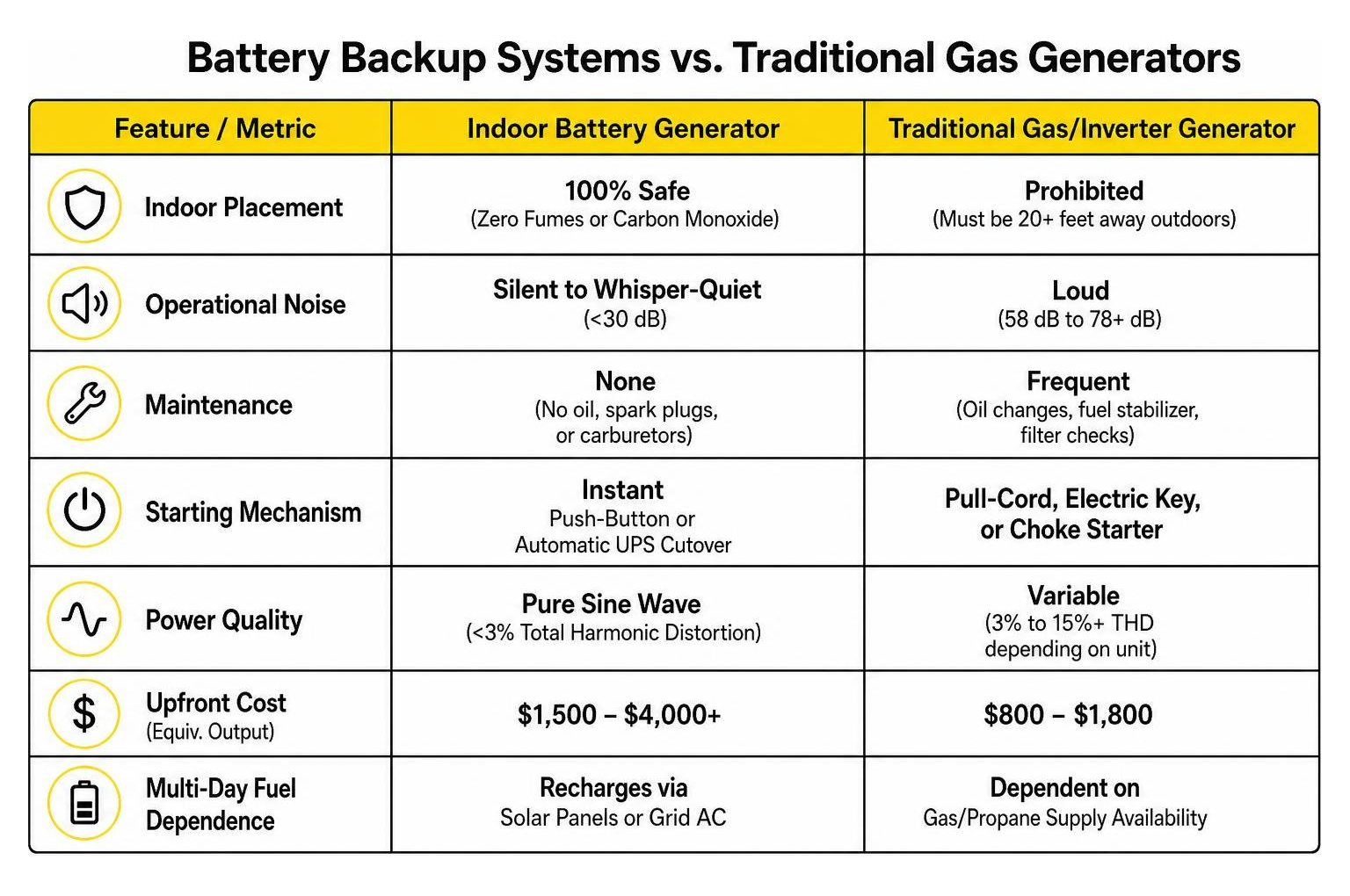
Deciding between a battery backup system and a traditional combustion generator comes down to where you can place the unit, how much noise you can tolerate, and how long you need it to run without grid power.
| Feature / Metric | Indoor Battery Generator | Traditional Gas/Inverter Generator |
|---|---|---|
| Indoor Placement | 100% Safe (Zero Fumes or Carbon Monoxide) | Prohibited (Must be 20+ feet away outdoors) |
| Operational Noise | Silent to Whisper-Quiet (<30 dB) | Loud (58 dB to 78+ dB) |
| Maintenance | None (No oil, spark plugs, or carburetors) | Frequent (Oil changes, fuel stabilizer, filter checks) |
| Starting Mechanism | Instant Push-Button or Automatic UPS Cutover | Pull-Cord, Electric Key, or Choke Starter |
| Power Quality | Pure Sine Wave (<3% Total Harmonic Distortion) | Variable (3% to 15%+ THD depending on unit) |
| Upfront Cost (Equiv. Output) | $1,500 – $4,000+ | $800 – $1,800 |
| Multi-Day Fuel Dependence | Recharges via Solar Panels or Grid AC | Dependent on Gas/Propane Supply Availability |
Independent product reviews, such as those from Consumer Reports, consistently highlight that battery stations excel at providing instant, hassle-free indoor power for short-to-medium disruptions.
Zero Emissions and Indoor Living Space Placement
Combustion generators produce deadly, odorless carbon monoxide (CO) gas. Federal safety guidelines require gas and diesel generators to run outdoors, at least 20 feet away from any windows, doors, or fresh-air intakes. For apartment residents, condo owners, or suburban homes with tight lot lines in Sevierville or Kingsport, running a gas generator safely is often impossible.
Battery generators produce zero emissions. You can set a battery power station directly on your kitchen counter to keep the refrigerator running, or place it right beside your nightstand to run essential medical devices. Because many units use passive heatsinks and intelligent, temperature-controlled cooling fans, they operate silently, letting you rest through a storm without the roar of a small combustion engine rattling your neighborhood.
Upfront Investment and Operational Runtime Realities
A quality battery generator requires a higher upfront financial investment than an entry-level gas generator. A 3,600-watt inverter gas unit typically costs around $1,000, whereas a 3,600-watt, high-capacity battery station often runs between $2,000 and $3,000.
The trade-off lies in ongoing costs and operational realities. With a gas generator, you must purchase fuel, maintain engine oil, drain carburetors before storage, and run the engine monthly. With a battery generator, ongoing maintenance costs are zero. However, as outlined in our complete guide to home battery backup options, battery runtimes are finite. A 3,600 watt-hour battery powering a continuous 700-watt appliance load will last roughly 5 hours before needing a recharge. If an ice storm takes down regional power lines for three full days, you must pair your battery with rooftop or ground-mounted solar panels to replenish your reserve capacity each day.
How to Choose the Right Battery Generator for Home Backup
Selecting the right unit requires matching your critical household appliances with the battery’s inverter wattage and energy capacity.
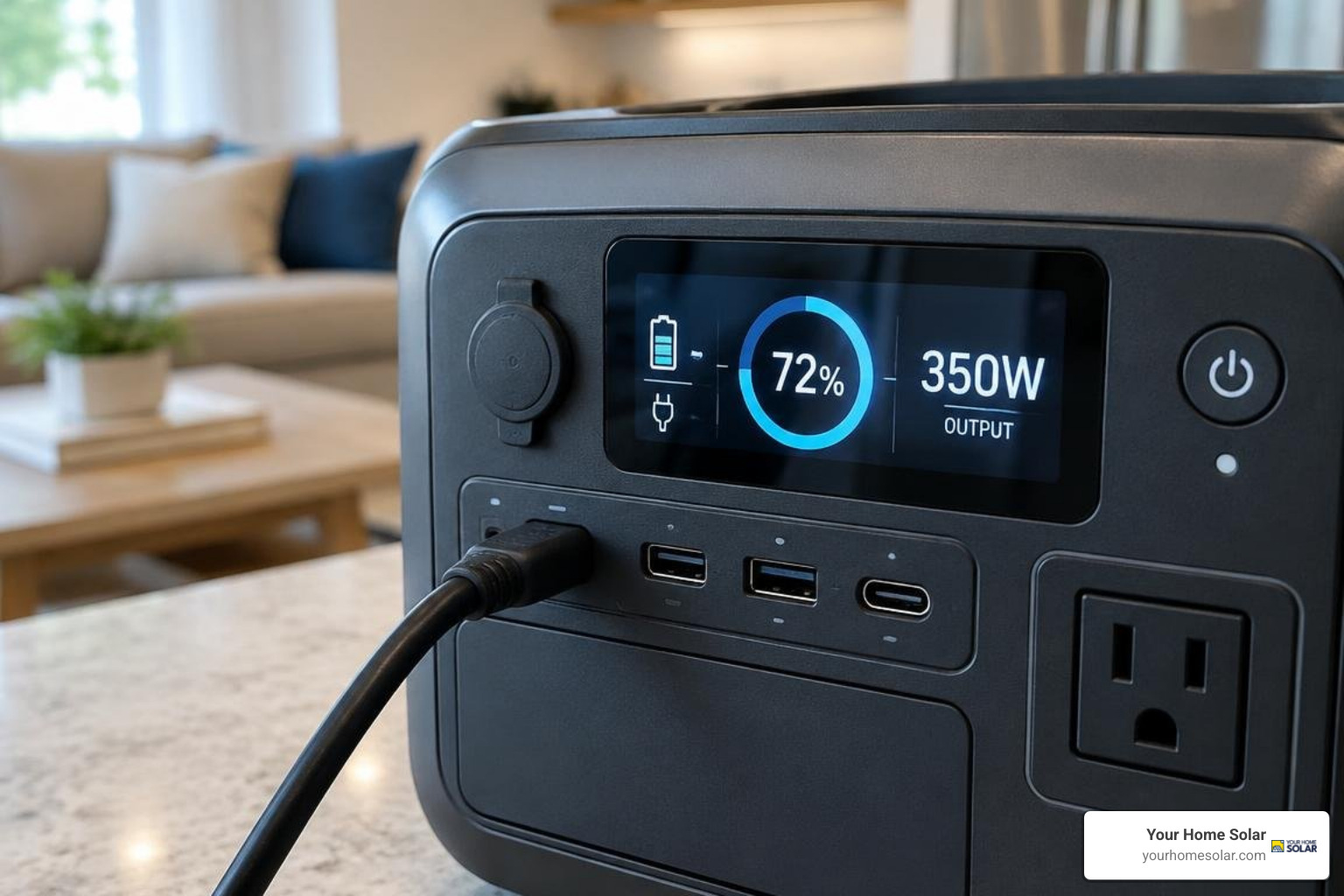
Before buying, review our practical steps for choosing a battery backup for house power to build an accurate household load profile.
Sizing Your Battery Generator for Home Emergency Needs
Battery capacity is measured in watt-hours (Wh) or kilowatt-hours (kWh), where 1 kWh equals 1,000 Wh. To calculate how long a unit will run your equipment, add up the total running watts of your devices and divide the battery’s usable capacity by that number:
The 0.85 multiplier accounts for standard inverter conversion efficiency losses (roughly 15%).
- Small Stations (500Wh – 1,000Wh): Best for charging smartphones, laptops, running LED table lamps, Wi-Fi routers, and CPAP machines for 1 to 2 nights.
- Medium Stations (1,000Wh – 2,500Wh): Can run a full-size home refrigerator (drawing 150 to 400 average running watts), a microwave, and television screens for 6 to 14 hours.
- Heavy-Duty Stations (3,000Wh – 10,000Wh+): Capable of backing up major household circuits, including deep freezers, space heaters, well pumps, and lighting circuits for 24 hours or longer when properly managed.
For an extensive selection of portable units across these power brackets, national retailers like The Home Depot and Lowe’s offer various modular capacities to explore.
Running Watts vs. Surge Watts for Heavy Household Loads
Every battery generator lists two critical wattage specifications: Running (Continuous) Watts and Surge (Peak) Watts.
Running watts represent the continuous power the inverter can sustain indefinitely. Surge watts represent the brief burst of power the inverter can deliver for a few seconds to start electric motors. Appliances with inductive motor loads—such as refrigerators, sump pumps, well pumps, and air conditioning compressors—draw two to four times their running wattage the instant they kick on.
If your basement sump pump runs at 800 continuous watts but surges to 2,200 watts on startup, your battery generator must have a surge rating of at least 2,400 watts to prevent its internal protection circuit from tripping.
Recharging Capabilities and Solar Panel Integration
A battery generator is only as dependable as your plan to recharge it when the utility grid is down.
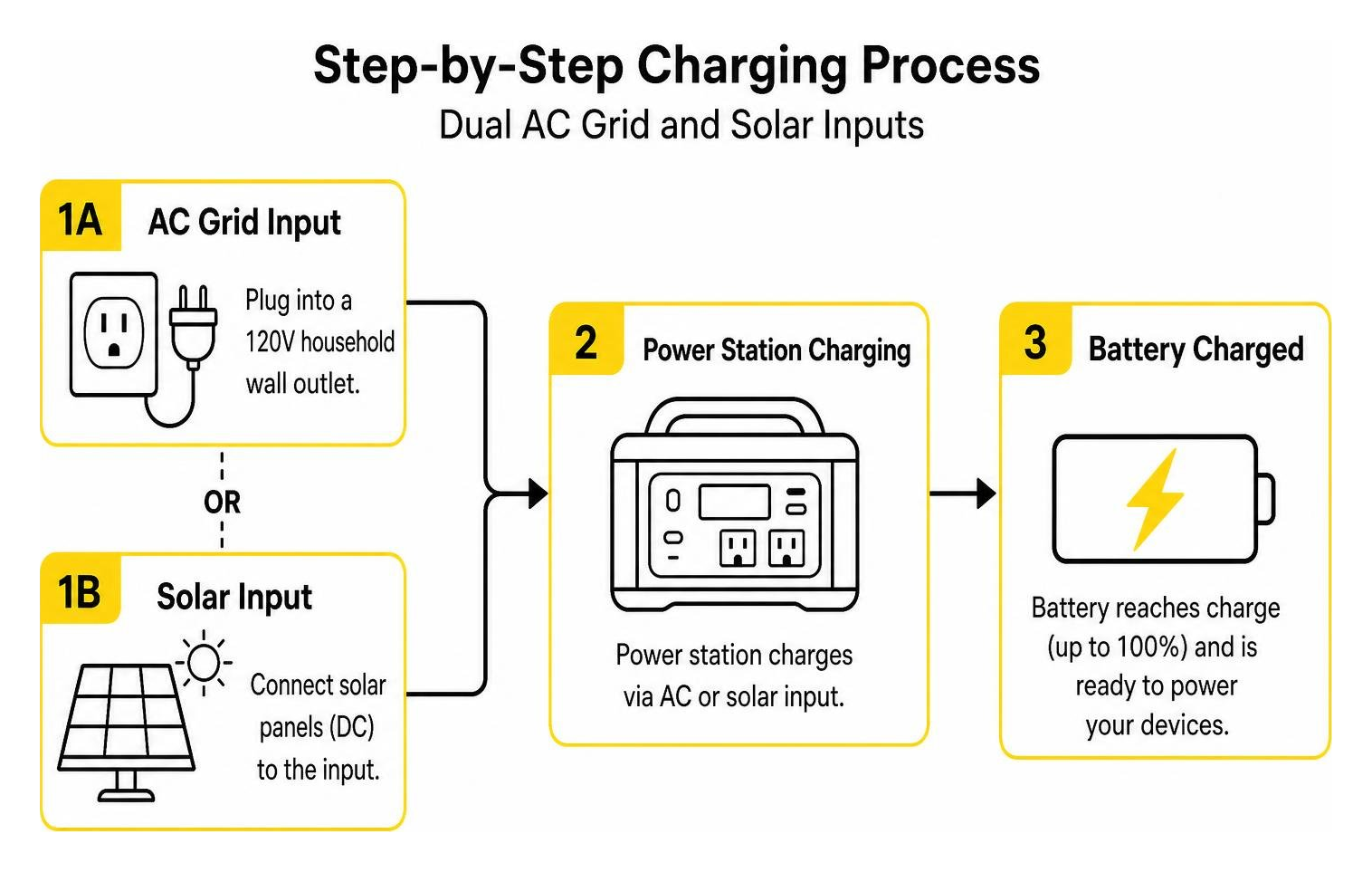
Modern power stations offer dual-charging capabilities, accepting high-speed AC current from standard wall outlets or DC power generated by solar panels. Understanding 120-volt solar generator integration for household loads gives you complete energy independence when regional storms disable local power infrastructure.
AC Wall Fast Charging vs. Off-Grid Solar Arrays
When utility power is available, modern fast-charging circuitry can recharge a high-capacity battery from 0% to 80% in about 60 to 90 minutes via a standard 120V household wall plug.
During an extended blackout, portable or roof-mounted solar panels become your primary fuel source. Solar panels generate direct current, which passes through the battery station’s internal Maximum Power Point Tracking (MPPT) charge controller. An MPPT controller continuously optimizes the voltage and current coming off the solar array, ensuring maximum charging efficiency even in hazy or partly cloudy conditions across East Tennessee. High-capacity battery units can accept between 1,000W and 3,000W of solar input, allowing you to replenish a depleted 3,000Wh battery in roughly 3 to 5 hours of direct sunlight.
Expandable Modular Capacity for Extended Blackouts
Leading manufacturers design their flagship home battery generators with modular architecture. Instead of being locked into a fixed storage capacity, you can connect secondary expansion battery packs via heavy-gauge DC cascade cables.
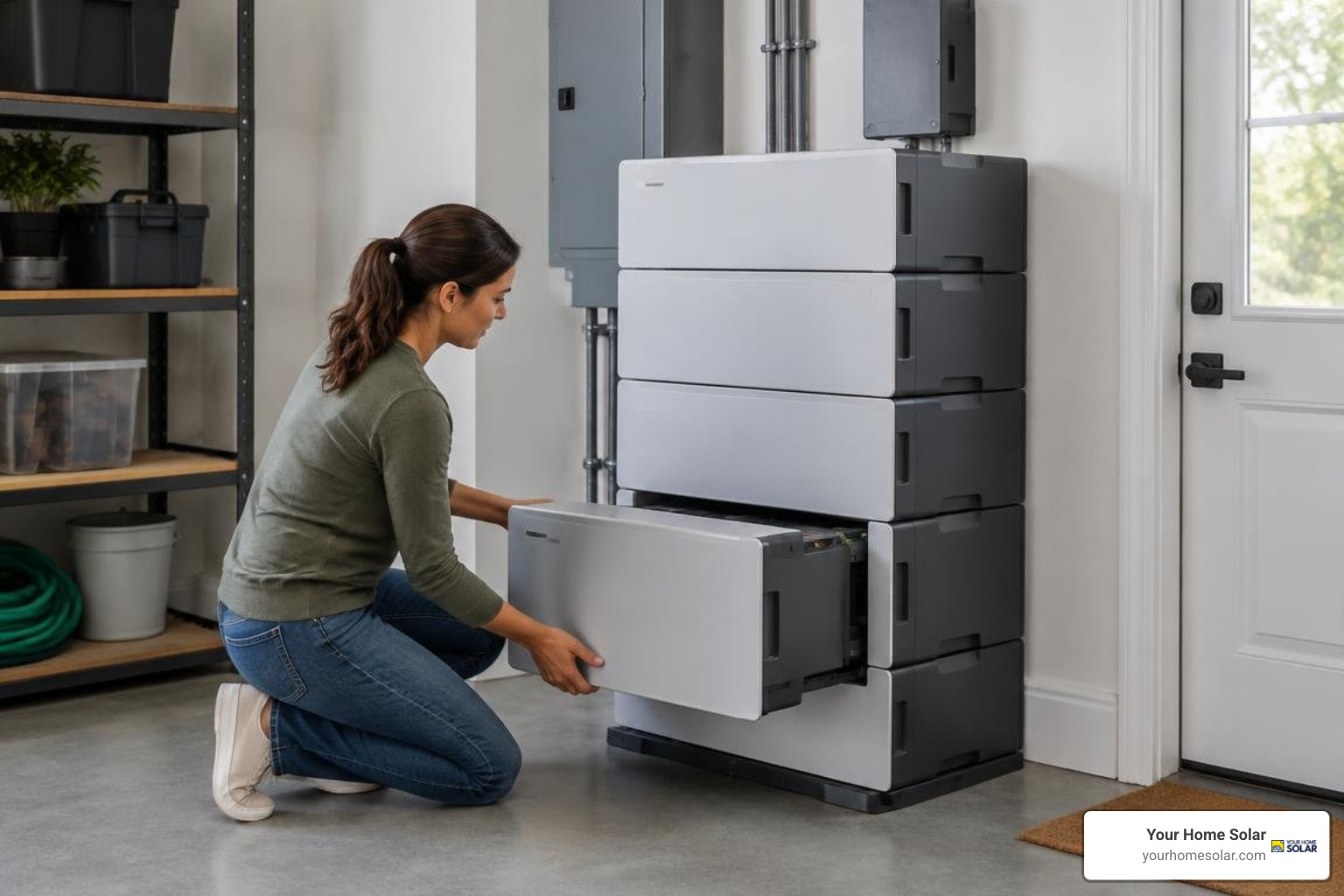
For example, a base station with 3,600Wh of capacity can expand to over 10,000Wh or even 15,000Wh by stacking external battery modules alongside the primary inverter unit. If you want to connect high-draw 240V appliances—such as a central well pump or an electric clothes dryer—many expandable systems allow you to link two identical units together to deliver split-phase 120V/240V output. Exploring our home battery backup options will help you find the right scale for your property’s electrical demands.
Integration with Household Electrical Panels
While you can run individual appliances by plugging heavy-duty extension cords directly into the front ports of a battery station, integrating the system directly with your home’s electrical panel offers far greater safety and convenience.
Connecting a Battery Generator for Home Circuits Safely
To power hardwired home circuits—such as ceiling lighting, hardwired furnace blowers, and well pump switches—your battery station can connect to an exterior or interior power inlet box wired directly to your main electrical panel.
Using integrated wheels, telescoping luggage handles, or heavy-duty carrying grips, high-capacity units (which often weigh between 70 and 100 pounds) can be easily rolled into your utility room or garage and connected with a heavy-duty 30-amp or 50-amp generator cable.
Preventing Hazardous Electrical Back-Feeding with Transfer Switches
You must never connect a battery generator to your home by plugging it into a standard wall outlet with a double-male plug. This dangerous practice, known as back-feeding, sends unmetered high-voltage current backward through your electrical panel and out onto neighborhood utility lines. Back-feeding can severely injure or kill utility line workers who are actively working to restore the grid.
To prevent back-feeding, electrical codes require a manual transfer switch or an electrical interlock kit installed by a licensed electrician. A transfer switch physically disconnects selected household circuits from the electrical utility before connecting them to your battery generator. This keeps your home safe, complies with National Electrical Code (NEC) standards, and lets you toggle critical circuits on and off with a simple flip of a switch.
Frequently Asked Questions About Home Battery Backup
Can a battery generator power a whole house during a blackout?
Yes, high-capacity battery generators featuring dual-unit split-phase connections (delivering 240V) or large whole-home systems can power your entire house. However, running heavy central air conditioning, electric water heaters, and electric stoves simultaneously requires substantial capacity (typically 10kWh to 20kWh or more) and disciplined load management to avoid draining the system prematurely.
How long does a LiFePO4 battery generator last before losing capacity?
A quality LiFePO4 battery generator typically lasts between 3,000 and 4,000 complete charge cycles before declining to 80% of its factory capacity. Under typical home emergency backup use (cycling 20 to 50 times per year), the battery cells can easily maintain reliable performance for 10 to 15 years or longer.
Is it safe to leave a battery generator plugged in continuously?
Yes. Modern home battery stations feature internal Battery Management Systems with pass-through charging and float-mode protection. When utility power is running normally, incoming AC power bypasses the battery cells to power your connected devices directly. When the grid fails, the unit switches to battery power in under 20 milliseconds, functioning as an Uninterruptible Power Supply (UPS) for computers, medical devices, and home internet routers.
Conclusion
A clean, indoor battery generator provides a safe, quiet, and reliable way to protect your household against grid blackouts. By pairing advanced LiFePO4 chemistry with pure sine wave inverters, you can keep your essential food storage, communications, medical equipment, and lighting running indoors without toxic fumes, carbon monoxide hazards, or pull-cord maintenance.
At Your Home Solar, we provide comprehensive residential energy solutions across East Tennessee, including Knoxville, Maryville, Oak Ridge, Johnson City, Kingsport, and surrounding counties. Our team specializes in designing tailored solar installations, whole-home battery backup systems, and EV charging infrastructure built to keep your family comfortable and resilient through any storm.
Ready to take control of your household energy security? Explore our comprehensive off-grid solar systems guide or reach out to our team today to schedule an evaluation for your home.