Why Home Battery Backup Options Matter More Than Ever in East Tennessee
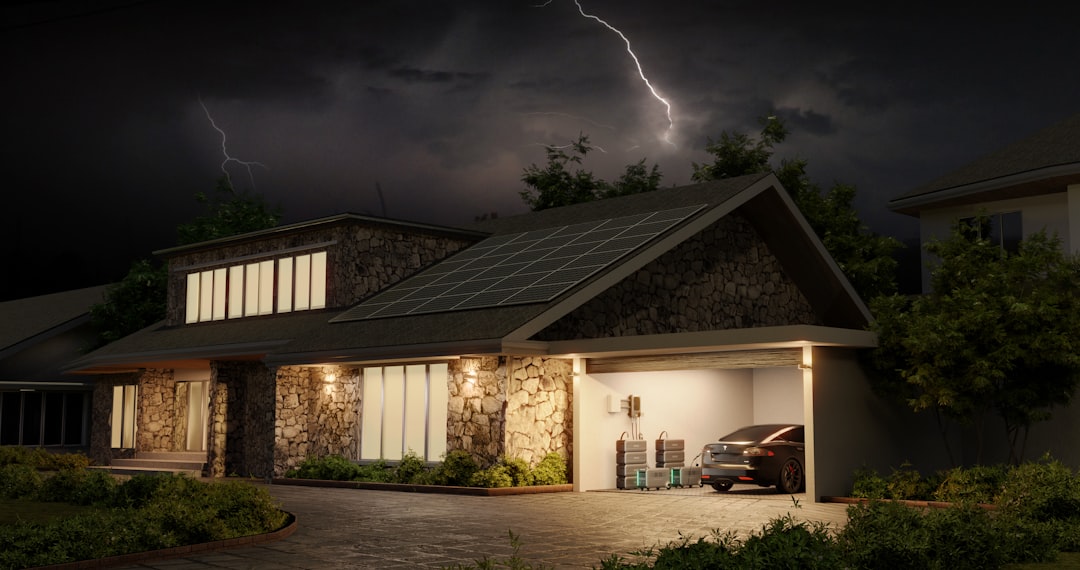
When the lights go out, home battery backup options can mean the difference between staying comfortable and scrambling for candles. In East Tennessee, severe storms, aging grid infrastructure, and rising energy costs make that choice more urgent every year.
Here’s a quick look at the main types of home battery backup systems available today:
| Type | Best For | Typical Capacity | Approx. Cost (Before Incentives) |
|---|---|---|---|
| Portable battery station | Brief outages, essential loads | 1.5 – 10 kWh | $1,500 – $10,000 |
| Whole-home battery system | Full-house backup | 10 – 90 kWh | $10,000 – $25,000+ |
| Solar + battery system | Long outages, bill savings | 10 – 90 kWh | $15,000 – $40,000+ |
| Grid-charged standalone battery | Outage protection without solar | 10 – 30 kWh | $10,000 – $20,000 |
The good news: a 30% federal tax credit applies to qualifying battery systems, significantly reducing what you actually pay out of pocket.
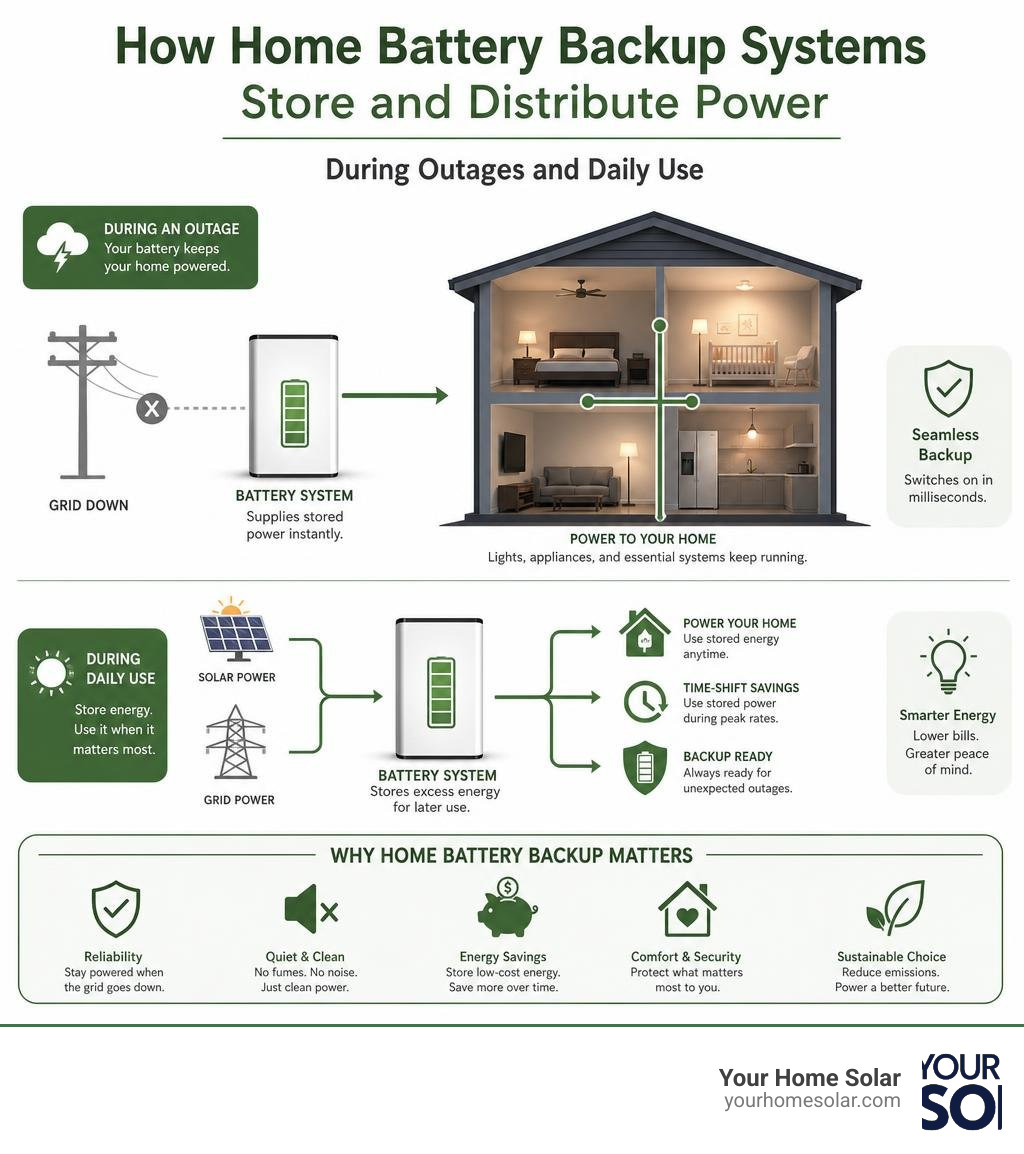
Power outages are getting longer and more frequent across the country. The average U.S. home loses power for roughly eight hours a year — but in storm-prone regions, that number climbs fast. And when the grid goes down, a battery system switches on in milliseconds, silently and automatically, with zero fumes. A gas generator can’t match that.
This guide walks you through every major option, what things cost, how long batteries last, and how to pick the right system for your home.
I’m Ernie Bussell, founder and CEO of Your Home Solar and a former operations leader who helped scale a $40 million solar installation business — and helping East Tennessee homeowners navigate home battery backup options is one of the most important things my team does every day. Let’s break it all down so you can make a confident, informed decision.
Understanding Your Home Battery Backup Options
When exploring home battery backup options, the first thing to understand is the technology beating at the heart of these systems: the battery chemistry. The market has moved rapidly over the last few years, transitioning away from older lead-acid batteries toward advanced lithium-ion technologies.
Today, the residential storage market is dominated by two primary lithium chemistries:
- Lithium Iron Phosphate (LiFePO4 or LFP): LFP has quickly become the gold standard for home energy storage. It is incredibly stable, highly resistant to thermal runaway (making it exceptionally safe for indoor installations), and boasts an impressive lifespan. Most LFP home batteries easily last 10 or more years, enduring several thousand full charge-and-discharge cycles before experiencing any notable capacity degradation.
- Lithium Nickel Manganese Cobalt (NMC): NMC batteries are highly power-dense, meaning they pack a lot of energy into a smaller, lighter footprint. While they are common in electric vehicles and portable power stations, they generally have a shorter cycle life (often around 500 to 1,000 cycles to 80% capacity) and require sophisticated cooling systems to maintain safety.
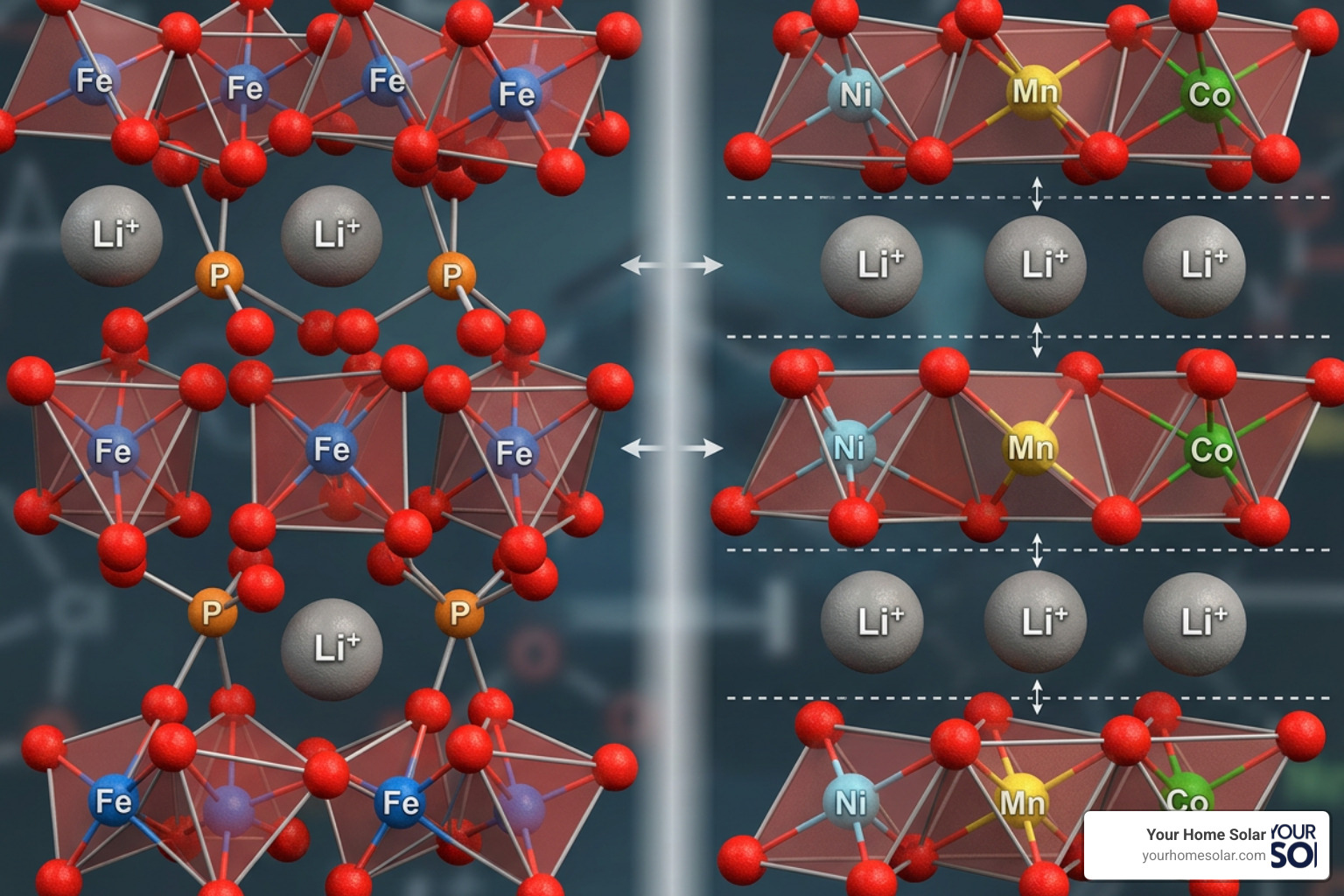
Understanding these chemical differences is crucial because they directly impact how long your investment will last and how safely it will operate inside your utility room or garage. For a deeper dive into how these technologies stack up, check out our In-Depth Guide to Solar Battery Backup Comparison.
Portable Home Battery Backup Options for Quick Setup
If you are looking for an immediate, budget-friendly solution that does not require a massive electrical overhaul, portable battery backup options are an excellent entry point. These systems are essentially heavy-duty, clean, and silent power stations that can be easily set up in your home.
Most portable options utilize a “plug-and-play” design. During a blackout, you can run heavy-duty extension cords directly from the battery unit to your refrigerator, Wi-Fi router, and phones. However, for a much cleaner experience, you can have a licensed electrician install a manual transfer switch. This allows you to plug the portable unit directly into a designated inlet box, immediately routing backup power to up to 10 pre-selected critical loads in your main breaker panel.
A prime example of this technology is the Yeti 6000X Power Station. With roughly 6,000 watt-hours of base capacity, this unit can keep your lights, refrigerator, and medical devices humming for days without the noise, fumes, or maintenance of a gas generator. Best of all, if you go camping or move to a new home in East Tennessee, you can simply unplug it and take your power with you.
Whole-Home Battery Backup Options for Complete Energy Security
For homeowners who want a seamless, hands-off experience during a grid failure, whole-home battery backup systems represent the pinnacle of energy resilience. These systems are permanently wired into your home’s electrical infrastructure.
When the grid goes down, an automatic transfer switch (ATS) or a smart electrical panel detects the interruption and disconnects your home from the utility grid in under 20 milliseconds. This transition is so fast that your digital clocks won’t even blink, and your computers won’t reboot.
Whole-home systems are designed to manage large loads and can be scaled up by stacking multiple battery modules to meet your household’s exact energy demands. Premium systems, such as the Whole Home Battery Backup, offer advanced load management, allowing you to prioritize which appliances get power dynamically through a smartphone app.
Other industry-leading options like the Powerwall and the Home Energy System for Solar & Backup Power | Generac offer robust, weatherproof enclosures that can be installed indoors or outdoors, giving you complete peace of mind no matter how severe the storm is outside.
How Standalone Battery Backup Works Without Solar
A common misconception is that you must have solar panels installed to benefit from a home battery. In reality, standalone grid-charged batteries are highly effective tools for both emergency backup and daily financial savings.
Without solar, a standalone battery connects directly to your home’s electrical panel and charges using electricity from the local utility grid. The battery remains fully charged and on standby, waiting to step in the instant a storm knocks down power lines.
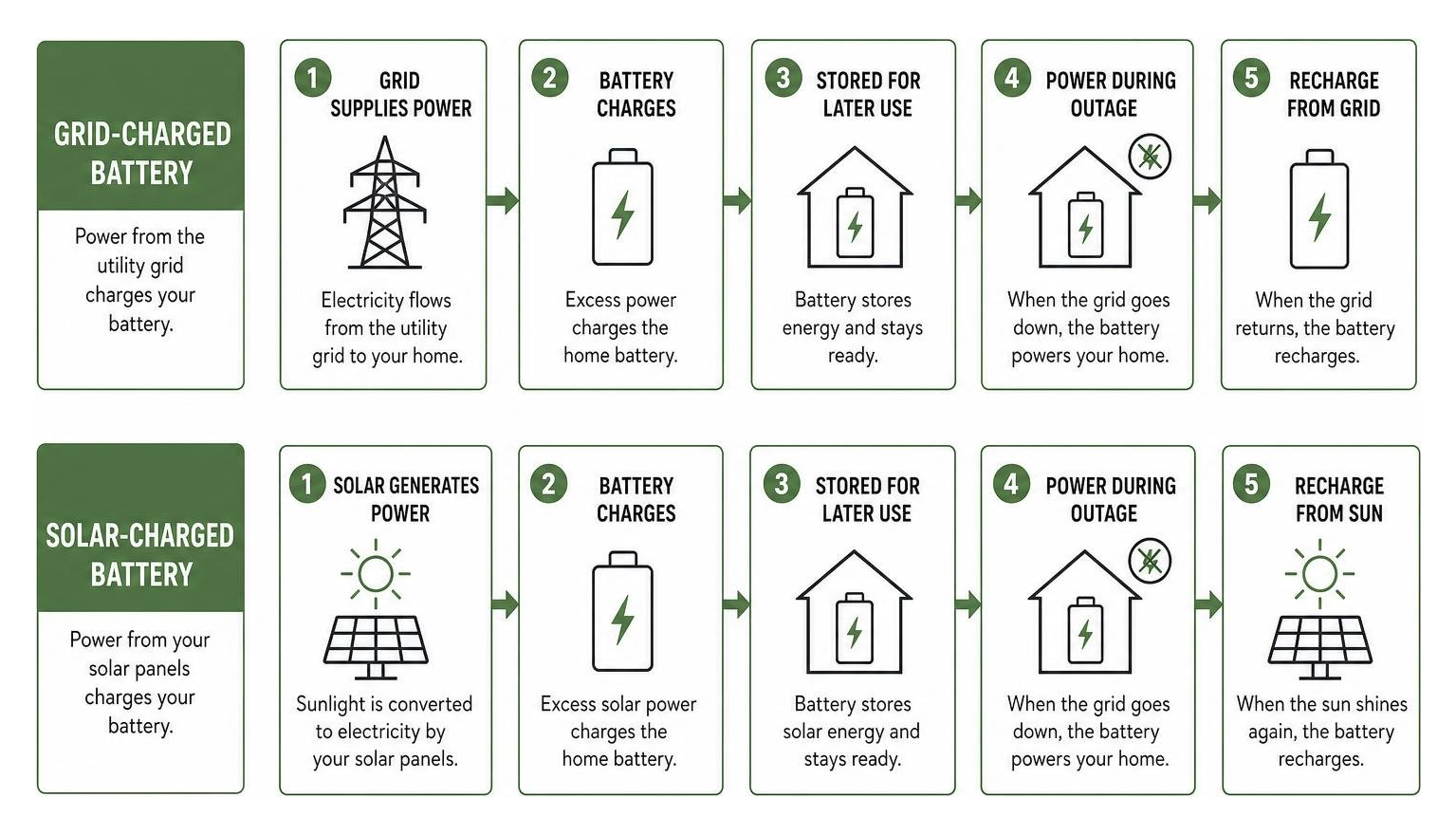
Beyond simple emergency protection, standalone batteries can be programmed to save you money every single day through a process known as load shifting or peak shaving. Many utility companies charge different rates for electricity depending on the time of day, known as Time-of-Use (TOU) rates.
With a smart standalone battery, you can program the system to charge from the grid during the middle of the night when electricity rates are at their lowest. Then, during peak evening hours when rates skyrocket, the battery discharges to power your home, avoiding expensive utility charges altogether. For a step-by-step breakdown of how to integrate this technology seamlessly into your household, read The Ultimate Guide to Choosing a Battery Backup for House Power Without Losing Your Mind.
Pros and Cons of Standalone Grid-Charged Batteries
Before deciding on a standalone battery system, it is important to weigh the advantages and limitations of this setup:
Pros
- Lower Upfront Cost: By skipping the solar panels, microinverters, and complex roof mounting systems, you can save thousands of dollars on your initial installation.
- Immediate Protection: You get the same instant, silent backup protection during outages as a solar-paired system.
- Tax Incentives: Thanks to updated federal guidelines, standalone battery installations with a capacity of 3 kWh or more qualify for the same 30% federal tax credit as solar-plus-storage systems.
- Aesthetic and Roof Freedom: If your home is heavily shaded by East Tennessee’s beautiful trees, or if your roof is not structurally suited for solar panels, a standalone battery is the perfect alternative.
Cons
- Grid Dependency: Because the battery charges from the grid, you are still ultimately dependent on the utility company. If a catastrophic storm causes an outage that lasts for weeks, once your battery drains, you cannot recharge it until grid power returns.
- Limited Backup Duration: Unlike a solar battery that recharges daily under the sun, a standalone battery only has one “tank” of fuel per outage.
- Reduced Long-Term Savings: While load shifting helps lower your monthly power bill, you won’t achieve the near-total energy independence that comes with generating your own free solar power.
To learn more about how different battery types perform in standalone configurations, take a look at our comprehensive article, Everything You Need to Know About Residential Solar Battery Types: What’s Best?.
Comparing Battery Backup Systems vs. Traditional Generators
For decades, the go-to solution for emergency backup power was a fossil-fuel-powered standby generator. While generators are still highly effective, modern home battery systems solve the outage problem in fundamentally different, and often superior, ways.
Here is a direct head-to-head comparison to help you understand which technology fits your lifestyle:
| Feature | Home Battery Backup System | Traditional Standby Generator |
|---|---|---|
| Upfront Cost | $10,000 – $25,000+ | $3,000 – $15,000+ |
| Operating Cost | $0 per hour | $5 – $15+ per hour (fuel costs) |
| Transfer Time | Instant (<20 milliseconds) | 10 – 30 second startup delay |
| Noise Level | Completely silent (0 dB) | Loud (60 – 80+ dB) |
| Emissions | Zero direct emissions | Produces carbon monoxide & exhaust |
| Maintenance | None required | Regular oil, filter, and spark plug changes |
| Fuel Dependency | None (recharges via solar or grid) | Constant supply of propane, natural gas, or diesel |
| Lifespan | 10 – 15 years | 10 – 20 years (limited by running hours) |
While generators boast a lower upfront purchase price and can run indefinitely as long as you have fuel, they come with significant operating costs, noise, and maintenance demands. If you live in a quiet neighborhood in Knoxville or Farragut, the silent, automated operation of a battery system is often highly preferred.
Additionally, a battery system has zero startup delay. When the grid fails, your home remains powered without a single interruption, protecting sensitive electronics like home servers, medical equipment, and smart home hubs. If you are torn between these two paths, our guide on Power to the People with a Battery Generator Backup offers an excellent breakdown of how some homeowners are even combining both technologies for the ultimate backup solution.
Sizing and Cost: How Much Battery Capacity Do You Need?
Determining the right battery capacity for your home is a balancing act between your budget and your power requirements. Battery capacity is measured in kilowatt-hours (kWh), which represents the total amount of energy the battery can store.
Continuous power (measured in kilowatts, or kW) represents how much electricity the battery can deliver at any single moment. For example, a battery might store 13.5 kWh of total energy but only be able to deliver 5 kW of continuous power. If you try to run your clothes dryer, microwave, and air conditioner all at once, you might exceed that 5 kW limit, causing the battery to shut down to protect itself.
To size your system correctly, you must first decide what you want to power during an outage:
- Essentials-Only Backup (~10 kWh): This setup is designed to keep your absolute necessities running. It will easily power your refrigerator, home router, LED lights, phone chargers, and a few choice outlets for 24 hours or more.
- Whole-Home Backup (30+ kWh): To run your entire home without changing your lifestyle—including heavy loads like central air conditioning, well pumps, and electric water heaters—the average home requires at least 30 kWh of storage to get through a full day without recharging.

Calculating your exact load requirements can feel overwhelming, but we have simplified the process in our guide, Shocking or Saving: What a Home Battery Backup Actually Costs.
Typical Costs, Incentives, and Tax Credits in 2026
As of July 2026, the average home battery backup system costs roughly $15,000 for a standard 13.5 kWh unit (such as the Tesla Powerwall 3, which is priced around $998 per kWh of capacity) before any rebates or tax incentives are applied. This price typically includes the battery itself, the necessary gateway or inverter, and professional installation by a certified electrician.
Fortunately, several powerful financial incentives are available to help East Tennessee homeowners offset these upfront equipment and installation costs:
- The Residential Clean Energy Credit (Section 25D): This federal program offers a 30% tax credit on the total cost of your battery backup system. Crucially, this credit applies to both solar-paired batteries and standalone battery systems with a capacity of 3 kWh or more. This means a $15,000 installation could qualify for a $4,500 direct reduction in your federal tax liability.
- Local Utility Rebates: Depending on where you live in East Tennessee—whether you are served by the Knoxville Utilities Board (KUB), local electric cooperatives, or TVA—there may be local programs, net metering options, or grid-support incentives that offer additional financial benefits for installing home energy storage.
To get a realistic, transparent view of the financial commitment and long-term return on investment, be sure to read our detailed analysis, The Real Price of Never Losing Power Again.
Frequently Asked Questions About Home Battery Backup
We hear a lot of great questions from homeowners in Oak Ridge, Maryville, and Johnson City when they are researching home battery backup options. Here are answers to the most common queries we receive:
Can a home battery backup system run a central air conditioner?
Yes, but it requires careful planning. Central air conditioners demand a massive surge of electrical current (known as locked rotor amps or LRA) just to start their compressors. This initial surge can easily exceed the peak power output of a single standard home battery.
To run a central AC unit, you typically need to do one of two things:
- Install Multiple Batteries: Stacking two or more batteries increases both your continuous and peak power output, allowing the system to handle the AC’s startup surge.
- Install a Soft Starter: A soft starter is a small, inexpensive device installed on your AC unit that reduces its startup power demand by up to 70%, allowing a single battery to start and run the air conditioner safely.
Systems like the Whole Home Battery Backup or the SolarEdge Home Backup – Blackout Protection | SolarEdge are highly capable of managing heavy HVAC loads when configured correctly.
Can I expand or upgrade my battery storage capacity later?
Absolutely. Most modern residential battery systems are designed with modularity in mind. If you start with a single 10 kWh or 13.5 kWh battery to back up your essential circuits, you can easily stack additional battery modules later as your budget allows or as your household power needs grow.
For example, systems utilizing advanced LFP technology allow you to parallel multiple battery units together on a single inverter. This modular approach makes future-proofing your home simple, allowing you to easily add solar panels or expand your storage capacity down the road without having to redesign your entire electrical setup.
How long will a home battery last during a prolonged power outage?
The runtime of your battery depends entirely on your capacity and your energy conservation strategies.
If you have a 13.5 kWh battery and only run your refrigerator, LED lights, and Wi-Fi, the battery can easily last for two to three days on a single charge. However, if you run your electric oven, take long hot showers (using an electric water heater), and keep the central AC blasting, you could drain that same battery in just a few hours.
By practicing smart load management—such as turning off non-essential breakers and using energy-efficient appliances—you can stretch your battery life significantly. And if your battery is paired with a home solar system, it will recharge every day when the sun comes up, providing you with an indefinite source of clean power during extended grid outages.
Conclusion
Navigating the wide array of home battery backup options doesn’t have to be overwhelming. Whether you are looking for the simplicity of a portable power station, the affordability of a standalone grid-charged battery, or the complete peace of mind that comes with a solar-paired, whole-home backup system, there is a perfect solution for your home.
At Your Home Solar, we are proud to be East Tennessee’s leading energy experts. Serving communities across Knoxville, Sevierville, Kingsport, and the surrounding counties, we specialize in designing customized, reliable, and highly rewarding home energy installations. We handle everything from the initial site assessment to securing permits and maximizing your tax credits, ensuring 100% customer satisfaction.
Don’t wait for the next major storm to leave you in the dark. Secure your home’s energy future today by contacting our friendly team for a free, personalized consultation. Let’s work together to keep your lights on, no matter what happens to the grid!