
What Is Ground Mounted PV and When Does It Make Sense?
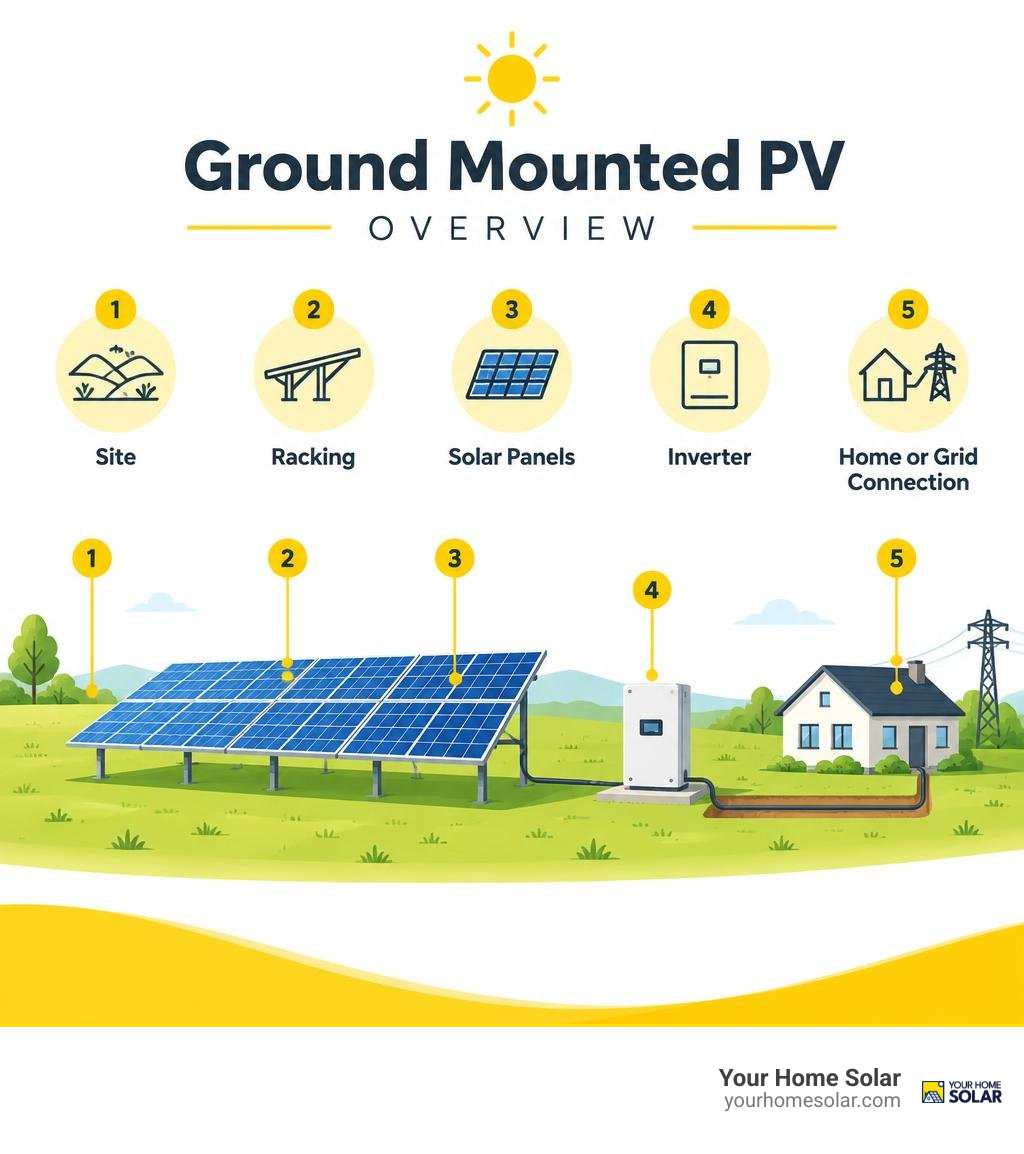
Ground mounted PV is a solar panel system installed on a freestanding rack in your yard, field, or other open land instead of on your roof. It is often the best choice when a roof is shaded, faces the wrong direction, needs repairs, or cannot support a large enough system.
Unlike rooftop solar, a ground array can be set at the best tilt and direction for local sun exposure. It is also easier to access for cleaning, inspections, and repairs. The tradeoff is higher upfront cost because the project may need foundations, trenching, wiring, and site work.
For homeowners and businesses, the basic decision is simple:
- Choose rooftop solar when the roof is sound, sunny, and large enough.
- Consider a fixed ground mount when you have open land and want dependable production with fewer moving parts.
- Consider a solar tracker when higher energy output justifies more equipment, land, and maintenance.
Ground-mounted systems range from small residential arrays to utility-scale solar fields. Fixed-tilt systems commonly use about 4 to 6 acres per megawatt, while single-axis tracker projects often need 5 to 8 acres per megawatt because rows need more space to avoid shading each other.
I am Ernie Bussell, Founder and CEO of Your Home Solar. My experience leading solar operations, installation planning, and homeowner education helps me explain ground mounted PV in practical terms, from site design and production to long-term service.
Simple ground mounted pv word guide:
Ground-Mounted Solar vs. Rooftop Solar: Key Differences and Benefits
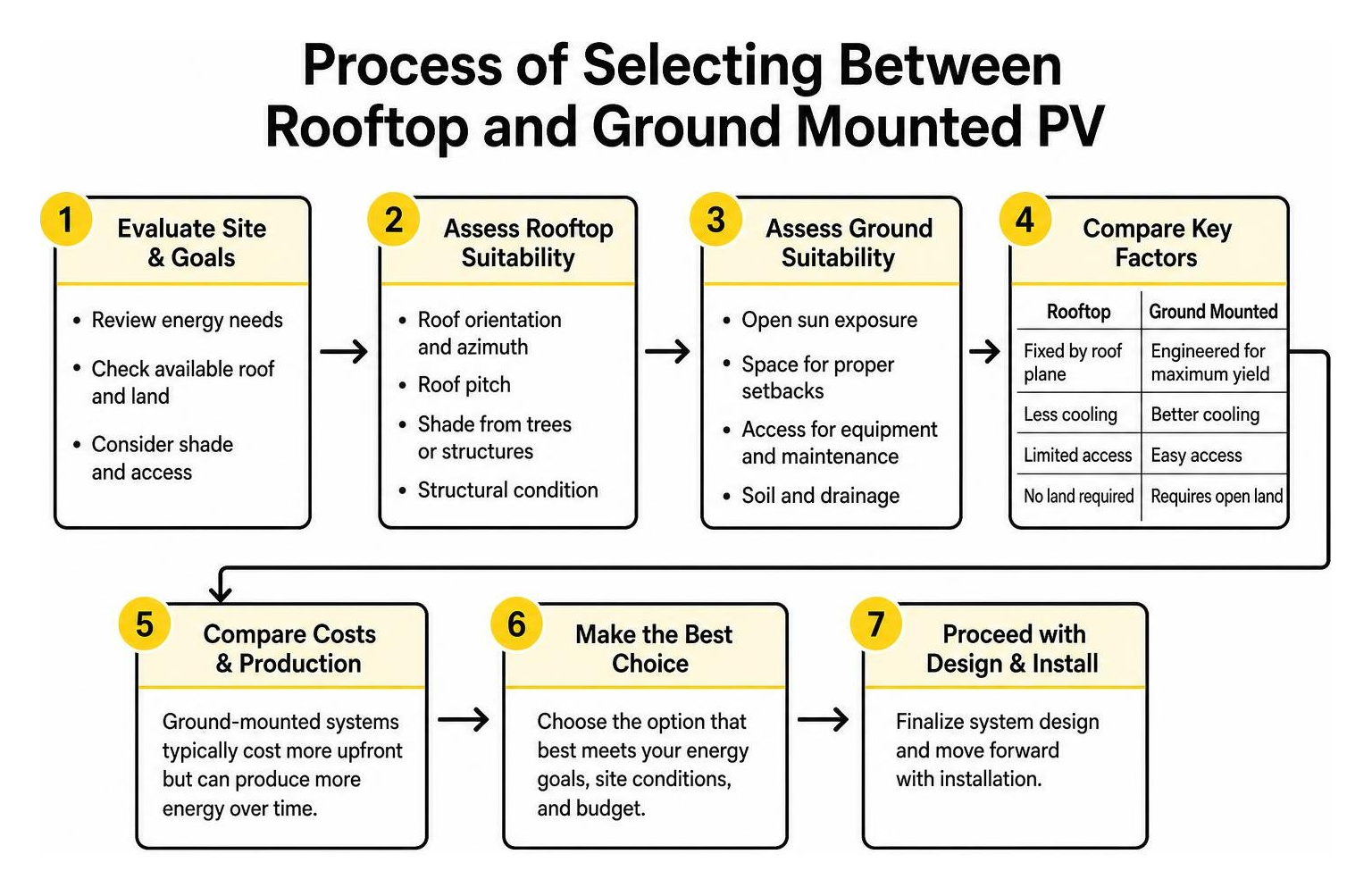
When assessing clean energy upgrades, property owners frequently compare surface racking systems against rooftop arrays. While rooftop setups preserve open ground, freestanding ground installations provide total engineering control over angle, azimuth, and cooling dynamics.
Property owners also benefit by protecting roof integrity without structural penetration, which avoids roof leaks and removes the need to dismantle panels when shingles eventually require replacement.
| Factor | Rooftop Solar | Ground-Mounted Solar |
|---|---|---|
| Upfront Installation Cost | Baseline cost; utilizes existing structure | Typically ~41% higher due to trenching and foundations |
| Orientation & Azimuth | Dictated entirely by the building’s roof plane | Engineered directly toward true south for maximum yield |
| Panel Tilt Angle | Fixed by existing roof pitch (often suboptimal) | Calibrated precisely to latitude for peak seasonal capture |
| Thermal Operating Efficiency | Warmer airflow behind modules degrades output | Open-air ventilation underneath improves operating efficiency |
| Bifacial Energy Capture | Minimal (flush-mount absorbs direct front light only) | Elevated racking captures backside albedo ground reflections |
| Maintenance Accessibility | Requires ladders, safety harnesses, and roof walking | Walk-up access for inspections, snow removal, and washing |
Understanding Ground-Mounted Solar Fundamentals
Ground arrays utilize heavy-duty metal frameworks securely anchored into the earth, elevating solar panels from a few inches to several feet high. By exploring diverse residential installation types, you can quickly determine whether freestanding racking better serves your energy demands compared to roof or wall mounts.
Open acreage allows designers to place panels completely outside the shade line of mature tree canopies, chimneys, and nearby buildings, resulting in consistent daily power production.
Comparing Production Efficiency, Costs, and System Longevity
Ground-mounted installations carry an upfront cost premium—averaging roughly 41% more than rooftop solar according to recent industry data. In residential applications, an average 14.7 kW ground-mounted array represents an expenditure of approximately $43,571 before incentives.
However, by understanding residential energy system options, buyers realize that ground mounts reliably yield 15% to 30% more total kilowatt-hours than poorly oriented roofs. The superior convective airflow beneath open racking cools the silicon wafers, preventing thermal degradation during peak summer heat waves.
Engineering and Foundation Options for Ground Mounted PV Systems
Engineering a reliable ground mount requires accounting for wind uplift forces, dead loads, and regional seismic conditions under ASCE 7-22 structural standards. Steel components must receive hot-dip galvanization per ISO 1461 (minimum 85 to 120 µm coating) to prevent corrosion from moisture and acidic soils over decades of service.
Commercial and residential project engineers frequently design systems in accordance with power plant design guidelines to guarantee structural integrity and long-term electrical safety.
Foundation Types: Driven Piles, Ground Screws, and Concrete Ballasts
The subterranean anchor provides the structural backbone for the entire array:
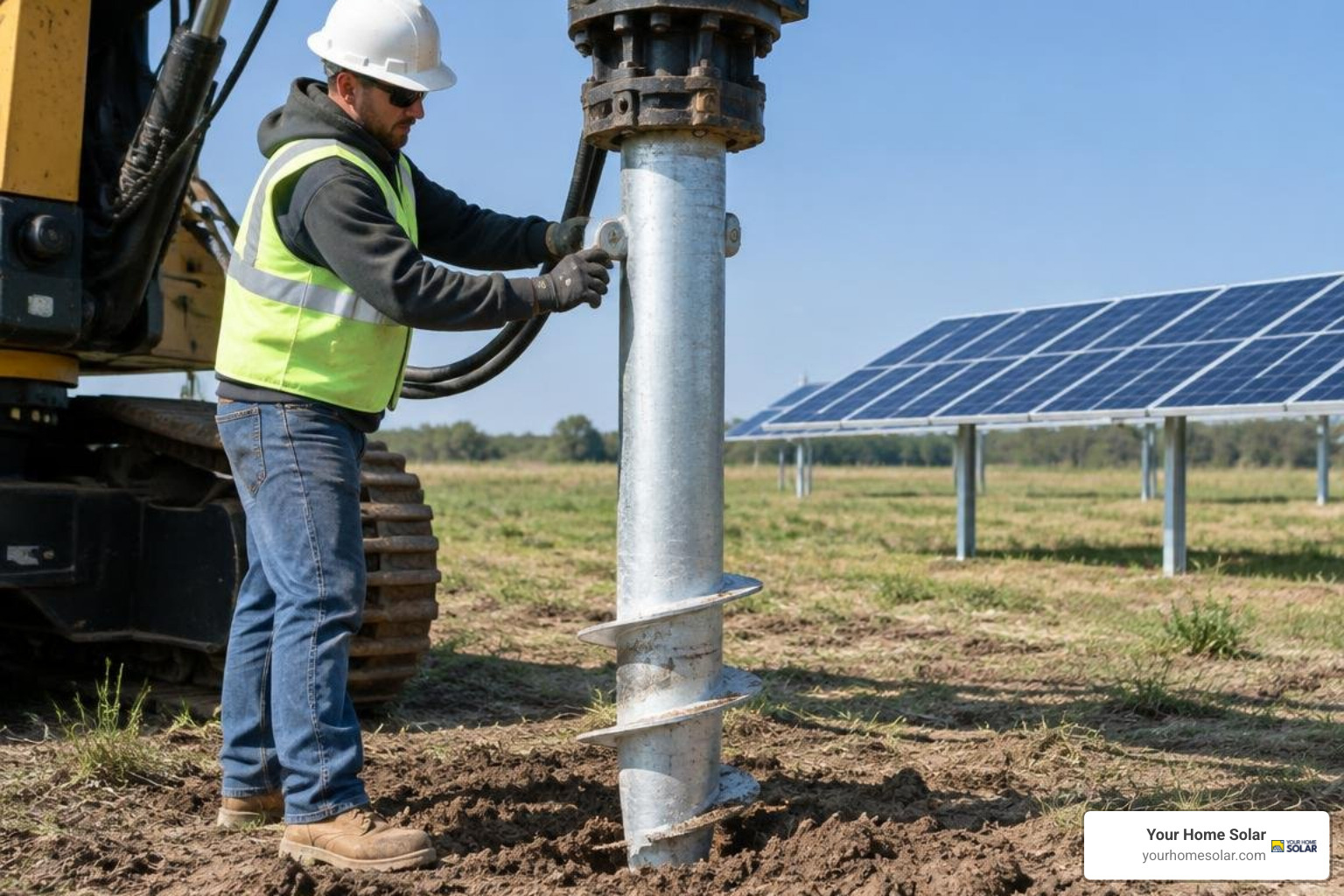
- Driven C-Channel Piles: Steel beams driven deep into cohesive or dense soils using hydraulic ram equipment. They offer exceptional uplift resistance at the lowest per-unit material cost ($18–$25 per pile).
- Helical Ground Screws: Large threaded steel shafts drilled directly into rocky, sandy, or frost-susceptible soils. Screws offer instantaneous torque-to-capacity verification during installation ($30–$45 per screw).
- Ballasted Surface Mounts: Heavy concrete blocks sitting directly on the surface, anchoring arrays via mass rather than subsurface penetration ($50–$80 per mount equivalent). Ballasts are essential for capped landfills, brownfields, or shallow bedrock where excavation is prohibited.
Engineers routinely conduct geotechnical pull-out testing—often testing 1 in every 50 driven piles to 150% of design wind uplift demand—to ensure the array will remain locked in place during severe storms.
Structural Loads, Wind Uplift, and Geotechnical Assessment
Soil bearing capacity, bedrock depth, and frost depth govern how deep a post must be embedded. In cold climates, foundations must extend below the frost heave line to prevent freeze-thaw cycles from pushing posts upward.
Wind passing over tilted panels creates substantial aerodynamic uplift (ranging from 1,500 to 2,000 Pa). To ensure electrical safety across expansive metal arrays, a continuous 4 AWG copper grounding loop must bond all posts and structural rails in strict compliance with NEC 250, ensuring resistance remains under 0.1 Ω to disperse electrical faults and lightning surges.
System Architecture, Sizing, and Layout Optimization
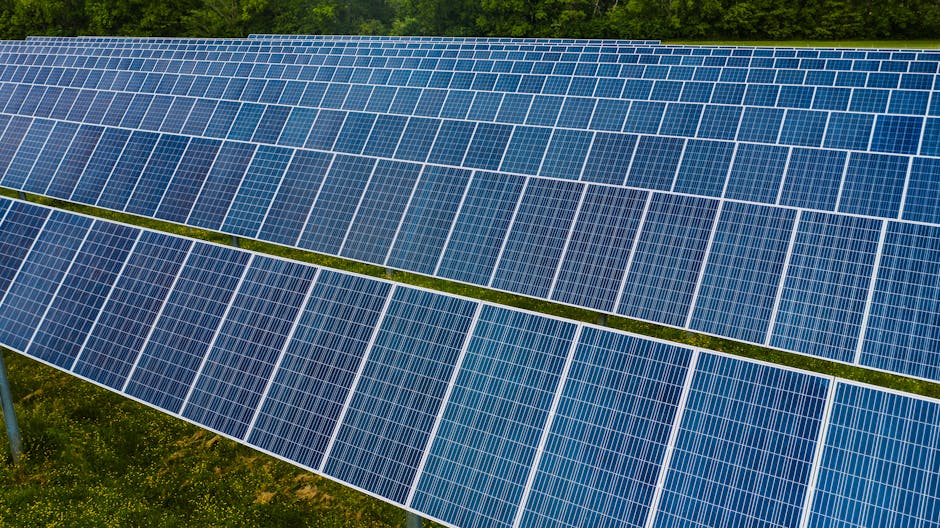
Ground array layouts balance energy production against land constraints. Designers calculate the Ground Coverage Ratio (GCR)—the ratio of module surface area to total land area—targeting 0.30 to 0.45 for fixed-tilt systems and 0.25 to 0.40 for tracking systems.
Row pitch must be wide enough to prevent inter-row shading between 9:00 AM and 3:00 PM on the winter solstice, when the sun sits lowest in the sky. For remote sites, exploring off-grid system configuration options ensures proper battery and inverter sizing alongside array layout optimization.
Sizing and Land Requirements for Ground Mounted PV
A typical residential home consuming around 30 kWh per day requires an array of approximately 19 high-efficiency 400W solar panels, occupying roughly 350 to 500 square feet of racking space (plus boundary clearances).
When scaling to commercial installations, fixed-tilt arrays require 4 to 6 acres per megawatt of DC capacity. Calculating exact property requirements and proper system sizing for Tennessee properties ensures the system satisfies annual electrical consumption without unnecessary equipment overbuild.
Fixed-Tilt vs. Tracking Ground Mounted PV Arrays
Choosing between stationary and motorized mounts depends on land budget, terrain, and capital:
- Fixed-Tilt Arrays: Modules remain stationary on rigid rails angled toward the equator (latitude ±5°). They have zero moving parts, minimal maintenance needs, and lower BOS (Balance of System) costs.
- Single-Axis Trackers: Modules rotate along a north-south horizontal torque tube, tracking the sun from east to west. They boost total energy yield by 15% to 25% compared to fixed racking, though they require 5 to 8 acres per megawatt and demand regular mechanical maintenance.
Tracking arrays run automated backtracking algorithms during morning and late afternoon hours, slightly flattening panel angles to prevent adjacent rows from casting shadows over one another.
Land Use, Environmental Co-Benefits, and Agrivoltaics
Ground arrays can easily coexist with nature and farming activities. Instead of stripping land bare, sustainable sites establish pollinator-friendly wildflower habitats beneath panels, creating ecological corridors for bees, butterflies, and native wildlife.
Landowners evaluating solar viability across Tennessee landscapes find that integrating ground arrays onto underutilized acreage preserves open green space while generating steady clean power.
Dual-Use Solar and Agricultural Integration
Agrivoltaics merges active agricultural production with solar energy harvesting. Elevating racking to provide 6 to 8 feet of ground clearance allows farmers to cultivate shade-tolerant specialty crops (such as leafy greens and berries) underneath the panels. The partial shading reduces soil evaporation and moderates peak heat stress.
Alternatively, rotational sheep grazing keeps ground cover neatly trimmed for $300 to $600 per megawatt annually, eliminating the need for gas-powered mowers while generating revenue for local livestock managers. (Cattle and goats are avoided because they tend to chew cables and lean against racking.)
Site Preparation, Setbacks, and Vegetation Management
Preparing a site requires clearing brush, managing civil drainage, and establishing gravel access paths. Installers must maintain at least 0.8 meters (roughly 32 to 36 inches) of lower-edge clearance to permit mechanical mowing without risking damage to module edges.
Because commercial ground arrays frequently operate at high direct-current voltages up to 1500V DC—which carries severe shock and arc-flash hazards—facilities must be secured with restricted-access perimeter fencing, lockable gates, and clear danger signage.
Frequently Asked Questions About Ground-Mounted Solar
How much does a ground-mounted solar installation cost compared to rooftop solar?
Ground-mounted solar systems cost about 41% more upfront than rooftop systems. A typical 14.7 kW residential ground array costs roughly $43,571 before incentives ($2.96 per watt). The extra cost stems from geotechnical site testing, steel foundation piles, heavy equipment excavation, and underground trenching for conduit. However, because ground arrays can be oriented at the ideal tilt angle and run cooler than rooftop systems, their higher energy yield often delivers a competitive long-term return on investment.
How much land is required for a residential or commercial ground array?
A standard residential ground-mount system requires about 350 to 800 square feet of clear, unshaded ground, which leaves adequate room for perimeter setbacks and maintenance paths. Utility and commercial installations generally require 4 to 6 acres per megawatt for fixed-tilt configurations, or 5 to 8 acres per megawatt for single-axis tracking systems to prevent inter-row shading during low winter sun angles.
Can ground-mounted PV systems be installed on rocky or sloping land?
Yes. Sloping ground (up to 10–15% for fixed-tilt systems) can be accommodated using variable-height foundation posts that level out the array frame. For rocky soils or shallow bedrock, installers utilize heavy-duty helical ground screws or pre-drilled rock anchors rather than standard driven piles. On sites where excavation is prohibited, such as capped landfills, concrete ballast blocks are placed directly on the surface to hold the array securely in place.
Conclusion
Ground-mounted solar photovoltaic systems offer an ideal clean energy alternative when rooftop space is constrained, shaded, or structurally unsuitable. By giving you complete freedom over array orientation, tilt angles, foundation selection, and dual-use land planning, ground mounts deliver outstanding long-term energy yield and durability.
Whether you are seeking clean power for a rural homestead, commercial facility, or agricultural acreage, consulting with Your Home Solar for custom solar installations in Knoxville and East Tennessee ensures your ground array is engineered for maximum performance, safety, and decades of reliable energy independence.