Where to Find Grants for Home Solar Panels
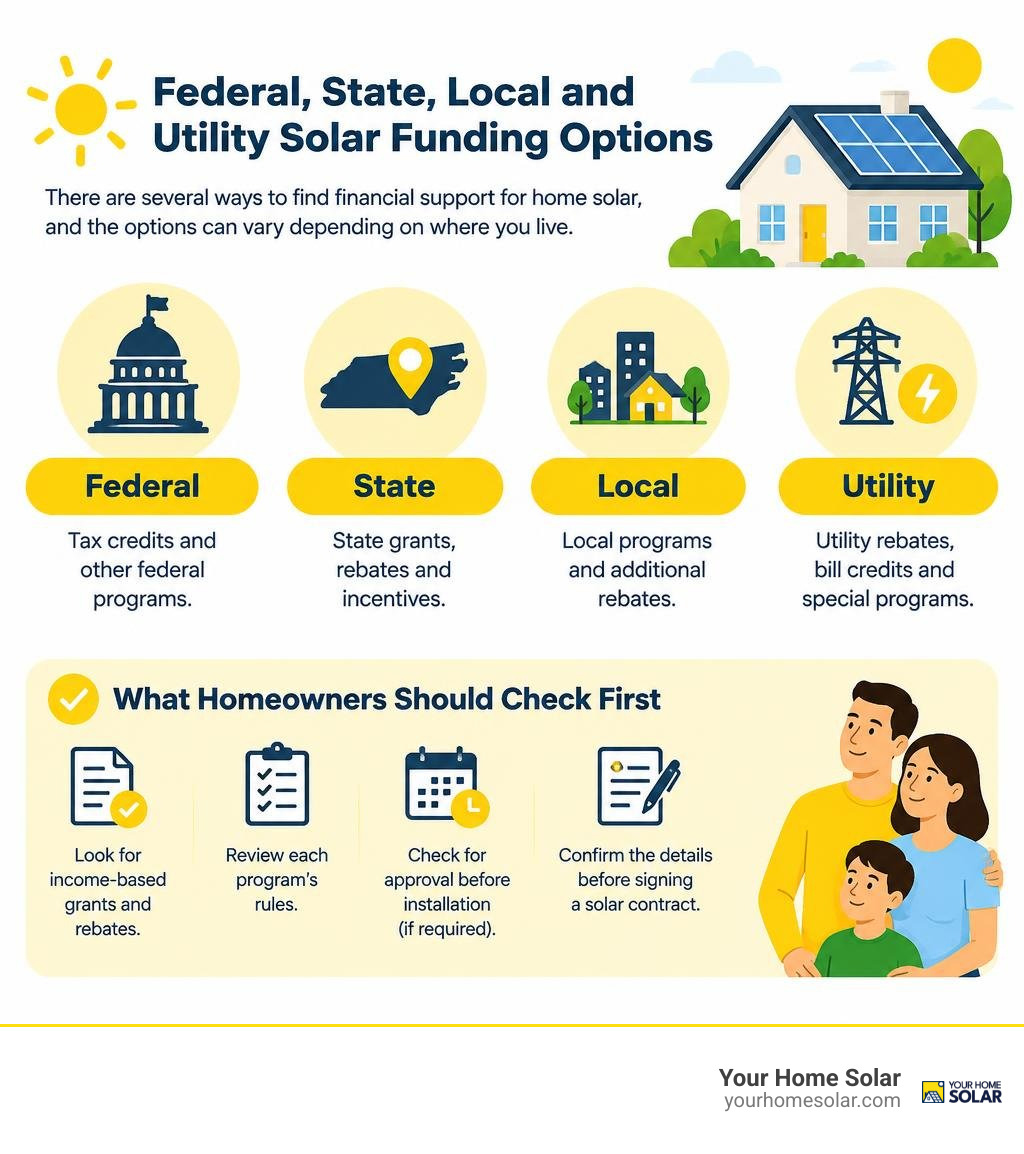
Start with your state energy office and electric utility. Ask about income-based grants, local rebates, and bill credits, then check each program’s rules before signing a solar contract. Some programs require approval before installation. There is no single grant that pays for solar panels on every home, but many homeowners can still find solar panels for home grants through state, utility, and income-qualified programs.
Federal tax rules matter, too: the 30% Residential Clean Energy Credit may apply to eligible systems installed by December 31, 2025, but it is not available for new residential installations completed in 2026. The grants and bill credits still available depend on where you live, your income, and your utility.
I’m Ernie Bussell, founder of Your Home Solar in East Tennessee. My work in solar operations and installation has taught me to help homeowners sort through solar panels for home grants without confusing a real grant with a loan or a “no upfront cost” sales offer.
Solar panels for home grants terminology:
Understanding Federal and State Solar Panels for Home Grants

Navigating the landscape of clean energy funding requires distinguishing between tax credits, direct grants, and utility-sponsored rebates. Many homeowners assume that a “grant” is simply any program that cuts their system costs. In reality, grants are direct financial awards that do not need to be repaid, whereas tax incentives reduce your tax burden.
To build a cost-effective setup, it helps to understand how federal, state, and local programs interact. While federal programs establish broad baselines, state and municipal energy offices frequently administer dedicated funding pools aimed at improving household energy efficiency and broadening access to renewables.
How the 30% Federal Clean Energy Tax Credit Operates
For systems placed in service within the qualifying eligibility windows, the Residential Clean Energy Credit administered by the IRS has served as one of the most substantial federal cost-reduction mechanisms. By claiming this incentive using IRS Form 5695, qualifying property owners could deduct up to 30% of their total equipment and installation labor costs from their federal tax liability.
Understanding the mechanics of federal solar tax incentives is critical:
- Tax Liability Reduction: Because this is a nonrefundable tax credit rather than a cash grant, it offsets income taxes owed dollar-for-dollar. It does not produce a refund check if your tax liability is zero.
- Carry-Forward Provisions: If your credit exceeds your total federal tax burden for the installation year, the remaining balance can roll over to offset taxes in subsequent tax years.
- Battery Storage Inclusion: Modern clean energy provisions expanded coverage to standalone energy storage systems with a capacity of 3 kWh or greater, making home resilience packages eligible for significant deductions.
Stacking Rebates, Subsidies, and Grants for Maximum Savings
Maximizing your return involves stacking compatible funding options. When combining state and federal solar incentives, program administrators follow strict accounting rules to determine your final out-of-pocket balance.
Under federal tax guidelines, any non-taxable upfront utility rebates or direct subsidies must be subtracted from your gross system costs before calculating the percentage-based tax credit. Conversely, performance payments that are taxable income, such as Solar Renewable Energy Credits (SRECs), generally do not reduce your initial qualifying expense basis.
| Incentive Type | Financial Mechanism | Upfront vs. Ongoing | Typical Impact on Federal Basis |
|---|---|---|---|
| Direct Grants | Lump-sum cash award | Upfront / Post-install | Reduces net qualifying basis |
| Utility Rebates | Cash-back or invoice discount | Upfront | Subtracted from gross project cost |
| Tax Credits | Federal/State tax liability reduction | Annual tax filing | Applied to adjusted post-rebate basis |
| SRECs / Performance | Market-based energy credits | Ongoing revenue | Does not reduce installation basis |
State-Specific Direct Grants and Low-Income Solar Programs
State energy offices and regional utilities develop targeted funding frameworks to address energy poverty and expand grid stability. Tracking state solar policy developments helps property owners discover location-specific incentives that significantly lower financial barriers to entry.
Qualifying for Income-Qualified Solar Panels for Home Grants
Targeted low-to-moderate income (LMI) grant programs exist to help families experiencing high energy burdens transition to renewable energy. A prime example is outlined in the Maryland Energy Administration’s Funding Opportunity Announcement (“FOA”) for the Maryland Solar Access Program.
Under targeted state frameworks like Maryland’s Low Income Solar Grant initiatives:
- Grant allocations can reach up to $25,000 per qualifying solar photovoltaic installation.
- Eligibility is tied directly to Area Median Income (AMI) thresholds, prioritizing households earning below specific regional benchmarks or residing in designated underserved communities.
- Many state frameworks require prior completion of an energy audit or weatherization upgrades to guarantee the home operates efficiently before adding generation capacity.
Regional Grant Initiatives Across New York, Colorado, Texas, and Oregon
Various states take distinct policy approaches to residential solar deployment:
- New York: The Energy Affordability Program (EAP) connects qualifying customers with monthly solar bill savings via the S-SFA and REACH programs. These initiatives distribute clean energy bill credits directly to households in Disadvantaged Communities to help lower ongoing utility expenses.
- Colorado: Colorado exempts 100% of the added property value of a solar array from real estate assessments. Concurrently, programs like Xcel Energy’s Solar*Rewards deliver upfront rebates of $1 per watt (up to $10,000 for income-qualified homeowners), paired with municipal funding such as Denver’s Climate Action Rebate.
- Texas: While Texas features a deregulated market without a uniform net metering rule, homeowners benefit from a 100% state property tax exemption on renewable equipment using Form 50-123, complemented by municipal utility rebates from providers like Austin Energy and Oncor.
- Oregon: The Energy : Oregon Solar + Storage Rebate Program provides income-qualified homeowners with direct rebates up to $5,000 for solar arrays and an additional $2,500 for integrated battery storage, reserving funds prior to construction through approved contractors.
| State / Program | Primary Incentive Form | Maximum Value / Benefit | Target Criteria |
|---|---|---|---|
| New York (S-SFA/REACH) | Monthly utility bill credits | Variable annual solar generation credit | EAP-enrolled / Disadvantaged communities |
| Colorado (Xcel / Denver) | Upfront cash-per-watt rebates | Up to $10,000 (Xcel) / $2,000 (Denver) | Income-qualified residential customers |
| Texas (State & Utility) | Property tax exemption & utility rebates | 100% property value exempt + utility cash | Single-family homeowners |
| Oregon (OSSRP) | Contractor-disbursed state rebate | Up to $5,000 solar / $2,500 storage | Income-qualified primary residences |
Global Perspectives: Applying for Ireland’s SEAI Solar PV Scheme
Looking at international models illustrates how structured grant administrations operate. The Sustainable Energy Authority of Ireland provides Solar Electricity PV Grants | Home Energy Grants | SEAI to support domestic microgeneration:
- Grant Formula: The scheme allocates €700 per kWp for systems up to 2 kWp, adding €200 for every additional kWp up to 4 kWp.
- Maximum Cap: Funding is capped at a maximum of €1,800.
- Compliance Checks: Homeowners must complete installations using SEAI-registered contractors, obtain a formal Letter of Offer before starting work, and conduct a post-installation Building Energy Rating (BER) assessment before funds are released.
Revenue Mechanisms: SRECs, Buyback Plans, and Net Metering
Beyond one-time grants and rebates, solar installations create long-term value through ongoing utility grid interaction and market-based renewable commodities.
How Net Metering and Solar Buybacks Generate Ongoing Value
Net metering allows your home to send surplus energy back to the grid during peak production hours, turning your utility meter backward.
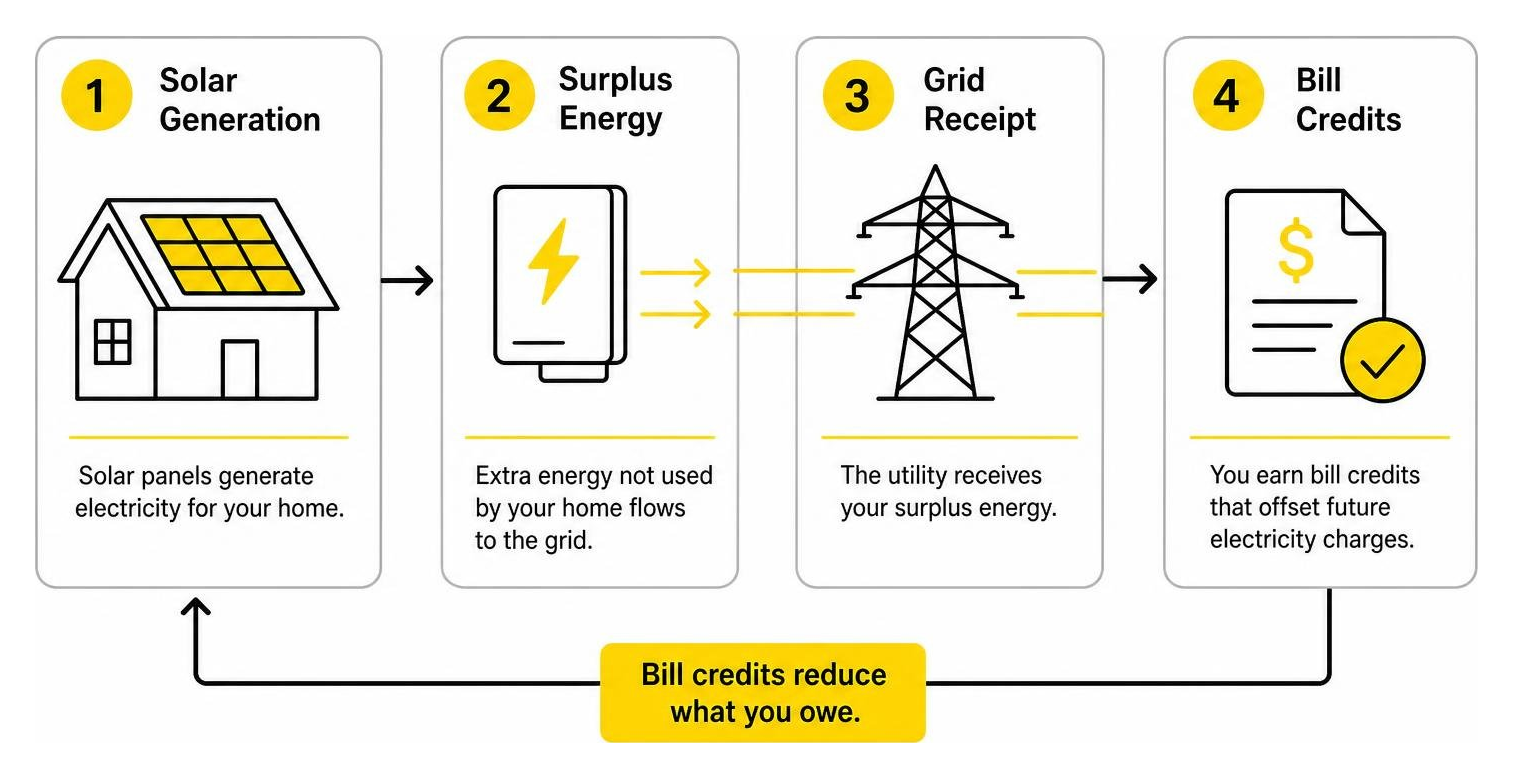
- 1-to-1 Net Metering: In regulated territories with traditional net metering, utilities credit every excess kilowatt-hour exported at the full retail electricity rate, offsetting nighttime power draw.
- Avoided-Cost and Real-Time Buybacks: In areas without retail net metering mandates, retail electric providers offer solar buyback programs that compensate exports at wholesale or avoided-cost rates.
- Storage Optimization: Adding battery systems allows property owners to store excess daytime generation for use during peak evening pricing periods, avoiding low export credit valuations.
Selling Solar Renewable Energy Credits (SRECs) for Cash
In states with statutory Renewable Portfolio Standards (RPS), utilities are legally required to produce or procure a defined percentage of clean energy. Homeowners earn one Solar Renewable Energy Credit (SREC) for every 1,000 kilowatt-hours (1 MWh) of electricity their panels generate.
Specialized SREC brokerages allow homeowners to sell these certificates on the open compliance market. Because energy suppliers buy SRECs to satisfy state mandates and avoid financial penalties, this mechanism generates steady, recurring income throughout the lifespan of the array.
How to Secure Solar Panels for Home Grants and Avoid Scams
Securing clean energy incentives requires careful planning and vetting. Reviewing a detailed guide to navigating residential incentives helps you distinguish legitimate assistance from aggressive marketing ploys.
Step-by-Step Preparation and Application Process
Securing solar grants requires following a clear sequence to ensure you meet all compliance rules:
- Conduct an Energy Audit: Identify baseline power usage and resolve thermal envelope leaks before sizing your system.
- Examine Structural and Roof Readiness: Verify your roof has at least 15 to 20 years of remaining operational life.
- Gather Financial and Utility Records: Compile recent electric statements, proof of homeownership, and income verification forms.
- Obtain Certified Quotes: Work with NABCEP-certified professionals who map out proper financing and cost planning.
- Reserve Grant Funds: Many grant programs require a confirmed reservation of funds before any installation labor begins.
- Complete Interconnection and Final Inspection: Secure permission to operate (PTO) from your utility to validate final disbursements.
Spotting “Free Solar” Scams and Deceptive Financing Offers
Homeowners should be wary of misleading advertisements promising “free government solar panels.” The reality behind the truth about free solar panels from the government is that most zero-down claims are actually standard leases or Power Purchase Agreements (PPAs).
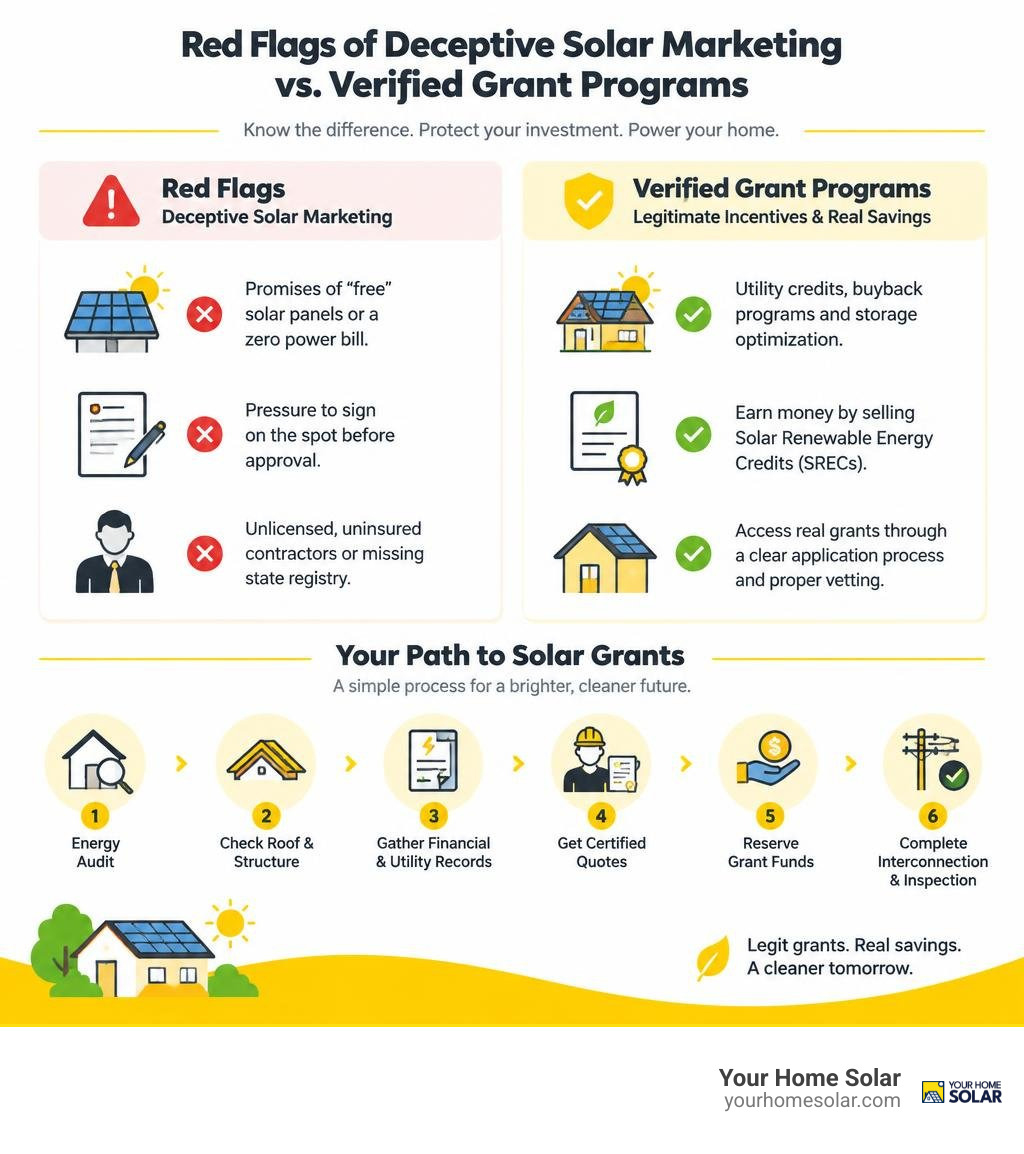
When reviewing solicitations, implement practical strategies for avoiding solar scams:
- Avoid vendors claiming government programs will completely eliminate your power bill with no investment whatsoever.
- Reject aggressive sales tactics demanding on-the-spot signatures before you receive formal grant approval.
- Confirm that third-party contractors are licensed, fully insured, and listed on your state energy agency’s approved registry.
Frequently Asked Questions About Solar Grants
Can homeowners get solar panels installed for free through government grants?
Direct grants that cover 100% of solar installation costs are generally limited to specific low-income assistance programs, disaster relief initiatives, or specialized weatherization packages. Most mainstream incentives come as percentage-based tax credits, local property tax abatements, or partial utility rebates rather than completely free equipment.
Do utility rebates reduce the 30% federal clean energy credit?
Yes. IRS regulations stipulate that non-taxable utility rebates and subsidies must be subtracted from your total system cost before applying the percentage calculation for federal credits. However, payments received from selling SRECs are considered taxable income and typically do not lower your qualifying equipment basis.
What documentation is required when applying for residential solar grants?
Applicants typically must provide:
- Proof of homeownership (deed or property tax records).
- Recent electric utility statements showing account standing and baseline usage.
- Household income documentation (tax transcripts or W-2s) for income-qualified programs.
- A signed installation agreement from an authorized, certified solar contractor.
- Final municipal inspection certificates and utility interconnection approvals.
Conclusion
Taking full advantage of solar panels for home grants, rebates, and tax exemptions allows property owners to reduce installation costs while securing reliable energy independence. Stacking local utility rebates, property tax protections, and smart grid buybacks makes clean energy a practical, rewarding investment.
If you are ready to evaluate your property’s potential and navigate the funding options available for your home, explore comprehensive residential solar energy solutions with our experienced team today.