Solar Money Is Out There — Here’s How to Find It
Residential solar grants and incentives can significantly cut the upfront cost of going solar — sometimes down to zero for qualifying homeowners.
Quick Answer: Main Ways to Get Financial Help for Residential Solar
| Program Type | Who It’s For | Potential Savings |
|---|---|---|
| Federal Clean Energy Tax Credit | Most homeowners | 30% of total system cost |
| State Grant Programs (e.g., Maryland, Oregon) | Income-qualified residents | Up to $5,000 or more |
| Low-Income / DAC Programs | Low-income households | Free or deeply discounted solar |
| Utility Rebates | Customers of participating utilities | Hundreds to thousands of dollars |
| Community Solar | Renters or homes with poor roof access | 20%+ off electricity bills |
Electricity bills in East Tennessee keep climbing. Power outages are a real concern. And the environment? It matters. The good news is that going solar doesn’t have to mean draining your savings account. Between federal tax credits, state grant programs, and utility rebates, most homeowners can dramatically reduce — or even eliminate — their out-of-pocket costs before a single panel hits the roof.
The challenge is that these programs have different rules, deadlines, and income limits. Knowing which ones apply to you makes all the difference.
I’m Ernie Bussell, Founder and CEO of Your Home Solar — East Tennessee’s #1 solar contractor — and I’ve spent years helping homeowners navigate residential solar grants, tax credits, and incentive programs to maximize their savings. In this guide, I’ll walk you through exactly what’s available and how to take advantage of it.
Terms related to residential solar grants:
Federal Incentives: The Residential Clean Energy Credit
When we talk about saving money on solar, the heavy hitter is the Federal Government. The most significant financial boost available to homeowners in Knoxville, Maryville, and across the country is the Residential Clean Energy Credit | Internal Revenue Service.
As of May 2026, this credit is a cornerstone of any solar investment. It allows you to claim 30% of the cost of your new, qualified clean energy property. This isn’t just a deduction from your taxable income; it’s a dollar-for-dollar credit against your federal income tax liability.
How the 30% Credit Works
If you spend $20,000 on a solar system for your home in Johnson City, you could qualify for a $6,000 tax credit. This applies to systems installed through December 31, 2032, before it begins to phase out. The credit covers:
- Solar photovoltaic (PV) panels.
- Solar water heaters (if certified).
- Wind turbines and geothermal heat pumps.
- Battery storage technology: This is a big one for us in East Tennessee. If you install a battery with at least 3 kWh of capacity, it qualifies for the 30% credit, even if you add it to an existing solar array.
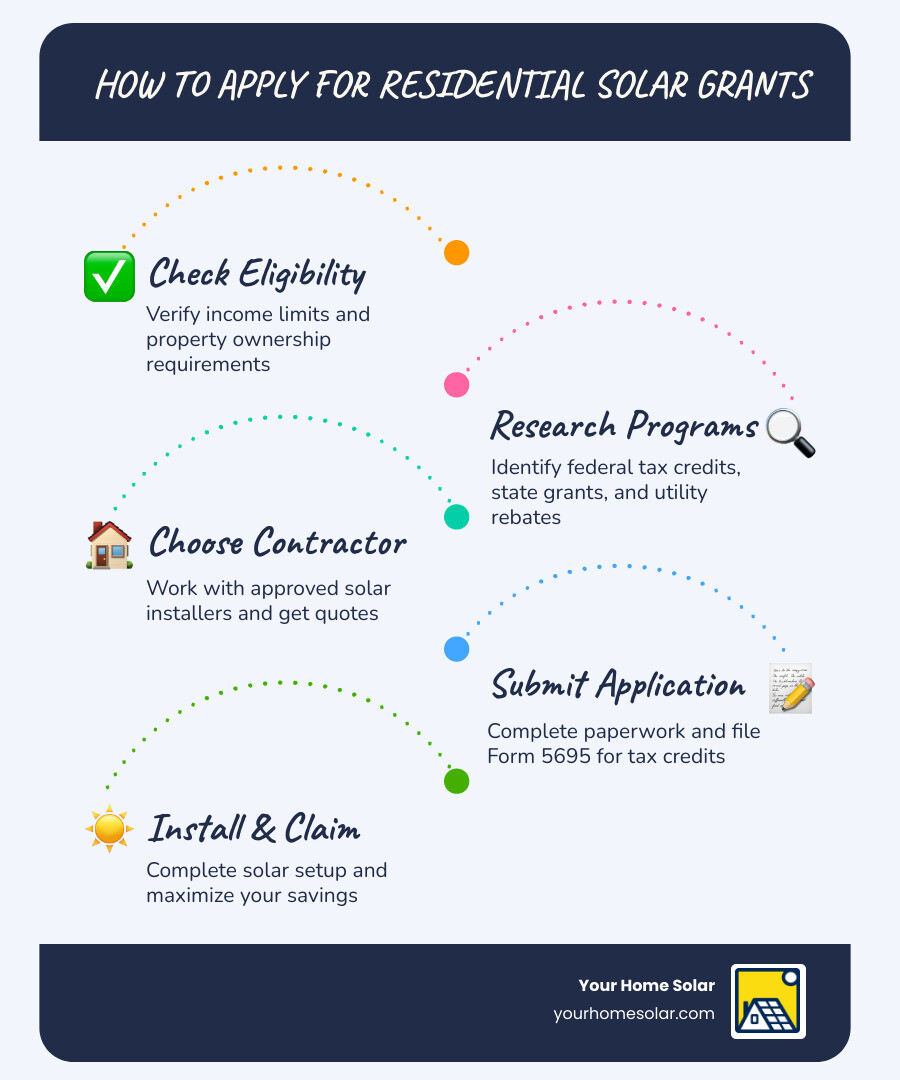
To claim this, you’ll use IRS Form 5695 when you file your taxes. If your credit is higher than the taxes you owe for the year, don’t worry—the IRS allows you to carry the remaining credit forward to future tax years. To dive deeper into the mechanics of this, check out our guide on how to Harness the Sun, Save on Taxes: Everything About the Federal Solar Credit.
Understanding State-Level Residential Solar Grants
While the federal credit is available to everyone with a tax liability, residential solar grants are often state-specific. These programs are designed to bridge the gap for families who might not have a high tax bill but want to lower their monthly energy costs.
In various parts of the country, states have pioneered programs that serve as a roadmap for what we look for in local incentives. For example, programs like the Maryland Solar Access Program and Oregon’s Solar + Storage Rebate (OSSRP) have shown how targeted funding can help residents. Maryland’s program recently managed a $12 million budget for FY26 to assist residents with solar PV installations.
In Tennessee, we focus on how these types of incentives can be “stacked.” Stacking means you use the federal tax credit first, then apply any state or local rebates on top of it. This layering can sometimes cover more than 50% of the total project cost. For a complete list of what’s currently active, visit our page on Tax Credits & Incentives.
Eligibility Requirements for Residential Solar Grants
Every grant program has its own “fine print,” but most follow a similar structure. If you are looking for residential solar grants, you’ll usually need to meet these criteria:
- Household Income: Many grants are “income-qualified,” meaning they are reserved for low-to-moderate-income households. For instance, some programs require your income to be below 80% of the area’s median income.
- Property Ownership: Generally, you must own the home where the solar is being installed. Landlords usually don’t qualify for residential-specific grants unless they live on the property.
- System Size: Some programs require a minimum system size (like 2 kW-DC) to ensure the investment provides a meaningful reduction in grid reliance.
- Approved Contractors: This is critical. To prevent scams and poor workmanship, most grant programs require you to work with a certified or “approved” contractor. We always recommend reading our Don’t Get Burned: A Guide to Residential Solar Incentives to ensure you’re following the right steps.
Low-Income and Community Solar Access
We believe everyone should have access to the sun’s power, regardless of their roof’s shape or their bank account balance. This is where “Solar for All” initiatives and community solar programs come into play.
For those who live in “disadvantaged communities” (DACs), there are often specialized programs like DAC-SASH (Disadvantaged Communities – Single-family Affordable Solar Homes). These programs can provide no-cost or highly subsidized rooftop solar installations.
Rooftop Solar vs. Community Solar
What if you rent an apartment in Knoxville or your roof is covered in beautiful (but shade-producing) oak trees? You can still benefit from solar through Community Solar.
| Feature | Rooftop Solar | Community Solar |
|---|---|---|
| Ownership | You own/lease the panels on your roof | You subscribe to a share of a local solar farm |
| Upfront Cost | Higher (offset by grants/credits) | Usually $0 |
| Maintenance | Homeowner responsibility | Handled by the solar farm operator |
| Savings | Direct reduction in grid use | Bill credits (often 20% discount) |
| Best For | Homeowners with sunny roofs | Renters or shaded properties |
Community solar allows you to support clean energy and receive credits on your utility bill without installing a single piece of hardware. It’s a fantastic option for increasing equity in the clean energy transition. For more details on these specialized options, see our Residential Solar Solutions Guide: Incentives and Tax Credits for Solar Systems.
Maximizing Solar Benefits in East Tennessee
Living in East Tennessee gives us a unique advantage. While we don’t have a single “state grant” that applies to everyone, we have the Tennessee Valley Authority (TVA) and local municipal programs that make a huge difference.
In cities like Knoxville, Oak Ridge, and Maryville, we work closely with local utility standards to ensure your system is optimized for “Net Metering” or buy-back programs. While TVA programs change periodically, they often provide the framework for how you get paid for the excess energy your panels produce.
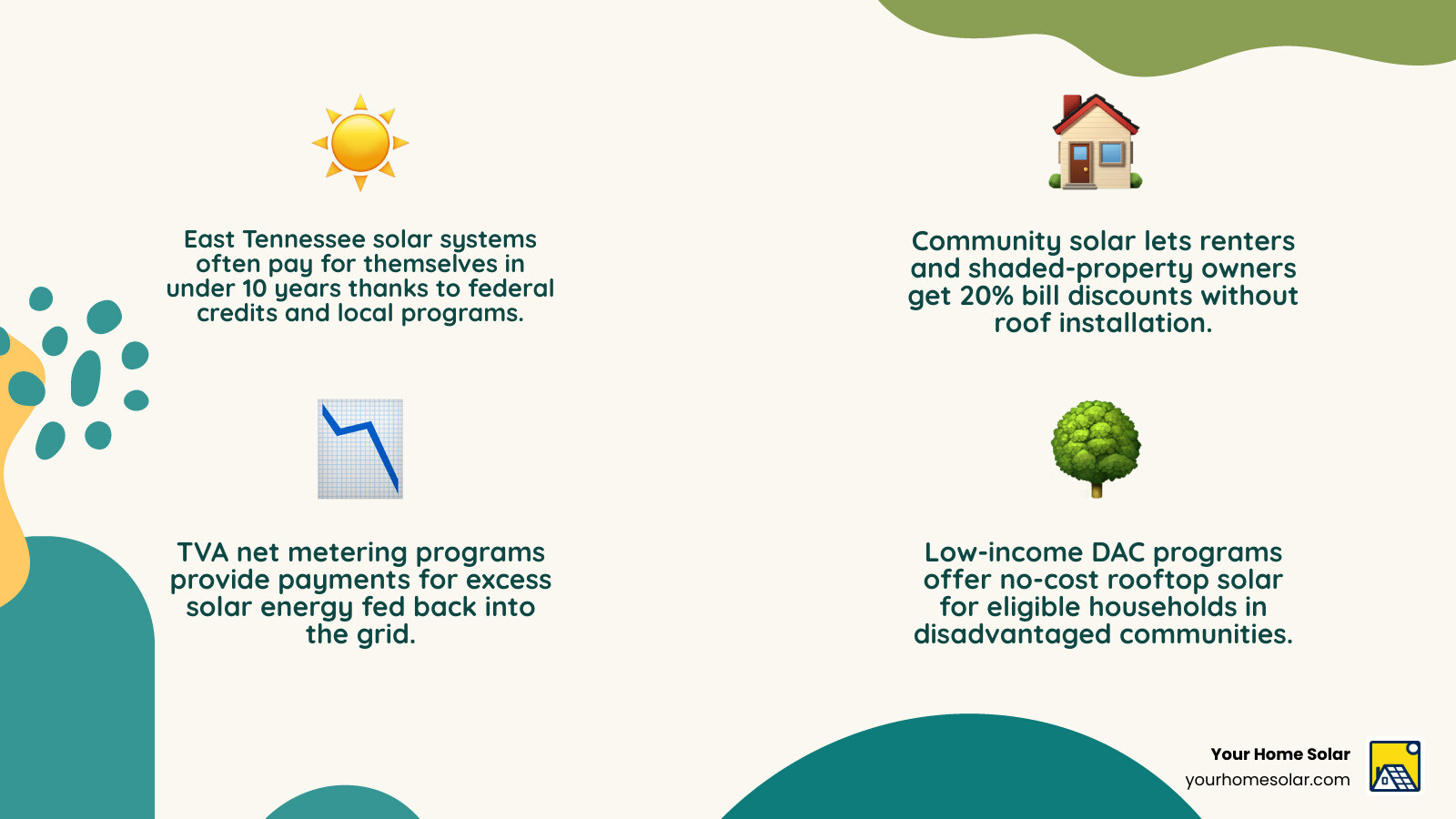
If you’re in Johnson City or Kingsport, the cost of solar is often lower than the national average, making the “payback period”—the time it takes for the system to pay for itself—much shorter. Combined with the 30% federal credit, many of our customers see their systems pay for themselves in under 8 to 10 years.
For a localized look at what’s happening right now, check out our Solar Incentives Tennessee 2026 Guide and learn How to Save Big with Tennessee Solar Incentives.
Frequently Asked Questions about Residential Solar Grants

Q: Are there deadlines for applying for solar grants? A: Yes! Many grant programs operate on a “first-come, first-served” basis with a set annual budget. For example, some state programs have reached 93% of their budget reservation within just a few months of opening. It’s always best to apply as early in the year as possible.
Q: Will I still get an electric bill if I have solar? A: Most likely, yes. Even if your solar panels produce 100% of the energy you use, most utilities charge a small monthly connection fee to keep you tied to the grid. However, your actual energy usage charge can drop to $0.
Q: Do I need a battery for my solar system to work? A: You don’t need one to save money, but we highly recommend them for resilience. In East Tennessee, where storms can knock out power, a battery ensures your lights stay on. Plus, with the 30% federal credit, batteries are more affordable than ever.
Q: How do I know if I qualify for low-income solar programs? A: Qualification is usually based on your household size and gross annual income. For a household of four, the limits are often surprisingly generous. Ernie answers many of these specifics in our video: What Incentives Exist in Solar Within Tennessee? Ernie Answers This Commonly Asked Question.
Conclusion
Navigating residential solar grants can feel like trying to solve a puzzle, but you don’t have to do it alone. At Your Home Solar, we pride ourselves on being more than just installers—we are your partners in energy independence.
From the initial consultation in Sevierville to the final inspection in Farragut, we handle the heavy lifting. We help you identify every possible tax credit, grant, and rebate available to ensure your installation is as rewarding as it is reliable. We serve all of East Tennessee, including Knox, Blount, Sullivan, and Washington counties, with a commitment to 100% customer satisfaction.
Ready to see how much you can save? Start by reviewing our Ultimate Checklist for Solar Incentives in Tennessee or visit our Residential Solar page to request a custom quote. Let’s harness the sun together and turn your roof into a powerhouse of savings!