
How to Prepare Emergency Solar Backup for a Multi-Day Outage
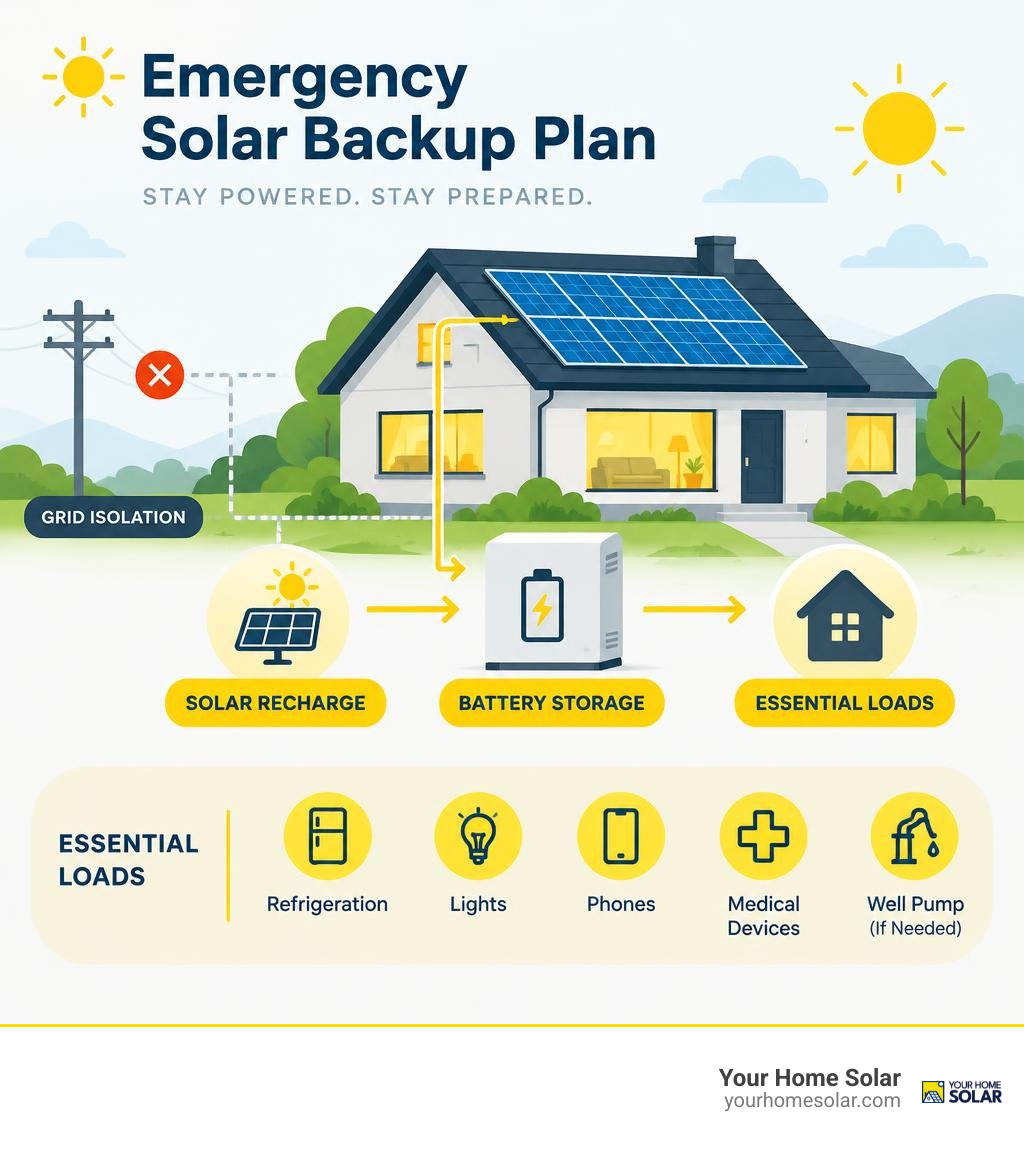
For emergency solar backup that can last through a multi-day outage, start with the loads you must keep running: refrigeration, lights, phones, medical devices, and, if needed, a well pump. Size the battery for those loads, make sure the system can safely disconnect from the grid, and plan for cloudy days when the panels may not fully recharge it. A backup generator can help if an outage outlasts the stored power.
Rooftop panels alone usually will not power your home in a blackout. A standard grid-tied system shuts down to protect utility workers. The right backup design lets your home use stored energy and recharge from solar while safely isolated from the grid.
I’m Ernie Bussell, founder of Your Home Solar. My Navy quality-assurance background and years leading solar operations shape how I approach emergency solar backup: plan for the loads, the weather, and the days after the first night.
Simple emergency solar backup word guide:
The Anti-Islanding Reality: Why Standard Solar Fails in Blackouts
One of the most widespread surprises for homeowners during a grid failure is discovering that their rooftop panels have gone completely dark alongside the rest of the neighborhood. Even on a crystal-clear afternoon with peak sun exposure, a standard grid-tied solar system produces zero electricity for your home when the utility feed cuts out.
This automatic shutdown happens because grid-tied inverters must comply with mandatory safety standards like IEEE 1547. Under these rules, an inverter must immediately disconnect upon sensing a loss of grid voltage or frequency instability. This mechanism, known as anti-islanding protection, prevents your rooftop array from back-feeding high-voltage electricity into downstream power lines. If standard systems remained energized, line workers attempting to repair downed utility poles would face lethal electrocution risks.
To deliver usable energy during an outage, your equipment must form an intentional microgrid. The system must physically sever its connection to the utility grid before creating an independent, self-regulated electrical island. Detailed technical research on PV resilience planning demonstrates that without storage and dual-function inverters, photovoltaic arrays cannot regulate voltage fluctuations caused by shifting cloud cover and changing household demand. Understanding these core grid dynamics is essential for staying powered when the grid goes down.
Essential Hardware for Off-Grid Islanding Capability
Transforming variable sunlight into a steady power source during a blackout requires specific balance-of-system hardware working in total synchronization:
- Island-Mode / Hybrid Inverters: Unlike standard string inverters, hybrid inverters can switch between grid-tied operation and off-grid islanding within milliseconds. They generate their own 60-hertz AC reference signal to power your home.
- Microgrid Interconnection Devices (MIDs) & Automatic Transfer Switches (ATS): An intelligent gateway detects the grid failure, opens a physical mechanical switch to isolate your home from the utility, and signals the inverter to form an island.
- Lithium Iron Phosphate (LiFePO4) Battery Bank: Solar output rises and falls throughout the day. A battery acts as an essential buffer, absorbing excess midday generation and stabilizing voltage during surges.
- Critical Load Subpanels: Rather than backing up the entire main service panel, critical circuits (refrigeration, lighting, water pumps, medical devices) are separated into a dedicated backup panel to prevent rapid battery depletion.
- Frequency Regulation Controllers: When the battery reaches full charge during islanded operation, the hybrid inverter slightly shifts its output frequency (e.g., from 60 Hz to 61 or 62 Hz) to signal rooftop microinverters to curtail power production, preventing dangerous overcharging.

Sizing and Engineering an Emergency Solar Backup System
Engineering an emergency system requires distinguishing between power (measured in watts or kilowatts) and capacity (measured in watt-hours or kilowatt-hours).
Power represents how much work your system can perform at any single moment. For example, starting a well pump might require 3,500 running watts and a surge of 7,000 starting watts. If your inverter cannot handle that momentary surge, it will trip offline regardless of how much energy remains in your battery. Capacity, on the other hand, represents the total volume of energy stored over time. A 10kWh battery can deliver 1,000 watts of continuous power for roughly 10 hours (assuming 100% usable depth of discharge).
Proper electrical engineering also demands careful voltage architecture. In residential DC-coupled configurations, utilizing a 48-volt nominal architecture dramatically reduces amperage compared to older 12-volt or 24-volt designs. Lower amperage minimizes resistive heat losses and keeps voltage drop across your wiring below the recommended 3% limit.
Following an established guide to sizing wiring and fuses for solar backup ensures that wire gauges match calculated overcurrent protection ratings (applying standard 1.25 safety factors), preventing melted conduits or blown electronics. Reviewing home battery backup options helps determine whether AC-coupled or DC-coupled architecture matches your existing electrical setup.
Sizing Essential Loads for Your Emergency Solar Backup
During an extended blackout, attempting to run central air conditioning, electric clothes dryers, and water heaters will drain an average residential battery within a few hours. System longevity comes down to selective load management.
| Essential Appliance / Load | Running Watts | Daily Operating Hours | Daily Energy (Watt-Hours) | Estimated Runtime on 10kWh Battery | Estimated Runtime on 20kWh Battery |
|---|---|---|---|---|---|
| High-Efficiency Refrigerator | 150W | 8h (cycling) | 1,200 Wh | ~75 Hours | ~150 Hours |
| Well Pump (1/2 HP) | 1,000W | 1h total runtime | 1,000 Wh | ~9.5 Hours continuous | ~19 Hours continuous |
| Home Medical Ventilator/CPAP | 60W | 8h | 480 Wh | ~190 Hours | ~380 Hours |
| LED Lighting (6 Rooms) | 60W | 5h | 300 Wh | ~150 Hours | ~300 Hours |
| Wi-Fi Router & Devices | 40W | 24h | 960 Wh | ~100 Hours | ~200 Hours |
| Combined Essential Circuit Load | ~425W avg | Continuous mix | ~4,800 Wh / day | ~24 to 36 Hours | ~48 to 72 Hours |
A standard 10kWh battery provides 12 to 24 hours of conservative whole-house essential power under cloudy skies, while a 20kWh system expands that operating window to 24 to 36 hours without any daytime solar input.
Multi-Day Resilience and Solar Recharge Dynamics
Real survival through an extended grid collapse depends on the daily replenishment cycle. Solar irradiance is not constant; winter storms, dense overcast skies, and snow accumulation can reduce array output by 60% to 85% compared to clear summer afternoons.
To maintain continuous power across multi-day outages, your solar array must produce enough surplus energy during short winter daylight windows (often just 3 to 4 hours of peak sun) to both power daytime loads and fully replenish the battery bank before sunset.
Municipal resilience projects demonstrate how pairing generation with storage withstands long-term grid outages. The Sterling municipal energy storage resilience study highlights how a 2MW array paired with a 3.9MWh battery system provides up to 12 consecutive days of emergency power for critical emergency dispatch and public safety operations while isolated from the grid. Homeowners must design their domestic systems with these exact replenishment ratios in mind when preparing for regional severe storms.
System Architecture: Installed Battery Storage vs. Fuel Generators
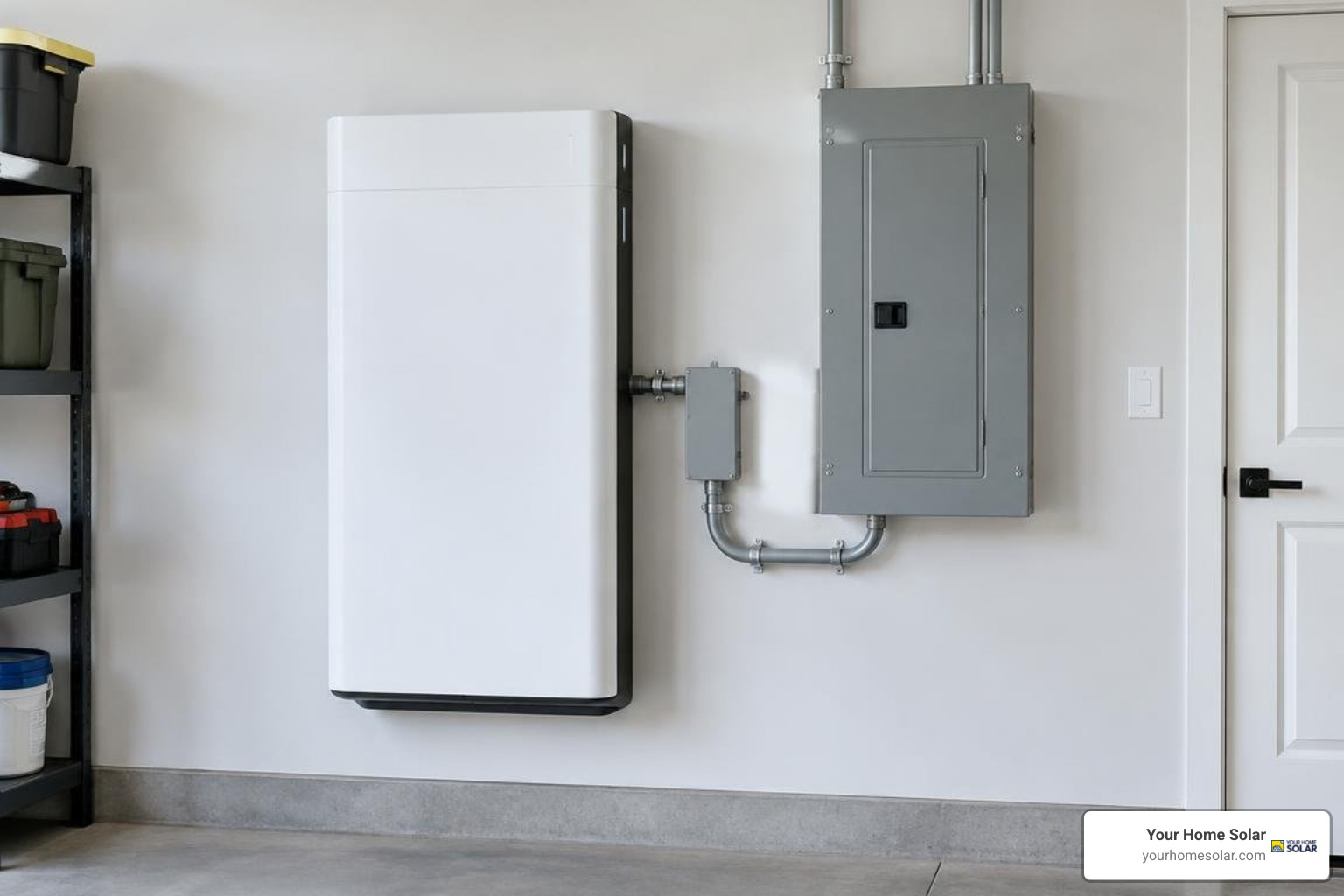
When preparing for emergencies, homeowners generally choose between dedicated battery storage, traditional fuel-powered standby generators, or portable power stations. Each approach carries distinct operational characteristics, ongoing maintenance demands, and physical limitations during prolonged crises.
| System Characteristic | Installed Battery Storage (LiFePO4) | Whole-Home Standby Generator | Portable Fuel Generator |
|---|---|---|---|
| Upfront Cost Range | $10,000 – $20,000 installed | $6,000 – $12,000 installed | $400 – $1,200 unit only |
| Fuel Dependency | Zero (Daily Solar Recharge) | Natural Gas or Propane supply | Petrol / Diesel (Manual refueling) |
| Operational Noise | Completely Silent (<25 dB) | Loud (65 – 75 dB) | Very Loud (70 – 85 dB) |
| Transfer Time | Seamless (<16 milliseconds) | 10 to 30 second delay | Manual setup & cord routing |
| Maintenance Requirements | Minimal (Software monitoring) | Annual engine servicing & oil | Carburetor cleaning, fresh fuel |
| Continuous Lifespan | 4,000 – 6,000 Cycles (10–15 yrs) | ~1,500 – 3,000 Operating Hours | ~500 – 1,000 Operating Hours |
Portable solar generators (power stations) serve smaller temporary needs, but their limited inverter surge capacities and slow recharging inputs (often capped at 400W to 1,600W of solar input) make hardwired battery storage systems the superior choice for seamless, unattended home survival.
Battery Chemistry and Inverter Considerations for Emergency Solar Backup
Modern home energy storage has largely transitioned away from older lead-acid batteries and nickel-manganese-cobalt (NMC) chemistries in favor of Lithium Iron Phosphate (LiFePO4).
LiFePO4 batteries offer exceptional thermal stability, virtually eliminating the risk of thermal runaway. They safely support up to 100% depth of discharge without severe capacity loss and provide 4,000 to 6,000 full charge-discharge cycles while retaining over 80% of original capacity. In comparison, deep-cycle lead-acid batteries degrade rapidly if discharged beyond 50% of their rated capacity and typically fail after 500 to 1,000 cycles.
Furthermore, pairing your battery with a pure sine wave inverter is mandatory for modern households. Modified sine wave units produce “choppy” electrical waveforms with high harmonic distortion, which can overheat sensitive electronics, damage refrigerator compressors, and cause medical devices to malfunction. We explore these differences in depth when comparing solar battery backup with gas generators.
Cost Analysis and Investment Trade-Offs
Adding full off-grid backup capabilities to an existing or new solar installation requires an investment beyond standard grid-tied hardware. A standard grid-tied solar setup might cost between $15,000 and $25,000, while adding a certified islanding gateway, critical load subpanel, hybrid inverter, and 10kWh to 15kWh of lithium storage generally adds an additional $8,000 to $15,000 in equipment and specialized installation labor.
While the upfront cost is higher than a portable petrol generator, solar energy storage incurs zero ongoing fuel costs. During natural disasters, fuel stations frequently lose power or exhaust their fuel supplies within hours, rendering mechanical generators useless once local fuel runs out. Examining these factors helps in evaluating the price of whole-home backup security over a 10-to-15-year lifecycle.
Dead Battery Recovery: Black-Start and Hybrid Generator Integration
A serious hazard during prolonged winter outages is a complete loss of battery state of charge (SoC). If consecutive days of heavy snow or cloud cover prevent solar production while household loads continue to draw power, the battery may reach a critical low-voltage cutoff.
Once a battery bank reaches its lower threshold (often between 2% and 5% SoC), all internal electronics, internal contactors, and communication microchips enter a protective sleep mode to prevent permanent cell damage. When this happens, the system loses its internal reference voltage and cannot boot up its own solar charge controllers—a situation known as losing black-start capability. Even if bright sunlight returns the next morning, the sleeping inverter cannot initialize to accept solar power.
Advanced systems use specialized recovery algorithms to prevent this failure mode. For example, technical documentation in the Enphase battery state-of-charge recovery brief details how smart battery software initiates an automatic charge recovery algorithm when the battery drops into a 2% to 10% critical window. The system attempts to pulse on for up to six minutes to form a microgrid and accept sunlight, cycling retry attempts on an exponential timer (from 10 to 120 minutes).
If the state of charge drops below 2%, however, all electronics shut down entirely, requiring external manual recovery. This is one reason why battery backup outshines standalone generators, provided you maintain an integrated recovery pathway.
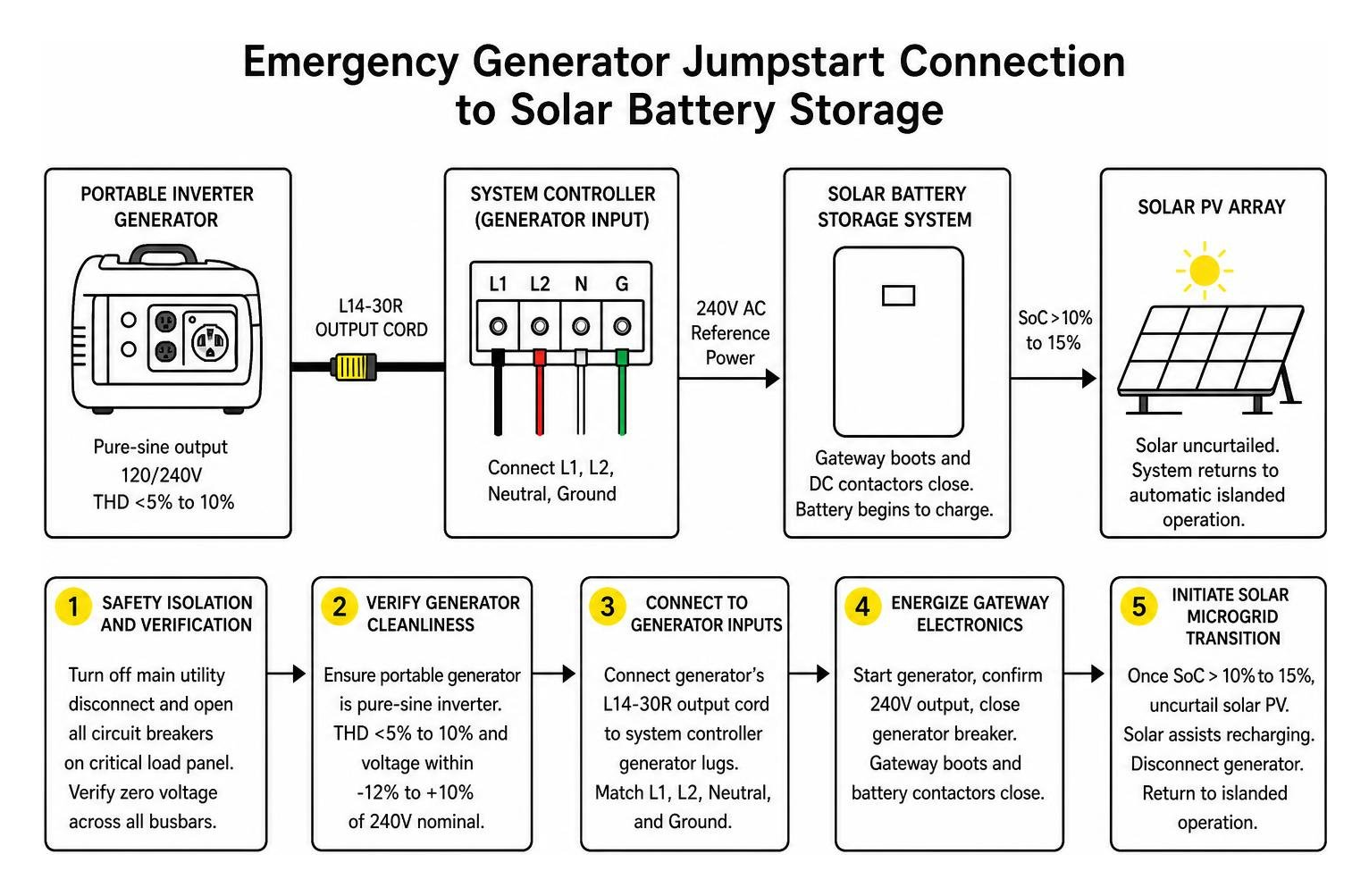
Step-by-Step Generator Jumpstart for Critical Low State-of-Charge
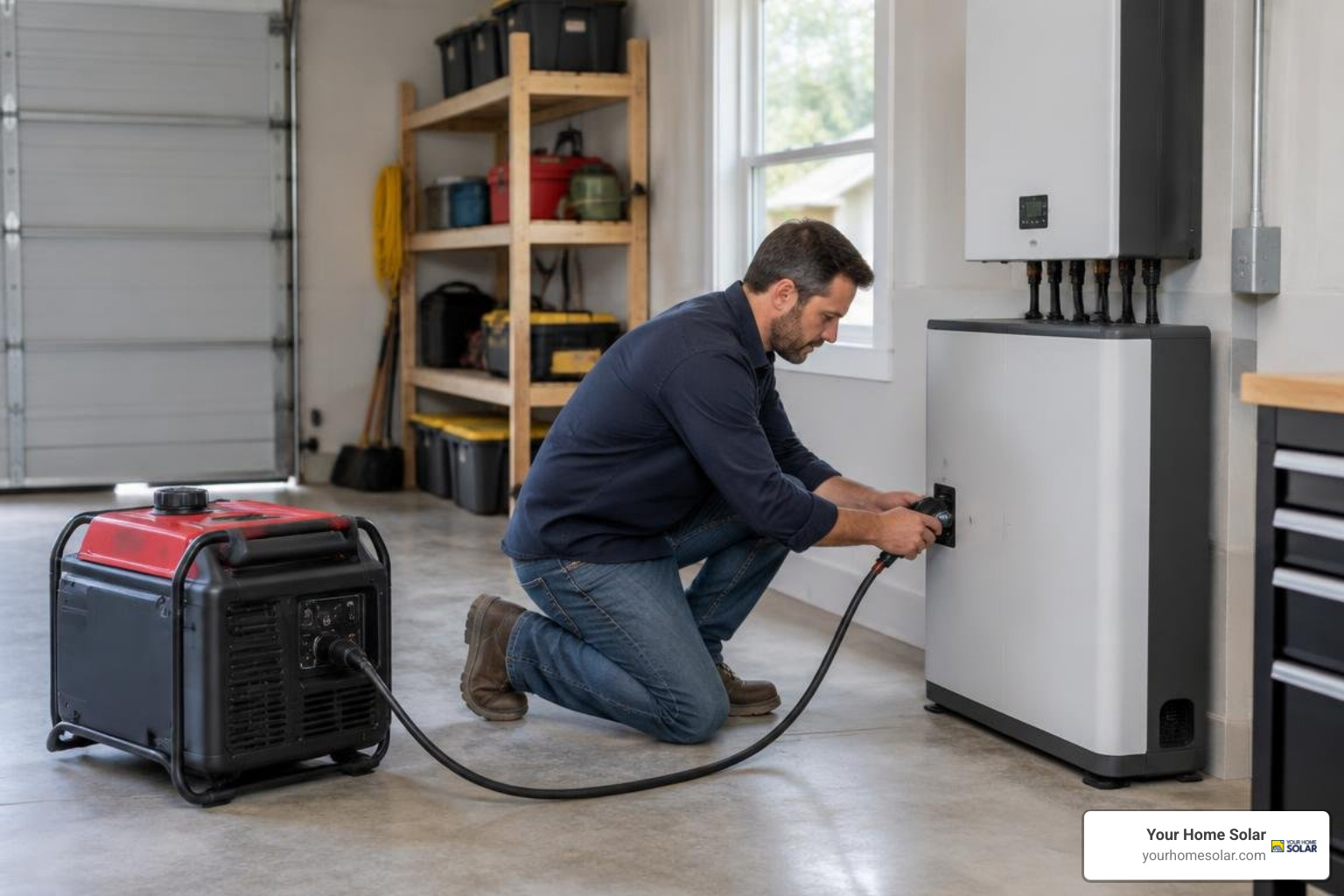
If an emergency battery completely depletes past its automated recovery limit, a clean-power inverter generator can supply the reference voltage needed to wake the system and restore normal solar microgrid operation.
- Safety Isolation and Voltage Verification: Turn off the main utility disconnect and open all circuit breakers on your critical load panel. Use a clamp-on multimeter to verify zero voltage across all internal busbars before touching any connections.
- Verify Generator Cleanliness: Ensure the portable generator is a pure-sine inverter unit. System controllers require a stable 120/240V output with total harmonic distortion (THD) strictly below limits (often <5% to 10%) and phase voltage within -12% to +10% of nominal 240V.
- Connect to Generator Inputs: Connect the generator’s L14-30R output cord to the designated generator lugs or external recovery breaker slot within the system controller, matching L1, L2, Neutral, and Ground bars.
- Energize Gateway Electronics: Start the generator, confirm steady 240V output, and close the generator breaker. Allow the system controller gateway to boot, synchronize with the AC reference signal, and close internal DC battery contactors.
- Initiate Solar Microgrid Transition: Once the battery state of charge rises safely above 10% to 15%, uncurtail the solar PV breakers. The solar array will begin assisting with battery recharging. Disconnect the auxiliary generator and return the system to automated islanded operation.
Frequently Asked Questions About Emergency Solar Backup
Can rooftop solar panels power a home during a blackout without batteries?
No, standard grid-tied solar installations cannot power your home during a blackout. By law and engineering design, standard inverters shut down within cycles of a grid disconnection to prevent back-feeding the utility grid (anti-islanding protection). Furthermore, solar output fluctuates constantly as clouds pass overhead; without battery storage to buffer these rapid swings, your home’s appliances would experience severe brownouts and damaging voltage spikes.
How long can a 10kWh solar backup system run essential appliances?
A 10kWh battery bank typically supports a dedicated critical loads panel (refrigeration, LED lighting, Wi-Fi router, communication hubs, and medical devices) for 12 to 24 consecutive hours without any solar replenishment. When sunny conditions return, a properly sized rooftop array will power household loads during the day while recharging the 10kWh battery to full capacity within 3 to 5 hours of direct sunlight, enabling indefinite off-grid cycling.
What happens if an emergency solar battery completely drains to 0% during an outage?
When an energy storage system drops below its safe operating limit (usually 2% to 5% SoC), it opens internal contactors and enters deep sleep mode to prevent irreversible chemical degradation. In this state, the inverter cannot wake itself up, even under full sun. Restoring the system requires an automated recovery pulse or manual black-start assistance using an approved inverter generator to jumpstart the control electronics.
Conclusion
Surviving an extended grid failure requires more than simply installing standard solar panels on your roof. True energy resilience demands an engineered ecosystem: dual-function islanding switchgear, responsive hybrid inverters, long-lasting LiFePO4 battery chemistry, and carefully managed critical load distribution.
When designed correctly, an emergency solar backup provides continuous, clean, and silent electricity that recharges day after day without fuel supply chain disruptions. Take the time to calculate your essential running loads, verify your system’s surge capacities, and work with certified installation professionals who understand off-grid safety.
To explore system configurations, battery sizing formulas, and tailored resilience designs for your home, review our complete solar battery and energy storage guide and protect your household before the next storm hits.