

Why Solar and Powerwall Together Is a Game-Changer for Homeowners
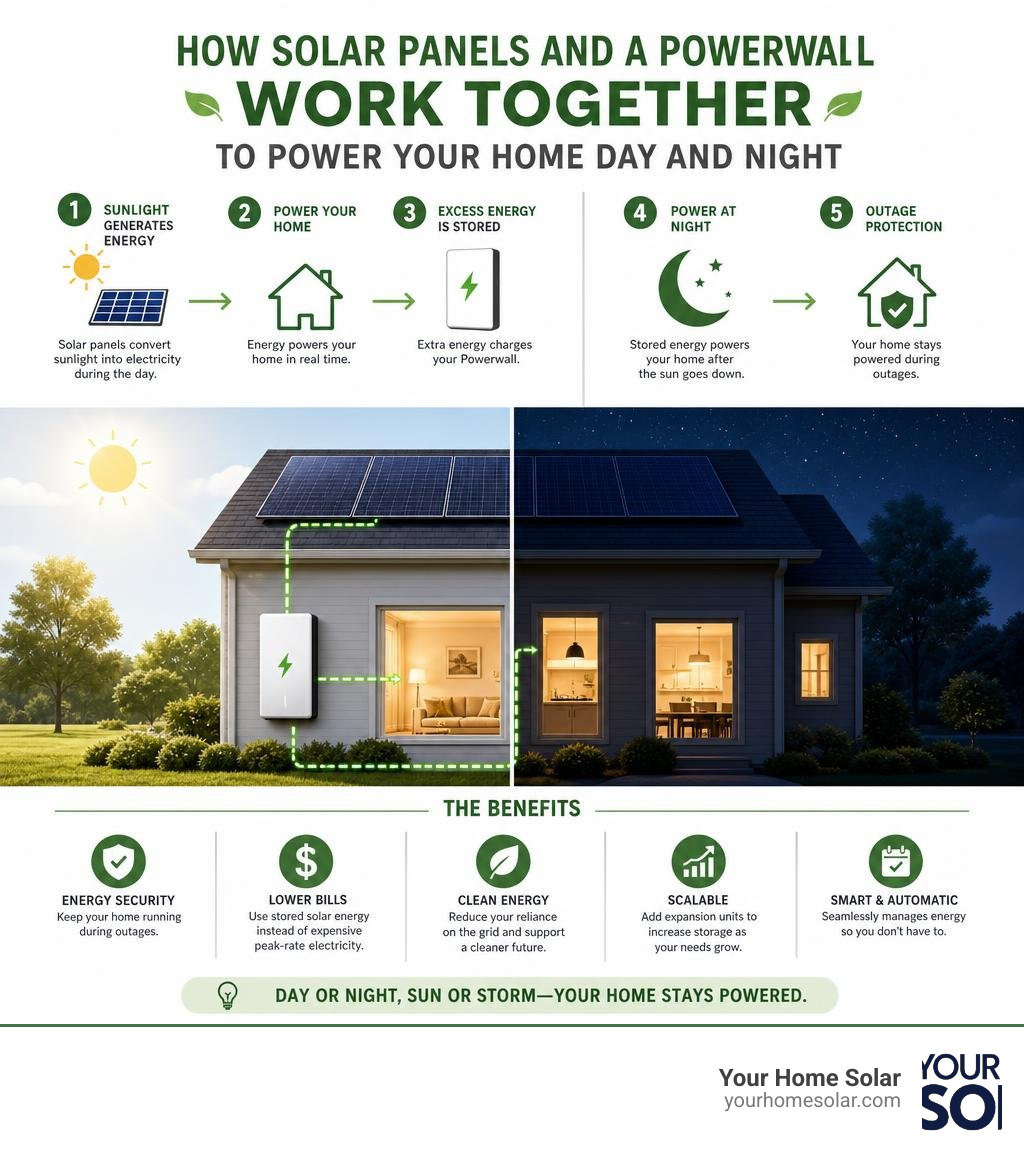
Solar and Powerwall systems are one of the most powerful combinations available to homeowners today. Here’s a quick summary of what you need to know:
What does a solar and Powerwall system do?
- Generates energy — Solar panels produce electricity from sunlight during the day
- Stores excess energy — The Powerwall 3 stores power your panels produce but your home doesn’t immediately use
- Powers your home during outages — Stored energy keeps your lights and appliances running when the grid goes down
- Reduces your electricity bill — You draw from stored solar energy instead of buying from the utility at peak rates
- Scales to your needs — You can add up to three expansion units for a total of 54 kWh of storage
At a glance:
| Feature | Tesla Powerwall 3 |
|---|---|
| Storage capacity | 13.5 kWh (expandable to 54 kWh) |
| Continuous power output | 11.5 kW |
| Round-trip efficiency | 89% |
| Warranty | 10 years / 70% capacity retention |
| Cost before incentives | $15,300 – $16,200 |
For East Tennessee homeowners, power outages aren’t a rare inconvenience — they’re a real and recurring problem. Severe weather, aging grid infrastructure, and rising electricity rates make energy independence less of a luxury and more of a practical necessity.
The good news? A home solar system paired with a battery like the Powerwall 3 addresses all of it at once. You generate your own power, store what you don’t use, and stay protected when the grid fails. And with federal tax credits and other incentives still available in 2026, the cost barrier is lower than many homeowners expect.
This guide covers everything you need to make a confident, informed decision — from technical specs and real costs to what the system actually does during a blackout.
I’m Ernie Bussell, founder and CEO of Your Home Solar and the #1 solar energy contractor in East Tennessee, and I’ve spent years helping homeowners navigate solar and Powerwall decisions with clarity and confidence. My background spans operations management in the solar industry, executive leadership, and over a decade working directly with people — so I know how to cut through the noise and give you straight answers.
Understanding the Tesla Powerwall 3: Key Specifications and Features
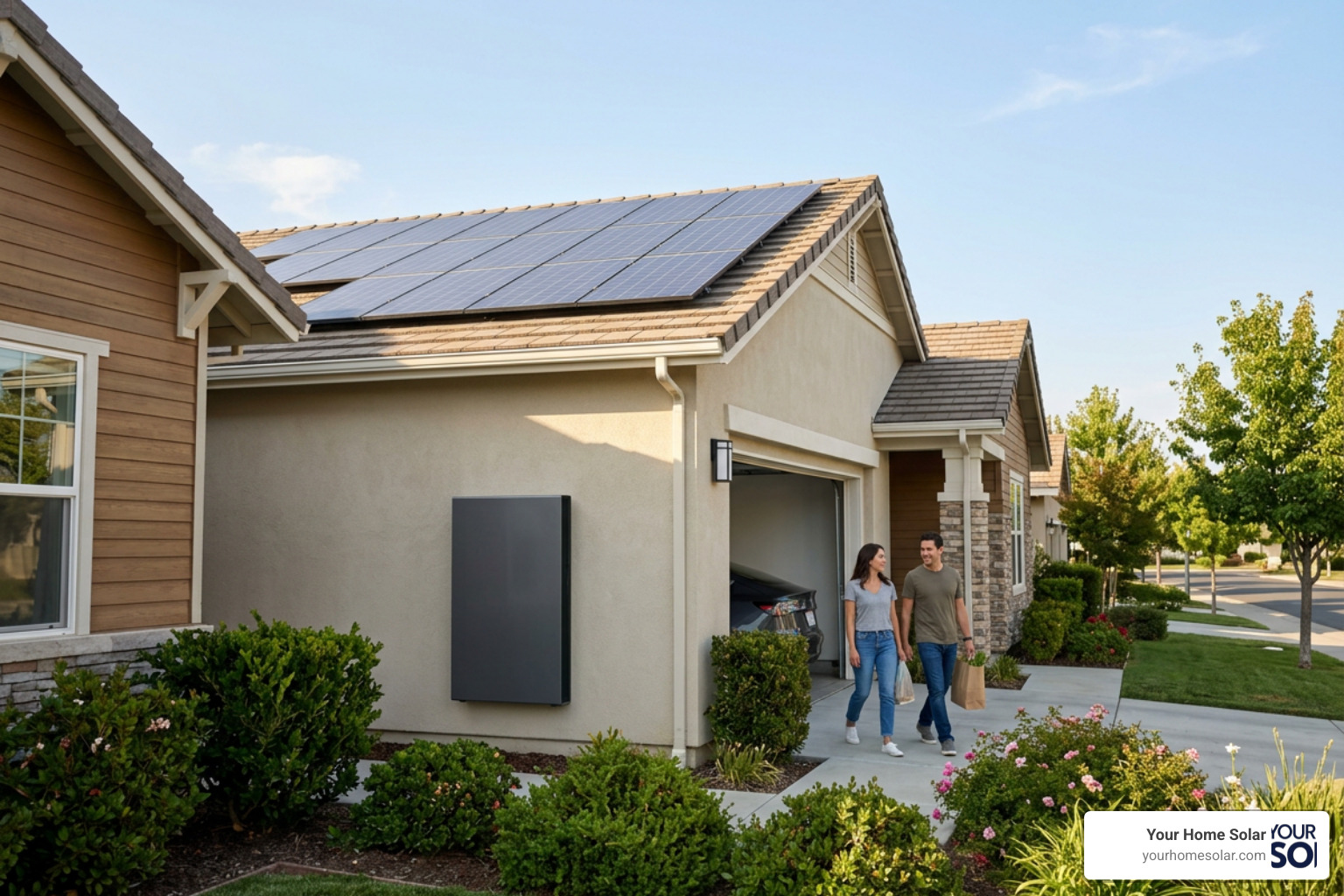
The Powerwall has long been the gold standard for residential energy storage, and the Powerwall 3 refines this legacy even further. To understand why this battery is leading the market in July 2026, we have to look closely at its core specifications and chemistry.
The Powerwall 3 features a usable battery capacity of 13.5 kilowatt-hours (kWh). This is the total amount of electricity the battery can store and deliver to your home. But capacity is only half the story; you also need to know how fast that energy can be delivered. The Powerwall 3 boasts an impressive 11.5 kW continuous power rating. This means it can deliver a massive amount of electricity all at once, allowing you to run power-hungry appliances like central air conditioning, well pumps, or electric vehicle chargers without breaking a sweat.
Under the hood, Tesla transitioned the Powerwall 3 to Lithium Iron Phosphate (LFP) chemistry. Compared to older Nickel Manganese Cobalt (NMC) batteries, LFP chemistry is inherently safer, less prone to thermal runaway, and environmentally cleaner because it doesn’t rely on cobalt.
Additionally, LFP chemistry allows the battery to achieve a 100% depth of discharge (DoD). This means you can use every single drop of the 13.5 kWh capacity without damaging the battery’s long-term health. Combine that with a round-trip efficiency of 89% (meaning only 11% of the energy is lost during the storage and retrieval process), and you have an incredibly efficient energy vault on your wall.
If 13.5 kWh isn’t quite enough for your household, the system is highly scalable. You can easily expand your storage capacity by stacking up to three DC-coupled expansion units. These expansion units cost $5,900 each and connect directly to the main unit, bringing your total potential storage up to an incredible 54 kWh without requiring extra inverters.
Comparing Powerwall 3 to Previous Models
The jump from previous models to the Powerwall 3 represents a massive leap in hardware design. The most notable change is the built-in hybrid solar inverter. In older setups, you needed a separate solar inverter on your wall alongside the battery. The Powerwall 3 consolidates both into a single unit, which drastically simplifies the installation process and reduces energy conversion losses.
Let’s look at how the specs stack up side-by-side:
| Specification | Powerwall 2 | Powerwall 3 |
|---|---|---|
| Usable Capacity | 13.5 kWh | 13.5 kWh |
| Continuous Power (On-Grid) | 5.0 kW | 11.5 kW |
| Peak Power (Off-Grid) | 7.0 kW | 30.0 kW |
| Inverter Integration | Requires external inverter | Built-in hybrid inverter |
| MPPT Solar Inputs | None (uses external) | 6 solar inputs |
| Battery Chemistry | Lithium NMC | Lithium LFP |
As detailed in the official Powerwall 3 datasheet rev 1 03312023.pdf , the unit includes six Maximum Power Point Trackers (MPPTs). This is a massive win for homes in East Tennessee with complex, shaded, or multi-angled roofs. It allows your solar panels to operate at peak efficiency even if some portions of the roof are temporarily shaded by our beautiful local pine and oak trees.
Furthermore, the Powerwall 3’s 30 kW peak power output gives it incredible load start capability. When heavy appliances like your HVAC system kick on, they require a massive surge of “startup” current. The Powerwall 3 handles these surges with ease, whereas older battery models would often trip or require you to install expensive soft-start kits.
To learn more about how battery chemistry affects performance, check out our guide on Everything You Need to Know About Residential Solar Battery Types – What’s Best? or read our comprehensive guide on Don’t Get Left in the Dark: A Guide to Battery Packs for Home Solar Systems.
How Much Does a Solar and Powerwall System Cost in 2026?

Let’s talk numbers. The current cost of a single Tesla Powerwall 3 unit ranges between $15,300 and $16,200 before taxes, rebates, or solar panel integration. This range depends largely on your location and the complexity of your home’s electrical setup.
When you factor in professional installation, permitting, electrical materials, and labor, the average all-in cash price for a single standalone battery installation hovers around $16,600. If you are installing a complete, brand-new system featuring both solar and Powerwall units, the total investment typically ranges from $25,000 to $45,000+ depending on the size of your solar array.
For a deeper dive into the economics of battery installations, read our article on Powering Up: The Ultimate Guide to Home Battery Installation and Costs.
Factors Influencing Your Total Installation Cost
No two homes are identical, and several key variables will dictate where your final quote lands:
- Number of Units: While a single unit provides 13.5 kWh of storage, larger homes or those wanting absolute off-grid security may need multiple units or the cheaper $5,900 expansion packs.
- Electrical Upgrades: If your home has an outdated electrical panel, you may need a main panel upgrade (MPU) to safely handle the bidirectional flow of electricity.
- The Tesla Backup Switch: In areas where local utilities allow it, Tesla’s proprietary Backup Switch can plug directly into your electric meter socket. This clever device acts as the system gateway and can save up to six hours of manual labor, significantly lowering your overall installation costs.
- Labor Rates: Local labor markets dictate installation costs. For instance, labor costs in Farragut or Oak Ridge can vary slightly based on local permitting timelines and utility interconnection processes.
Rebates, Tax Credits, and Financial Incentives
Fortunately, you don’t have to shoulder the entire cost alone. There are fantastic financial incentives available in July 2026 to help offset your investment:
- The Federal Residential Clean Energy Credit (Section 25D): This allows you to deduct 30% of the total installation cost of both your solar panels and your Powerwall system from your federal taxes. This incentive applies to both the hardware and labor, instantly shaving thousands off your net cost.
- Tesla’s ‘Next Million Powerwall’ Rebate: Tesla periodically offers direct rebates, currently giving homeowners $500 off a single unit and $1,000 off multi-unit systems when installed by certified partners.
- Local Utility Incentives: Depending on where you live in East Tennessee, local power companies offer unique solar and storage programs. For example, if you are looking at Sevierville, TN Solar Panel Cost: 2026 Prices and Savings or researching options using the Solar Panel Cost Guide in Farragut, TN (2025 Update) – EcoWatch , you can find localized utility connection programs that make energy storage even more rewarding.
To get a precise estimate tailored to your house, you can use the official tool to Design your Solar + Powerwall system and see how incentives apply to your specific zip code.
Maximizing Efficiency with Solar and Powerwall Integration
Installing solar panels is a great first step, but without a battery, you are still entirely dependent on the electrical grid. When your panels produce excess energy during the middle of the day, that electricity is sent back to the utility grid. Then, when the sun goes down and your energy usage spikes, you have to buy that electricity back—often at higher rates.
By pairing solar and Powerwall systems, you create a closed-loop energy ecosystem. Instead of exporting your clean solar energy to the grid for pennies, your excess power is funneled directly into your battery. During the evening, your home seamlessly transitions to drawing power from the Powerwall. This process, known as self-consumption, maximizes your financial return and keeps your home running on 100% clean, self-generated energy.
How Solar and Powerwall Systems Work Together
The magic of the Powerwall 3 lies in its elegant energy management. In traditional solar-plus-storage systems, DC power from the solar panels must travel to an external solar inverter to be converted to AC power for your home. If you want to store it, that AC power has to be converted back to DC power by the battery, and then converted to AC again when you want to use it.
Every conversion step loses energy. The Powerwall 3’s integrated hybrid inverter streamlines this process, handling the DC-to-AC conversion directly inside the unit.

This direct DC-coupling minimizes conversion losses, ensuring that you get the absolute maximum amount of usable electricity out of your solar array. To understand this flow in detail, check out The Ultimate Guide to Solar Batteries and Energy Storage Solutions and our breakdown of a 10kW Solar System with Battery Storage Explained.
Backup Power and Grid Independence During Outages
When severe weather rolls through East Tennessee and the grid goes dark, a standard grid-tied solar system will shut down automatically to prevent backfeeding electricity into the power lines (which protects utility workers).
However, when you have a Powerwall 3, your system instantly enters off-grid mode. The Gateway isolates your home from the utility grid in a fraction of a second—so fast that you won’t even notice your digital clocks blinking.
With its incredible 30 kW peak power output, the Powerwall 3 provides robust load start capability. This means you don’t have to pick and choose which critical loads to back up. You can confidently run your refrigerator, well pump, lights, and your central HVAC system simultaneously.
For more tips on staying safe during blackouts, read Beyond the Grid: How Solar Battery Banks Keep Your Lights On and explore our list of the Don’t Be Powerless: Top Home Battery Backup Solutions.
Is the Powerwall 3 Worth the Investment?
Evaluating whether a solar and Powerwall system is worth the investment requires looking at both financial metrics and personal value.
From a purely financial standpoint, adding a battery does extend your solar payback period. A standard solar panel system without a battery in Tennessee typically pays for itself in about 10 years. When you add a Powerwall 3 to the mix, that payback period extends to roughly 14 years in the best-case scenarios.
However, focusing solely on the payback period misses the primary reason most homeowners install batteries: uninterrupted peace of mind. You cannot put a price tag on keeping your family safe, warm, and comfortable during a multi-day winter power outage. Furthermore, a solar-and-battery system immediately increases your home’s equity and protects you against future utility rate hikes.
Is a Solar and Powerwall Setup Right for Your Home?
A Powerwall 3 is an ideal fit for you if:
- You experience frequent power outages: If your neighborhood’s grid is unreliable, a battery is a cleaner, quieter, and completely automatic alternative to a noisy gas generator.
- You want to maximize self-consumption: If your local utility does not offer 1-to-1 net metering, storing your own solar power is far more profitable than selling it back to the grid.
- You want hands-off convenience: Unlike traditional generators that require fuel, oil changes, and manual startup, the Powerwall is completely silent and maintenance-free.
If you are weighing the costs and benefits of different backup options, read our analysis on Shocking or Saving: What a Home Battery Backup Actually Costs or check out our guide on Generac Solar Battery Installation in East Tennessee.
Pros and Cons of the Powerwall 3
To help you make an objective decision, let’s look at the key pros and cons of the Powerwall 3:
Pros:
- Incredible Power Output: The 11.5 kW continuous and 30 kW peak output leads the industry, allowing you to back up whole-home loads easily.
- Safer LFP Chemistry: Highly stable, long lifespan, and environmentally friendlier.
- Cost-Effective Scalability: Adding storage capacity is incredibly affordable with the $5,900 expansion units.
- All-in-One Design: The integrated hybrid inverter saves wall space and reduces installation complexity.
Cons:
- Customer Service: Tesla’s corporate customer support has a reputation for being slow and difficult to reach. Working with a highly rated, certified local installer like Your Home Solar bypasses this headache entirely.
- Retrofit Limitations: Because of its built-in hybrid inverter, the Powerwall 3 is primarily designed for brand-new solar installations. While it can be AC-coupled to existing systems, it requires careful engineering.
For a broader look at how the Powerwall stacks up against other options on the market, check out our In-Depth Guide to Solar Battery Backup Comparison.
Frequently Asked Questions about Solar and Powerwall Systems
What is the lifespan and warranty of the Powerwall 3?
The Tesla Powerwall 3 is backed by a robust 10-year warranty that guarantees it will retain at least 70% of its original 13.5 kWh capacity at the end of the decade. Under normal operating conditions, the LFP battery cells are designed to last 15 years or more. Best of all, Tesla’s warranty includes unlimited charge cycles for essential daily operations like solar self-consumption and backup reserve.
Can I add a Powerwall 3 to an existing solar panel system?
Yes, you can. While the Powerwall 3 is optimized as a hybrid inverter for new solar arrays, it can be integrated with existing solar panel systems using a method called AC-coupling. In this configuration, your existing solar inverter remains in place to handle your solar panels, and the Powerwall 3 acts purely as an intelligent battery backup.
How many Powerwall units do I need to power my entire home?
For most average-sized homes in East Tennessee, one Powerwall 3 is sufficient to back up all critical loads (refrigerator, lights, Wi-Fi, outlets, and select appliances) for a full day. If you want true whole-home backup—including running your central air conditioning, dryer, and EV charger simultaneously—we typically recommend installing two Powerwall units or pairing a single main unit with one or two expansion packs.
Conclusion
Investing in a solar and Powerwall system is about taking control of your home’s energy future. Whether you want to slash your monthly utility bills, reduce your carbon footprint, or protect your family from unpredictable grid failures, this state-of-the-art technology delivers unmatched reliability.
At Your Home Solar, we provide comprehensive home energy solutions tailored specifically to East Tennessee. From Knoxville and Maryville to Oak Ridge, Johnson City, and Sevierville, we bring trusted expertise and a commitment to 100% customer satisfaction to every single installation. We handle the entire process—from custom system design and local permitting to professional installation and utility connection.
Ready to take the first step toward true energy independence? Contact Your Home Solar today to design your custom solar and storage system.