Why Home Battery Backup Matters for East Tennessee Homes
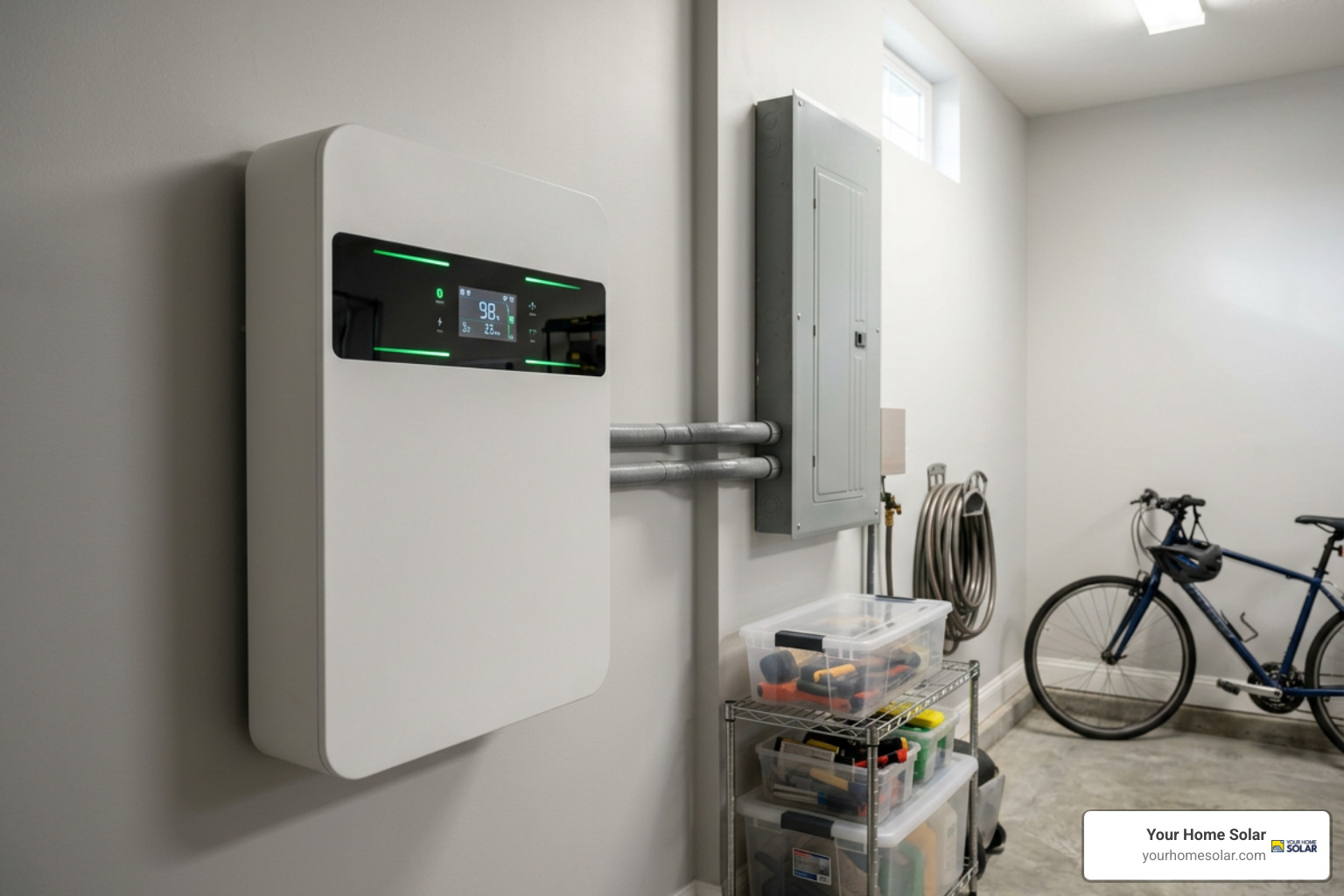
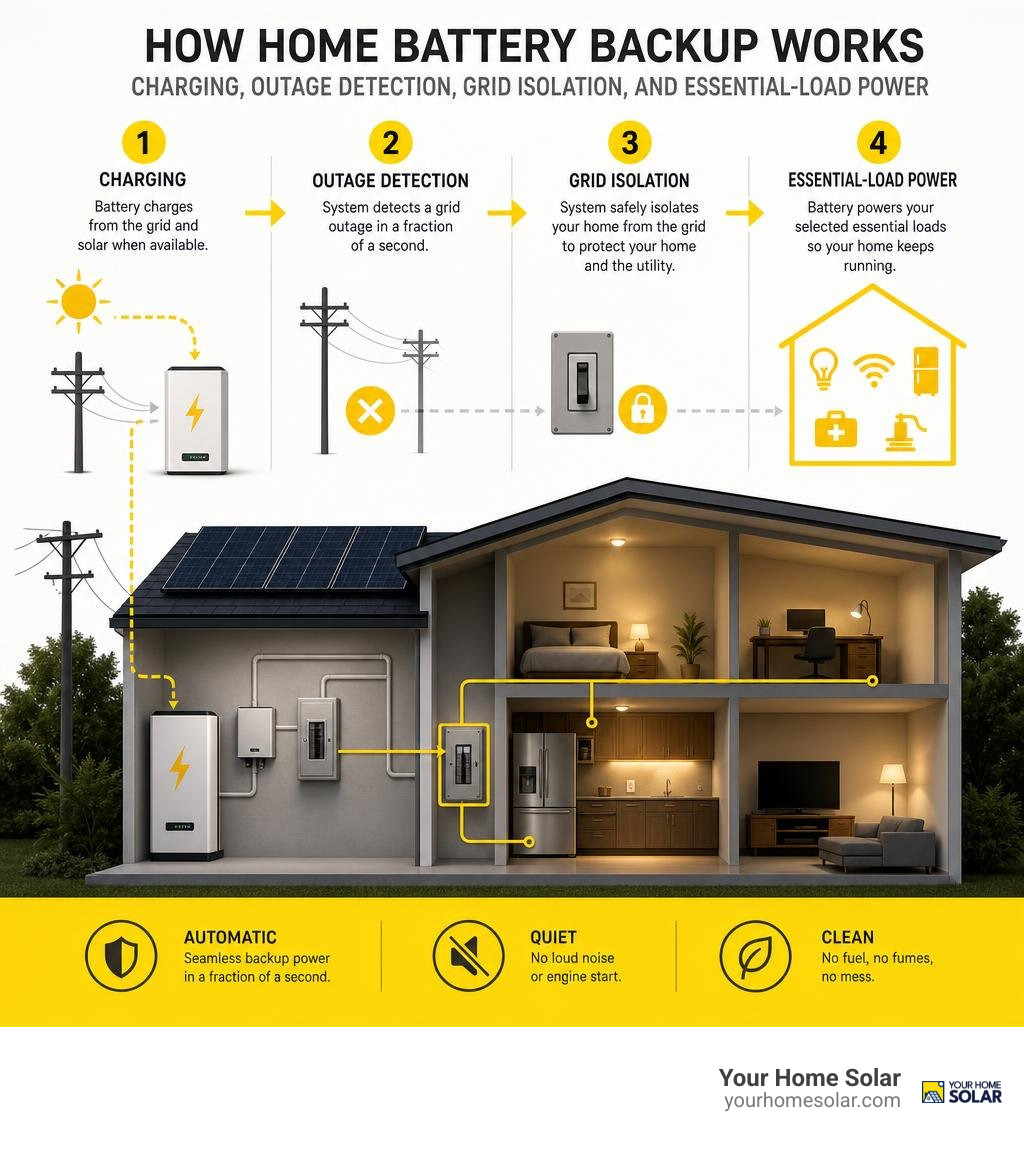
A home battery backup stores electricity so your home can keep running when the grid goes down. It can switch on automatically in a fraction of a second, powering selected essentials – such as refrigeration, lights, Wi-Fi, medical equipment, and a well pump – or, with enough capacity and smart load control, much of the home.
The right system depends on three things:
- Which appliances you need during an outage
- How many hours or days of backup you want
- Whether you want to pair the battery with solar for daytime recharging and lower utility costs
For many households, a battery provides roughly 8 to 24 hours of critical-load backup. It can also store lower-cost or excess solar electricity for use when rates are high. Unlike a conventional generator, it operates quietly, produces no exhaust at your home, and does not rely on fuel deliveries.
I am Ernie Bussell, founder and CEO of Your Home Solar. My experience leading solar operations and installing practical energy solutions in East Tennessee helps homeowners make clear, informed decisions about home battery backup and long-term energy resilience.
How a Home Battery Backup System Works and Key Components
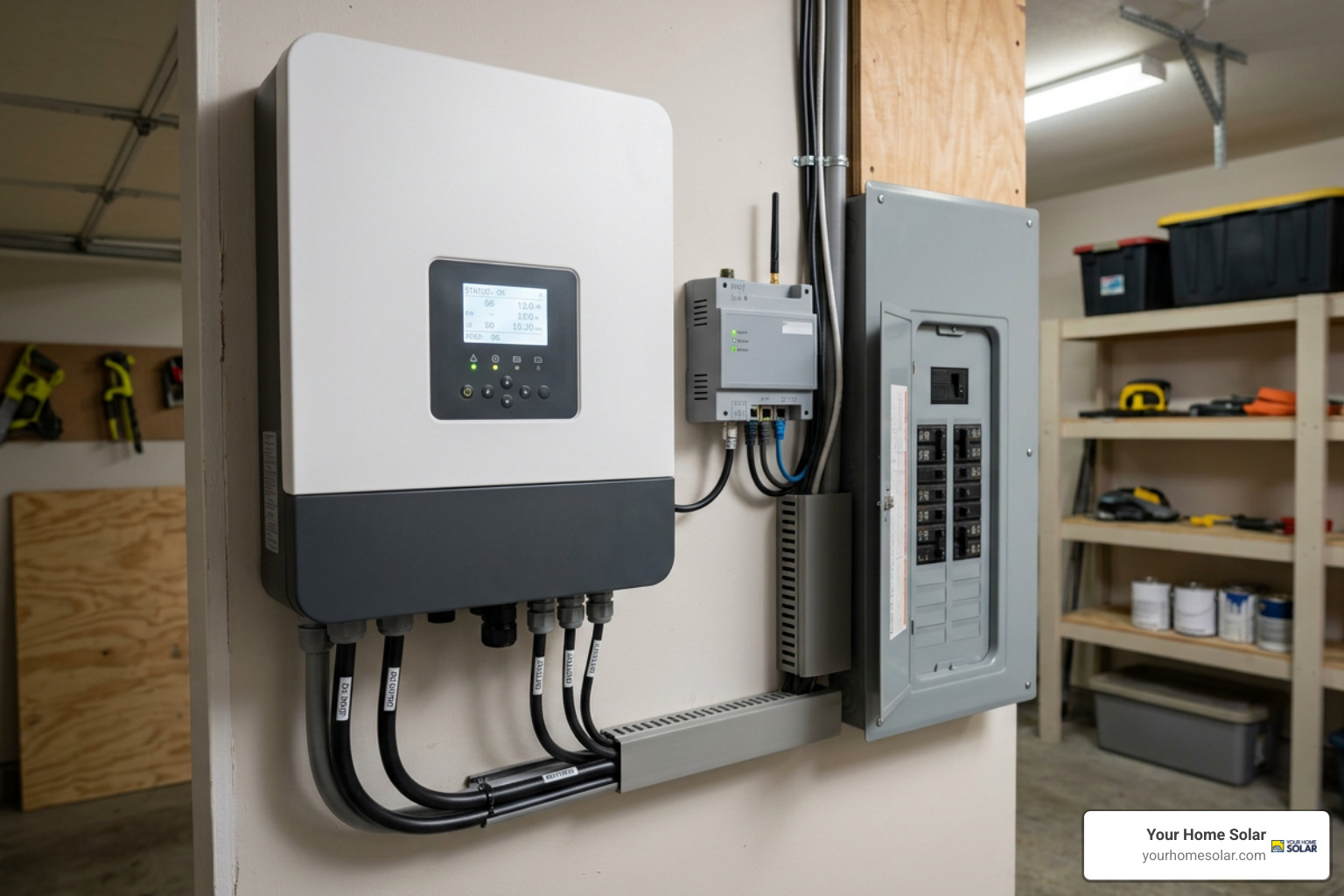
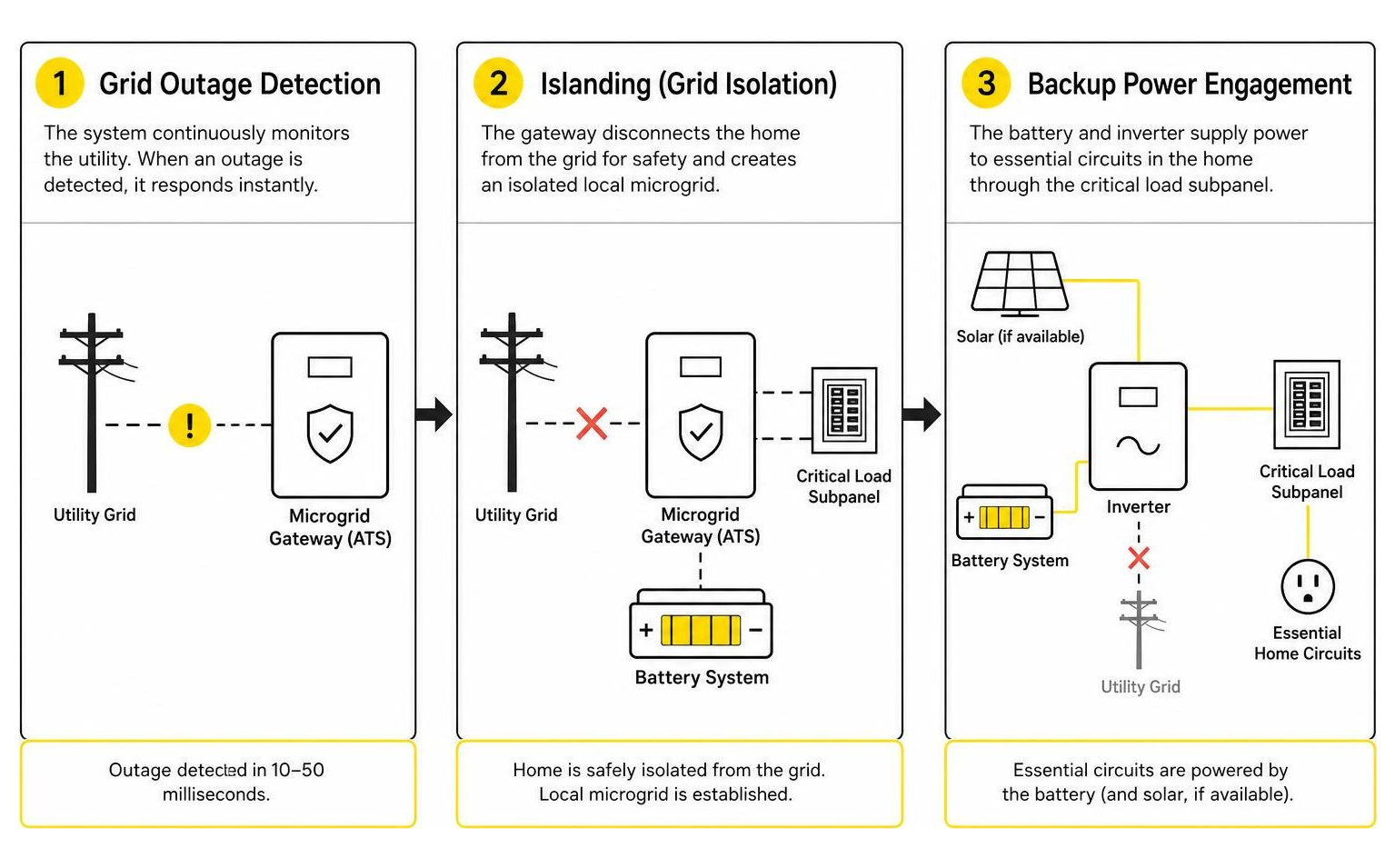
At its core, a residential energy storage setup captures electrical energy, stores it chemically in safe lithium battery cells, and deploys it whenever the central electrical grid falters. Under normal conditions, the system remains in standby mode, continuously optimizing household power flows while keeping its internal cells charged.
The entire process hinges on coordinated hardware and software components working together:
- Battery Cells and Enclosure: The physical energy bank where direct current (DC) electricity is stored safely.
- Battery Management System (BMS): An internal computer that monitors cell temperatures, voltage levels, state-of-charge, and health to prevent thermal stress or overcharging.
- Power Inverter: Converts direct current (DC) from batteries and solar panels into alternating current (AC) used by standard household appliances.
- Energy Management System (EMS): Intelligent control software that automates energy consumption, tracks solar production, and directs power flows.
- Automatic Transfer Switch (ATS) / Microgrid Gateway: Detects utility outages in 10 to 50 milliseconds, performs rapid islanding to disconnect the home from the grid for worker safety, and establishes an isolated local microgrid.
- Critical Load Subpanel: A dedicated electrical panel that isolates essential household circuits, ensuring non-essential appliances do not drain battery reserves during an emergency.
Understanding these hardware roles is vital when evaluating your options for staying powered when the grid goes down.
AC-Coupled vs. DC-Coupled Home Battery Backup Systems
When designing your home storage setup, the architecture linking the battery, inverter, and solar array matters significantly. Residential battery configurations fall into two distinct engineering categories:
- DC-Coupled Systems: In a DC-coupled design, solar panels feed DC power directly to a shared hybrid inverter and charge the battery through a charge controller without intermediate AC conversion. This architecture minimizes energy losses by avoiding what engineers call the “triple conversion penalty” (DC solar to AC, AC back to DC for storage, and DC back to AC for home consumption). For example, the high-voltage architecture of the SolarEdge Home Battery 400V: Empowering Residential Solutions achieves up to a 94.5% round-trip efficiency, effectively delivering up to 10 days of equivalent free power each year through reduced thermal loss.
- AC-Coupled Systems: In an AC-coupled arrangement, the solar array and the battery storage system operate on separate inverters. While this introduces minor conversion losses, it offers unparalleled retrofit flexibility. If you already have existing rooftop solar panels, our team can install an AC-coupled battery bank without altering your existing solar inverters. Understanding the mechanics of AC coupling solar ensures your inverter sizing matches safety ratios seamlessly.
Standalone Battery Storage vs. Solar-Integrated Backup
Homeowners are often surprised to learn that an energy storage system does not strictly require solar panels to function.
A standalone battery system charges directly from the utility grid during low-demand or off-peak hours. When a storm knocks out the local substation, the charged battery automatically steps in to keep your lights on. In areas with Time-of-Use (TOU) billing, a standalone battery can perform rate arbitrage—charging when electricity is cheapest and discharging to power your home when utility rates spike.
However, a solar-integrated system provides true indefinite resilience. While a standalone battery will eventually run empty during a multi-day blackout, pairing storage with rooftop panels allows you to recharge the battery every day using clean sunshine. Utilizing solar panel emergency power provides a self-sustaining loop of self-consumption, grid independence, and long-term utility bill protection.
Comparing Home Battery Systems with Standby Generators
When planning for severe weather and utility instability, homeowners often weigh lithium battery storage against traditional fossil fuel standby generators. Both protect your household, but their operation, maintenance, and long-term costs differ substantially.
| Feature / Metric | Home Battery Backup System | Standby Generator (Propane / Natural Gas) |
|---|---|---|
| Transfer Speed | Instantaneous (<50 milliseconds) | Delayed (10 to 30 seconds) |
| Operational Noise | Silent (0 dB) | Loud (60 to 80 dB at 23 feet) |
| Emissions & Fumes | Zero local emissions | Carbon monoxide, NOx, exhaust fumes |
| Fuel Source | Solar generation or stored grid power | Natural gas line, propane tank, or diesel |
| Routine Maintenance | Minimal (automated BMS monitoring) | Regular oil changes, spark plugs, exercise cycles |
| Fuel Supply Vulnerability | None (unlimited sunlight potential) | Fuel shortages, pipeline disruptions, delivery delays |
| Lifespan | 10 to 15 years (6,000–10,000 cycles) | 10 to 20 years (limited to 2,000–3,000 run hours) |
| Daily Utility Savings | High (load shifting & solar self-consumption) | None (costs money every time it runs) |
While whole-home fossil fuel generators deliver sustained high wattage during extended winter outages, they come with maintenance hurdles and fuel dependence. For a detailed breakdown of fuel types and mechanical tradeoffs, explore our guide on comparing solar with traditional gas generators as well as our review of home backup generator options.
Critical Loads vs. Whole-Home Energy Support
Deciding between critical load backup and whole-home power shapes your system design and budget:
- Critical Load Backup: Focuses exclusively on non-negotiable household circuits routed into an isolated subpanel. This includes your refrigerator, freezer, LED lighting circuits, medical equipment, home networking routers, and well water pumps. By excluding heavy energy consumers, a single 10 to 13.5 kWh battery can comfortably power these essentials for 18 to 24 hours on a single charge.
- Whole-Home Backup: Backs up the entire main electrical service panel, including central air conditioners, electric heat pumps, water heaters, and electric vehicle chargers. Running these heavy appliances requires managing substantial inrush surge currents (the massive spike of power a motor draws when starting up). Whole-home backup typically requires stacking two, three, or more modular battery units, paired with smart load shedding to keep power balanced.
Integrating smart power outage solutions allows you to dynamically toggle high-draw appliances from your phone, maximizing runtime when utility power drops.
How to Determine the Right Battery Capacity and Chemistry
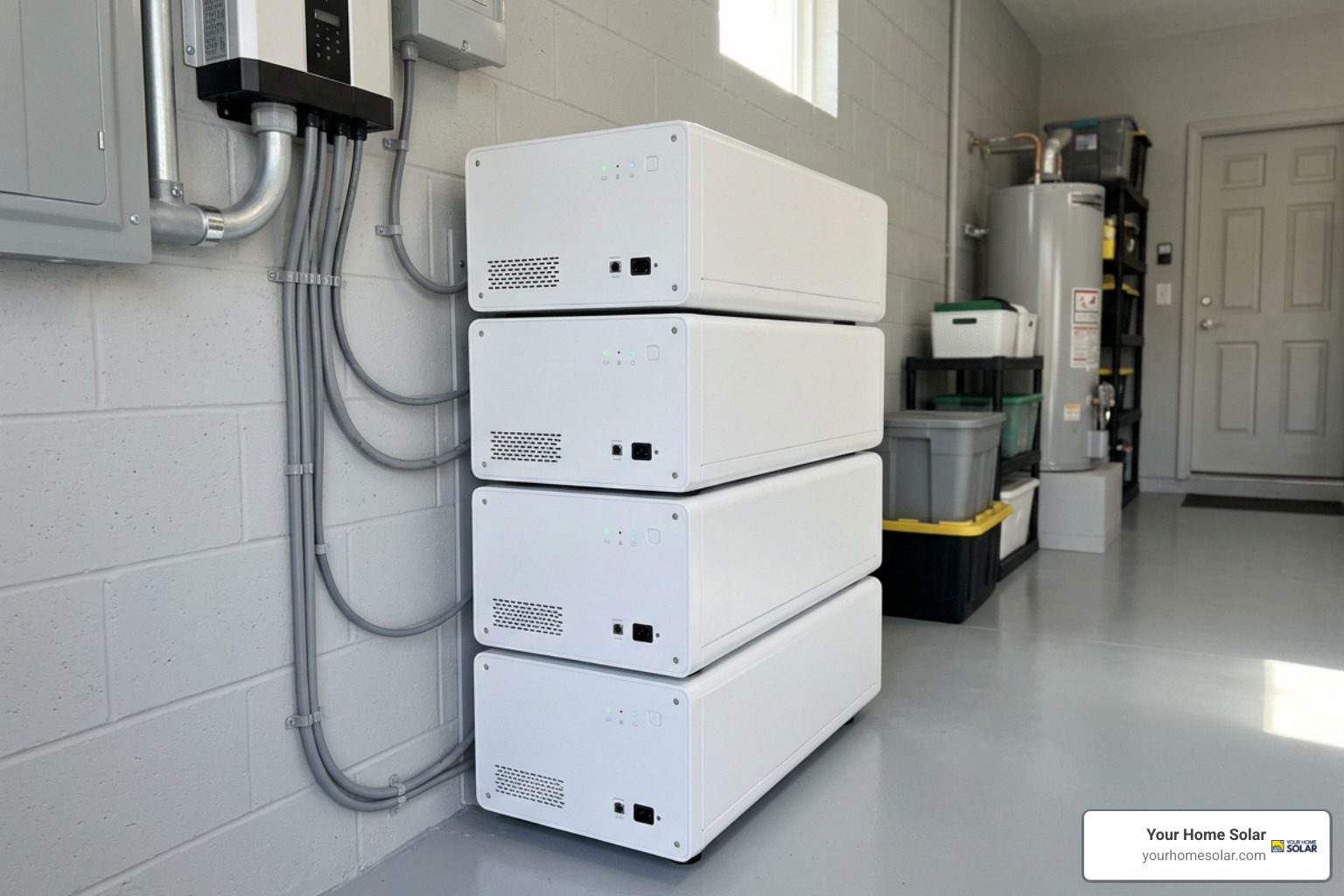
Calculating the right battery capacity starts with understanding your daily energy baseline. Sizing an energy storage system involves evaluating both storage capacity (measured in kilowatt-hours, or kWh) and continuous/peak power output (measured in kilowatts, or kW).
To determine the storage capacity you need, use this formula:
$$\text{Required Capacity (kWh)} = \frac{\text{Hourly Essential Consumption (kW)} \times \text{Desired Backup Hours}}{\text{Usable Depth of Discharge}}$$
For example, if your home’s essential baseline draw is 1.5 kW, you want 12 hours of guaranteed runtime, and your battery features an 85% usable depth of discharge (DoD):
$$\text{Required Capacity} = \frac{1.5 \text{ kW} \times 12 \text{ hours}}{0.85} = 21.17 \text{ kWh}$$
A modular system with approximately 20 to 22 kWh of usable storage will keep your household secure. This reliable sizing is critical when planning resilience against Tennessee storms, where high winds, summer thunderstorms, and winter ice events can take down distribution lines for days.
Selecting the Best Chemistry: LFP vs. NMC
Most modern residential storage platforms use one of two advanced lithium chemistries:
- Lithium Iron Phosphate (LFP / LiFePO4): LFP is the undisputed gold standard for residential stationary storage. LFP chemistry provides exceptional thermal stability, eliminates the risk of thermal runaway fires, contains no cobalt, and delivers extended cycle life (typically 6,000 to 10,000 full cycles while retaining 70% to 80% capacity).
- Nickel Manganese Cobalt (NMC): NMC batteries offer higher volumetric energy density, making them lighter and more compact. While they perform well across freezing temperatures, they have a shorter cycle lifespan (typically 3,000 to 5,000 cycles) and higher thermal sensitivity compared to LFP.
Both chemistries meet rigorous safety benchmarks, including the UL9540A fire safety standard, which tests thermal runaway mitigation to ensure units are safe for attached garages and basements. For a full technical breakdown, read our guide to residential solar battery types.
Top Residential Battery Storage Platforms in 2026
We carefully select, design, and install premium storage systems matched to your property’s electrical architecture:
- Tesla Powerwall 3: Featuring an integrated solar inverter, a usable capacity of 13.5 kWh, and an impressive 11.5 kW continuous power output, the Powerwall 3 easily handles heavy appliance surge currents.
- Generac PWRcell: A modular, high-capacity system offering flexible sizing from 9 kWh to 36 kWh. Homeowners interested in this platform can explore our certified Generac solar battery installation services.
- Sol-Ark Hybrid Inverters: The industry benchmark for whole-home off-grid and grid-tied resilience, offering massive peak surge wattage and seamless generator integration. See how our Sol-Ark battery storage installations provide unmatched flexibility.
- HomeGrid Stack’d Series: A modular, ultra-safe LFP battery system that expands easily by stacking physical battery slices up to 38.4 kWh per stack. Discover the benefits of our HomeGrid modular systems.
Understanding Home Battery Costs, Incentives, and ROI
Investing in energy storage requires evaluating upfront hardware, installation labor, electrical upgrades, and ongoing utility savings.
On average, a standard residential battery backup system ranges from $10,000 to $25,000 installed. Comprehensive whole-home systems that utilize multiple stacked batteries and advanced energy management panels range between $25,000 and $50,000+. On a hardware capacity basis, premium lithium systems average between $850 and $1,200 per kWh of usable storage.
Several variables influence total project investment:
- Usable storage capacity and peak inverter power output
- Electrical service upgrades (such as main service panel replacements or 200A smart panel installations)
- Permitting, engineering stamps, and utility interconnection approval
- Physical placement, trenching, and indoor/outdoor conduit routing
To see how these costs compare across different project sizes, review our guide on the cost of solar PV battery storage in 2026, as well as current regional solar and battery pricing data.
Sizing Your Budget for a Home Battery Backup
To understand how hardware costs translate into practical installations, look at our breakdown of what a home battery backup actually costs.
A single Tesla Powerwall 3 installation typically runs between $11,500 and $15,000 fully permitted and commissioned, while a robust three-unit whole-home setup averages $28,000 to $35,000. When pairing batteries with clean generation, a complete 10kW solar system with battery storage creates a resilient, closed-loop power station right on your property.
Financial incentives help lower this upfront investment:
- Federal Clean Energy Tax Credit: Homeowners can claim a 30% federal tax credit on the total cost of battery storage systems with a capacity of 3 kWh or greater, regardless of whether the battery is charged by solar or the utility grid.
- Local Utility Programs and Rebates: Many local power distributors and electric cooperatives offer equipment rebates, virtual power plant (VPP) incentives, and favorable rate structures for homeowners who install grid-interactive storage.
Frequently Asked Questions About Home Energy Storage
How long can a residential battery run my house during an outage?
A standard 13.5 kWh battery will power basic critical circuits (such as a refrigerator, LED lighting, Wi-Fi router, and device chargers drawing ~1.5 kW) for approximately 8 to 10 hours continuously. When paired with a rooftop solar system that recharges the battery bank during daylight hours, your backup power can run indefinitely during extended multi-week grid interruptions.
Can I install a home battery if I don’t have solar panels?
Yes. Standalone battery storage systems can charge directly from your standard utility grid connection. The system automatically maintains a 100% reserve state-of-charge, standing ready to power your home the moment a grid outage occurs. It can also be programmed to charge during low-cost off-peak hours and discharge during peak rate periods.
How long do modern lithium home batteries last?
Modern Lithium Iron Phosphate (LFP) and NMC residential batteries have an expected lifespan of 10 to 15 years. High-quality manufacturers provide comprehensive 10-year warranties that guarantee the battery will retain 70% to 80% of its initial rated capacity after 6,000 to 10,000 continuous charge-discharge cycles.
Conclusion: Powering Your Home with Confidence
Securing your family’s home against severe storms, transformer failures, and rising electricity costs is easier than ever with modern energy storage. At Your Home Solar, we provide tailored, turn-key energy solutions throughout East Tennessee, including Knoxville, Maryville, Sevierville, Oak Ridge, Johnson City, and surrounding communities.
Our certified team handles every detail—from custom electrical load calculations and panel engineering to local utility permitting and professional commissioning. Ready to protect your home with clean, silent, and automated energy storage? Explore the top home battery backup solutions with Your Home Solar today and take complete control of your home’s power.