Understanding the Economics of Home Solar Power
1000 kwh per month solar system cost typically ranges from $15,000 to $25,000 before incentives in East Tennessee. Here’s what you need to know:
- System Size Needed: 6-8 kW (approximately 18-24 solar panels)
- Average Cost Per Watt: $2.50 to $3.50 in Tennessee
- After Federal Tax Credit (30%): $10,500 to $17,500
- Typical Payback Period: 7-10 years
- Monthly Savings: $100-150 on your electricity bill
If your East Tennessee home uses around 1,000 kilowatt-hours (kWh) each month, you’re probably tired of watching your electricity bills climb year after year. 1000 kwh per month solar system cost might seem like a mystery wrapped in technical jargon, but it doesn’t have to be. The truth is, most homeowners in our region use between 800 and 1,200 kWh monthly, making this a common target for solar system sizing.
The average U.S. home consumes about 1,000 kWh per month, which means you’re right in line with national usage. For East Tennessee homeowners dealing with hot, humid summers and unpredictable weather patterns, solar panels offer a path to energy independence and protection against rising utility rates. Taking control of your electricity bills through solar isn’t just about saving money today—it’s about locking in predictable energy costs for decades to come.
But what does a system that produces 1,000 kWh monthly actually cost? The answer depends on several factors: your roof’s characteristics, the equipment you choose, local labor costs, and available incentives. This guide will walk you through each step of calculating your system cost, from sizing to installation to long-term savings.
I’m Ernie Bussell, founder and CEO of Your Home Solar, the #1 solar energy contractor in East Tennessee. After helping hundreds of local homeowners steer the 1000 kwh per month solar system cost and achieve energy independence, I’ve learned that understanding your options is the first step toward making a confident decision. Let me break down exactly what you’ll pay, what factors influence that price, and how to maximize your return on investment.
Step 1: Sizing Your System for 1000 kWh of Monthly Use
Before we can talk about the 1000 kwh per month solar system cost, we first need to understand what “size” system your home actually needs. Solar system size is measured in kilowatts (kW), representing the system’s peak power output. To effectively offset your 1,000 kWh monthly electricity usage, we need to determine the right kW capacity for your East Tennessee home.

A typical U.S. home that consumes around 1,000 kWh of electricity per month generally needs a solar system between 6.5 kW and 8 kW. This range accounts for variations in local solar resources and system efficiency. The average location in the U.S. has about 5 hours of effective solar resource per day. This means that over a month, your panels will receive approximately 150 hours of sunlight (5 hours/day x 30 days). To generate 1,000 kWh per month with this solar resource, a system of roughly 6.67 kW would be required (1,000 kWh / 150 hours).
However, real-world conditions, including East Tennessee’s specific weather patterns, roof orientation, and potential shading, will influence the precise sizing. This is where our local expertise comes in. We conduct a thorough solar site assessment to accurately calculate your home’s unique solar potential. Understanding your annual energy usage is key, and we always recommend checking your past 12 months of utility bills for the most accurate data.
For a precise estimate custom to your home’s unique needs and the specific solar potential in East Tennessee, we rely on tools like the PV Watts calculator from the National Renewable Energy Laboratory. This helps us factor in local weather data, system type, and other variables to design a system that truly meets your 1,000 kWh monthly goal. For more detailed guidance on system sizing, you can refer to our guide on Properly Sizing a Solar System for Your East Tennessee Home: Expert Tips.
How Many Solar Panels and How Much Space?
Once we establish the ideal system size in kilowatts, the next step is to translate that into the number of solar panels and the physical roof space required.
Modern solar panels typically have a power output of around 350 to 400 watts (0.35 to 0.4 kW) per panel. The average solar panel is approximately 18 square feet in size, including a buffer for racking and spacing.
Let’s use our 6.67 kW system as an example. If we assume an average panel output of 350 watts (0.35 kW):
- Number of panels: 6.67 kW / 0.35 kW/panel ≈ 19 panels
- Physical space required: 19 panels * 18 sqft/panel ≈ 342 square feet
This means a system designed to produce 1,000 kWh per month would typically require around 19 to 24 panels, depending on the specific wattage of the panels chosen. This will occupy approximately 340 to 430 square feet of roof space. Higher-efficiency panels, such as monocrystalline panels, can generate more power in less space, which can be a significant advantage for homes with limited or complex roof areas.
The orientation and pitch of your roof are critical factors. Panels facing south generally maximize electricity production, though west-facing panels can be beneficial if your utility has time-of-use rates that make afternoon electricity more valuable. We carefully evaluate these aspects during our site assessment. To understand more about how we assess your home’s solar potential, visit our page on Evaluating Clinton’s Solar Potential: Tips for a Site Assessment.
From kWh to kW: A Simple Calculation
Let’s simplify the calculation for system sizing. To determine the size of the system needed in kilowatts (kW) based on your monthly energy consumption in kilowatt-hours (kWh), we use this general formula:
System Size (kW) = (Monthly kWh Usage * 12) / (Annual Equivalent Full Sunlight Hours)
For a target of 1,000 kWh per month, your annual usage would be 12,000 kWh. If we use a conservative estimate of 5 peak sun hours per day, that translates to approximately 1,825 annual equivalent full sunlight hours (5 hours/day * 365 days/year).
So, for a 1,000 kWh per month system:
System Size (kW) = (1,000 kWh/month * 12 months/year) / 1,825 hours/year = 12,000 kWh / 1,825 hours ≈ 6.57 kW
This calculation confirms that a system in the 6.5 kW to 7.5 kW range is a good starting point for meeting 1,000 kWh of monthly usage. Local weather patterns, including temperature and cloud cover, play a role in actual energy production. For instance, solar panels can perform more efficiently in cooler temperatures, while excessive heat can slightly reduce their output. We factor these nuances into our designs to ensure optimal performance for your East Tennessee home. Learn more about how temperature affects solar output in our article on Home Solar Energy Output: How Temperature Affects Performance.
Step 2: The Upfront 1000 kWh Per Month Solar System Cost
Now for the burning question: what is the actual 1000 kwh per month solar system cost before any incentives? As we mentioned in the intro, for East Tennessee, this typically falls within the range of $15,000 to $25,000. This estimate is based on a system size of approximately 6.5 kW to 8 kW, at an average cost per watt of $2.50 to $3.50.
Nationally, residential solar panels cost between $2.53 and $3.15 per watt, with the average homeowner spending around $2.70 per watt before incentives. In Tennessee, we see similar pricing trends, though local market dynamics can cause slight variations. For example, a 6 kW system might cost between $15,180 and $18,900, while a 10 kW system could range from $25,300 to $31,500 before tax credits. Our goal at Your Home Solar is always to provide transparent and competitive pricing for your Affordable Solar Installation in Knoxville, TN and throughout East Tennessee.
Breaking Down the Total 1000 kWh per month solar system cost
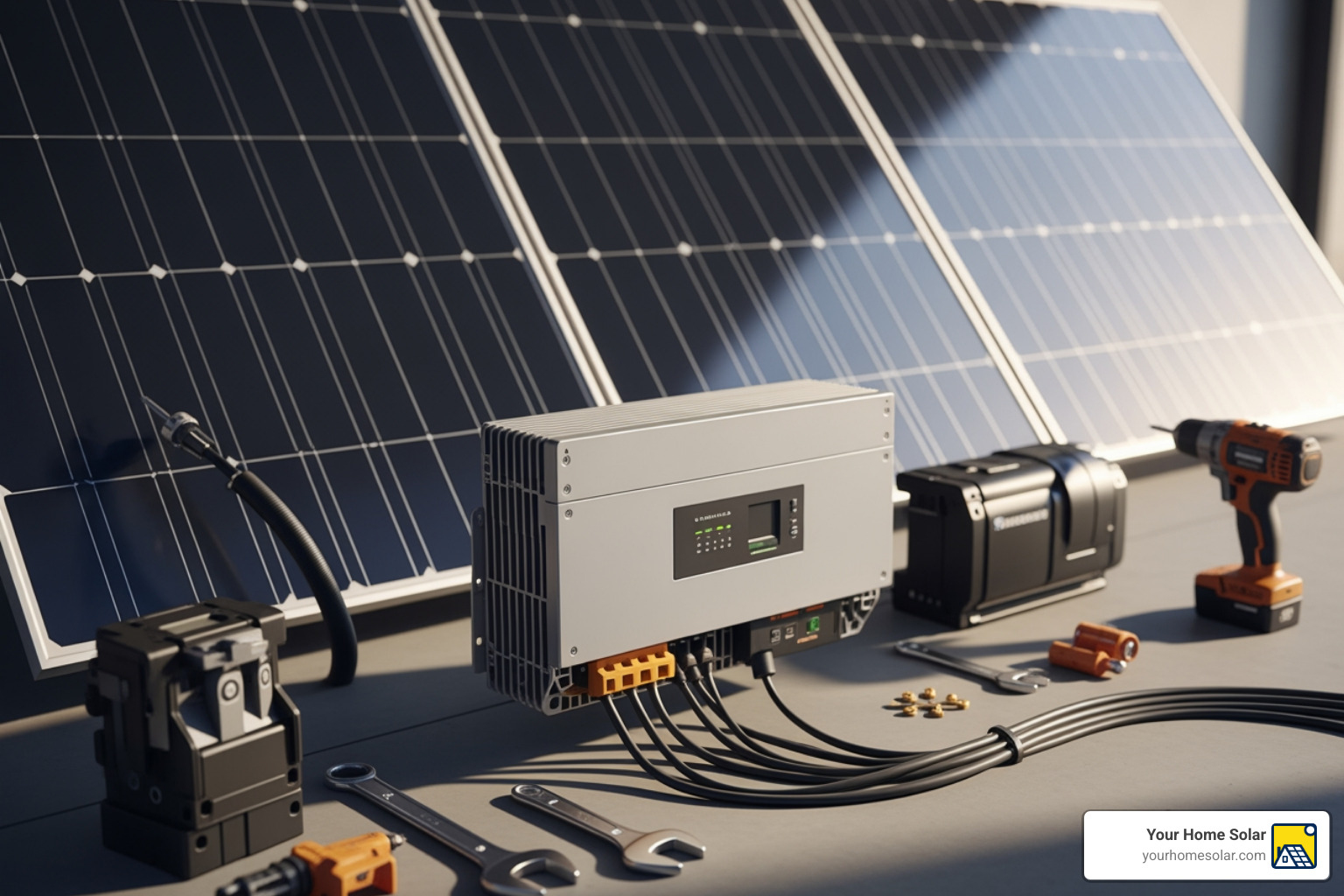
The total cost of your solar system isn’t just about the panels themselves. It’s a comprehensive package that includes several key components and services. Understanding this breakdown helps clarify where your investment goes:
- Solar Panels (Modules): While often the most visible part, the actual solar modules typically account for less than 20% of the overall installation cost. The quality and efficiency of the panels you choose will impact this portion of the cost.
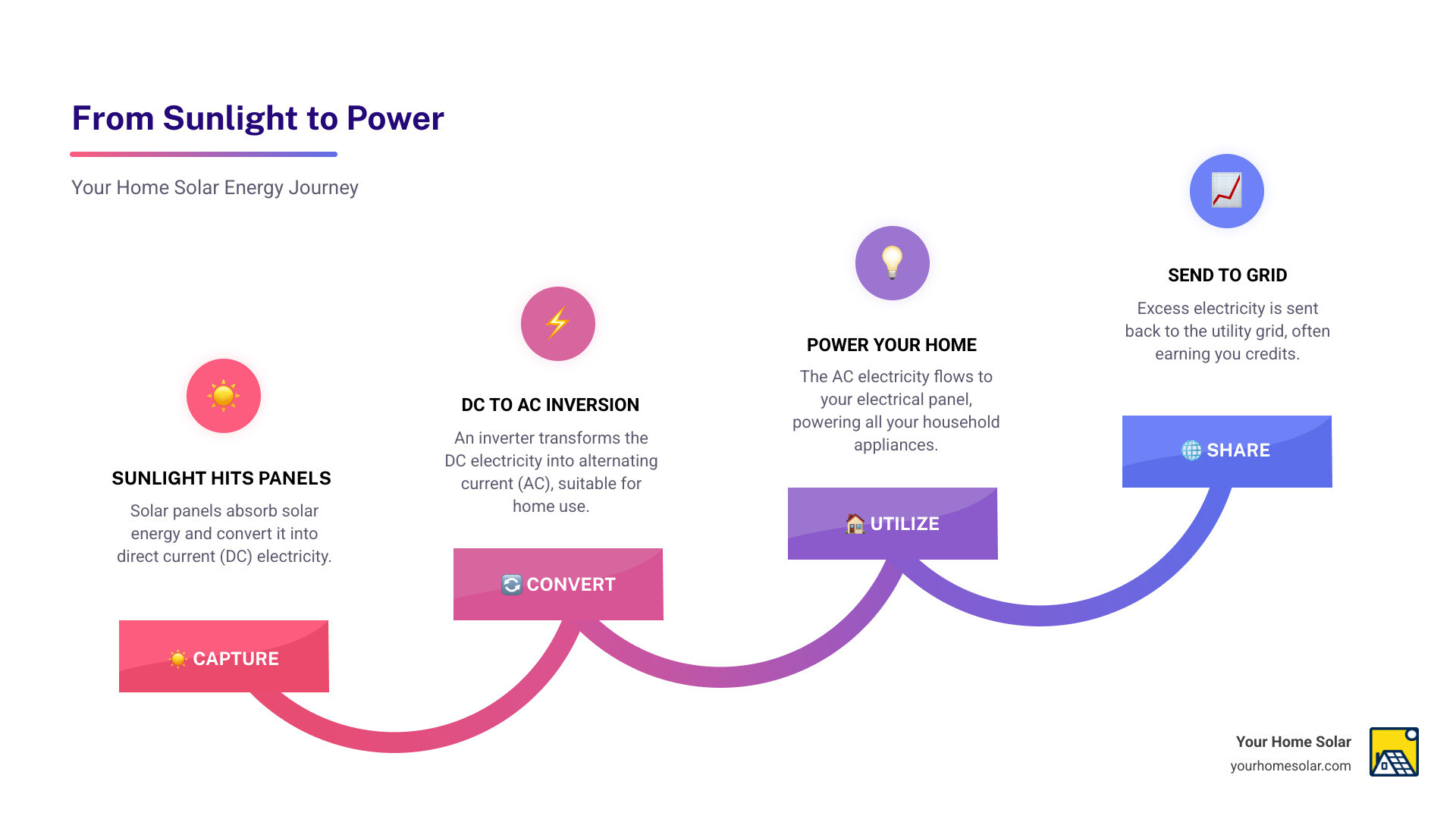
- Inverter Technology: This crucial component converts the direct current (DC) electricity from your panels into alternating current (AC) electricity that your home appliances use. Inverters can account for a significant portion, often 20-25% of the total cost.
- Racking and Mounting Hardware: These are the structures that securely fasten your solar panels to your roof or ground. This typically makes up another 20-25% of the cost, ensuring durability and proper panel positioning.
- Labor and Installation: The actual installation work, including electrical wiring, structural mounting, and system commissioning, is a substantial part of the cost. While installation labor itself might be around 5.5% of the total project cost, according to NREL data, the broader category of labor, logistics, and overhead (including design, project management, and sales) can account for a much larger portion.
- Permitting and Inspection Fees: Every solar installation requires permits from local authorities (city, county) and inspections to ensure compliance with building codes and safety standards. These “soft costs” also include interconnection fees from your utility company and can make up a considerable portion of the overall expense.
These various components and services are all integrated into the final price per watt that we quote, ensuring a high-quality, safe, and fully functional system for your home.
Cost Per Watt vs. Cost Per kWh
When evaluating solar quotes, you’ll often hear two key terms: “cost per watt” and “cost per kWh.” Understanding the difference is crucial for making an informed decision about your 1000 kwh per month solar system cost.
- Cost Per Watt ($/W): This is the total upfront cost of your solar system divided by its total wattage (or peak power capacity). For example, a $20,000 system with a 7,000-watt (7 kW) capacity has a cost per watt of $2.86/W. This metric is excellent for comparing different solar quotes on an apples-to-apples basis.
- Cost Per Kilowatt-Hour (cents/kWh) or Levelized Cost of Electricity (LCOE): This metric represents the average cost of electricity your solar system will produce over its entire lifespan. It factors in the upfront cost, expected energy production, and the system’s longevity. For instance, the average cost of a solar system purchased through solar.com is 6-8 cents per kWh. This is the most effective way to compare solar energy to the cost of electricity you’d buy from your utility company.
Comparing your solar system’s LCOE to your utility’s electricity rates is where the real magic happens. If your utility charges, say, 12-15 cents per kWh, and your solar system can produce power for 6-8 cents per kWh over its lifetime, you’re looking at significant long-term savings. This is how solar acts as a hedge against the rising utility rates we constantly see in East Tennessee. We help you evaluate these savings in detail. Find out more on How Your Home Solar Evaluates Your Solar Savings in East Tennessee.
Step 3: Factors That Adjust Your Final Price Tag
While we can provide a general range for the 1000 kwh per month solar system cost, several factors can nudge that price tag up or down. These variables are why a personalized quote is always essential.
- Equipment Quality and Efficiency: Just like cars, not all solar panels are created equal. High-efficiency monocrystalline panels, which are typically black and offer superior performance in less space, generally cost more than less efficient alternatives. The brand and quality of your inverter also play a role, with some offering advanced monitoring and longer warranties.
- Roof Complexity and Condition: A simple, unshaded, south-facing roof is ideal. However, many East Tennessee homes have roofs with multiple angles, dormers, skylights, or vents. These complexities require more labor and specialized racking, increasing installation costs. If your roof is older and nearing the end of its lifespan, we might recommend replacing it before solar installation, as panels are designed to last 25 years or more.
- Shading Issues: Trees or nearby structures that cast significant shade on your roof can reduce your system’s output. To compensate, a larger system might be needed, or we might recommend trimming trees or using specialized equipment to mitigate the shading’s impact.
At Your Home Solar, we work with leading technologies like SolarEdge, which offers advanced inverter and power optimizer solutions to maximize energy harvest, even on complex or partially shaded roofs. We are experts in SolarEdge Installation and Service in East Tennessee.
The Cost of Energy Independence: Adding Battery Backup
For many East Tennessee homeowners, solar isn’t just about saving money; it’s about energy independence and having reliable power during outages. This is where battery backup comes into play, and it will certainly adjust your 1000 kwh per month solar system cost.
While a standard grid-tied solar system sends excess power back to the utility grid, it typically shuts down during a power outage for safety reasons (to prevent back-feeding the grid and harming utility workers). Adding a solar battery storage system allows you to store excess solar energy generated during the day and use it when the sun isn’t shining or when the grid goes down.
The cost of adding battery backup varies significantly based on the battery’s capacity (how much energy it can store in kWh) and its chemistry. Lithium-ion batteries are the most popular choice for residential solar, offering high efficiency and a long lifespan.
Here’s a general comparison:
| System Type | Estimated Upfront Cost (Before Incentives) | Benefits |
|---|---|---|
| Grid-Tied System (No Battery) | $15,000 – $25,000 | Lower upfront cost, net metering savings, no power during outages. |
| Grid-Tied System with 10-15 kWh Battery | $23,000 – $40,000 | Backup power for essential loads during outages, optimizes self-consumption, increased energy independence. |
Adding a 10-15 kWh battery system can increase your upfront 1000 kwh per month solar system cost by approximately $8,000 to $15,000, depending on the battery chemistry (lithium-ion being the most common and cost-effective for residential use) and brand. While lead-acid batteries are cheaper ($200/kWh), lithium-ion options typically range from $500-$1,000/kWh, offering superior performance and longevity.
For many homeowners in East Tennessee, the peace of mind that comes with backup power during grid outages makes the added investment worthwhile. A 10 kWh battery system can typically power your essential electrical systems for up to three days, providing crucial reliability. Whether you’re looking to store energy for evening use or ensure your lights stay on during a storm, we can help you integrate the right battery solution. Explore our comprehensive guide to The Ultimate Guide to Solar Batteries and Energy Storage Solutions and consider if Can My East Tennessee Home Be 100% Off-Grid? It Depends..
Step 4: Slashing the Price with Incentives and Payback
While the upfront 1000 kwh per month solar system cost can seem substantial, a variety of incentives significantly reduce your out-of-pocket expenses, making solar a much more accessible investment for East Tennessee homeowners.
The most impactful incentive is the Federal Solar Investment Tax Credit (ITC). This credit allows you to deduct 30% of the cost of your solar energy system (including battery storage) from your federal taxes. For a system costing $20,000, this means a $6,000 reduction in your tax liability. This powerful incentive has been a cornerstone of solar growth across the U.S.
Beyond the federal credit, homeowners in East Tennessee may also benefit from state-specific incentives or utility programs, such as those offered by the Tennessee Valley Authority (TVA). These can include net metering policies (which we’ll discuss next) and other potential rebates or grants. We stay up-to-date on all available incentives to ensure you maximize your savings. For the latest details on local programs, consult our Solar Incentives Tennessee 2026 Guide.
Calculating Your Payback Period
The payback period is the time it takes for the savings on your electricity bills to equal the initial investment in your solar system. This is a critical metric for understanding your return on investment.
Payback Period (Years) = Net System Cost (After Incentives) / Annual Electricity Bill Savings
For a typical 1,000 kWh per month system in East Tennessee, the payback period usually falls between 7 and 10 years. This can vary based on your specific electricity rates, how much energy you consume, the final cost of your system after incentives, and how you finance your purchase. With utility rates consistently rising, your solar savings (and thus your payback) can accelerate over time.
Once your system has paid for itself, you’ll continue to generate free electricity for the remainder of its 25+ year lifespan, leading to substantial long-term savings and a strong return on investment. This financial advantage is a key reason why Why Knoxville Homeowners Are Rushing to Install Residential Solar in 2023.
How Net Metering Affects the 1000 kWh per month solar system cost and Savings
Net metering is a billing mechanism that allows you to receive credit for the excess electricity your solar panels generate and send back to the grid. Here’s how it works:
When your solar panels produce more electricity than your home consumes (e.g., during peak daylight hours), the surplus power is exported to the utility grid. Your utility meter effectively runs backward, and you receive a credit on your electricity bill. Conversely, when your panels aren’t producing enough power (e.g., at night or on cloudy days), you draw electricity from the grid, and your meter runs forward.
At the end of the billing cycle, you are only charged for your “net” electricity consumption (the difference between what you drew from the grid and what you sent back). This policy is vital for maximizing the financial benefits of solar, as it ensures you’re compensated for every kilowatt-hour your system produces, even if your home doesn’t use it instantly.
In East Tennessee, policies from the Tennessee Valley Authority (TVA) and local power companies govern how net metering works. These policies can vary, affecting how your excess power is credited and thus influencing your overall savings and the effective 1000 kwh per month solar system cost. We help you understand the specific net metering rules in your area to optimize your system design and ensure you get the most value from your solar investment. To learn more about local policies, read our article Do East Tennessee Utility Companies Buy Back Solar Power? Find Out Here!.
Frequently Asked Questions
How long will a solar system last?
Modern solar panels are incredibly durable and built to last. Most high-quality solar panels come with a performance warranty of 25 to 30 years, guaranteeing that they will still produce at least 80-90% of their original capacity by the end of that period. In reality, solar panels often continue to produce meaningful electricity for much longer. For instance, some of the first modern solar cells created in 1954 are still producing power, and a panel installed in Vermont in 1980 is still operating at 92% of its original capacity.
While panels are robust, components like inverters might have a shorter lifespan (typically 10-15 years) and may need replacement once during the system’s lifetime. However, their replacement cost is a small fraction of the overall system. With proper maintenance, your solar system can reliably power your home for decades. Find more about Solar Panel Durability: How Long Do They Last? and get tips on How to Maintain and Extend the Lifespan of Your Home Solar Panels.
Is it cheaper to stay on the grid or go solar?
For most East Tennessee homeowners, going solar is financially advantageous in the long run. Utility electricity prices have seen a steady increase over the past few decades, rising from approximately 5 cents per kWh to nearly 18 cents per kWh nationally. This trend of rising utility rates means that the cost of staying on the grid will likely continue to climb.
In contrast, investing in solar power allows you to lock in your electricity costs at a much lower and more predictable rate. As we’ve discussed, the Levelized Cost of Electricity (LCOE) from a residential solar system is typically between 6-8 cents per kWh. By generating your own power, you effectively hedge against energy inflation, making your electricity expenses stable and predictable for the next 25+ years. This makes solar a smart investment that not only saves you money but also increases your home’s value. Learn more about Unlocking Your Home’s Potential: How Solar Energy Can Save You Money.
Can I finance a solar panel system?
Absolutely! While a cash purchase often yields the greatest lifetime savings, we understand that not everyone has the upfront capital for a solar investment. That’s why we offer a variety of financing options to make solar accessible for East Tennessee homeowners:
- Solar Loans: Many homeowners choose to finance their solar system with a dedicated solar loan. These loans can often be structured so that your monthly loan payments are less than or equal to your previous electricity bill, allowing for “Day 1” savings.
- Cash Purchase: If you have the funds, paying cash maximizes your long-term return on investment, as you avoid interest payments and fully benefit from all incentives and energy savings immediately.
We work with you to explore the best financing solution for your budget and financial goals, ensuring that transitioning to solar is a smooth and rewarding experience. For a comprehensive overview of your options, visit our page on Solar Home Energy Financing in East Tennessee.
Get a Precise Quote for Your Home
Understanding the factors that influence the 1000 kwh per month solar system cost is the first step toward making a confident decision about going solar. As we’ve explored, the exact price tag depends on your home’s specific energy needs, roof characteristics, equipment choices, and available incentives.
At Your Home Solar, we pride ourselves on providing custom, reliable, and rewarding installations. Our team of trusted experts will conduct a complimentary, no-obligation assessment of your East Tennessee home to provide you with a precise, customized quote. We’ll walk you through every detail, from system sizing and equipment options to incentive programs and financing.
Ready to take control of your energy future and open up significant savings? Let us help you steer the journey to energy independence.
Get a Free Estimate today, or Learn more about the cost and financing of solar systems with Your Home Solar.