Why Solar Panel Benefits Matter More Than Ever for East Tennessee Homeowners
Solar panel benefits are changing how East Tennessee homeowners think about energy. Here’s what matters most:
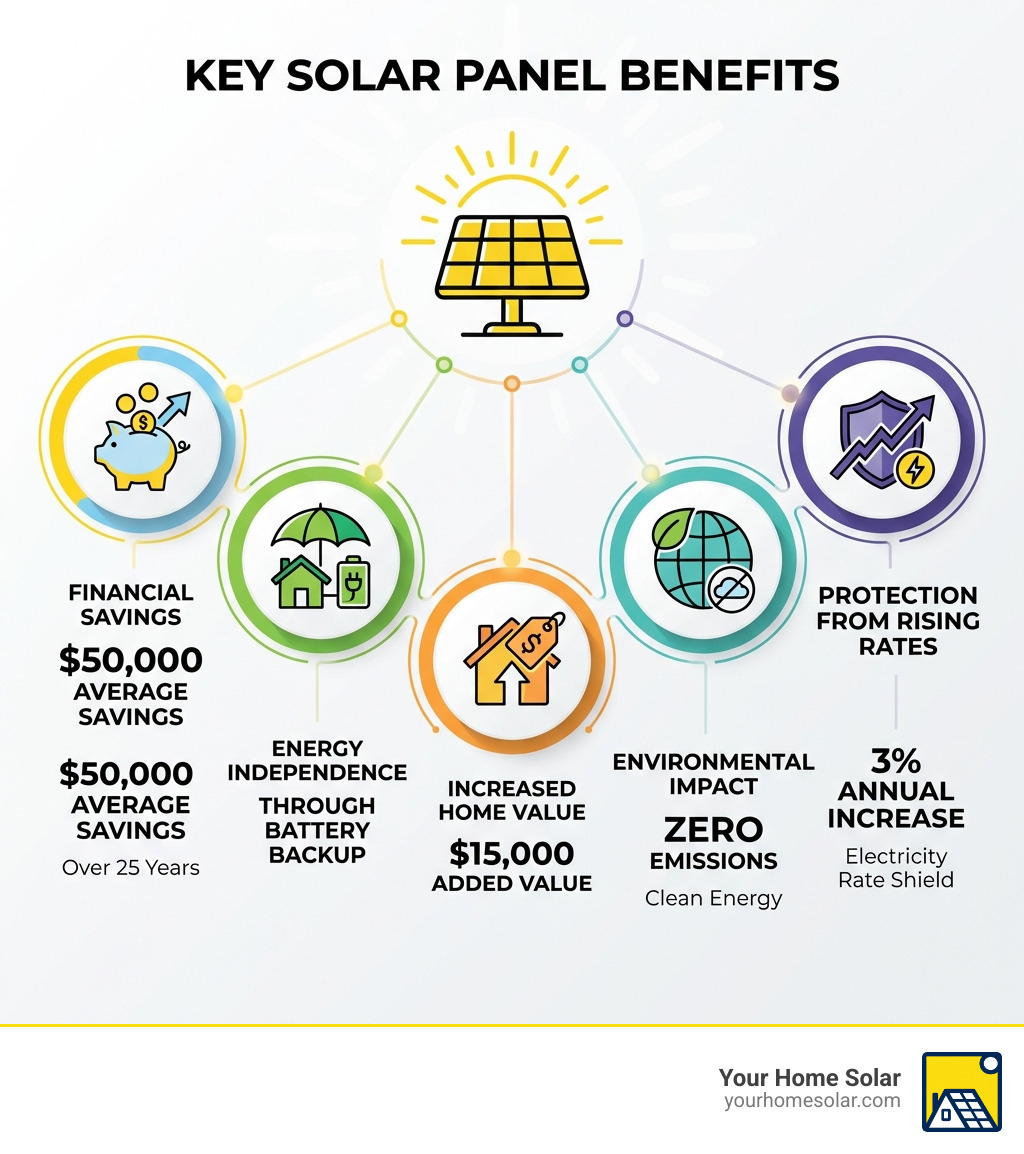
- Financial Savings: Average homeowners save $50,000 over 25 years
- Energy Independence: Power through outages with battery storage
- Increased Home Value: Solar adds an average of $15,000 to your home’s worth
- Environmental Impact: Clean energy with zero operational emissions
- Grid Resilience: Protection from rising electricity rates (up 3% annually since 1970)
The solar industry has exploded, with nearly 4 million American households now generating their own power. The amount of solar connected to the grid has grown exponentially for good reason.
Rising energy costs hit East Tennessee families hard. Electricity rates continue climbing, while extreme weather causes more frequent power outages. Homeowners are increasingly concerned about their environmental impact and want solutions that deliver both financial returns and energy security.
Solar panels check every box. They slash your monthly utility bills, protect you from volatile energy markets, keep your lights on during grid failures, and reduce your carbon footprint—all while increasing your property value.
However, the solar industry is full of confusing claims and one-size-fits-all solutions that don’t account for East Tennessee’s unique climate and energy landscape.
This guide cuts through the noise. We’ll break down the real solar panel benefits that matter to your family, your budget, and your home’s future. You’ll learn how solar works in our four-season climate, what financial incentives are available, and how to determine if solar is the right choice for you.
I’m Ernie Bussell, founder and CEO of Your Home Solar, East Tennessee’s #1 solar energy contractor. Over the past three years, I’ve helped hundreds of homeowners realize the true solar panel benefits available to them. My background in quality assurance and operational leadership helped me build a company homeowners can trust.
The Financial Wins: How Solar Panels Boost Your Bottom Line
Investing in solar panels for your East Tennessee home isn’t just about going green; it’s a smart financial decision that pays dividends for decades. Think of it as an upgrade that continuously puts money back in your pocket. We’ve seen how homeowners transform their budgets by embracing solar.

Unpacking the Financial Solar Panel Benefits
One of the most compelling solar panel benefits is the profound impact on your wallet. Installing a solar system gives you control over your energy usage and significantly lowers your costs, with many customers seeing their utility bills shrink to nearly zero.
Homes with solar panels rely less on the traditional electric grid. By capturing energy from the sun, you offset a substantial portion of your energy usage, directly reducing monthly bills.
Consider this: electricity rates have been on a steady climb, increasing over 3% per year on average since 1970. With solar, the energy your system produces comes at a fixed, predictable cost. This stability protects you from future rate hikes and the volatility of the energy market.
The long-term savings are remarkable. On average, U.S. homeowners save an estimated $50,000 over 25 years. While the initial investment is significant, the payback time is rapidly shrinking to as short as 5-6 years in some regions, making solar a sound financial choice.
To truly understand how solar can transform your finances, we encourage you to explore our detailed guide: Unlocking Your Home’s Potential: How Solar Energy Can Save You Money.
Increase Your Home’s Value and Appeal
Beyond immediate savings, another significant solar panel benefit is the boost to your home’s market value. Solar panels are a premium home upgrade, and homebuyers across the country are increasingly recognizing this value.
Studies consistently show that homes with solar sell faster and often command a premium price. A notable Berkeley National Laboratory study found that, on average, solar increased a home’s value by about $15,000. This is a substantial return on investment that many other home improvements can’t match.
For East Tennessee homeowners, your solar investment improves your property’s desirability and resale potential. Your home will stand out, attracting buyers willing to pay more for the long-term advantages solar offers.
Learn more about this win-win situation for East Tennessee homeowners: Solar Energy and Home Resale Value: A Win-Win for East Tennessee Homeowners.
Making Solar Affordable: Tax Credits and Financing
While the initial cost of solar isn’t cheap, it’s more affordable than ever thanks to robust incentives and flexible financing options for East Tennessee homeowners.
The most impactful incentive is the Federal Residential Solar Tax Credit, which allows taxpayers to claim a 30% tax credit on the cost of solar systems. This credit significantly reduces your out-of-pocket expenses. It is set to decrease after 2032, so acting sooner can maximize your savings.
Beyond tax credits, a variety of financing options exist:
- Solar Loans: Many homeowners opt for solar loans, similar to home improvement loans. The monthly loan payment is often less than an average utility bill, meaning you can start saving from day one. Some programs from the Federal Housing Administration and Fannie Mae even allow you to integrate solar financing into your mortgage.
- Solar Leases and Power Purchase Agreements (PPAs): For those who prefer no upfront costs, a third-party company owns, installs, and maintains the system on your roof. You purchase the electricity at a fixed, often discounted, rate. While these options provide lower electricity bills, you do not own the system and cannot claim the federal tax credit.
Navigating these options can be complex, but we’re here to help. The Clean Energy States Alliance has a helpful guide: Download the guide, and we also offer custom advice for our East Tennessee neighbors: Home Solar Energy Financing in East Tennessee.
Energy Independence and Resilience: Powering Through Uncertainty
In East Tennessee, we’re no strangers to unexpected weather and power outages. One of the most critical solar panel benefits is the energy independence and resilience it provides, giving you peace of mind when the grid falters.
Gain Control Over Rising Energy Costs
Energy markets are increasingly volatile. Global events can send fossil fuel prices soaring, directly impacting our electricity bills. The World Bank forecasts have highlighted these dramatic increases in oil and natural gas prices.
This unpredictability makes budgeting a nightmare. With solar energy, you essentially lock in your electricity costs. Once your system is installed, the sunlight is free. This creates a powerful shield against inflation and market shocks, allowing you to control your long-term energy expenses. It’s why we often say, Why Skipping Solar Panels Could Be Costing You more than you realize.
Achieve Energy Security with Solar and Battery Storage
A reassuring solar panel benefit for East Tennessee homeowners is improved energy security, especially when paired with battery storage. A standard grid-tied system shuts down during an outage for safety, but adding a battery storage system changes everything.
Solar-plus-storage systems provide power regardless of the weather or time of day, independent of the grid. When the grid goes down, your home seamlessly switches to battery power, keeping essential appliances running. Your panels then recharge the battery with sunlight, ensuring continuous power during extended outages, which are becoming more frequent due to extreme weather events.
This flexibility gives you true energy independence. Find everything you need to know in The Ultimate Guide to Solar Batteries and Energy Storage Solutions and why Solar Panels for Homes Are the Best Choices for Emergency Power Backup.
Smart Energy Management for Maximum Savings
Optimizing your solar energy usage is key to maximizing its solar panel benefits. Since sunlight is intermittent and many people aren’t home during peak production hours, smart solutions are needed.
The evolution of battery technology has been a game-changer. Historically an expensive hurdle, today’s advanced lithium-ion and other batteries offer more efficient, durable, and scalable storage solutions crucial for energy resilience.
With battery storage, you can store excess solar electricity from sunny hours and use it when the sun isn’t shining or during peak demand times when grid electricity is most expensive. This strategy works perfectly with “time-of-use” (TOU) tariffs, allowing you to significantly cut down on your grid purchases.
Even without a battery, you can optimize usage by setting timers for appliances like washing machines to run during the sunniest parts of the day. This direct self-consumption is often more financially beneficial than sending excess power back to the grid.
For a deeper dive, check out Maximizing Solar Energy Production: Tips for Optimizing Your Solar Panel System.
The Environmental and Economic Solar Panel Benefits
Beyond financial and energy security, solar panel benefits extend to the health of our planet and the vitality of our economy. Choosing solar is a powerful statement for a sustainable future in East Tennessee.
Reduce Your Carbon Footprint for a Greener Home
A widely recognized solar panel benefit is the dramatic reduction in your carbon footprint. By switching to solar, you choose a clean, renewable energy source that lessens our reliance on fossil fuels. Unlike grid electricity from mixed sources, solar is a pure, emission-free choice.
Solar power plants produce no air pollution or greenhouse gases when operating. This means cleaner air for East Tennessee, healthier waterways, and a contribution to combating climate change. The IEA indicates we need to reach 100 million households with rooftop solar PV by 2030 to achieve global net-zero goals, and your home can be part of the solution.
Explore more about The Environmental Impact of Solar Energy: Reducing Your Carbon Footprint.
Understanding the Full Lifecycle: Manufacturing and Recycling
While operationally green, we believe in transparency about the entire lifecycle. Manufacturing solar panels is energy-intensive and involves mining raw materials, which has environmental impacts. The multi-step process for crystalline silicon PV, from raw materials to module assembly, requires careful consideration.
However, a PV system typically produces the energy equivalent to its manufacturing within 1 to 4 years. With an operating life of 30+ years, it generates clean energy for decades after paying back its initial energy investment.
Responsible end-of-life management is also crucial. Some manufacturing processes use hazardous materials that require careful handling. Fortunately, significant efforts to address end-of-life issues are underway, including state recycling laws and federal regulations. We are committed to promoting a circular economy for solar: Solar Energy and the Circular Economy: Reducing Waste, Maximizing Resources.
Fueling Economic Growth and Job Creation
The solar industry’s growth brings substantial economic solar panel benefits, creating jobs and fostering domestic manufacturing in the U.S. and East Tennessee. It’s about building a robust, sustainable economy.
The solar industry has seen phenomenal job growth, with over 364,500 Americans working in solar across more than 10,000+ companies as of 2023. Solar installers are ranked among the fastest-growing occupations.
Expanding rooftop solar supports domestic manufacturing, and policies like the Inflation Reduction Act (IRA) are boosting this growth. As a local East Tennessee business, Your Home Solar is proud to contribute to this economic vitality by creating local jobs and supporting our community. Learn more: Green Businesses in East Tennessee: How Solar Powers Sustainability.
Practical Considerations: Is Solar Right for Your Home?
Deciding to go solar is a big step. While the solar panel benefits are numerous, it’s important to understand the practical aspects to ensure solar is a good fit for your East Tennessee home.
Debunking Myths and Understanding Challenges
Let’s address some common questions and potential challenges.
Initial Cost vs. Long-Term Value: While the initial cost is a significant investment, it’s offset by long-term savings, increased home value, and tax credits. As the industry grows, economies of scale are driving prices down. It’s important to focus on the lifetime value, not just the upfront figure. We love to Debunk Solar Myths: What Knoxville Homeowners Need to Know About Solar Panels for Homes.
Sunlight Dependency Solutions: Solar panels need sunshine, but they still work on cloudy days and in winter. While less efficient in gloomy weather, they still generate power. Our systems are designed for East Tennessee’s climate, and battery storage provides a reliable solution for continuous power, day or night.
Roof Suitability: Not every roof is a perfect candidate. Panels work best on south-facing roofs free from shade. If your roof is nearing the end of its 10-15 year warranty, it’s smart to replace it before installing a 30+ year solar system. This can save thousands in the long run by avoiding the cost of removing and reinstalling panels later. We always recommend consulting a qualified roofer first.
We address more misconceptions in Solar Energy Myths Debunked: Separating Fact from Fiction.
System Types and Siting: What Works for You?
There are different system types and mounting options for your East Tennessee property.
Roof-Mount vs. Ground-Mount:
- Roof-Mount Systems: The most common residential option. Systems are attached to roof joists on pitched roofs or use a weighted ballast on flat roofs. A qualified installer will ensure all penetrations are sealed, keeping your roof watertight.
- Ground-Mount Systems: An excellent option if your roof isn’t suitable or if you have ample land. They can be positioned for maximum sun exposure but require more site work, including trenching and concrete footers.
Grid-Tied vs. Off-Grid Systems:
- Grid-Tied Systems: Most residential systems are grid-tied, connecting to the utility grid. This allows you to sell excess power and draw from the grid when needed. A standard grid-tied system won’t provide power during an outage (unless paired with a battery), but it is eligible for federal tax incentives.
- Off-Grid Systems: These are independent of the grid and require substantial battery storage. They offer complete energy independence but are generally not eligible for federal tax incentives, making them a niche solution for remote properties.
Solar Thermal vs. Photovoltaic (PV):
- Solar Water Heaters (Solar Thermal): These systems use panels to heat water, not generate electricity. They can cut water heating bills by 50-80%.
- Passive Solar Design: This uses building materials and strategic orientation to control indoor temperatures naturally, without requiring electricity.
Understanding these options is the first step. Get more insights into Preparing Your Home for Solar Installation: What You Need to Know and learn Who Are Not Candidates For Solar?.
Solar for Everyone: Climate and Housing Solutions
“Does solar even work in East Tennessee’s four seasons?” Absolutely! A key solar panel benefit is its viability in diverse climates.
Performance in Four-Season Climates: Solar panels are surprisingly efficient in colder weather. Even with fewer daylight hours in winter, there’s enough sun to power an average home. Our systems are designed for East Tennessee’s climate to ensure optimal year-round performance. You can find more about Solar Panel Viability in Tennessee.
Community Solar Programs: If your home isn’t suitable for panels or you’re a renter, you can still access solar panel benefits. Community solar programs allow multiple people to share a single, off-site solar array. Participants receive credits on their electricity bills for their share of the generated energy, providing the advantages of solar without owning a system.
Frequently Asked Questions About Solar Panels
We often get asked similar questions by East Tennessee homeowners exploring solar. Here are some of the most common ones, along with our expert answers.
How long do solar panels last?
Modern solar panels are incredibly durable and built to last. The estimated operational lifespan of a photovoltaic (PV) module is about 30 to 35 years. Most manufacturers offer performance warranties that guarantee panels will produce at least 80% to 85% of their original output after 25 years. This means your investment is designed to provide clean energy and savings for a very long time.
To learn more about the longevity of your system, see Solar Panel Durability: How Long Do They Last?.
Do solar panels require a lot of maintenance?
Fortunately, solar panels are a low-maintenance technology. They have no moving parts, making them incredibly reliable. For most East Tennessee homes, occasional cleaning (usually just rinsing them off with a hose a few times a year) is sufficient to remove dust, pollen, or leaves that might reduce efficiency. Heavy rainfall often takes care of this naturally. We also recommend periodic professional inspections to ensure everything is functioning optimally. The maintenance cost impact for solar panels is typically around 1% of the system cost annually, a small price for decades of clean energy.
For tips on keeping your system running smoothly, visit Solar Energy Maintenance 101: Tips for Keeping Your System Running Smoothly.
Will my solar panels work during a power outage?
This is a critical question. A standard grid-tied solar system, without battery storage, will not work during a power outage. This is a safety feature designed to protect utility workers who may be repairing power lines. However, this limitation is easily overcome by pairing your solar panels with a battery storage system.
When you have solar panels combined with a Powerwall or similar battery, your home gains true energy independence. During an outage, the battery seamlessly takes over, keeping your essential appliances running. Your solar panels then continue to recharge the battery with sunlight, ensuring you have continuous backup power. This integrated approach offers superior resilience compared to traditional gas generators, which require fuel and produce emissions.
For a detailed comparison, explore Comparing Solar with Traditional Gas Generators for East Tennessee Homes.
Conclusion: Make the Bright Choice for Your Home’s Future
We’ve explored the extensive solar panel benefits, from the significant financial savings and increased home value to the crucial energy independence and positive environmental impact. For East Tennessee homeowners, embracing solar means taking control of your energy future, protecting your budget from rising costs, and contributing to a healthier planet.
At Your Home Solar, we’re dedicated to bringing these benefits to your doorstep. Our trusted expertise and commitment to 100% customer satisfaction mean we provide custom, reliable, and rewarding installations designed specifically for your home and our unique East Tennessee climate.
Don’t let another day pass paying ever-increasing utility bills. It’s time to make the bright choice for your home’s future.
Learn more about our residential solar solutions and get a free estimate today