
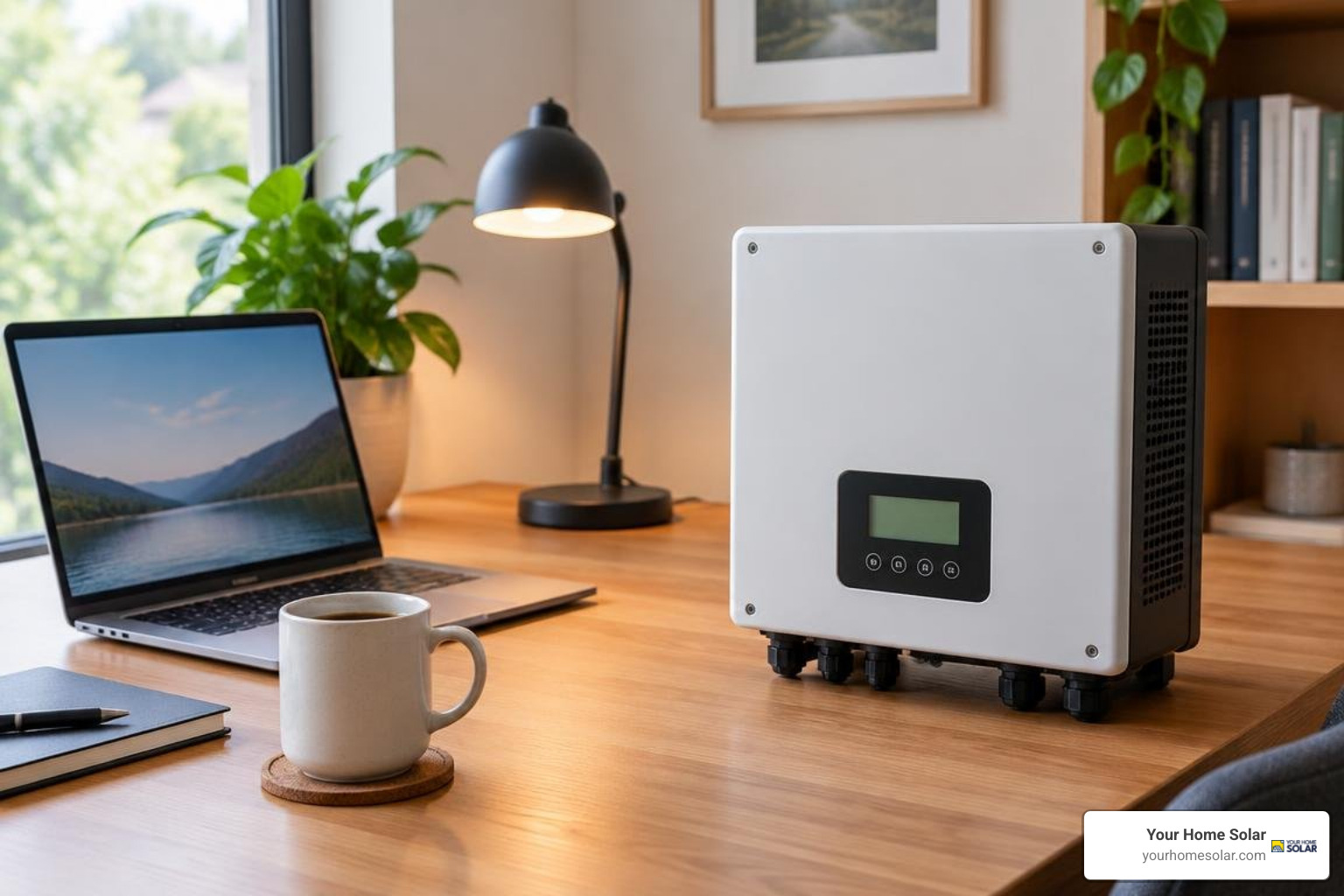
What a 1kW Solar Inverter Can Do
A 1kw solar inverter turns DC power from solar panels or a battery into AC power for household devices. Its 1,000-watt rating is the amount it can supply continuously, not the amount of energy it makes in a day. It can power a few small loads, such as lights, a router, and a laptop, but not an entire home.
Outage backup depends on the setup. A standard grid-tied system shuts off when the grid goes down. A properly configured battery-backed or off-grid system can keep selected devices running, as long as their combined power use and startup surge stay within the inverter’s limits.
I’m Ernie Bussell, founder of Your Home Solar. My experience leading solar operations in East Tennessee helps me explain where a 1kw solar inverter fits in a practical home energy plan.
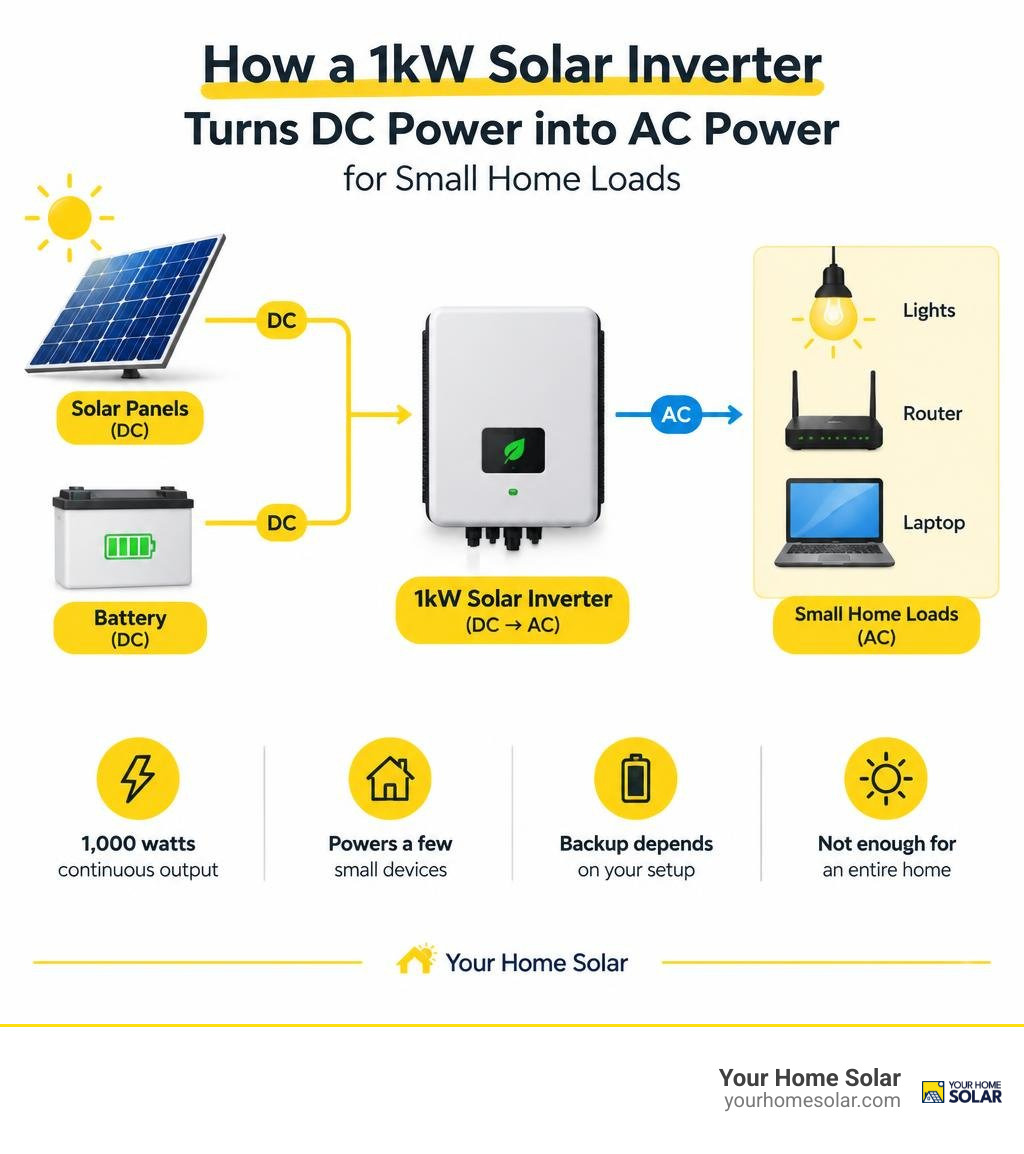
Key 1kw solar inverter vocabulary:
What Is a 1kw Solar Inverter and How Does It Work?
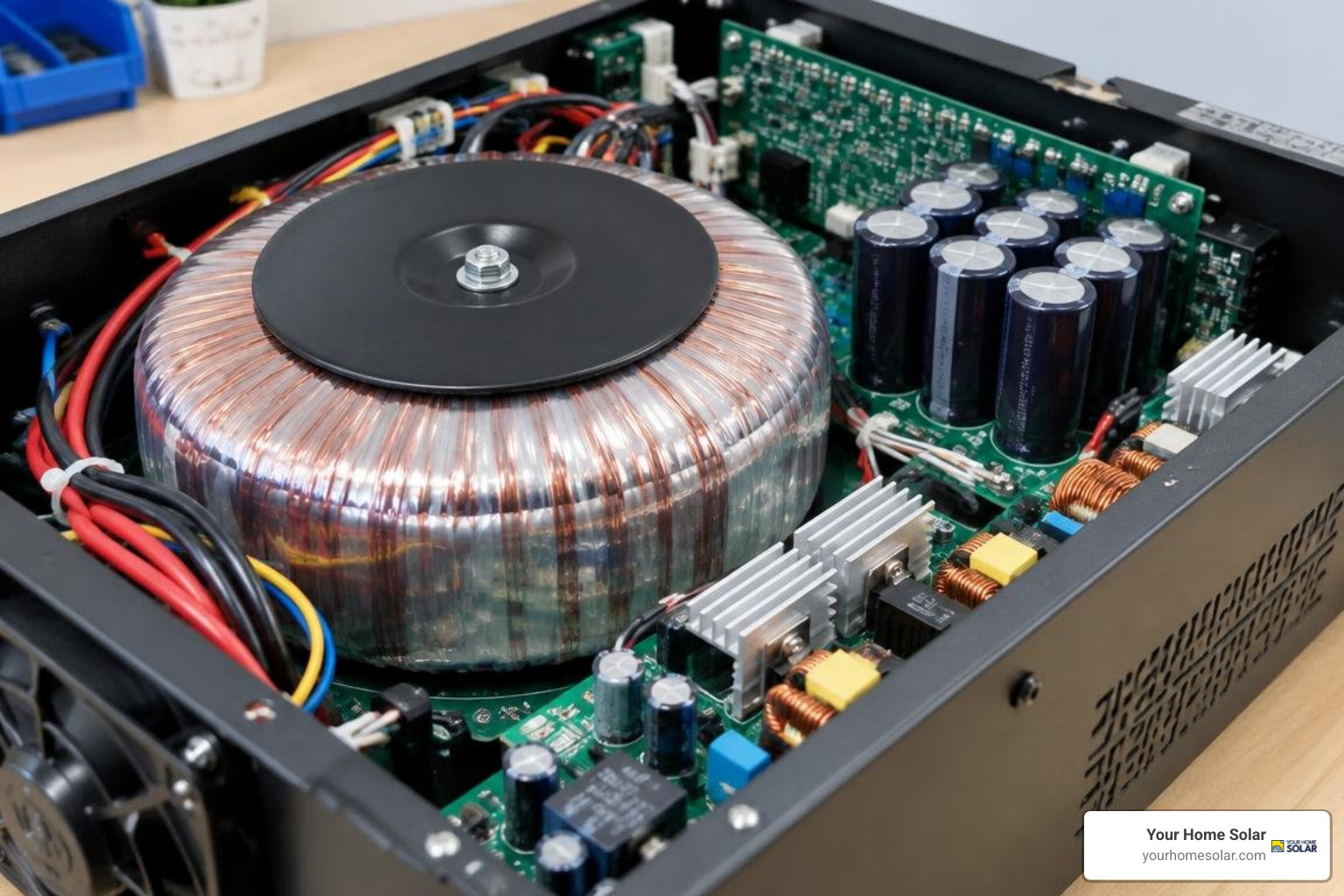
At its foundation, a solar power inverter functions as the brain and engine of your small power station. When photovoltaic modules absorb sunlight, they generate direct current (DC) electricity. However, the appliances plugged into your wall sockets require alternating current (AC). Understanding the role of a solar power inverter helps demystify how this transformation occurs.
The 1kW rating signifies continuous delivery: the unit can supply 1,000 watts of electrical power uninterruptedly. In addition to continuous output, robust inverters feature a surge or peak capacity—often between 2,000VA and 3,000VA—to manage the momentary inrush currents demanded by inductive loads like compressor motors or power tools.
Internally, modern units employ advanced switching topologies. Premium models utilize heavy-duty, low-frequency toroidal transformers that minimize electromagnetic interference and deliver conversion efficiencies exceeding 85% in battery mode and over 99% in direct AC bypass mode. Learning how photovoltaic panels convert sunlight into DC energy makes it easy to see how every link in the generation chain works together.
Pure Sine Wave vs. Modified Sine Wave Technology
When choosing a 1kW unit, waveform quality is paramount:
- Pure Sine Wave: Replicates the smooth, oscillating wave of utility grid power with minimal total harmonic distortion (typically under 3%). This clean signal is critical for sensitive electronics, laptops, CPAP machines, and variable-speed motors.
- Modified Sine Wave: Produces a blocky, stepped square wave. While cheaper, modified sine wave inverters cause inductive loads to run hotter, buzz noticeably, and lose operational efficiency.
For any modern home office, communication setup, or delicate electronic device, investing in pure sine wave architecture prevents premature equipment wear and ensures silent, stable operation.
Grid-Tied, Off-Grid, and Hybrid System Configurations
Inverter architecture dictates how your system interacts with both the local utility grid and energy storage banks:
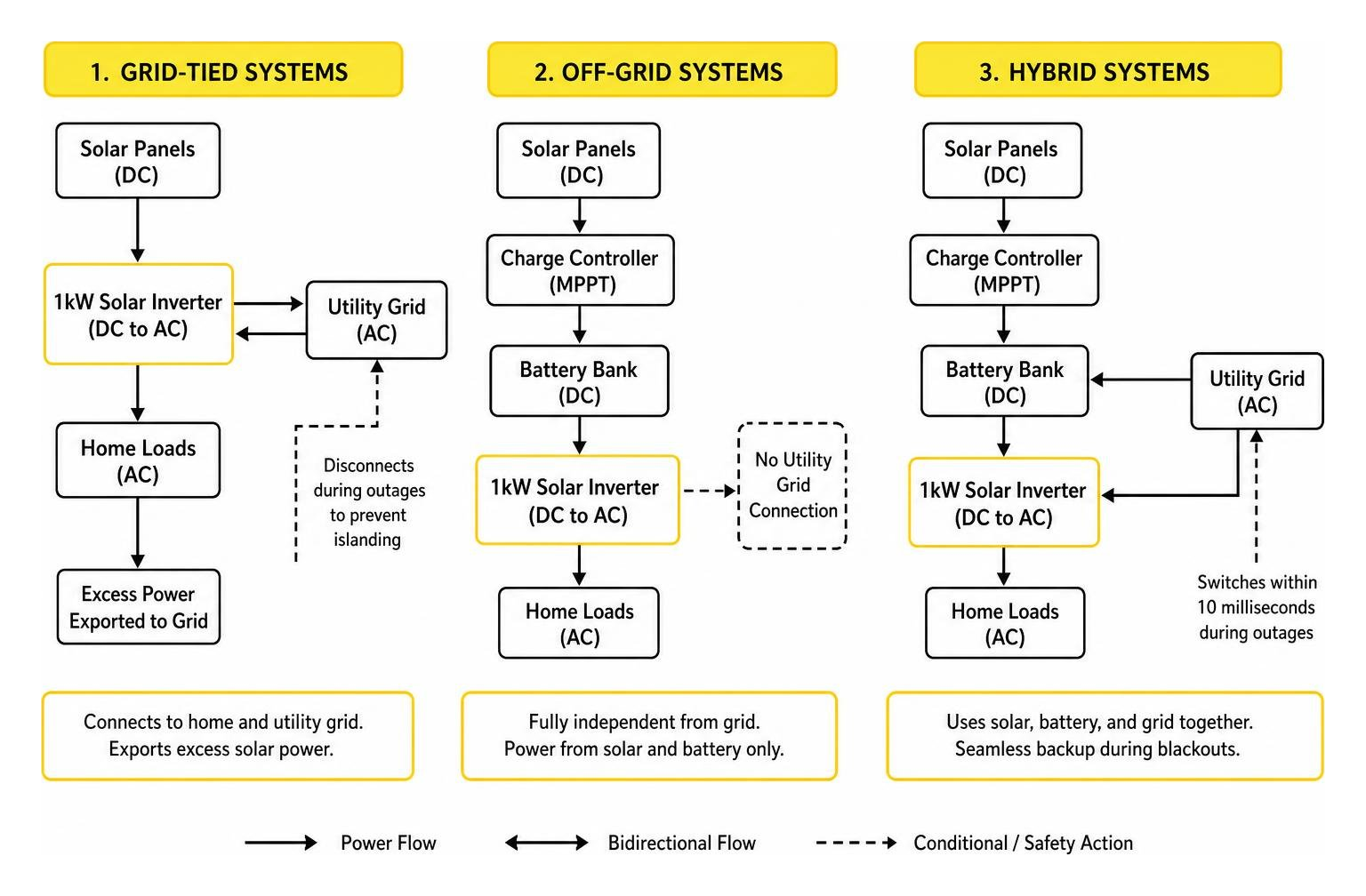
When designing off-grid and grid-connected residential power setups, your specific goals determine the ideal path:
- Grid-Tied Systems: Connect directly to your home distribution panel, feeding solar energy into household circuits alongside grid power. Under standard safety protocols, they disconnect during outages to prevent islanding.
- Off-Grid Systems: Operate completely severed from the electrical utility, drawing DC power exclusively from solar arrays and dedicated battery banks.
- Hybrid Inverters: Combine the strengths of both worlds. Advanced hybrid units can supply circuits from solar, top off batteries from the grid, and switch over within 10 milliseconds during blackouts. Some hybrid models even feature battery-less operational modes, running MPPT-optimized solar directly to day loads while following local regional energy efficiency guidance.
Types and Architectures of 1kW Inverter Systems
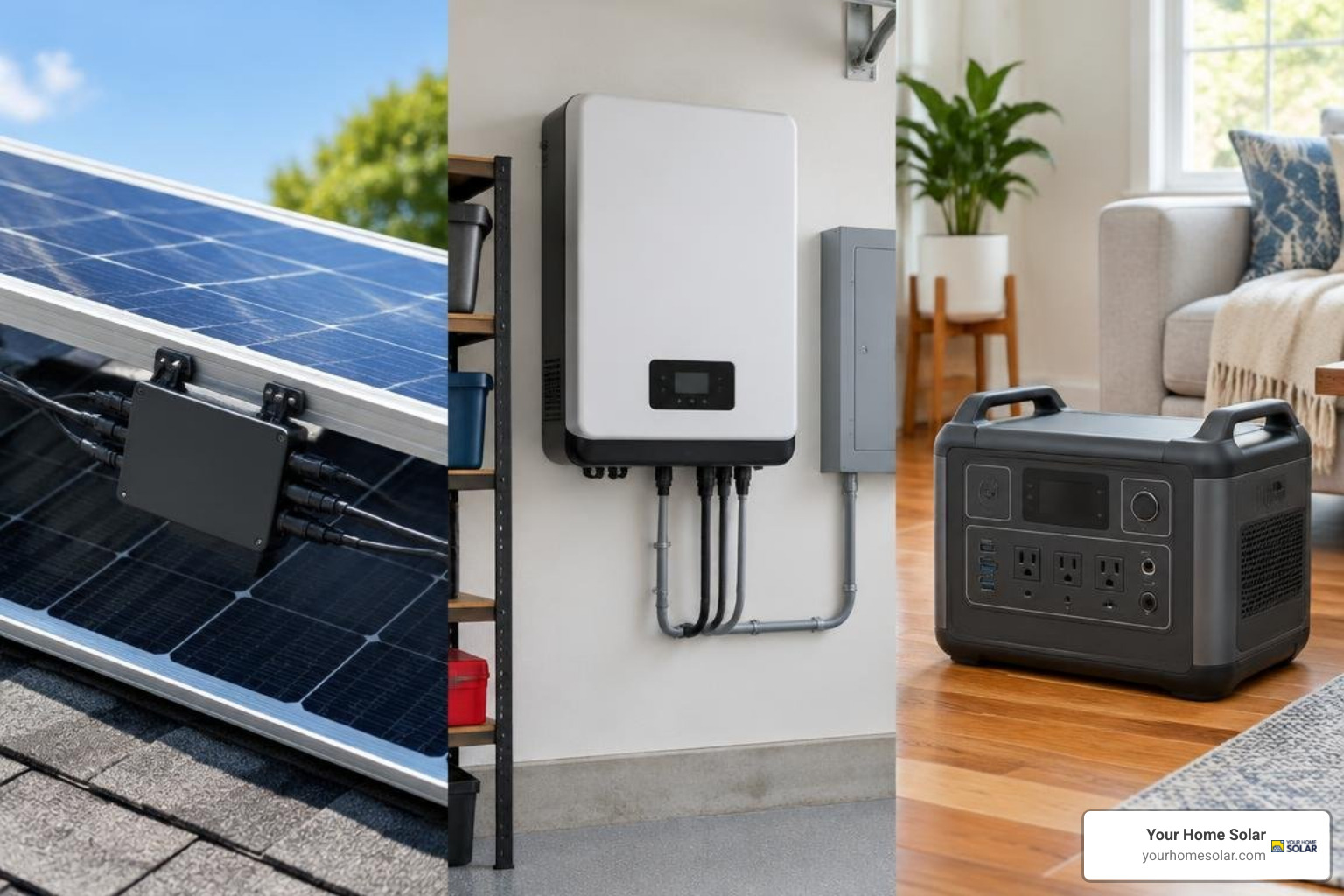
Compact solar systems under the 1,000W threshold fall into three main mechanical and electrical categories.
| Feature | Microinverter Clusters | Standalone Hybrid Inverters | All-in-One Power Units |
|---|---|---|---|
| Typical Form Factor | Panel-mounted micro-units | Wall-mounted enclosure | Portable plug-and-play console |
| Battery Storage | External AC coupling required | External 12V / 24V / 48V banks | Integrated LiFePO4 or GEL pack |
| Voltage Output | 240V / 208V single-phase AC | 120V or 230V selectable AC | 120V AC, 12V DC, and USB ports |
| Ideal Application | Roof arrays with partial shading | Permanent cabins and workshops | Emergency backup and mobile setups |
Microinverters for Decentralized Small-Scale Arrays
Microinverters attach directly underneath individual photovoltaic modules, performing module-level power electronics (MLPE) conversion. Instead of running high-voltage DC wiring down your roof, each microinverter converts power to AC immediately at the panel.
Individual microinverters are available in several output ranges. By combining three or four sub-1kW microinverters in a branch circuit, you achieve a resilient 1kW aggregate array. If a passing cloud or falling leaves shade a single module, the remaining panels continue producing power at peak performance.
All-in-One Units vs. Component-Based Hybrid Inverters
Component-based hybrid systems separate the inverter, solar charge controller, and battery bank. This gives DIY enthusiasts and custom builders complete flexibility to scale battery amp-hours or replace individual parts over time.
Conversely, all-in-one systems combine a 1,000W pure sine wave inverter, an integrated Maximum Power Point Tracking (MPPT) charge controller, and internal battery storage (such as a 12V 100Ah GEL or a 25.6V 50Ah LiFePO4 pack) inside a single chassis. With dual CPU digital controls, automatic uninterruptible power supply (UPS) changeover, and built-in cooling management, these turnkey systems eliminate complex wiring while delivering true plug-and-play simplicity.
Sizing Solar Panels and Batteries for a 1kw Solar Inverter
A 1kW system requires balance between your solar input, inversion limits, and energy storage capacity. Reviewing established sizing guidelines for small-scale solar arrays ensures your system produces adequate energy throughout the seasons.
Under clear conditions, a well-sited 1kW array generates roughly 4 to 5 kilowatt-hours (kWh) of energy per day, amounting to 120 to 150 kWh monthly. On overcast days, output typically drops to 10% to 30% of nameplate rating. Tracking regional solar production data in places like Knoxville, Sevierville, or Johnson City helps establish realistic generation expectations across changing weather patterns.
Calculating Array Wattage and MPPT Voltage Windows
To consistently feed a 1kW inverter, homeowners typically pair it with 1,000W to 1,200W of total solar capacity. Using three 400W or four 300W high-efficiency modules provides an ideal DC-to-AC ratio, ensuring your inverter operates near its peak efficiency curve even during early morning or late afternoon hours.
When wiring your solar modules, ensure that the array’s open-circuit voltage (Voc) and operating voltage fall comfortably within the inverter’s MPPT tracking window. While compact off-grid charge controllers often operate across 30V to 120V ranges, high-voltage hybrid architectures can track inputs up to 500V, minimizing transmission current losses across long wire runs.
Selecting the Right Battery Bank for a 1kw Solar Inverter
Choosing your battery chemistry and system voltage directly impacts round-trip efficiency and overall service life:
- 12V Configurations: Best suited for simple, low-power applications. A 12V 100Ah GEL battery provides approximately 1.2kWh of gross storage, delivering practical backup for intermittent lighting and telecommunication gear.
- 24V & 48V Configurations: Higher nominal voltages reduce DC amperage across cables, allowing cooler operation and smaller wire gauges. A 25.6V 50Ah (1.28kWh) lithium iron phosphate (LiFePO4) battery offers over 2,000 deep discharge cycles, maintaining an operational lifespan of 5 to 10 years with integrated Battery Management System (BMS) safeguards.
To store a full clear day’s harvest (4 to 5 kWh), sizing a 24V or 48V lithium bank between 4kWh and 5.12kWh guarantees multi-day autonomy during stormy periods.
Performance Metrics and Realistic Load Capacities
Understanding what a 1kW inverter can—and cannot—power prevents frustrating overload trips.
Key Technical Specifications to Evaluate
When comparing manufacturer datasheets, look closely at these operational benchmarks:
- Surge Rating: Quality units deliver a 2x to 3x momentary surge capacity (2,000VA to 3,000VA) to start small motor-driven appliances without faulting.
- Transfer Speed: Uninterruptible transfer times of 10 milliseconds (ms) or less keep sensitive desktop computers and modems running smoothly through utility outages.
- Efficiency Ratings: Peak DC-to-AC inversion efficiencies of 85% to 94% conserve battery capacity during heavy use.
- Thermal Management: Intelligent, temperature-activated cooling fans maintain internal power MOSFETs within optimal thermal windows, reducing standby parasitic drain.
What Appliances Can a 1kw Solar Inverter Realistically Run?
A continuous 1,000W ceiling provides substantial power for daily essentials when managed with a thoughtful energy budget:
- Home Office & Communications: A 10W Wi-Fi router, 65W laptop, smartphone chargers, and multiple 9W LED lamps consume under 120W combined, running for 10+ hours on a standard 1.28kWh lithium battery.
- Entertainment: A 50-inch LED television (80W) and digital media box run easily alongside household lighting.
- Kitchen Essentials: An energy-efficient compact refrigerator (drawing 150W running, with a momentary 800W startup surge) operates seamlessly. Small intermittent loads like a 700W blender or small coffee maker can run individually.
Clear Limitations: High-amperage heating and cooling devices—such as central air conditioning, electric water heaters, clothes dryers, and large microwaves—will immediately trip a 1,000W inverter’s overload protection.
Frequently Asked Questions About 1kW Solar Inverters
Can a 1kW solar inverter power an entire house?
No. A 1kW inverter is engineered exclusively for essential circuits, dedicated outbuildings, workshops, and off-grid cabins. Average residential homes require 5kW to 10kW systems to handle simultaneous major appliances, central HVAC, and heavy kitchen equipment.
What is the expected cost of a 1kW inverter and complete solar setup?
Standalone 1kW inverters generally cost between $200 and $500 depending on surge capability, MPPT inclusion, and monitoring features. A complete turnkey 1kW system—including 3 to 4 solar modules, mounting hardware, cabling, and a 1.2kWh to 5.12kWh battery bank—ranges from $1,800 to $3,000 without batteries, or $2,800 to $5,800 with premium lithium storage.
How many solar panels are needed to run a 1kW inverter efficiently?
To maximize a 1,000W inverter’s output, install between three and four 300W to 400W solar modules (totaling 1,000W to 1,200W DC). This slight array oversizing accounts for ambient thermal losses and lower winter sun angles, ensuring your inverter reaches its full generation potential across all seasons.
Conclusion
A 1kW solar inverter offers an efficient, accessible path to resilient energy management. Whether you are setting up an off-grid workshop, preparing an emergency backup station for essential electronics, or powering an off-grid cabin, these compact systems deliver reliable performance without excessive complexity.
At Your Home Solar, we specialize in delivering tailored, top-tier energy independence solutions across East Tennessee. To explore larger residential installations, check out our comprehensive guide to residential solar inverters or contact our expert team today to design your home energy system.