Why a 1000 Watt Portable Solar Panel Is a Game-Changer for Off-Grid Power
A 1000 watt portable solar panel system gives you serious off-grid power — enough to run a mini fridge, charge laptops, power LED lights, and keep a CPAP machine running, all without a generator or hookup.
Here’s a quick snapshot of what you need to know:
- What it is: A high-capacity foldable solar panel (or set of panels) that produces up to 1000W of power from sunlight
- Daily output: 4–6 kWh per day under good sun conditions
- Best for: Camping, RV trips, emergency backup, and off-grid living
- Works with: Portable power stations (typically 999–1264Wh capacity) via MPPT charge controllers
- Real-world efficiency: Expect 50–70% of rated output depending on weather and panel angle
- Not ideal for: Full-size electric stoves, hair dryers, or other appliances above 1000W
Whether you’re a weekend camper or an East Tennessee homeowner preparing for the next power outage, understanding what these panels can actually do — and what they can’t — saves you time, money, and frustration.
I’m Ernie Bussell, founder and CEO of Your Home Solar, and after years leading solar installations and helping homeowners across East Tennessee make smart energy decisions, I’ve seen what a well-matched 1000 watt portable solar panel setup can do — and where buyers go wrong. Let’s break it all down so you can make a confident choice.
Easy 1000 watt portable solar panel glossary:
What is a 1000 Watt Portable Solar Panel?

When we talk about a 1000 watt portable solar panel, we are looking at the heavyweight champion of mobile solar technology. But to understand its true value, we must first define what it actually is.
Unlike a single massive, rigid panel you would see on a suburban rooftop, a 1000W portable setup is typically a coordinated system of high-efficiency folding panels. It is designed specifically to be packed down, tossed in the back of an SUV, and set up in minutes at a campsite, remote cabin, or in your backyard in Oak Ridge or Sevierville during a grid outage.
To put this in perspective, the global solar market is expanding rapidly, projected to reach $234.86 billion by 2030. Within this boom, portable solar panel adoption has increased by 35% year-over-year in the RV and camping sectors. People want clean, silent energy wherever they go, and a 1000W system represents the sweet spot between ultimate power output and transportability.
For a deeper dive into how these systems function from the ground up, explore our In-Depth Guide to Portable Solar Systems.
How It Differs from Fixed and Smaller Panels
The differences between a 1000W portable setup, standard fixed residential panels, and smaller solar accessories come down to three factors: flexibility, weight, and structural design.
- Fixed Panels: These are rigid, heavy, and bolted permanently to a roof or ground mount. They use heavy aluminum frames and tempered glass to withstand decades of harsh weather. They are highly durable but completely stationary.
- Smaller Portable Panels (50W–200W): These are incredibly lightweight and highly packable, but they offer limited power. A 100W panel is great for charging phones or a small tablet, but it will struggle to keep a compressor-based camp freezer running over a cloudy weekend.
- 1000W Portable Systems: This setup usually consists of multiple medium-sized foldable panels (such as five 200W panels or a specialized high-output array) connected in series or parallel. They utilize lightweight materials like ETFE (Ethylene Tetrafluoroethylene) laminates rather than heavy glass, allowing them to fold down into manageable carrying cases.
If you are trying to decide whether to go mobile or install a permanent fixture, check out our Ultimate Guide to Off-Grid Power to see which configuration aligns with your lifestyle.
Real-World Performance of a 1000 Watt Portable Solar Panel
One of the most common mistakes we see folks in East Tennessee make is expecting a 1000W panel system to produce exactly 1000 watts of power every hour of the day. In the real world, solar panels are rated under Standard Test Conditions (STC)—perfect laboratory light and temperature.
Real-world performance is influenced by:
- Sun Angle and Location: Whether you are camping in the shaded valleys of the Great Smoky Mountains or set up in an open field in Johnson City, the angle of the sun matters.
- Temperature: Solar cells actually lose efficiency as they get extremely hot.
- Atmospheric Conditions: Passing clouds, humidity, and morning haze will reduce output.
On a clear day, a premium monocrystalline panel with an efficiency rating of 23% to 23.5% will realistically deliver about 50% to 70% of its rated capacity (roughly 500W to 700W of actual continuous input) during peak hours. Over the course of a full sunny day, a typical 1000W portable solar panel system can generate 4–6 kWh of electricity.
If you want to compare various models and check out current marketplace pricing, you can browse the 1000 Watt Solar Panel on Amazon to get an idea of the physical dimensions and configurations available.
What Can You Power with a 1000W Portable Solar System?

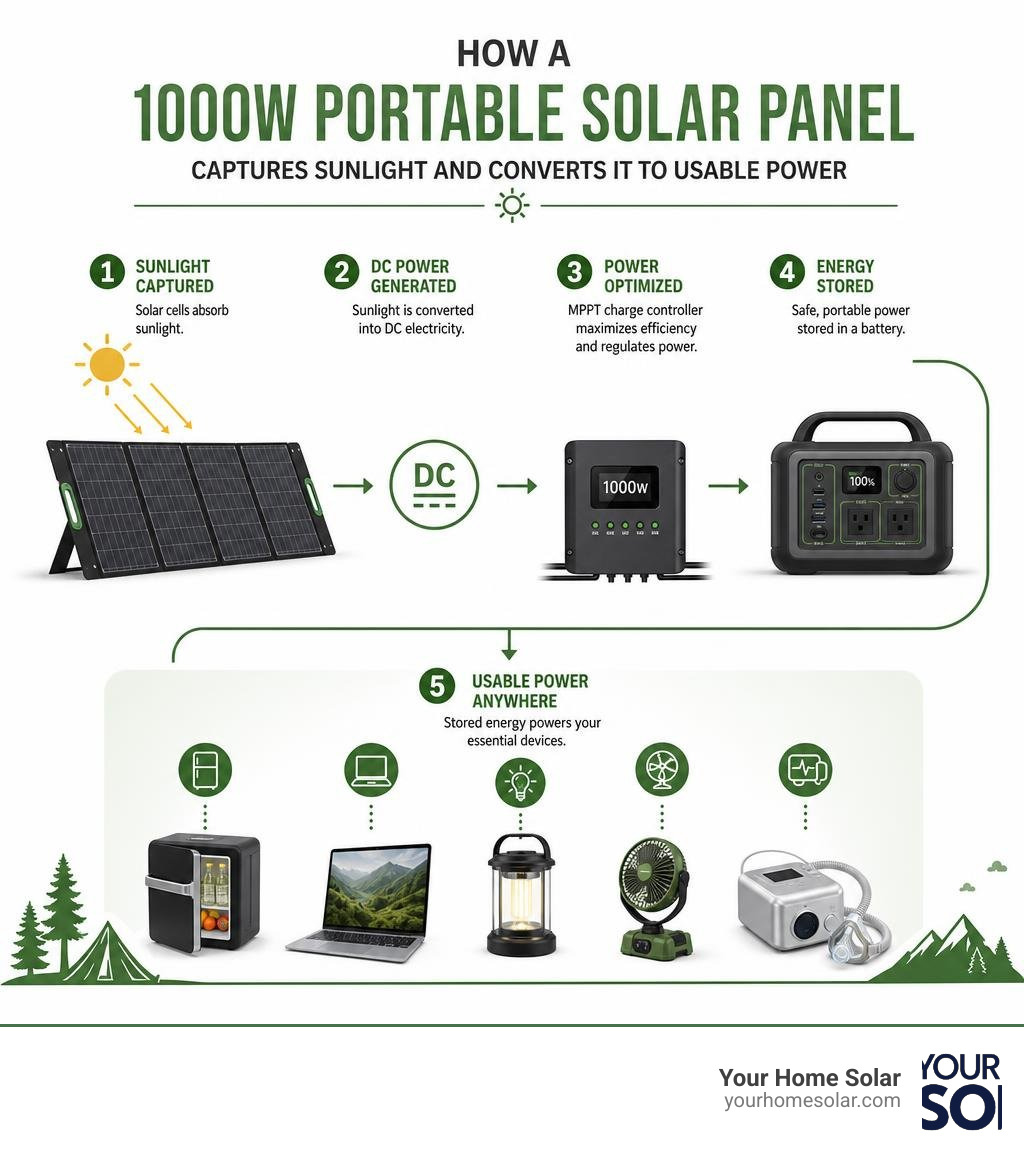
A 1000 watt portable solar panel system is a powerhouse, but it does not work in isolation. To run your appliances, the DC electricity generated by your panels must flow into a portable power station (often called a solar generator). This station houses a battery bank to store the energy and an inverter to convert it into 120V AC power—the standard plug type you use at home.
When paired with a quality 1000Wh to 2000Wh power station, a 1000W solar array creates a continuous cycle of harvesting and spending energy. For a detailed breakdown of what a 1kW battery capacity means for your daily camp chores, read our guide on What Can a 1kW Station Actually Do?.
Compatible Campsite Appliances and Devices
With 1000W of solar replenishment feeding your battery, you can comfortably run a wide array of typical campsite appliances. Here is what you can realistically power:
- Portable Mini Fridge/Freezer (60W–90W): Can run continuously. A 1000Wh battery can power a mini fridge for 8 to 12 hours on a single charge without any solar input; with 1000W of panels connected, you can run it indefinitely while keeping the battery fully topped off.
- CPAP Machines (30W–60W): Essential for many campers. A fully charged power station will easily run a CPAP machine through the night, and the solar panels will recharge the battery in less than an hour the next morning.
- Laptops (45W–90W) and Smartphones (5W–20W): You can charge dozens of personal devices simultaneously without putting a dent in your power reserves.
- LED Camp Lighting (5W–15W): You can run string lights and lanterns all evening.
To estimate how long a device will run on your system, use this standard industry formula:
Runtime = (Battery Capacity in Wh × 0.85) / Operating Wattage of Device
(Note: We multiply by 0.85 to account for natural energy loss during DC-to-AC conversion through the inverter.)
High-Wattage Limitations and Surge Requirements
While a 1000W system is highly capable, it is crucial to recognize its limits. You cannot run high-wattage, heat-producing appliances continuously.
Appliances like standard kitchen microwaves (1000W–1500W), electric camp kettles (1200W–1800W), and portable space heaters (1500W) draw massive amounts of power. Additionally, many motorized appliances have “surge” or “peak” power requirements—meaning they need double their running wattage for a few seconds just to start up.
If your power station’s inverter is only rated for 1000W of continuous load, plugging in a 1500W hair dryer will trigger an automatic safety shutdown. Always check the labels on your appliances before plugging them in, and manage your loads so you do not exceed your inverter’s maximum continuous output.
Key Features, Integration, and Maintenance Tips
Investing in a high-power portable solar setup requires looking closely at the build quality and technology of the panels. Not all solar cells are created equal, and choosing the wrong type can leave you stranded with dead batteries in the middle of a beautiful East Tennessee state park.
For those looking to transition to mobile living or tiny homes in areas like Blount County or Washington County, check out our guide on Choosing Solar Kits for Mobile Living.
Choosing the Right 1000 Watt Portable Solar Panel for Your Needs
When shopping for a 1000 watt portable solar panel system, you will generally choose between monocrystalline, flexible, and bifacial technologies.
- Monocrystalline Cells: These are the gold standard for portable solar. They are made from single-crystal silicon, giving them the highest efficiency ratings (often 22% to 23.5%). They perform exceptionally well in tight spaces because you get more watts per square inch.
- Flexible Panels: These are ultra-thin and can curve to fit the roof of an RV or a teardrop camper. However, they are typically less efficient, more prone to scratching, and have a shorter lifespan.
- Bifacial Technology: These innovative panels feature solar cells on both the front and back. The front captures direct sunlight, while the back absorbs reflected light from the ground (albedo effect). This can boost your total energy yield by up to 20% to 28%, especially when set up on light-colored surfaces like sand, light gravel, or concrete.
Here is a quick comparison to help you choose:
| Panel Type | Typical Efficiency | Portability | Durability | Best Use Case |
|---|---|---|---|---|
| Monocrystalline Foldable | 21% – 23.5% | High (folds down) | High (protective backing) | General camping & emergency backup |
| Flexible Monocrystalline | 15% – 18% | Medium (lightweight but large) | Moderate (susceptible to scratches) | Curved RV roofs & marine use |
| Bifacial Foldable | 22% – 25% (with rear boost) | High (folds down) | High (rugged glass/ETFE) | Maximum yield in snowy, sandy, or gravelly sites |
Portability, Weight, and Setup Accessories
A 1000W system is highly powerful, but you must be able to move it. Weight and setup design are critical. A single 100W foldable panel typically weighs between 6 and 8 pounds. Therefore, a complete 1000W system (comprising multiple panels) will weigh anywhere from 60 to 80 pounds in total.
To make setup manageable, look for panels that feature:
- Built-in Adjustable Kickstands: These allow you to angle the panels directly at the sun (ideally between 30 and 60 degrees depending on the season) to maximize efficiency.
- Durable Carry Cases: Heavy-duty zippered cases with comfortable handles protect your investment during transit.
- Standardized MC4 Connectors: These weather-resistant, locking connectors make daisy-chaining multiple panels in series or parallel safe and straightforward.
Connecting to Portable Power Stations and RVs
To integrate your 1000 watt portable solar panel system with a battery or RV, you need a charge controller. The controller acts as a gatekeeper, preventing the panels from overcharging your battery.

There are two main types of charge controllers:
- PWM (Pulse Width Modulation): Older, cheaper, and less efficient. They work by slowly reducing the power limit as the battery fills.
- MPPT (Maximum Power Point Tracking): The modern standard. An MPPT controller constantly monitors the voltage and current output of your panels, adjusting to match the battery’s requirements. This technology achieves up to 99% efficiency, ensuring you get every drop of power out of your system.
Most modern portable power stations come with a built-in MPPT controller, allowing you to plug your solar panels directly into the unit. If you are integrating panels into an RV or boat system, you can learn more about the technical specifications of these systems by viewing the 1000 Watt Portable Solar Power Generator specifications.
Long-Term Maintenance and Safety Considerations
Portable solar panels are built for the outdoors, but they still require basic care to maintain their efficiency and ensure safety.
- Keep Them Clean: Dust, pollen, bird droppings, and fallen leaves block sunlight and drop your power output significantly. Clean the panel surface using a soft, damp cloth. Avoid abrasive sponges, harsh chemical cleaners, or high-pressure hoses, as these can scratch the protective ETFE coating or compromise the seals.
- Watch the Temperature: While the panels themselves can operate in extreme temperatures (often rated from -40°F to 180°F), portable power stations are much more sensitive. LFP (LiFePO4) batteries should typically only be charged between 32°F and 113°F (0°C to 45°C). Keep your power station shaded under a camp table or inside your tent while your panels sit out in the hot sun.
- Electrical Safety: Always connect your panels to the charge controller or power station before exposing them to direct sunlight. This prevents open-circuit sparking at the connector tips.
For a broader look at whether portable solar systems are a smart fit for your primary residence in East Tennessee, read our article: Is a Portable Solar System Right for Your Home?.
Frequently Asked Questions about High-Power Portable Solar
Can a 1000W portable solar panel run a full-sized refrigerator?
The short answer is yes, but not directly, and it depends on your battery.
A modern, energy-efficient residential refrigerator draws about 100W to 200W of running power but needs a high surge of 800W to 1200W to start its compressor motor. A 1000W solar panel system generates more than enough daily energy (4–6 kWh) to cover a refrigerator’s daily consumption (typically 1–2 kWh).
However, you must plug the refrigerator into a power station with a heavy-duty inverter that can handle the starting surge, paired with a battery capacity of at least 1500Wh to 2000Wh to keep the fridge running through cloudy spells and overnight when the sun isn’t shining.
How long does it take to charge a 1000Wh battery with these panels?
Under optimal conditions, a 1000W solar array can charge a 1000Wh battery in about 1.5 to 2 hours.
In the real world, we must account for efficiency losses. If your 1000W panels are outputting a realistic 600W of actual power in steady, direct sunlight, the calculation is simple:
1000Wh / 600W = ~1.6 hours
If it is a hazy day in Farragut or Powell and your panels are only producing 300W, it will take closer to 3.5 hours.
Are portable solar panels completely waterproof?
Most high-quality portable solar panels carry an IP67 or IP68 water-resistance rating. This means they are highly resistant to dust and can easily withstand rain showers, splashes, and dew.
However, “water-resistant” is not the same as “waterproof.” You should never submerge portable panels in water, and you must protect the junction boxes, cables, and especially your portable power station from heavy downpours. Always dry your panels thoroughly before folding them up and storing them to prevent mildew and corrosion.
Conclusion
A 1000 watt portable solar panel system represents the ultimate in clean, quiet, and reliable off-grid energy. Whether you are setting up camp deep in the Cherokee National Forest, taking a road trip through Sullivan County, or securing backup power for your home in Knoxville, this high-power setup ensures you never have to choose between modern convenience and outdoor adventure.
While portable solar is a fantastic solution for mobile living and recreational camping, many East Tennessee homeowners find that integrating a permanent solar and battery backup system provides true long-term energy independence and protection against rising utility rates. To see how solar investments stack up locally, check out the Knoxville solar cost and payback (July 2026) data.
At Your Home Solar, we are dedicated to helping our neighbors throughout East Tennessee find the perfect energy solutions. From portable off-grid setups to robust residential solar installations, we deliver trusted expertise and 100% customer satisfaction.
Ready to explore your options for complete energy independence? Read our comprehensive guide on Off-Grid Solar Panel Systems or reach out to us today to start planning your home energy transition!