Why a Solar Battery Backup System Is Critical for East Tennessee Homes
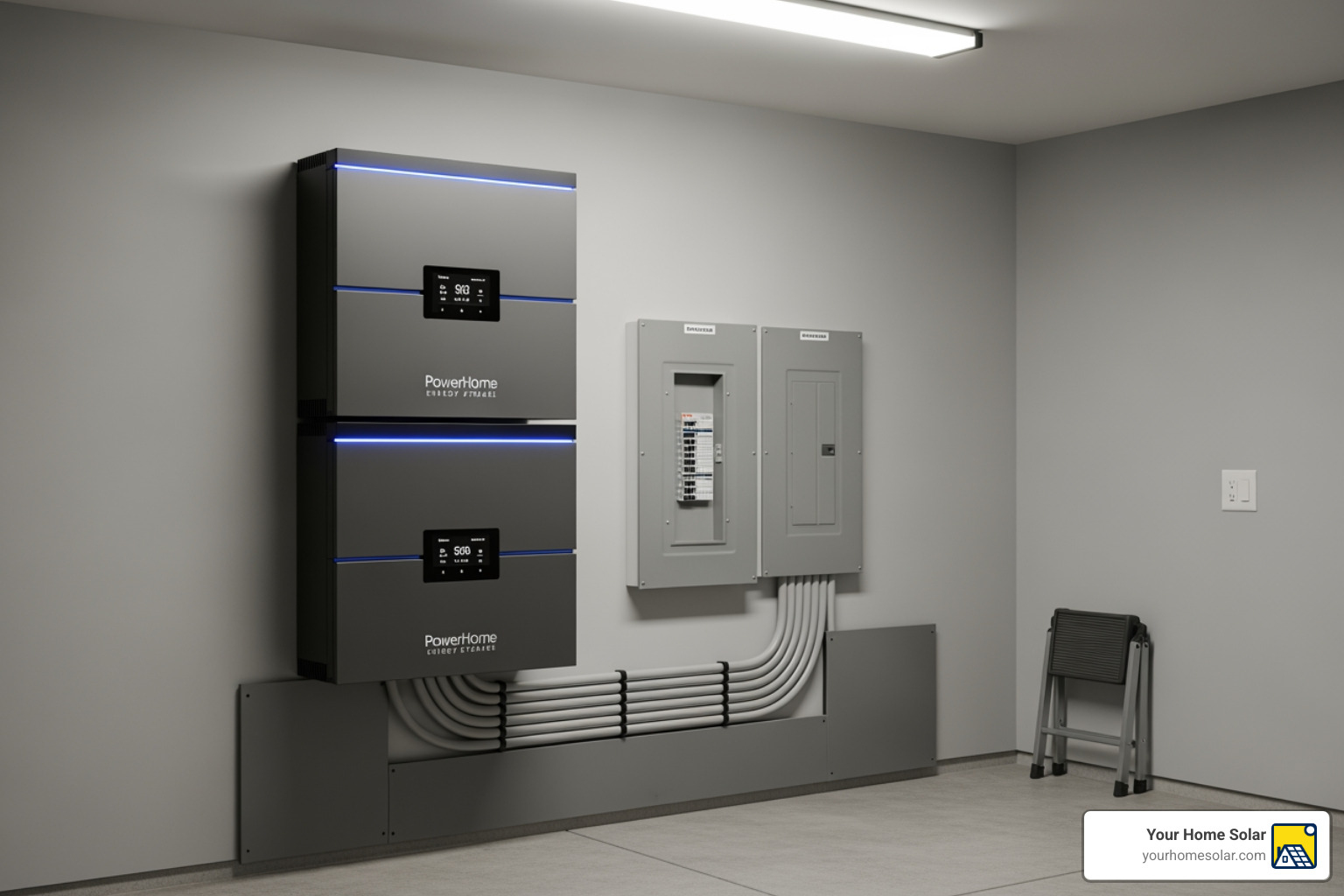
A back up solar bank is a battery system that stores excess energy from your solar panels so you can use it when the sun isn’t shining or when the power grid goes down. It automatically switches on during outages, keeping your essential appliances running without interruption.
What a Solar Battery Backup Does:
- Stores excess solar energy generated during the day for use at night or during outages
- Automatically detects grid failures and transitions your home to battery power in milliseconds
- Powers essential appliances like refrigerators, lights, medical equipment, and HVAC systems
- Reduces electricity bills by using stored energy during peak-rate hours instead of grid power
- Provides energy independence from an aging grid and unpredictable utility rate increases
If you live in East Tennessee, you already know how unpredictable weather can knock out power for hours or even days. Rising electricity costs make every bill harder to swallow. Meanwhile, the grid keeps getting older and less reliable.
A solar battery backup system solves all three problems at once. It captures free energy from the sun, stores it for when you need it most, and keeps your lights on when everyone else’s go dark.
One homeowner using a Generac system put it simply: “We don’t even know, often, when there is a power outage, because the inverter and battery kicks right on.” That’s the peace of mind a properly sized back up solar bank delivers.
I’m Ernie Bussell, founder and CEO of Your Home Solar, and I’ve spent the last three years helping East Tennessee families gain energy independence through solar and battery systems. My background includes managing operations for a $40 million solar company, where I oversaw installations, system design, and customer support—so I understand exactly what makes a back up solar bank work reliably for the long haul.
How a Solar Battery Backup System Works
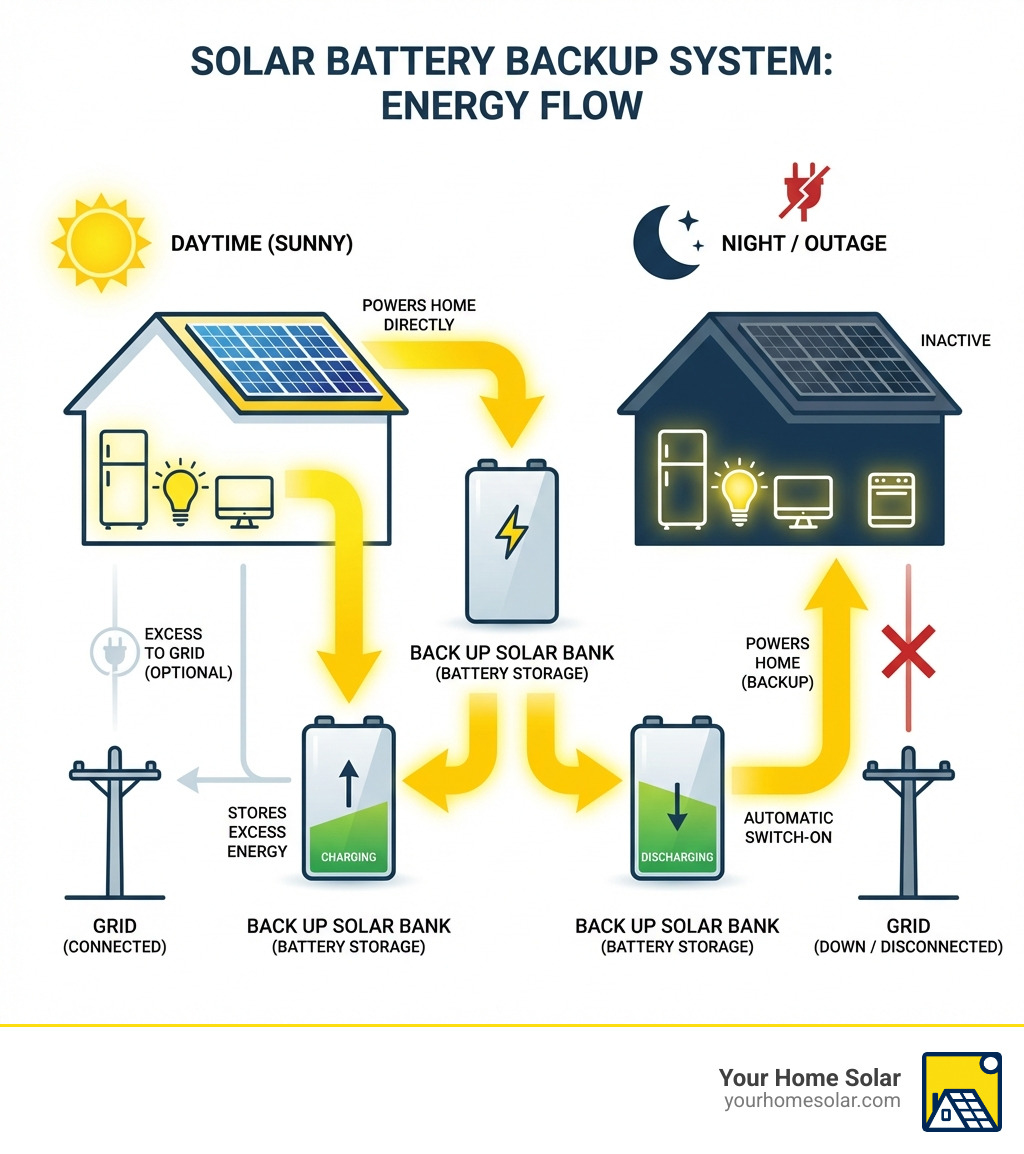
Imagine a silent, tireless guardian for your home’s electricity. That’s essentially what a solar battery backup system is. The process begins with your solar panels diligently converting sunlight into usable electricity. During peak sunlight hours, your home consumes the power it needs, and any surplus energy—the amount your panels generate beyond your immediate consumption—is directed to your back up solar bank for storage.
This stored energy becomes your personal reserve. When the sun sets, or more critically, when the grid goes down, your system automatically kicks into action. Solar battery backup systems are designed to instantly detect a grid service failure and seamlessly transition your home from grid power to backup power. This happens in milliseconds, often so fast that you won’t even notice the lights flicker. For example, some systems boast a rapid 20ms UPS (Uninterruptible Power Supply) switch, ensuring your essential appliances remain powered without interruption.
This capability is crucial for disaster resilience, as it allows your home to maintain power even when the broader community is in the dark. It means your refrigerator stays cold, your medical equipment continues to run, and you can charge your devices to stay connected. Whether your system is grid-tied with backup capabilities or designed for off-grid living, the core principle remains the same: harness solar energy, store it, and deploy it precisely when you need it most. You can learn more about how solar energy plays a vital role in community resilience in our article, The Role of Solar Energy in Disaster Resilience: Building Stronger Communities.
The Core Components
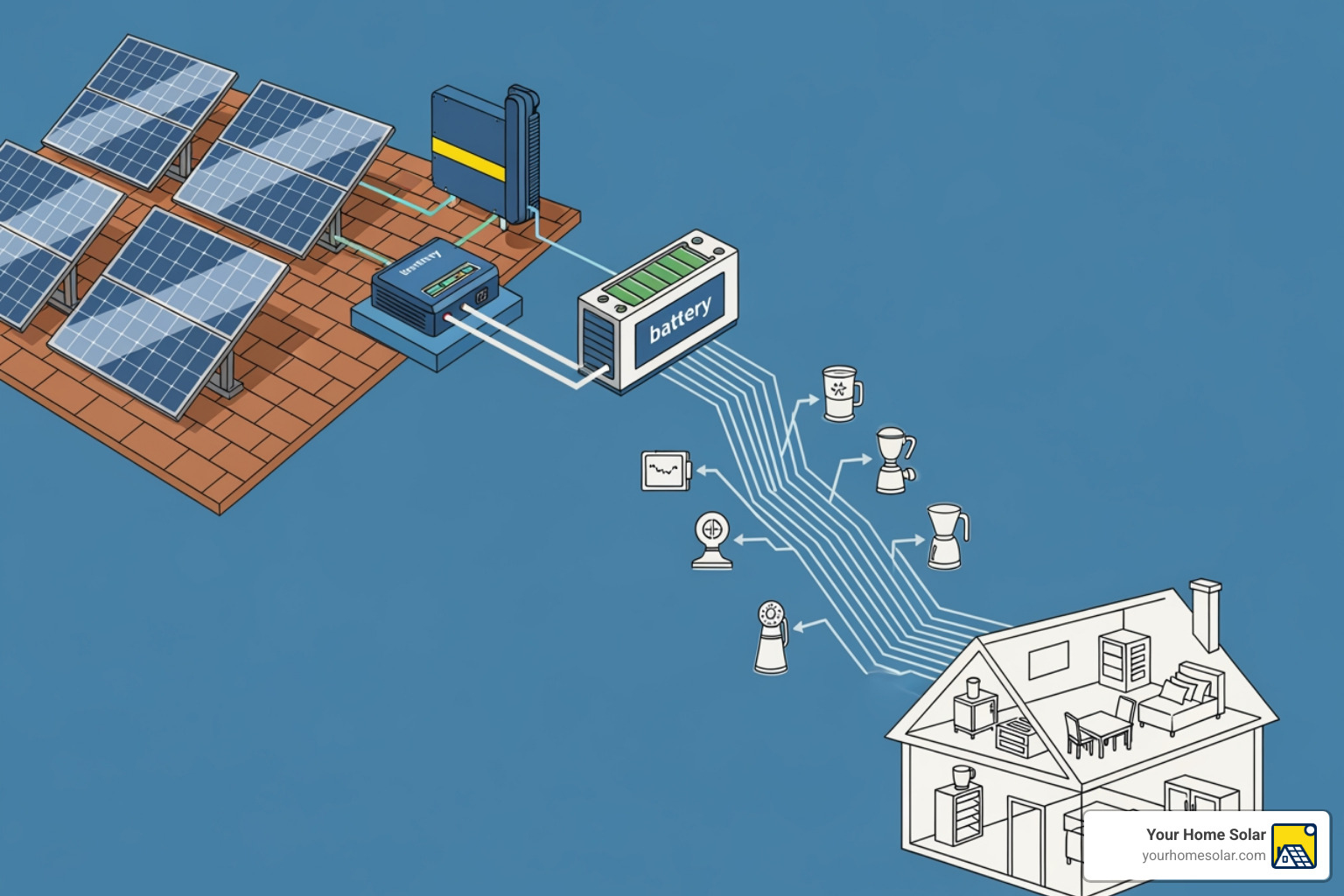
A complete solar battery backup system, whether for your home in Knoxville, Maryville, or Sevierville, relies on several key components working in harmony:
- Solar Panels: These are the primary energy collectors, converting sunlight into direct current (DC) electricity.
- Battery Unit (The Back Up Solar Bank): This is the heart of the system, storing the DC electricity generated by your panels. Modern battery banks can range from compact units like a 9.7kWh SolarEdge Energy Bank to large, modular systems like the Sol-Ark L3-HV-60-KWH, which can offer 61.44kWh of system energy. These units are designed to withstand various conditions, with some even capable of maintaining normal operation in high humidity or cold temperatures as low as -4°F.
- Inverter: This crucial device converts the DC electricity from your solar panels and battery into alternating current (AC) electricity, which is what your home appliances use. Many modern battery systems, like the Powerwall 3, now feature integrated solar inverters for increased efficiency and faster installation. Other systems, like the SolarEdge Energy Bank, are specifically designed to work with their proprietary inverters, such as the SolarEdge Energy Hub.
- Monitoring Software: This allows you to track your energy production, consumption, and battery status in real-time, often through a convenient smartphone app. This smart control helps you optimize energy usage and manage backup reserves.
These components ensure that your home remains powered, providing a reliable source of electricity even when the grid fails. For a deeper dive into why solar panels are the best choice for emergency power, check out Why Solar Panels for Homes Are the Best Choices for Emergency Power Backup.
Day vs. Night Operation
The beauty of a solar battery backup system lies in its ability to manage energy flow throughout the day and night, adapting to your home’s needs and the sun’s availability.
- Using Solar Power Directly: During daylight hours, especially when the sun is shining brightly, your solar panels generate electricity that your home uses immediately. This direct consumption of solar energy is the most efficient way to power your home.
- Charging the Battery with Surplus Energy: Any electricity your solar panels produce that isn’t immediately consumed by your home is then directed to your back up solar bank. This “excess power” charges your battery, building up your energy reserves for later. This is often referred to as “storing free solar energy,” as highlighted by Generac, which emphasizes using this stored energy during peak hours or at night.
- Discharging the Battery at Night: Once the sun sets and your solar panels are no longer producing electricity, your home seamlessly switches to drawing power from your charged battery bank. This ensures continuous power without relying on the grid, even after dark.
- Discharging During Peak Grid Hours: Many utility companies in East Tennessee have “time-of-use” rates, where electricity costs more during certain peak demand periods. A smart solar battery system can be programmed to discharge stored energy during these expensive hours, rather than drawing from the grid. This intelligent energy management helps you save significantly on your electricity bills. For instance, the Powerwall optimizes stored energy using your usage history, weather forecasts, and utility price estimates to power your home more efficiently, day and night. You can even set a “backup reserve” so a portion of your battery is always dedicated to outages, while the rest is available for daily use.
Key Benefits of a Back Up Solar Bank
Investing in a back up solar bank for your East Tennessee home offers a multitude of advantages that go far beyond simply keeping the lights on during an outage.

- Energy Independence: This is perhaps the most empowering benefit. By generating and storing your own electricity, you gain a significant degree of independence from the traditional power grid and your utility company. You control your energy usage, reduce your reliance on an aging infrastructure, and buffer yourself against unpredictable rate hikes.
- Savings on Electricity Bills: A solar battery bank allows you to maximize your solar investment. Instead of sending excess solar power back to the grid for minimal credit, you store it for your own use. This means you can power your home at night or during peak demand hours with your own free solar energy, significantly reducing or even eliminating your electricity bill. One Generac customer reported their last bill was $0! When comparing solar with traditional gas generators, the lifetime cost savings can be substantial, with some systems offering at least five times more savings than a natural gas generator over its lifetime. Learn more about these comparisons in our article, Comparing Solar with Traditional Gas Generators for East Tennessee Homes.
- Reliability During Natural Disasters: East Tennessee is no stranger to severe weather, from heavy snows to thunderstorms that can cause widespread power outages. A solar battery backup system acts as a resilient shield for your home. Systems like the Powerwall are designed to withstand extreme weather conditions, including cold temperatures, high humidity, and even flooding up to two feet of water. Features like “Storm Watch” can automatically charge your battery to maximum capacity when severe weather is forecast, ensuring you’re prepared. Even in temperatures as low as -4°F, advanced systems with “Heat Mode” can maintain optimal performance.
- Environmental Benefits: By relying more on solar energy and less on fossil fuel-generated electricity, you significantly reduce your home’s carbon footprint. Solar energy is clean, renewable, and non-polluting, contributing to a healthier environment for our communities in places like Johnson City, Kingsport, and Morristown.
- Reduced Carbon Footprint: Every kilowatt-hour you generate and store from the sun means less demand on power plants that often burn fossil fuels. This directly translates to fewer greenhouse gas emissions and a cleaner planet.
These benefits combine to offer not just convenience, but genuine peace of mind and a more sustainable way of living for homeowners across East Tennessee.
Choosing the Right Solar Battery System
Selecting the ideal back up solar bank for your East Tennessee home involves understanding the different technologies available and matching them to your specific needs. The market offers various battery chemistries, each with its own strengths and weaknesses.
We typically encounter two main types in residential solar battery banks:
- Lithium Ferro Phosphate (LiFePO4 or LFP): Known for their excellent safety, long cycle life (often over 3,000 charge cycles), and good thermal stability. Brands like iFORWAY and Sol-Ark use LiFePO4 chemistry.
- Lithium-ion Nickel Manganese Cobalt (Li-ion NMC): Often found in systems like the SolarEdge Energy Bank, these batteries offer high energy density and good efficiency, while still meeting advanced safety ratings.
| Feature | LiFePO4 (LFP) | Li-ion NMC |
|---|---|---|
| Cycle Life | Very high (3,000+ cycles typical) | High (often 1,000-3,000+ cycles) |
| Safety | Excellent (very stable, less prone to thermal runaway) | Good (with robust battery management systems) |
| Efficiency | High (e.g., 90-95% round-trip) | Very High (e.g., 94.5-97.5% round-trip) |
| Cost | Generally lower per kWh of usable energy | Can be higher per kWh of usable energy |
| Temperature Range | Good performance in varying temperatures | Good performance, some with advanced thermal management |
The best choice depends on your priorities regarding budget, lifespan expectations, safety concerns, and system performance. We recommend professional consultation to steer these options and ensure you get a custom solution. For a comprehensive overview of battery types, explore Everything You Need to Know About Residential Solar Battery Types: What’s Best?.
What to Look for in a Back Up Solar Bank
When evaluating different back up solar bank options, several key features and specifications will help you determine the best fit for your home:
- Energy Capacity (kWh): This measures how much electricity the battery can store. For example, the SolarEdge Energy Bank offers 9.7kWh, while modular systems like the iFORWAY G24pro can expand up to 17.4kWh, and the Sol-Ark L3-HV-60-KWH provides a substantial 61.44kWh (55.29kWh usable). Larger capacity means more stored energy and longer backup times.
- Power Output (kW): This indicates how much electricity the battery can deliver at any given moment. A higher power output means you can run more appliances simultaneously, including large ones like air conditioners or electric heaters. The SolarEdge Energy Bank can provide 5kW continuous power (with 7.5kW peak) per battery, while some systems can reach 6000W output in parallel mode.
- Round-trip efficiency: This percentage reflects how much energy is lost during the charging and discharging process. A higher efficiency, such as SolarEdge Energy Bank’s 94.5% or Powerwall 3’s 97.5% solar-to-grid efficiency, means more of your generated solar power is actually available for use.
- Depth of Discharge (DoD): This refers to the percentage of the battery’s total capacity that can be used before it needs to be recharged. Modern lithium-ion batteries often boast 100% DoD, meaning you can use their full stated capacity without damaging the battery.
- Cycle life: This specifies the number of charge and discharge cycles a battery can undergo before its capacity significantly degrades. LiFePO4 batteries, like those in the iFORWAY G24Pro, typically offer over 3,000 charge cycles, indicating a long operational lifespan.
- Warranty terms: A strong warranty provides peace of mind. Look for a warranty that covers both the battery’s components and its capacity retention over time. Many top brands offer 10-year warranties, often guaranteeing at least 70% capacity retention after that period, like the SolarEdge Energy Bank.
Sizing Your System
Properly sizing your back up solar bank is critical to ensure it meets your energy needs, whether you’re in Farragut, Powell, or any other part of East Tennessee. An undersized system won’t provide adequate backup, while an oversized one can be an unnecessary expense and might even be less efficient if it can’t fully recharge.
- Calculating Daily Energy Usage: Start by looking at your past electricity bills to determine your average daily kilowatt-hour (kWh) consumption. This gives you a baseline for how much energy your home uses.
- Identifying Essential Loads: During an outage, you likely won’t need to power everything. Make a list of critical appliances: refrigerator, well pump, lights, medical devices, internet router, and perhaps a few outlets for charging phones. Determine their wattage and how long you’d need them to run. This helps you define your “essential load.” Powerwall, for instance, can power your entire home, including your heater or A/C, as well as other large appliances, if sized appropriately.
- Planning for Outage Duration: How long do you want your backup power to last? A few hours, a day, or several days? This directly influences the required battery capacity. Our team can help you use a battery bank calculator, if you know your monthly kWh usage, to determine the required battery bank size.
- Future-proofing for EVs: If you own or plan to purchase an electric vehicle, consider how you might want to charge it using your solar energy. Some systems, like Powerwall, can optimize backup protection to charge your EV with clean energy. Tesla’s innovative Powershare even allows the EV’s battery to power the home during an outage, extending your backup capabilities. Factor this into your capacity planning to avoid future upgrades.
Our experts at Your Home Solar can help you precisely size a system that’s just right for your home, providing the perfect balance of independence and cost-effectiveness.
Installation, Integration, and Maintenance
Installing a back up solar bank is a significant investment that pays dividends in energy security and savings. Ensuring it’s done correctly is paramount for safety, efficiency, and longevity.
Professional installation by certified technicians, like those at Your Home Solar, is essential. Our team includes electricians with trade licenses and installers with NABCEP (North American Board of Certified Energy Practitioners) certification. These certifications ensure adherence to national standards, ethical practices, and ongoing education, which is crucial for complex PV installations. While some may consider DIY, the intricacies of high-voltage systems and grid interaction necessitate expert handling.
The initial costs of a solar battery backup system can vary widely based on capacity, brand, and installation complexity. However, when you consider the typical lifespan of these systems—many batteries offer 10-year warranties with significant capacity retention, and some LiFePO4 batteries boast over 3,000 charge cycles—the long-term value becomes clear. Furthermore, modern systems are designed for surprisingly low maintenance, with products like Powerwall requiring minimal service. You can find more insights into energy storage systems in this Homeowner’s guide to energy storage systems.
Integrating a Back Up Solar Bank with Your Home
Seamless integration is key to maximizing the benefits of your back up solar bank.
- Compatibility with existing solar panels: Most modern battery systems are designed to integrate with existing solar panel installations. However, specific brands may require their own ecosystem. For instance, the SolarEdge Energy Bank is exclusively compatible with the SolarEdge Energy Hub inverter and not other brands or older SolarEdge models. Our team ensures compatibility and optimal performance for your specific setup in East Tennessee.
- The role of microinverters: While traditional string inverters convert DC power for an entire array, microinverters optimize the output of individual solar panels. In a battery backup system, microinverters can improve overall system efficiency and allow for more granular control. Generac’s PWRmicro, for example, delivers up to 40% more power into your home than some market leaders, optimizing solar harvest for storage.
- Smart home integration: Many battery backup systems offer advanced smart home integration, allowing you to monitor and manage your energy usage from anywhere.
- App control for monitoring: Dedicated mobile apps, like the mySolarEdge app or iFORWAY’s app control, provide real-time data on your solar production, home consumption, and battery charge levels. You can often adjust settings, such as backup reserve levels, to prioritize daily savings or outage protection. This level of control puts your energy management literally at your fingertips.
Frequently Asked Questions about Solar Battery Banks
We often hear similar questions from homeowners across Anderson County, Blount County, and Knox County interested in a back up solar bank. Here are some of the most common:
Are there government incentives for installing a solar battery?
Yes! There are significant incentives that can make installing a solar battery bank more affordable for East Tennessee homeowners:
- Residential Clean Energy Credit: This is a federal tax credit that currently allows you to claim 30% of the cost of a new residential renewable energy system, including solar panels and qualified battery storage. This 30% tax credit applies to the total system cost, offering substantial savings.
- Inflation Reduction Act: This landmark legislation extended and improved the Residential Clean Energy Credit, ensuring its availability for years to come and making it an excellent time to invest in solar and battery storage.
- State and local incentives: While the federal credit is the largest, some states and local utilities may offer additional incentives, rebates, or programs for energy storage. Our team at Your Home Solar stays up-to-date on all applicable incentives in East Tennessee to ensure you maximize your savings.
Can a solar battery bank let me live completely off-grid?
While a back up solar bank is a crucial component for off-grid living, achieving complete energy independence requires careful planning and significant investment.
- Off-grid requirements: Living entirely off the grid means your home is completely disconnected from the utility grid. This requires your solar array and battery bank to be sized to meet 100% of your energy needs year-round, accounting for seasonal variations in sunlight and periods of high consumption.
- System sizing for full independence: The battery bank is often the most complicated and costly component of an off-grid system. It must be large enough to supply power during extended periods without sun, which means substantial capacity. Our article, Can My East Tennessee Home Be 100% Off-Grid? It Depends., digs into the complexities of achieving this in East Tennessee.
- Lifestyle adjustments: Off-grid living often necessitates conscious energy conservation and a willingness to adjust usage habits based on your system’s current capacity and weather conditions. While a powerful battery like the Sol-Ark L3-HV-60-KWH can provide extensive storage, it’s a commitment.
For most homeowners, a grid-tied system with a robust battery backup offers the best of both worlds: energy independence during outages and the reliability of the grid when needed, along with the ability to sell excess power back.
How long will a solar battery power my home during an outage?
The duration a back up solar bank can power your home during an outage depends on two primary factors:
- Battery Capacity: This is measured in kilowatt-hours (kWh). The larger the capacity, the more energy it can store, and the longer it can power your home. For example, a single Powerwall unit offers 13.5 kWh of capacity. A modular system like the Sol-Ark L3-HV-60-KWH can provide 55.29kWh of usable energy, offering significantly longer backup.
- Home Energy Consumption: This refers to how much electricity your appliances are drawing. If you’re running only essential items (refrigerator, lights, Wi-Fi), your battery will last much longer than if you’re trying to power your entire home, including a central air conditioner or electric stove.
- Essential vs. whole-home backup: Most homeowners opt for “essential load” backup, focusing on critical appliances. However, with sufficient capacity, whole-home backup is entirely possible. The Powerwall, for instance, is advertised for “Whole-Home Backup, 24/7.”
- Load management: Smart energy management systems and homeowner choices play a big role. You can prioritize which appliances receive power and when. Some systems allow you to set a “backup reserve” level. For example, a 30% backup reserve means 70% of your battery is available for daily use, and 30% is strictly reserved for outages, ensuring you always have a minimum amount of power when the grid goes down.
Our team can help you analyze your specific energy needs and design a system that provides the backup duration you desire for your East Tennessee home.
Secure Your Energy Future
As we’ve explored, a back up solar bank is more than just an emergency power source; it’s a strategic investment in your home’s resilience, financial well-being, and environmental stewardship. It provides unparalleled peace of mind, knowing that your lights will stay on, your food will stay cold, and your family will remain comfortable, even when the grid falters. From the significant savings on your electricity bills to the reduced carbon footprint, the benefits are clear and compelling for homeowners across East Tennessee, from Chattanooga to Kingsport and everywhere in between.
At Your Home Solar, we pride ourselves on being the trusted experts in comprehensive home energy solutions. We understand the unique needs of East Tennessee homes and are committed to providing custom, reliable, and rewarding installations. Our trusted expertise and 100% customer satisfaction are at the core of everything we do, ensuring you get a system that works perfectly for your lifestyle.
It’s time to take control of your power, gain true energy independence, and secure a brighter, more sustainable future for your home and family.
Explore our comprehensive guide to solar batteries and energy storage solutions to take the next step towards energy independence.