
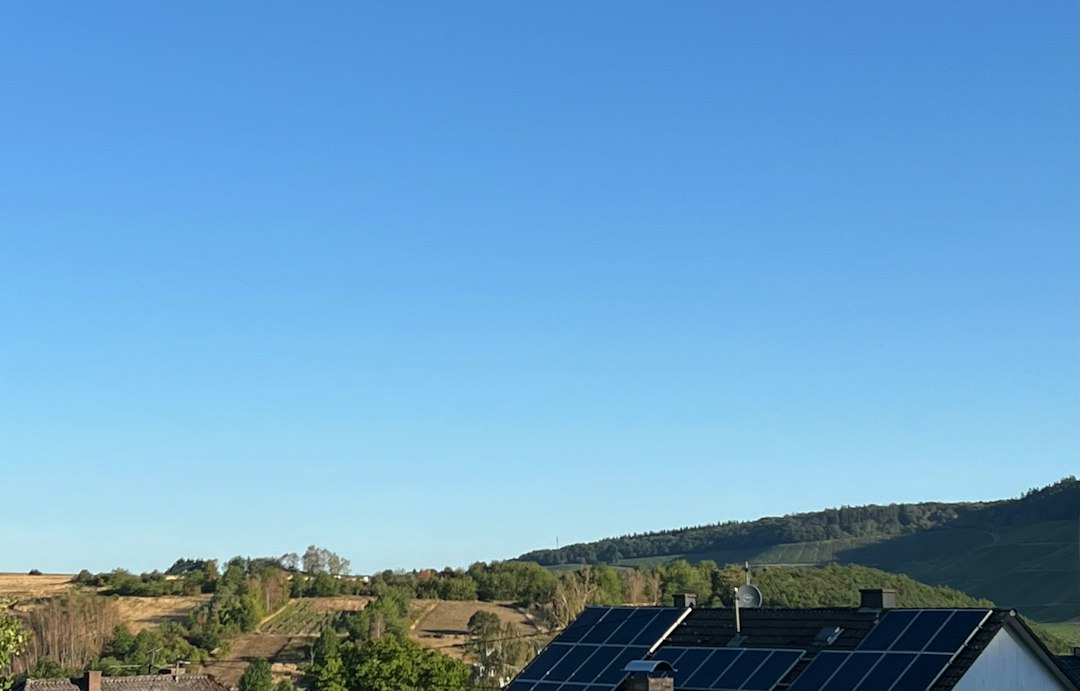
What Does a 3kW Solar System Cost?
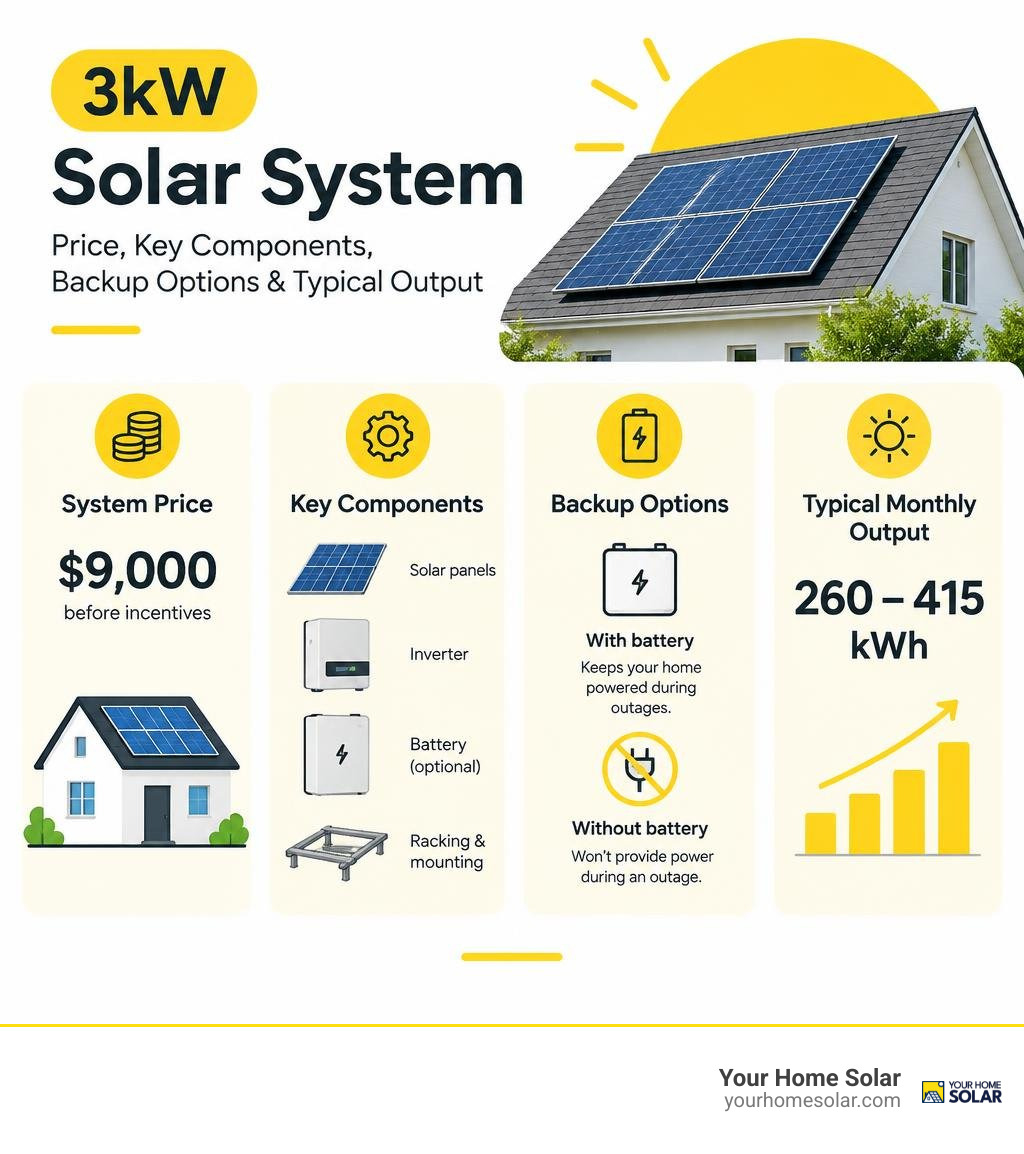
In the U.S., a professionally installed 3kW solar system costs about $9,000 before incentives. That is a useful starting point, not a guaranteed quote. A battery and backup equipment raise the price, while a low-cost kit may leave out the battery, installation, or even enough panels to produce 3kW.
A 3kW system can generate roughly 260 to 415 kWh per month, depending on sunlight, shade, and roof position. It can cut a small home’s electric bill, but a standard grid-tied system will not keep the lights on during an outage without backup equipment. Also, 3kVA describes an inverter rating; it does not tell you how much solar panel capacity you are buying.
I’m Ernie Bussell, founder of Your Home Solar. My experience leading solar operations and installation teams has shown me why a search for “3kv solar system price” can return quotes for very different systems–and why the full equipment list matters more than the headline price.
3kv solar system price vocab explained:
Global and Domestic 3kv Solar System Price Breakdown

When homeowners look into solar, understanding home installation costs is the first step toward building a realistic energy budget. A 3kW system sits right in the “sweet spot” for small cottages, energy-conscious couples, cabins, and rental homes. However, hardware costs, regional labor rates, supply chain realities, and local government programs create wide variations in the net price you actually pay.
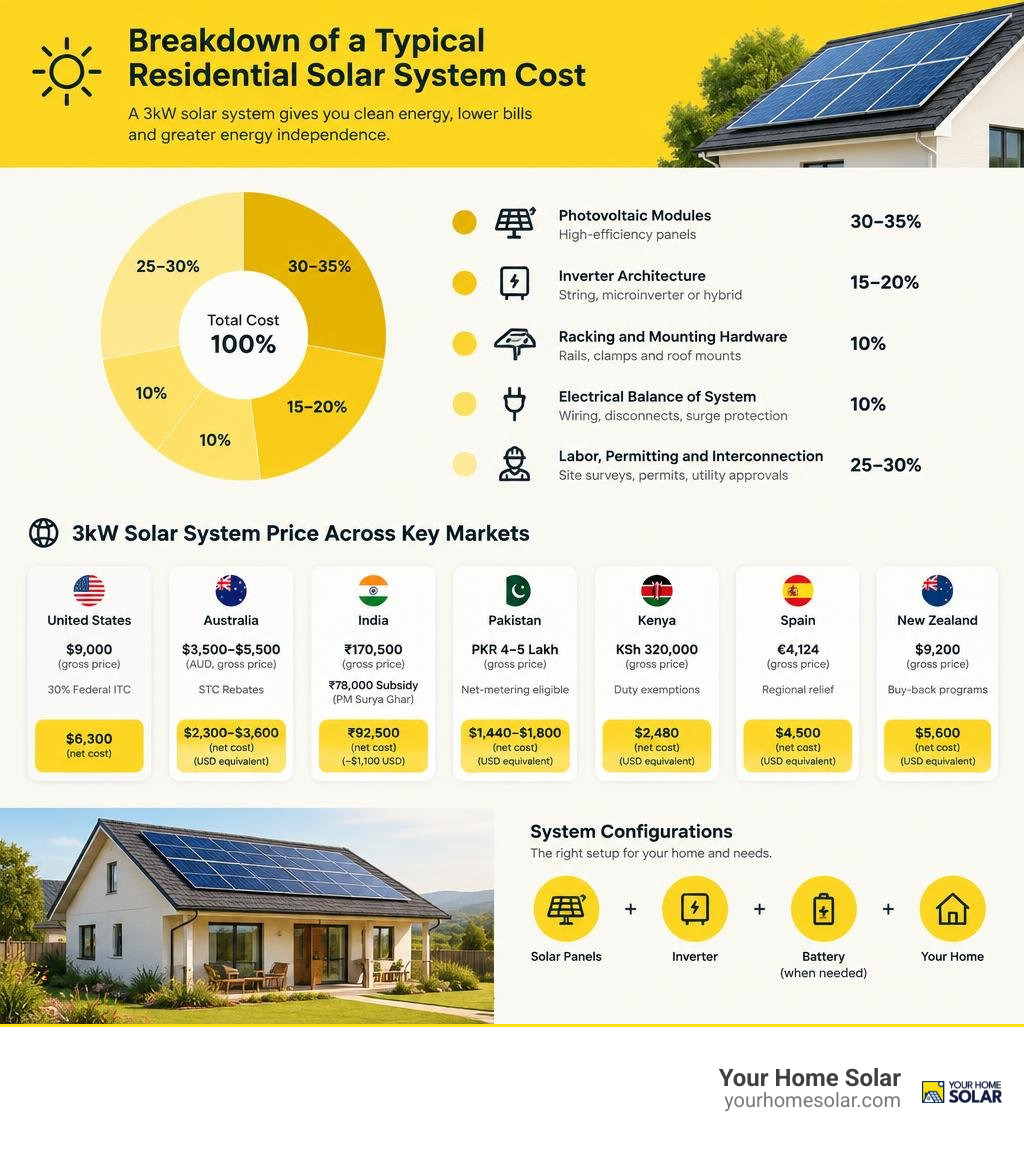
The baseline price ranges across major solar markets highlight how domestic incentives and regional hardware supply chains impact the total investment:
| Country / Region | Average Gross Price | Local Incentives / Subsidies | Net Installed Cost (USD Equivalent) | System Type |
|---|---|---|---|---|
| United States | $9,000 USD | 30% Federal ITC | ~$6,300 USD | On-Grid Turnkey |
| Australia | $3,500–$5,500 AUD | STC Rebates applied at sale | ~$2,300–$3,600 USD | On-Grid Turnkey |
| India | ₹170,500 INR | ₹78,000 Central Subsidy (PM Surya Ghar) | ~$1,100 USD (₹92,500 net) | On-Grid Turnkey |
| Pakistan | PKR 4–5 Lakh | Net-metering eligible | ~$1,440–$1,800 USD | On-Grid Turnkey |
| Kenya | KSh 320,000 | Duty exemptions on solar PV | ~$2,480 USD | Complete Hybrid Kit + 5.12kWh Battery |
| Spain | €4,124 EUR | Regional self-consumption relief | ~$4,500 USD | Turnkey Off-Grid Kit |
| New Zealand | $9,200 NZD | Retailer buy-back programs | ~$5,600 USD | On-Grid Turnkey |
Baseline 3kv Solar System Price Across Key Markets
In the United States, a turnkey 3kW rooftop setup averages roughly $9,000 before federal tax credits. With the 30% residential clean energy credit, that net investment drops directly to around $6,300.
Looking internationally provides valuable context on equipment costs. In Australia, strong market competition keeps a 3kW setup between $3,500 and $5,500 AUD fully installed. In India, central incentives like the PM Surya Ghar subsidy lower a ₹170,500 on-grid array down to an effective ₹92,500. Turnkey packages in Pakistan range from PKR 4 to 5 Lakh for grid-tied setups, while complete hybrid installations in Kenya—including a 3kVA solar system kit with 5.12kWh lithium storage—sit around KSh 320,000. In Europe, an all-inclusive 3 kW off-grid solar kit for a country house starts at €4,124 turnkey, while New Zealand turnkey installations average around $9,200 NZD.
Equipment vs Installation: Where Does the Money Go?
Evaluating your quote requires looking beyond the total sum to see if you are paying an average solar cost per watt that matches the hardware quality provided:
- Photovoltaic Modules (30–35%): High-efficiency N-type TOPCon or monocrystalline panels.
- Inverter Architecture (15–20%): A pure sine wave string inverter, microinverters, or a hybrid inverter unit.
- Racking and Mounting Hardware (10%): Flashed roof mounts, aluminum rails, and clamps engineered for wind and snow loads.
- Electrical Balance of System (10%): AC/DC disconnects, wiring conduit, surge protectors, and combiner boxes.
- Labor, Permitting, and Interconnection (25–30%): Site surveys, municipal electrical permits, utility interconnection approvals, and certified installer labor.
System Configurations and Component Choices
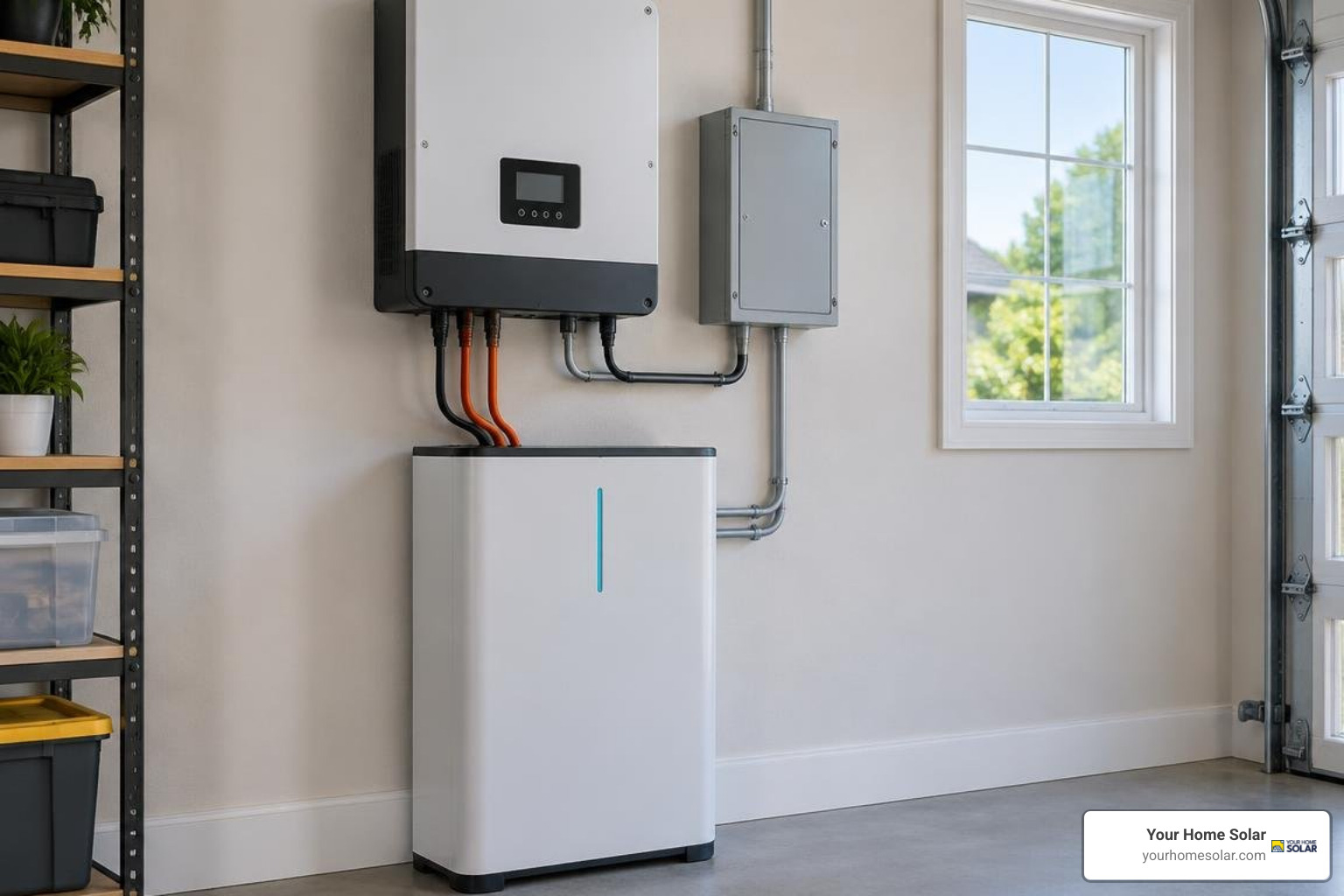
The architectural setup of your array impacts performance, electrical resilience, and overall cost. When planning an installation, research from institutions like Sandia National Laboratories technical analysis on grid integration shows that matching your inverter conversion type to your utility grid profile is vital for long-term safety and stability.
How System Architecture Affects Your 3kv Solar System Price
When comparing entry-level installations, such as entry-level 2kW solar systems against 3kW options, the inverter configuration determines whether you can keep running when utility lines fail:
- Grid-Tied (On-Grid): The simplest and most economical layout. Solar panels feed a central string inverter that supplies power directly to your home’s breaker panel, exporting surplus electricity to the utility grid. Without batteries, these systems shut down during utility blackouts to prevent backfeeding power lines.
- Off-Grid: Designed for complete independence in remote locations, cabins, or rural properties. These systems use an MPPT charge controller, a battery bank, and a stand-alone inverter. They require no utility connection or net-metering approval.
- Hybrid (Storage-Ready): The best of both worlds. A hybrid inverter manages solar inputs, household electrical loads, the utility grid, and a dedicated battery storage system simultaneously. You can install a storage-ready grid-tied system with or without batteries on day one, leaving room to add storage later without buying a new inverter.
Adding Battery Storage: Lithium vs Lead-Acid Economics
Integrating solar PV battery storage systems significantly changes your project investment:
| Feature / Metric | On-Grid 3kW System | Off-Grid 3kW System | Hybrid 3kW System (with Battery) |
|---|---|---|---|
| Typical Equipment | 6–8 Panels, String Inverter, Mounting Hardware | 6–8 Panels, MPPT Inverter, Battery Bank, Off-Grid Box | 6–8 Panels, Hybrid Inverter, 5kWh LiFePO4 Battery |
| Average Hardware Cost | Lowest ($3,500–$5,500 kit) | Moderate ($4,800–$7,000 kit) | Higher ($7,500–$10,500 kit) |
| Grid Power Dependency | 100% reliant on grid for backup | 0% (Fully Autonomous) | Low (Uses grid only when depleted) |
| Power Outage Operation | Shuts down automatically | Runs seamlessly off batteries | Instantly powers essential backup circuits |
| Battery Life Expectancy | N/A | 4–6 yrs (Lead-Acid) / 10–15 yrs (Lithium) | 10–15 years (6,000+ cycles at 80% DoD) |
Modern LiFePO4 (lithium iron phosphate) chemistry has replaced older deep-cycle lead-acid batteries. While lead-acid carries a lower upfront price, its limited depth of discharge (50%) and short 3- to 5-year replacement cycle make lithium batteries more cost-effective over a 15- to 25-year system lifespan.
Real-World Energy Production, Sizing, and Load Capacity
Understanding residential solar power fundamentals helps set clear expectations for what a 3kW system will actually produce each day.
Daily and Monthly kWh Generation by Region
Solar production depends on peak sun hours, roof azimuth (south-facing is ideal in the Northern Hemisphere), tilt angle, ambient temperature, and shading. On average, a standard 3kW array yields 10 to 15 kWh (units) of electricity per day, translating to 260 to 415 kWh per month (or 3,120 to 4,980 kWh annually).
Regional environmental conditions create subtle differences in daily generation:
- Temperate & Inland Valleys (4.0–4.8 Peak Sun Hours): 11.5–13.0 kWh/day average.
- Coastal & Sunny Regions (5.0–5.5 Peak Sun Hours): 13.0–15.5 kWh/day average.
- High-Irradiance Subtropical Climates (5.5–6.0+ Peak Sun Hours): 16.0–19.0 kWh/day average.
System losses—such as dirt accumulation, wiring resistance, and inverter conversion efficiency—typically reduce gross panel nameplate ratings by about 12% to 15% under real-world conditions.
What Household Appliances Can a 3kW System Run?
A 3kW system provides solid daytime power for modest households, cabins, and small homes.
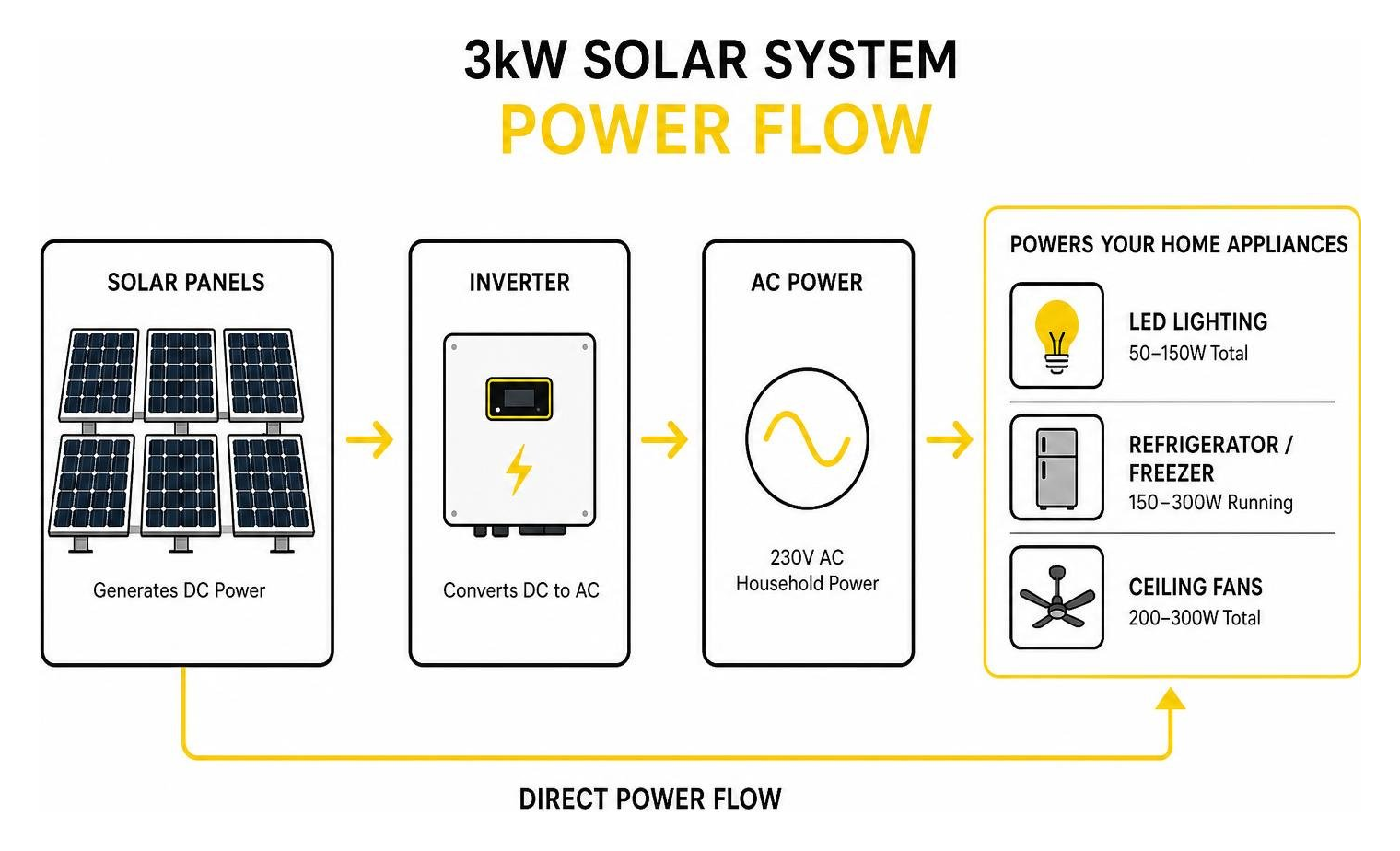
A properly configured 3kW setup can easily run:
- High-efficiency LED lighting throughout the entire home (50–150W total)
- Standard residential refrigerator/freezer (150–300W running)
- 3 to 4 overhead ceiling fans (200–300W total)
- Home internet routers, laptops, television, and device charging stations (150–400W)
- A 1-ton (12,000 BTU) high-efficiency inverter air conditioner (800–1,200W continuous during peak daylight)
- Dedicated shallow-well water pump or sump pump intermittently (750–1,200W)
Capacity Limitations: A 3kW array cannot run heavy electrical loads—such as central 4-ton AC units, electric clothes dryers, electric water heaters, and whole-house ovens—at the same time without drawing extra power from the grid or a secondary generator.
Return on Investment, Monthly Savings, and Payback Timelines
A solar installation should be evaluated as an investment in fixed-cost energy production.
Monthly Electric Bill Offsets and Incentives
In the U.S., where electricity rates average between $0.12 and $0.22 per kWh depending on your utility, generating 350 kWh per month saves roughly $45 to $77 every month in avoided utility purchases. In areas with higher retail power rates, monthly savings can reach $90 to $110.
In international markets with high electricity tariffs relative to system cost, financial returns can be even faster. In Pakistan, where electricity costs have climbed, a 3kW system can save Rs 12,000 to 16,000 per month in typical utility bill reductions.
Realistic Payback Periods Across Regions
| Region | Installed Net Cost (USD) | Estimated Annual Savings | Average Payback Period | 25-Year Net Generation Value |
|---|---|---|---|---|
| United States | ~$6,300 (Post-ITC) | $600–$900 | 7.0–10.5 Years | $18,000–$25,000 |
| Australia | ~$2,300–$3,600 | $700–$1,000 AUD | 3.5–5.0 Years | $16,000–$22,000 AUD |
| India | ~$1,100 (Post-Subsidy) | ₹25,000–₹35,000 INR | 2.5–3.5 Years | ₹600,000+ INR |
| Pakistan | ~$1,440–$1,800 | PKR 140,000–190,000 | 3.0–4.0 Years (On-Grid) | PKR 3,500,000+ |
| Kenya | ~$2,480 (Hybrid Kit) | KSh 75,000–110,000 | 2.5–4.0 Years | KSh 1,800,000+ |
| Spain | ~$4,500 (Off-Grid) | €850–€1,100 (vs Generator) | 1.6–2.5 Years | €20,000+ |
| New Zealand | ~$5,600 | $1,200–$1,400 NZD | 6.5–8.5 Years | $33,000–$46,000 NZD |
With Tier-1 solar panels backed by 25-year performance warranties (guaranteeing at least 80–85% of nameplate power output at Year 25), a 3kW system will continue producing value long after it has paid for itself.
Frequently Asked Questions About 3kW Solar Installations
How many solar panels and how much roof space do I need for a 3kW setup?
Modern residential solar panels typically range from 400W to 585W each. To build a 3kW (3,000-watt) array, you need:
- 6 panels if using 500W–550W modules
- 7 to 8 panels if using 400W–450W modules
Each panel measures approximately 18 to 22 square feet. A 3kW array requires 140 to 200 square feet of unobstructed, unshaded roof space. Using high-efficiency panels helps keep the footprint compact on smaller roofs.
What is the practical difference between a 3kVA and a 3kW solar system?
kW (kilowatts) measures actual real working power, while kVA (kilovolt-amperes) measures apparent power (the combination of real power and reactive power in an AC electrical circuit).
In residential solar applications with a pure sine wave inverter operating near a 1.0 power factor, a 3kVA inverter delivers roughly 3kW of usable active power. However, standard electric motors and compressors exhibit a power factor around 0.8 to 0.9, meaning a 3kVA inverter might only support continuous inductive loads of 2,400 to 2,700 watts. Always check both the continuous wattage and surge ratings of your inverter before sizing your system.
Can a 3kW solar system run an entire house off-grid?
A 3kW off-grid kit can easily power an energy-efficient cabin, tiny home, or small cottage that uses gas for heating and cooking.
However, running a typical modern home completely off-grid requires careful load management. High-draw appliances like electric heating elements, central air conditioners, and electric water heaters will quickly drain a modest battery bank. For larger properties or high-draw appliances, a 6kW to 10kW array is usually recommended.
Conclusion
A 3kW solar installation offers an accessible, low-risk way to lower your monthly electric bills and gain energy independence. Whether you choose an affordable grid-tied setup, a self-sufficient off-grid system, or an expandable hybrid configuration with battery storage, knowing your exact equipment specs helps you avoid misleading quotes and get the best return on your investment.
At Your Home Solar, we provide clear, reliable advice and tailored installations designed around your home’s real energy needs. To see how a right-sized solar or backup system can work for your property, explore our guide on financing and residential solar solutions and schedule a consultation with our team today.